child lock DODGE AVENGER 2010 2.G User Guide
[x] Cancel search | Manufacturer: DODGE, Model Year: 2010, Model line: AVENGER, Model: DODGE AVENGER 2010 2.GPages: 448, PDF Size: 7.17 MB
Page 65 of 448
covers the window. The airbag inflates in about 30 ms
(about one-quarter of the time that it takes to blink your
eyes) with enough force to injure you if you are not belted
and seated properly, or if items are positioned in the area
where the side curtain airbag inflates. This especially
applies to children. The side curtain airbag is only about
3-1/2 in (9 cm) thick when it is inflated.
Because airbag sensors estimate deceleration over time,
vehicle speed and damage are not good indicators of
whether or not an airbag should have deployed.
NOTE:In a rollover the pretensioners and/or SABIC
airbags may deploy on both sides of the vehicle.
Front and Side Impact Sensors
In front and side impacts, impact sensors can aid the
ORC in determining appropriate response to impact
events. Additional sensors in the ORC determine the
level of airbag deployment and provide verification.
Enhanced Accident Response System
In the event of an impact causing airbag deployment, if
the communication network remains intact, and the
power remains intact, depending on the nature of the
event the ORC will determine whether to have the
Enhanced Accident Response System perform the follow-
ing functions:
•Cut off fuel to the engine.
•Flash hazard lights as long as the battery has power or
until the ignition key is turned off.
•Turn on the interior lights, which remain on as long as
the battery has power or until the ignition key is
removed.
•Unlock the doors automatically.
If a Deployment Occurs
The front airbags are designed to deflate immediately
after deployment.
64 THINGS TO KNOW BEFORE STARTING YOUR VEHICLE
Page 73 of 448
bend over the front of the seat when their back is
against the seatback, should use the lap/shoulder belt
in a rear seat.
•Before buying any restraint system, make sure that it
has a label certifying that it meets all applicable Safety
Standards. We also recommend that you make sure
that you can install the child restraint in the vehicle
where you will use it, before you buy it.
•The restraint must be appropriate for your child’s
weight and height. Check the label on the restraint for
weight and height limits.
•Carefully follow the instructions that come with the
restraint. If you install the restraint improperly, it may
not work when you need it.
•All passenger seating positions contain automatic
locking retractors. However, any seat belt system will
loosen with time, so check the belt occasionally and
pull it tight if necessary.
•In the rear seat, you may have trouble tightening the
lap/shoulder belt on the child restraint because the
buckle or latch plate is too close to the belt path
opening on the restraint. Disconnect the latch plate
from the buckle and twist the short buckle end of the
belt several times to shorten it. Insert the latch plate
into the buckle with the release button facing out.
•If the belt still can’t be tightened, or if pulling and
pushing on the restraint loosens the belt, disconnect
the latch plate from the buckle, turn the latch plate
around, and insert the latch plate into the buckle
again. If you still can’t make the child restraint secure,
try a different seating position.
•Buckle the child into the seat according to the child
restraint manufacturer’s directions.
72 THINGS TO KNOW BEFORE STARTING YOUR VEHICLE
Page 79 of 448
Installing Child Restraints Using the Vehicle Seat
Belt
The passenger seat belts are equipped with Automatic
Locking Retractors (ALRs), which are designed to keep
the lap portion tight around the child restraint.
The seat belt must be in the Automatic Locking Mode in
order to enable a child restraint to be tightly installed.
Refer to “Automatic Locking Mode” for further informa-
tion. A locking clip should not be necessary once the
automatic locking feature is enabled. Position the shoul-
der and lap belt on the child restraint. The Automatic
Locking Retractor (ALR) is activated by first attaching
the child seat, then pulling all of the webbing out of the
retractor, then allowing the webbing to retract. As the
webbing retracts, you will hear a clicking sound. This
indicates the safety belt is now in the Automatic Locking
Mode. To release, simply unbuckle the seat belt by
depressing the button, and allow the webbing to retract
into the retractor.In the rear seat, you may have trouble tightening the
lap/shoulder belt on the child restraint because the
buckle or latch plate is too close to the belt path opening
on the restraint. Disconnect the latch plate from the
buckle and twist the short buckle-end belt several times
to shorten it. Insert the latch plate into the buckle with the
release button facing out.
If the belt still can’t be tightened, or if pulling and
pushing on the restraint loosens the belt, you may need
to do something more. Disconnect the latch plate from
the buckle, turn the buckle around, and insert the latch
plate into the buckle again. If you still can’t make the
child restraint secure, try a different seating position.
78 THINGS TO KNOW BEFORE STARTING YOUR VEHICLE
Page 105 of 448
WARNING!
The rear cargo area of the vehicle (with the rear
seatbacks in the locked-up or folded down position)
should not be used as a play area by children. They
could be seriously injured in an accident. Children
should be seated and using the proper restraint
system.
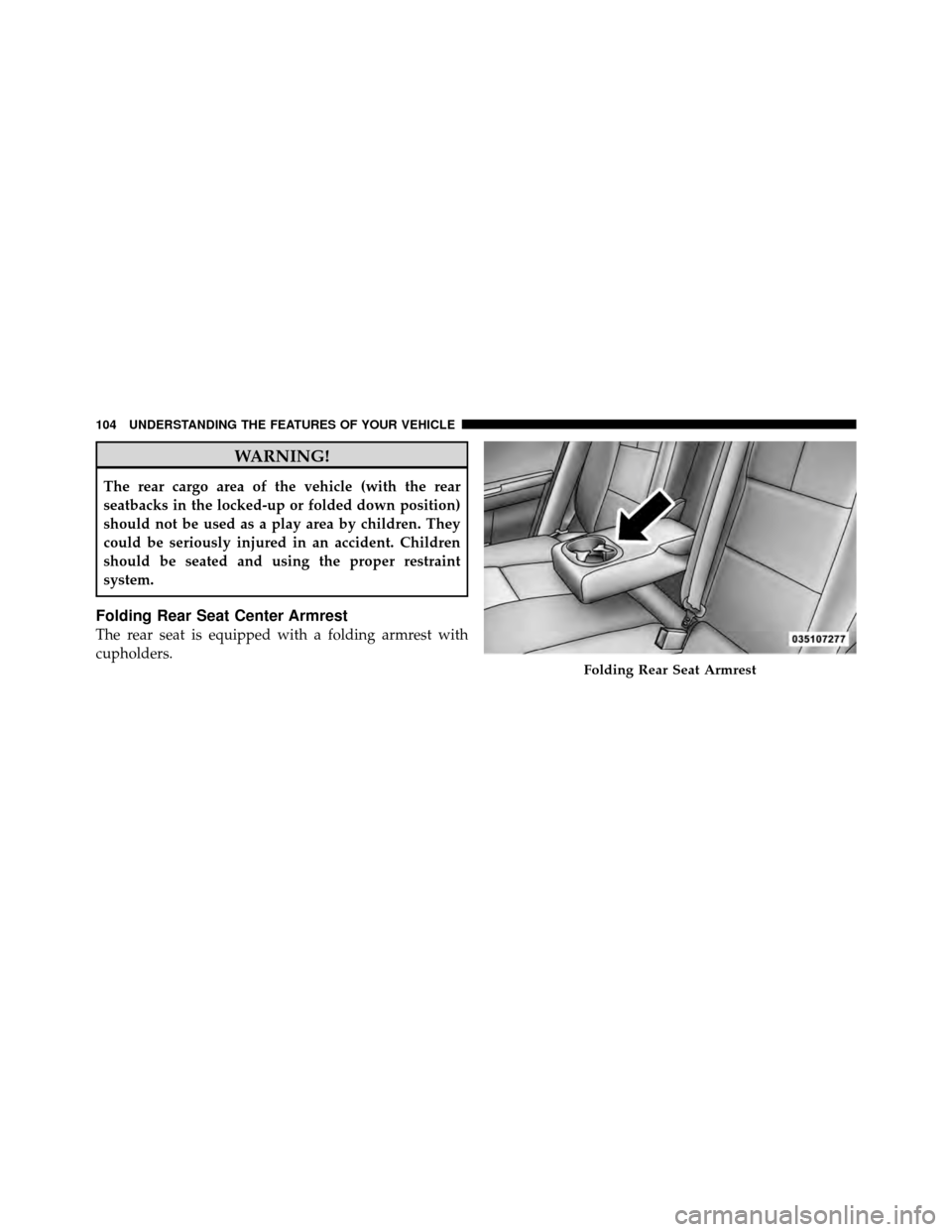
Folding Rear Seat Center Armrest
The rear seat is equipped with a folding armrest with
cupholders.
Folding Rear Seat Armrest
104 UNDERSTANDING THE FEATURES OF YOUR VEHICLE
Page 136 of 448
Cargo Area
The 60/40 split-folding rear seat provides cargo-carrying
versatility. The seatbacks fold down easily by pulling
nylon tabs between the seatbacks and the bolsters. When
the seats are folded down, they provide a continuous,
nearly flat extension of the load floor.When the seatback is folded to the upright position, make
sure it is latched by strongly pulling on the top of the
seatback above the seat strap.
WARNING!
•Be certain that the seatback is securely locked into
position. If the seatback in not securely locked
into position, the seat will not provide the proper
stability for child seats and/or passengers. An
improperly latched seat could cause serious injury.
•The cargo area in the rear of the vehicle (with the
rear seatbacks in the locked-up or folded down
position) should not be used as a play area by
children when the vehicle is in motion. They could
be seriously injured in an accident. Children
should be seated and using the proper restraint
system.
(Continued)
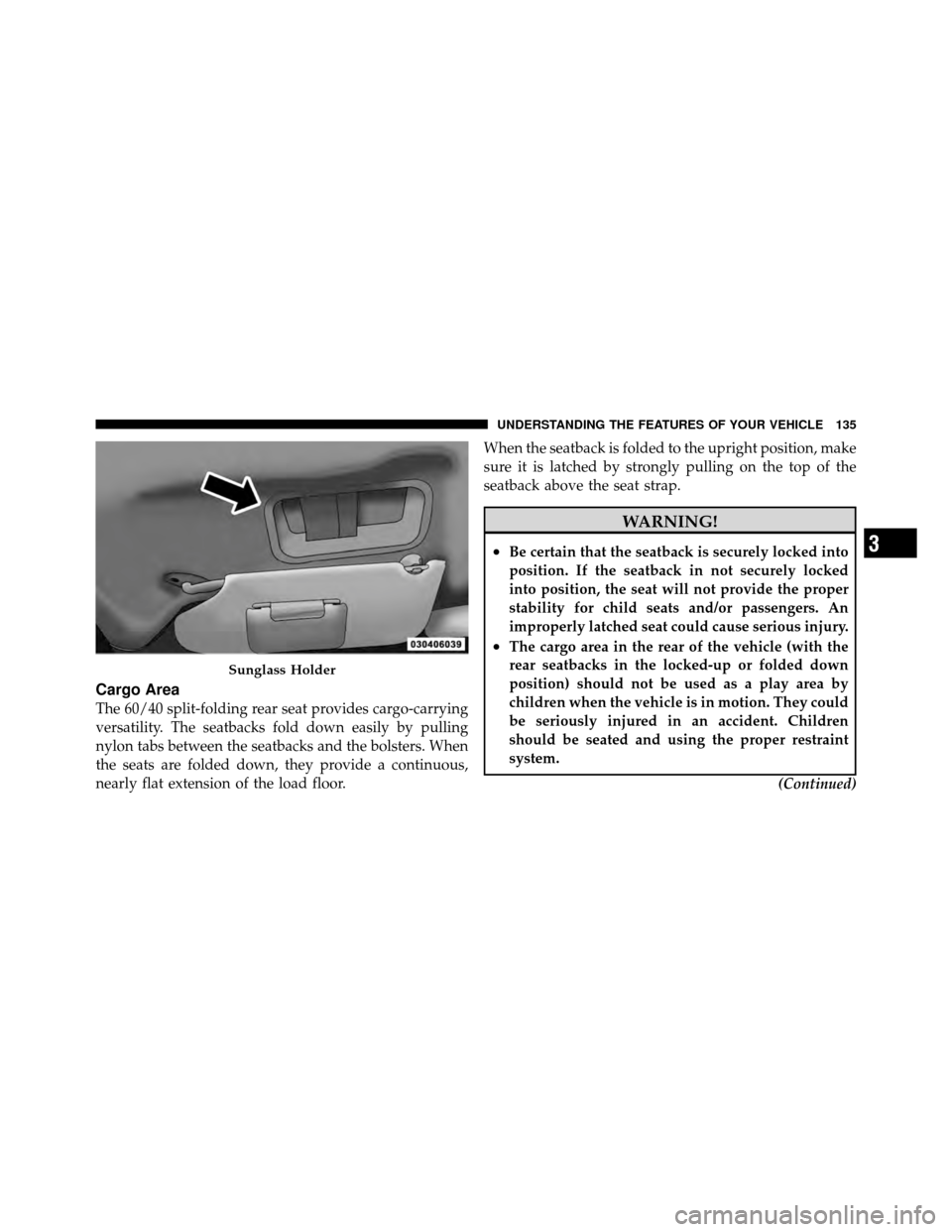
Sunglass Holder
3
UNDERSTANDING THE FEATURES OF YOUR VEHICLE 135
Page 244 of 448
STARTING PROCEDURES
Before starting your vehicle, adjust your seat, adjust the
inside and outside mirrors, fasten your seat belt, and if
present, instruct all other occupants to buckle their seat
belts.
WARNING!
Never leave children alone in a vehicle. Leaving
children in a vehicle unattended is dangerous for a
number of reasons. A child or others could be seri-
ously or fatally injured. Do not leave the keys in the
ignition. A child could operate power windows,
other controls, or move the vehicle.
Automatic Transmission
The shift lever must be in the PARK or NEUTRAL
position before you can start the engine. Apply the brakes
before shifting to any driving gear.NOTE:
The ignition switch must be in the ON position,
and you must press the brake pedal before shifting out of
PARK.
Normal Starting
NOTE: Normal starting of either a cold or a warm
engine is obtained without pumping or pressing the
accelerator pedal.
For vehicles not equipped with Tip Start (Four-Speed
Transmission), turn the ignition switch to the START
position and release it when the engine starts. If the
engine fails to start within 10 seconds, turn the ignition
switch to the LOCK position, wait 10 to 15 seconds, then
repeat the “Normal Starting” procedure.
For vehicles equipped with Tip Start (Six-Speed Trans-
mission), turn the ignition switch to the START position
and release it as soon as the starter engages. The starter
5
STARTING AND OPERATING 243
Page 249 of 448
WARNING! (Continued)
•Unintended movement of a vehicle could injure
those in and near the vehicle. As with all vehicles,
you should never exit a vehicle while the engine is
running. Before exiting a vehicle, you should
always shift the vehicle into PARK, remove the
key from the ignition, and apply the parking
brake. Once the key is removed from the ignition,
the shift lever is locked in the PARK position,
securing the vehicle against unwanted movement.
Furthermore, you should never leave children un-
attended inside a vehicle.
Key Ignition Park Interlock
This vehicle is equipped with a Key Ignition Park Inter-
lock which requires the shift lever to be placed in PARK
prior to rotating the key to the LOCK position. The keycan only be removed from the ignition when the ignition
is in the LOCK position and once removed the shift lever
is locked in PARK.
Brake/Transmission Interlock System
This vehicle is equipped with a Brake Transmission Shift
Interlock System (BTSI) that holds the shift lever in the
PARK position when the ignition switch is in the LOCK
position. To move the shift lever out of the PARK
position, the ignition switch must be turned to any other
switch position (ACC, ON, or START) (engine running or
not) and the brake pedal must be pressed.
NOTE:
If a malfunction occurs, the transmission will
not shift out of park. Battery power is required to release
the brake/transmission interlock system. However, there
is an override system that allows you to shift out of PARK
in case of loss of power. To activate the override system:
•Firmly apply the parking brake
248 STARTING AND OPERATING
Page 251 of 448
Never attempt to use PARK while vehicle is in motion.
Apply parking brake when leaving vehicle in this range.
When parking on a flat surface, place the shift lever in the
PARK position first, and then apply the parking brake.
When parking on a hill, it is important to set the parking
brake before placing the shift lever in PARK, otherwise
the load on the transmission locking mechanism may
make it difficult to move the shift lever out of PARK. As
an added precaution, turn the front wheels toward the
curb on a downhill grade and away from the curb on an
uphill grade.
WARNING!
•Never use the PARK position as a substitute for
the parking brake. Always apply the parking
brake fully when parked to guard against vehicle
movement and possible injury or damage.(Continued)
WARNING! (Continued)
•Never leave children alone in a vehicle. Leaving
unattended children in a vehicle is dangerous for a
number of reasons. A child or others could be
seriously or fatally injured. Do not leave the
ignition key in the ignition switch. A child could
operate power windows, other controls, or move
the vehicle.
CAUTION!
DO NOT race the engine when shifting from PARK
or NEUTRAL positions into another gear range as
this can damage the drivetrain.
REVERSE
This range is for moving the vehicle backward. Shift into
REVERSE only after the vehicle has come to a complete
stop.
250 STARTING AND OPERATING
Page 431 of 448
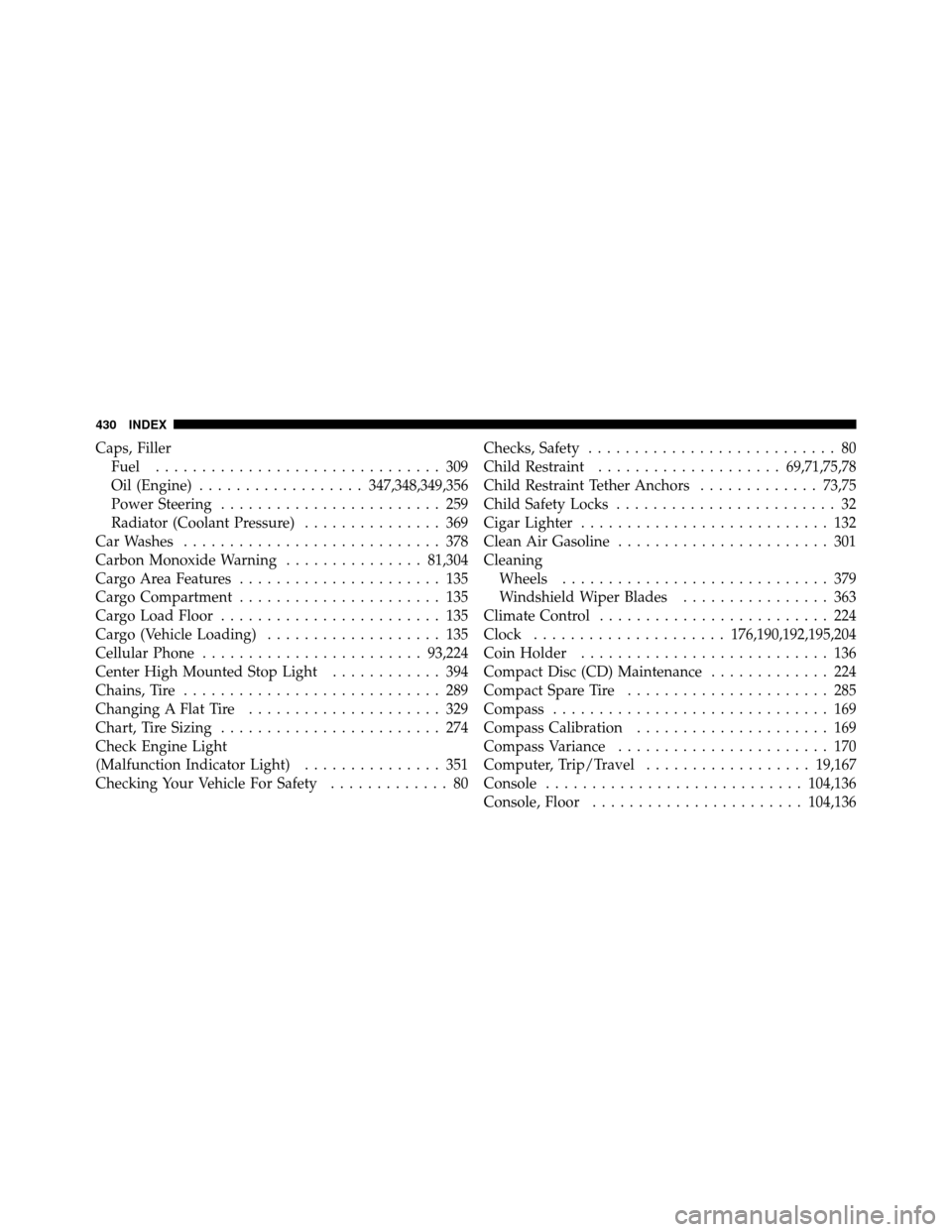
Caps, FillerFuel ............................... 309
Oil (Engine) .................. 347,348,349,356
Power Steering ........................ 259
Radiator (Coolant Pressure) ............... 369
Car Washes ............................ 378
Carbon Monoxide Warning ...............81,304
Cargo Area Features ...................... 135
Cargo Compartment ...................... 135
Cargo Load Floor ........................ 135
Cargo (Vehicle Loading) ................... 135
Cellular Phone ........................ 93,224
Center High Mounted Stop Light ............ 394
Chains, Tire ............................ 289
Changing A Flat Tire ..................... 329
Chart, Tire Sizing ........................ 274
Check Engine Light
(Malfunction Indicator Light) ............... 351
Checking Your Vehicle For Safety ............. 80Checks, Safety
........................... 80
Child Restraint .................... 69,71,75,78
Child Restraint Tether Anchors .............73,75
Child Safety Locks ........................ 32
Cigar Lighter ........................... 132
Clean Air Gasoline ....................... 301
Cleaning Wheels ............................. 379
Windshield Wiper Blades ................ 363
Climate Control ......................... 224
Clock ..................... 176,190,192,195,204
Coin Holder ........................... 136
Compact Disc (CD) Maintenance ............. 224
Compact Spare Tire ...................... 285
Compass .............................. 169
Compass Calibration ..................... 169
Compass Variance ....................... 170
Computer, Trip/Travel .................. 19,167
Console ............................ 104,136
Console, Floor ....................... 104,136
430 INDEX
Page 439 of 448
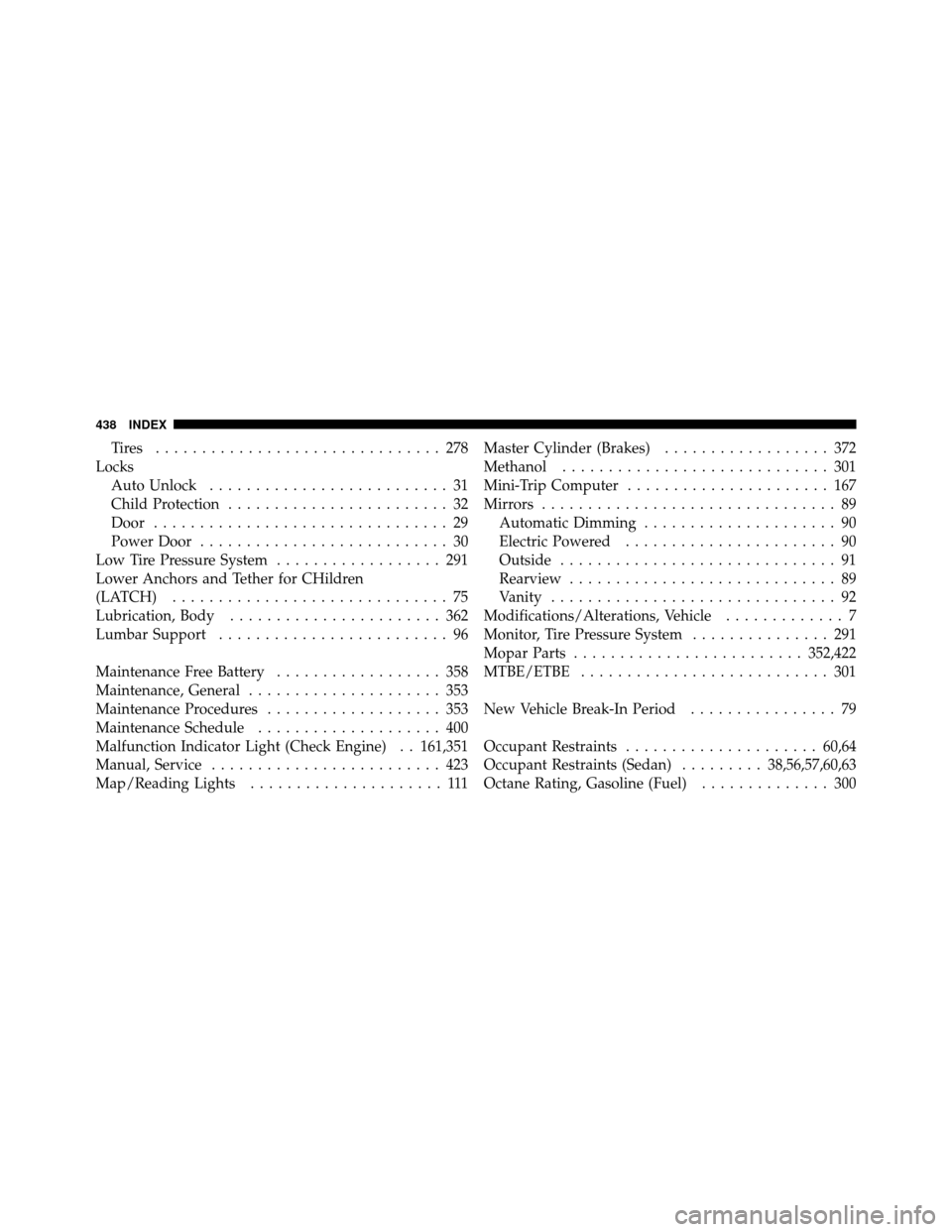
Tires ............................... 278
Locks Auto Unlock .......................... 31
Child Protection ........................ 32
Door ................................ 29
Power Door ........................... 30
Low Tire Pressure System .................. 291
Lower Anchors and Tether for CHildren
(LATCH) .............................. 75
Lubrication, Body ....................... 362
Lumbar Support ......................... 96
Maintenance Free Battery .................. 358
Maintenance, General ..................... 353
Maintenance Procedures ................... 353
Maintenance Schedule .................... 400
Malfunction Indicator Light (Check Engine) . . 161,351
Manual, Service ......................... 423
Map/Reading Lights ..................... 111 Master Cylinder (Brakes)
.................. 372
Methanol ............................. 301
Mini-Trip Computer ...................... 167
Mirrors ................................ 89
Automatic Dimming ..................... 90
Electric Powered ....................... 90
Outside .............................. 91
Rearview ............................. 89
Vanity ............................... 92
Modifications/Alterations, Vehicle ............. 7
Monitor, Tire Pressure System ............... 291
Mopar Parts ......................... 352,422
MTBE/ETBE ........................... 301
New Vehicle Break-In Period ................ 79
Occupant Restraints ..................... 60,64
Occupant Restraints (Sedan) .........38,56,57,60,63
Octane Rating, Gasoline (Fuel) .............. 300
438 INDEX