transmission oil DODGE AVENGER 2013 2.G Owners Manual
[x] Cancel search | Manufacturer: DODGE, Model Year: 2013, Model line: AVENGER, Model: DODGE AVENGER 2013 2.GPages: 519, PDF Size: 3.1 MB
Page 98 of 519
ENGINE BREAK-IN RECOMMENDATIONS
A long break-in period is not required for the engine and
drivetrain (transmission and axle) in your vehicle.
Drive moderately during the first 300 miles (500 km).
After the initial 60 miles (100 km), speeds up to 50 or
55 mph (80 or 90 km/h) are desirable.
While cruising, brief full-throttle acceleration within the
limits of local traffic laws contributes to a good break-in.
Wide-open throttle acceleration in low gear can be detri-
mental and should be avoided.
The engine oil installed in the engine at the factory is a
high-quality energy conserving type lubricant. Oil changes
should be consistent with anticipated climate conditions
under which vehicle operations will occur. For the recom-
mended viscosity and quality grades, refer to “Mainte-
nance Procedures” in “Maintaining Your Vehicle”.
CAUTION!
Never use Non-Detergent Oil or Straight Mineral Oil
in the engine or damage may result.
NOTE: A new engine may consume some oil during its
first few thousand miles (kilometers) of operation. This
should be considered a normal part of the break-in and
not interpreted as an indication of difficulty.
96 THINGS TO KNOW BEFORE STARTING YOUR VEHICLE
Page 217 of 519
belt remains unbuckled, the Seat Belt Warning Light will
flash or remain on continuously. Refer to “Occupant
Restraints” in “Things To Know Before Starting Your
Vehicle” for further information.
9. Oil Pressure Warning LightThis light indicates low engine oil pressure. The
light will come on and remain on when the ignition
switch is turned from the OFF to the ON/RUN position,
and the light will turn off after the engine is started. If the
bulb does not come on during starting, have the system
checked by an authorized dealer.
If the light comes on and remains on while driving, stop
the vehicle and shut off the engine. DO NOT OPERATE
THE VEHICLE UNTIL THE CAUSE IS CORRECTED.
The light does not show the quantity of oil in the engine.
This can be determined using the procedure shown in
“Maintaining Your Vehicle”. 10. Engine Temperature Warning Light
This light warns of an overheated engine condi-
tion. As engine coolant temperatures rise and the
gauge approaches H, this indicator will illuminate and a
single chime will sound after reaching a set threshold.
Further overheating will cause the temperature gauge to
pass H, and a continuous chime will occur until the
engine is allowed to cool or the 4 minutes duration is
expired, whichever come first.
If the light turns on while driving, safely pull over and
stop the vehicle. If the A/C system is on, turn it off. Also,
shift the transmission into NEUTRAL and idle the ve-
hicle. If the temperature reading does not return to
normal, turn the engine off immediately and call for
service. Refer to “If Your Engine Overheats” in “What To
Do In Emergencies” for further information.
4
UNDERSTANDING YOUR INSTRUMENT PANEL 215
Page 229 of 519
WARNING!
If you continue operating the vehicle when the
Transmission Temperature Warning Light is illumi-
nated you could cause the fluid to boil over, come in
contact with hot engine or exhaust components and
cause a fire.
28. High Beam Indicator This light indicates that the headlights are on high
beam. Pull the turn signal lever toward the steer-
ing wheel to switch the headlights to low beam.
29. Electronic Vehicle Information Center (EVIC)
Display — If Equipped
This display shows the EVIC messages when the appro-
priate conditions exist. Refer to “Electronic Vehicle Infor-
mation Center (EVIC)” for further information.
MINI-TRIP COMPUTER — IF EQUIPPED
The Mini-Trip Computer is located in the instrument
cluster and features a driver-interactive trip information
and temperature display.
NOTE: The system will display the last known outside
temperature when starting the vehicle and may need to
be driven several minutes before the updated tempera-
ture is displayed. Engine temperature can also affect the
displayed temperature; therefore, temperature readings
are not updated when the vehicle is not moving.
4
UNDERSTANDING YOUR INSTRUMENT PANEL 227
Page 433 of 519
CAUTION!(Continued)
•Your vehicle has been built with improved fluids
that protect the performance and durability of your
vehicle and also allow extended maintenance inter-
vals. Do not use chemical flushes in these compo-
nents as the chemicals can damage your engine,
transmission, power steering or air conditioning.
Such damage is not covered by the New Vehicle
Limited Warranty. If a flush is needed because of
component malfunction, use only the specified
fluid for the flushing procedure.
Engine Oil
Checking Oil Level
To assure proper engine lubrication, the engine oil must
be maintained at the correct level. Check the oil level at
regular intervals, such as every fuel stop. The best time to check the engine oil level is about five minutes after a
fully warmed engine is shut off. Do not check oil level
before starting the engine after it has sat overnight.
Checking engine oil level when the engine is cold will
give you an incorrect reading.
Checking the oil while the vehicle is on level ground and
only when the engine is hot, will improve the accuracy of
the oil level readings. Maintain the oil level between the
range markings on the dipstick. Either the range mark-
ings consist of a crosshatch zone marked SAFE or a
crosshatch zone marked with MIN at the low end of the
range and MAX at the high end of the range. Adding one
quart of oil when the reading is at the low end of the
range marking will raise the oil level to the high end of
the range marking.
7
MAINTAINING YOUR VEHICLE 431
Page 454 of 519
WARNING!(Continued)
the air resulting in a lower boiling point. This may
cause it to boil unexpectedly during hard or pro-
longed braking, resulting in sudden brake failure.
This could result in a collision.
• Overfilling the brake fluid reservoir can result in
spilling brake fluid on hot engine parts, causing
the brake fluid to catch fire. Brake fluid can also
damage painted and vinyl surfaces, care should be
taken to avoid its contact with these surfaces.
• Do not allow petroleum based fluid to contaminate
the brake fluid. Brake seal components could be
damaged, causing partial or complete brake failure.
This could result in a collision.
Automatic Transmission
Selection Of Lubricant
It is important to use the proper transmission fluid to
ensure optimum transmission performance and life. Use
only the manufacturer’s recommended transmission
fluid. Refer to “Fluids, Lubricants, and Genuine Parts” in
“Maintaining Your Vehicle” for fluid specifications. It is
important to maintain the transmission fluid at the
correct level using the recommended fluid.
NOTE:
No chemical flushes should be used in any trans-
mission; only the approved lubricant should be used.
CAUTION!
Using a transmission fluid other than the manufac-
turer’s recommended fluid may cause deterioration
in transmission shift quality and/or torque converter
(Continued)
452 MAINTAINING YOUR VEHICLE
Page 456 of 519
4. Place the shift lever momentarily into each gear posi-tion (allowing time for the transmission to fully en-
gage in each position), ending with the transmission in
PARK.
5. Wipe the area around the dipstick clean to prevent dirt from entering the transmission.
6.
Remove the dipstick and determine if the fluid is hot or
cold. Hot fluid is approximately 180° F (82° C), which is
the normal operating temperature after the vehicle is
driven at least 15 miles (24 km). Hot fluid cannot be held
comfortably between the fingertips. Cold fluid is at a
temperature of approximately 80° F (27° C).
7. Wipe the dipstick clean and reinsert it until seated. Then, remove the dipstick and note the fluid level on
both sides. The fluid level reading is only valid if there
is a solid coating of oil on both sides of the dipstick. Note that the holes in the dipstick will be full of fluid
if the actual level is at or above the hole.
• If the fluid is hot, the fluid level should be in the
crosshatched area marked “HOT” (between the up-
per two holes in the dipstick).
• If the fluid is cold, the fluid level should be between
the lower two holes in the area marked “COLD.”
If the fluid level is low, add fluid through the dipstick
tube to bring it to the proper level. Do not overfill. After
adding any quantity of oil through the dipstick tube, wait
at least two minutes for the oil to fully drain into the
transmission before rechecking the fluid level.
8. Check for leaks. Release the parking brake.
To prevent dirt and water from entering the transmission
after checking or replenishing fluid, make sure that the
dipstick cap is properly reseated.
454 MAINTAINING YOUR VEHICLE
Page 481 of 519
•Check the fluid levels of the coolant reservoir, brake
master cylinder, power steering and transmission as
needed
• Check function of all interior and exterior lights
Required Maintenance Intervals.
Refer to the maintenance schedules on the following
page for the required maintenance intervals.
At Every Oil Change Interval As Indicated By Oil Change Indicator System:
•Change oil and filter.
• Rotate the tires. Rotate at the first sign of irregu-
lar wear, even if it occurs before the oil indicator
system turns on.
• Inspect battery and clean and tighten terminals as
required.
At Every Oil Change Interval As Indicated By Oil
Change Indicator System:
•Inspect automatic transmission fluid if equipped
with dipstick.
• Inspect brake pads, shoes, rotors, drums, hoses
and park brake.
• Inspect engine cooling system protection and
hoses.
• Inspect exhaust system.
• Inspect engine air cleaner if using in dusty or
off-road conditions.
8
M
A I
N T
E
N
A
N
C E
S
C
H E
D
U L
E
SMAINTENANCE SCHEDULES 479
Page 501 of 519
Automatic Transmission....................303
Adding Fluid ......................... .453
Fluid and Filter Changes ..................456
Fluid Level Check ...................... .453
Fluid Type ........................... .452
Gear Ranges .......................... .306
Special Additives ...................... .453
Autostick .............................. .321
Auto Unlock, Doors ........................34
Auto Up Power Windows ....................38
Battery ................................ .435
Keyless Transmitter Replacement (RKE) ........27
Location ............................. .435
Belts, Seat ...............................98
Body Mechanism Lubrication .................440
B-Pillar Location ......................... .345
Brake Assist System ...................... .334
Brake, Parking .......................... .328Brake System
........................... .450
Anti-Lock (ABS) ....................... .330
Fluid Check .......................... .450
Master Cylinder ....................... .450
Parking ............................. .328
Warning Light ........................ .216
Brake/Transmission Interlock .................305
Bulb Replacement ........................ .468
Bulbs, Light ............................ .101
Calibration, Compass ..................... .235
Capacities, Antifreeze (Engine Coolant) ...........22
Capacities, Fluid ......................... .474
Caps, Filler Fuel ................................ .379
Oil (Engine) .......................... .425
Power Steering ........................ .327
Radiator (Coolant Pressure) ................447
Carbon Monoxide Warning ...................97
10
INDEX 499
Page 503 of 519
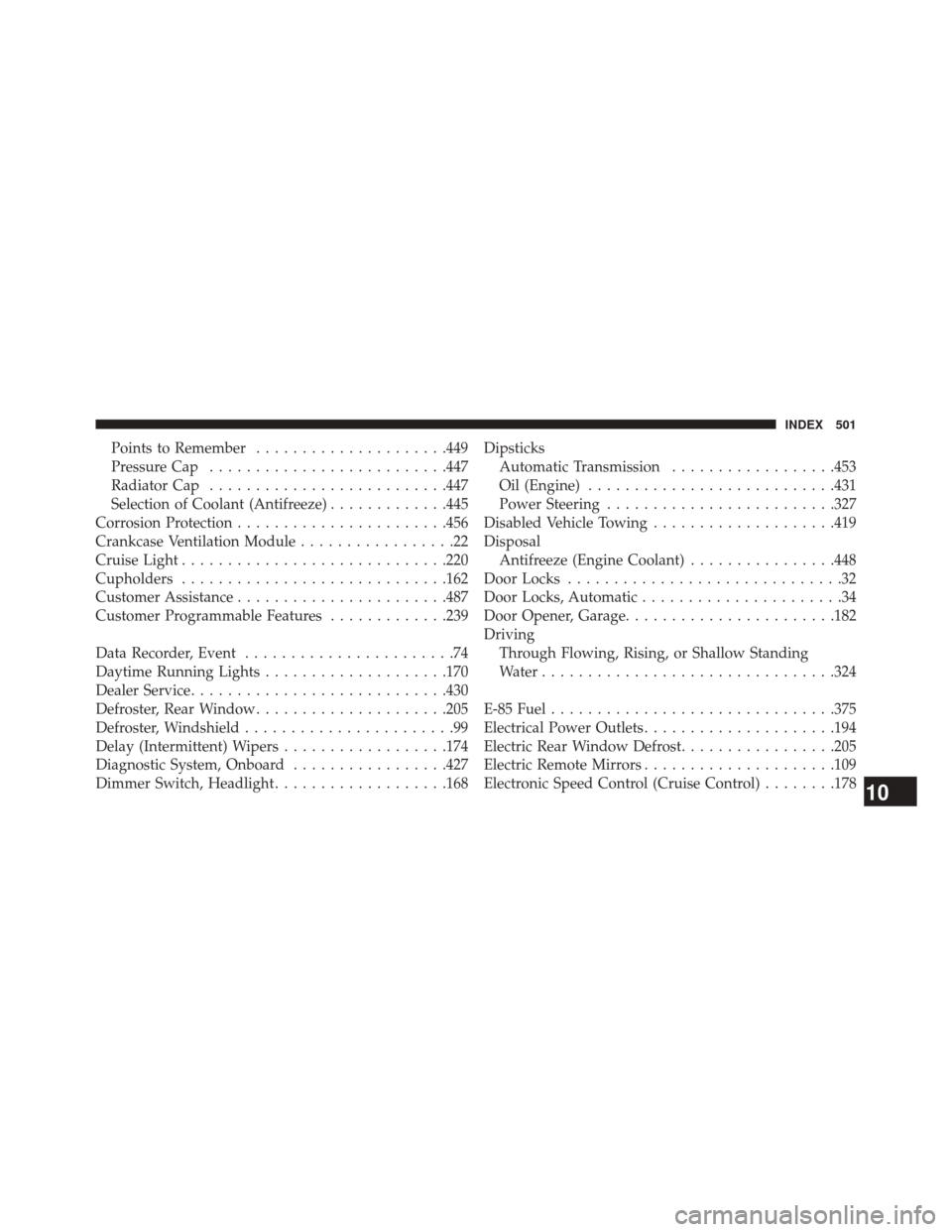
Points to Remember.....................449
Pressure Cap ......................... .447
Radiator Cap ......................... .447
Selection of Coolant (Antifreeze) .............445
Corrosion Protection ...................... .456
Crankcase Ventilation Module .................22
Cruise Light ............................ .220
Cupholders ............................ .162
Customer Assistance ...................... .487
Customer Programmable Features .............239
Data Recorder, Event .......................74
Daytime Running Lights ....................170
Dealer Service ........................... .430
Defroster, Rear Window .....................205
Defroster, Windshield .......................99
Delay (Intermittent) Wipers ..................174
Diagnostic System, Onboard .................427
Dimmer Switch, Headlight ...................168 Dipsticks
Automatic Transmission ..................453
Oil (Engine) .......................... .431
Power Steering ........................ .327
Disabled Vehicle Towing ....................419
Disposal Antifreeze (Engine Coolant) ................448
Door Locks ..............................32
Door Locks, Automatic ......................34
Door Opener, Garage ...................... .182
Driving Through Flowing, Rising, or Shallow Standing
Water ............................... .324
E-85 Fuel .............................. .375
Electrical Power Outlets .....................194
Electric Rear Window Defrost .................205
Electric Remote Mirrors .....................109
Electronic Speed Control (Cruise Control) ........178
10
INDEX 501
Page 505 of 519
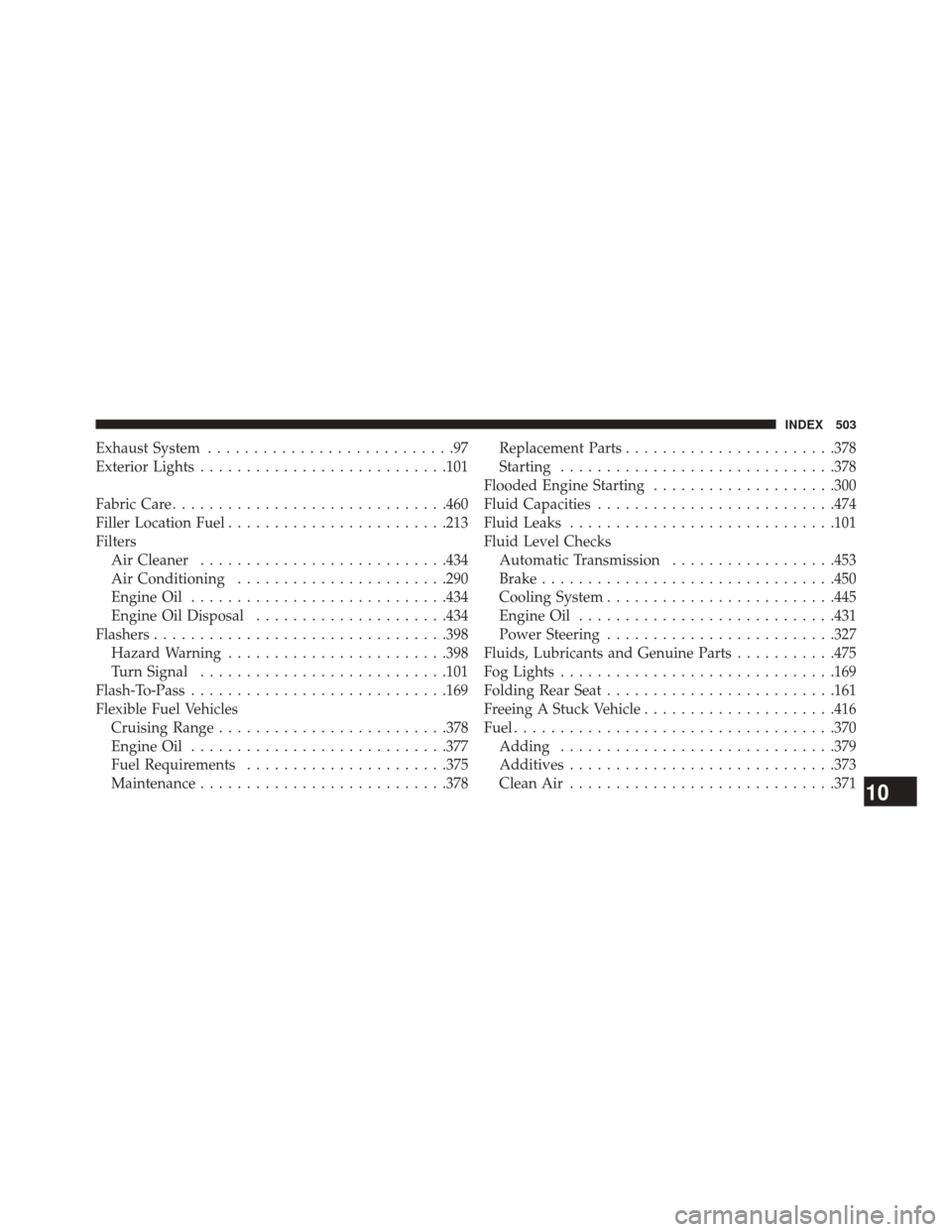
Exhaust System...........................97
Exterior Lights .......................... .101
Fabric Care ............................. .460
Filler Location Fuel ....................... .213
Filters Air Cleaner .......................... .434
Air Conditioning ...................... .290
Engine Oil ........................... .434
Engine Oil Disposal .....................434
Flashers ............................... .398
Hazard Warning ....................... .398
Turn Signal .......................... .101
Flash-To-Pass ........................... .169
Flexible Fuel Vehicles Cruising Range ........................ .378
Engine Oil ........................... .377
Fuel Requirements ..................... .375
Maintenance .......................... .378Replacement Parts
...................... .378
Starting ............................. .378
Flooded Engine Starting ....................300
Fluid Capacities ......................... .474
Fluid Leaks ............................ .101
Fluid Level Checks Automatic Transmission ..................453
Brake ............................... .450
Cooling System ........................ .445
Engine Oil ........................... .431
Power Steering ........................ .327
Fluids, Lubricants and Genuine Parts ...........475
Fog Lights ............................. .169
Folding Rear Seat ........................ .161
Freeing A Stuck Vehicle .....................416
Fuel .................................. .370
Adding ............................. .379
Additives ............................ .373
Clean Air ............................ .371
10
INDEX 503