air conditioning DODGE AVENGER 2014 2.G User Guide
[x] Cancel search | Manufacturer: DODGE, Model Year: 2014, Model line: AVENGER, Model: DODGE AVENGER 2014 2.GPages: 517, PDF Size: 3.58 MB
Page 334 of 517
WARNING!
Electronic Stability Control (ESC) cannot prevent the
natural laws of physics from acting on the vehicle,
nor can it increase the traction afforded by prevailing
road conditions. ESC cannot prevent accidents, in-
cluding those resulting from excessive speed in
turns, driving on very slippery surfaces, or hydro-
planing. ESC also cannot prevent accidents resulting
from loss of vehicle control due to inappropriate
driver input for the conditions. Only a safe, attentive,
and skillful driver can prevent accidents. The capa-
bilities of an ESC equipped vehicle must never be
exploited in a reckless or dangerous manner which
could jeopardize the user ’s safety or the safety of
others.
ESC Operating Modes
The ESC system has two available operating modes:
Full On
This is the normal operating mode for ESC. Whenever
the vehicle is started the ESC system will be in this mode.
This mode should be used for almost all driving situa-
tions. ESC should only be turned to “Partial Off” for
specific reasons as noted below.
Partial Off
This mode is entered by momentarily pressing the “ESC
Off” switch (located in the lower switch bank below the
heater/air conditioning controls). When in “Partial Off”
mode, the TCS portion of ESC, except for the limited slip
feature described in the TCS section, has been disabled
and the “ESC OFF Indicator Light” will be illuminated.
All other stability features of ESC function normally, with
the exception of engine power reduction. This mode is
332 STARTING AND OPERATING
Page 394 of 517
•To prevent excess heat generation, avoid continuous
driving at high RPM. Reduce vehicle speed as neces-
sary to avoid extended driving at high RPM. Return to
a higher gear or vehicle speed when grade and road
conditions allow.
Electronic Speed Control — If Equipped
• Do not use in hilly terrain or with heavy loads.
• When using the speed control, if you experience speed
drops greater than 10 mph (16 km/h), disengage until
you can get back to cruising speed.
• Use speed control in flat terrain and with light loads to
maximize fuel efficiency.
Cooling System
To reduce potential for engine and transmission over-
heating, take the following actions:
City Driving
When stopped for short periods of time, shift the trans-
mission into NEUTRAL and increase engine idle speed.
Highway Driving
Reduce speed.
Air Conditioning
Turn off temporarily.
392 STARTING AND OPERATING
Page 433 of 517
CAUTION!(Continued)
•Your vehicle has been built with improved fluids
that protect the performance and durability of your
vehicle and also allow extended maintenance inter-
vals. Do not use chemical flushes in these compo-
nents as the chemicals can damage your engine,
transmission, power steering or air conditioning.
Such damage is not covered by the New Vehicle
Limited Warranty. If a flush is needed because of
component malfunction, use only the specified
fluid for the flushing procedure.
Engine Oil
Checking Oil Level
To assure proper engine lubrication, the engine oil must
be maintained at the correct level. Check the oil level at
regular intervals, such as every fuel stop. The best time to
check the engine oil level is about five minutes after a fully warmed engine is shut off. Do not check oil level
before starting the engine after it has sat overnight.
Checking engine oil level when the engine is cold will
give you an incorrect reading.
Checking the oil while the vehicle is on level ground and
only when the engine is hot, will improve the accuracy of
the oil level readings. Maintain the oil level between the
range markings on the dipstick. Either the range mark-
ings consist of a crosshatch zone marked SAFE or a
crosshatch zone marked with MIN at the low end of the
range and MAX at the high end of the range. Adding one
quart of oil when the reading is at the low end of the
range marking will raise the oil level to the high end of
the range marking.
7
MAINTAINING YOUR VEHICLE 431
Page 439 of 517
Air Conditioner Maintenance
For best possible performance, your air conditioner
should be checked and serviced by an authorized dealer
at the start of each warm season. This service should
include cleaning of the condenser fins and a performance
test. Drive belt tension should also be checked at this
time.
CAUTION!
Do not use chemical flushes in your air conditioning
system as the chemicals can damage your air condi-
tioning components. Such damage is not covered by
the New Vehicle Limited Warranty.
WARNING!
•Use only refrigerants and compressor lubricants
approved by the manufacturer for your air condi-
tioning system. Some unapproved refrigerants are
flammable and can explode, injuring you. Other
unapproved refrigerants or lubricants can cause the
system to fail, requiring costly repairs. Refer to
Warranty Information Book, located on the DVD,
for further warranty information.
• The air conditioning system contains refrigerant
under high pressure. To avoid risk of personal
injury or damage to the system, adding refrigerant
or any repair requiring lines to be disconnected
should be done by an experienced technician.
7
MAINTAINING YOUR VEHICLE 437
Page 440 of 517
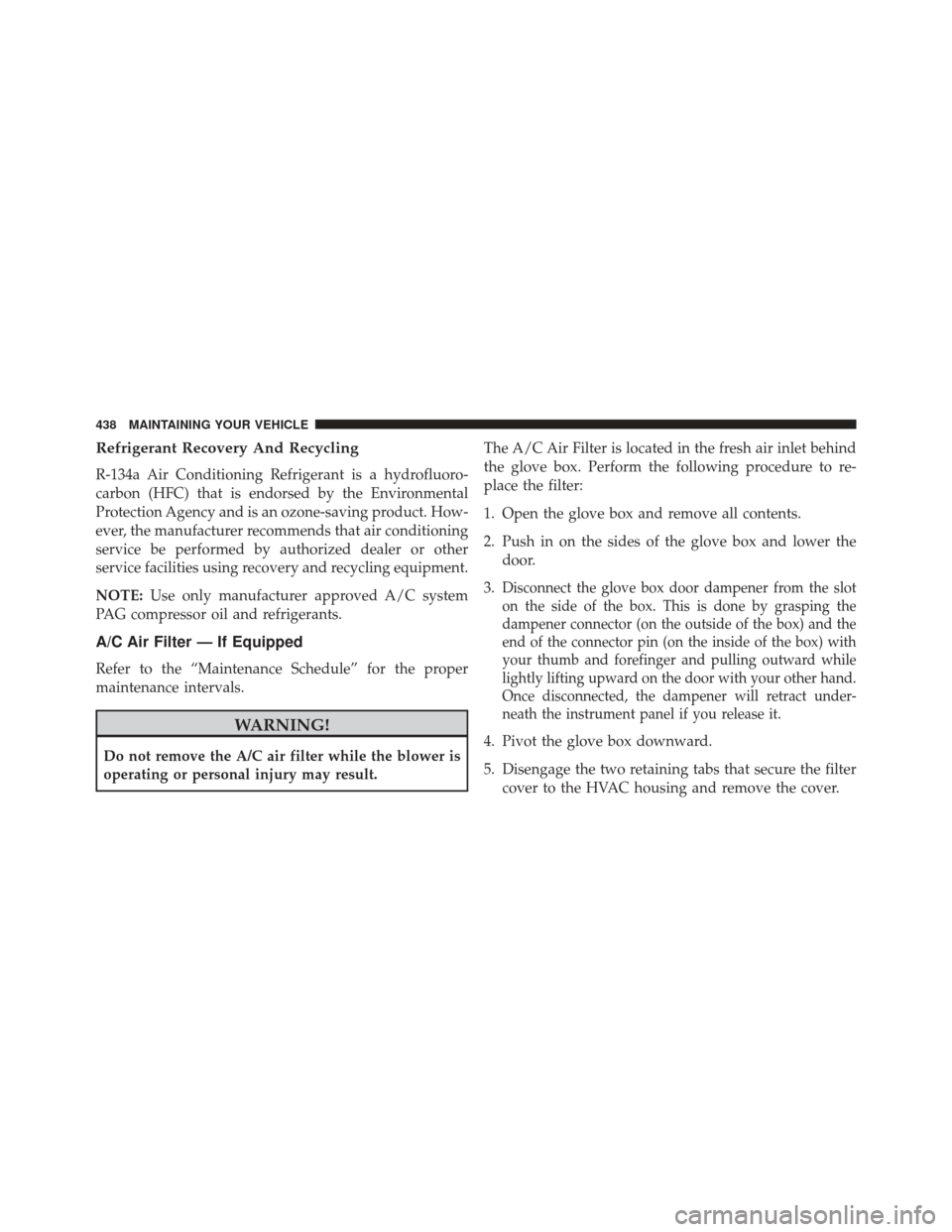
Refrigerant Recovery And Recycling
R-134a Air Conditioning Refrigerant is a hydrofluoro-
carbon (HFC) that is endorsed by the Environmental
Protection Agency and is an ozone-saving product. How-
ever, the manufacturer recommends that air conditioning
service be performed by authorized dealer or other
service facilities using recovery and recycling equipment.
NOTE:Use only manufacturer approved A/C system
PAG compressor oil and refrigerants.
A/C Air Filter — If Equipped
Refer to the “Maintenance Schedule” for the proper
maintenance intervals.
WARNING!
Do not remove the A/C air filter while the blower is
operating or personal injury may result. The A/C Air Filter is located in the fresh air inlet behind
the glove box. Perform the following procedure to re-
place the filter:
1. Open the glove box and remove all contents.
2. Push in on the sides of the glove box and lower the
door.
3.
Disconnect the glove box door dampener from the slot
on the side of the box. This is done by grasping the
dampener connector (on the outside of the box) and the
end of the connector pin (on the inside of the box) with
your thumb and forefinger and pulling outward while
lightly lifting upward on the door with your other hand.
Once disconnected, the dampener will retract under-
neath the instrument panel if you release it.
4. Pivot the glove box downward.
5. Disengage the two retaining tabs that secure the filter cover to the HVAC housing and remove the cover.
438 MAINTAINING YOUR VEHICLE
Page 452 of 517
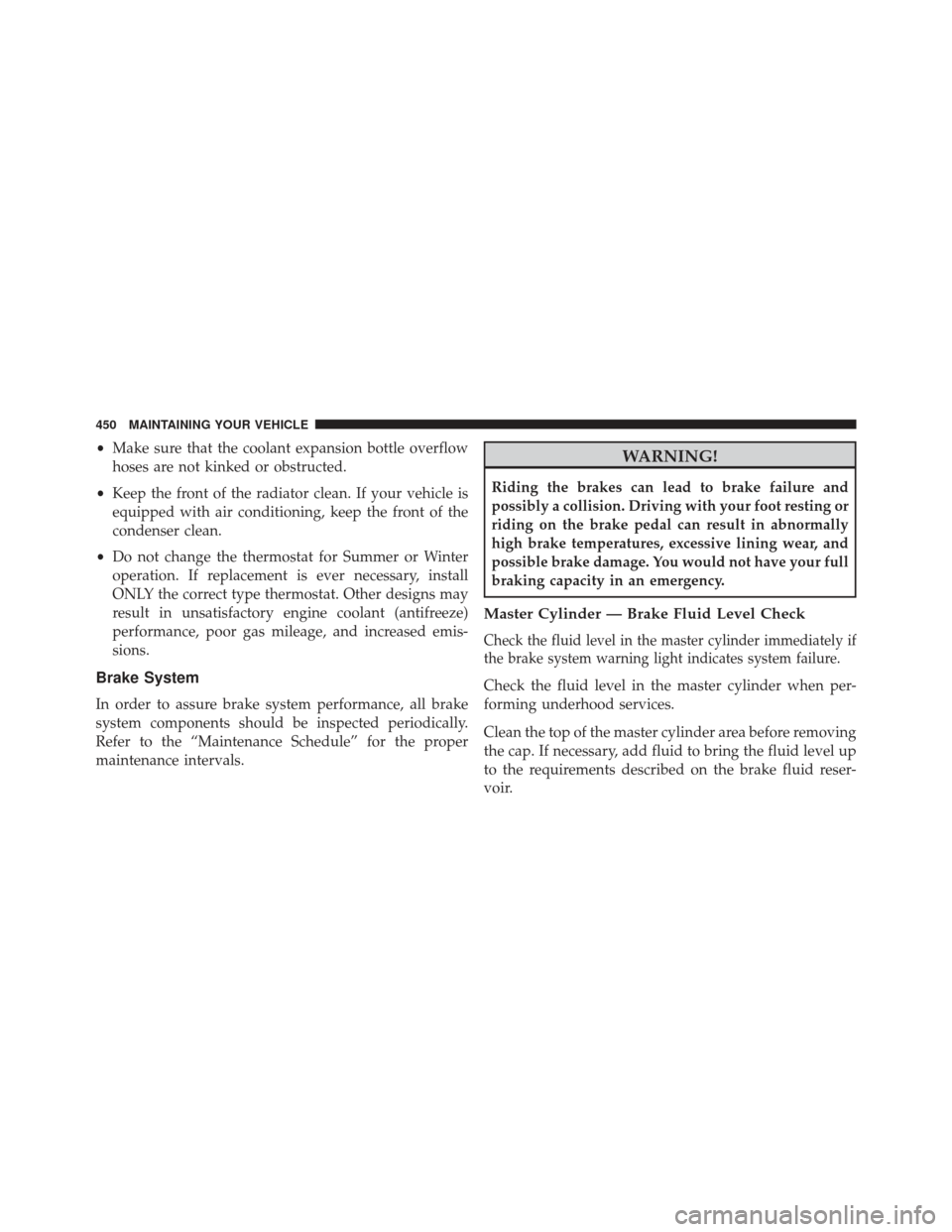
•Make sure that the coolant expansion bottle overflow
hoses are not kinked or obstructed.
• Keep the front of the radiator clean. If your vehicle is
equipped with air conditioning, keep the front of the
condenser clean.
• Do not change the thermostat for Summer or Winter
operation. If replacement is ever necessary, install
ONLY the correct type thermostat. Other designs may
result in unsatisfactory engine coolant (antifreeze)
performance, poor gas mileage, and increased emis-
sions.
Brake System
In order to assure brake system performance, all brake
system components should be inspected periodically.
Refer to the “Maintenance Schedule” for the proper
maintenance intervals.
WARNING!
Riding the brakes can lead to brake failure and
possibly a collision. Driving with your foot resting or
riding on the brake pedal can result in abnormally
high brake temperatures, excessive lining wear, and
possible brake damage. You would not have your full
braking capacity in an emergency.
Master Cylinder — Brake Fluid Level Check
Check the fluid level in the master cylinder immediately if
the brake system warning light indicates system failure.
Check the fluid level in the master cylinder when per-
forming underhood services.
Clean the top of the master cylinder area before removing
the cap. If necessary, add fluid to bring the fluid level up
to the requirements described on the brake fluid reser-
voir.
450 MAINTAINING YOUR VEHICLE
Page 471 of 517
VEHICLE STORAGE
If you will not be using your vehicle for more than 21
days, you may want to take steps to preserve your
battery.
•Disengage the mini-fuse in the Power Distribution
Center labeled IOD (Ignition Off-Draw).
• Or disconnect the negative cable from the battery.
• Anytime you store your vehicle, or keep it out of
service (i.e., vacation) for two weeks or more, run the
air conditioning system at idle for about five minutes
in the fresh air and high blower setting. This will
ensure adequate system lubrication to minimize the
possibility of compressor damage when the system is
started again.
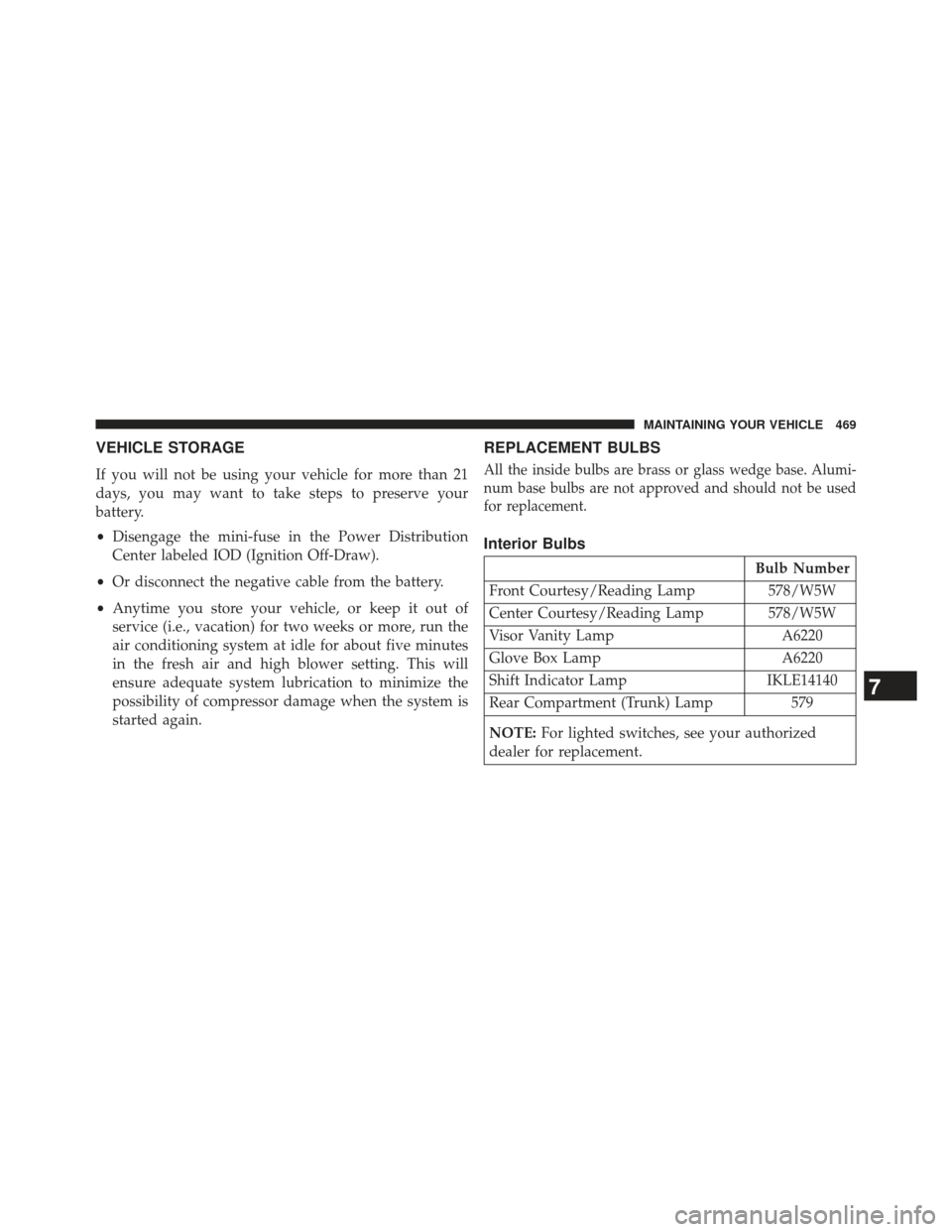
REPLACEMENT BULBS
All the inside bulbs are brass or glass wedge base. Alumi-
num base bulbs are not approved and should not be used
for replacement.
Interior Bulbs
Bulb Number
Front Courtesy/Reading Lamp 578/W5W
Center Courtesy/Reading Lamp 578/W5W
Visor Vanity Lamp A6220
Glove Box Lamp A6220
Shift Indicator Lamp IKLE14140
Rear Compartment (Trunk) Lamp 579
NOTE: For lighted switches, see your authorized
dealer for replacement.
7
MAINTAINING YOUR VEHICLE 469
Page 483 of 517
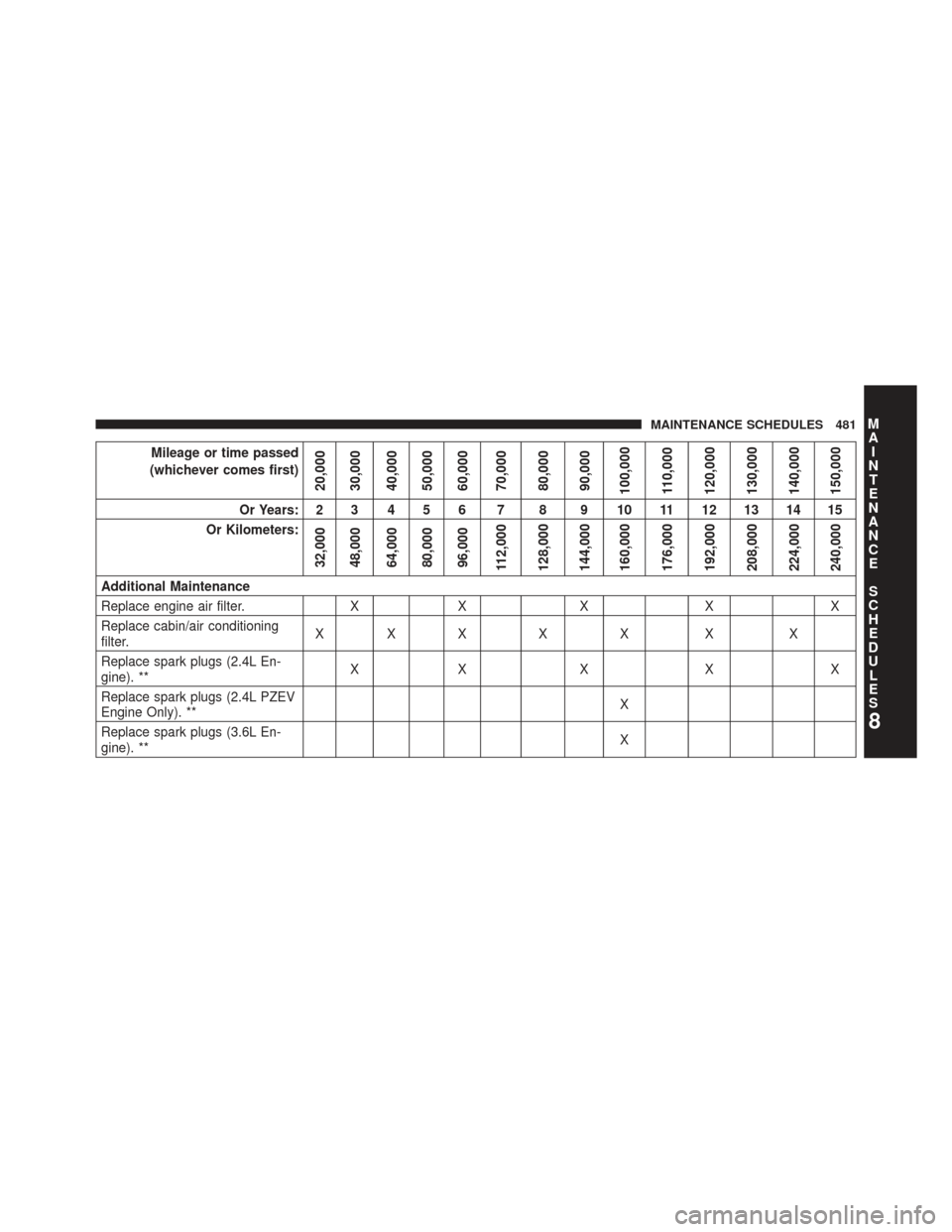
Mileage or time passed
(whichever comes first)
20,000
30,000
40,000
50,000
60,000
70,000
80,000
90,000
100,000
110,000
120,000
130,000
140,000
150,000
Or Years: 2 3 4 5 6 7 8 9 10 11 12 13 14 15
Or Kilometers:
32,000
48,000
64,000
80,000
96,000
112,000
128,000
144,000
160,000
176,000
192,000
208,000
224,000
240,000
Additional Maintenance
Replace engine air filter. XX X X X
Replace cabin/air conditioning
filter. XXX X X X X
Replace spark plugs (2.4L En-
gine). ** XX X X X
Replace spark plugs (2.4L PZEV
Engine Only). ** X
Replace spark plugs (3.6L En-
gine). ** X
8
M
A I
N T
E
N
A
N
C E
S
C
H E
D
U L
E
SMAINTENANCE SCHEDULES 481
Page 498 of 517
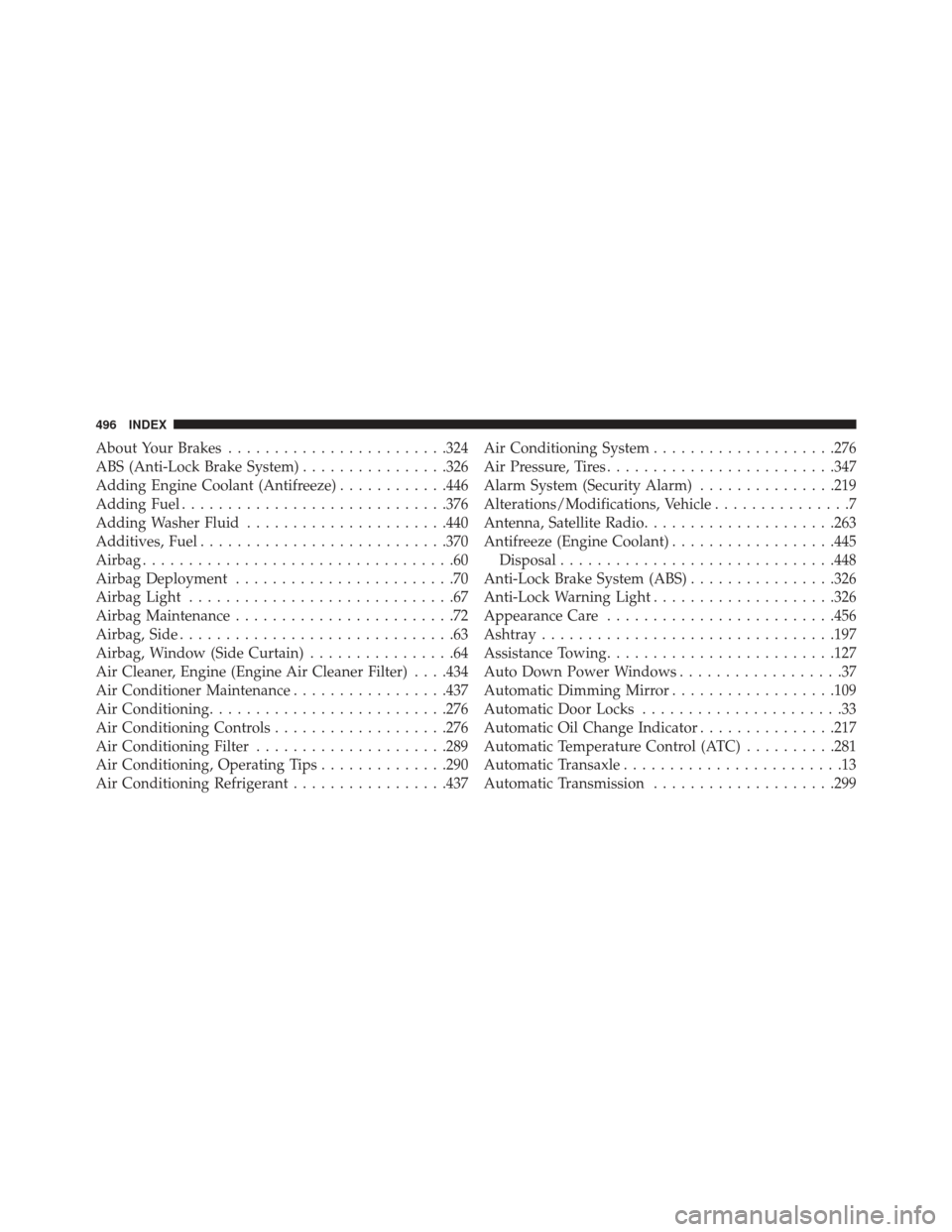
About Your Brakes....................... .324
ABS (Anti-Lock Brake System) ................326
Adding Engine Coolant (Antifreeze) ............446
Adding Fuel ............................ .376
Adding Washer Fluid ..................... .440
Additives, Fuel .......................... .370
Airbag ..................................60
Airbag Deployment ........................70
Airbag Light .............................67
Airbag Maintenance ........................72
Airbag, Side ..............................63
Airbag, Window (Side Curtain) ................64
Air Cleaner, Engine (Engine Air Cleaner Filter) . . . .434
Air Conditioner Maintenance .................437
Air Conditioning ......................... .276
Air Conditioning Controls ...................276
Air Conditioning Filter .....................289
Air Conditioning, Operating Tips ..............290
Air Conditioning Refrigerant .................437Air Conditioning System
....................276
Air Pressure, Tires ........................ .347
Alarm System (Security Alarm) ...............219
Alterations/Modifications, Vehicle ...............7
Antenna, Satellite Radio .....................263
Antifreeze (Engine Coolant) ..................445
Disposal ............................. .448
Anti-Lock Brake System (ABS) ................326
Anti-Lock Warning Light ....................326
Appearance Care ........................ .456
Ashtray ............................... .197
Assistance Towing ........................ .127
Auto Down Power Windows ..................37
Automatic Dimming Mirror ..................109
Automatic Door Locks ......................33
Automatic Oil Change Indicator ...............217
Automatic Temperature Control (ATC) ..........281
Automatic Transaxle ........................13
Automatic Transmission ....................299
496 INDEX
Page 503 of 517
Exterior Lights.......................... .101
Fabric Care ............................. .460
Filler Location Fuel ........................211
Filters Air Cleaner .......................... .434
Air Conditioning ...................... .289
Engine Oil ........................... .434
Engine Oil Disposal .....................434
Flashers ............................... .396
Hazard Warning ....................... .396
Turn Signal .......................... .101
Flash-To-Pass ........................... .168
Flexible Fuel Vehicles Cruising Range ........................ .375
Engine Oil ........................... .375
Fuel Requirements ..................... .372
Maintenance .......................... .376
Replacement Parts ...................... .376Starting
............................. .375
Flooded Engine Starting ....................297
Fluid Capacities ......................... .474
Fluid Leaks ............................ .101
Fluid Level Checks Automatic Transmission ..................453
Brake ............................... .450
Cooling System ........................ .444
Engine Oil ........................... .431
Power Steering ........................ .323
Fluids, Lubricants and Genuine Parts ...........475
Fog Lights ............................. .169
Folding Rear Seat ........................ .161
Freeing A Stuck Vehicle .....................416
Fuel .................................. .368
Adding ............................. .376
Additives ............................ .370
Clean Air ............................ .368
Ethanol ............................. .369
10
INDEX 501