cooling DODGE AVENGER 2014 2.G User Guide
[x] Cancel search | Manufacturer: DODGE, Model Year: 2014, Model line: AVENGER, Model: DODGE AVENGER 2014 2.GPages: 517, PDF Size: 3.58 MB
Page 447 of 517
Refer to the “Maintenance Schedule” for the proper
maintenance intervals.
NOTE:Some vehicles require special tools to add cool-
ant properly. Failure to fill these systems properly could
lead to severe internal engine damage. If any coolant is
needed to be added to the system please contact your
local authorized dealer.
Selection Of Coolant
Refer to “Fluids, Lubricants, and Genuine Parts” in
“Maintaining Your Vehicle” for further information.
CAUTION!
• Mixing of engine coolant (antifreeze) other than
specified Organic Additive Technology (OAT) en-
gine coolant (antifreeze), may result in engine
damage and may decrease corrosion protection.
Organic Additive Technology (OAT) engine cool-
ant is different and should not be mixed with
Hybrid Organic Additive Technology (HOAT) en-
gine coolant (antifreeze) or any “globally compat-
ible” coolant (antifreeze). If a non-OAT engine
coolant (antifreeze) is introduced into the cooling
system in an emergency, the cooling system will
need to be drained, flushed, and refilled with fresh
OAT coolant (conforming to MS-12106), by an
authorized dealer as soon as possible.
(Continued)
7
MAINTAINING YOUR VEHICLE 445
Page 449 of 517
(antifreeze) solution. The use of lower quality water
will reduce the amount of corrosion protection in the
engine cooling system.
Please note that it is the owner’s responsibility to main-
tain the proper level of protection against freezing ac-
cording to the temperatures occurring in the area where
the vehicle is operated.
NOTE:
• Some vehicles require special tools to add coolant
properly. Failure to fill these systems properly could
lead to severe internal engine damage. If any coolant is
needed to be added to the system please contact your
local authorized dealer. •
Mixing engine coolant (antifreeze) types is not recom-
mended and can result in cooling system damage. If
HOAT and OAT coolant are mixed in an emergency,
have a authorized dealer drain, flush, and refill with
OAT coolant (conforming to MS-12106) as soon as
possible.
Cooling System Pressure Cap
The cap must be fully tightened to prevent loss of engine
coolant (antifreeze), and to ensure that engine coolant
(antifreeze) will return to the radiator from the coolant
recovery tank.
The cap should be inspected and cleaned if there is any
accumulation of foreign material on the sealing surfaces.
7
MAINTAINING YOUR VEHICLE 447
Page 450 of 517
WARNING!
•The warning words “DO NOT OPEN HOT” on the
cooling system pressure cap are a safety precaution.
Never add engine coolant (antifreeze) when the
engine is overheated. Do not loosen or remove the
cap to cool an overheated engine. Heat causes
pressure to build up in the cooling system. To
prevent scalding or injury, do not remove the
pressure cap while the system is hot or under
pressure.
• Do not use a pressure cap other than the one
specified for your vehicle. Personal injury or en-
gine damage may result.
Disposal Of Used Engine Coolant
Used ethylene glycol-based engine coolant (antifreeze) is
a regulated substance requiring proper disposal. Check
with your local authorities to determine the disposal rules for your community. To prevent ingestion by ani-
mals or children, do not store ethylene glycol-based
engine coolant in open containers or allow it to remain in
puddles on the ground. If ingested by a child or pet, seek
emergency assistance immediately. Clean up any ground
spills immediately.
Coolant Level
Four-Cylinder Engines —
the coolant bottle provides a
quick visual method for determining that the engine
coolant (antifreeze) level is adequate. With the engine
idling and warm to normal operating temperature, the
level of the engine coolant (antifreeze) in the bottle
should be between the “ADD” and “FULL” lines, shown
on the bottle.
Six-Cylinder Engines — the level of the engine coolant
(antifreeze) in the pressurized coolant bottle should be
between the “COLD” and “FULL” range on the bottle
when the engine is cold.
448 MAINTAINING YOUR VEHICLE
Page 451 of 517
The radiator normally remains completely full, so there is
no need to remove the radiator cap unless checking for
engine coolant (antifreeze) freeze point or replacing cool-
ant. Advise your service attendant of this. As long as the
engine operating temperature is satisfactory, the coolant
bottle need only be checked once a month. When addi-
tional engine coolant (antifreeze) is needed to maintain
the proper level, it should be added to the coolant bottle.
Do not overfill.
Points To Remember
NOTE:When the vehicle is stopped after a few miles/
kilometers of operation, you may observe vapor coming
from the front of the engine compartment. This is nor-
mally a result of moisture from rain, snow, or high
humidity accumulating on the radiator and being vapor-
ized when the thermostat opens, allowing hot engine
coolant (antifreeze) to enter the radiator. If an examination of your engine compartment shows no
evidence of radiator or hose leaks, the vehicle may be
safely driven. The vapor will soon dissipate.
•
Do not overfill the coolant expansion bottle.
•
Check the coolant freeze point in the radiator and in the
coolant expansion bottle. If engine coolant (antifreeze)
needs to be added, the contents of the coolant expansion
bottle must also be protected against freezing.
• If frequent engine coolant (antifreeze) additions are
required, the cooling system should be pressure tested
for leaks.
• Maintain engine coolant (antifreeze) concentration at a
minimum of 50% OAT coolant (conforming to MS-
12106) and distilled water for proper corrosion protec-
tion of your engine which contains aluminum compo-
nents.
7
MAINTAINING YOUR VEHICLE 449
Page 476 of 517
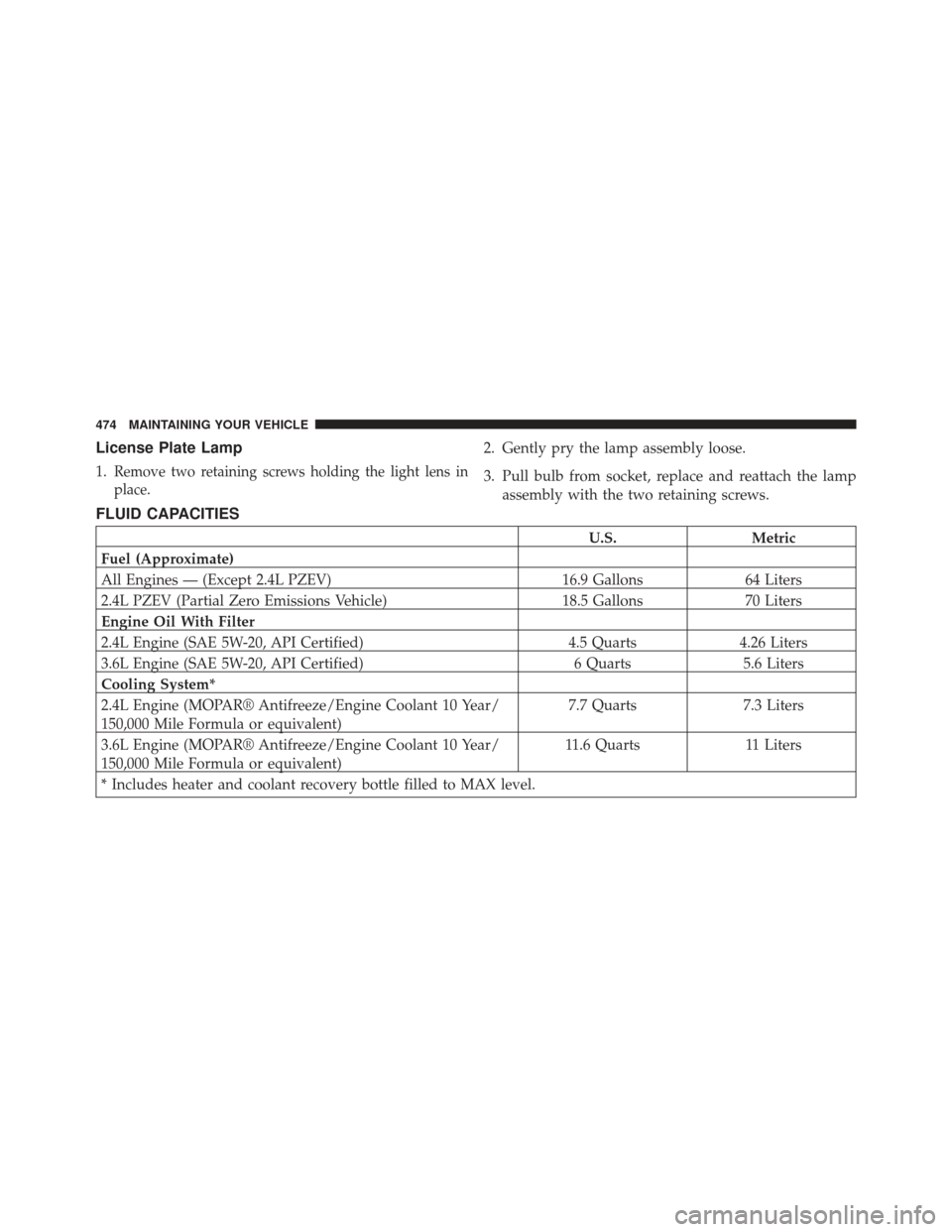
License Plate Lamp
1.Remove two retaining screws holding the light lens in
place.
2. Gently pry the lamp assembly loose.
3. Pull bulb from socket, replace and reattach the lampassembly with the two retaining screws.
FLUID CAPACITIES
U.S. Metric
Fuel (Approximate)
All Engines — (Except 2.4L PZEV) 16.9 Gallons 64 Liters
2.4L PZEV (Partial Zero Emissions Vehicle) 18.5 Gallons 70 Liters
Engine Oil With Filter
2.4L Engine (SAE 5W-20, API Certified) 4.5 Quarts 4.26 Liters
3.6L Engine (SAE 5W-20, API Certified) 6 Quarts 5.6 Liters
Cooling System*
2.4L Engine (MOPAR® Antifreeze/Engine Coolant 10 Year/
150,000 Mile Formula or equivalent) 7.7 Quarts 7.3 Liters
3.6L Engine (MOPAR® Antifreeze/Engine Coolant 10 Year/
150,000 Mile Formula or equivalent) 11.6 Quarts
11 Liters
* Includes heater and coolant recovery bottle filled to MAX level.
474 MAINTAINING YOUR VEHICLE
Page 481 of 517
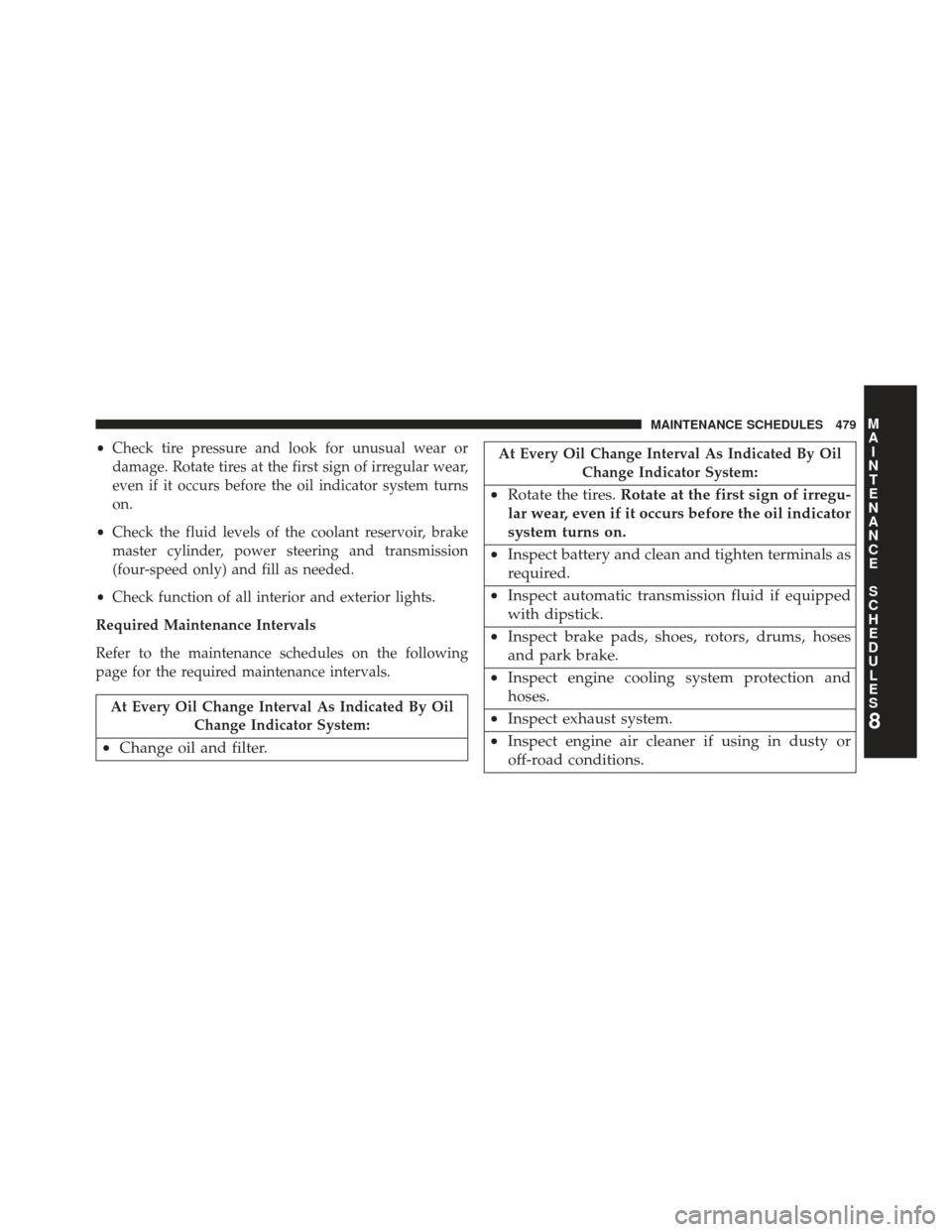
•Check tire pressure and look for unusual wear or
damage. Rotate tires at the first sign of irregular wear,
even if it occurs before the oil indicator system turns
on.
• Check the fluid levels of the coolant reservoir, brake
master cylinder, power steering and transmission
(four-speed only) and fill as needed.
• Check function of all interior and exterior lights.
Required Maintenance Intervals
Refer to the maintenance schedules on the following
page for the required maintenance intervals.
At Every Oil Change Interval As Indicated By Oil Change Indicator System:
•Change oil and filter.
At Every Oil Change Interval As Indicated By Oil
Change Indicator System:
•Rotate the tires. Rotate at the first sign of irregu-
lar wear, even if it occurs before the oil indicator
system turns on.
• Inspect battery and clean and tighten terminals as
required.
• Inspect automatic transmission fluid if equipped
with dipstick.
• Inspect brake pads, shoes, rotors, drums, hoses
and park brake.
• Inspect engine cooling system protection and
hoses.
• Inspect exhaust system.
• Inspect engine air cleaner if using in dusty or
off-road conditions.
8
M
A I
N T
E
N
A
N
C E
S
C
H E
D
U L
E
SMAINTENANCE SCHEDULES 479
Page 500 of 517
Cellular Phone...........................113
Certification Label ........................ .379
Chains, Tire ............................ .357
Changing A Flat Tire ...................... .399
Chart, Tire Sizing ........................ .337
Check Engine Light (Malfunction Indicator Light) . .428
Checking Your Vehicle For Safety ...............97
Checks, Safety ............................97
Child Restraint ............................74
Child Safety Locks .........................34
Cigar Lighter ........................... .197
Clean Air Gasoline ....................... .368
Cleaning Wheels .............................. .458
Climate Control ......................... .276
Clock ................................. .241
Cold Weather Operation ....................297
Compact Disc (CD) Maintenance ..............275
Compact Spare Tire ....................... .352Compass
.............................. .225
Compass Calibration ...................... .233
Compass Variance ........................ .233
Computer, Trip/Travel ......................21
Connector UCI................................ .266
Universal Consumer Interface (UCI) ..........266
Console ............................... .162
Console, Floor .......................... .162
Contract, Service ......................... .489
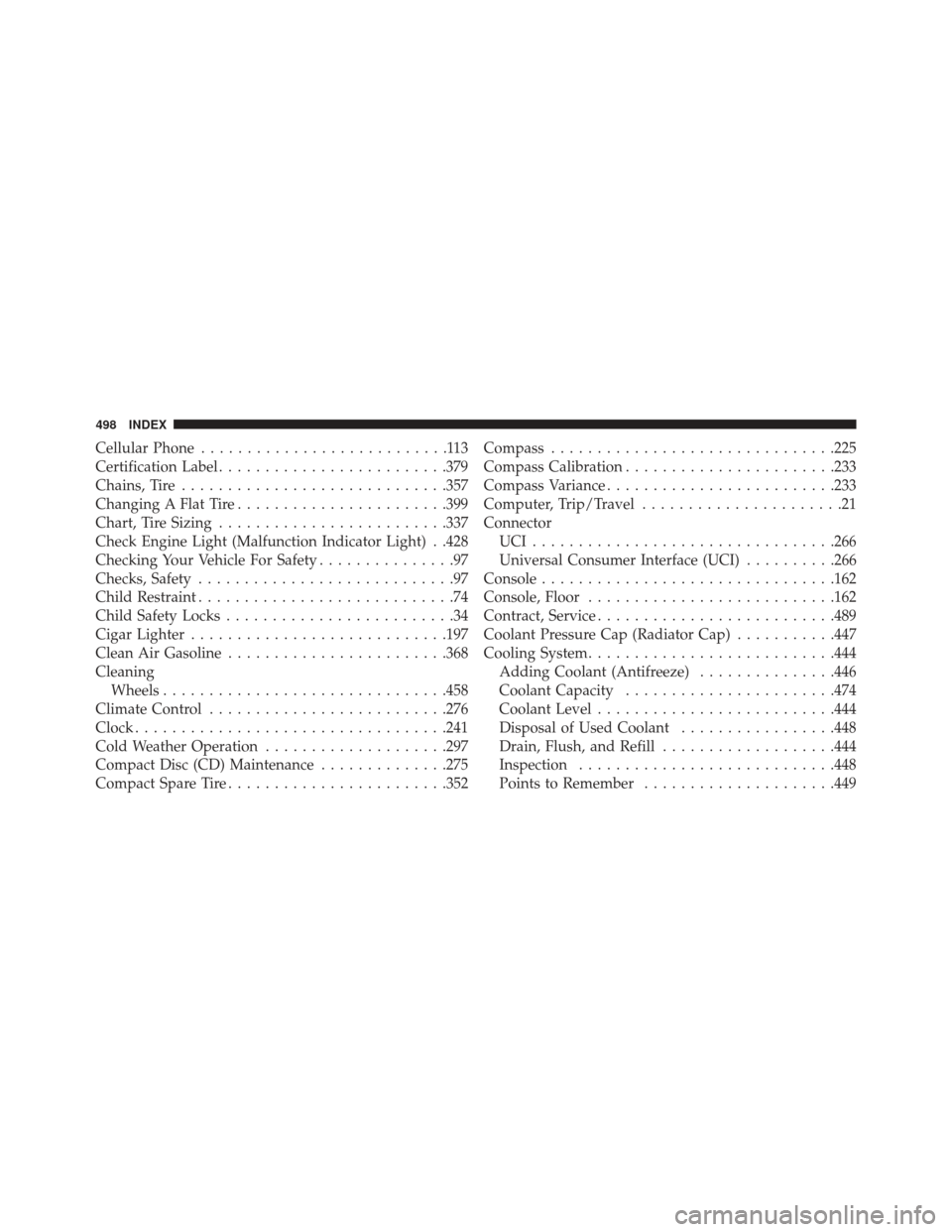
Coolant Pressure Cap (Radiator Cap) ...........447
Cooling System .......................... .444
Adding Coolant (Antifreeze) ...............446
Coolant Capacity ...................... .474
Coolant Level ......................... .444
Disposal of Used Coolant .................448
Drain, Flush, and Refill ...................444
Inspection ........................... .448
Points to Remember .....................449
498 INDEX
Page 502 of 517
Electronic Vehicle Information Center (EVIC)......226
Emergency, In Case of Jacking .............................. .399
Jump Starting ..........................411
Towing ............................. .418
Emergency Trunk Release ....................41
Emission Control System Maintenance ..........428
Engine ................................ .425
Air Cleaner .......................... .434
Block Heater ......................... .299
Break-In Recommendations .................96
Checking Oil Level ..................... .431
Compartment ......................... .426
Compartment Identification ................426
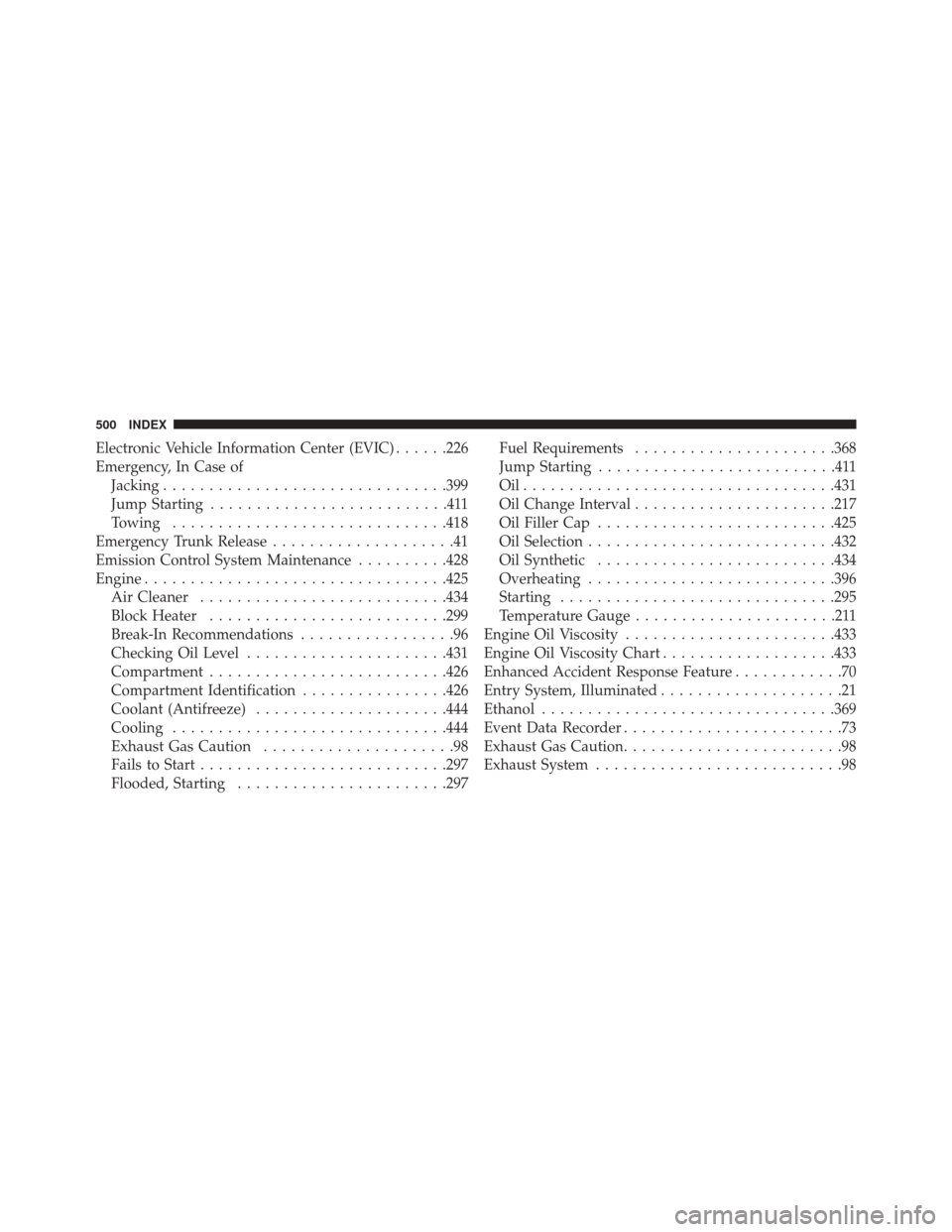
Coolant (Antifreeze) .....................444
Cooling ............................. .444
Exhaust Gas Caution .....................98
Fails to Start .......................... .297
Flooded, Starting ...................... .297Fuel Requirements
..................... .368
Jump Starting ..........................411
Oil................................. .431
Oil Change Interval ..................... .217
Oil Filler Cap ......................... .425
Oil Selection .......................... .432
Oil Synthetic ......................... .434
Overheating .......................... .396
Starting ............................. .295
Temperature Gauge ......................211
Engine Oil Viscosity ...................... .433
Engine Oil Viscosity Chart ...................433
Enhanced Accident Response Feature ............70
Entry System, Illuminated ....................21
Ethanol ............................... .369
Event Data Recorder ........................73
Exhaust Gas Caution ........................98
Exhaust System ...........................98
500 INDEX
Page 503 of 517
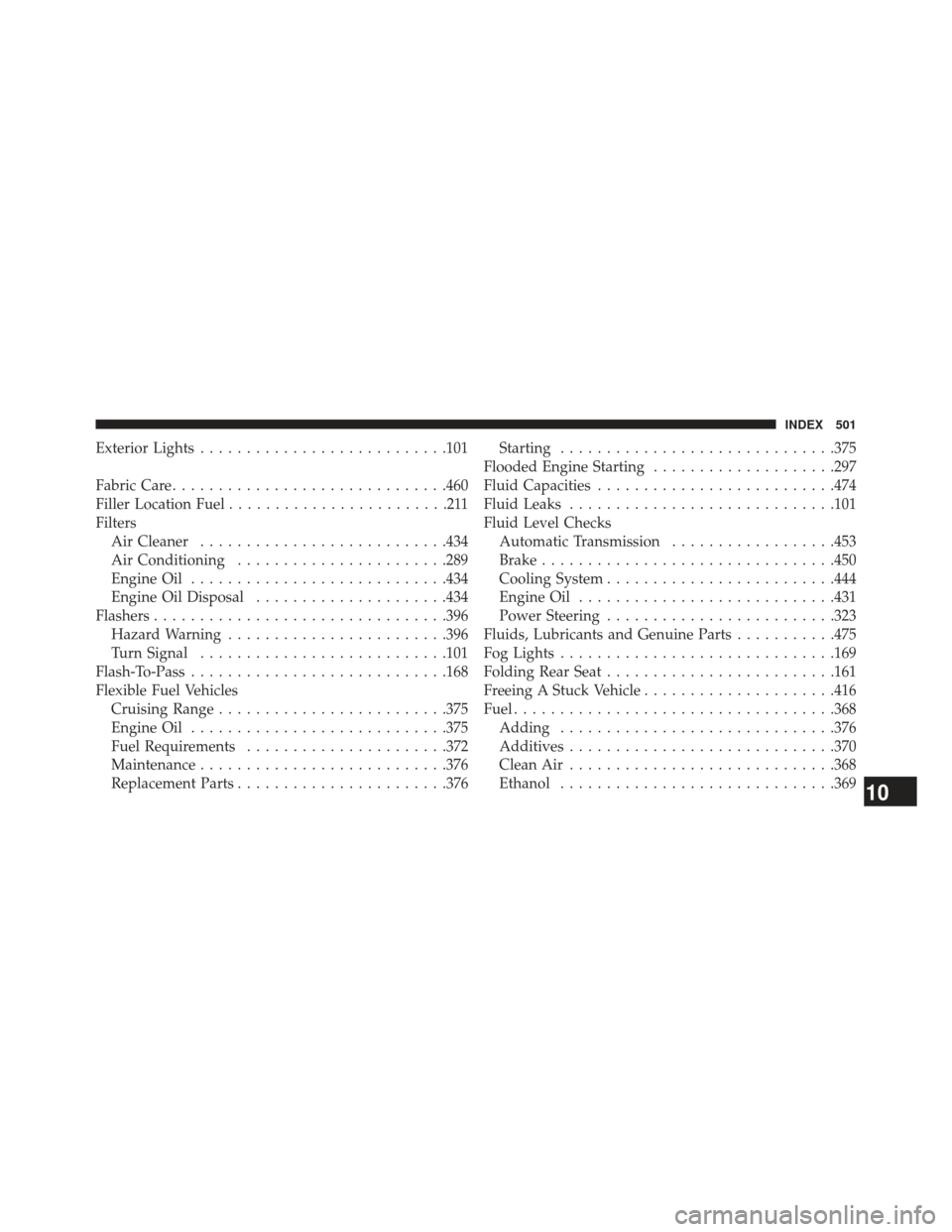
Exterior Lights.......................... .101
Fabric Care ............................. .460
Filler Location Fuel ........................211
Filters Air Cleaner .......................... .434
Air Conditioning ...................... .289
Engine Oil ........................... .434
Engine Oil Disposal .....................434
Flashers ............................... .396
Hazard Warning ....................... .396
Turn Signal .......................... .101
Flash-To-Pass ........................... .168
Flexible Fuel Vehicles Cruising Range ........................ .375
Engine Oil ........................... .375
Fuel Requirements ..................... .372
Maintenance .......................... .376
Replacement Parts ...................... .376Starting
............................. .375
Flooded Engine Starting ....................297
Fluid Capacities ......................... .474
Fluid Leaks ............................ .101
Fluid Level Checks Automatic Transmission ..................453
Brake ............................... .450
Cooling System ........................ .444
Engine Oil ........................... .431
Power Steering ........................ .323
Fluids, Lubricants and Genuine Parts ...........475
Fog Lights ............................. .169
Folding Rear Seat ........................ .161
Freeing A Stuck Vehicle .....................416
Fuel .................................. .368
Adding ............................. .376
Additives ............................ .370
Clean Air ............................ .368
Ethanol ............................. .369
10
INDEX 501
Page 513 of 517
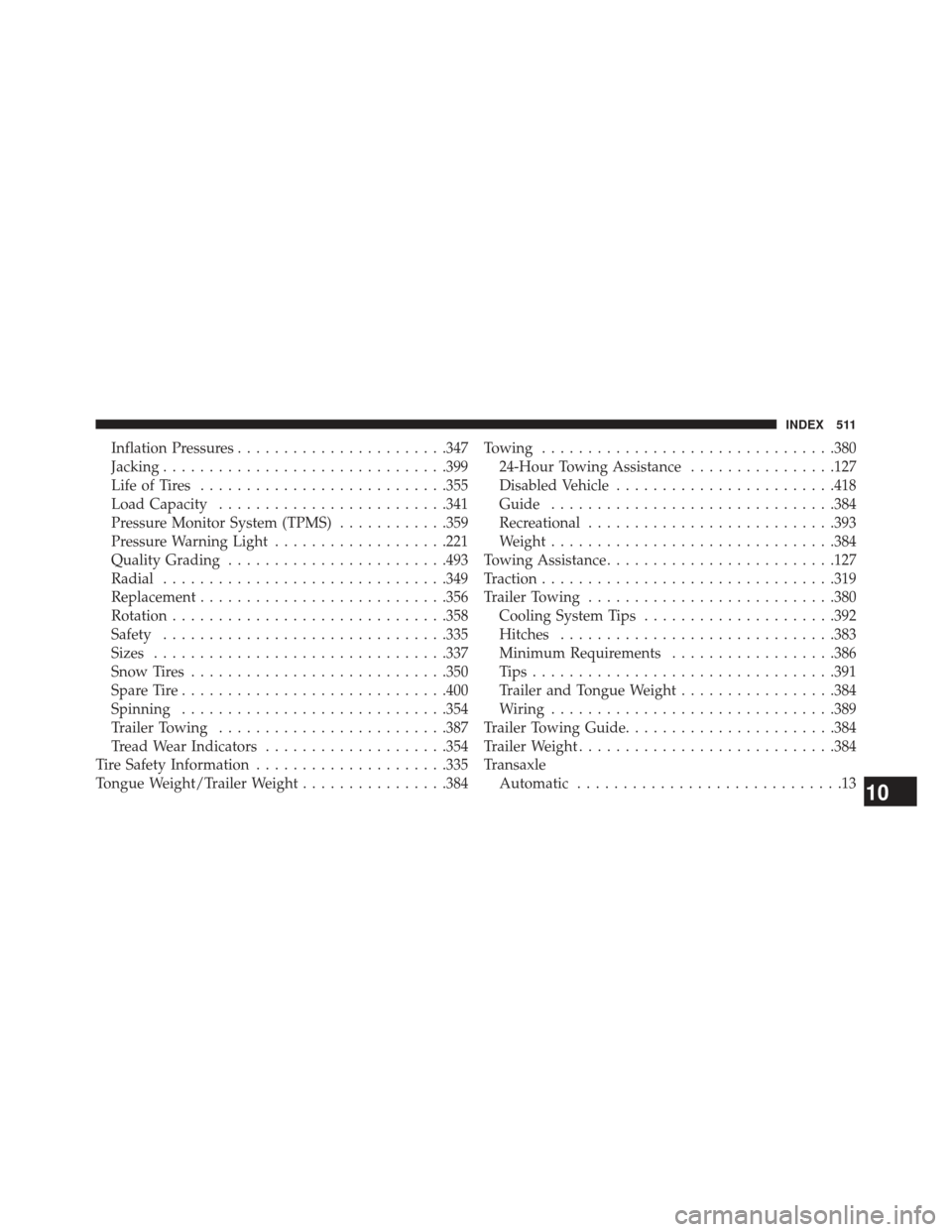
Inflation Pressures...................... .347
Jacking .............................. .399
Life of Tires .......................... .355
Load Capacity ........................ .341
Pressure Monitor System (TPMS) ............359
Pressure Warning Light ...................221
Quality Grading ....................... .493
Radial .............................. .349
Replacement .......................... .356
Rotation ............................. .358
Safety .............................. .335
Sizes ............................... .337
Snow Tires ........................... .350
Spare Tire ............................ .400
Spinning ............................ .354
Trailer Towing ........................ .387
Tread Wear Indicators ....................354
Tire Safety Information .....................335
Tongue Weight/Trailer Weight ................384Towing
............................... .380
24-Hour Towing Assistance ................127
Disabled Vehicle ....................... .418
Guide .............................. .384
Recreational .......................... .393
Weight .............................. .384
Towing Assistance ........................ .127
Traction ............................... .319
Trailer Towing .......................... .380
Cooling System Tips .....................392
Hitches ............................. .383
Minimum Requirements ..................386
Tips................................ .391
Trailer and Tongue Weight .................384
Wiring .............................. .389
Trailer Towing Guide ...................... .384
T
railer Weight ........................... .384
Transaxle Automatic .............................13
10
INDEX 511