check oil DODGE CALIBER 2006 1.G User Guide
[x] Cancel search | Manufacturer: DODGE, Model Year: 2006, Model line: CALIBER, Model: DODGE CALIBER 2006 1.GPages: 322, PDF Size: 5.99 MB
Page 254 of 322
WARNING!
Fluid level should be checked on a level surface and
with the engine off to prevent injury from moving
parts and to insure accurate fluid level reading. Do
not overfill. Use only manufacturers recommended
power steering fluid.
If necessary, add fluid to restore to the proper indicated
level. With a clean cloth, wipe any spilled fluid from all
surfaces. Refer to Fluids, Lubricants, and Genuine Parts
for correct fluid types.
Front Suspension Ball Joints
There are two front suspension lower ball joints that are
permanently lubricated. Inspect these ball joints when-
ever under vehicle service is done. Damaged seals and
their corresponding potentially damaged ball joints must
be replaced.
Body Lubrication
Locks and all body pivot points, including such items as
seat tracks, doors, liftgate and hood hinges, should be
lubricated periodically to assure quiet, easy operation
and to protect against rust and wear. Prior to the appli-
cation of any lubricant, the parts concerned should be
wiped clean to remove dust and grit; after lubricating
excess oil and grease should be removed. Particular
attention should also be given to hood latching compo-
nents to insure proper function. When performing other
underhood services, the hood latch, release mechanism
and safety catch should be cleaned and lubricated.
The external lock cylinders should be lubricated twice a
year, preferably in the fall and spring. Apply a small
amount of a high quality lubricant such as MopartLock
Cylinder Lubricant directly into the lock cylinder.
Windshield Wiper Blades
Clean the rubber edges of the wiper blades and the
windshield periodically with a sponge or soft cloth and a
mild non abrasive cleaner or use the washer solvent. This
will remove accumulations of salt, waxes or road film
and help reduce streaking and smearing.
254 MAINTAINING YOUR VEHICLE
Page 255 of 322
Operation of the wipers on dry glass for long periods may
cause deterioration of the wiper blades. Always use washer
fluid when using the wipers to remove salt or dirt from a
dry windshield. Avoid using the wiper blades to remove
frost or ice from the windshield. make sure that they are
not frozen to the glass before turning them on to avoid
damaging the blade. Keep the blade rubber out of contact
with petroleum products such as engine oil, gasoline, etc.
Windshield Wiper Blade Replacement
1. Lift the wiper arm away from the glass.
2. Push the release tab shown in the illustration and slide
the wiper blade assembly down along the arm. Gently
place the wiper arm on the windshield.
3. Install the new blade assembly onto the wiper arm tip
until it locks in place.
Windshield Washer Reservoir
The washer fluid reservoir is located in the rear of the
engine compartment on the right side and should be
checked for fluid level at regular intervals. Fill the
reservoir with windshield washer solvent (not radiator
antifreeze).
Exhaust System
The best protection against carbon monoxide entry into the
vehicle body is a properly maintained engine exhaust
system.
If you notice a change in the sound of the exhaust system,
or if exhaust fumes can be detected inside the vehicle, or
when the underside or rear of the vehicle is damaged;
have a competent technician inspect the complete ex-
haust system and adjacent body areas for broken, dam-
aged, deteriorated, or mispositioned parts. Open seams
or loose connections could permit exhaust fumes to seep
into the passenger compartment. In addition, inspect the
exhaust system each time the vehicle is raised for an oil
change or lubrication. Replace as required.
WARNING!
Exhaust gases can injure or kill. They contain carbon
monoxide (CO) which is colorless and odorless.
Breathing it can make you unconscious and can even-
tually poison you. To avoid breathing CO, refer to
Exhaust Gas in the Safety Tips section of this manual.
MAINTAINING YOUR VEHICLE 255
7
Page 262 of 322
Brake Master Cylinder
The fluid level in the master cylinder should be checked
when performing under hood services, or immediately if
the brake system warning lamp is on.
Be sure to clean the top of the master cylinder area before
removing the cap. If necessary, add fluid to bring the
fluid level up to the requirements described on the brake
fluid reservoir. Fluid level can be expected to fall as the
brake pads wear. Brake fluid level should be checked
when pads are replaced. However, low fluid level may be
caused by a leak and a checkup may be needed.
NOTE:If your vehicle is equipped with amanual
transaxle, the Brake Fluid Reservoir supplies fluid to
both the Brake System and the Clutch Release System.
The two systems are separated in the reservoir and a leak
in one system will not affect the other system. The
Manual TransaxleClutch Release System should not
require fluid replacement during the life of the vehicle. If
the Brake Fluid Reservoir is low, and the brake system
does not indicate any leaks or other problems, it may be
a result of a leak in the Hydraulic Clutch Release System.
See your local authorized dealer for service.Use only manufacturers recommended brake fluid, refer
to Fluids, Lubricants and Genuine Parts for correct fluid
type.
WARNING!
Use of a brake fluid that may have a lower initial
boiling point or unidentified as to specification, may
result in sudden brake failure during hard pro-
longed braking. You could have an accident.
CAUTION!
Use of improper brake fluids will affect overall
clutch system performance. Improper brake fluids
may damage the clutch system resulting in loss of
clutch function and the ability to shift the transaxle.
262 MAINTAINING YOUR VEHICLE
Page 264 of 322

Special Additives
Do not add any materials (other than leak detection dyes)
to Automatic Transmission Fluid (ATF). ATF is an engi-
neered product and its performance may be impaired by
supplemental additives.
Manual Transaxle
Lubricant Selection
Use only manufacturers recommended transmission
fluid. Refer to Fluids, Lubricants and Genuine Parts for
correct fluid type.
Fluid Level Check
Check the fluid level by removing the fill plug. The fluid
level should be between the bottom of the fill hole and a
point not more that 3/16º (4.7 mm) below the bottom of
the hole.
Add fluid, if necessary, to maintain the proper level.
Frequency Of Fluid Change
Under normal operating conditions, the fluid installed at
the factory will give satisfactory lubrication for the life of
the vehicle. Fluid changes are not necessary unless the
following conditions exist:
²The lubricant has become contaminated with water. If
contaminated with water, the fluid should be changed
immediately.
²If severe usage has occurred, refer to Maintenance
Schedule ªBº in Section 8 of this manual.
Rear Drive Assembly (RDA)± AWD Models Only
Lubricant Selection
Use only manufacturers recommended fluid. Refer to
Fluids, Lubricants and Genuine Parts for correct fluid
type.
Fluid Level Check
Visually inspected the unit at each oil change for leakage.
If leakage is detected, Check the fluid level by removing
the fill plug. The fluid level should be maintained be-
tween the bottom of the fill hole to 1/8 inch (4 mm)
below the fill hole.
Add fluid, if necessary, to maintain the proper level.
264 MAINTAINING YOUR VEHICLE
Page 265 of 322

Frequency Of Fluid Change
Refer to the ªMaintenance Schedule located if section 8 of
this manual for the correct change interval for your type
of driving.
Power Transfer Unit (PTU) ± AWD Models Only
Lubricant Selection
Use only manufacturers recommended fluid. Refer to
Fluids, Lubricants and Genuine Parts for correct fluid
type.
Fluid Level Check
Visually inspected the unit at each oil change for leakage.
If leakage is detected, Check the fluid level by removing
the fill plug. The fluid level should be maintained be-
tween the bottom of the fill hole to 1/8 inch (4 mm)
below the fill hole.
Add fluid, if necessary, to maintain the proper level.
Frequency Of Fluid Change
Refer to the ªMaintenance Schedule located if section 8 of
this manual for the correct change interval for your type
of driving.
Appearance Care And Protection From Corrosion
Protection Of Body And Paint from Corrosion
Vehicle body care requirements vary according to geo-
graphic locations and usage. Chemicals that make roads
passable in snow and ice, and those that are sprayed on
trees and road surfaces during other seasons, are highly
corrosive to the metal in your vehicle. Outside parking,
which exposes your vehicle to airborne contaminants,
road surfaces on which the vehicle is operated, extreme
hot or cold weather and other extreme conditions will
have an adverse effect on paint, metal trim, and under-
body protection.
The following maintenance recommendations will enable
you to obtain maximum benefit from the corrosion
resistance built into your vehicle.
What Causes Corrosion?
Corrosion is the result of deterioration or removal of
paint and protective coatings from your vehicle.
The most common causes are:
²Road salt, dirt and moisture accumulation.
MAINTAINING YOUR VEHICLE 265
7
Page 283 of 322
NOTE:IfANYof these apply to you then change your
engine oil every 3,000 miles (5 000 km) or 3 months,
whichever comes first and follow schedule ªBº of the
9Maintenance Schedules9section of this manual.
NOTE:IfANYof these apply to you then change your
coolant every 102,000 miles (170 000 km) or 60 months,
whichever comes first and follow schedule ªBº of the
9Maintenance Schedules9section of this manual.
Second is ScheduleªAº. It is for vehicles that are not
operated under any of the conditions listed under Sched-
ule9B9.
Use the schedule that best describes your driving condi-
tions. Where time and mileage are listed, follow the
interval that occurs first.
NOTE:Under no circumstances should oil change
intervals exceed 6000 miles (10 000 km) or 6 months
whichever comes first.
CAUTION!
Failure to perform the required maintenance items
may result in damage to the vehicle.
At Each Stop for Fuel
²
Check the engine oil level about 5 minutes after a fully
warmed engine is shut off. Checking the oil level while
the vehicle is on level ground will improve the accu-
racy of the oil level reading. Add oil only when the
level is at or below the ADD or MIN mark.
²Check the windshield washer solvent and add, if
required.
Once a Month
²
Check tire pressure and look for unusual wear or
damage.
²Inspect the battery and clean and tighten the terminals
as required.
MAINTENANCE SCHEDULES 283
8
M
A
I
N
T
E
N
A
N
C
E
S
C
H
E
D
U
L
E
S
Page 284 of 322
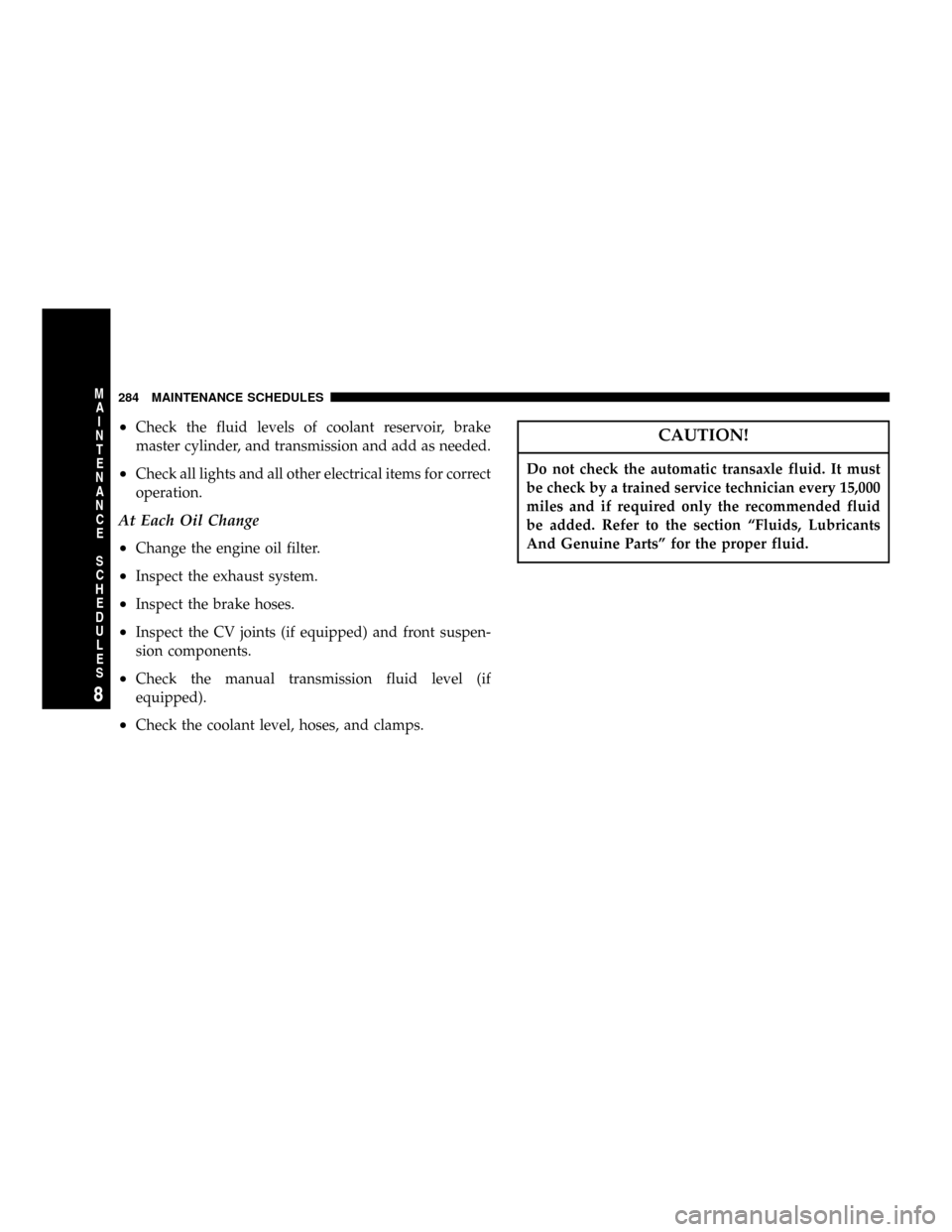
²Check the fluid levels of coolant reservoir, brake
master cylinder, and transmission and add as needed.
²Check all lights and all other electrical items for correct
operation.
At Each Oil Change
²
Change the engine oil filter.
²Inspect the exhaust system.
²Inspect the brake hoses.
²Inspect the CV joints (if equipped) and front suspen-
sion components.
²Check the manual transmission fluid level (if
equipped).
²Check the coolant level, hoses, and clamps.
CAUTION!
Do not check the automatic transaxle fluid. It must
be check by a trained service technician every 15,000
miles and if required only the recommended fluid
be added. Refer to the section ªFluids, Lubricants
And Genuine Partsº for the proper fluid.
284 MAINTENANCE SCHEDULES
8
M
A
I
N
T
E
N
A
N
C
E
S
C
H
E
D
U
L
E
S
Page 286 of 322
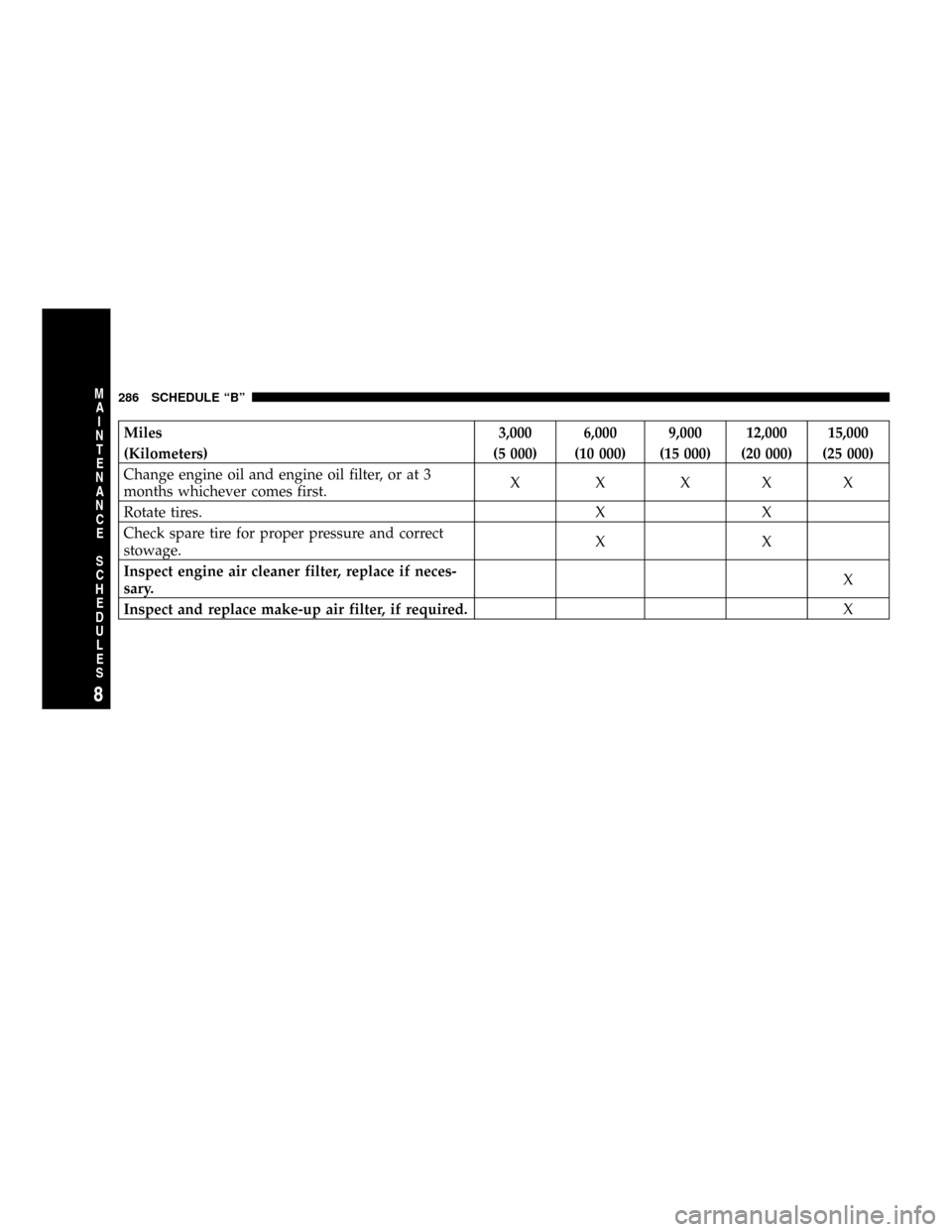
Miles 3,000 6,000 9,000 12,000 15,000
(Kilometers) (5 000) (10 000) (15 000) (20 000) (25 000)
Change engine oil and engine oil filter, or at 3
months whichever comes first.X X XXX
Rotate tires. X X
Check spare tire for proper pressure and correct
stowage.XX
Inspect engine air cleaner filter, replace if neces-
sary.X
Inspect and replace make-up air filter, if required.X
286 SCHEDULE ªBº
8
M
A
I
N
T
E
N
A
N
C
E
S
C
H
E
D
U
L
E
S
Page 287 of 322
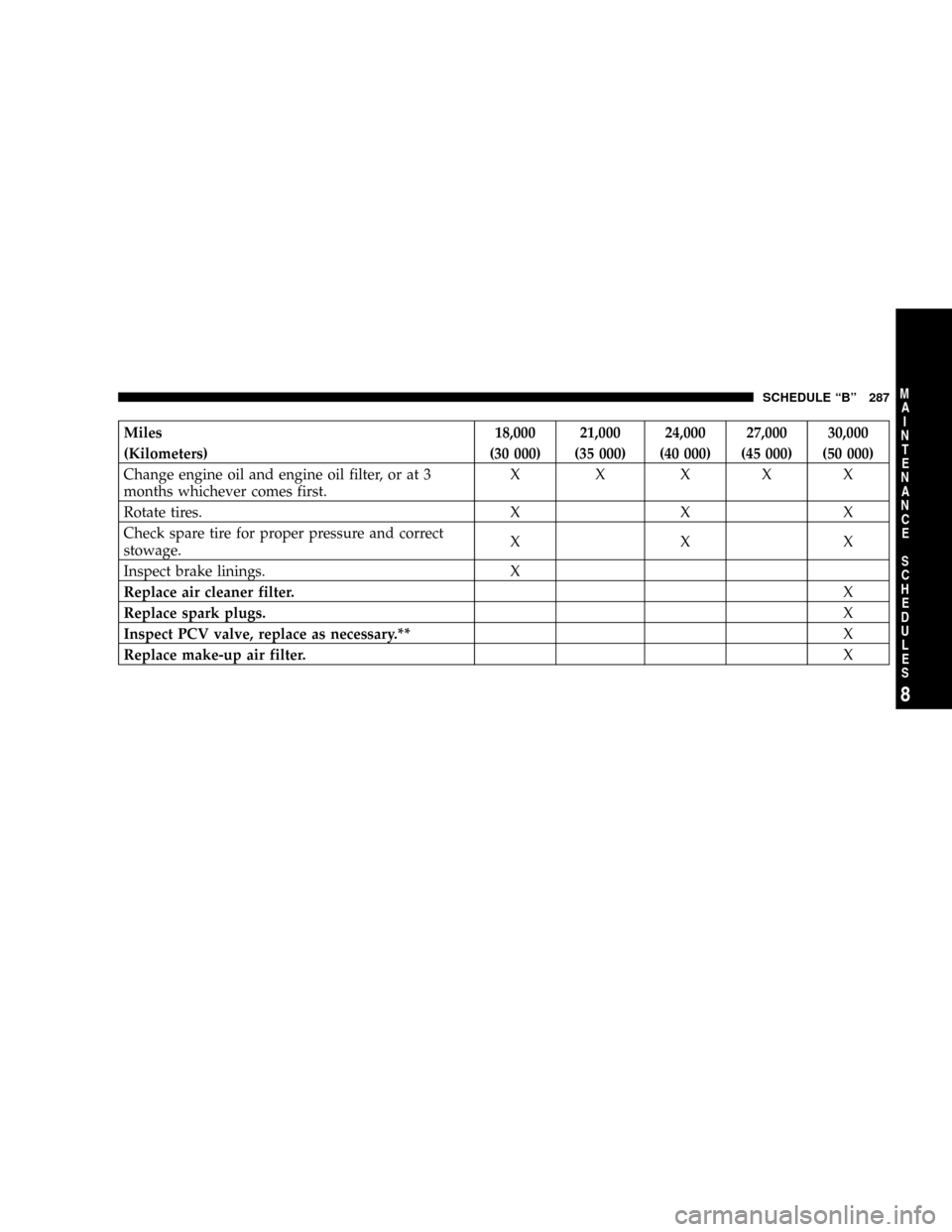
Miles 18,000 21,000 24,000 27,000 30,000
(Kilometers) (30 000) (35 000) (40 000) (45 000) (50 000)
Change engine oil and engine oil filter, or at 3
months whichever comes first.X X XXX
Rotate tires. X X X
Check spare tire for proper pressure and correct
stowage.XXX
Inspect brake linings. X
Replace air cleaner filter.X
Replace spark plugs.X
Inspect PCV valve, replace as necessary.**X
Replace make-up air filter.X
SCHEDULE ªBº 287
8
M
A
I
N
T
E
N
A
N
C
E
S
C
H
E
D
U
L
E
S
Page 288 of 322
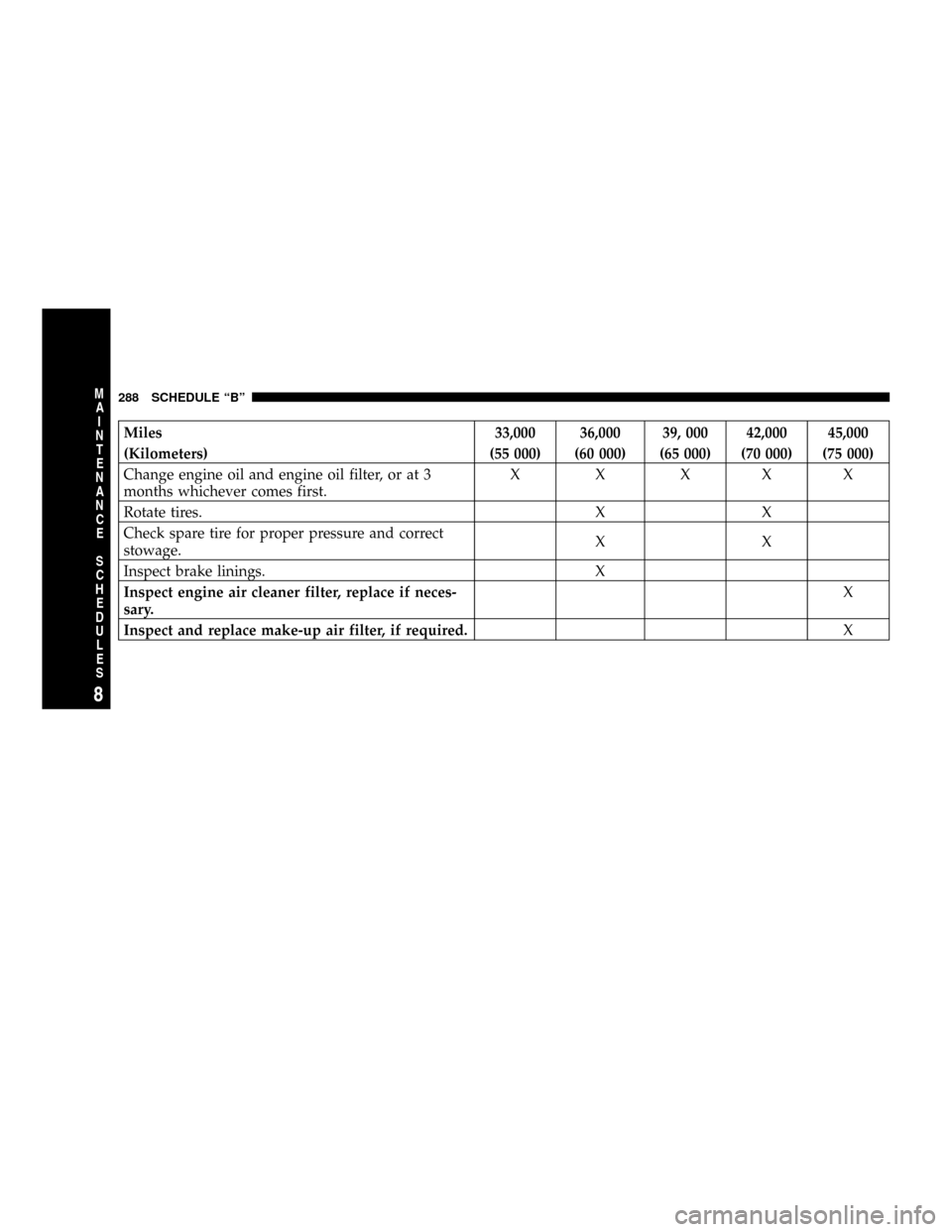
Miles 33,000 36,000 39, 000 42,000 45,000
(Kilometers) (55 000) (60 000) (65 000) (70 000) (75 000)
Change engine oil and engine oil filter, or at 3
months whichever comes first.X X XXX
Rotate tires. X X
Check spare tire for proper pressure and correct
stowage.XX
Inspect brake linings. X
Inspect engine air cleaner filter, replace if neces-
sary.X
Inspect and replace make-up air filter, if required.X
288 SCHEDULE ªBº
8
M
A
I
N
T
E
N
A
N
C
E
S
C
H
E
D
U
L
E
S