child seat DODGE CALIBER 2006 1.G User Guide
[x] Cancel search | Manufacturer: DODGE, Model Year: 2006, Model line: CALIBER, Model: DODGE CALIBER 2006 1.GPages: 322, PDF Size: 5.99 MB
Page 54 of 322
WARNING!
²Improper installation can lead to failure of an
infant or child restraint. It could come loose in a
collision. The child could be badly injured or
killed. Follow the manufacturer's directions ex-
actly when installing an infant or child restraint.
²A rearward facing child restraint should only be
used in a rear seat. A rearward facing child re-
straint in the front seat may be struck by a
deploying passenger airbag which may cause se-
vere or fatal injury to the infant.
Here are some tips on getting the most out of your child
restraint:
²Before buying any restraint system, make sure that it
has a label certifying that it meets all applicable Safety
Standards. We also recommend that you make sure
that you can install the child restraint in the vehicle
where you will use it, before you buy it.
²The restraint must be appropriate for your child's
weight and height. Check the label on the restraint for
weight and height limits.
²Carefully follow the instructions that come with the
restraint. If you install the restraint improperly, it may
not work when you need it.
The passenger seat belts are equipped with either
cinching latch plates or seat belt retractors that can be
switched to an automatic locking mode, which are
designed to keep the lap portion tight around the child
restraint so that it is not necessary to use a locking clip.
If the seat belt has a cinching latch plate, pulling up on
the shoulder portion of the lap/shoulder belt will
tighten the belt. The cinching latch plate will keep the
belt tight, however, any seat belt system will loosen
with time, so check the belt occasionally and pull it
tight if necessary.
54 THINGS TO KNOW BEFORE STARTING YOUR VEHICLE
Page 55 of 322

If the seat belt has a switchable retractor, it will have a
distinctive label. To operate the switchable retractor,
please refer to Automatic-Locking Retractor (ALR) in
this section.
²In the rear seat, you may have trouble tightening the
lap/shoulder belt on the child restraint because the
buckle or latch plate is too close to the belt path
opening on the restraint. Disconnect the latch plate
from the buckle and twist the short buckle end of the
belt several times to shorten it. Insert the latch plate
into the buckle with the release button facing out.
²If the belt still can't be tightened, or if by pulling and
pushing on the restraint loosens the belt, disconnect
the latch plate from the buckle, turn the latch plate
around, and insert the latch plate into the buckle
again. If you still can't make the child restraint secure,
try a different seating position.
²Buckle the child into the seat according to the child
restraint manufacturer's directions.
²When your child restraint is not in use, secure it in the
vehicle with the seat belt or remove it from the vehicle.
Don't leave it loose in the vehicle. In a sudden stop or
collision, it could strike the occupants or seat backs
and cause serious personal injury.
Automatic-Locking Retractor (ALR)
To operate the switchable retractor, pull the belt from the
retractor until there is enough to allow you to pass
through the child restraint and slide the latch plate into
the buckle. Then pull on the belt until it is all removed
from the retractor. Allow the belt to return into the
retractor, pulling on the excess webbing to tighten the lap
portion about the child restraint. Follow the instructions
of the child restraint manufacture.
NOTE:To reset this feature you must let all of the belt
webbing return into the retractor. You will not be able to
pull out more webbing until all of the webbing has been
returned back into the retractor.
THINGS TO KNOW BEFORE STARTING YOUR VEHICLE 55
2
Page 56 of 322

Lower Anchors and Tether for CHildren (LATCH)
Your vehicle is equipped with the child restraint anchor-
age system called LATCH, which stands for Lower
Anchors and Tether for CHildren. The LATCH system
provides for the installation of the child restraint without
using the vehicle seat belt. All three rear seating positions
have lower anchorages that are capable of accommodat-
ing LATCH-compatible child seats having flexible,
webbing-mounted lower attachments. Child seats with
fixed lower attachments must be installed in the out-
board positions only. Regardless of the specific type of
lower attachment,NEVERinstall LATCH-compatible
child seats such that two seats share a common lower
anchorage. If you are installing LATCH-compatible child
restraints in adjacent rear seating positions, you can use
the LATCH anchors or the vehicle's seat belt for the
outboard position, but you must use the vehicle's seat
belt at the center position. If your child restraints are not
LATCH-compatible, you can only install the child re-
straints using the vehicle's seat belts. Please refer to,
Installing the Child Restraint System for typical installa-
tion instructions.Child restraints systems having attachments designed to
connect to the lower anchorages are now available. Child
restraints having tether straps and hooks for connection
to the top tether anchorage have been available for some
time. In fact, many child restraint manufacturers will
provide add-on tether strap kits for some of their older
products. Tether anchorage kits are also available for
most older vehicles.
Rear Seat LATCH
56 THINGS TO KNOW BEFORE STARTING YOUR VEHICLE
Page 57 of 322

Because the lower anchorages are to be introduced to
passenger carrying vehicles over a period of years, child
restraint systems having attachments for those anchor-
ages will continue to have features for installation in
vehicles using the lap or lap/shoulder belt. They will also
have tether straps, and you are urged to take advantage
of all of the available attachments provided with your
child restraint in any vehicle.
NOTE:When using the LATCH attaching system to
install a child restraint, please ensure that all seat belts
not being used for occupant restraints are stowed and out
of reach of children. It is recommended that before
installing the child restraint, buckle the seat belt so the
seat belt is tucked behind the child restraint and out of
reach. If the buckled seat belt interferes with the child
restraint installation, instead of tucking the seat beltbehind the child restraint, route the seat belt through the
child restraint belt path and then buckle it. This should
stow the seat belt out of the reach of an inquisitive child.
Remind all children in the vehicle that the seat belts are
not toys and should not be played with, and never leave
your child unattended in the vehicle.
Installing the Child Restraint System
We urge that you carefully follow the directions of the
manufacturer when installing your child restraint. Many,
but not all, restraint systems will be equipped with
separate straps on each side, with each having a hook or
connector and a means for adjusting the tension in the
strap. Forward-facing toddler restraints and some
rearward-facing infant restraints will also be equipped
with a tether strap with a hook and means for adjusting
the tension in the strap.
THINGS TO KNOW BEFORE STARTING YOUR VEHICLE 57
2
Page 58 of 322
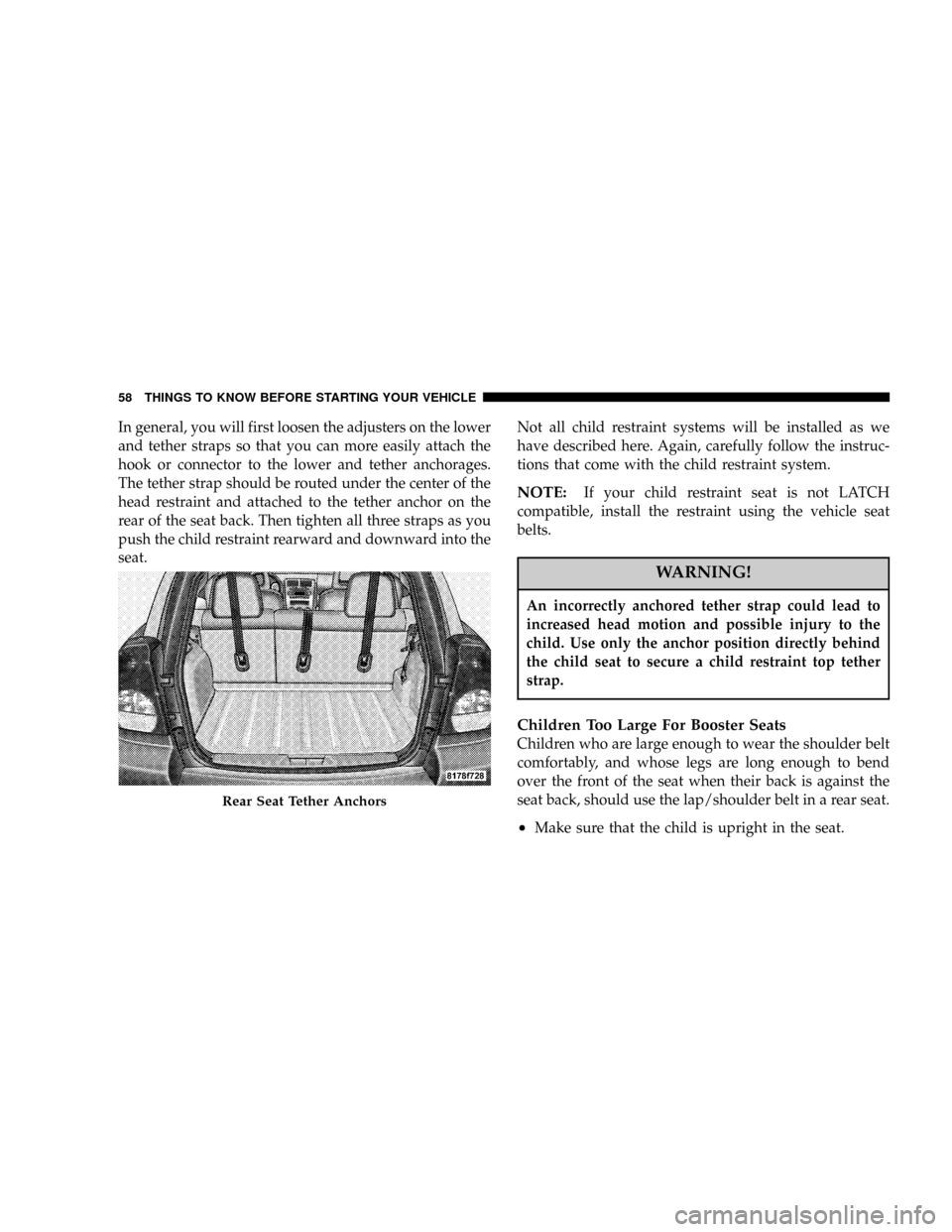
In general, you will first loosen the adjusters on the lower
and tether straps so that you can more easily attach the
hook or connector to the lower and tether anchorages.
The tether strap should be routed under the center of the
head restraint and attached to the tether anchor on the
rear of the seat back. Then tighten all three straps as you
push the child restraint rearward and downward into the
seat.Not all child restraint systems will be installed as we
have described here. Again, carefully follow the instruc-
tions that come with the child restraint system.
NOTE:If your child restraint seat is not LATCH
compatible, install the restraint using the vehicle seat
belts.
WARNING!
An incorrectly anchored tether strap could lead to
increased head motion and possible injury to the
child. Use only the anchor position directly behind
the child seat to secure a child restraint top tether
strap.
Children Too Large For Booster Seats
Children who are large enough to wear the shoulder belt
comfortably, and whose legs are long enough to bend
over the front of the seat when their back is against the
seat back, should use the lap/shoulder belt in a rear seat.
²Make sure that the child is upright in the seat.
Rear Seat Tether Anchors
58 THINGS TO KNOW BEFORE STARTING YOUR VEHICLE
Page 59 of 322

²The lap portion should be low on the hips and as snug
as possible.
²Check belt fit periodically. A child's squirming or
slouching can move the belt out of position.
²If the shoulder belt contacts the face or neck, move the
child closer to the center of the vehicle. Never allow a
child to put the shoulder belt under an arm or behind
their back.
Transporting Pets
Airbags deploying in the front seat could harm your pet.
An unrestrained pet will be thrown about and possibly
injured, or injure a passenger during panic braking or in
a collision.
Pets should be restrained in the rear seat in pet harnesses
or pet carriers that are secured by seat belts.
ENGINE BREAK-IN RECOMMENDATIONS
A long break-in period is not required for the engine in
your new vehicle.
Drive moderately during the first 300 miles (500 km).
After the initial 60 miles (100 km), speeds up to 50 or 55
mph (80 or 90 km/h) are desirable.
While cruising, brief full-throttle acceleration, within the
limits of local traffic laws, contributes to a good break-in.
Wide open throttle acceleration in low gear can be
detrimental and should be avoided.
The engine oil installed in the engine at the factory is a high
quality energy conserving type lubricant. Oil changes
should be consistent with anticipated climate conditions
under which vehicle operations will occur. The recom-
mended viscosity and quality grades are shown in Section
7 of this manual. NON-DETERGENT OR STRAIGHT MIN-
ERAL OILS MUST NEVER BE USED.
A new engine may consume some oil during its first few
thousand miles (kilometers) of operation. This should be
considered as a normal part of the break-in and not
interpreted as an indication of difficulty.
THINGS TO KNOW BEFORE STARTING YOUR VEHICLE 59
2
Page 91 of 322
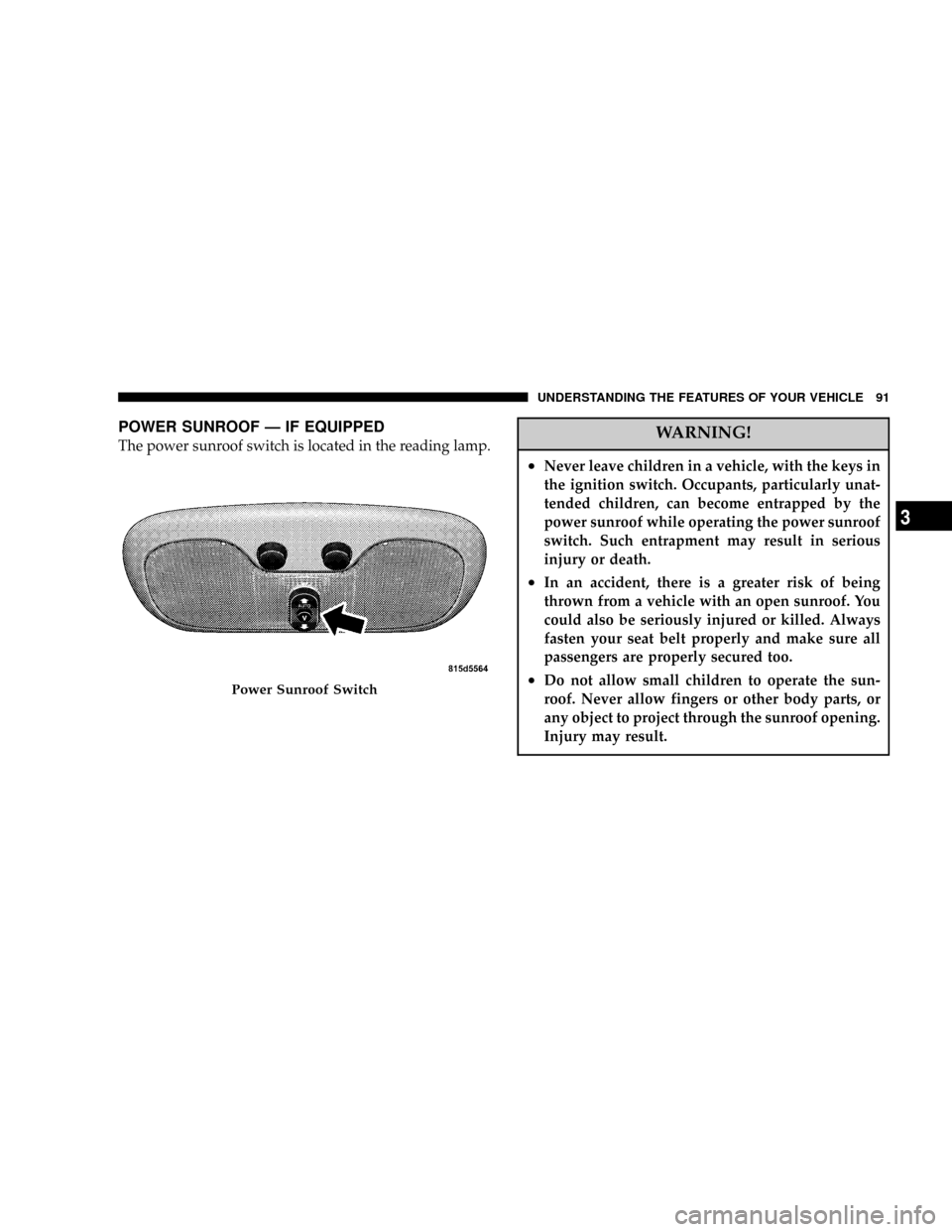
POWER SUNROOF Ð IF EQUIPPED
The power sunroof switch is located in the reading lamp.WARNING!
²Never leave children in a vehicle, with the keys in
the ignition switch. Occupants, particularly unat-
tended children, can become entrapped by the
power sunroof while operating the power sunroof
switch. Such entrapment may result in serious
injury or death.
²In an accident, there is a greater risk of being
thrown from a vehicle with an open sunroof. You
could also be seriously injured or killed. Always
fasten your seat belt properly and make sure all
passengers are properly secured too.
²Do not allow small children to operate the sun-
roof. Never allow fingers or other body parts, or
any object to project through the sunroof opening.
Injury may result.Power Sunroof Switch
UNDERSTANDING THE FEATURES OF YOUR VEHICLE 91
3
Page 99 of 322
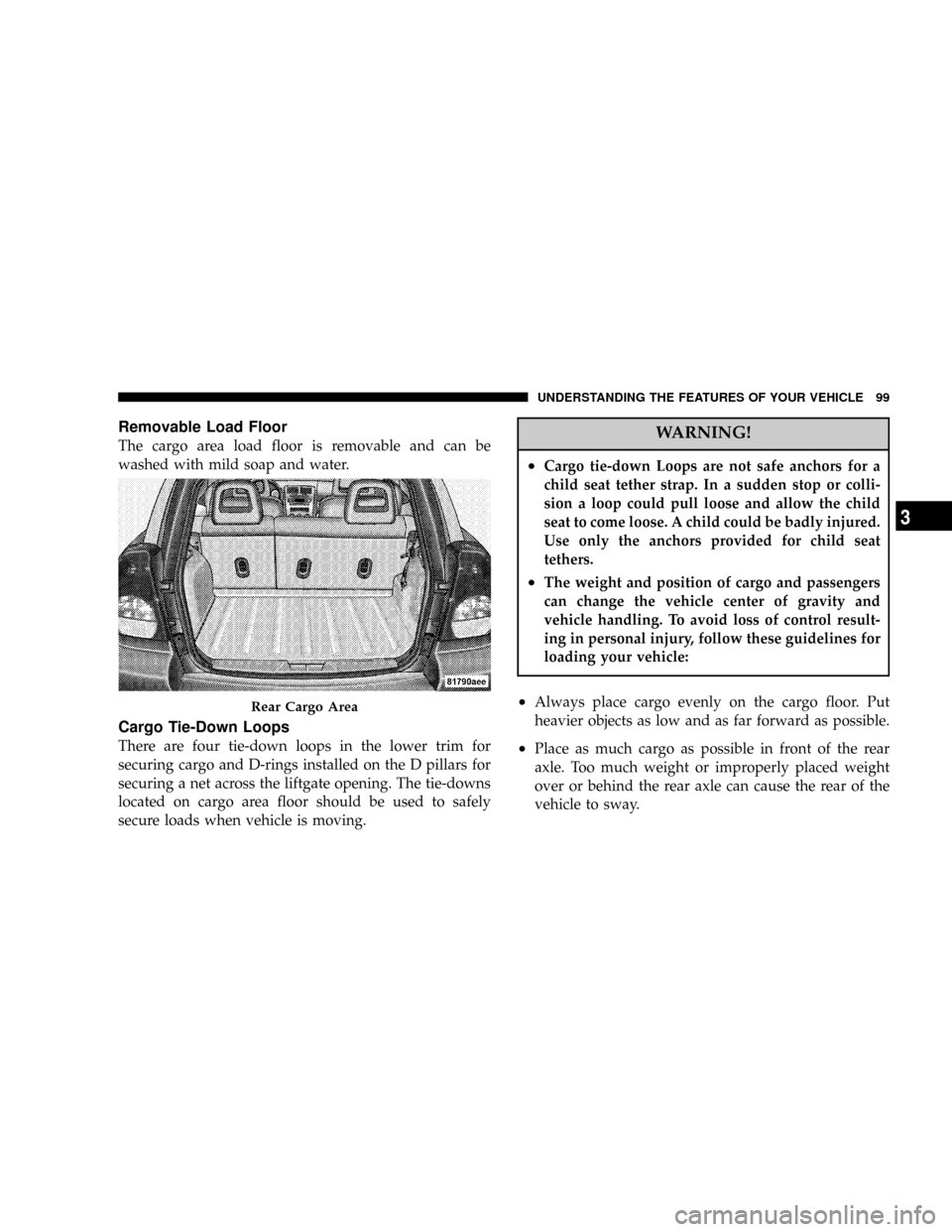
Removable Load Floor
The cargo area load floor is removable and can be
washed with mild soap and water.
Cargo Tie-Down Loops
There are four tie-down loops in the lower trim for
securing cargo and D-rings installed on the D pillars for
securing a net across the liftgate opening. The tie-downs
located on cargo area floor should be used to safely
secure loads when vehicle is moving.
WARNING!
²Cargo tie-down Loops are not safe anchors for a
child seat tether strap. In a sudden stop or colli-
sion a loop could pull loose and allow the child
seat to come loose. A child could be badly injured.
Use only the anchors provided for child seat
tethers.
²The weight and position of cargo and passengers
can change the vehicle center of gravity and
vehicle handling. To avoid loss of control result-
ing in personal injury, follow these guidelines for
loading your vehicle:
²Always place cargo evenly on the cargo floor. Put
heavier objects as low and as far forward as possible.
²Place as much cargo as possible in front of the rear
axle. Too much weight or improperly placed weight
over or behind the rear axle can cause the rear of the
vehicle to sway.
Rear Cargo Area
UNDERSTANDING THE FEATURES OF YOUR VEHICLE 99
3
Page 174 of 322
STARTING PROCEDURES
Before starting your vehicle, adjust your seat, adjust both
inside and outside mirrors, and fasten your seat belts.
CAUTION!
Long periods of engine idling, especially at high
engine speeds can cause excessive exhaust tempera-
tures which can damage your vehicle. Do not leave
your vehicle unattended with the engine running.
WARNING!
Do not leave children or animals inside parked
vehicles in hot weather. Interior heat build up may
cause serious injury or death.
Automatic Transaxle
The gear selector must be in the PARK or NEUTRAL
position before you can start the engine. Apply the brakes
before shifting to any driving gear.
NOTE:You must press the brake pedal before shifting
out of Park.
Manual Transaxle
Before starting the engine fully apply the parking brake,
press the clutch pedal to the floor and place the gear
selector in NEUTRAL.
NOTE:The engine will not start unless the clutch pedal
is pressed to the floor.
Normal Starting
Normal Starting of either a cold or a warm engine does
not require pumping or depressing the accelerator pedal.
Simply turn the ignition switch to the ªSTART'º position
and release when the engine starts. If the engine fails to
start within 15 seconds, turn the ignition switch to the
ªOFFº position, wait 10 to 15 seconds, then repeat the
normal starting procedure.
174 STARTING AND OPERATING
Page 310 of 322

Child Seat............................. 57
Clean Air Gasoline...................... 211
Cleaning
Wheels............................. 267
Climate Control........................ 164
Clock.......................128,131,137,148
Clutch............................... 262
Clutch Fluid........................... 262
Coin Holder........................... 96
Compact Disc (CD) Maintenance........... 163
Compact Spare Tire..................... 201
Compass............................. 127
Compass Calibration.................... 127
Compass Variance...................... 125
Console............................... 96
Contract, Service....................... 302
Coolant (Antifreeze)..................278,279
Cooler, Beverage....................... 103
Cooling System........................ 256
Adding Coolant (Antifreeze)............. 257
Coolant Level.....................256,259
Disposal of Used Coolant............... 258
Drain, Flush, and Refill................. 256Inspection........................... 259
Points to Remember................258,259
Pressure Cap........................ 258
Selection of Coolant (Antifreeze).......... 256
Corrosion Protection.................... 265
Crankcase Emission Control System......... 250
Cruise Light........................... 115
Cup Holder............................ 96
Customer Assistance.................... 300
Data Recorder, Event..................... 50
Dealer Service......................... 244
Defroster, Rear Window.................. 102
Defroster, Windshield..................61,165
Delay (Intermittent) Wipers................ 82
Diagnostic System, Onboard............... 242
Dimmer Switch, Headlight................. 80
Disposal
Antifreeze (Engine Coolant)............. 258
Engine Oil.......................... 248
Door Locks............................ 14
Door Locks, Automatic................... 16
Downshifting.......................... 182
310 INDEX