lock DODGE CALIBER 2010 1.G Owner's Manual
[x] Cancel search | Manufacturer: DODGE, Model Year: 2010, Model line: CALIBER, Model: DODGE CALIBER 2010 1.GPages: 484, PDF Size: 6.43 MB
Page 35 of 484
•For vehicles equipped with the EVIC, the power
window switches will remain active for up to 10 min-
utes after the ignition switch is turned to the LOCK
position. Opening either front door will cancel this
feature. The time for this feature is programmable.
Refer to “Electronic Vehicle Information Center
(EVIC)/Personal Settings (Customer-Programmable
Features)” in “Understanding Your Instrument Panel”
for further information.
WARNING!
Never leave children in a vehicle with the key in the
ignition switch. Occupants, particularly unattended
children, can become entrapped by the windows
while operating the power window switches. Such
entrapment may result in serious injury or death.
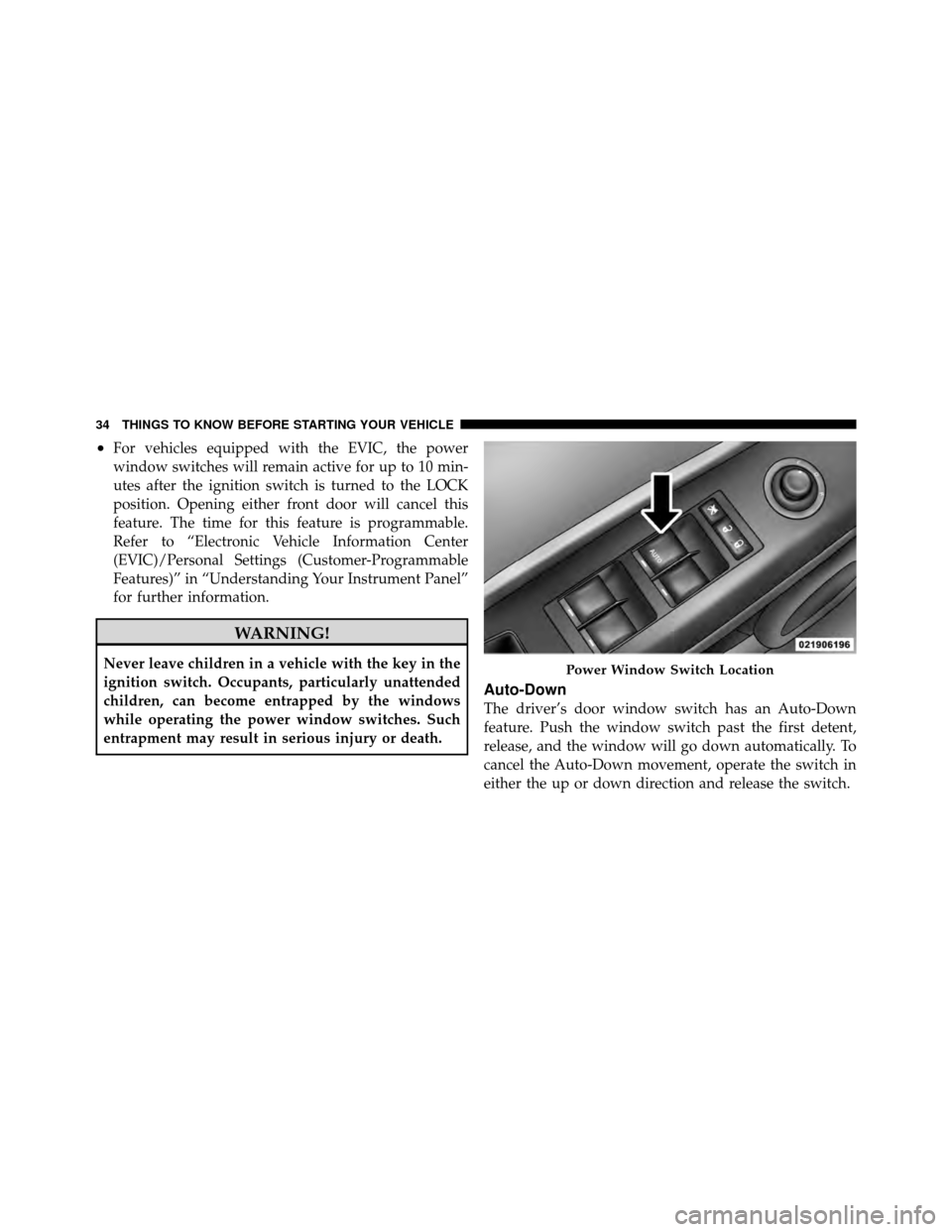
Auto-Down
The driver’s door window switch has an Auto-Down
feature. Push the window switch past the first detent,
release, and the window will go down automatically. To
cancel the Auto-Down movement, operate the switch in
either the up or down direction and release the switch.
Power Window Switch Location
34 THINGS TO KNOW BEFORE STARTING YOUR VEHICLE
Page 36 of 484
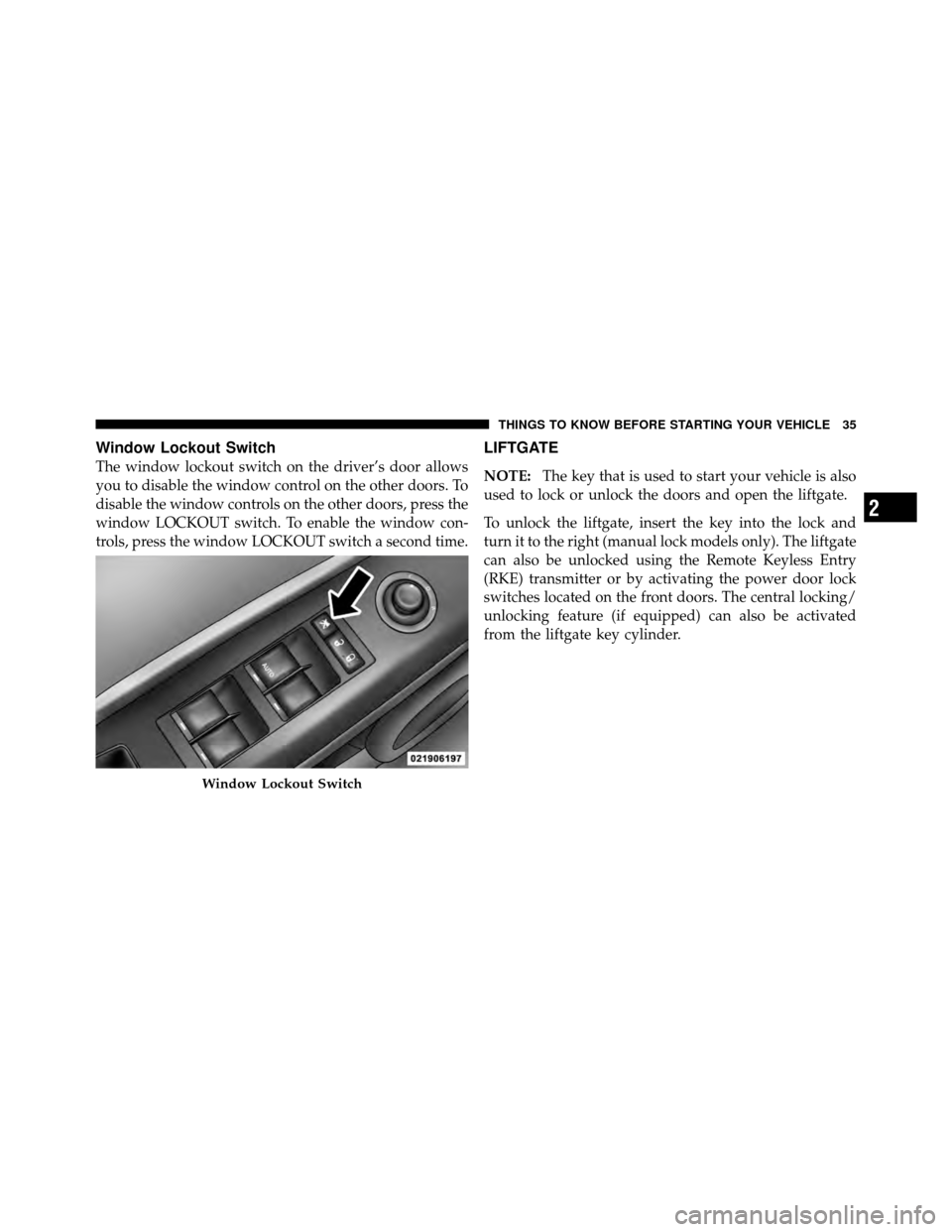
Window Lockout Switch
The window lockout switch on the driver’s door allows
you to disable the window control on the other doors. To
disable the window controls on the other doors, press the
window LOCKOUT switch. To enable the window con-
trols, press the window LOCKOUT switch a second time.
LIFTGATE
NOTE:The key that is used to start your vehicle is also
used to lock or unlock the doors and open the liftgate.
To unlock the liftgate, insert the key into the lock and
turn it to the right (manual lock models only). The liftgate
can also be unlocked using the Remote Keyless Entry
(RKE) transmitter or by activating the power door lock
switches located on the front doors. The central locking/
unlocking feature (if equipped) can also be activated
from the liftgate key cylinder.
Window Lockout Switch
2
THINGS TO KNOW BEFORE STARTING YOUR VEHICLE 35
Page 37 of 484
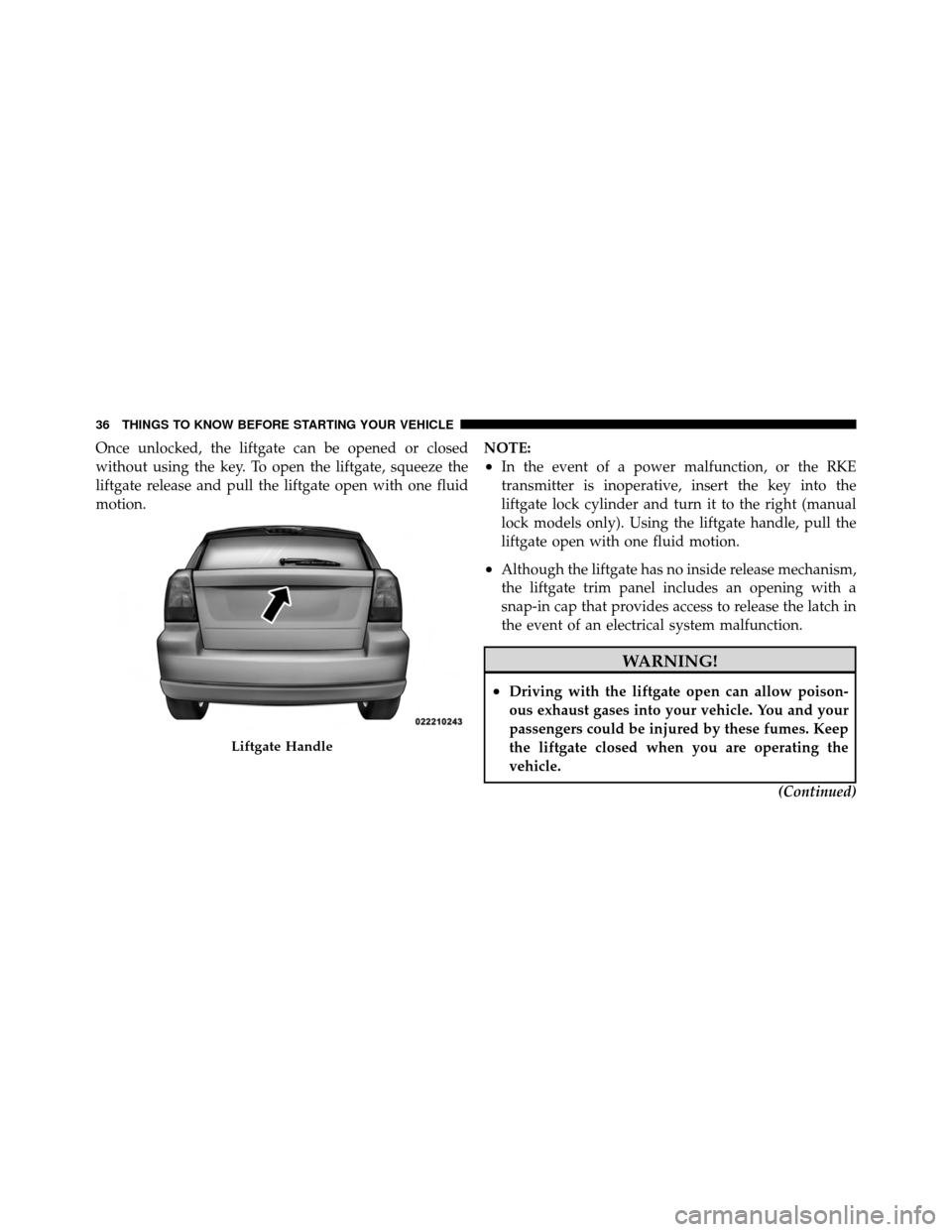
Once unlocked, the liftgate can be opened or closed
without using the key. To open the liftgate, squeeze the
liftgate release and pull the liftgate open with one fluid
motion.NOTE:
•In the event of a power malfunction, or the RKE
transmitter is inoperative, insert the key into the
liftgate lock cylinder and turn it to the right (manual
lock models only). Using the liftgate handle, pull the
liftgate open with one fluid motion.
•Although the liftgate has no inside release mechanism,
the liftgate trim panel includes an opening with a
snap-in cap that provides access to release the latch in
the event of an electrical system malfunction.
WARNING!
•Driving with the liftgate open can allow poison-
ous exhaust gases into your vehicle. You and your
passengers could be injured by these fumes. Keep
the liftgate closed when you are operating the
vehicle.
(Continued)
Liftgate Handle
36 THINGS TO KNOW BEFORE STARTING YOUR VEHICLE
Page 38 of 484
WARNING! (Continued)
•If you are required to drive with the liftgate open,
make sure that all windows are closed, and the
climate control blower switch is set at high speed.
DO NOT use the recirculation mode.
Gas props support the liftgate in the open position.
However, because the gas pressure drops with tempera-
ture, it may be necessary to assist the props when
opening the liftgate in cold weather.
OCCUPANT RESTRAINTS
Some of the most important safety features in your
vehicle are the restraint systems:
•Three-point lap and shoulder belts for all seating
positions
•Advanced Front Airbags for driver and front passen-
ger
•Supplemental Active Head Restraints (AHR) located
on top of the front seats (integrated into the head
restraint)
•Supplemental driver side knee airbag
•Supplemental Side Airbag Inflatable Curtains (SABIC)
for the driver and passengers seated next to a window
•Supplemental Seat-Mounted Side Airbags (SAB) — if
equipped
•An energy-absorbing steering column and steering
wheel
•Knee bolsters/blockers for front seat occupants
•Front seat belts incorporate pretensioners to enhance
occupant protection by managing occupant energy
during an impact event — if equipped
•All seat belt systems (except the driver’s) include
Automatic Locking Retractors (ALRs), which lock the
2
THINGS TO KNOW BEFORE STARTING YOUR VEHICLE 37
Page 40 of 484
ejection and the risk of injury caused by striking the
inside of the vehicle.Everyone in a motor vehicle should
be belted at all times.
Lap/Shoulder Belts
All the seating positions in your vehicle are equipped
with combination lap/shoulder belts.
The belt webbing retractor is designed to lock during
very sudden stops or collisions. This feature allows the
shoulder part of the belt to move freely with you under
normal conditions. However in a collision, the belt will
lock and reduce the risk of you striking the inside of the
vehicle or being thrown out.
WARNING!
•It is dangerous to ride in a cargo area, inside or
outside of a vehicle. In a collision, people riding in
these areas are more likely to be seriously injured
or killed.
•Do not allow people to ride in any area of your
vehicle that is not equipped with seats and seat
belts.
•Be sure everyone in your vehicle is in a seat and
using a seat belt properly.
•Wearing a seat belt incorrectly is dangerous. Seat
belts are designed to go around the large bones of
your body. These are the strongest parts of your
body and can take the forces of a collision the best.
(Continued)
2
THINGS TO KNOW BEFORE STARTING YOUR VEHICLE 39
Page 45 of 484
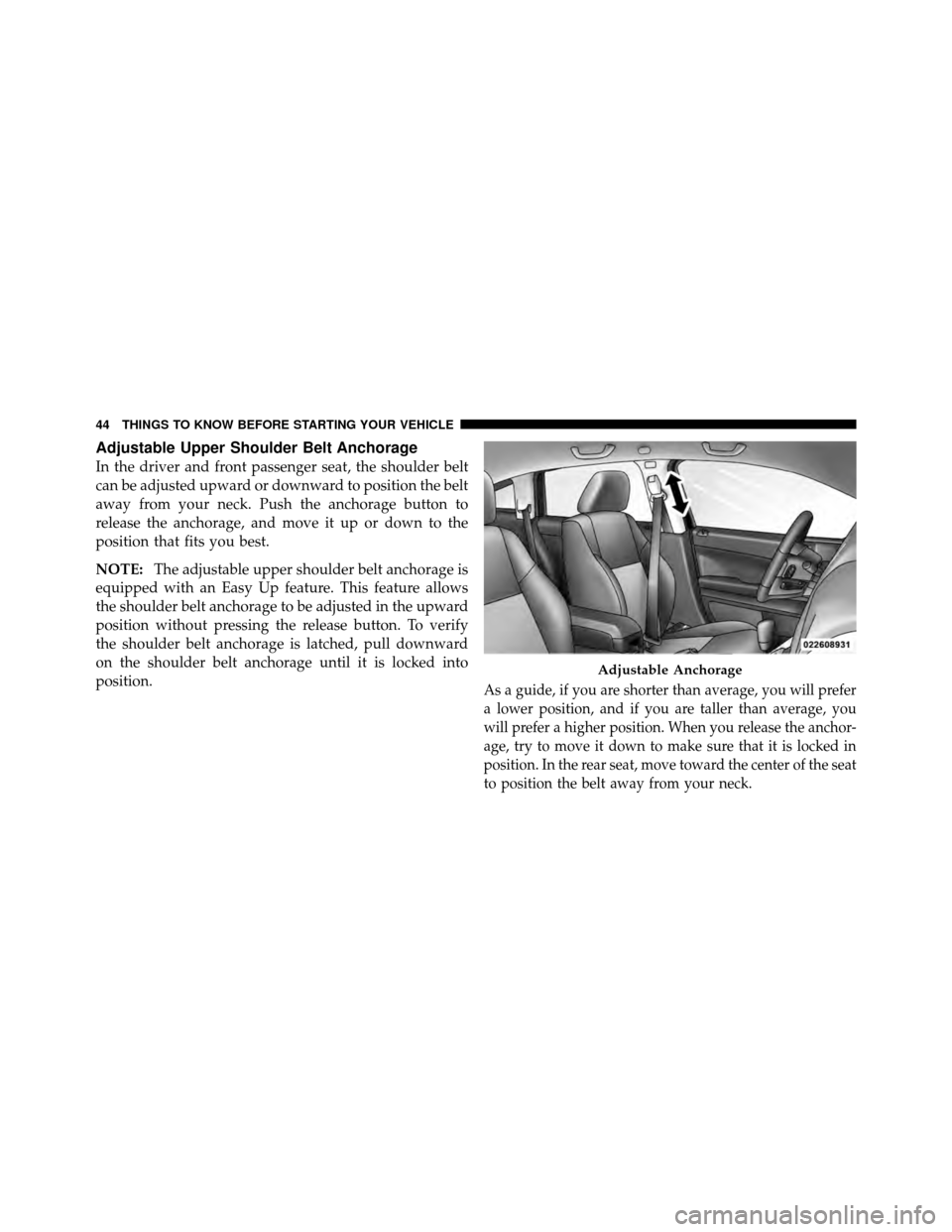
Adjustable Upper Shoulder Belt Anchorage
In the driver and front passenger seat, the shoulder belt
can be adjusted upward or downward to position the belt
away from your neck. Push the anchorage button to
release the anchorage, and move it up or down to the
position that fits you best.
NOTE:The adjustable upper shoulder belt anchorage is
equipped with an Easy Up feature. This feature allows
the shoulder belt anchorage to be adjusted in the upward
position without pressing the release button. To verify
the shoulder belt anchorage is latched, pull downward
on the shoulder belt anchorage until it is locked into
position.
As a guide, if you are shorter than average, you will prefer
a lower position, and if you are taller than average, you
will prefer a higher position. When you release the anchor-
age, try to move it down to make sure that it is locked in
position. In the rear seat, move toward the center of the seat
to position the belt away from your neck.
Adjustable Anchorage
44 THINGS TO KNOW BEFORE STARTING YOUR VEHICLE
Page 49 of 484
10. To disengage the mini-latch from the mini-buckle for
storage, insert the regular latch plate into the black
button on the top of the mini-buckle. The belt will
automatically retract to its stowed position. If necessary,
slide the latch plate down the webbing to allow the belt
to retract fully. Insert the mini-latch plate into the slot
provided in the trim panel.
Lap/Shoulder Belt Untwisting Procedure
Use the following procedure to untwist a twisted lap/
shoulder belt.
1. Position the latch plate as close as possible to the
anchor point.
2. At about 6 to 12 in (15 to 30 cm) above the latch plate,
grasp and twist the belt webbing 180 degrees to create a
fold that begins immediately above the latch plate.3. Slide the latch plate upward over the folded webbing.
The folded webbing must enter the slot at the top of the
latch plate.
4. Continue to slide the latch plate up until it clears the
folded webbing.
Automatic Locking Retractors (ALR) Mode — If
Equipped
In this mode, the shoulder belt is automatically pre-
locked. However, the belt will still retract to remove slack
in the shoulder belt. Use the Automatic Locking Mode
any time a child safety seat is installed in a seating
position that has a seat belt with this feature. Children
12 years old and under should be properly restrained in
the rear seat.
48 THINGS TO KNOW BEFORE STARTING YOUR VEHICLE
Page 50 of 484
When To Engage The Automatic Locking Mode
Use the Automatic Locking Mode anytime a child safety
seat is installed in a seating position that has a belt with
this feature. Children 12 years old and under should
always be properly restrained in the rear seat.
How To Engage The Automatic Locking Mode
1. Buckle the combination lap and shoulder belt.
2. Grasp the shoulder portion and pull downward until
the entire belt is extracted.
3. Allow the belt to retract. As the belt retracts, you will
hear a clicking sound. This indicates the safety belt is
now in the Automatic Locking Mode.
How To Disengage The Automatic Locking Mode
Unbuckle the combination lap and shoulder belt and
allow it to retract completely to disengage the Automatic
Locking mode and activate the vehicle sensitive (emer-
gency) locking mode.
Seat Belts In Passenger Seating Positions
The seat belts in the passenger seating positions are
equipped with an Automatic Locking Retractor (ALR)
which are used to secure a child restraint system. For
additional information refer to “Installing Child Re-
straints Using the Vehicle Seat Belt” under the “Child
Restraints” section. The chart below defines the type of
feature for each seating position.
Left Center Right
First Row ALR
Second Row ALR ALR ALR Third Row
If the passenger seating position is equipped with an
ALR and is being used for normal usage:
Only pull the belt webbing out far enough to comfortably
wrap around the occupants mid-section so as to not
activate the ALR. If the ALR is activated you will hear a
ratcheting sound as the belt retracts. Allow the webbing
2
THINGS TO KNOW BEFORE STARTING YOUR VEHICLE 49
Page 52 of 484
WARNING!
•The belt and retractor assembly must be replaced
if the seat belt assembly Automatic Locking Re-
tractor (ALR) feature or any other seat belt func-
tion is not working properly when checked ac-
cording to the procedures in the Service Manual.
•Failure to replace the belt and retractor assembly
could increase the risk of injury in collisions.
Supplemental Active Head Restraints (AHR)
These head restraints are passive, deployable compo-
nents, and vehicles with this equipment cannot be readily
identified by any markings, only through visual inspec-
tion of the head restraint. The head restraint will be split
in two halves, with the front half being soft foam and
trim, the back half being decorative plastic.How the Active Head Restraints (AHR) Work
The Occupant Restraint Controller (ORC) determines
whether the severity, or type of rear impact will require
the Active Head Restraints (AHR) to deploy. If a rear
impact requires deployment, both the driver and front
passenger seat AHRs will be deployed.
When AHRs deploy during a rear impact, the front half
of the head restraint extends forward to minimize the gap
between the back of the occupant’s head and the AHR.
This system is designed to help prevent or reduce the
extent of injuries to the driver and front passenger in
certain types of rear impacts.
NOTE:
The Active Head Restraints (AHR) may or may
not deploy in the event of a front or side impact.
However if during a front impact, a secondary rear
impact occurs, the AHR may deploy based on the sever-
ity and type of the impact.
2
THINGS TO KNOW BEFORE STARTING YOUR VEHICLE 51
Page 54 of 484
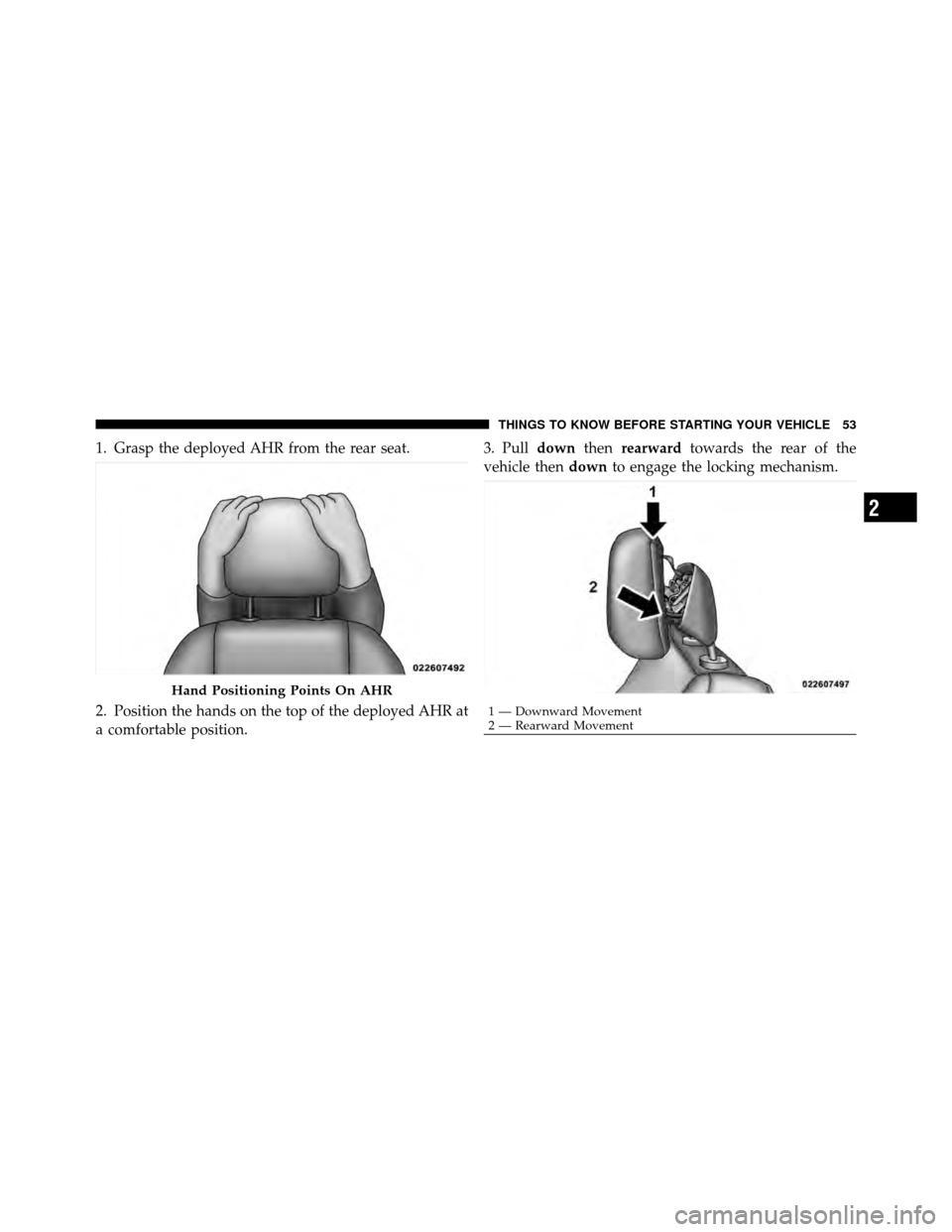
1. Grasp the deployed AHR from the rear seat.
2. Position the hands on the top of the deployed AHR at
a comfortable position.3. Pull
downthenrearward towards the rear of the
vehicle then downto engage the locking mechanism.
Hand Positioning Points On AHR
1 — Downward Movement
2 — Rearward Movement
2
THINGS TO KNOW BEFORE STARTING YOUR VEHICLE 53