flat tire DODGE CALIBER 2011 1.G Owner's Manual
[x] Cancel search | Manufacturer: DODGE, Model Year: 2011, Model line: CALIBER, Model: DODGE CALIBER 2011 1.GPages: 486, PDF Size: 2.88 MB
Page 348 of 486
The TPMS consists of the following components:
•Receiver Module
•Four Tire Pressure Monitoring Sensors
•Three Trigger Modules (mounted in three of the four
wheel wells)
•Various Tire Pressure Monitoring System Messages,
which display in the Electronic Vehicle Information
Center (EVIC)
•Tire Pressure Monitoring Telltale Light
Tire Pressure Monitoring Low Pressure Warnings
The Tire Pressure Monitoring Telltale Light will illumi-
nate in the instrument cluster and an audible chime will
be activated when one or more of the four active road tire
pressures are low. The audible chime will sound once
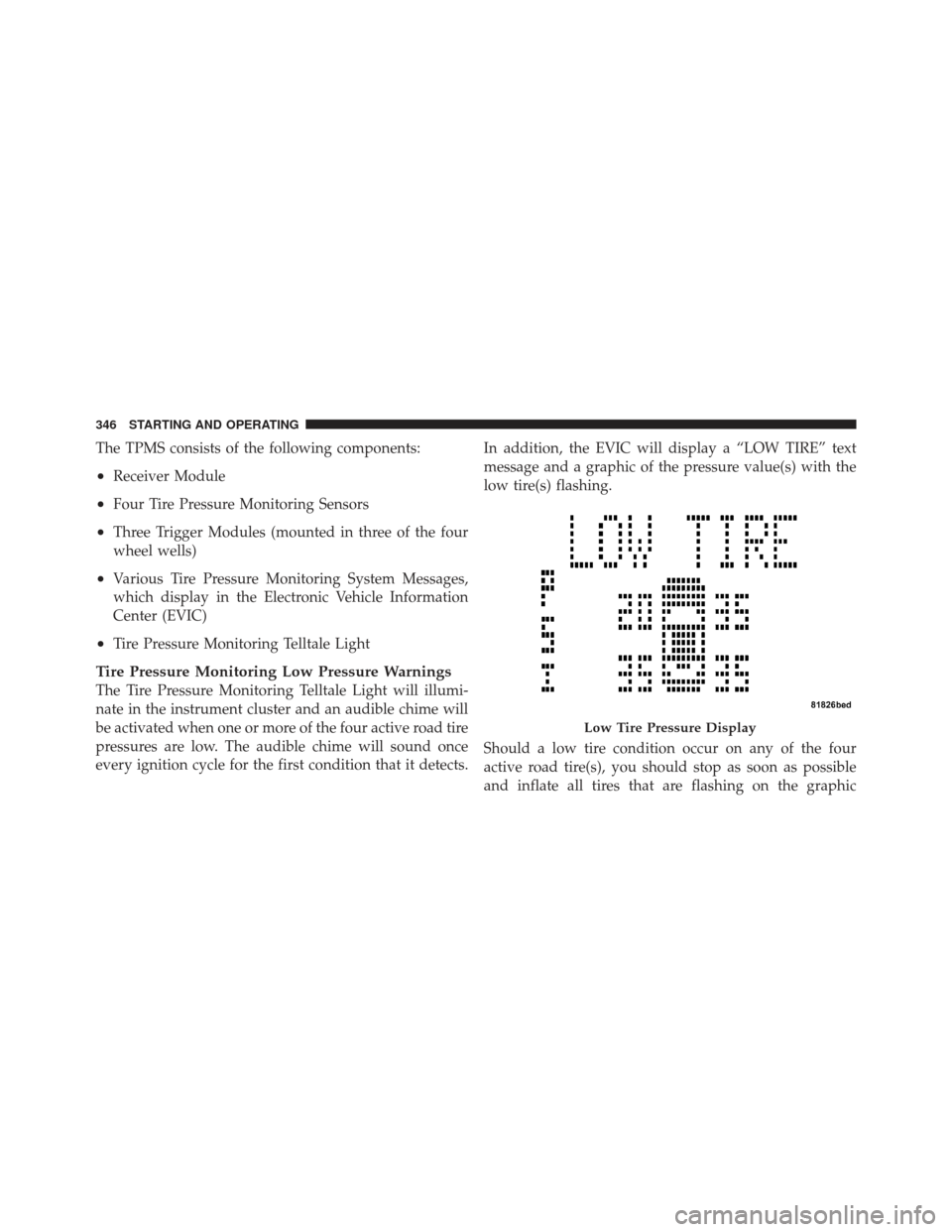
every ignition cycle for the first condition that it detects.In addition, the EVIC will display a “LOW TIRE” text
message and a graphic of the pressure value(s) with the
low tire(s) flashing.
Should a low tire condition occur on any of the four
active road tire(s), you should stop as soon as possible
and inflate all tires that are flashing on the graphic
Low Tire Pressure Display
346 STARTING AND OPERATING
Page 359 of 486
Gross Vehicle Weight Rating (GVWR)
The GVWR is the total allowable weight of your vehicle.
This includes driver, passengers, and cargo. The total
load must be limited so that you do not exceed the
GVWR.
Tire Size
The tire size on the Vehicle Certification Label represents
the actual tire size on your vehicle. Replacement tires
must be equal to the load capacity of this tire size.
Rim Size
This is the rim size that is appropriate for the tire size
listed.
Inflation Pressure
This is the cold tire inflation pressure for your vehicle, for
all loading conditions.
Curb Weight
The curb weight of a vehicle is defined as the total weight
of the vehicle with all fluids, including vehicle fuel, at full
capacity conditions, and with no occupants or cargo
loaded into the vehicle. The front and rear curb weight
values are determined by weighing your vehicle on a
commercial scale before any occupants or cargo are
added.
Overloading
The load carrying components (springs, tires, wheels,
etc.) of your vehicle will provide satisfactory service as
long as you do not exceed the GVWR.
The best way to figure out the total weight of your
vehicle is to weigh it when it is fully loaded and ready for
operation. Weigh it on a commercial scale to ensure that
it is not over the GVWR.5
STARTING AND OPERATING 357
Page 368 of 486
Towing Requirements – Tires
Do not attempt to tow a trailer while using a compact
spare tire.
Proper tire inflation pressures are essential to the safe
and satisfactory operation of your vehicle. Refer to
“Tires – General Information” in “Starting and Oper-
ating” for proper tire inflation procedures.
Check the trailer tires for proper tire inflation pres-
sures before trailer usage.
Check for signs of tire wear or visible tire damage
before towing a trailer. Refer to “Tires – General
Information” in “Starting and Operating” for the
proper inspection procedure.
When replacing tires, refer to “Tires – General Infor-
mation” in “Starting and Operating” for proper tirereplacement procedures. Replacing tires with a higher
load carrying capacity will not increase the vehicle’s
GVWR and GAWR limits.
Towing Requirements – Trailer Brakes
Do
not interconnect the hydraulic brake system or
vacuum system of your vehicle with that of the trailer.
This could cause inadequate braking and possible
personal injury.
An electronically actuated trailer brake controller is
required when towing a trailer with electronically
actuated brakes. When towing a trailer equipped with
a hydraulic surge actuated brake system, an electronic
brake controller is not required.
Trailer brakes are recommended for trailers over
1,000 lbs (450 kg) and required for trailers in excess of
2,000 lbs (907 kg).
366 STARTING AND OPERATING
Page 379 of 486
WARNING! (Continued)
•If working on or near a roadway, be extremely
careful of motor traffic.
•To assure that spare tires, flat or inflated, are
securely stowed, spares must be stowed with the
valve stem facing the ground.
CAUTION!
Do not attempt to raise the vehicle by jacking on
locations other than those indicated in the Jacking
Instructions for this vehicle.
NOTE: Refer to “Tires — General Information” in
“Starting And Operating” for further information about
the spare tire, it’s use, and operation.
1. Remove the scissors jack and lug wrench from the
spare wheel as an assembly. Turn the jack screw to the left
to loosen the lug wrench and remove the wrench from
the jack assembly.
2. Loosen, but do not remove, the wheel nuts by turning
them to the left one turn while the wheel is still on the
ground.
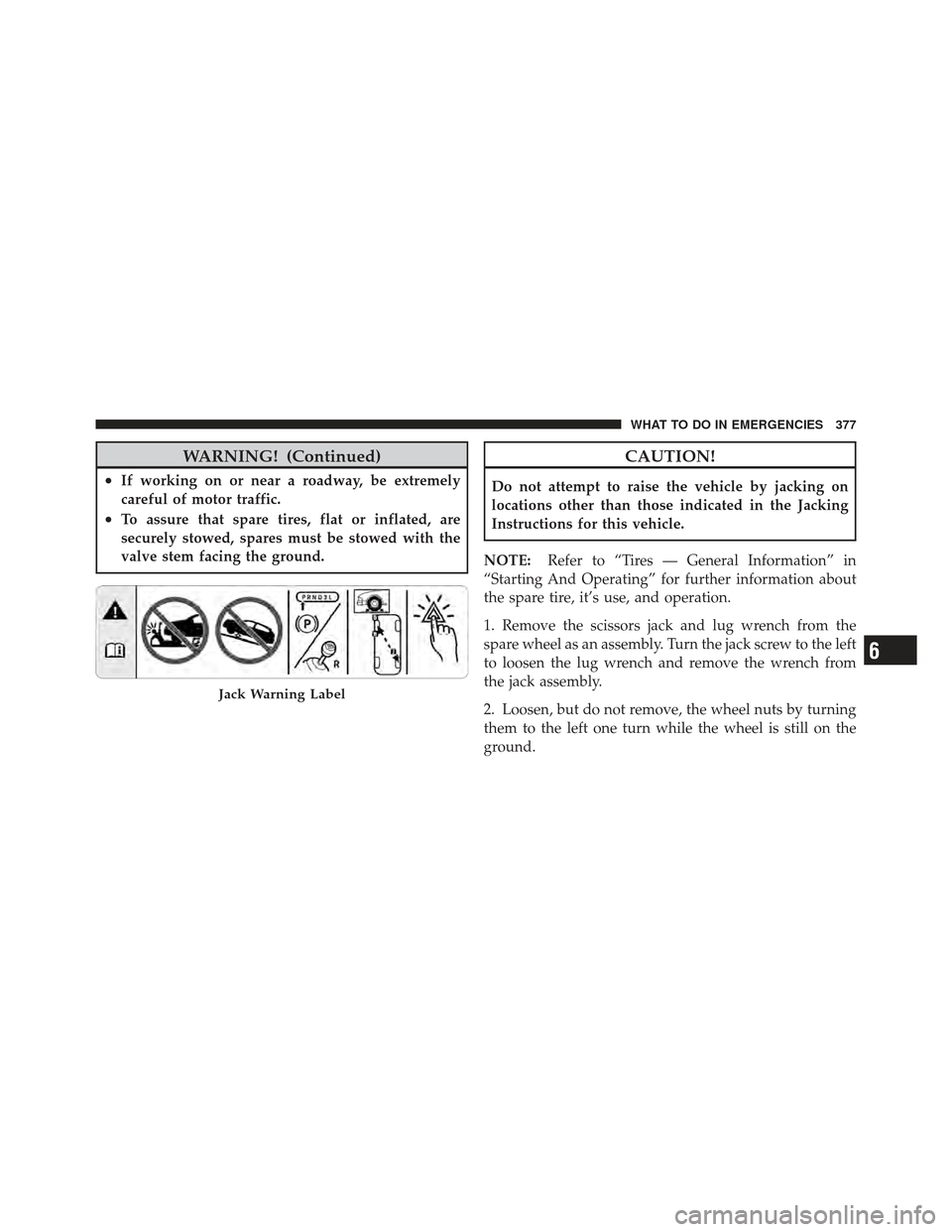
Jack Warning Label
6
WHAT TO DO IN EMERGENCIES 377
Page 383 of 486
8. Remove the wheel blocks and lower the jack until it is
free. Reassemble the lug wrench to the jack assembly and
stow it in the spare tire area. Secure the assembly using
the means provided.
WARNING!
A loose tire or jack thrown forward in a collision or
hard stop could endanger the occupants of the ve-
hicle. Always stow the jack parts and the spare tire in
the places provided.
9. Place the deflated (flat) tire in the cargo area, have the
tire repaired or replaced as soon as possible.
WARNING!
A loose tire thrown forward in a collision or hard
stop could injure the occupants in the vehicle. Have
the deflated (flat) tire repaired or replaced immedi-
ately.
10. Check the spare tire pressure as soon as possible.
Correct the tire pressure as required.
JUMP-STARTING PROCEDURES
If your vehicle has a discharged battery it can be jump-
started using a set of jumper cables and a battery in
another vehicle or by using a portable battery booster
pack. Jump-starting can be dangerous if done improperly
so please follow the procedures in this section carefully.
NOTE: When using a portable battery booster pack
follow the manufacturer ’s operating instructions and
precautions.6
WHAT TO DO IN EMERGENCIES 381
Page 466 of 486
Temperature Grades
The temperature grades are A (the highest), B, and C,
representing the tire’s resistance to the generation of heat
and its ability to dissipate heat, when tested under
controlled conditions on a specified indoor laboratory
test wheel. Sustained high temperature can cause the
material of the tire to degenerate and reduce tire life, and
excessive temperature can lead to sudden tire failure. The
grade C corresponds to a level of performance, which all
passenger car tires must meet under the Federal Motor
Vehicle Safety Standard No. 109. Grades B and A repre-
sent higher levels of performance on the laboratory test
wheel, than the minimum required by law.WARNING!
The temperature grade for this tire is established for
a tire that is properly inflated and not overloaded.
Excessive speed, under-inflation, or excessive load-
ing, either separately or in combination, can cause
heat buildup and possible tire failure.
464 IF YOU NEED CONSUMER ASSISTANCE
Page 470 of 486
Cargo CompartmentLight ............................. 175
Cargo Light ............................ 175
Cargo Load Floor ........................ 178
Cargo Tie-Downs ........................ 179
Cellular Phone ........................ 97,274
Center High Mounted Stop Light ............ 434
Chains, Tire ............................ 339
Changing A Flat Tire ..................... 374
Chart, Tire Sizing ........................ 322
Check Engine Light
(Malfunction Indicator Light) .............202,396
Checking Your Vehicle For Safety ............. 84
Checks, Safety ........................... 84
Child Restraint .......................... 74
Child Restraint Tether Anchors ............... 78
Child Safety Locks ........................ 31
Child Seat .............................. 79
Clean Air Gasoline ....................... 350 Cleaning
Wheels ............................ 421
Climate Control ......................... 274
Clock ........................... 218,237,246
Clutch ............................... 415
Clutch Fluid ........................... 415
Coin Holder ........................... 174
Compact Disc (CD) Maintenance ............. 273
Compact Spare Tire ...................... 334
Connector UCI ........................... 260,265
Universal Consumer Interface (UCI) ....260,265
Console .............................. 174
Contract, Service ........................ 459
Coolant (Antifreeze) ................... 435,436
Cooler, Beverage ........................ 182
Cooling System ......................... 409
Adding Coolant (Antifreeze) ............. 411
Coolant Level .................... 410,413
468 INDEX
Page 482 of 486
Synthetic Engine Oil...................... 401
System, Remote Starting .................... 24
Tachometer ............................ 195
Taillights .............................. 431
Temperature Control, Automatic (ATC) ........ 279
Temperature Gauge, Engine Coolant .......191,373
Tether Anchor, Child Restraint ............... 78
Theft Alarm (Security Alarm) ................ 17
Theft System (Security Alarm) ............... 17
Tie Down Hooks, Cargo ................... 179
Tilt Steering Column ..................... 154
Tire and Loading Information Placard ......... 326
Tire Identification Number (TIN) ............. 324
Tire Markings .......................... 320
Tire Safety Information .................... 320
Tires ............................ 88,330,463
Aging (Life of Tires) .................. 337
Air Pressure ........................ 330 Chains
............................ 339
Changing .......................... 374
Compact Spare ...................... 334
General Information .................. 330
High Speed ......................... 333
Inflation Pressures .................... 331
Jacking ............................ 374
Life of Tires ........................ 337
Load Capacity .................... 326,327
Pressure Monitor System (TPMS) ......... 341
Pressure Warning Light ................ 201
Quality Grading ..................... 463
Radial ............................ 333
Replacement ........................ 338
Rotation ........................... 340
Safety .......................... 320,330
Sizes ............................. 322
Snow Tires ......................... 339
Spare Tire .......................... 375
480 INDEX