child restraint DODGE CALIBER 2012 1.G User Guide
[x] Cancel search | Manufacturer: DODGE, Model Year: 2012, Model line: CALIBER, Model: DODGE CALIBER 2012 1.GPages: 506, PDF Size: 3.03 MB
Page 82 of 506
•The restraint must be appropriate for your child’s
weight and height. Check the label on the restraint for
weight and height limits.
•Carefully follow the instructions that come with the
restraint. If you install the restraint improperly, it may
not work when you need it.
NOTE: For additional information, refer to
www.seatcheck.org or call 1–866–SEATCHECK. Cana-
dian residents should refer to Transport Canada’s web-
site for additional information: http://www.tc.gc.ca/
roadsafety/safedrivers/childsafety/index.htm
Lower Anchors and Tether for CHildren (LATCH)
Your vehicle is equipped with the child restraint anchor-
age system called LATCH, which stands for Lower
Anchors and Tether for CHildren. The LATCH system
provides for the installation of the child restraint without
using the vehicle seat belt, instead securing the child restraint using lower anchorages and upper tether straps
from the child restraint to the vehicle structure.
LATCH-compatible child restraint systems are now avail-
able. However, because the lower anchorages are to be
introduced over a period of years, child restraint systems
having attachments for those anchorages will continue to
have features for installation using the vehicle’s seat
belts. Child restraints having tether straps and hooks for
connection to the top tether anchorages have been avail-
able for some time. For some older child restraints, many
child restraint manufacturers offer add-on tether strap
kits or retrofit kits. You are urged to take advantage of all
the available attachments provided with your child re-
straint in any vehicle.
Child seats with fixed lower attachments must be in-
stalled in the outboard positions only. If you are installing
LATCH-compatible child restraints in adjacent rear seat-
ing positions, you can use the LATCH anchors or the
80 THINGS TO KNOW BEFORE STARTING YOUR VEHICLE
Page 83 of 506
vehicle’s seat belt for the outboard position, but you must
use the vehicle’s seat belt at the center position. If your
child restraints are not LATCH-compatible, you can only
install the child restraints using the vehicle’s seat belts.
Please refer to “Installing The Child Restraint System” for
typical installation instructions.
WARNING!
You should never install LATCH-compatible child
seats so that two seats share a common anchorage. If
installing seats in adjacent seating positions, or if
your child restraints are not LATCH-compatible, in-
stall the restraints using the vehicle’s seat belts.
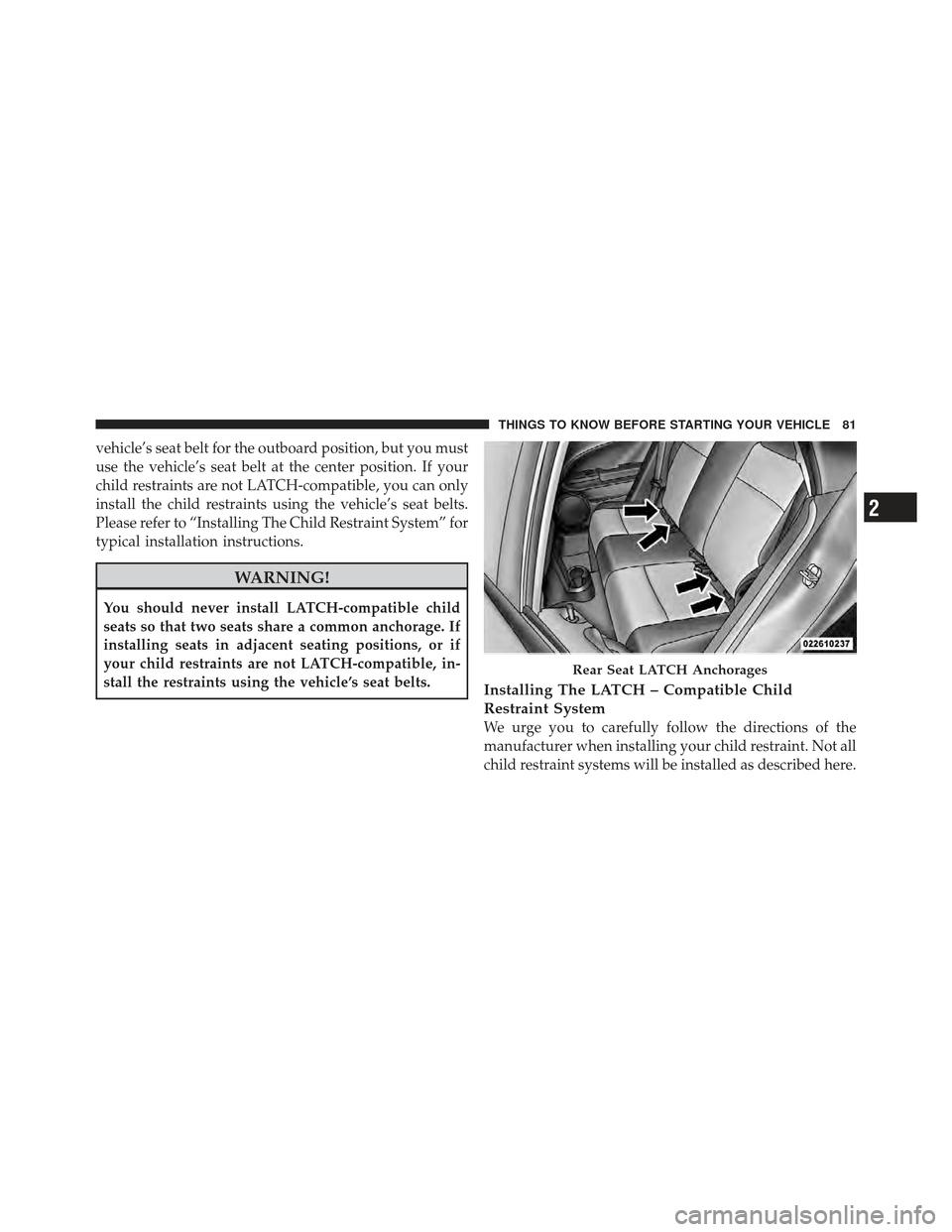
Installing The LATCH – Compatible Child
Restraint System
We urge you to carefully follow the directions of the
manufacturer when installing your child restraint. Not all
child restraint systems will be installed as described here.
Rear Seat LATCH Anchorages
2
THINGS TO KNOW BEFORE STARTING YOUR VEHICLE 81
Page 84 of 506
Again, carefully follow the installation instructions that
are provided with the child restraint system.The lower anchorages are round bars, part of
the seat and body structure, and are readily
visible. In addition, there are tether strap an-
chorages behind each rear seating position,
located in the rear surface of the seat back.
These are round bars, located at the rear of the seat
cushion where it meets the seat back, and just visible
when you lean into the rear seat to install the child
restraint. You will easily feel them if you run your finger
along the intersection of the surfaces
The lower strap hooks are passed over the top of each
bar, pushing aside the seat cover material
Many, but not all, restraint systems will be
equipped with separate straps on each side,
with each having a hook or connector for attachment to the lower anchorage and a means of
adjusting the tension in the strap. Forward-facing toddler
restraints and some rear-facing infant restraints will also
be equipped with a tether strap, a hook for attachment to
the tether strap anchorage and a means of adjusting the
tension of the strap.
While there are LATCH anchorages at all three rear
seating positions, do not install child restraints at all three
positions at the same time. The anchorages are not
designed to restrain three child restraints at one time.
Instead, you may install one child restraint at the center
position, or two child restraints at the right and left
positions.
You will first loosen the child seat adjusters on the lower
straps and on the tether strap so that you can more easily
attach the hook or connectors to the vehicle anchorages.
Next, attach the lower hooks or connectors over the top
of the seat cover material. Then attach the tether strap to
82 THINGS TO KNOW BEFORE STARTING YOUR VEHICLE
Page 85 of 506
the anchorage directly behind the seat where you are
placing the child restraint, being careful to route the
tether strap to provide the most direct path between the
anchor and the child restraint, preferably between the
head restraint posts underneath the head restraint. Fi-
nally, tighten all three straps as you push the child
restraint rearward and downward into the seat, remov-
ing slack in the straps according to the child restraint
manufacturer ’s instructions.
NOTE:
•Ensure that the tether strap does not slip into the
opening between the seatbacks as you remove the
slack in the strap.
•When using the LATCH attaching system to install a
child restraint, please ensure that all seat belts not
being used for occupant restraints are stowed and out
of reach of children. It is recommended that before
installing the child restraint, buckle the seat belt so theseat belt is tucked behind the child restraint. This
should stow the seat belt out of the reach of an
inquisitive child. Remind all children in the vehicle
that the seat belts are not toys and that they should not
play with them. In addition, never leave unattended
children in the vehicle.
WARNING!
Improper installation of a child restraint to the
LATCH anchorages can lead to failure of an infant or
child restraint. The child could be badly injured or
killed. Follow the manufacturer’s directions exactly
when installing an infant or child restraint.
Installing Child Restraints Using The Vehicle Seat
Belt
The seat belts in the passenger seating positions are
equipped with an Automatic Locking Retractor (ALR) to
secure a Child Restraint System (CRS). These types of
2
THINGS TO KNOW BEFORE STARTING YOUR VEHICLE 83
Page 86 of 506
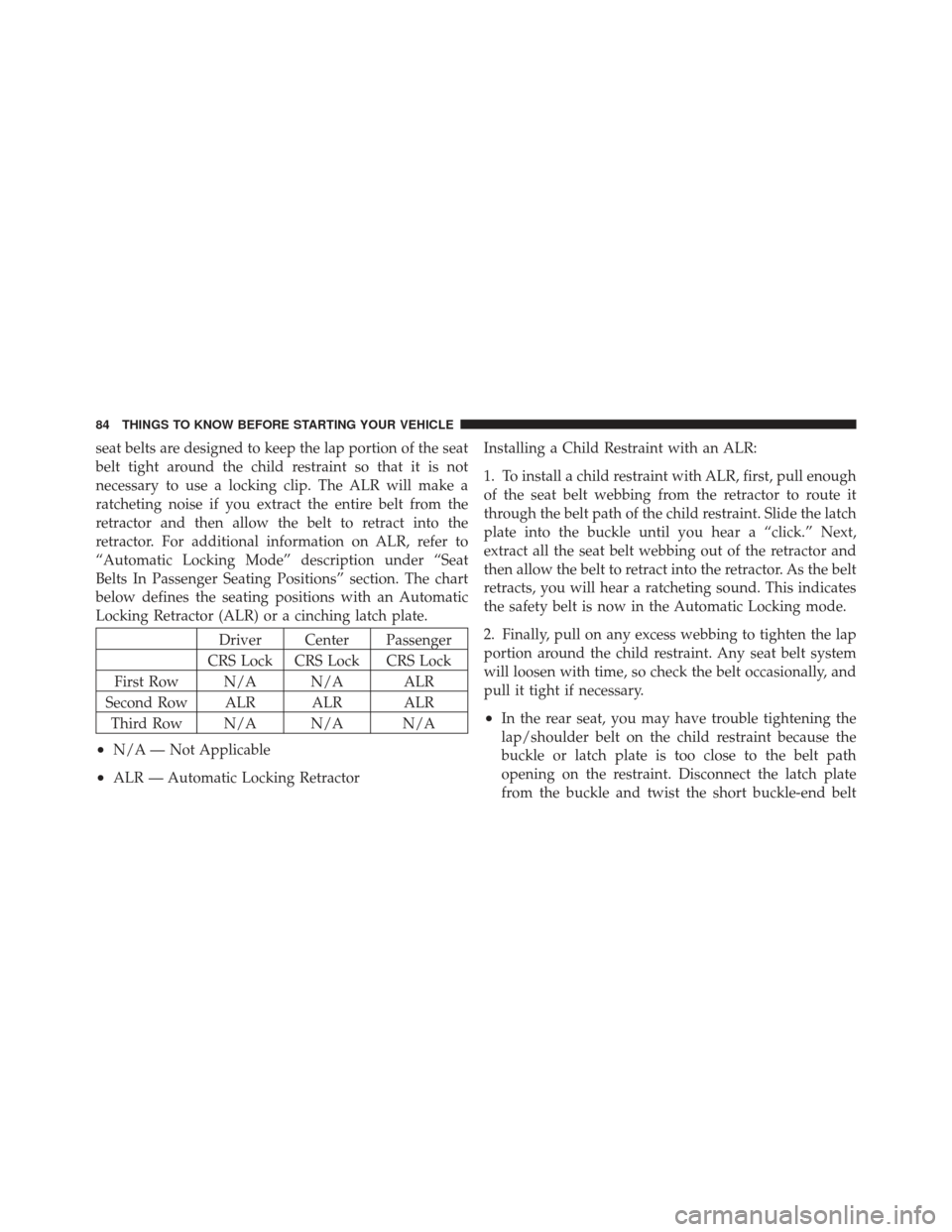
seat belts are designed to keep the lap portion of the seat
belt tight around the child restraint so that it is not
necessary to use a locking clip. The ALR will make a
ratcheting noise if you extract the entire belt from the
retractor and then allow the belt to retract into the
retractor. For additional information on ALR, refer to
“Automatic Locking Mode” description under “Seat
Belts In Passenger Seating Positions” section. The chart
below defines the seating positions with an Automatic
Locking Retractor (ALR) or a cinching latch plate.
Driver Center Passenger
CRS Lock CRS Lock CRS Lock
First Row N/A N/A ALR
Second Row ALR ALR ALR Third Row N/A N/A N/A
•N/A — Not Applicable
•ALR — Automatic Locking Retractor Installing a Child Restraint with an ALR:
1. To install a child restraint with ALR, first, pull enough
of the seat belt webbing from the retractor to route it
through the belt path of the child restraint. Slide the latch
plate into the buckle until you hear a “click.” Next,
extract all the seat belt webbing out of the retractor and
then allow the belt to retract into the retractor. As the belt
retracts, you will hear a ratcheting sound. This indicates
the safety belt is now in the Automatic Locking mode.
2. Finally, pull on any excess webbing to tighten the lap
portion around the child restraint. Any seat belt system
will loosen with time, so check the belt occasionally, and
pull it tight if necessary.
•In the rear seat, you may have trouble tightening the
lap/shoulder belt on the child restraint because the
buckle or latch plate is too close to the belt path
opening on the restraint. Disconnect the latch plate
from the buckle and twist the short buckle-end belt
84 THINGS TO KNOW BEFORE STARTING YOUR VEHICLE
Page 87 of 506
several times to shorten it. Insert the latch plate into
the buckle with the release button facing out.
•If the belt still can’t be tightened, or if pulling and
pushing on the restraint loosens the belt, disconnect
the latch plate from the buckle, turn the buckle
around, and insert the latch plate into the buckle
again. If you still can’t make the child restraint secure,
try a different seating position.
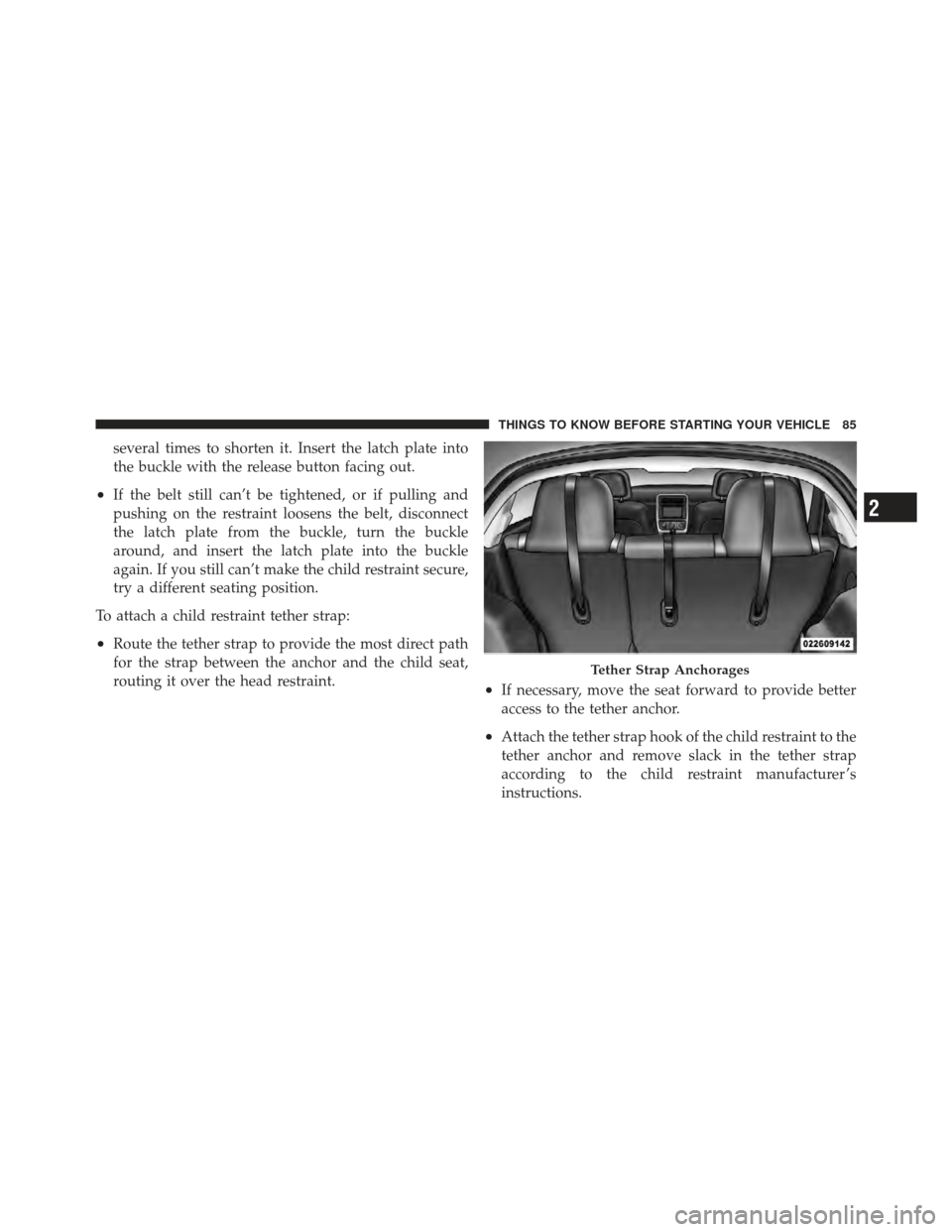
To attach a child restraint tether strap:
•Route the tether strap to provide the most direct path
for the strap between the anchor and the child seat,
routing it over the head restraint.
•If necessary, move the seat forward to provide better
access to the tether anchor.
•Attach the tether strap hook of the child restraint to the
tether anchor and remove slack in the tether strap
according to the child restraint manufacturer ’s
instructions.
Tether Strap Anchorages
2
THINGS TO KNOW BEFORE STARTING YOUR VEHICLE 85
Page 88 of 506
NOTE:Ensure that the tether strap does not slip into the
opening between the seatbacks as you remove slack in
the strap.
WARNING!
An incorrectly anchored tether strap could lead to
increased head motion and possible injury to the
child. Use only the anchor position directly behind
the child seat to secure a child restraint top tether
strap.
Transporting Pets
Air Bags deploying in the front seat could harm your pet.
An unrestrained pet will be thrown about and possibly
injured, or could injure a passenger during panic braking
or in a collision.
Pets should be restrained in the rear seat in pet harnesses
or pet carriers that are secured by seat belts.
ENGINE BREAK-IN RECOMMENDATIONS
A long break-in period is not required for the engine and
drivetrain (transmission and axle) in your vehicle.
Drive moderately during the first 300 miles (500 km).
After the initial 60 miles (100 km), speeds up to 50 or
55 mph (80 or 90 km/h) are desirable.
While cruising, brief full-throttle acceleration within the
limits of local traffic laws contributes to a good break-in.
Wide-open throttle acceleration in low gear can be detri-
mental and should be avoided.
The engine oil installed in the engine at the factory is a
high-quality energy conserving type lubricant. Oil
changes should be consistent with anticipated climate
conditions under which vehicle operations will occur. For
the recommended viscosity and quality grades, refer to
“Maintenance Procedures” in “Maintaining Your Ve-
hicle”.
86 THINGS TO KNOW BEFORE STARTING YOUR VEHICLE
Page 490 of 506
Cargo CompartmentLight ............................. 185
Cargo Light ............................ 185
Cargo Load Floor ........................ 189
Cargo Tie-Downs ........................ 189
Cellular Phone ....................... 101,279
Center High Mounted Stop Light ............ 454
Chains, Tire ............................ 351
Changing A Flat Tire ..................... 390
Chart, Tire Sizing ........................ 333
Check Engine Light (Malfunction Indicator
Light) ............................. 212,416
Checking Your Vehicle For Safety ............. 87
Checks, Safety ........................... 87
Child Restraint ........................ 76,78
Child Restraint Tether Anchors ............... 80
Child Safety Locks ........................ 34
Child Seat .............................. 81
Clean Air Gasoline ....................... 363 Cleaning
Wheels ............................ 442
Climate Control ......................... 280
Clock ........................... 227,247,256
Clutch ............................... 435
Clutch Fluid ........................... 435
Coin Holder ........................... 184
Compact Disc (CD) Maintenance ............. 279
Compact Spare Tire ...................... 345
Connector UCI .............................. 270
Universal Consumer Interface (UCI) ....... 270
Console .............................. 184
Contract, Service ........................ 479
Coolant (Antifreeze) ................... 455,456
Cooler, Beverage ........................ 192
Cooling System ......................... 430
Adding Coolant (Antifreeze) ............. 431
Coolant Level .................... 430,433
488 INDEX
Page 499 of 506
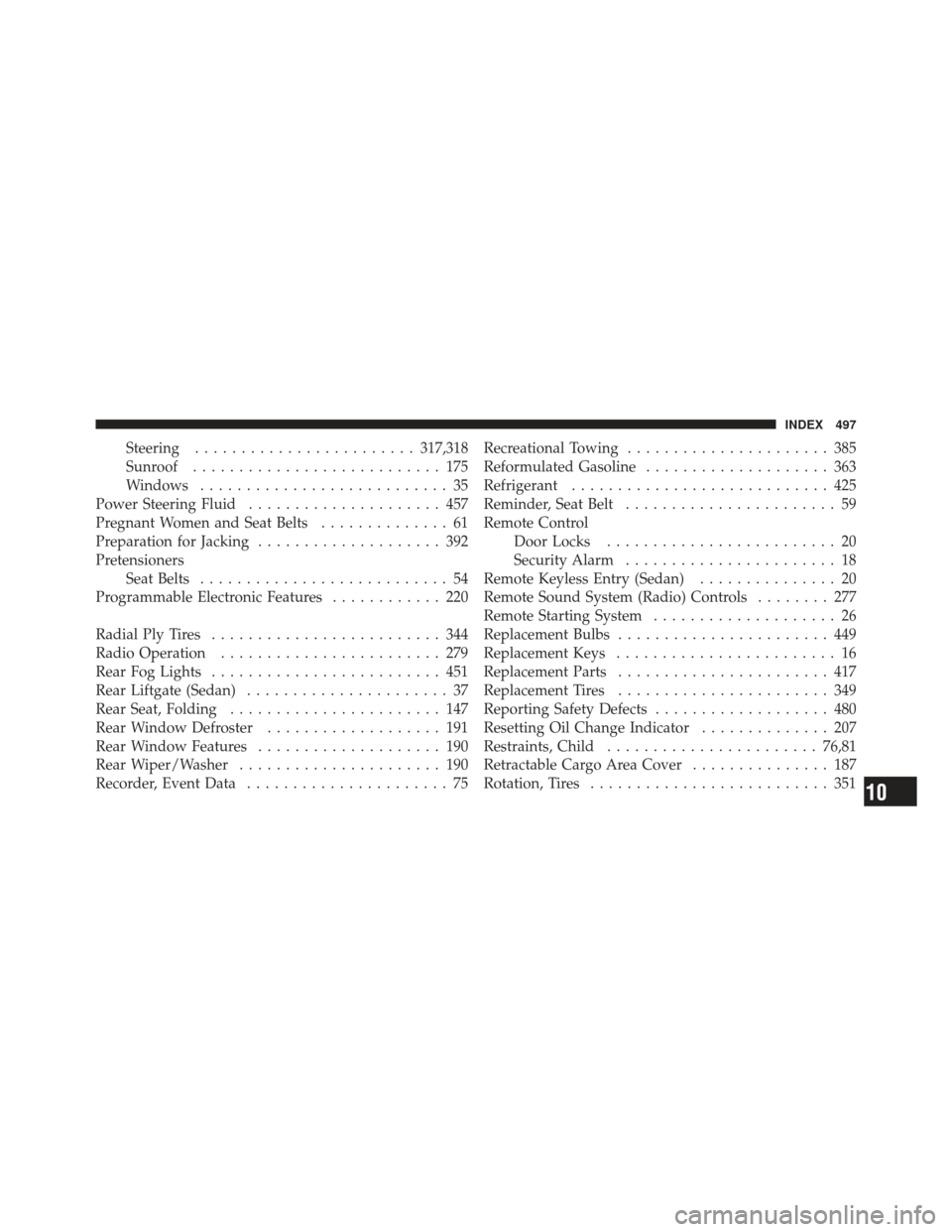
Steering........................ 317,318
Sunroof ........................... 175
Windows ........................... 35
Power Steering Fluid ..................... 457
Pregnant Women and Seat Belts .............. 61
Preparation for Jacking .................... 392
Pretensioners Seat Belts ........................... 54
Programmable Electronic Features ............ 220
Radial Ply Tires ......................... 344
Radio Operation ........................ 279
Rear Fog Lights ......................... 451
Rear Liftgate (Sedan) ...................... 37
Rear Seat, Folding ....................... 147
Rear Window Defroster ................... 191
Rear Window Features .................... 190
Rear Wiper/Washer ...................... 190
Recorder, Event Data ...................... 75 Recreational Towing
...................... 385
Reformulated Gasoline .................... 363
Refrigerant ............................ 425
Reminder, Seat Belt ....................... 59
Remote Control Door Locks ......................... 20
Security Alarm ....................... 18
Remote Keyless Entry (Sedan) ............... 20
Remote Sound System (Radio) Controls ........ 277
Remote Starting System .................... 26
Replacement Bulbs ....................... 449
Replacement Keys ........................ 16
Replacement Parts ....................... 417
Replacement Tires ....................... 349
Reporting Safety Defects ................... 480
Resetting Oil Change Indicator .............. 207
Restraints, Child ....................... 76,81
Retractable Cargo Area Cover ............... 187
Rotation, Tires .......................... 351
10
INDEX 497
Page 500 of 506
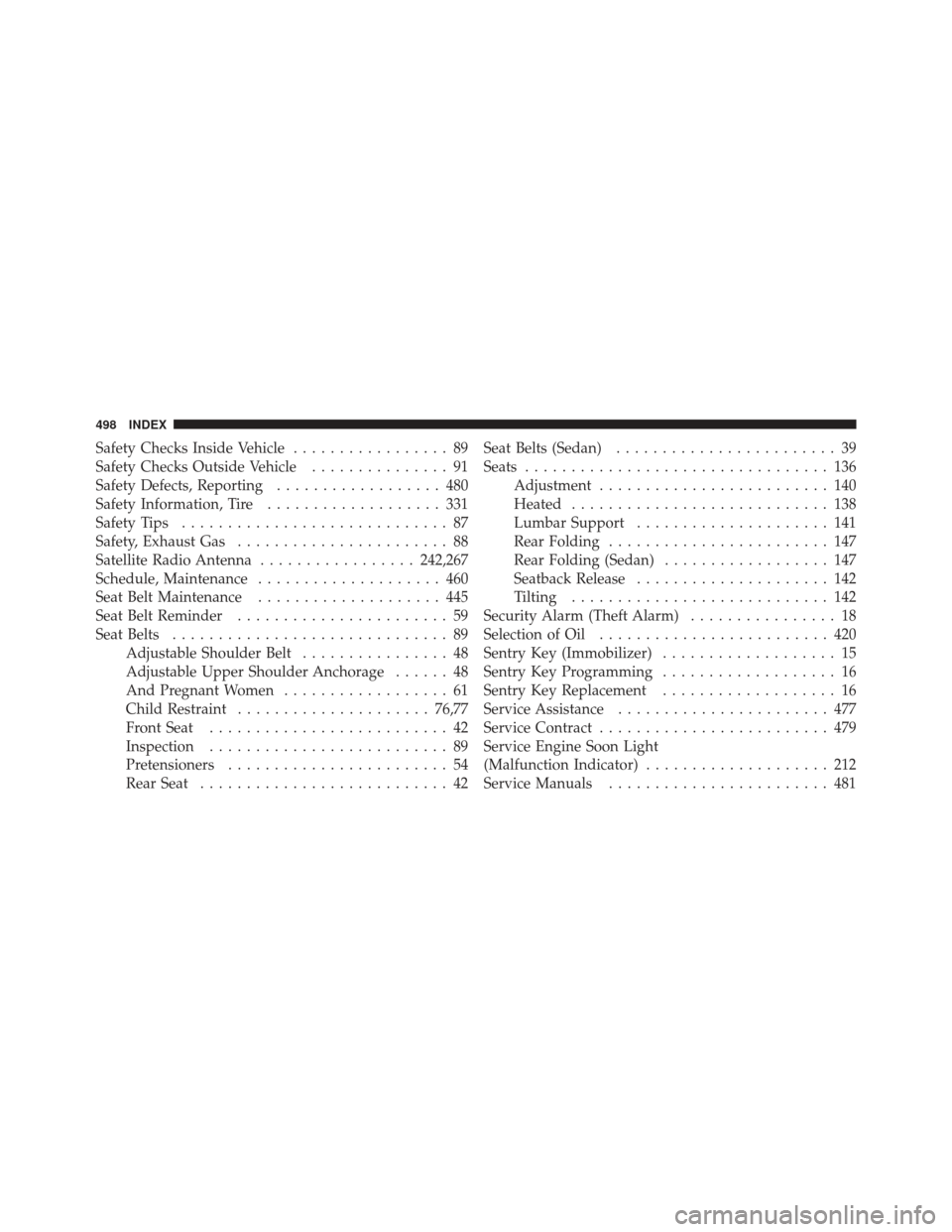
Safety Checks Inside Vehicle................. 89
Safety Checks Outside Vehicle ............... 91
Safety Defects, Reporting .................. 480
Safety Information, Tire ................... 331
Safety Tips ............................. 87
Safety, Exhaust Gas ....................... 88
Satellite Radio Antenna .................242,267
Schedule, Maintenance .................... 460
Seat Belt Maintenance .................... 445
Seat Belt Reminder ....................... 59
Seat Belts .............................. 89
Adjustable Shoulder Belt ................ 48
Adjustable Upper Shoulder Anchorage ...... 48
And Pregnant Women .................. 61
Child Restraint ..................... 76,77
Front Seat .......................... 42
Inspection .......................... 89
Pretensioners ........................ 54
Rear Seat ........................... 42 Seat Belts (Sedan)
........................ 39
Seats ................................. 136
Adjustment ......................... 140
Heated ............................ 138
Lumbar Support ..................... 141
Rear Folding ........................ 147
Rear Folding (Sedan) .................. 147
Seatback Release ..................... 142
Tilting ............................ 142
Security Alarm (Theft Alarm) ................ 18
Selection of Oil ......................... 420
Sentry Key (Immobilizer) ................... 15
Sentry Key Programming ................... 16
Sentry Key Replacement ................... 16
Service Assistance ....................... 477
Service Contract ......................... 479
Service Engine Soon Light
(Malfunction Indicator) .................... 212
Service Manuals ........................ 481
498 INDEX