engine overheat DODGE CALIBER 2012 1.G User Guide
[x] Cancel search | Manufacturer: DODGE, Model Year: 2012, Model line: CALIBER, Model: DODGE CALIBER 2012 1.GPages: 506, PDF Size: 3.03 MB
Page 390 of 506
HAZARD WARNING FLASHERS
The Hazard Warning flasher switch is located on the
instrument panel, below the radio.Press the switch to turn on the Hazard Warning
flasher. When the switch is activated, all directional
turn signals will flash on and off to warn oncoming
traffic of an emergency. Press the switch a second time to
turn off the Hazard Warning flashers.
This is an emergency warning system and it should not
be used when the vehicle is in motion. Use it when your
vehicle is disabled and it is creating a safety hazard for
other motorists.
When you must leave the vehicle to seek assistance, the
Hazard Warning flashers will continue to operate even
though the ignition is placed in the OFF position.
NOTE: With extended use the Hazard Warning flashers
may wear down your battery.
IF YOUR ENGINE OVERHEATS
In any of the following situations, you can reduce the
potential for overheating by taking the appropriate ac-
tion.
•On the highways — slow down.
•In city traffic — while stopped, place the transmission
in NEUTRAL, but do not increase engine idle speed.
NOTE: There are steps that you can take to slow down
an impending overheat condition:
•If your air conditioner (A/C) is on, turn it off. The A/C
system adds heat to the engine cooling system and
turning the A/C off can help remove this heat.
•You can also turn the temperature control to maximum
heat, the mode control to floor and the blower control
to high. This allows the heater core to act as a
supplement to the radiator and aids in removing heat
from the engine cooling system.
388 WHAT TO DO IN EMERGENCIES
Page 391 of 506
CAUTION!
Driving with a hot cooling system could damage
your vehicle. If the pointer rises to the H (red) mark,
the instrument cluster will sound a chime. When
safe, pull over and stop the vehicle with the engine at
idle. Turn off the air conditioning and wait until the
pointer drops back into the normal range. If the
pointer remains on the H (red) mark for more than a
minute, turn the engine off immediately and call for
service.
WARNING!
You or others can be badly burned by hot engine
coolant (antifreeze) or steam from your radiator. If
you see or hear steam coming from under the hood,
do not open the hood until the radiator has had time
to cool. Never try to open a cooling system pressure
cap when the radiator or coolant bottle is hot.
AUTOMATIC TRANSMISSION OVERHEATING
During sustained high speed driving or trailer towing up
long grades on hot days, the automatic transmission oil
may become too hot.If this happens, the transmission overheat in-
dicator light will come on, and the vehicle will
slow slightly until the automatic transmission
cools down enough to allow a return to the
requested speed. If the high speed is maintained, the
overheating may reoccur, as before, in a cyclic fashion.6
WHAT TO DO IN EMERGENCIES 389
Page 408 of 506
CAUTION!
Racing the engine or spinning the wheels may lead to
transmission overheating and failure. Allow the en-
gine to idle with the shift lever in NEUTRAL for at
least one minute after every five rocking-motion
cycles. This will minimize overheating and reduce
the risk of transmission failure during prolonged
efforts to free a stuck vehicle.
NOTE: If your vehicle is equipped with Traction Con-
trol or Electronic Stability Control (ESC), turn the system
OFF before attempting to “rock” the vehicle.
CAUTION!
•When “rocking” a stuck vehicle by moving be-
tween DRIVE and REVERSE (with automatic
transmission) or 1st gear and Reverse (with
manual transmission), do not spin the wheels
faster than 15 mph (24 km/h), or drivetrain damage
may result.
•Revving the engine or spinning the wheels too fast
may lead to transmission overheating and failure.
It can also damage the tires. Do not spin the
wheels above 30 mph (48 km/h) while in gear (no
transmission shifting occurring).
406 WHAT TO DO IN EMERGENCIES
Page 430 of 506
WARNING!
•Exhaust gases can injure or kill. They contain
carbon monoxide (CO), which is colorless and
odorless. Breathing it can make you unconscious
and can eventually poison you. To avoid breathing
CO, refer to “Safety Tips/Exhaust Gas” in “Things
To Know Before Starting Your Vehicle” for further
information.
•A hot exhaust system can start a fire if you park
over materials that can burn. Such materials might
be grass or leaves coming into contact with your
exhaust system. Do not park or operate your ve-
hicle in areas where your exhaust system can
contact anything that can burn.
CAUTION!
•The catalytic converter requires the use of un-
leaded fuel only. Leaded gasoline will destroy the
effectiveness of the catalyst as an emissions con-
trol device and may seriously reduce engine per-
formance and cause serious damage to the engine.
•Damage to the catalytic converter can result if your
vehicle is not kept in proper operating condition.
In the event of engine malfunction, particularly
involving engine misfire or other apparent loss of
performance, have your vehicle serviced promptly.
Continued operation of your vehicle with a severe
malfunction could cause the converter to overheat,
resulting in possible damage to the converter and
vehicle.
428 MAINTAINING YOUR VEHICLE
Page 431 of 506
Under normal operating conditions, the catalytic con-
verter will not require maintenance. However, it is im-
portant to keep the engine properly tuned to assure
proper catalyst operation and prevent possible catalyst
damage.
NOTE:Intentional tampering with emissions control
systems can result in civil penalties being assessed
against you.
In unusual situations involving grossly malfunctioning
engine operation, a scorching odor may suggest severe
and abnormal catalyst overheating. If this occurs, stop
the vehicle, turn off the engine and allow it to cool.
Service, including a tune-up to manufacturer’s specifica-
tions, should be obtained immediately. To minimize the possibility of catalytic converter dam-
age:
•Do not shut off the engine or interrupt the ignition,
when the transmission is in gear and the vehicle is in
motion.
•Do not try to start the engine by pushing or towing the
vehicle.
•Do not idle the engine with any spark plug wires
disconnected or removed, such as when diagnostic
testing, or for prolonged periods during very rough
idle or malfunctioning operating conditions.
7
MAINTAINING YOUR VEHICLE 429
Page 435 of 506
WARNING!
•The warning words “DO NOT OPEN HOT” on
the cooling system pressure cap are a safety pre-
caution. Never add engine coolant (antifreeze)
when the engine is overheated. Do not loosen or
remove the cap to cool an overheated engine. Heat
causes pressure to build up in the cooling system.
To prevent scalding or injury, do not remove the
pressure cap while the system is hot or under
pressure.
•Do not use a pressure cap other than the one
specified for your vehicle. Personal injury or en-
gine damage may result.
Disposal Of Used Engine Coolant
Used ethylene glycol-based engine coolant (antifreeze) is
a regulated substance requiring proper disposal. Check
with your local authorities to determine the disposalrules for your community. To prevent ingestion by ani-
mals or children do not store ethylene glycol-based
engine coolant (antifreeze) in open containers or allow it
to remain in puddles on the ground. If ingested by a child
or pet, seek emergency assistance immediately. Clean up
any ground spills immediately.
Coolant Level
The coolant bottle provides a quick visual method for
determining that the coolant level is adequate. With the
engine idling and warm to normal operating tempera-
ture, the level of the engine coolant (antifreeze) in the
bottle should be between the “ADD” and “FULL” lines
shown on the bottle.
The radiator normally remains completely full, so there is
no need to remove the radiator cap unless checking for
the coolant freeze point or replacing the engine coolant
(antifreeze). Advise your service attendant of this. As
7
MAINTAINING YOUR VEHICLE 433
Page 488 of 506
ABS (Anti-Lock Brake System).............. 322
Adding Engine Coolant (Antifreeze) .......... 431
Adding Fuel ........................... 367
Adding Washer Fluid ..................... 426
Additives, Fuel ......................... 365
Air Cleaner, Engine (Engine Air Cleaner Filter) . . . 422
Air Conditioner Maintenance ............... 424
Air Conditioning ........................ 280
Air Conditioning Controls ................. 280
Air Conditioning Filter .................... 292
Air Conditioning Refrigerant .............424,425
Air Conditioning System .............280,284,424
Air Conditioning, Operating Tips ............ 293
Air Pressure, Tires ....................... 342
Airbag .............................. 61,71
Airbag Deployment ....................... 72
Airbag Light ..................... 69,75,89,203
Airbag Maintenance ....................... 74
Airbag, Side ........................ 65,68,71Airbag, Window (Side Curtain)
...........66,68,71
Alarm Light ........................... 210
Alarm System (Security Alarm) ............... 18
Alterations/Modifications, Vehicle ............. 7
Antenna, Satellite Radio ................242,267
Anti-Lock Brake System (ABS) .............. 322
Anti-Lock Warning Light .................. 213
Anti-Theft Security Alarm (Theft Alarm) ........ 18
Antifreeze (Engine Coolant) ...........431,455,456
Capacities .......................... 455
Disposal ........................... 433
Appearance Care ........................ 439
Assistance Towing ....................... 114
Automatic Dimming Mirror ................. 97
Automatic Door Locks ................... 31,32
Automatic Temperature Control (ATC) ......... 284
Automatic Transaxle ................. 12,299,389
Overheating ........................ 389
Automatic Transmission ................304,438
486 INDEX
Page 492 of 506
Brake Assist System................... 325
Electronic Stability Program ............. 328
Traction Control System ................ 326
Electronic Speed Control (Cruise Control) ...... 162
Electronic Stability Program (ESP) ............ 328
Electronic Vehicle Information Center (EVIC) .... 215
Emergency, In Case of Jacking ............................ 390
Jump Starting ....................... 401
Towing ............................ 408
Emission Control System Maintenance ......... 416
Engine ............................ 413,414
Block Heater ........................ 302
Break-In Recommendations .............. 86
Checking Oil Level ................... 419
Cooling ........................... 430
Exhaust Gas Caution ................88,367
Fuel Requirements .................... 363
Jump Starting ....................... 401 Oil .........................
419,455,456
Oil Change Interval ................... 420
Oil Filler Cap .................. 413,414,421
Oil Filter ........................... 456
Oil Selection ........................ 420
Oil Synthetic ........................ 421
Overheating ........................ 388
Temperature Gauge ................... 201
Enhanced Accident Response Feature .......... 72
Ethanol ............................... 364
Event Data Recorder ...................... 75
Exhaust Gas Caution ................. 38,88,367
Exhaust System ....................... 88,427
Exterior Lights .......................... 91
Filler Location Fuel ...................... 202
Filters Air Cleaner ......................... 422
Air Conditioning ..................... 292
490 INDEX
Page 498 of 506
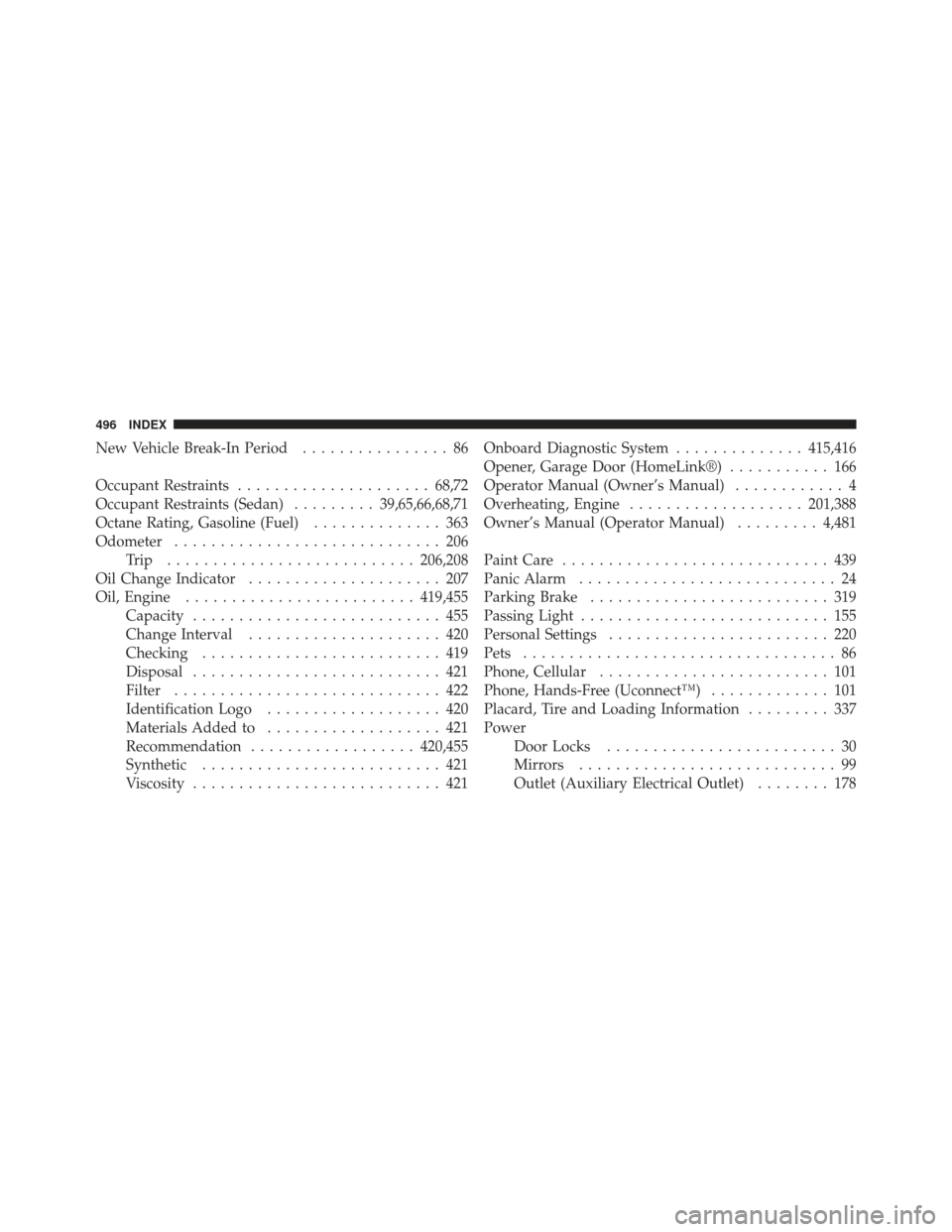
New Vehicle Break-In Period................ 86
Occupant Restraints ..................... 68,72
Occupant Restraints (Sedan) .........39,65,66,68,71
Octane Rating, Gasoline (Fuel) .............. 363
Odometer ............................. 206
Trip ........................... 206,208
Oil Change Indicator ..................... 207
Oil, Engine ......................... 419,455
Capacity ........................... 455
Change Interval ..................... 420
Checking .......................... 419
Disposal ........................... 421
Filter ............................. 422
Identification Logo ................... 420
Materials Added to ................... 421
Recommendation .................. 420,455
Synthetic .......................... 421
Viscosity ........................... 421 Onboard Diagnostic System
..............415,416
Opener, Garage Door (HomeLink®) ........... 166
Operator Manual (Owner’s Manual) ............ 4
Overheating, Engine ................... 201,388
Owner’s Manual (Operator Manual) .........4,481
Paint Care ............................. 439
Panic Alarm ............................ 24
Parking Brake .......................... 319
Passing Light ........................... 155
Personal Settings ........................ 220
Pets .................................. 86
Phone, Cellular ......................... 101
Phone, Hands-Free (Uconnect™) ............. 101
Placard, Tire and Loading Information ......... 337
Power Door Locks ......................... 30
Mirrors ............................ 99
Outlet (Auxiliary Electrical Outlet) ........ 178
496 INDEX