flat tire DODGE CALIBER 2012 1.G Owner's Manual
[x] Cancel search | Manufacturer: DODGE, Model Year: 2012, Model line: CALIBER, Model: DODGE CALIBER 2012 1.GPages: 506, PDF Size: 3.03 MB
Page 358 of 506
The TPMS consists of the following components:
•Receiver Module
•Four Tire Pressure Monitoring Sensors
•Tire Pressure Monitoring Telltale Light
Tire Pressure Monitoring Low Pressure Warnings
The Tire Pressure Monitoring Telltale Light will illumi-
nate in the instrument cluster, a LOW TIRE message will
be displayed for a minimum of five seconds, and an
audible chime will be activated when one or more of the
four active road tire pressures are low. Should this occur,
you should stop as soon as possible, check the inflation
pressure of each tire on your vehicle, and inflate each tire
to the vehicle’s recommended cold placard pressure
value. The system will automatically update and the Tire
Pressure Monitoring Light will extinguish and the LOW
TIRE message will turn off once the updated tire pres-
sures have been received. The vehicle may need to be
driven for up to 20 minutes above 15 mph (24 km/h) to
receive this information.
Check TPMS Warnings
The Tire Pressure Monitoring Telltale Light will flash on
and off for 75 seconds and remain on solid when a system
fault is detected. The system fault will also sound a
chime. If the ignition key is cycled, this sequence will
repeat providing the system fault still exists. The Tire
Pressure Monitoring Telltale Light will turn off when the
fault condition no longer exists. A system fault can occur
with any of the following scenarios:
1. Jamming due to electronic devices or driving next to
facilities emitting the same radio frequencies as the TPM
sensors.
2. Installing some form of aftermarket window tinting
that affects radio wave signals.
3. Snow or ice around the wheels or wheel housings.
4. Using tire chains on the vehicle.
5. Using wheels/tires not equipped with TPM sensors.
356 STARTING AND OPERATING
Page 361 of 506
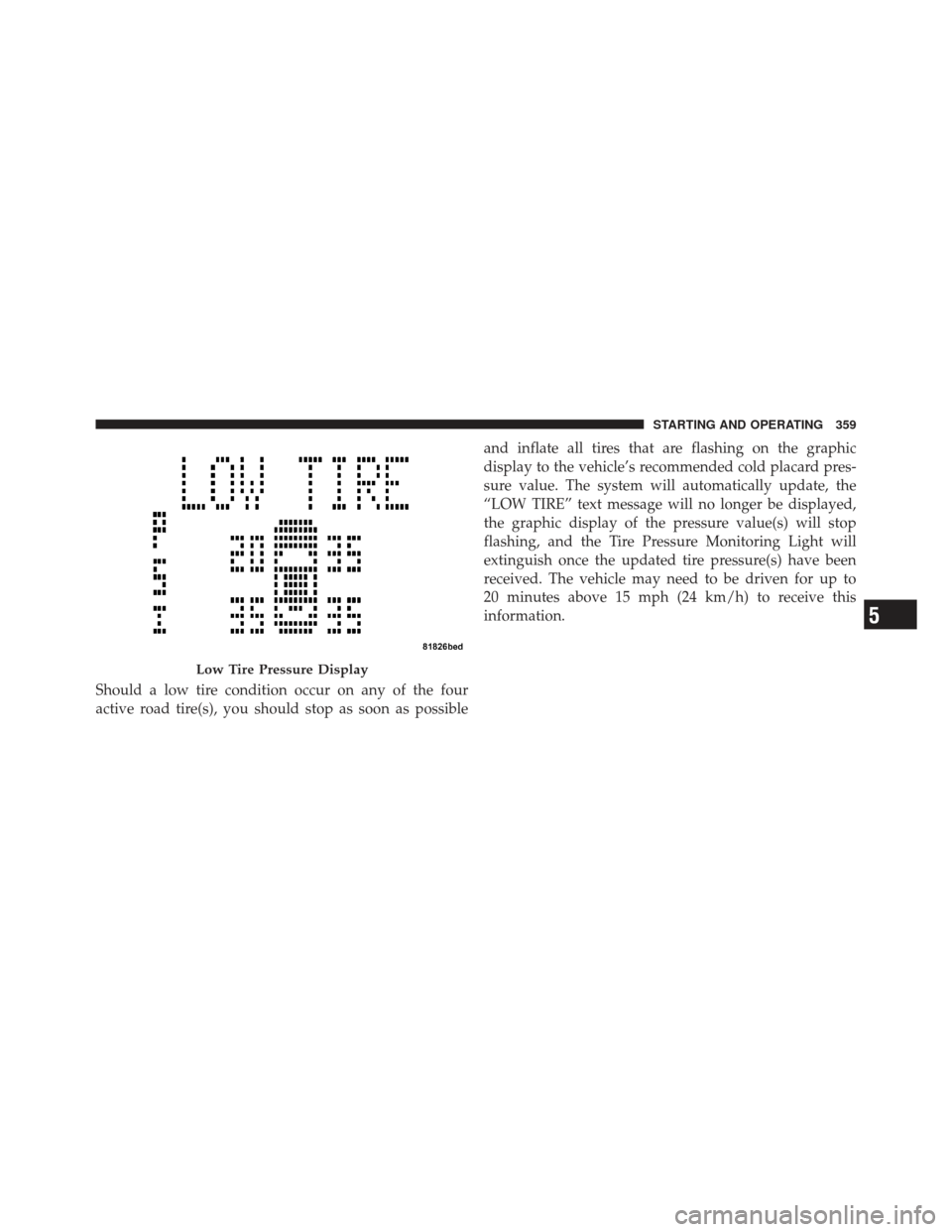
Should a low tire condition occur on any of the four
active road tire(s), you should stop as soon as possibleand inflate all tires that are flashing on the graphic
display to the vehicle’s recommended cold placard pres-
sure value. The system will automatically update, the
“LOW TIRE” text message will no longer be displayed,
the graphic display of the pressure value(s) will stop
flashing, and the Tire Pressure Monitoring Light will
extinguish once the updated tire pressure(s) have been
received. The vehicle may need to be driven for up to
20 minutes above 15 mph (24 km/h) to receive this
information.
Low Tire Pressure Display
5
STARTING AND OPERATING 359
Page 372 of 506
Vehicle Certification Label
Your vehicle has a Vehicle Certification Label attached to
the driver’s door B-Pillar.
The label contains the following information:
•Name of manufacturer
•Month and year of manufacture
•Gross Vehicle Weight Rating (GVWR)
•Vehicle Identification Number (VIN)
•Type of Vehicle
•Month, Day and Hour of Manufacture (MDH)
The bar code allows a computer scanner to read the
Vehicle Identification Number (VIN).
Gross Vehicle Weight Rating (GVWR)
The GVWR is the total allowable weight of your vehicle.
This includes driver, passengers, and cargo. The total
load must be limited so that you do not exceed the
GVWR.
Tire Size
The tire size on the Vehicle Certification Label represents
the actual tire size on your vehicle. Replacement tires
must be equal to the load capacity of this tire size.
Rim Size
This is the rim size that is appropriate for the tire size
listed.
Inflation Pressure
This is the cold tire inflation pressure for your vehicle, for
all loading conditions.
370 STARTING AND OPERATING
Page 382 of 506
WARNING! (Continued)
2. GTW
3. GAWR
4. Tongue weight rating for the trailer hitch utilized
(this requirement may limit the ability to always
achieve the 10% to 15% range of tongue weight as a
percentage of total trailer weight).
Towing Requirements – Tires
Do not attempt to tow a trailer while using a compact
spare tire.
Proper tire inflation pressures are essential to the safe
and satisfactory operation of your vehicle. Refer to
“Tires – General Information” in “Starting and Oper-
ating” for proper tire inflation procedures.
Check the trailer tires for proper tire inflation pres-
sures before trailer usage.
Check for signs of tire wear or visible tire damage
before towing a trailer. Refer to “Tires – General
Information” in “Starting and Operating” for the
proper inspection procedure.
When replacing tires, refer to “Tires – General Infor-
mation” in “Starting and Operating” for proper tire
replacement procedures. Replacing tires with a higher
load carrying capacity will not increase the vehicle’s
GVWR and GAWR limits.
Towing Requirements – Trailer Brakes
Donot interconnect the hydraulic brake system or
vacuum system of your vehicle with that of the trailer.
This could cause inadequate braking and possible
personal injury.
An electronically actuated trailer brake controller is
required when towing a trailer with electronically
380 STARTING AND OPERATING
Page 395 of 506
WARNING! (Continued)
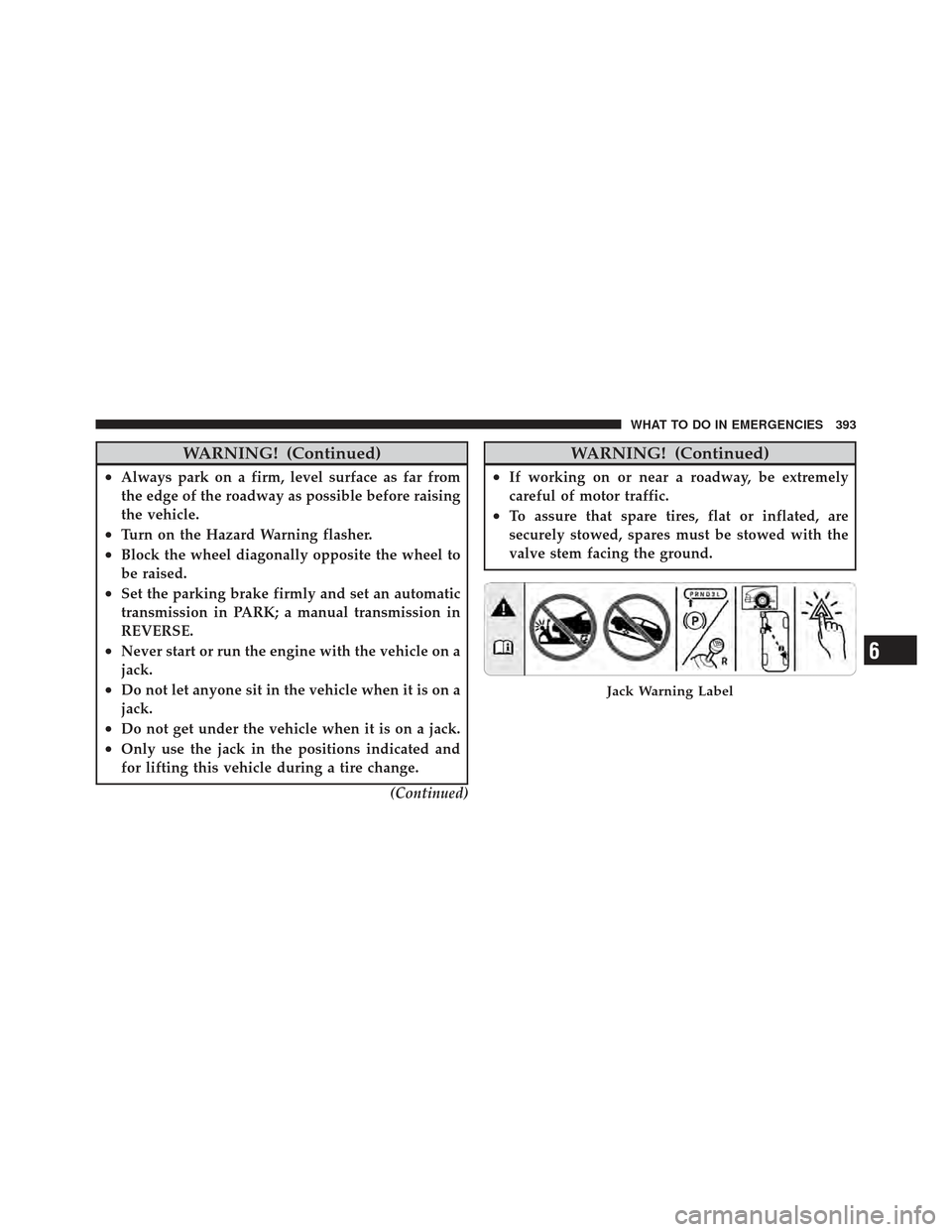
•Always park on a firm, level surface as far from
the edge of the roadway as possible before raising
the vehicle.
•Turn on the Hazard Warning flasher.
•Block the wheel diagonally opposite the wheel to
be raised.
•Set the parking brake firmly and set an automatic
transmission in PARK; a manual transmission in
REVERSE.
•Never start or run the engine with the vehicle on a
jack.
•Do not let anyone sit in the vehicle when it is on a
jack.
•Do not get under the vehicle when it is on a jack.
•Only use the jack in the positions indicated and
for lifting this vehicle during a tire change.(Continued)
WARNING! (Continued)
•If working on or near a roadway, be extremely
careful of motor traffic.
•To assure that spare tires, flat or inflated, are
securely stowed, spares must be stowed with the
valve stem facing the ground.
Jack Warning Label
6
WHAT TO DO IN EMERGENCIES 393
Page 400 of 506
WARNING!
A loose tire or jack thrown forward in a collision or
hard stop could endanger the occupants of the ve-
hicle. Always stow the jack parts and the spare tire in
the places provided.
9. Place the deflated (flat) tire in the cargo area, have the
tire repaired or replaced as soon as possible.
WARNING!
A loose tire thrown forward in a collision or hard
stop could injure the occupants in the vehicle. Have
the deflated (flat) tire repaired or replaced immedi-
ately.
10. Check the spare tire pressure as soon as possible.
Correct the tire pressure as required.
Road Tire Installation
Vehicles Equipped With Wheel Covers
1. Mount the road tire on the axle.
2. To ease the installation process for steel wheels with
wheel covers, install two lug nuts on the mounting studs
which are on each side of the valve stem. Install the lug
nuts with the cone shaped end of the nut toward the
wheel. Lightly tighten the lug nuts.
WARNING!
To avoid the risk of forcing the vehicle off the jack,
do not tighten the lug nuts fully until the vehicle is
lowered to the ground. Failure to follow this warning
may result in personal injury.
398 WHAT TO DO IN EMERGENCIES
Page 486 of 506
Temperature Grades
The temperature grades are A (the highest), B, and C,
representing the tire’s resistance to the generation of heat
and its ability to dissipate heat, when tested under
controlled conditions on a specified indoor laboratory
test wheel. Sustained high temperature can cause the
material of the tire to degenerate and reduce tire life, and
excessive temperature can lead to sudden tire failure. The
grade C corresponds to a level of performance, which all
passenger car tires must meet under the Federal Motor
Vehicle Safety Standard No. 109. Grades B and A repre-
sent higher levels of performance on the laboratory test
wheel, than the minimum required by law.WARNING!
The temperature grade for this tire is established for
a tire that is properly inflated and not overloaded.
Excessive speed, under-inflation, or excessive load-
ing, either separately or in combination, can cause
heat buildup and possible tire failure.
484 IF YOU NEED CONSUMER ASSISTANCE
Page 490 of 506
Cargo CompartmentLight ............................. 185
Cargo Light ............................ 185
Cargo Load Floor ........................ 189
Cargo Tie-Downs ........................ 189
Cellular Phone ....................... 101,279
Center High Mounted Stop Light ............ 454
Chains, Tire ............................ 351
Changing A Flat Tire ..................... 390
Chart, Tire Sizing ........................ 333
Check Engine Light (Malfunction Indicator
Light) ............................. 212,416
Checking Your Vehicle For Safety ............. 87
Checks, Safety ........................... 87
Child Restraint ........................ 76,78
Child Restraint Tether Anchors ............... 80
Child Safety Locks ........................ 34
Child Seat .............................. 81
Clean Air Gasoline ....................... 363 Cleaning
Wheels ............................ 442
Climate Control ......................... 280
Clock ........................... 227,247,256
Clutch ............................... 435
Clutch Fluid ........................... 435
Coin Holder ........................... 184
Compact Disc (CD) Maintenance ............. 279
Compact Spare Tire ...................... 345
Connector UCI .............................. 270
Universal Consumer Interface (UCI) ....... 270
Console .............................. 184
Contract, Service ........................ 479
Coolant (Antifreeze) ................... 455,456
Cooler, Beverage ........................ 192
Cooling System ......................... 430
Adding Coolant (Antifreeze) ............. 431
Coolant Level .................... 430,433
488 INDEX
Page 502 of 506
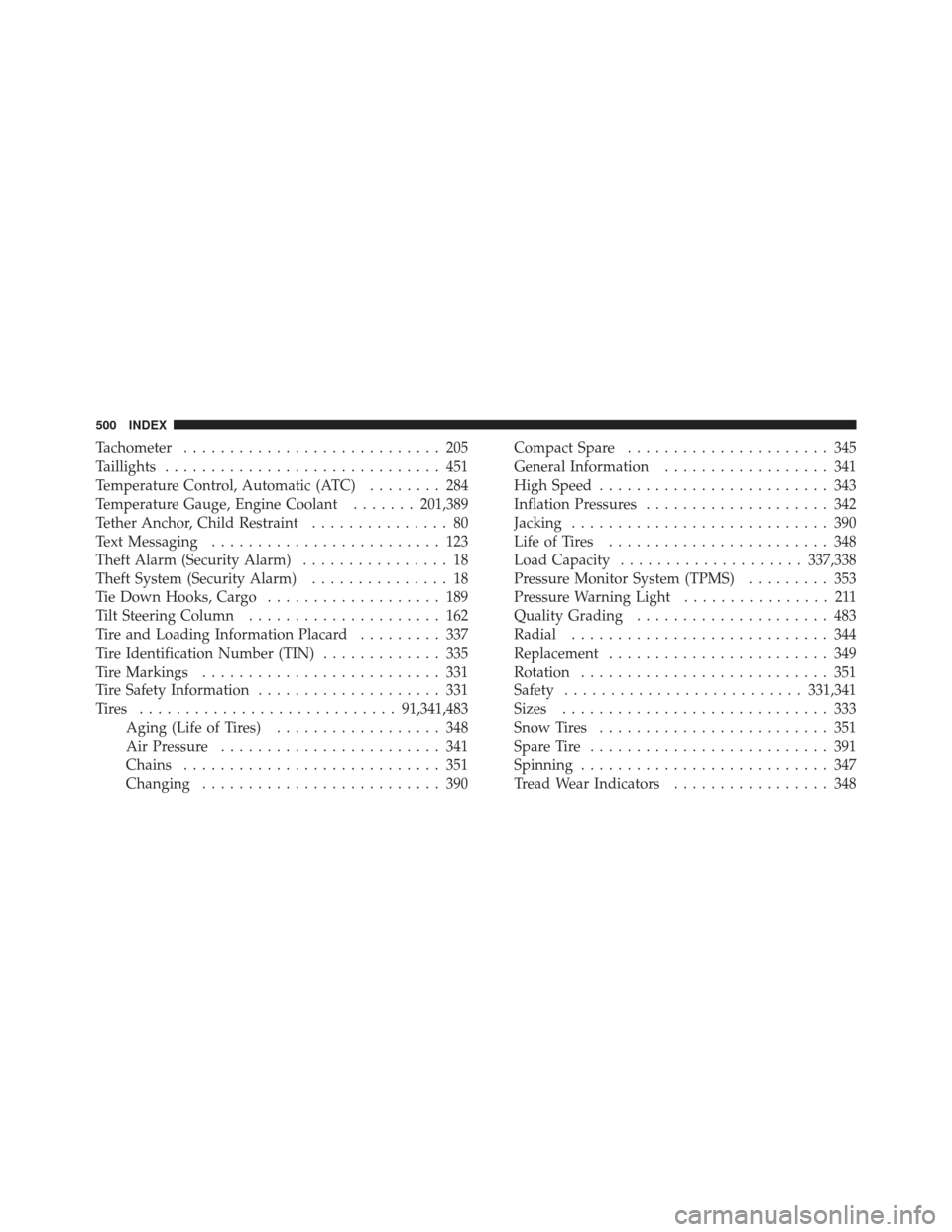
Tachometer............................ 205
Taillights .............................. 451
Temperature Control, Automatic (ATC) ........ 284
Temperature Gauge, Engine Coolant .......201,389
Tether Anchor, Child Restraint ............... 80
Text Messaging ......................... 123
Theft Alarm (Security Alarm) ................ 18
Theft System (Security Alarm) ............... 18
Tie Down Hooks, Cargo ................... 189
Tilt Steering Column ..................... 162
Tire and Loading Information Placard ......... 337
Tire Identification Number (TIN) ............. 335
Tire Markings .......................... 331
Tire Safety Information .................... 331
Tires ............................ 91,341,483
Aging (Life of Tires) .................. 348
Air Pressure ........................ 341
Chains ............................ 351
Changing .......................... 390 Compact Spare
...................... 345
General Information .................. 341
High Speed ......................... 343
Inflation Pressures .................... 342
Jacking ............................ 390
Life of Tires ........................ 348
Load Capacity .................... 337,338
Pressure Monitor System (TPMS) ......... 353
Pressure Warning Light ................ 211
Quality Grading ..................... 483
Radial ............................ 344
Replacement ........................ 349
Rotation ........................... 351
Safety .......................... 331,341
Sizes ............................. 333
Snow Tires ......................... 351
Spare Tire .......................... 391
Spinning ........................... 347
Tread Wear Indicators ................. 348
500 INDEX