battery DODGE CALIBER 2012 1.G Owner's Guide
[x] Cancel search | Manufacturer: DODGE, Model Year: 2012, Model line: CALIBER, Model: DODGE CALIBER 2012 1.GPages: 506, PDF Size: 3.03 MB
Page 426 of 506
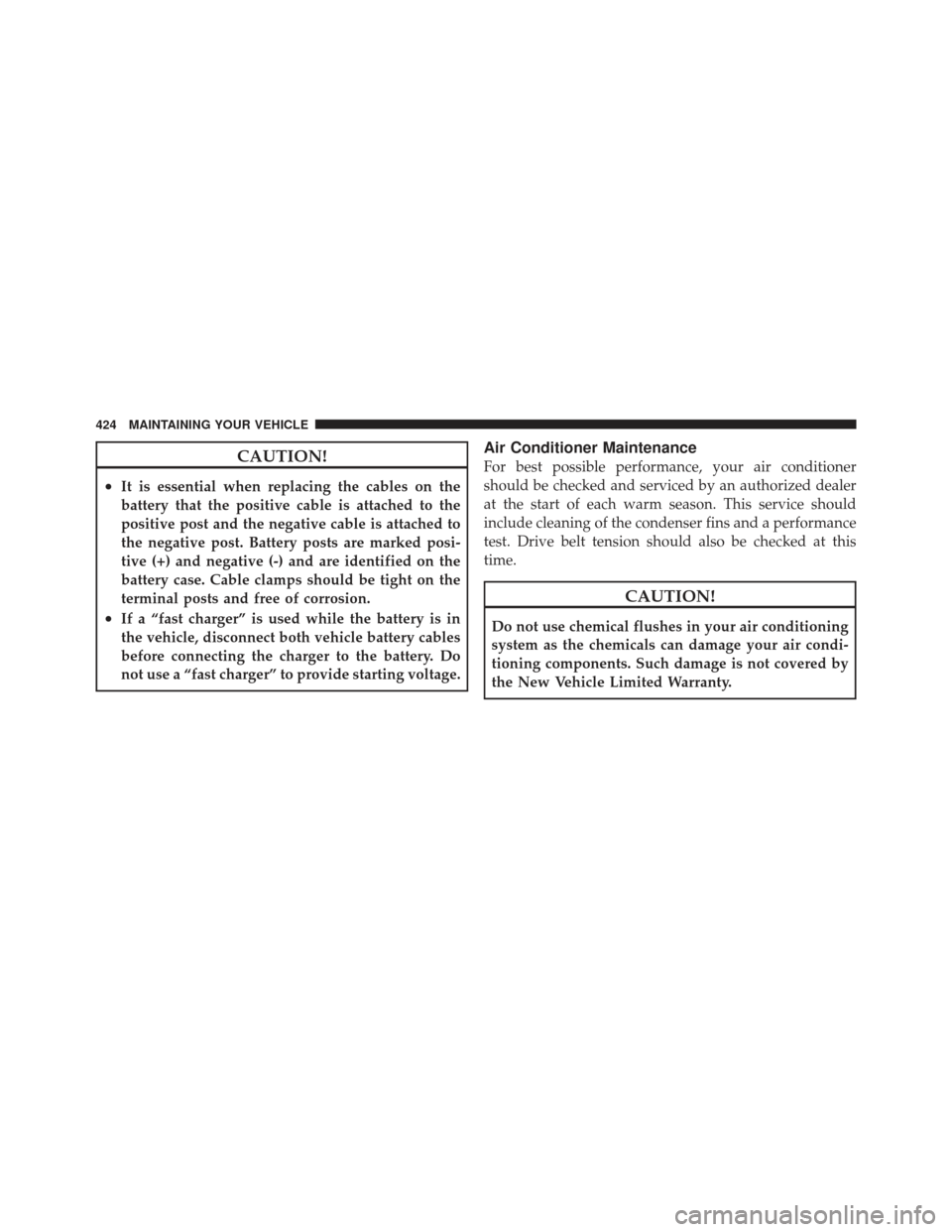
CAUTION!
•It is essential when replacing the cables on the
battery that the positive cable is attached to the
positive post and the negative cable is attached to
the negative post. Battery posts are marked posi-
tive (+) and negative (-) and are identified on the
battery case. Cable clamps should be tight on the
terminal posts and free of corrosion.
•If a “fast charger” is used while the battery is in
the vehicle, disconnect both vehicle battery cables
before connecting the charger to the battery. Do
not use a “fast charger” to provide starting voltage.
Air Conditioner Maintenance
For best possible performance, your air conditioner
should be checked and serviced by an authorized dealer
at the start of each warm season. This service should
include cleaning of the condenser fins and a performance
test. Drive belt tension should also be checked at this
time.
CAUTION!
Do not use chemical flushes in your air conditioning
system as the chemicals can damage your air condi-
tioning components. Such damage is not covered by
the New Vehicle Limited Warranty.
424 MAINTAINING YOUR VEHICLE
Page 451 of 506
VEHICLE STORAGE
If you will not be using your vehicle for more than
21 days, you may want to take steps to preserve your
battery.
•Disengage the mini-fuse in the Power Distribution
Center labeled IOD (Ignition Off-Draw).
•Or disconnect the negative cable from the battery.
•Anytime you store your vehicle, or keep it out of
service (i.e., vacation) for two weeks or more, run the
air conditioning system at idle for about five minutes
in the fresh air and high blower setting. This will
ensure adequate system lubrication to minimize the
possibility of compressor damage when the system is
started again.
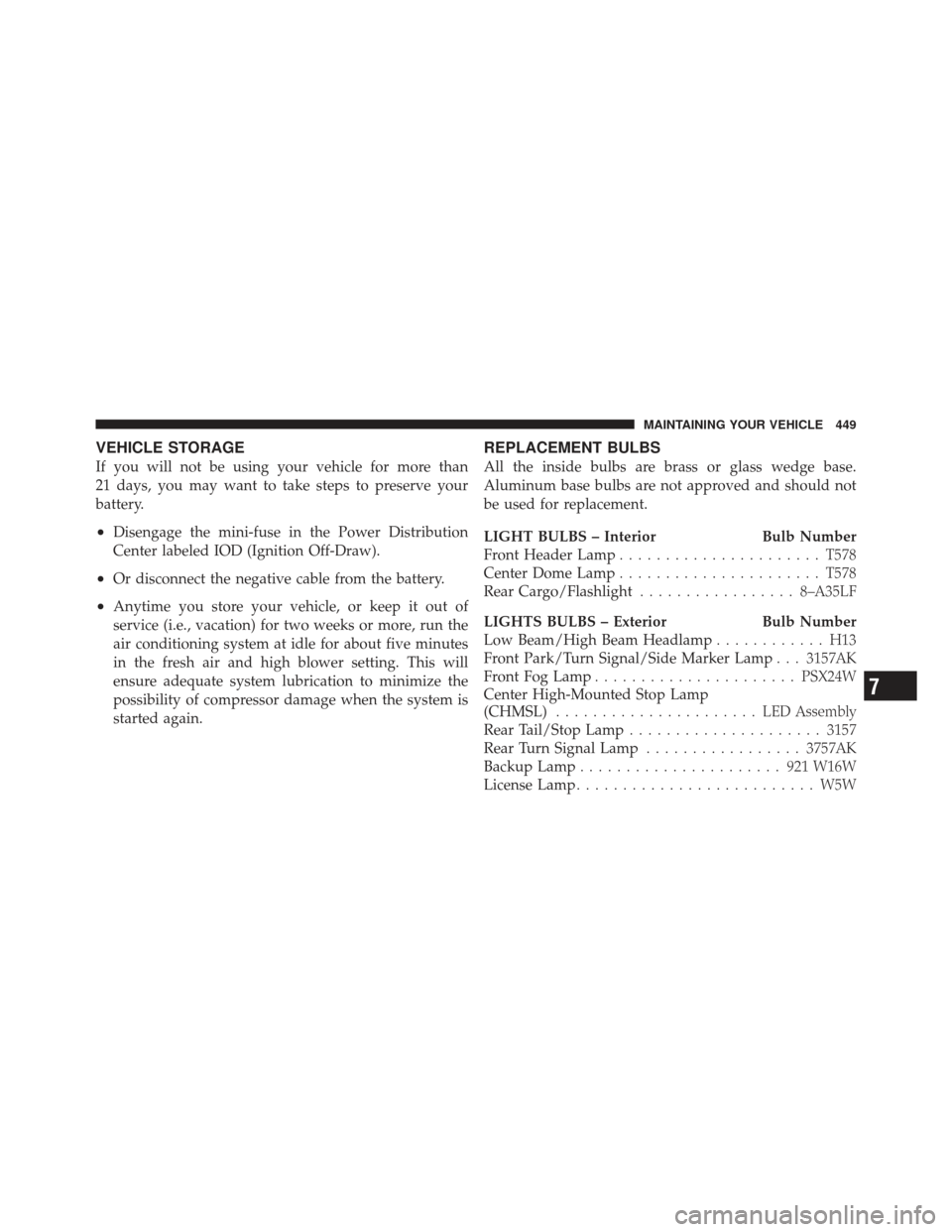
REPLACEMENT BULBS
All the inside bulbs are brass or glass wedge base.
Aluminum base bulbs are not approved and should not
be used for replacement.
LIGHT BULBS – Interior Bulb Number
Front Header Lamp...................... T578
Center Dome Lamp ...................... T578
Rear Cargo/Flashlight ................. 8–A35LF
LIGHTS BULBS – Exterior Bulb Number
Low Beam/High Beam Headlamp ............ H13
Front Park/Turn Signal/Side Marker Lamp . . . 3157AK
Front Fog Lamp ...................... PSX24W
Center High-Mounted Stop Lamp
(CHMSL) ...................... LED Assembly
Rear Tail/Stop Lamp ..................... 3157
Rear Turn Signal Lamp .................3757AK
Backup Lamp ...................... 921 W16W
License Lamp .......................... W5W
7
MAINTAINING YOUR VEHICLE 449
Page 452 of 506
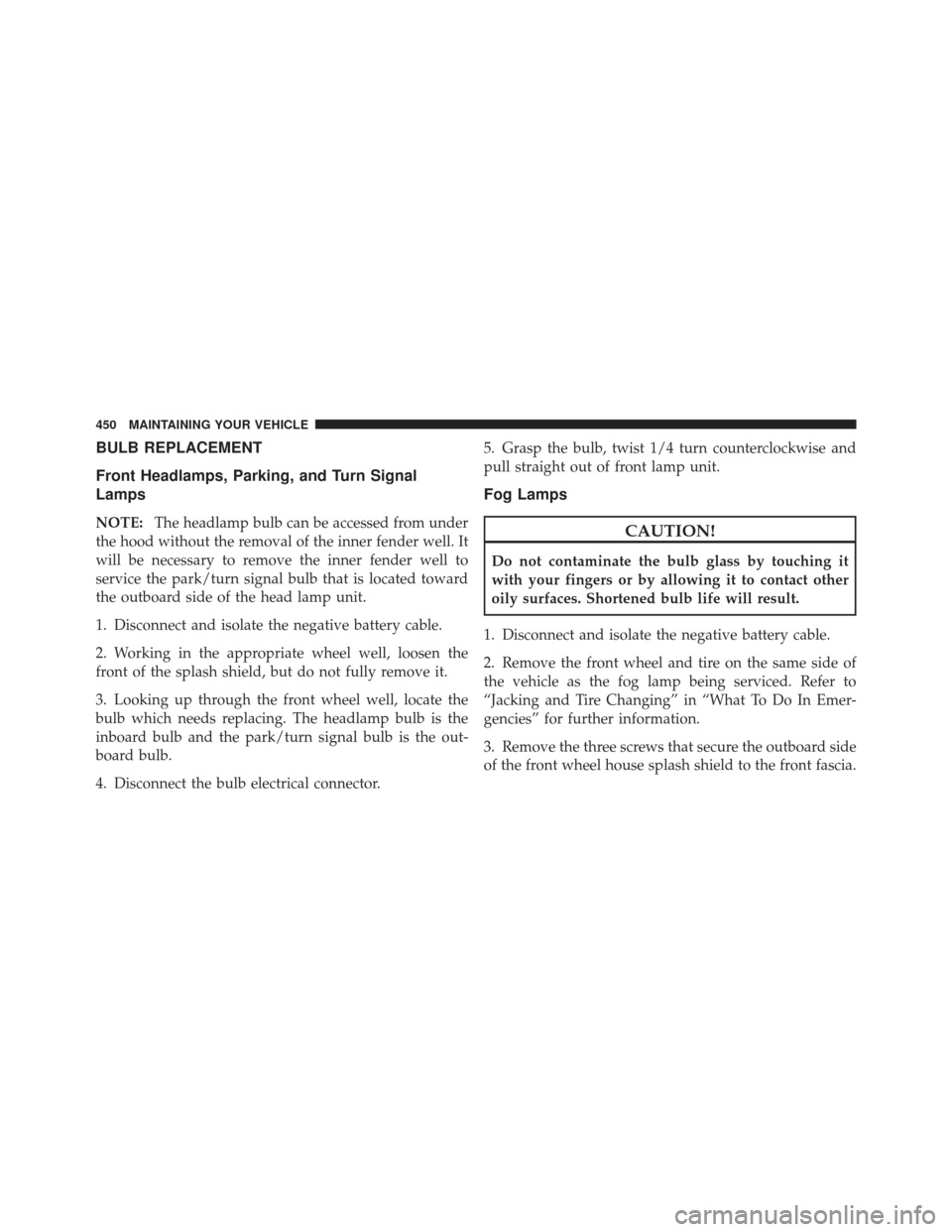
BULB REPLACEMENT
Front Headlamps, Parking, and Turn Signal
Lamps
NOTE:The headlamp bulb can be accessed from under
the hood without the removal of the inner fender well. It
will be necessary to remove the inner fender well to
service the park/turn signal bulb that is located toward
the outboard side of the head lamp unit.
1. Disconnect and isolate the negative battery cable.
2. Working in the appropriate wheel well, loosen the
front of the splash shield, but do not fully remove it.
3. Looking up through the front wheel well, locate the
bulb which needs replacing. The headlamp bulb is the
inboard bulb and the park/turn signal bulb is the out-
board bulb.
4. Disconnect the bulb electrical connector. 5. Grasp the bulb, twist 1/4 turn counterclockwise and
pull straight out of front lamp unit.
Fog Lamps
CAUTION!
Do not contaminate the bulb glass by touching it
with your fingers or by allowing it to contact other
oily surfaces. Shortened bulb life will result.
1. Disconnect and isolate the negative battery cable.
2. Remove the front wheel and tire on the same side of
the vehicle as the fog lamp being serviced. Refer to
“Jacking and Tire Changing” in “What To Do In Emer-
gencies” for further information.
3. Remove the three screws that secure the outboard side
of the front wheel house splash shield to the front fascia.
450 MAINTAINING YOUR VEHICLE
Page 464 of 506
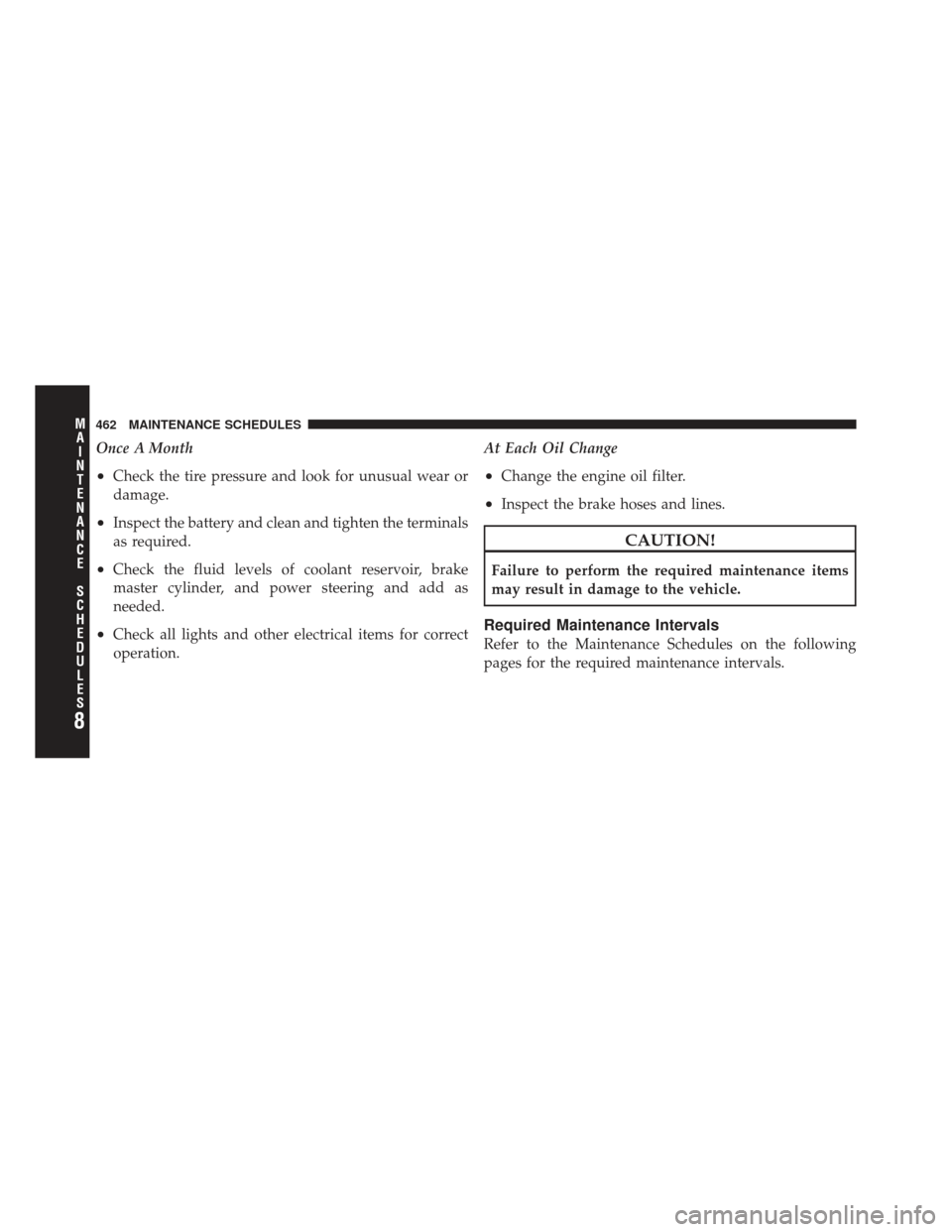
Once A Month
•Check the tire pressure and look for unusual wear or
damage.
•Inspect the battery and clean and tighten the terminals
as required.
•Check the fluid levels of coolant reservoir, brake
master cylinder, and power steering and add as
needed.
•Check all lights and other electrical items for correct
operation.At Each Oil Change
•Change the engine oil filter.
•Inspect the brake hoses and lines.
CAUTION!
Failure to perform the required maintenance items
may result in damage to the vehicle.
Required Maintenance Intervals
Refer to the Maintenance Schedules on the following
pages for the required maintenance intervals.
8
M
A I
N T
E
N A
N CE
S
C
H E
D
U L
E
S462 MAINTENANCE SCHEDULES
Page 489 of 506
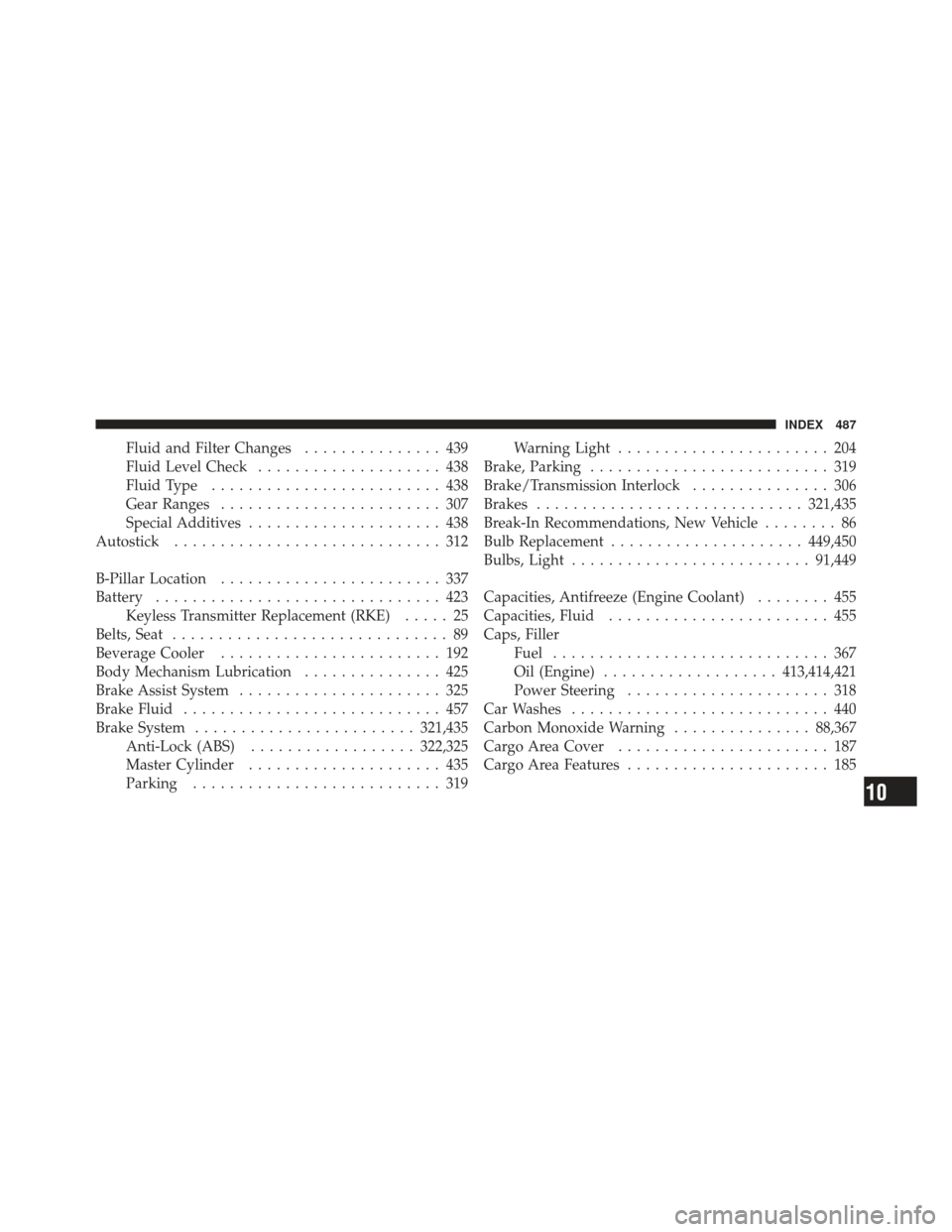
Fluid and Filter Changes............... 439
Fluid Level Check .................... 438
Fluid Type ......................... 438
Gear Ranges ........................ 307
Special Additives ..................... 438
Autostick ............................. 312
B-Pillar Location ........................ 337
Battery ............................... 423
Keyless Transmitter Replacement (RKE) ..... 25
Belts, Seat .............................. 89
Beverage Cooler ........................ 192
Body Mechanism Lubrication ............... 425
Brake Assist System ...................... 325
Brake Fluid ............................ 457
Brake System ........................ 321,435
Anti-Lock (ABS) .................. 322,325
Master Cylinder ..................... 435
Parking ........................... 319 Warning Light
....................... 204
Brake, Parking .......................... 319
Brake/Transmission Interlock ............... 306
Brakes ............................. 321,435
Break-In Recommendations, New Vehicle ........ 86
Bulb Replacement ..................... 449,450
Bulbs, Light .......................... 91,449
Capacities, Antifreeze (Engine Coolant) ........ 455
Capacities, Fluid ........................ 455
Caps, Filler Fuel .............................. 367
Oil (Engine) ................... 413,414,421
Power Steering ...................... 318
Car Washes ............................ 440
Carbon Monoxide Warning ...............88,367
Cargo Area Cover ....................... 187
Cargo Area Features ...................... 185
10
INDEX 487
Page 497 of 506
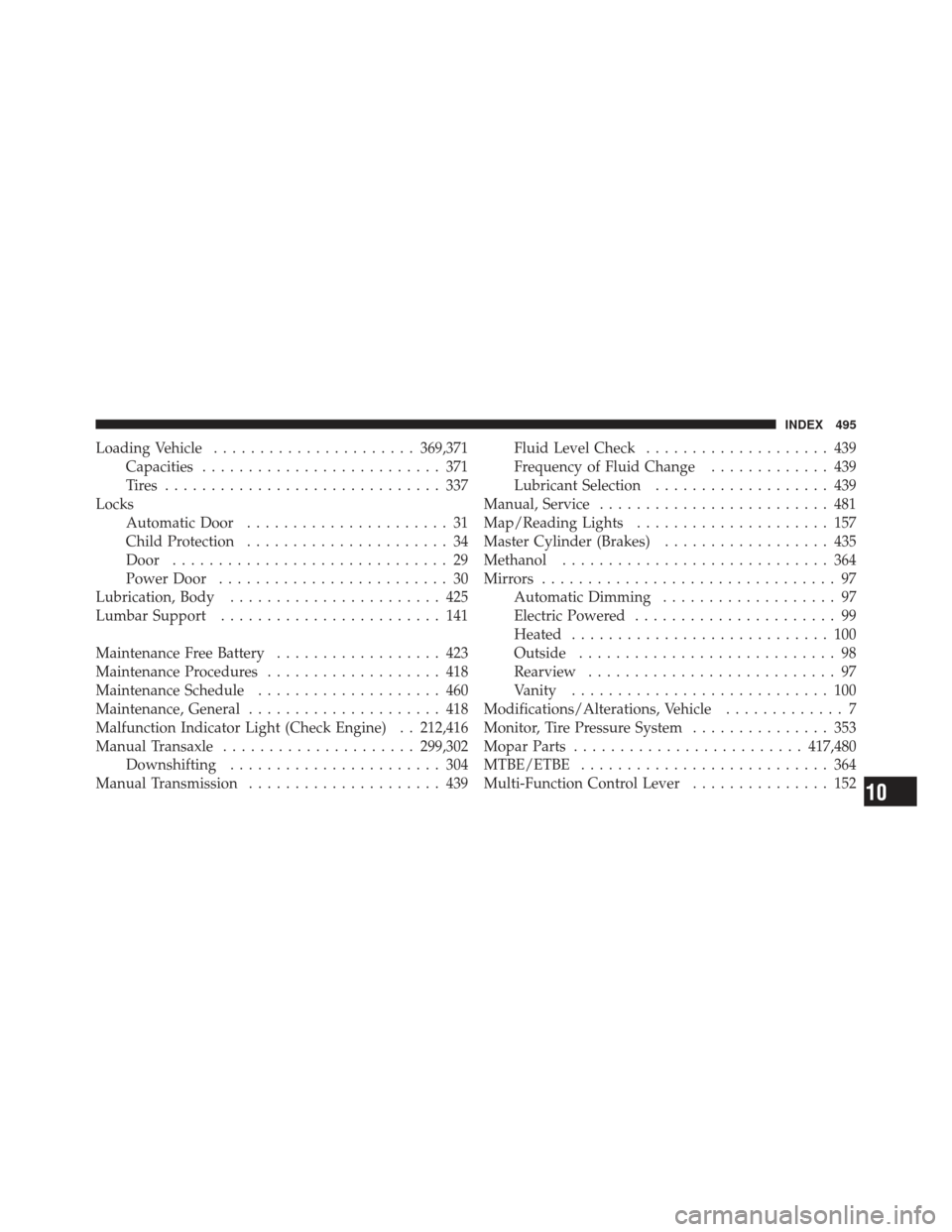
Loading Vehicle...................... 369,371
Capacities .......................... 371
Tires .............................. 337
Locks Automatic Door ...................... 31
Child Protection ...................... 34
Door .............................. 29
Power Door ......................... 30
Lubrication, Body ....................... 425
Lumbar Support ........................ 141
Maintenance Free Battery .................. 423
Maintenance Procedures ................... 418
Maintenance Schedule .................... 460
Maintenance, General ..................... 418
Malfunction Indicator Light (Check Engine) . . 212,416
Manual Transaxle ..................... 299,302
Downshifting ....................... 304
Manual Transmission ..................... 439 Fluid Level Check
.................... 439
Frequency of Fluid Change ............. 439
Lubricant Selection ................... 439
Manual, Service ......................... 481
Map/Reading Lights ..................... 157
Master Cylinder (Brakes) .................. 435
Methanol ............................. 364
Mirrors ................................ 97
Automatic Dimming ................... 97
Electric Powered ...................... 99
Heated ............................ 100
Outside ............................ 98
Rearview ........................... 97
Vanity ............................ 100
Modifications/Alterations, Vehicle ............. 7
Monitor, Tire Pressure System ............... 353
Mopar Parts ......................... 417,480
MTBE/ETBE ........................... 364
Multi-Function Control Lever ............... 152
10
INDEX 495
Page 503 of 506
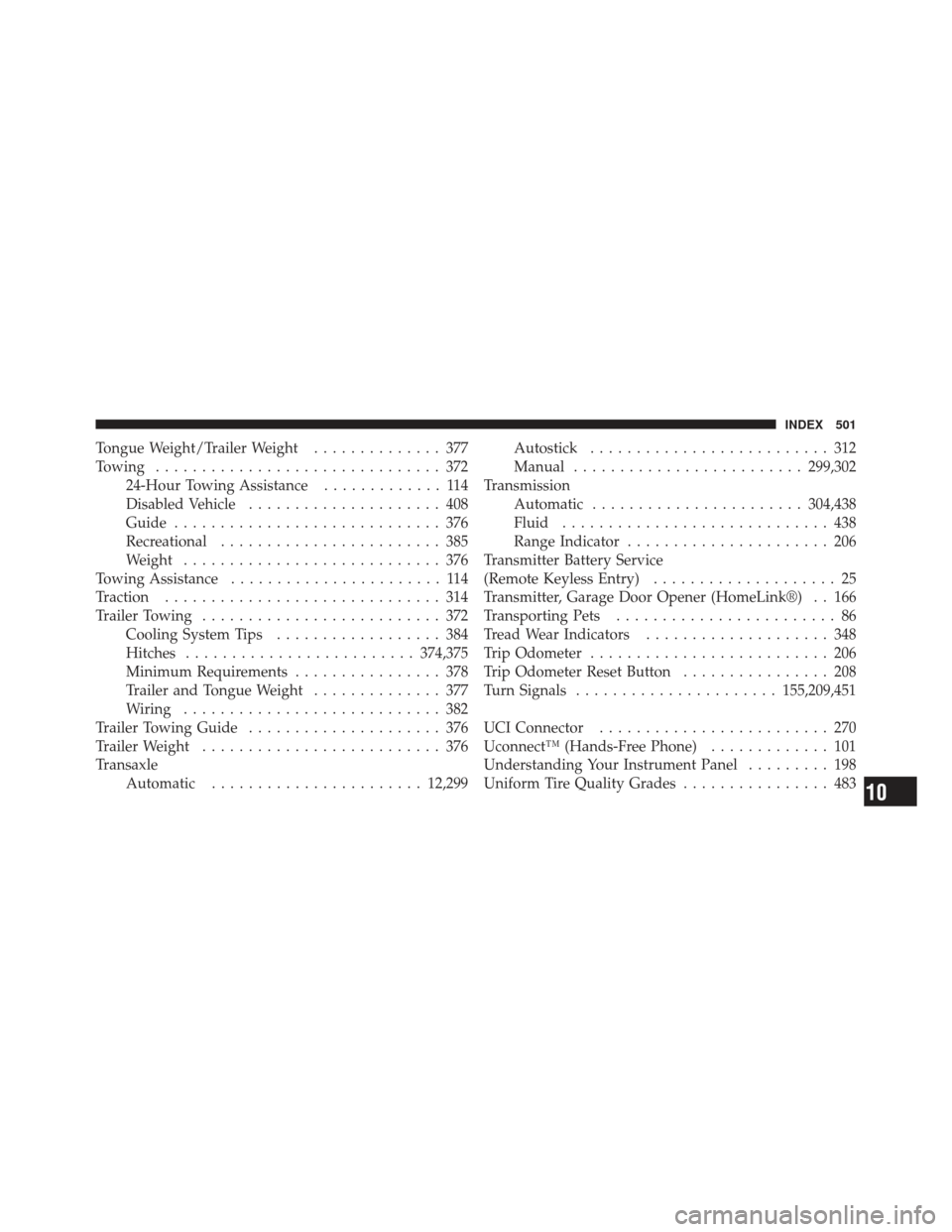
Tongue Weight/Trailer Weight.............. 377
Towing ............................... 372
24-Hour Towing Assistance ............. 114
Disabled Vehicle ..................... 408
Guide ............................. 376
Recreational ........................ 385
Weight ............................ 376
Towing Assistance ....................... 114
Traction .............................. 314
Trailer Towing .......................... 372
Cooling System Tips .................. 384
Hitches ......................... 374,375
Minimum Requirements ................ 378
Trailer and Tongue Weight .............. 377
Wiring ............................ 382
Trailer Towing Guide ..................... 376
Trailer Weight .......................... 376
Transaxle Automatic ....................... 12,299Autostick
.......................... 312
Manual ......................... 299,302
Transmission Automatic ....................... 304,438
Fluid ............................. 438
Range Indicator ...................... 206
Transmitter Battery Service
(Remote Keyless Entry) .................... 25
Transmitter, Garage Door Opener (HomeLink®) . . 166
Transporting Pets ........................ 86
Tread Wear Indicators .................... 348
Trip Odometer .......................... 206
Trip Odometer Reset Button ................ 208
Turn Signals ...................... 155,209,451
UCI Connector ......................... 270
Uconnect™ (Hands-Free Phone) ............. 101
Understanding Your Instrument Panel ......... 198
Uniform Tire Quality Grades ................ 483
10
INDEX 501
Page 505 of 506
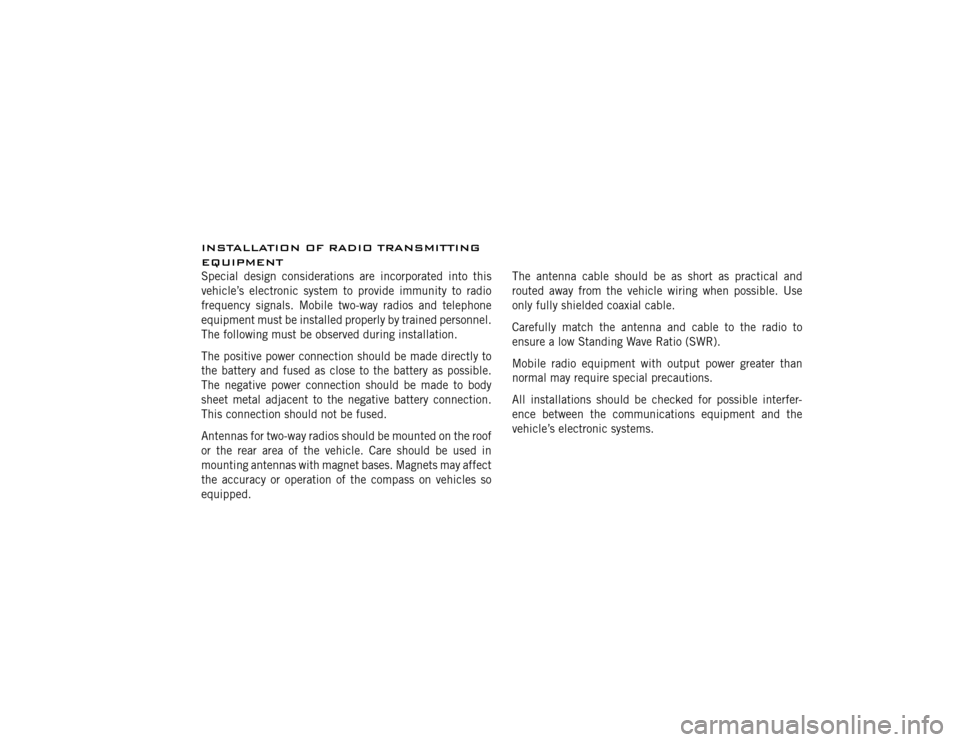
INSTALLATION OF RADIO TRANSMITTING
EQUIPMENTSpecial design considerations are incorporated into this
vehicle’s electronic system to provide immunity to radio
frequency signals. Mobile two-way radios and telephone
equipment must be installed properly by trained personnel.
The following must be observed during installation.
The positive power connection should be made directly to
the battery and fused as close to the battery as possible.
The negative power connection should be made to body
sheet metal adjacent to the negative battery connection.
This connection should not be fused.
Antennas for two-way radios should be mounted on the roof
or the rear area of the vehicle. Care should be used in
mounting antennas with magnet bases. Magnets may affect
the accuracy or operation of the compass on vehicles so
equipped.The antenna cable should be as short as practical and
routed away from the vehicle wiring when possible. Use
only fully shielded coaxial cable.
Carefully match the antenna and cable to the radio to
ensure a low Standing Wave Ratio (SWR).
Mobile radio equipment with output power greater than
normal may require special precautions.
All installations should be checked for possible interfer-
ence between the communications equipment and the
vehicle’s electronic systems.