warning DODGE CALIBER SRT 2008 1.G Owners Manual
[x] Cancel search | Manufacturer: DODGE, Model Year: 2008, Model line: CALIBER SRT, Model: DODGE CALIBER SRT 2008 1.GPages: 373, PDF Size: 3 MB
Page 310 of 373
Cooling System
WARNING!
²When working near the radiator cooling fan, dis-
connect the fan motor lead or turn the ignition
switch to the OFF position. The fan is temperature
controlled and can start at any time the ignition
switch is in the ON position.
²You or others can be badly burned by hot coolant
or steam from your radiator. If you see or hear
steam coming from under the hood, don't open the
hood until the radiator has had time to cool. Never
try to open a cooling system pressure cap when the
radiator is hot.
Coolant Checks
Check engine coolant (antifreeze) protection every 12
months (before the onset of freezing weather, where
applicable). If coolant is dirty or rusty in appearance, the
system should be drained, flushed and refilled with fresh
coolant. Check the front of the A/C condenser for any
accumulation of bugs, leaves, etc. If dirty, clean by gently
spraying water from a garden hose vertically down the
face of the condenser.
Check the coolant recovery bottle tubing for brittle rub-
ber, cracking, tears, cuts and tightness of the connection
at the bottle and radiator. Inspect the entire system for
leaks.
Cooling System Ð Drain, Flush and Refill
At the intervals shown in the ªMaintenance Schedule,º
the system should be drained, flushed and refilled. Refer
to Section 8 of this manual.
MAINTAINING YOUR VEHICLE 309
7
Page 313 of 373
WARNING!
²The warning words ªDO NOT OPEN HOTº on
the cooling system pressure cap are a safety pre-
caution. Never add coolant when the engine is
overheated. Do not loosen or remove the cap to
cool an overheated engine. Heat causes pressure to
build up in the cooling system. To prevent scald-
ing or injury, do not remove the pressure cap while
the system is hot or under pressure.
²Do not use a pressure cap other than the one
specified for your vehicle. Personal injury or en-
gine damage may result.
Disposal of Used Engine Coolant
Used ethylene glycol based engine coolant is a regulated
substance requiring proper disposal. Check with your
local authorities to determine the disposal rules for yourcommunity. To prevent ingestion by animals or children
do not store ethylene glycol based engine coolant in open
containers or allow it to remain in puddles on the
ground. If ingested by a child, contact a physician
immediately. Clean up any ground spills immediately.
Coolant Level
The coolant bottle provides a quick visual method for
determining that the coolant level is adequate. With the
engine idling and warm to normal operating tempera-
ture, the level of the coolant in the bottle should be
between the ªADDº and ªFULLº lines, shown on the
bottle.
The radiator normally remains completely full, so there is
no need to remove the radiator cap unless checking for
coolant freeze point or replacing coolant. Advise your
service attendant of this. As long as the engine operating
temperature is satisfactory, the coolant bottle need only
be checked once a month.
312 MAINTAINING YOUR VEHICLE
Page 316 of 373
Brake System
In order to assure brake system performance, all brake
system components should be inspected periodically.
Suggested service intervals can be found in the Mainte-
nance Section.
WARNING!
Riding the brakes can lead to brake failure and
possibly an accident. Driving with your foot resting
or riding on the brake pedal can result in abnormally
high brake temperatures, excessive lining wear, and
possible brake damage. You wouldn't have your full
braking capacity in an emergency.
Brake And Power Steering System Hoses
When servicing the vehicle for scheduled maintenance,
inspect the surface of the hoses and nylon tubing for
evidence of heat and mechanical damage. Hard andbrittle rubber, cracking, tears, cuts, abrasions, and exces-
sive swelling suggest deterioration of the rubber. Particu-
lar attention should be made to examining those hose
surfaces nearest to high heat sources, such as the exhaust
manifold.
Inspect all hose clamps and couplings to make sure they
are secure and no leaks are present.
Insure nylon tubing in these areas has not melted or
collapsed.
NOTE:Often, fluids such as oil, power steering fluid,
and brake fluid are used during assembly plant opera-
tions to ease the assembly of hoses to couplings. There-
fore, oil wetness at the hose-coupling area is not neces-
sarily an indication of leakage. Actual dripping of hot
fluid when systems are under pressure (during vehicle
operation) should be noted before a hose is replaced
based on leakage.
MAINTAINING YOUR VEHICLE 315
7
Page 317 of 373
NOTE:Inspection of brake hoses should be done when-
ever the brake system is serviced and at every engine oil
change.
WARNING!
Worn brake hoses can burst and cause brake failure.
You could have an accident. If you see any signs of
cracking, scuffing, or worn spots, have the brake
hoses replaced immediately.
Brake Master Cylinder
The fluid level in the master cylinder should be checked
when performing under hood services, or immediately if
the brake system warning lamp is on.
Be sure to clean the top of the master cylinder area before
removing the cap. If necessary, add fluid to bring the
fluid level up to the requirements described on the brakefluid reservoir. Fluid level can be expected to fall as the
brake pads wear. Brake fluid level should be checked
when pads are replaced. However, low fluid level may be
caused by a leak and a checkup may be needed.
NOTE:The Brake Fluid Reservoir supplies fluid to both
the Brake System and the Clutch Release System. The
two systems are separated in the reservoir and a leak in
one system will not affect the other system. TheManual
TransaxleClutch Release System should not require fluid
replacement during the life of the vehicle. If the Brake
Fluid Reservoir is low, and the brake system does not
indicate any leaks or other problems, it may be a result of
a leak in the Hydraulic Clutch Release System. See your
local authorized dealer for service.
Use only manufacturers recommended brake fluid, refer
to ªFluids, Lubricants, and Genuine Partsº for correct
fluid type.
316 MAINTAINING YOUR VEHICLE
Page 318 of 373
WARNING!
Use of a brake fluid that may have a lower initial
boiling point or unidentified as to specification, may
result in sudden brake failure during hard prolonged
braking. You could have an accident.
CAUTION!
Use of improper brake fluids will affect overall
clutch system performance. Improper brake fluids
may damage the clutch system resulting in loss of
clutch function and the ability to shift the transaxle.
WARNING!
Overfilling the brake fluid reservoir can result in
spilling brake fluid on hot engine parts and the
brake fluid catching fire.
Use only brake fluid that has been in a tightly closed
container to avoid contamination from foreign matter.
Do not allow petroleum based fluid to contaminate the
brake fluid as seal damage will result!
Manual Transaxle
Lubricant Selection
Use only the manufacturers recommended transmission
fluid. Refer to ªFluids, Lubricants, and Genuine Partsº
for correct fluid type.
MAINTAINING YOUR VEHICLE 317
7
Page 322 of 373
Interior Care
Use Mopar Total Clean to clean fabric upholstery and
carpeting.
Use Mopar Total Clean to clean vinyl upholstery.
Mopar Total Clean is specifically recommended for
leather upholstery.
Your leather upholstery can be best preserved by regular
cleaning with a damp soft cloth. Small particles of dirt
can act as an abrasive and damage the leather upholstery
and should be removed promptly with a damp cloth.
Stubborn soils can be removed easily with a soft cloth
and Mopar Total Clean. Care should be taken to avoid
soaking your leather upholstery with any liquid. Please
do not use polishes, oils, cleaning fluids, solvents, deter-
gents, or ammonia based cleaners to clean your leather
upholstery. Application of a leather conditioner is not
required to maintain the original condition.WARNING!
Do not use volatile solvents for cleaning purposes.
Many are potentially flammable, and if used in
closed areas they may cause respiratory harm.
Cleaning Headlights
Your vehicle has plastic headlights that are lighter and
less susceptible to stone breakage than glass headlights.
Plastic is not as scratch resistant as glass and therefore
different lens cleaning procedures must be followed.
To minimize the possibility of scratching the lenses and
reducing light output, avoid wiping with a dry cloth. To
remove road dirt, wash with a mild soap solution fol-
lowed by rinsing.
Do not use abrasive cleaning components, solvents, steel
wool or other aggressive material to clean the lenses.
MAINTAINING YOUR VEHICLE 321
7
Page 344 of 373
WARNING!
You can be badly injured working on or around a
motor vehicle. Do only that service work for which
you have the knowledge and the right equipment. If
you have any doubt about your ability to perform a
service job, take your vehicle to a competent
mechanic.
MAINTENANCE SCHEDULES 343
8
M
A
I
N
T
E
N
A
N
C
E
S
C
H
E
D
U
L
E
S
Page 351 of 373
WARNING!
Engine exhaust, some of its constituents, and certain
vehicle components contain, or emit, chemicals
known to the State of California to cause cancer and
birth defects or other reproductive harm. In addition,
certain fluids contained in vehicles and certain prod-
ucts of component wear contain, or emit, chemicals
known to the State of California to cause cancer and
birth defects or other reproductive harm.
WARRANTY INFORMATION (U.S. Vehicles Only)
See the Warranty Information Booklet for the terms and
provisions of DaimlerChrysler's warranties applicable to
this vehicle.
MOPARTPARTS
Mopartfluids, lubricants, parts, and accessories are
available from your dealer. They will help you keep your
vehicle operating at its best.
350 IF YOU NEED CONSUMER ASSISTANCE
Page 355 of 373
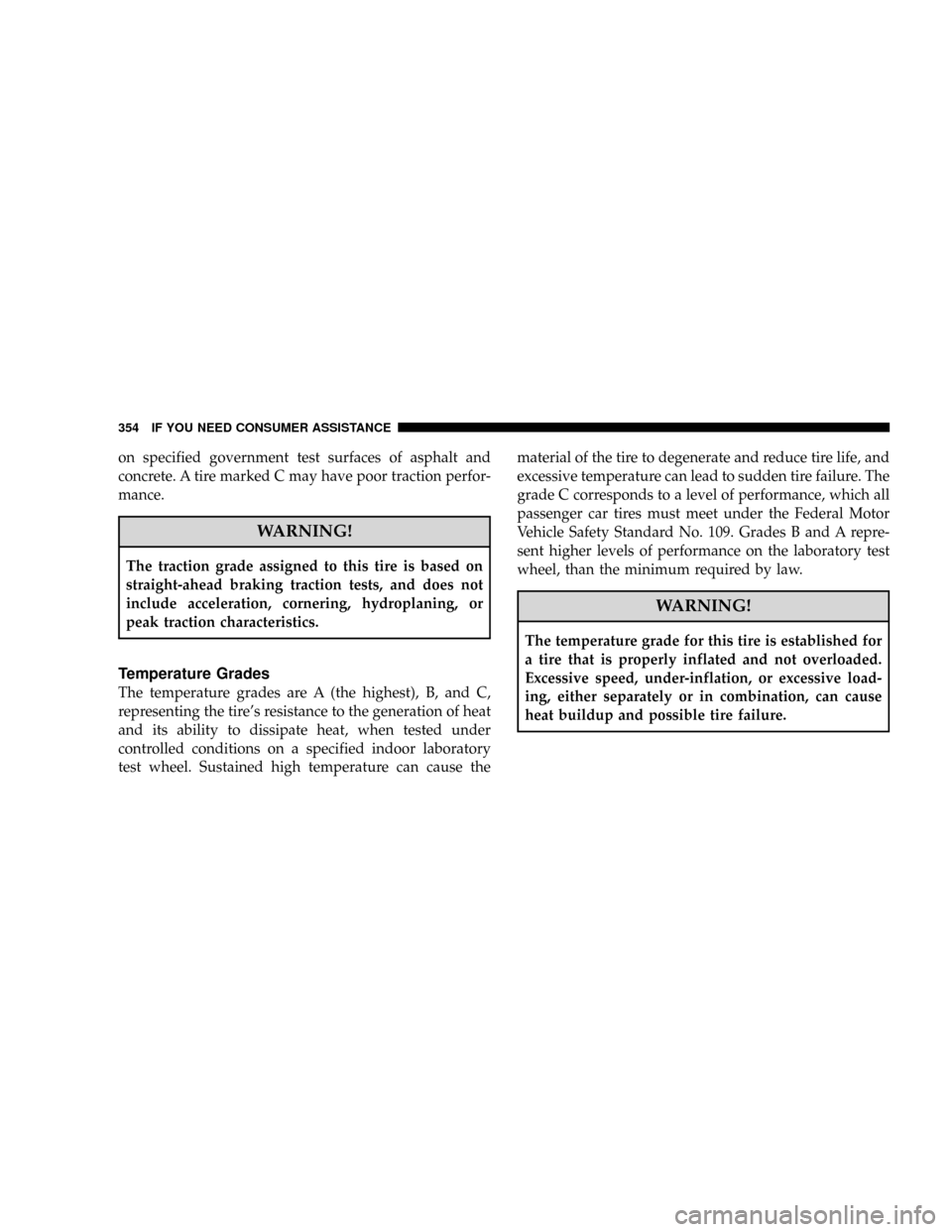
on specified government test surfaces of asphalt and
concrete. A tire marked C may have poor traction perfor-
mance.
WARNING!
The traction grade assigned to this tire is based on
straight-ahead braking traction tests, and does not
include acceleration, cornering, hydroplaning, or
peak traction characteristics.
Temperature Grades
The temperature grades are A (the highest), B, and C,
representing the tire's resistance to the generation of heat
and its ability to dissipate heat, when tested under
controlled conditions on a specified indoor laboratory
test wheel. Sustained high temperature can cause thematerial of the tire to degenerate and reduce tire life, and
excessive temperature can lead to sudden tire failure. The
grade C corresponds to a level of performance, which all
passenger car tires must meet under the Federal Motor
Vehicle Safety Standard No. 109. Grades B and A repre-
sent higher levels of performance on the laboratory test
wheel, than the minimum required by law.
WARNING!
The temperature grade for this tire is established for
a tire that is properly inflated and not overloaded.
Excessive speed, under-inflation, or excessive load-
ing, either separately or in combination, can cause
heat buildup and possible tire failure.
354 IF YOU NEED CONSUMER ASSISTANCE
Page 358 of 373
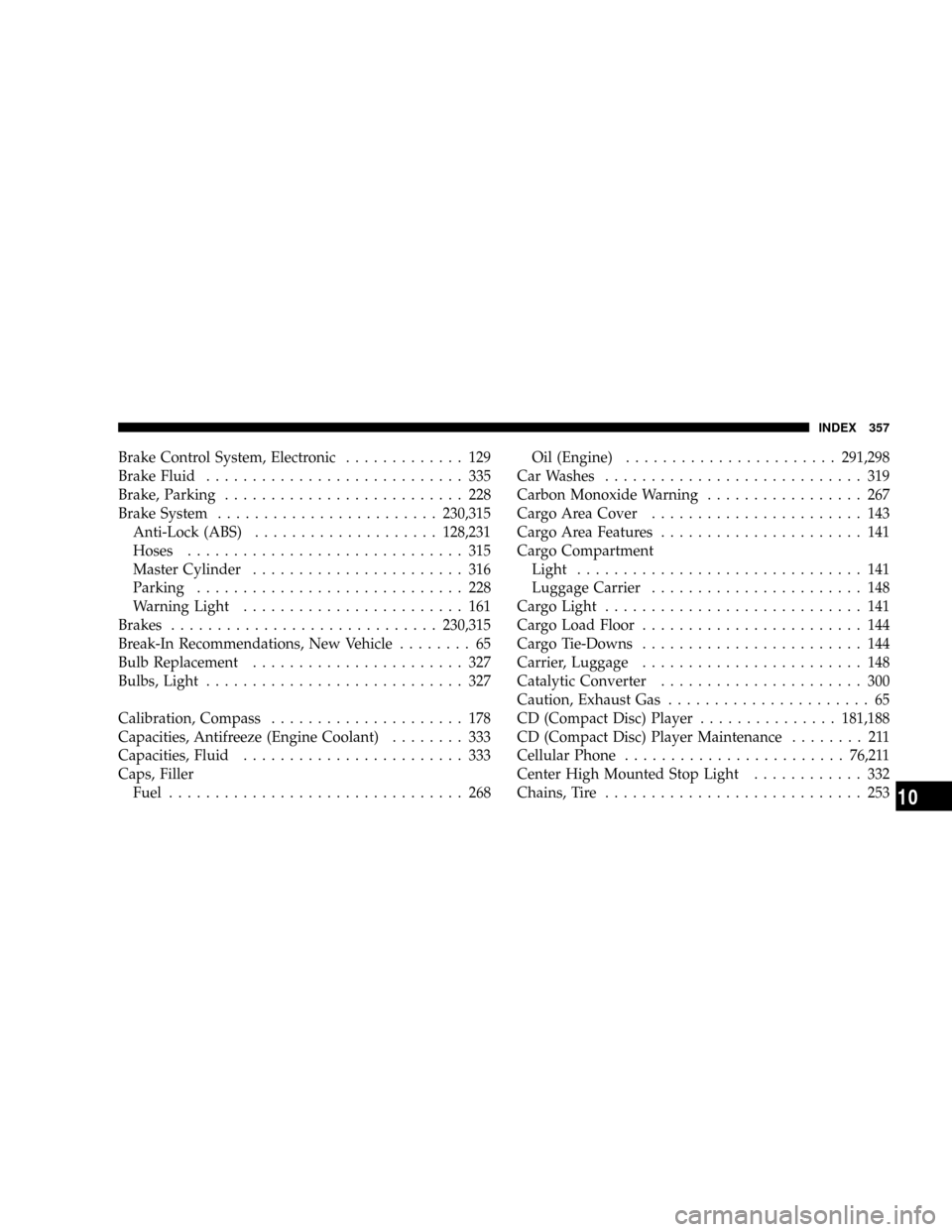
Brake Control System, Electronic............. 129
Brake Fluid............................ 335
Brake, Parking.......................... 228
Brake System........................230,315
Anti-Lock (ABS)....................128,231
Hoses.............................. 315
Master Cylinder....................... 316
Parking............................. 228
Warning Light........................ 161
Brakes.............................230,315
Break-In Recommendations, New Vehicle........ 65
Bulb Replacement....................... 327
Bulbs, Light............................ 327
Calibration, Compass..................... 178
Capacities, Antifreeze (Engine Coolant)........ 333
Capacities, Fluid........................ 333
Caps, Filler
Fuel................................ 268Oil (Engine).......................291,298
Car Washes............................ 319
Carbon Monoxide Warning................. 267
Cargo Area Cover....................... 143
Cargo Area Features...................... 141
Cargo Compartment
Light............................... 141
Luggage Carrier....................... 148
Cargo Light............................ 141
Cargo Load Floor........................ 144
Cargo Tie-Downs........................ 144
Carrier, Luggage........................ 148
Catalytic Converter...................... 300
Caution, Exhaust Gas...................... 65
CD (Compact Disc) Player...............181,188
CD (Compact Disc) Player Maintenance........ 211
Cellular Phone........................76,211
Center High Mounted Stop Light............ 332
Chains, Tire............................ 253
INDEX 357
10