engine oil DODGE CALIBER SRT 2008 1.G User Guide
[x] Cancel search | Manufacturer: DODGE, Model Year: 2008, Model line: CALIBER SRT, Model: DODGE CALIBER SRT 2008 1.GPages: 373, PDF Size: 3 MB
Page 292 of 373
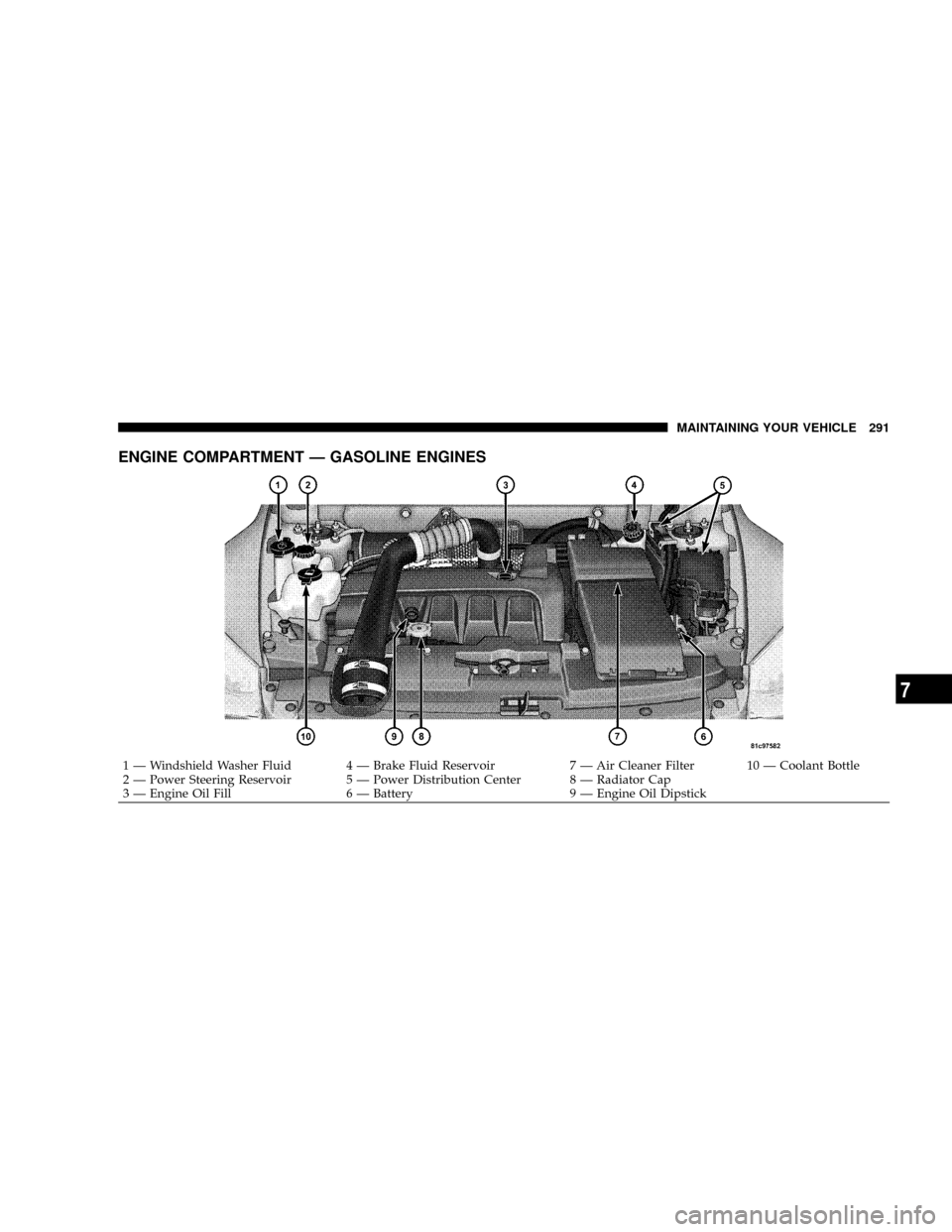
ENGINE COMPARTMENT Ð GASOLINE ENGINES
1 Ð Windshield Washer Fluid 4 Ð Brake Fluid Reservoir 7 Ð Air Cleaner Filter 10 Ð Coolant Bottle
2 Ð Power Steering Reservoir 5 Ð Power Distribution Center 8 Ð Radiator Cap
3 Ð Engine Oil Fill 6 Ð Battery 9 Ð Engine Oil DipstickMAINTAINING YOUR VEHICLE 291
7
Page 297 of 373
MAINTENANCE PROCEDURES
The pages that follow contain therequiredmaintenance
services determined by the engineers who designed your
vehicle.
Besides the maintenance items for which there are fixed
maintenance intervals, there are other items that should
operate satisfactorily without periodic maintenance.
However, if a malfunction of these items does occur, it
could adversely affect the engine or vehicle performance.
These items should be inspected if a malfunction is
observed or suspected.
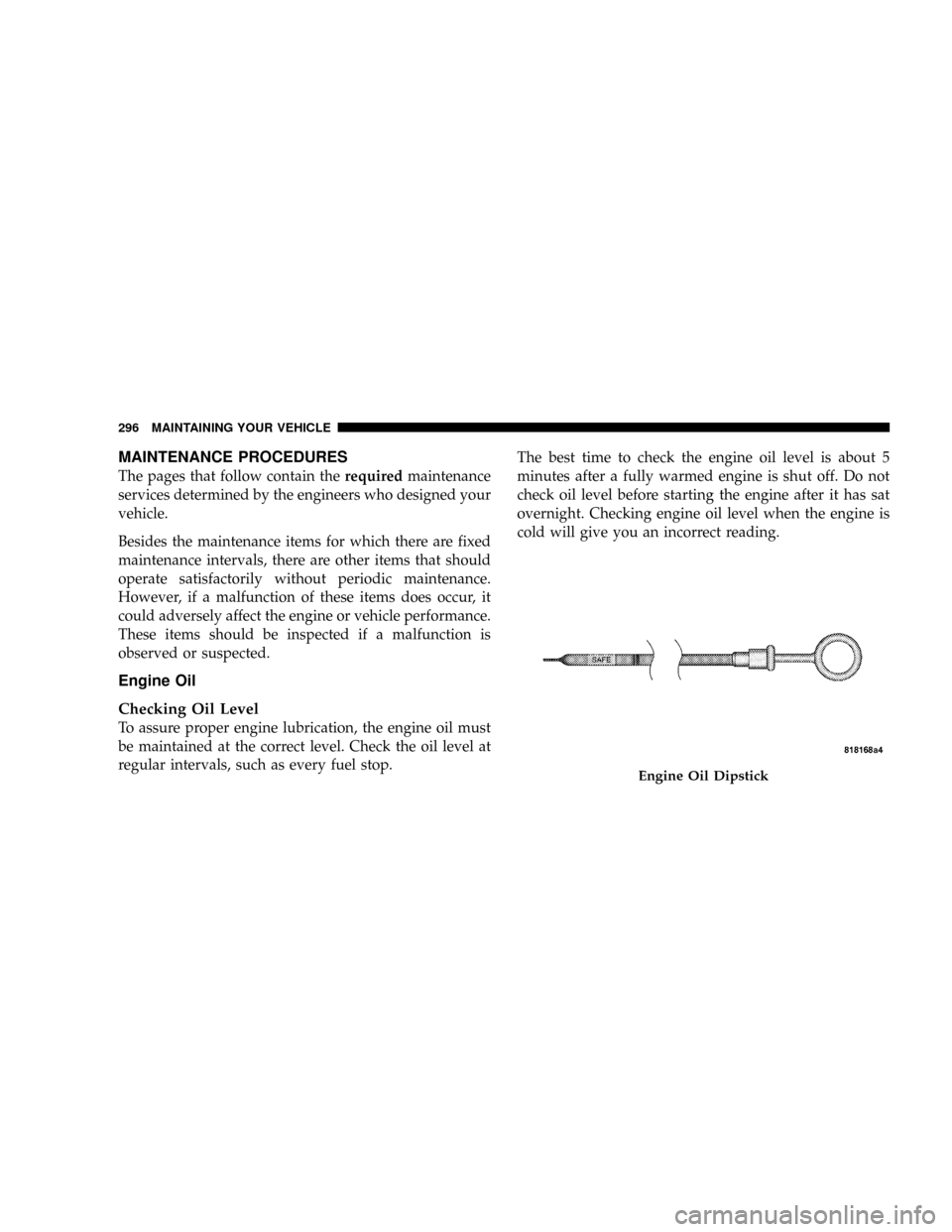
Engine Oil
Checking Oil Level
To assure proper engine lubrication, the engine oil must
be maintained at the correct level. Check the oil level at
regular intervals, such as every fuel stop.The best time to check the engine oil level is about 5
minutes after a fully warmed engine is shut off. Do not
check oil level before starting the engine after it has sat
overnight. Checking engine oil level when the engine is
cold will give you an incorrect reading.
Engine Oil Dipstick
296 MAINTAINING YOUR VEHICLE
Page 298 of 373
Checking the oil while the vehicle is on level ground and
only when the engine is hot, will improve the accuracy of
the oil level readings. Maintain the oil level between the
range markings on the dipstick. The range markings will
consist of a crosshatch zone that says SAFE or a cross-
hatch zone that says MIN at the low end of the range and
MAX at the high end of the range. Adding one quart of
oil when the reading is at the low end of the indicated
range will result in the oil level at the full end of the
indicator range.
CAUTION!
Do not overfill the engine. Overfilling the engine as
indicated by the range markings, as described above,
on the engine oil dipstick will cause oil aeration,
which can lead to loss of oil pressure and an increase
in oil temperature. This could damage your engine.
Change Engine Oil
Refer to the ªMaintenance Scheduleº in Section 8 for
recommended engine oil change intervals.
Engine Oil Selection
For best performance and maximum protection under all
types of operating conditions, the manufacturer only
recommends full synthetic engine oils that meet require-
ments of DaimlerChrysler Material Standard MS-10725.
The manufacturer recommends the use of a full synthetic
engine oil, such as Mobil 1tSAE 0W-40 or equivalent.
MAINTAINING YOUR VEHICLE 297
7
Page 299 of 373
Engine Oil Viscosity (SAE Grade)
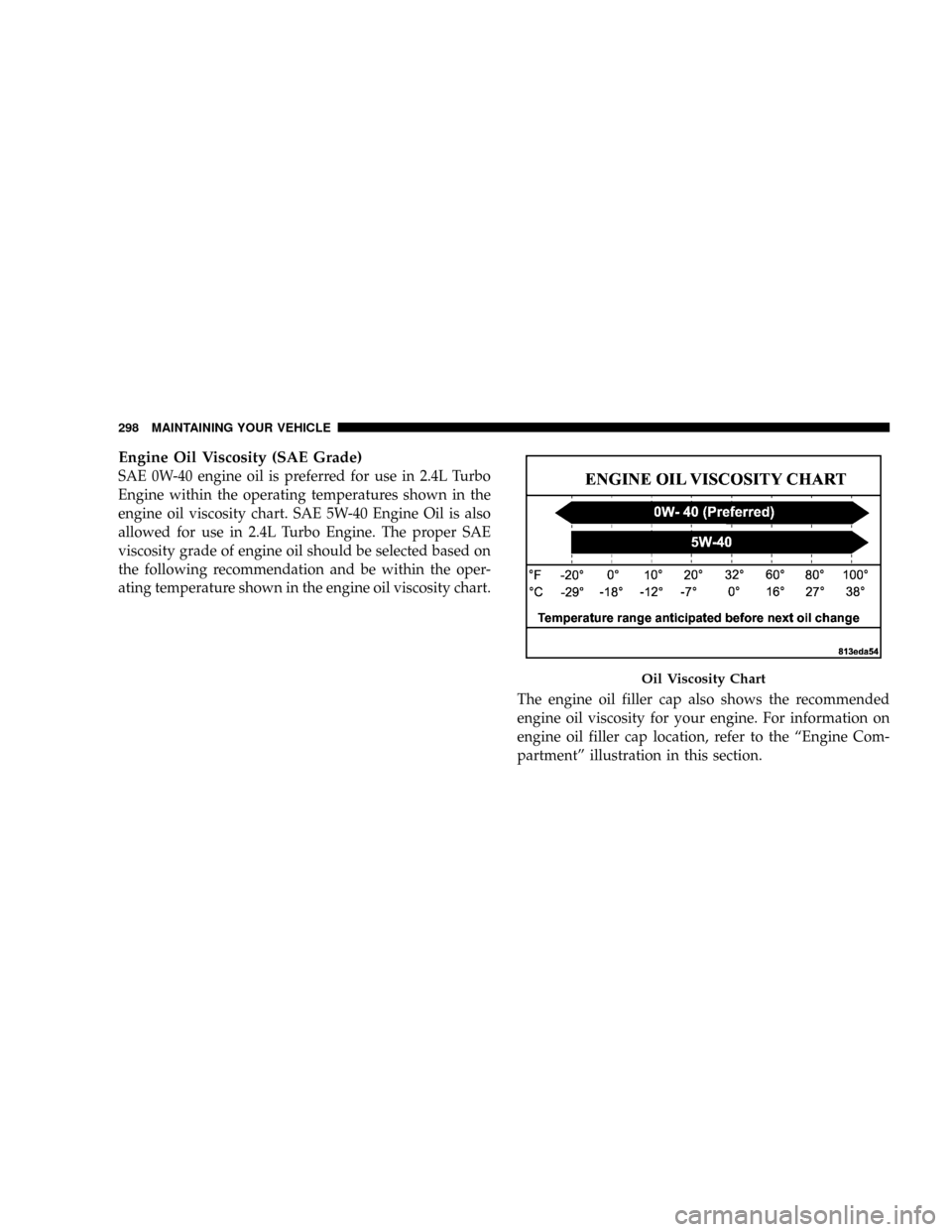
SAE 0W-40 engine oil is preferred for use in 2.4L Turbo
Engine within the operating temperatures shown in the
engine oil viscosity chart. SAE 5W-40 Engine Oil is also
allowed for use in 2.4L Turbo Engine. The proper SAE
viscosity grade of engine oil should be selected based on
the following recommendation and be within the oper-
ating temperature shown in the engine oil viscosity chart.
The engine oil filler cap also shows the recommended
engine oil viscosity for your engine. For information on
engine oil filler cap location, refer to the ªEngine Com-
partmentº illustration in this section.
Oil Viscosity Chart
298 MAINTAINING YOUR VEHICLE
Page 300 of 373
Materials Added To Engine Oils
The manufacture strongly recommends against the addi-
tion of any additives (other than leak detection dyes) to
the engine oil. Engine oil is an engineered product and
it's performance may be impaired by supplemental ad-
ditives.
Disposing of Used Engine Oil
Care should be taken in disposing of used engine oil from
your vehicle. Used oil, indiscriminately discarded, can
present a problem to the environment. Contact your
dealer, service station, or governmental agency for advice
on how and where used oil can be safely discarded in
your area.
Engine Oil Filter
The engine oil filter should be replaced at every engine
oil change.
Engine Oil Filter Selection
All of this manufacturers engines have a full-flow type
disposable oil filter. Use a filter of this type for replace-
ment. The quality of replacement filters varies consider-
ably. Only high quality filters should be used to assure
most efficient service. Mopar Engine Oil Filters are high
quality oil filters and are recommended.
Drive Belt ± Check Condition
Check the drive belt condition. Refer to the ªMaintenance
Scheduleº in Section 8 of this manual.
Inspect the drive belt for evidence of cuts, cracks, or
glazing and replace belt if any sign of damage which
could result in belt failure.
The belt is self-tensioning and will not need adjustment.
MAINTAINING YOUR VEHICLE 299
7
Page 303 of 373
Fuel Filter
A plugged fuel filter can cause hard starting or limit the
speed at which a vehicle can be driven. Should an
excessive amount of dirt accumulate in the fuel tank,
frequent filter replacement may be necessary. The fuel
filters are located inside the fuel tank. See your dealer for
service.
Air Cleaner Element (Filter)
Replace the filter at the intervals shown in the ªMainte-
nance Schedule.º Refer to Section 8 of this manual.
NOTE:For vehicles with a Turbo engine, a small
amount of oil accumulation in the air cleaner box is
normal. The amount will depend on driving style. The air
cleaner box should be cleaned out and a new make-up-
air filter element should be installed during the normal
air filter maintenance procedure.
WARNING!
The air cleaner can provide a measure of protection
in the case of engine backfire. Do not remove the air
cleaner unless such removal is necessary for repair or
maintenance. Make sure that no one is near the
engine compartment before starting the vehicle with
the air cleaner removed. Failure to do so can result in
serious personal injury.
Maintenance-Free Battery
You will never have to add water, nor is periodic main-
tenance required.
302 MAINTAINING YOUR VEHICLE
Page 307 of 373
WARNING!
Fluid level should be checked on a level surface and
with the engine off to prevent injury from moving
parts and to insure accurate fluid level reading. Do
not overfill. Use only manufacturers recommended
power steering fluid.
If necessary, add fluid to restore to the proper indicated
level. With a clean cloth, wipe any spilled fluid from all
surfaces. Refer to ªFluids, Lubricants, and Genuine
Partsº for correct fluid types.
Front Suspension Ball Joints
There are two front suspension lower ball joints that are
permanently lubricated. Inspect these ball joints when-
ever under vehicle service is done. Damaged seals and
their corresponding potentially damaged ball joints must
be replaced.
Body Lubrication
Locks and all body pivot points, including such items as
seat tracks, doors, liftgate and hood hinges, should be
lubricated periodically to assure quiet, easy operation
and to protect against rust and wear. Prior to the appli-
cation of any lubricant, the parts concerned should be
wiped clean to remove dust and grit; after lubricating
excess oil and grease should be removed. Particular
attention should also be given to hood latching compo-
nents to insure proper function. When performing other
underhood services, the hood latch, release mechanism
and safety catch should be cleaned and lubricated.
The external lock cylinders should be lubricated twice a
year, preferably in the fall and spring. Apply a small
amount of a high quality lubricant such as MopartLock
Cylinder Lubricant directly into the lock cylinder.
306 MAINTAINING YOUR VEHICLE
Page 308 of 373
Windshield Wiper Blades
Clean the rubber edges of the wiper blades and the
windshield periodically with a sponge or soft cloth and a
mild nonabrasive cleaner or use the washer solvent. This
will remove accumulations of salt, waxes or road film
and help reduce streaking and smearing.
Operation of the wipers on dry glass for long periods
may cause deterioration of the wiper blades. Always use
washer fluid when using the wipers to remove salt or dirt
from a dry windshield. Avoid using the wiper blades to
remove frost or ice from the windshield. make sure that
they are not frozen to the glass before turning them on to
avoid damaging the blade. Keep the blade rubber out of
contact with petroleum products such as engine oil,
gasoline, etc.
Windshield Wiper Blade Replacement
1. Lift the wiper arm away from the glass.2. Push the release tab and slide the wiper blade assem-
bly down along the arm. Gently place the wiper arm on
the windshield.
3. Install the new blade assembly onto the wiper arm tip
until it locks in place.
Windshield Washer Reservoir
The fluid reservoir is located in the engine compartment,
be sure to check the fluid level at regular intervals. Fill
the reservoir with windshield washer solvent only (not
radiator antifreeze). When refilling the washer fluid
reservoir, take some washer fluid and apply it to a cloth
or towel and wipe clean the wiper blades, this will help
blade performance.
To prevent freeze-up of your windshield washer system
in cold weather, select a solution or mixture that meets or
exceeds the temperature range of your climate. This
rating information can be found on most washer fluid
containers.
MAINTAINING YOUR VEHICLE 307
7
Page 309 of 373
The washer fluid reservoir will hold a full gallon of fluid
when the Low Washer Fluid Light illuminates.
Exhaust System
The best protection against carbon monoxide entry into
the vehicle body is a properly maintained engine exhaust
system.
If you notice a change in the sound of the exhaust system,
or if exhaust fumes can be detected inside the vehicle, or
when the underside or rear of the vehicle is damaged;
have a competent technician inspect the complete ex-
haust system and adjacent body areas for broken, dam-
aged, deteriorated, or mispositioned parts. Open seams
or loose connections could permit exhaust fumes to seep
into the passenger compartment. In addition, inspect the
exhaust system each time the vehicle is raised for an oil
change or lubrication. Replace as required.
WARNING!
Exhaust gases can injure or kill. They contain carbon
monoxide (CO) which is colorless and odorless.
Breathing it can make you unconscious and can
eventually poison you. To avoid breathing CO, refer
to Exhaust Gas in the Safety Tips section of this
manual.
308 MAINTAINING YOUR VEHICLE
Page 317 of 373
NOTE:Inspection of brake hoses should be done when-
ever the brake system is serviced and at every engine oil
change.
WARNING!
Worn brake hoses can burst and cause brake failure.
You could have an accident. If you see any signs of
cracking, scuffing, or worn spots, have the brake
hoses replaced immediately.
Brake Master Cylinder
The fluid level in the master cylinder should be checked
when performing under hood services, or immediately if
the brake system warning lamp is on.
Be sure to clean the top of the master cylinder area before
removing the cap. If necessary, add fluid to bring the
fluid level up to the requirements described on the brakefluid reservoir. Fluid level can be expected to fall as the
brake pads wear. Brake fluid level should be checked
when pads are replaced. However, low fluid level may be
caused by a leak and a checkup may be needed.
NOTE:The Brake Fluid Reservoir supplies fluid to both
the Brake System and the Clutch Release System. The
two systems are separated in the reservoir and a leak in
one system will not affect the other system. TheManual
TransaxleClutch Release System should not require fluid
replacement during the life of the vehicle. If the Brake
Fluid Reservoir is low, and the brake system does not
indicate any leaks or other problems, it may be a result of
a leak in the Hydraulic Clutch Release System. See your
local authorized dealer for service.
Use only manufacturers recommended brake fluid, refer
to ªFluids, Lubricants, and Genuine Partsº for correct
fluid type.
316 MAINTAINING YOUR VEHICLE