flat tire DODGE CALIBER SRT 2008 1.G User Guide
[x] Cancel search | Manufacturer: DODGE, Model Year: 2008, Model line: CALIBER SRT, Model: DODGE CALIBER SRT 2008 1.GPages: 373, PDF Size: 3 MB
Page 250 of 373
Tire Pressures for High Speed Operation
The manufacturer advocates driving at safe speeds
within posted speed limits. Where speed limits or condi-
tions are such that the vehicle can be driven at high
speeds, maintaining correct tire inflation pressure is very
important. Increased tire pressure and reduced vehicle
loading may be required for high-speed vehicle opera-
tion. Refer to original equipment or an authorized tire
dealer for recommended safe operating speeds, loading
and cold tire inflation pressures.
WARNING!
High speed driving with your vehicle under maxi-
mum load is dangerous. The added strain on your
tires could cause them to fail. You could have a
serious accident. Don't drive a vehicle loaded to the
maximum capacity at continuous speeds above 75
mph (120 km/h).
Radial-Ply Tires
WARNING!
Combining radial ply tires with other types of tires
on your vehicle will cause your vehicle to handle
poorly. The instability could cause an accident. Al-
ways use radial ply tires in sets of four (or 6, in case
of trucks with dual rear wheels). Never combine
them with other types of tires.
Cuts and punctures in radial tires are repairable only in
the tread area because of sidewall flexing. Consult your
authorized tire dealer for radial tire repairs.
STARTING AND OPERATING 249
5
Page 252 of 373
These indicators are molded into the bottom of the tread
grooves. They will appear as bands when the tread depth
becomes 1/16 inch (2 mm). When the tread is worn to the
tread wear indicators, the tire should be replaced.
Many states have laws requiring tire replacement at this
point.
Life of Tire
The service life of a tire is dependent upon varying
factors including but not limited to:
²Driving style
²Tire pressure
²Distance driven
WARNING!
Tires and spare tire should be replaced after six years,
regardless of the remaining tread. Failure to follow
this warning can result in sudden tire failure. You
could lose control and have an accident resulting in
serious injury or death.
Keep dismounted tires in a cool, dry place with as little
exposure to light as possible. Protect tires from contact
with oil, grease, and gasoline.
Replacement Tires
The tires on your new vehicle provide a balance of many
characteristics. They should be inspected regularly for
wear and correct cold tire inflation pressure. The manu-
facturer strongly recommends that you use tires equiva-
lent to the originals in size, quality and performance
when replacement is needed (refer to the paragraph on
STARTING AND OPERATING 251
5
Page 256 of 373
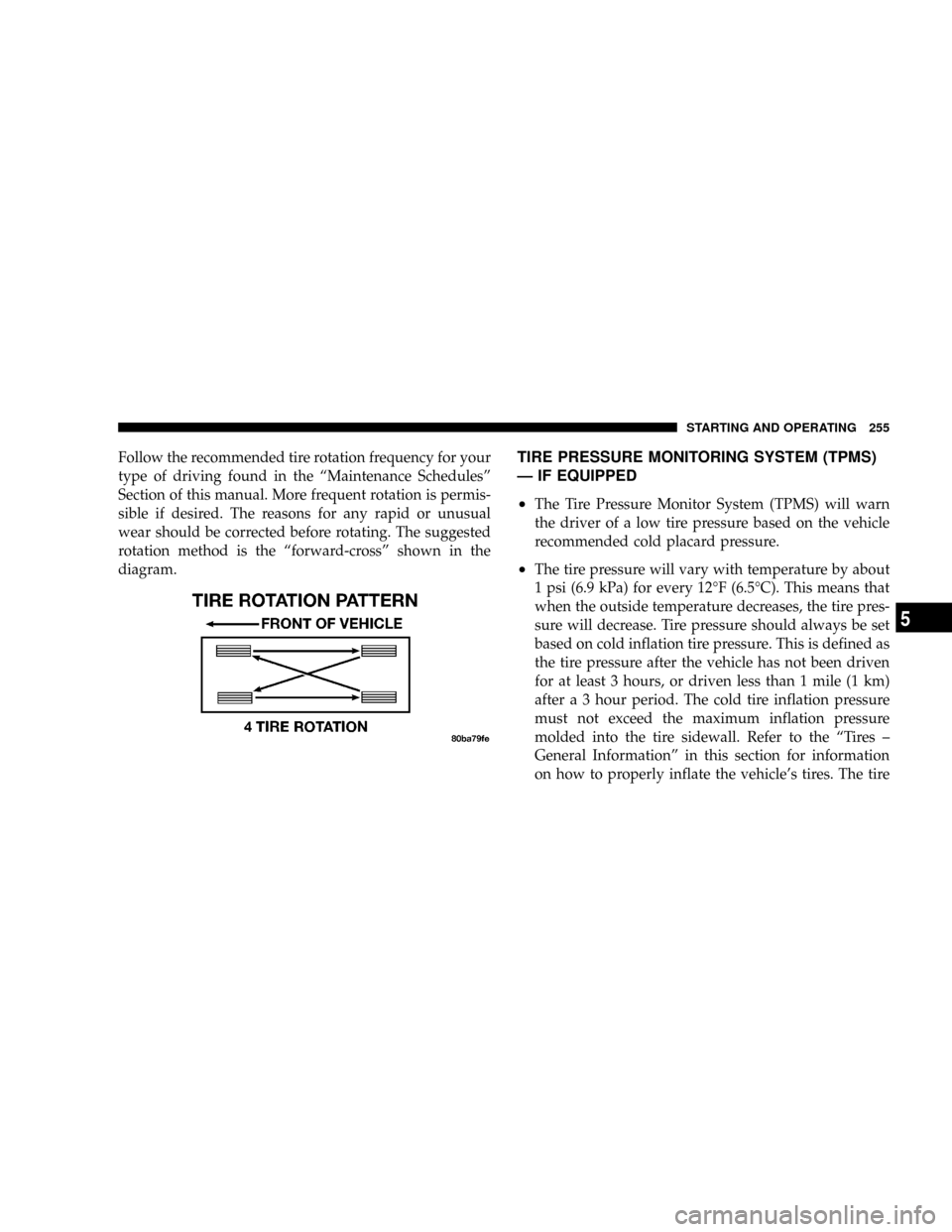
Follow the recommended tire rotation frequency for your
type of driving found in the ªMaintenance Schedulesº
Section of this manual. More frequent rotation is permis-
sible if desired. The reasons for any rapid or unusual
wear should be corrected before rotating. The suggested
rotation method is the ªforward-crossº shown in the
diagram.TIRE PRESSURE MONITORING SYSTEM (TPMS)
Ð IF EQUIPPED
²
The Tire Pressure Monitor System (TPMS) will warn
the driver of a low tire pressure based on the vehicle
recommended cold placard pressure.
²The tire pressure will vary with temperature by about
1 psi (6.9 kPa) for every 12ÉF (6.5ÉC). This means that
when the outside temperature decreases, the tire pres-
sure will decrease. Tire pressure should always be set
based on cold inflation tire pressure. This is defined as
the tire pressure after the vehicle has not been driven
for at least 3 hours, or driven less than 1 mile (1 km)
after a 3 hour period. The cold tire inflation pressure
must not exceed the maximum inflation pressure
molded into the tire sidewall. Refer to the ªTires ±
General Informationº in this section for information
on how to properly inflate the vehicle's tires. The tire
STARTING AND OPERATING 255
5
Page 257 of 373
pressure will also increase as the vehicle is driven - this
is normal and there should be no adjustment for this
increased pressure.
²The TPM System will warn the driver of a low tire
pressure if the tire pressure falls below the low-
pressure warning limit for any reason, including low
temperature effects, or natural pressure loss through
the tire.
²The TPM System will continue to warn the driver of
low tire pressure as long as the condition exists, and
will not turn off until the tire pressure is at or above
the recommended cold placard pressure. Once the low
tire pressure warning (Tire Pressure Monitoring Tell-
tale Light) illuminates, you must increase the tire
pressure to the recommended cold placard pressure in
order for the Tire Pressure Monitoring Telltale Light to
turn off. The system will automatically update and the
Tire Pressure Monitoring Telltale Light will turn offonce the system receives the updated tire pressures.
The vehicle may need to be driven for up to 10 minutes
above 15 mph (25 km/h) in order for the TPMS to
receive this information.
þFor example, your vehicle may have a recom-
mended cold (parked for more than 3 hours) placard
pressure of 30 psi (207 kPa). If the ambient tempera-
ture is 68ÉF (20ÉC) and the measured tire pressure is
27 psi (186 kPa), a temperature drop to 20ÉF (-7ÉC)
will decrease the tire pressure to approximately 26
psi (179 kPa). This tire pressure is sufficiently low
enough to turn ON the Tire Pressure Monitoring
Telltale light. Driving the vehicle may cause the tire
pressure to rise to approximately 27 psi (186 kPa),
but the Tire Pressure Monitoring Telltale Light will
still be ON. In this situation, the Tire Pressure
Monitoring Telltale Light will turn OFF only after
the tires are inflated to the vehicle's recommended
cold placard pressure value.
256 STARTING AND OPERATING
Page 258 of 373
CAUTION!
²The TPMS has been optimized for the original
equipment tires and wheels. TPMS pressures and
warning have been established for the tire size
equipped on your vehicle. Undesirable system
operation or sensor damage may result when us-
ing replacement equipment that is not of the same
size, type, and/or style. Aftermarket wheels can
cause sensor damage. Do not use aftermarket tire
sealants or balance beads if your vehicle is
equipped with a TPMS, as damage to the sensors
may result.
²After inspecting or adjusting the tire pressure,
always reinstall the valve stem cap. This will
prevent moisture and dirt from entering the valve
stem, which could damage the Tire Pressure Moni-
toring Sensor.NOTE:
²The TPMS is not intended to replace normal tire care
and maintenance, or to provide warning of a tire
failure or condition.
²The TPMS should not be used as a tire pressure gauge
while adjusting your tire pressure.
²Driving on a significantly under-inflated tire causes
the tire to overheat and can lead to tire failure.
Under-inflation also reduces fuel efficiency and tire
tread life, and may affect the vehicle's handling and
stopping ability.
²The TPMS is not a substitute for proper tire mainte-
nance, and it is the driver 's responsibility to maintain
correct tire pressure using an accurate tire gauge, even
if under-inflation has not reached the level to trigger
illumination of the Tire Pressure Monitoring Telltale
light.
STARTING AND OPERATING 257
5
Page 259 of 373
²Seasonal temperature changes will affect tire pressure,
and the TPM system will monitor the actual tire
pressure in the tire.
Base System ± If Equipped
This is the Tire Pressure Monitoring System warn-
ing indicator located in the instrument cluster.
The Tire Pressure Monitor System (TPMS) uses wireless
technology with wheel rim mounted electronic sensors to
monitor tire pressure levels. Sensors, mounted to each
wheel as part of the valve stem, transmit tire pressure
readings to the Receiver Module.
NOTE:It is particularly important for you to check the
tire pressure in all of the tires on your vehicle regularly
and to maintain the proper pressure.The TPMS consists of the following components:
²Receiver Module
²4 Tire Pressure Monitoring Sensors
²Tire Pressure Monitoring Telltale Light
The Tire Pressure Monitoring Telltale Lamp will illumi-
nate in the instrument cluster, and an audible chime will
be activated when one or more of the four active road tire
pressures are low. Should this occur, you should stop as
soon as possible, check the inflation pressure of each tire
on your vehicle, and inflate each tire to the vehicle's
recommended cold placard pressure value. The system
will automatically update and the Tire Pressure Monitor-
ing Lamp will extinguish once the updated tire pressures
have been received. The vehicle may need to be driven
for up to 10 minutes above 15 mph (25 kph) to receive
this information.
258 STARTING AND OPERATING
Page 262 of 373
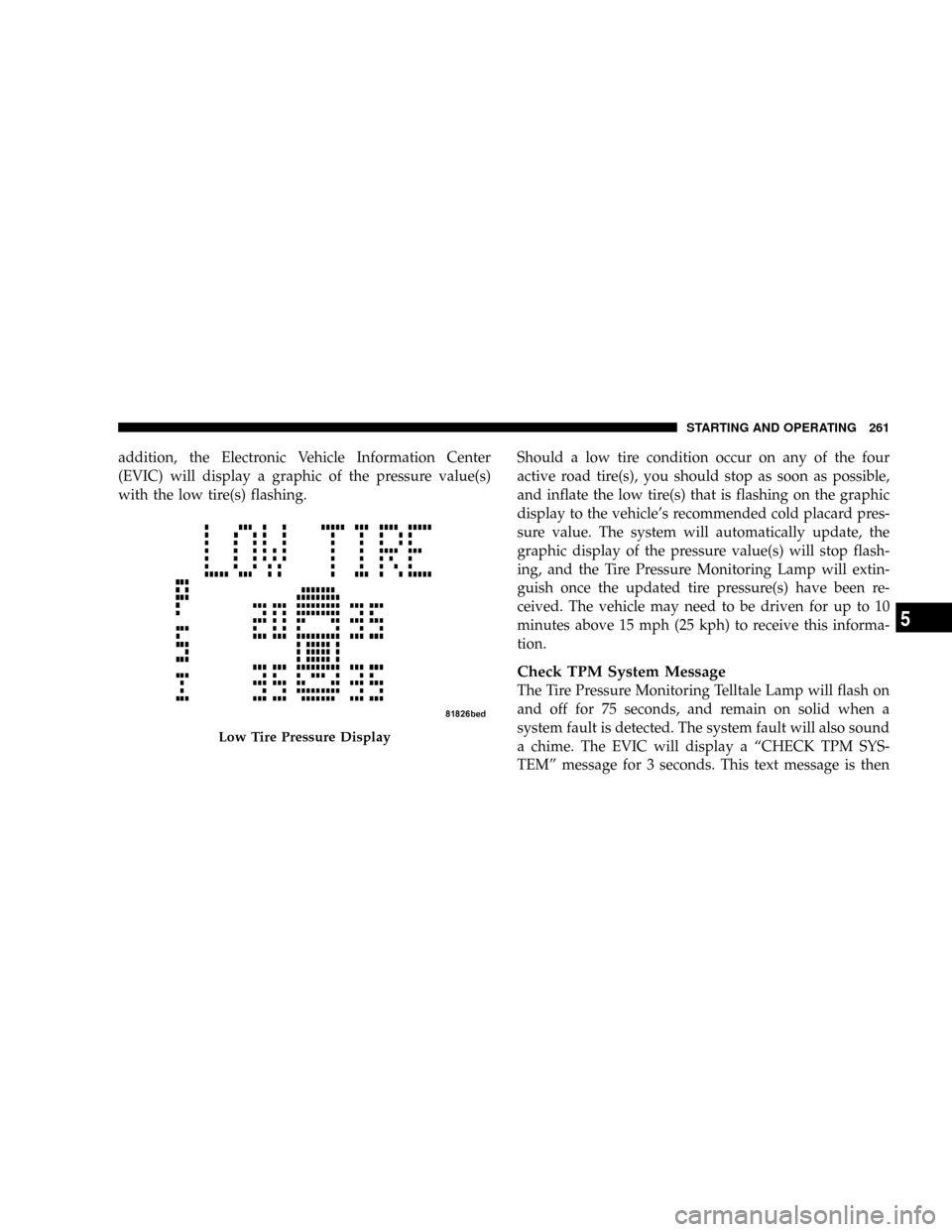
addition, the Electronic Vehicle Information Center
(EVIC) will display a graphic of the pressure value(s)
with the low tire(s) flashing.Should a low tire condition occur on any of the four
active road tire(s), you should stop as soon as possible,
and inflate the low tire(s) that is flashing on the graphic
display to the vehicle's recommended cold placard pres-
sure value. The system will automatically update, the
graphic display of the pressure value(s) will stop flash-
ing, and the Tire Pressure Monitoring Lamp will extin-
guish once the updated tire pressure(s) have been re-
ceived. The vehicle may need to be driven for up to 10
minutes above 15 mph (25 kph) to receive this informa-
tion.
Check TPM System Message
The Tire Pressure Monitoring Telltale Lamp will flash on
and off for 75 seconds, and remain on solid when a
system fault is detected. The system fault will also sound
a chime. The EVIC will display a ªCHECK TPM SYS-
TEMº message for 3 seconds. This text message is then
Low Tire Pressure Display
STARTING AND OPERATING 261
5
Page 278 of 373
TIREFIT Usage Precautions
NOTE:
²Replace the TIREFIT Sealant Bottle prior to the expi-
ration date (printed on the bottle label) to assure
optimum operation of the system.
²When the TIREFIT Sealant is in a liquid form, clean
water, and a damp cloth will remove the material from
the vehicle or tire and wheel components. Once the
sealant dries, it can easily be peeled off and properly
discarded.
²For optimum performance, make sure the valve stem
on the wheel is free of debris before connecting the
TIREFIT kit.
²You can use the TIREFIT air pump to inflate bicycle
tires. The kit also comes with two needles for inflating
sport balls, rafts, or like inflatable items. However, use
only the Black Air Pump Hose (6) and make sure the
Mode Select Knob (4) is in the Air Mode when
inflating such items to avoid injecting sealant into
them. The TIREFIT Sealant is only intended to seal
small punctures in the tire tread of a tire on this
vehicle.
WHAT TO DO IN EMERGENCIES 277
6
Page 279 of 373
WARNING!
²Do not attempt to seal a tire on the side of the vehicle close to traffic.
Pull far enough off the road to avoid the danger of being hit when
using the TIREFIT kit.
²Do not use TIREFIT or drive the vehicle under the following
circumstances:
þ If the cut or puncture in the tire tread is approximately 0.24 in. (6 mm)
or larger.
þ If the tire has any sidewall damage.
þ If the tire has any damage from driving with extremely low tire
pressure.
þ If the tire has any damage from driving on a flat tire.
þ If the wheel has any damage.
þ If you are unsure of the condition of the tire or the wheel.
²Keep TIREFIT away from open flame or heat source.
²TIREFIT is not a permanent flat tire repair. Have the tire inspected
and repaired or replaced after using TIREFIT. Do not exceed 55 mph
(90 km/h) until having the tire repaired or replaced.
²A loose TIREFIT kit thrown forward in a collision or hard stop could
endanger the occupants of the vehicle. Always stow the TIREFIT kit
in the place provided.
Failure to follow these warnings can result in injuries that are serious or
fatal to you, your passengers, and others around you.
WARNING!
²Take care not to allow the contents of TIREFIT to
come in contact with hair, eyes, or clothing. TIRE-
FIT is harmful if inhaled, swallowed, or absorbed
through the skin: It causes skin, eye, and respira-
tory irritation. Flush immediately with plenty of
water if there is any contact with eyes or skin.
Change clothing as soon as possible, if there is any
contact with clothing.
²TIREFIT Sealant solution contains latex. In case of
allergic reaction or rash, consult a physician imme-
diately. Keep TIREFIT out of reach of children. If
swallowed, rinse mouth immediately with plenty
of water and drink plenty of water. Do not induce
vomiting! Consult a physician immediately.
278 WHAT TO DO IN EMERGENCIES
Page 280 of 373
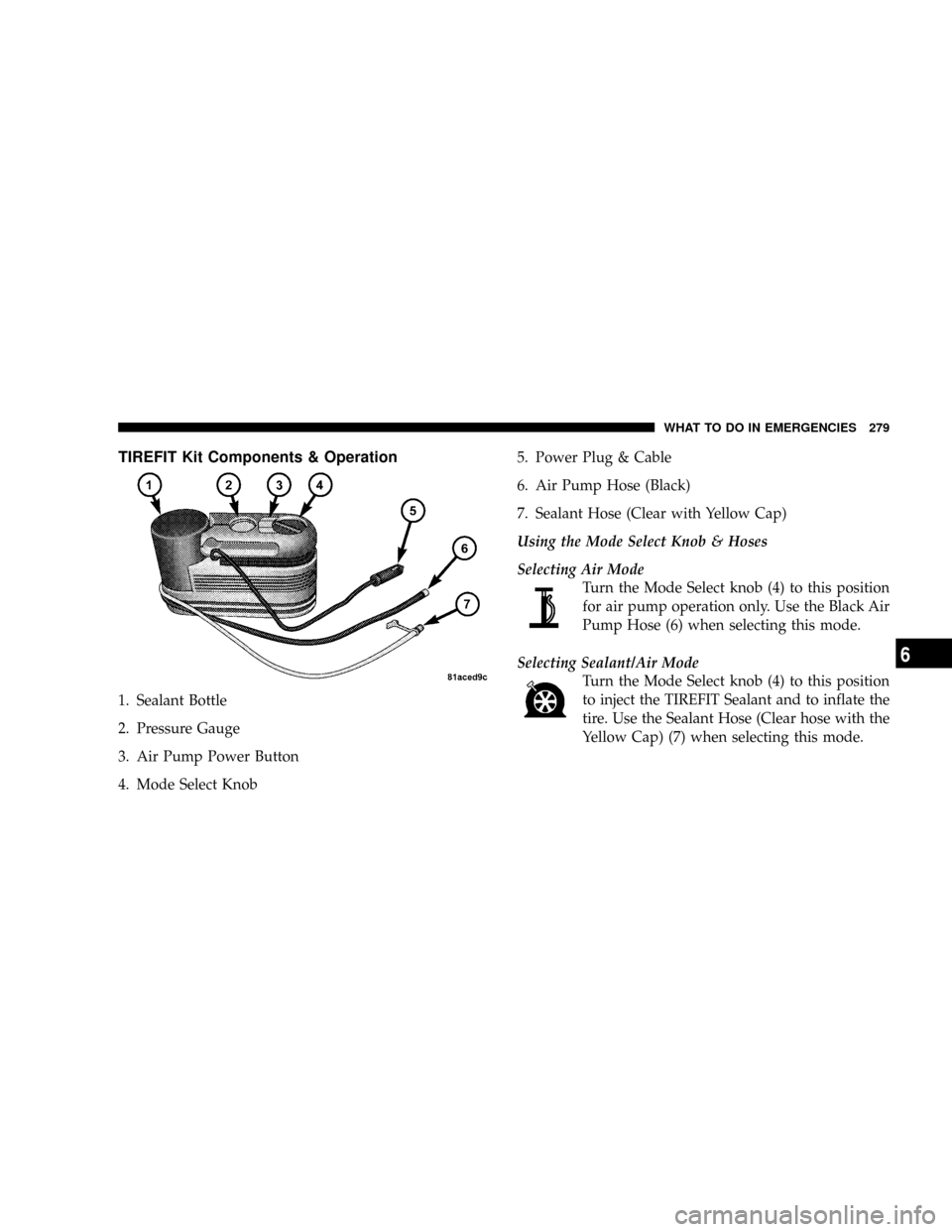
TIREFIT Kit Components & Operation
1. Sealant Bottle
2. Pressure Gauge
3. Air Pump Power Button
4. Mode Select Knob5. Power Plug & Cable
6. Air Pump Hose (Black)
7. Sealant Hose (Clear with Yellow Cap)
Using the Mode Select Knob & Hoses
Selecting Air Mode
Turn the Mode Select knob (4) to this position
for air pump operation only. Use the Black Air
Pump Hose (6) when selecting this mode.
Selecting Sealant/Air Mode
Turn the Mode Select knob (4) to this position
to inject the TIREFIT Sealant and to inflate the
tire. Use the Sealant Hose (Clear hose with the
Yellow Cap) (7) when selecting this mode.
WHAT TO DO IN EMERGENCIES 279
6