transmission DODGE CALIBER SRT 2008 1.G User Guide
[x] Cancel search | Manufacturer: DODGE, Model Year: 2008, Model line: CALIBER SRT, Model: DODGE CALIBER SRT 2008 1.GPages: 373, PDF Size: 3 MB
Page 229 of 373
CAUTION!
If you skip more than one gear while downshifting
or downshift at too high a vehicle speed, you could
damage the engine, transmission, or clutch.
To maintain a safe speed and prolong brake life, shift
down to 2nd or 1st when descending a steep grade.
When turning a corner, or driving up a steep grade,
downshift early so that the engine will not be overbur-
dened.
PARKING BRAKE
When the parking brake is applied with the
ignition on, the Brake Light in the instrument
cluster will come on.
NOTE:This light only shows that the parking brake is
on. It does not show the degree of brake application.
If the parking brake is applied while the vehicle is
moving, a chime will sound to alert the driver. The chime
will sound up to 10 times or until the vehicle has
returned to a stop.
Before leaving the vehicle, make sure that the parking
brake is set. To set the parking brake, pull up firmly on
the lever. Also place the gear selector in Reverse. To
release the parking brake, apply the brake pedal, pull up
slightly on the lever, then depress the button on the end
of the lever and push the lever fully down toward the
floor.
228 STARTING AND OPERATING
Page 237 of 373
Shallow Standing Water
Although your vehicle is capable of driving through
shallow standing water, consider the following Caution
and Warning before doing so.
CAUTION!
²Always check the depth of the standing water
before driving through it. Never drive through
standing water that is deeper than the bottom of
the tire rims mounted on the vehicle.
²Determine the condition of the road or the path
that is under water, and if there are any obstacles
in the way, before driving through the standing
water.
²Do not exceed 5 mph (8 km/h) when driving
through standing water. This will minimize wave
effects.
CAUTION!
²Driving through standing water may cause dam-
age to your vehicle's drivetrain components. Al-
ways inspect your vehicle's fluids (i.e., engine oil,
transmission, axle, etc.) for signs of contamination
(i.e., fluid that is milky or foamy in appearance)
after driving through standing water. Do not con-
tinue to operate the vehicle if any fluid appears
contaminated, as this may result in further dam-
age. Such damage is not covered by the New
Vehicle Limited Warranty.
²Getting water inside your vehicle's engine can
cause it to lock up and stall out, and cause serious
internal damage to the engine. Such damage is not
covered by the New Vehicle Limited Warranty.
236 STARTING AND OPERATING
Page 281 of 373
Using the Air Pump Power Button
Push and release the button (3) once to turn On
the TIREFIT kit. Push and release the button (3)
again to turn Off the TIREFIT kit.
Sealing a Tire with TIREFIT
(A) Whenever You Stop to Use TIREFIT:
Turn on the vehicle's hazard warning flashers.
1. Verify that the valve stem (on the wheel with the
deflated tire) is in a position that is near to the ground.
This will allow the TIREFIT Hoses (6) and (7) to reach the
valve stem and keep the TIREFIT kit flat on the ground.
This will provide the best positioning of the kit when
injecting the sealant into the deflated tire and running the
air pump. Move the vehicle as necessary to place the
valve stem in this position before proceeding.2. Place the transmission in Neutral and set the parking
brake.
3. Turn off the ignition.
(B) Setting Up to Use TIREFIT:
Turn the Mode Select knob (4) to the Sealant/
Air Mode position.
1. Uncoil the Clear Sealant Hose (7) and then remove the
Yellow Cap from the fitting at the end of the hose.
2. Place the TIREFIT kit flat on the ground next to the
deflated tire.
3. Remove the cap from the valve stem and then screw
the fitting at the end of the Sealant Hose (7) onto the
valve stem.
4. Uncoil the Power Plug and Cable (5) and then insert
the plug into the vehicle's power outlet.
280 WHAT TO DO IN EMERGENCIES
Page 289 of 373
All Transaxles
CAUTION!
If the vehicle being towed requires steering, the
ignition switch must be in the ACCESSORY posi-
tion, not in the LOCK position.
Do not attempt to use sling type equipment when
towing. When securing vehicle to flat bed truck, do
not attach to front or rear suspension components.
Damage to your vehicle may result from improper
towing.
If it is necessary to use the accessories while being towed
(wipers, defrosters, etc.), the key must be in the ON
position, not the ACCESSORY position. Make certain the
transaxle remains in NEUTRAL.
Without The Ignition Key
Special care must be taken when the vehicle is towed
with the ignition in the LOCK position. A dolly should be
used under the front wheels if the rear wheels are raised.
Proper towing equipment is necessary to prevent dam-
age to the vehicle.
Battery power is required to release the brake/
transmission interlock system. There is a removable plug
in the right side of the shifter housing that allows you to
insert your finger to override the system.
Towing This Vehicle Behind Another Vehicle (Flat
Towing With All Four Wheels On The Ground)
CAUTION!
DO NOT flat tow this vehicle. Damage to the driv-
etrain will result.
288 WHAT TO DO IN EMERGENCIES
Page 318 of 373
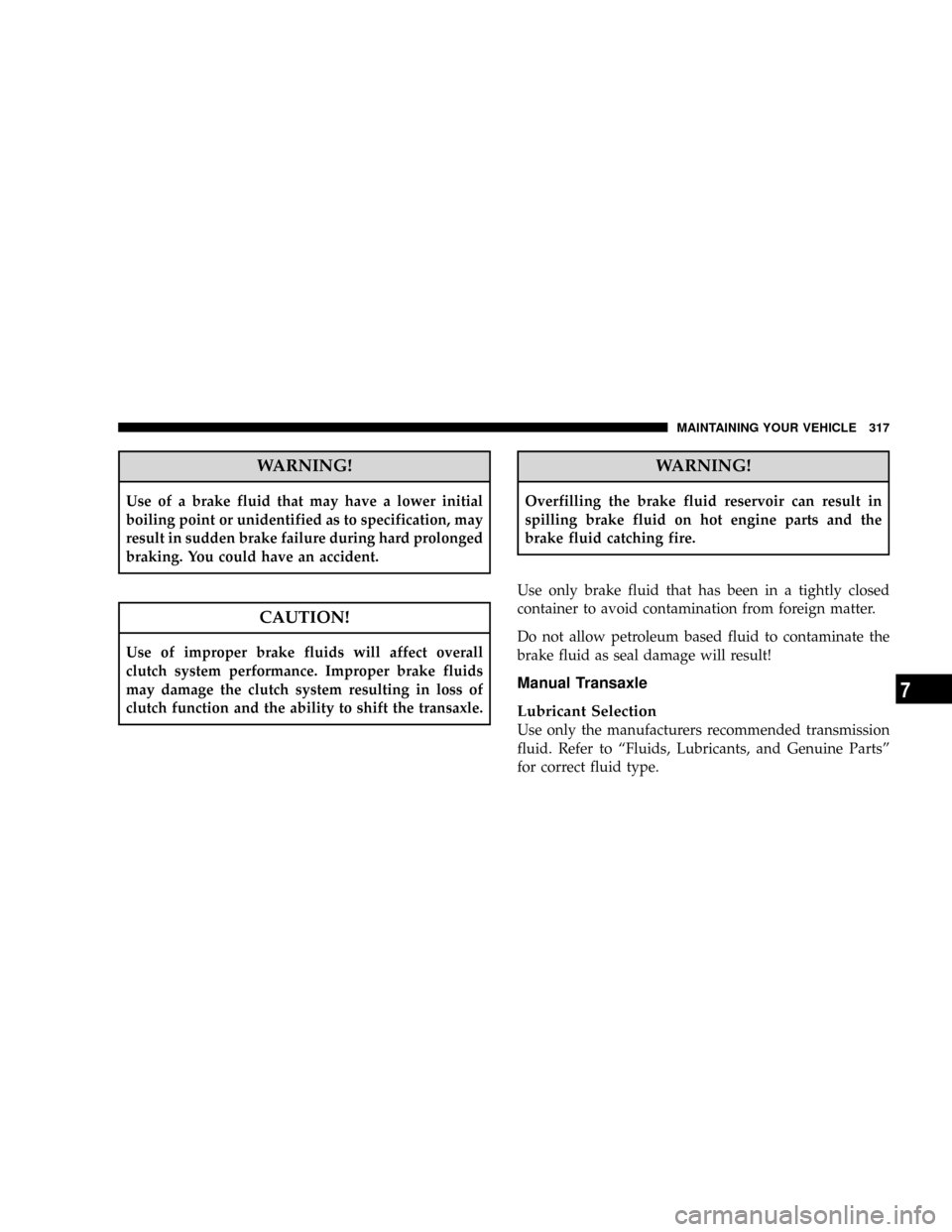
WARNING!
Use of a brake fluid that may have a lower initial
boiling point or unidentified as to specification, may
result in sudden brake failure during hard prolonged
braking. You could have an accident.
CAUTION!
Use of improper brake fluids will affect overall
clutch system performance. Improper brake fluids
may damage the clutch system resulting in loss of
clutch function and the ability to shift the transaxle.
WARNING!
Overfilling the brake fluid reservoir can result in
spilling brake fluid on hot engine parts and the
brake fluid catching fire.
Use only brake fluid that has been in a tightly closed
container to avoid contamination from foreign matter.
Do not allow petroleum based fluid to contaminate the
brake fluid as seal damage will result!
Manual Transaxle
Lubricant Selection
Use only the manufacturers recommended transmission
fluid. Refer to ªFluids, Lubricants, and Genuine Partsº
for correct fluid type.
MAINTAINING YOUR VEHICLE 317
7
Page 336 of 373
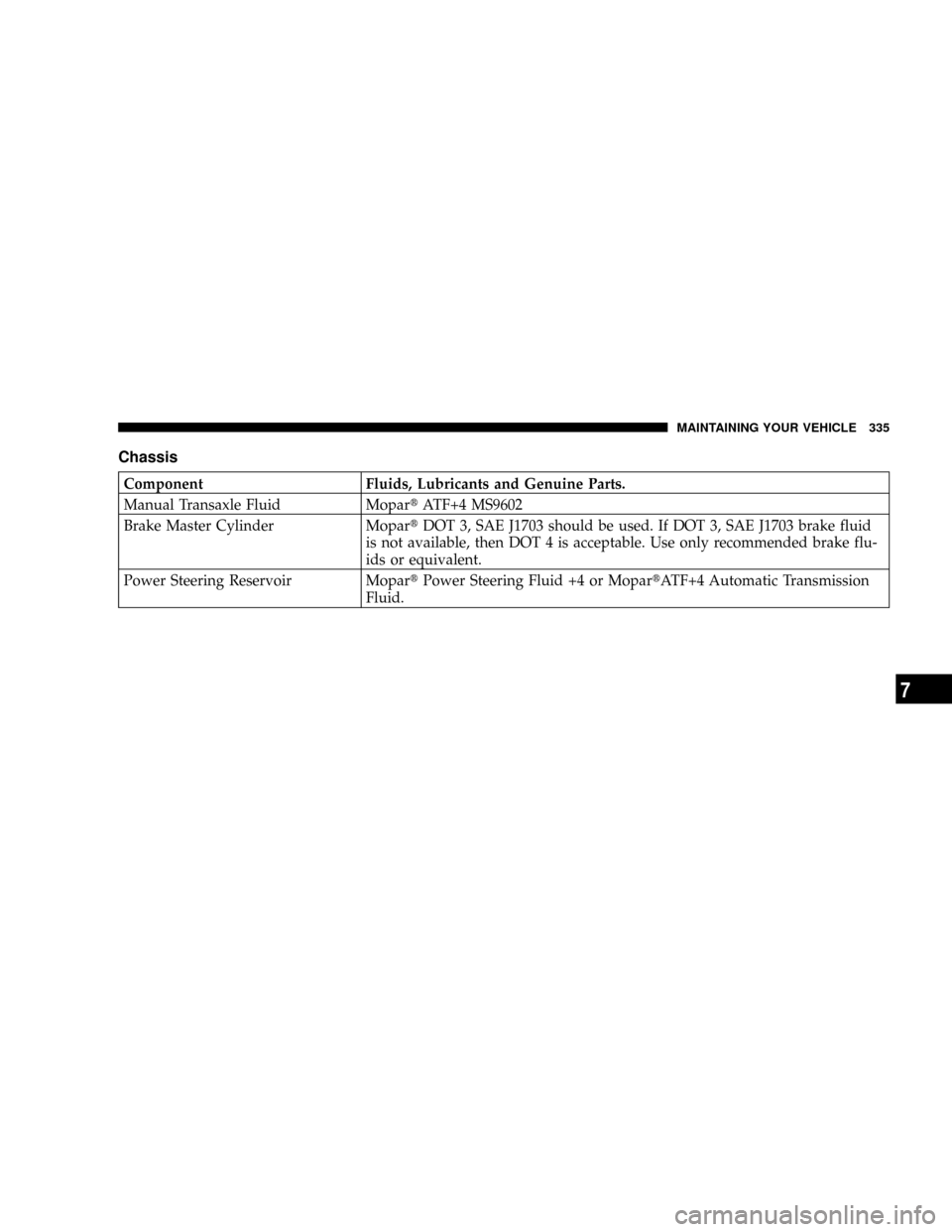
Chassis
Component Fluids, Lubricants and Genuine Parts.
Manual Transaxle Fluid MopartATF+4 MS9602
Brake Master Cylinder MopartDOT 3, SAE J1703 should be used. If DOT 3, SAE J1703 brake fluid
is not available, then DOT 4 is acceptable. Use only recommended brake flu-
ids or equivalent.
Power Steering Reservoir MopartPower Steering Fluid +4 or MopartATF+4 Automatic Transmission
Fluid.
MAINTAINING YOUR VEHICLE 335
7
Page 341 of 373
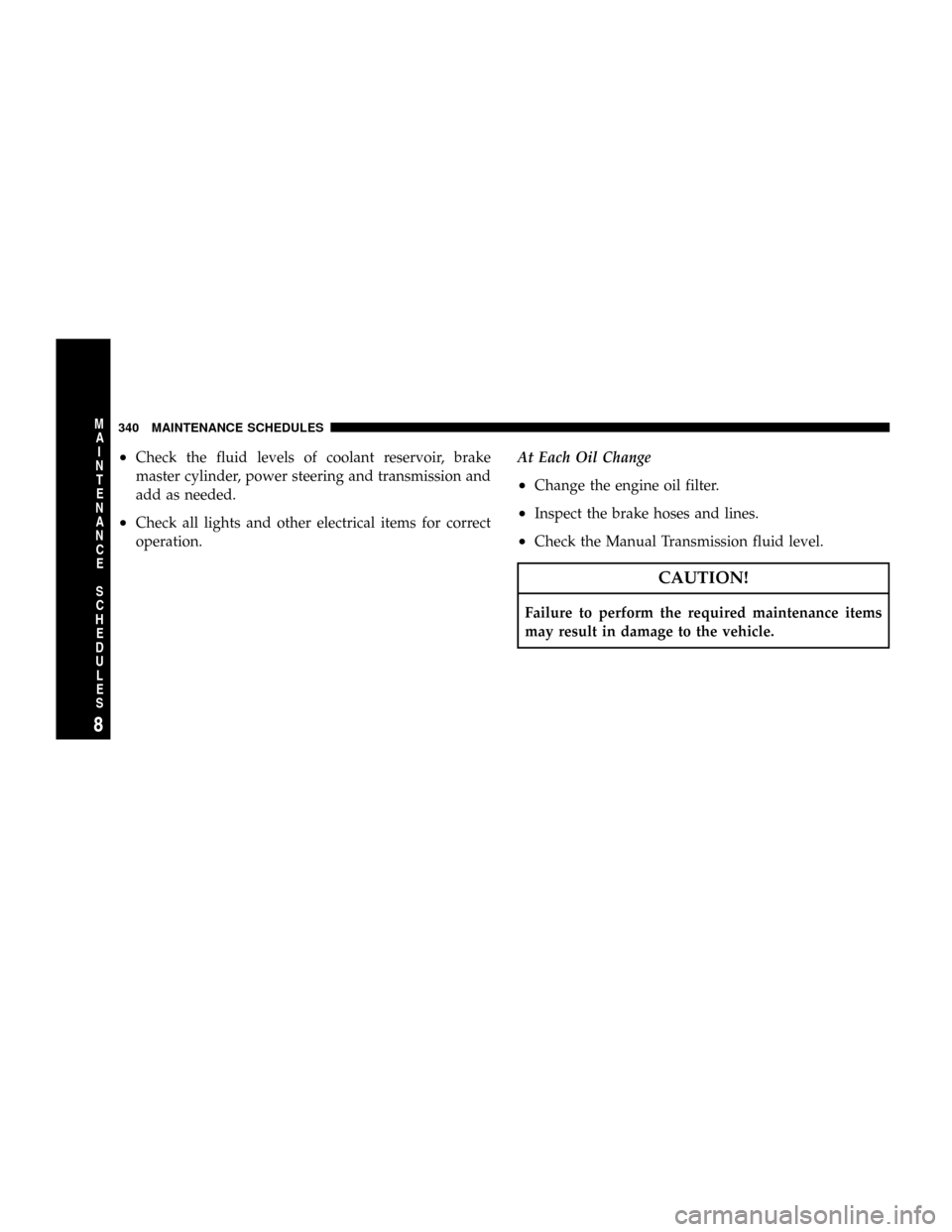
²Check the fluid levels of coolant reservoir, brake
master cylinder, power steering and transmission and
add as needed.
²Check all lights and other electrical items for correct
operation.At Each Oil Change
²Change the engine oil filter.
²Inspect the brake hoses and lines.
²Check the Manual Transmission fluid level.
CAUTION!
Failure to perform the required maintenance items
may result in damage to the vehicle.
340 MAINTENANCE SCHEDULES
8
M
A
I
N
T
E
N
A
N
C
E
S
C
H
E
D
U
L
E
S
Page 343 of 373
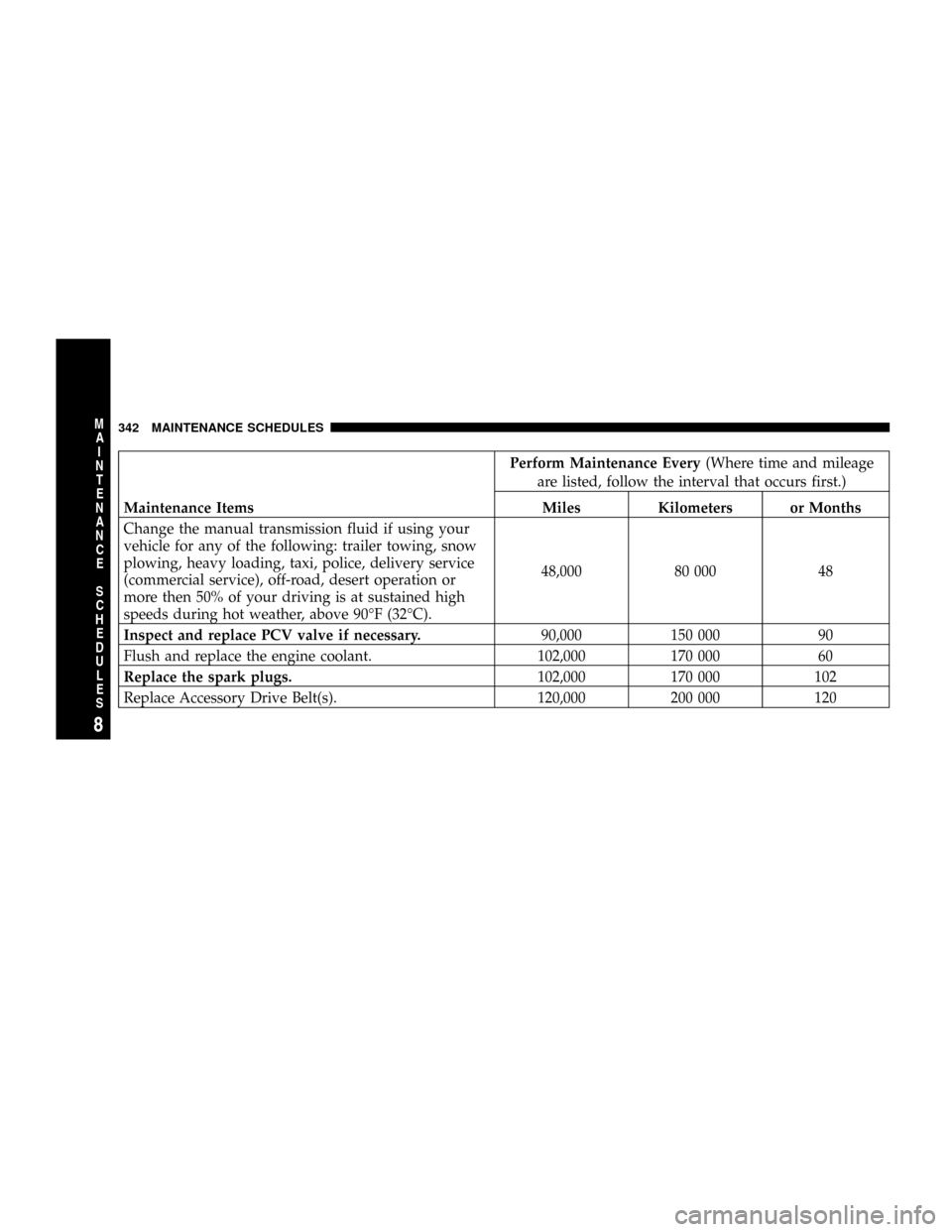
Perform Maintenance Every(Where time and mileage
are listed, follow the interval that occurs first.)
Maintenance Items Miles Kilometers or Months
Change the manual transmission fluid if using your
vehicle for any of the following: trailer towing, snow
plowing, heavy loading, taxi, police, delivery service
(commercial service), off-road, desert operation or
more then 50% of your driving is at sustained high
speeds during hot weather, above 90ÉF (32ÉC).48,000 80 000 48
Inspect and replace PCV valve if necessary.90,000 150 000 90
Flush and replace the engine coolant. 102,000 170 000 60
Replace the spark plugs.102,000 170 000 102
Replace Accessory Drive Belt(s). 120,000 200 000 120
342 MAINTENANCE SCHEDULES
8
M
A
I
N
T
E
N
A
N
C
E
S
C
H
E
D
U
L
E
S
Page 369 of 373
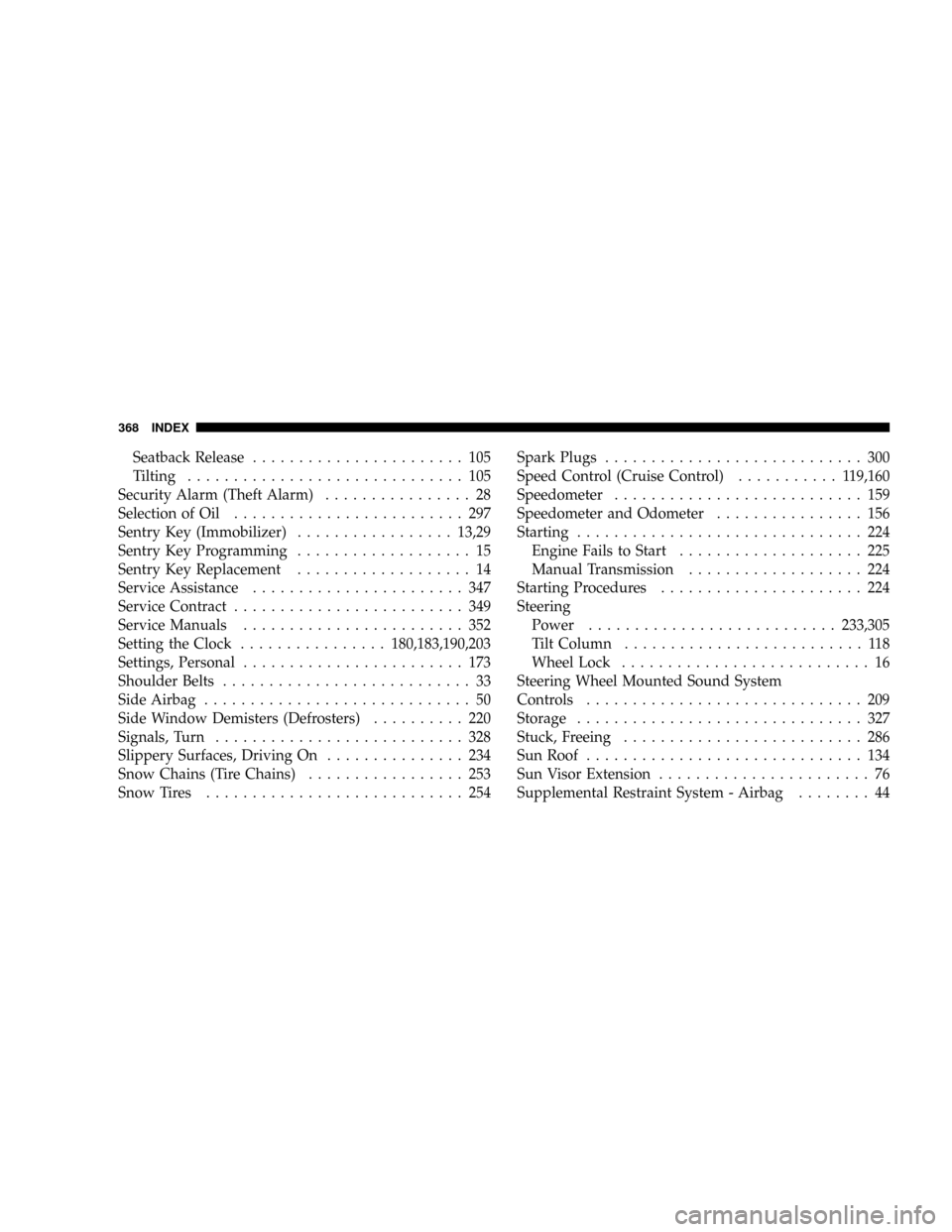
Seatback Release....................... 105
Tilting.............................. 105
Security Alarm (Theft Alarm)................ 28
Selection of Oil......................... 297
Sentry Key (Immobilizer).................13,29
Sentry Key Programming................... 15
Sentry Key Replacement................... 14
Service Assistance....................... 347
Service Contract......................... 349
Service Manuals........................ 352
Setting the Clock................180,183,190,203
Settings, Personal........................ 173
Shoulder Belts........................... 33
Side Airbag............................. 50
Side Window Demisters (Defrosters).......... 220
Signals, Turn........................... 328
Slippery Surfaces, Driving On............... 234
Snow Chains (Tire Chains)................. 253
Snow Tires............................ 254Spark Plugs............................ 300
Speed Control (Cruise Control)........... 119,160
Speedometer........................... 159
Speedometer and Odometer................ 156
Starting............................... 224
Engine Fails to Start.................... 225
Manual Transmission................... 224
Starting Procedures...................... 224
Steering
Power...........................233,305
Tilt Column.......................... 118
Wheel Lock........................... 16
Steering Wheel Mounted Sound System
Controls.............................. 209
Storage............................... 327
Stuck, Freeing.......................... 286
Sun Roof.............................. 134
Sun Visor Extension....................... 76
Supplemental Restraint System - Airbag........ 44
368 INDEX