lock DODGE CALIBER SRT 2008 1.G Owner's Manual
[x] Cancel search | Manufacturer: DODGE, Model Year: 2008, Model line: CALIBER SRT, Model: DODGE CALIBER SRT 2008 1.GPages: 373, PDF Size: 3 MB
Page 33 of 373
windows will operate only when the ignition switch is
turned to the ON position, ACC position, and for up to 10
minutes after the ignition is turned OFF or the driver's
door is opened. Refer to ªDelay Power Off to Accessories
Until Exitº under the ªUnderstanding your Instrument
Panelº section.
Auto Down
The driver's window switch has an Auto Down feature.
Push the window switch past the first detent, release, and
the window will go down automatically. To cancel the
Auto Down movement, operate the switch in either the
up or down direction and release the switch.
Window Lockout Switch
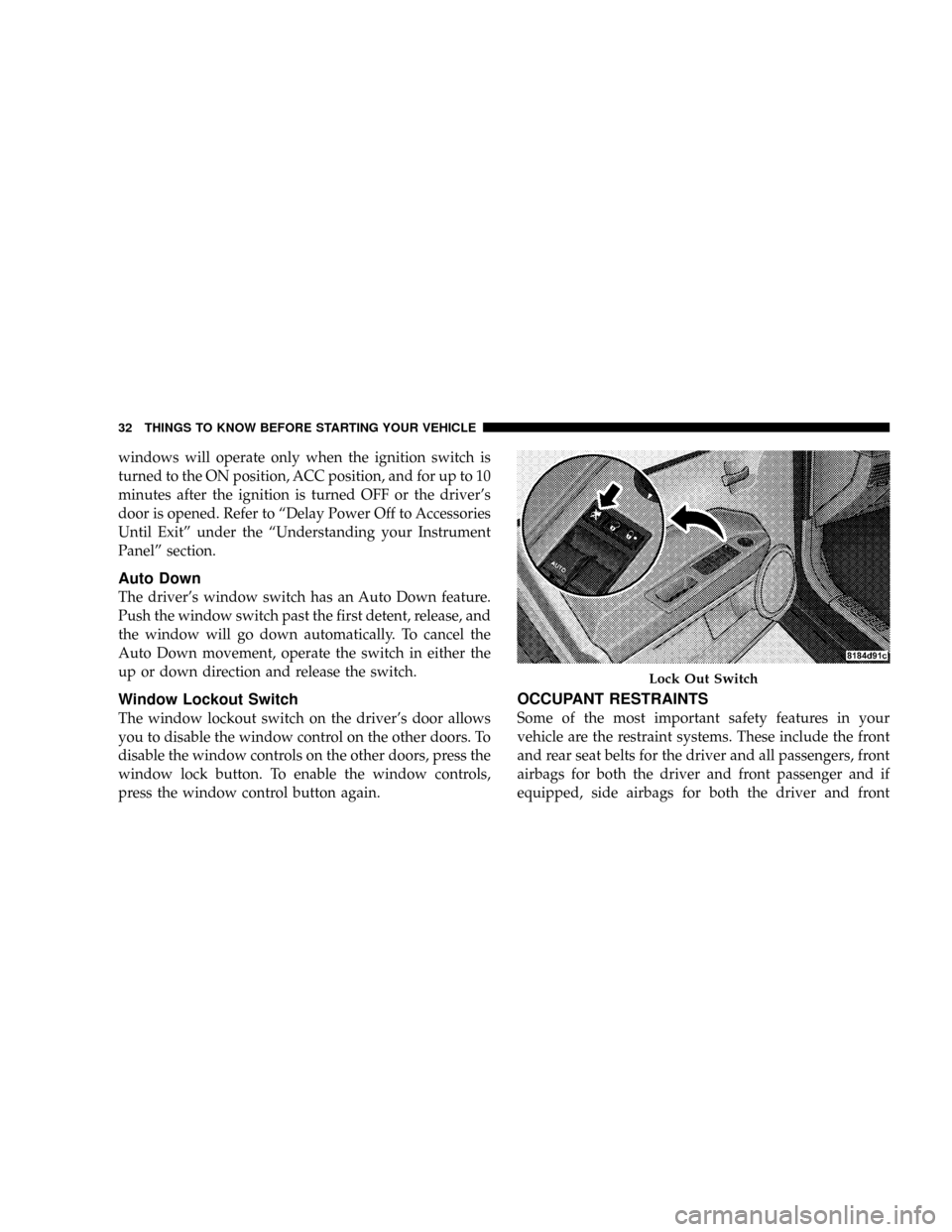
The window lockout switch on the driver's door allows
you to disable the window control on the other doors. To
disable the window controls on the other doors, press the
window lock button. To enable the window controls,
press the window control button again.
OCCUPANT RESTRAINTS
Some of the most important safety features in your
vehicle are the restraint systems. These include the front
and rear seat belts for the driver and all passengers, front
airbags for both the driver and front passenger and if
equipped, side airbags for both the driver and front
Lock Out Switch
32 THINGS TO KNOW BEFORE STARTING YOUR VEHICLE
Page 35 of 373
The belt webbing retractor is designed to lock during
very sudden stops or collisions. This feature allows the
shoulder part of the belt to move freely with you under
normal conditions. But in a collision, the belt will lock
and reduce the risk of your striking the inside of the
vehicle or being thrown out.
WARNING!
²It is extremely dangerous to ride in a cargo area,
inside or outside of a vehicle. In a collision, people
riding in these areas are more likely to be seri-
ously injured or killed.
²Do not allow people to ride in any area of your
vehicle that is not equipped with seats and seat
belts.
²Be sure everyone in your vehicle is in a seat and
using a seat belt properly.
WARNING!
²Wearing a seat belt incorrectly is dangerous. Seat
belts are designed to go around the large bones of
your body. These are the strongest parts of your
body and can take the forces of a collision the best.
²Wearing your belt in the wrong place could make
your injuries in a collision much worse. You might
suffer internal injuries, or you could even slide out
of part of the belt. Follow these instructions to
wear your seat belt safely and to keep your pas-
sengers safe, too.
²Two people should never be belted into a single
seat belt. People belted together can crash into one
another in an accident, hurting one another badly.
Never use a lap/shoulder belt or lap belt for more
than one person, no matter what their size.
34 THINGS TO KNOW BEFORE STARTING YOUR VEHICLE
Page 40 of 373
As a guide, if you are shorter than average, you will
prefer a lower position, and if you are taller than average,
you'll prefer a higher position. When you release the
anchorage, try to move it up or down to make sure that
it is locked in position.
Second Row Center Lap/Shoulder Belt Operating
Instructions
The second row center lap/shoulder belt features a three
point seat belt with a mini latch and buckle, which allows
the shoulder belt to detach from the lower anchor when
the seat is folded. The mini buckle and shoulder belt can
then be stored out of the way in the right side trim panel
for added convenience.
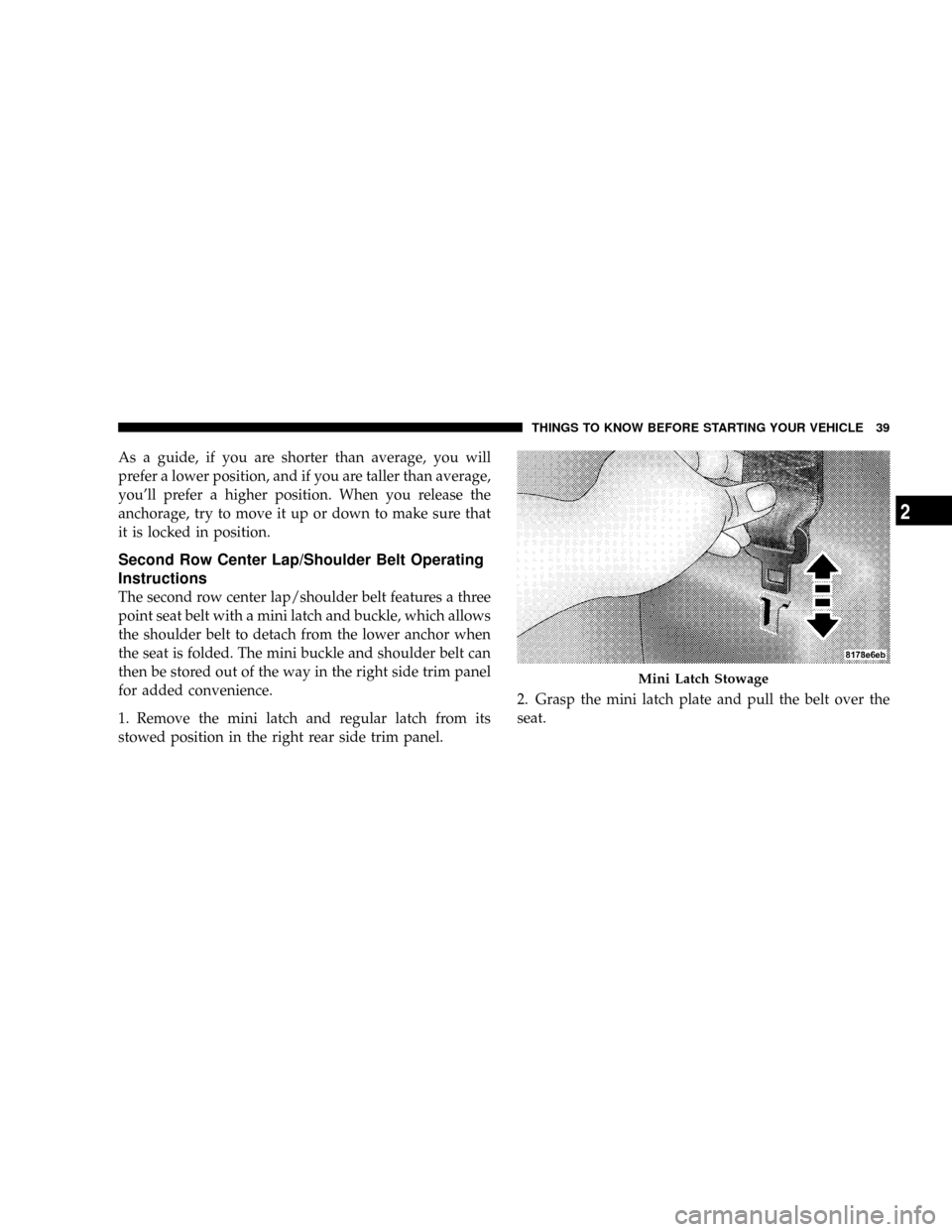
1. Remove the mini latch and regular latch from its
stowed position in the right rear side trim panel.2. Grasp the mini latch plate and pull the belt over the
seat.
Mini Latch Stowage
THINGS TO KNOW BEFORE STARTING YOUR VEHICLE 39
2
Page 44 of 373
the pretensioners are single use items. After a collision
that is severe enough to deploy the airbags and preten-
sioners, both must be replaced.
Enhanced Driver and Seat Belt Reminder System
(BeltAlert)
If the driver's seat belt has not been buckled within 60
seconds of starting the vehicle and if the vehicle speed is
greater than 5 mph (8 km/h), the Enhanced Warning
System (BeltAlert) will alert the driver to buckle their seat
belt. The driver should also instruct all other occupants to
buckle their seat belts. Once the warning is triggered, the
Enhanced Warning System (BeltAlert) will continue to
chime and flash the Seat Belt Warning Light for 96
seconds or until the driver's seat belt is buckled. The
Enhanced Warning System (BeltAlert) will be reactivated
if the driver's seat belt is unbuckled for more than 10
seconds and the vehicle speed is greater than 5 mph (8
km/h).The Enhanced Warning System (BeltAlert) can be en-
abled or disabled by your authorized dealer or by
following these steps:
NOTE:The following steps must occur within the first
60 seconds of the ignition switch being turned to the ON
or START position. DaimlerChrysler Corporation does
not recommend deactivating the Enhanced Warning Sys-
tem (BeltAlert).
1. Turn the ignition switch to the LOCK position and
buckle the driver or front passenger seat belt.
2. Turn the ignition switch to the ON position and wait
for the Seat Belt Warning Light to turn off.
3. Within 60 seconds of turning the ignition switch to the
ON position, unbuckle and then re-buckle the driver or
front passenger seat belt at least three times within 10
seconds, ending with the seat belt buckled.
THINGS TO KNOW BEFORE STARTING YOUR VEHICLE 43
2
Page 45 of 373
NOTE:Watch for the Seat Belt Warning Light to turn on
while unbuckling and off while re-buckling the seat belt.
It may be necessary to retract the seat belt.
4. Turn the ignition switch to the LOCK position. A
single chime will sound to signify that you have success-
fully completed the programming.
The Enhanced Warning System (BeltAlert) can be reacti-
vated by repeating this procedure.
NOTE:Although the Enhanced Warning System
(BeltAlert) has been deactivated, the Seat Belt Warning
Light will continue to illuminate while the driver or front
passenger seat belt remains unbuckled.
Seat Belts And Pregnant Women
We recommend that pregnant women use the seat belts
throughout their pregnancy. Keeping the mother safe is
the best way to keep the baby safe.Pregnant women should wear the lap part of the belt
across the thighs and as snug across the hips as possible.
Keep the belt low so that it does not come across the
abdomen. That way the strong bones of the hips will take
the force if there is a collision.
Driver and Front Passenger Supplemental
Restraint System (SRS) - Airbag
This vehicle has airbags for both the driver and front
passenger as a supplement to the seat belt restraint
systems. The driver's front airbag is mounted in the
center of the steering wheel. The passenger's front airbag
is mounted in the instrument panel, above the glove
compartment. The words SRS AIRBAG are embossed on
the airbag covers.
44 THINGS TO KNOW BEFORE STARTING YOUR VEHICLE
Page 47 of 373
WARNING!
²Do not put anything on or around the airbag
covers or attempt to manually open them. You may
damage the airbags and you could be injured
because the airbags are not there to protect you.
These protective covers for the airbag cushions are
designed to open only when the airbags are inflat-
ing.
²If your vehicle is equipped with side airbags, do
not use accessory seat covers or place objects
between you and the side airbags; the performance
could be adversely affected and/or objects could
be pushed into you, causing serious injury.
²If your vehicle is equipped with side airbags, do
not attach cup holders or any other objects on or
around the door. The inflating side airbag could
drive the object into occupants, causing serious
injury.Airbags inflate in moderate to high speed impacts. Along
with seat belts and pretensioners, front airbags work with
the driver inflatable knee blocker and the integrated
passenger knee blocker (non-inflatable) to provide im-
proved protection for the driver and front passenger. Side
airbags also work with seat belts to improve occupant
protection.
The seat belts are designed to protect you in many types
of collisions. The front airbags deploy in moderate to
severe frontal collisions. If your vehicle is equipped, the
side airbag on the crash side of the vehicle is triggered in
moderate to severe side collisions. In certain types of
collisions, both the front and side airbags may be trig-
gered. But even in collisions where the airbags work, you
need the seat belts to keep you in the right position for
the airbags to protect you properly.
46 THINGS TO KNOW BEFORE STARTING YOUR VEHICLE
Page 49 of 373
WARNING!
²Relying on the airbags alone could lead to more
severe injuries in a collision. The airbags work
with your seat belt to restrain you properly. In
some collisions the airbags won't deploy at all.
Always wear your seat belts even though you have
airbags.
²Being too close to the steering wheel or instrument
panel during front airbag deployment could cause
serious injury. Airbags need room to inflate. Sit
back, comfortably extending your arms to reach
the steering wheel or instrument panel.
²If the vehicle has side airbags, they also need room
to inflate. Do not lean against the door. Sit upright
in the center of the seat.The front airbag system consists of the following:
²Occupant Restraint Controller (ORC)
²Side Remote Acceleration Sensors (If Equipped)
²Airbag Warning Light
²Driver Airbag
²Front Passenger Airbag
²Supplemental Side Curtain Airbags above Side Win-
dows (If Equipped)
²Steering Wheel and Column
²Instrument Panel
²Interconnecting Wiring
²Seatbelt Reminder Light
²Knee Impact Bolsters
²Driver Inflatable Knee Blocker
48 THINGS TO KNOW BEFORE STARTING YOUR VEHICLE
Page 50 of 373
²Front Acceleration Sensors
²Driver and Front Passenger Seat Belt Pretensioners
How The Airbag System Works
²
TheOccupant Restraint Controller (ORC)determines
if a frontal collision is severe enough to require the
airbags to inflate. The front airbag inflators are de-
signed to provide different rates of airbag inflation
from direction provided by the ORC. This ORC will
detect roll over.
The ORC also monitors the readiness of the electronic
parts of the system whenever the ignition switch is in
the START or ON positions. These include all of the
items listed above except the knee bolster, the instru-
ment panel, and the steering wheel and column. If the
key is in the LOCK position, in the ACC position, or
not in the ignition, the airbags are not on and will not
inflate.The ORC also turns on the Airbag Warning
Light in the instrument panel for 6 to 8
seconds as a self-check when the ignition is
first turned on. After the self-check, the
Airbag Warning Light will turn off. If the ORC detects
a malfunction in any part of the system, it turns on the
Airbag Warning Light either momentarily or continu-
ously. A single chime will sound if the light comes on
again after initial start up.
WARNING!
Ignoring the AIRBAG light in your instrument panel
could mean you won't have the airbags to protect you
in a collision. If the light does not come on, stays on
after you start the vehicle, or if it comes on as you
drive, have the airbag system checked right away.
THINGS TO KNOW BEFORE STARTING YOUR VEHICLE 49
2
Page 52 of 373
properly, or if items are positioned in the area where the
side curtain airbag inflates. This especially applies to
children.
NOTE:If your vehicle is equipped with left and right
side curtain air bags, do not install a clothing bar
mounted to the coat hooks (or similarly mounted). A
clothing bar will impede the proper performance of the
bags.
²When the ORC and the impact sensors detect a
collision requiring theDriver Inflatable Knee
Blocker,it signals the inflator unit. A quantity of
nontoxic gas is generated to inflate the Driver Inflat-
able Knee Blocker. The Driver Inflatable Knee Blocker
inflates rearward towards the driver's knees to help
protect the knees and position you for the best inter-
action with the front airbag. The Driver Inflatable
Knee Blocker fully inflates in about 50 milliseconds,this is only about half of the time it takes you to blink
your eyes. It then quickly deflates while helping to
protect the driver's knees.
²TheKnee Impact Bolstershelp protect the knees, and
position everyone for the best interaction with the
front airbag.
WARNING!
Unapproved modifications or service procedures to
the front passenger seat assembly, its related compo-
nents, or seat cover may inadvertently change the
airbag deployment in case of a frontal crash. This
could result in death or serious injury to the front
seat passenger if the vehicle is involved in an acci-
dent. A modified vehicle may not comply with re-
quired Federal Motor Vehicle Safety Standards
(FMVSS).
THINGS TO KNOW BEFORE STARTING YOUR VEHICLE 51
2
Page 54 of 373
WARNING!
Deployed airbags can't protect you in another colli-
sion. Have the airbags replaced by an authorized
dealer as soon as possible.
Enhanced Accident Response System
In the event of an impact that causes airbag deployment,
with the vehicle stopped, and the vehicle communication
network intact, and the power intact, the Enhanced Acci-
dent Response System performs the following functions:
²Cuts off fuel to the engine.
²Flashes hazard lights.
²Turns on the interior lamps which remain on as long as
the battery has power or until the ignition key is
removed.
²Unlocks the doors automatically.
Maintaining Your Airbag System
WARNING!
²Modifications to any part of the airbag system
could cause it to fail when you need it. You could
be injured because the airbags are not there to
protect you. Do not modify the components or
wiring, including adding any kind of badges or
stickers to the steering wheel hub trim cover or the
upper passenger side of the instrument panel. Do
not modify the front bumper, vehicle body struc-
ture, or frame.
²You need proper knee impact protection in a
collision. Do not mount or locate any aftermarket
equipment on or behind the knee impact bolster.
²It is dangerous to try to repair any part of the
airbag system yourself. Be sure to tell anyone who
works on your vehicle that it has airbags.
THINGS TO KNOW BEFORE STARTING YOUR VEHICLE 53
2