steering DODGE CALIBER SRT 2008 1.G Owner's Guide
[x] Cancel search | Manufacturer: DODGE, Model Year: 2008, Model line: CALIBER SRT, Model: DODGE CALIBER SRT 2008 1.GPages: 373, PDF Size: 3 MB
Page 255 of 373
SNOW TIRES
Some areas of the country require the use of snow tires
during winter. Standard tires are of the All-Season type
and satisfy this requirement as indicated by the M+S
designation on the tire sidewall.
If you need snow tires, select tires equivalent in size and
type to the original equipment tires. Use snow tires only
in sets of four, failure to do so may adversely affect the
safety and handling of your vehicle.
Snow tires generally have lower speed ratings than what
was originally equipped with your vehicle and should
not be operated at sustained speeds over 75 mph (120
km/h).
TIRE ROTATION RECOMMENDATIONS
Tires on the front and rear axles of vehicles operate at
different loads and perform different steering, driving,
and braking functions. For these reasons, they wear at
unequal rates, and tend to develop irregular wear pat-
terns.
These effects can be reduced by timely rotation of tires.
The benefits of rotation are especially worthwhile with
aggressive tread designs such as those on all season type
tires. Rotation will increase tread life, help to maintain
mud, snow, and wet traction levels, and contribute to a
smooth, quiet ride.
254 STARTING AND OPERATING
Page 283 of 373
²If the tire inflates to at least 26 psi (1.8 bar) within 15
minutes, proceed to Step 2 of this procedure.
²If tire fails to inflate to 26 psi (1.8 bar) within 15
minutes, perform the procedure steps described
under ª(G) Distributing TIREFIT Sealant to Better
Enable Tire Inflation.º
²Press the Air Pump Power Button (3) to
turn off the TIREFIT kit.
2. Remove the Speed Limit sticker from the top of the
Sealant Bottle (1) and place the sticker on the steering
wheel.
3. Disconnect the TIREFIT kit from the valve stem and
place it in the vehicle.
(E) Securing TIREFIT Sealant in the Tire
Drive the vehicle for approximately 5 miles (8 km) to
ensure distribution of the TIREFIT Sealant within the tire.
WARNING!
TIREFIT is not a permanent flat tire repair. Have the
tire inspected and repaired or replaced after using
TIREFIT. Do not exceed 55 mph (90 km/h) until
having the tire repaired or replaced. Failure to follow
this warning can result in injuries that are serious or
fatal to you, your passengers, and others around you.
(F) After Securing TIREFIT Sealant in the Tire:
Turn the Mode Select knob (4) to the Air Mode
position.
1. Uncoil the Black Air Pump Hose (6) and connect it to
the valve stem.
2. Check the pressure in the tire by reading the Pressure
Gauge (2).
282 WHAT TO DO IN EMERGENCIES
Page 287 of 373
WARNING!
Battery fluid is a corrosive acid solution; do not allow
battery fluid to contact eyes, skin or clothing. Don't
lean over battery when attaching clamps or allow the
clamps to touch each other. If acid splashes in eyes or
on skin, flush the contaminated area immediately
with large quantities of water.
A battery generates hydrogen gas which is flam-
mable and explosive. Keep flame or spark away from
the vent holes. Do not use a booster battery or any
other booster source with an output that exceeds 12
volts.
6. Connect the other cable, first to the negative terminal
of the booster battery and then to the negative terminal of
the discharged battery. Make sure you have a good
contact.7. If the vehicle is equipped with Sentry Key Immobi-
lizer, turn the ignition switch to the ON position for 3
seconds before moving the ignition switch to the START
position.
8. Start the engine in the vehicle that has the booster
battery, let the engine idle a few minutes, then start the
engine in the vehicle with the discharged battery.
9. When removing the jumper cables, reverse the se-
quence exactly. Be careful of the moving belts and fan.
FREEING A STUCK VEHICLE
NOTE:If your vehicle is equipped with Traction Con-
trol or ESP, turn the system OFF before attempting to
ªrockº the vehicle.
If your vehicle becomes stuck in mud, sand or snow, it
can often be moved by a rocking motion. Turn your
steering wheel right and left to clear the area around the
front wheels. Then shift back and forth between Reverse
286 WHAT TO DO IN EMERGENCIES
Page 289 of 373
All Transaxles
CAUTION!
If the vehicle being towed requires steering, the
ignition switch must be in the ACCESSORY posi-
tion, not in the LOCK position.
Do not attempt to use sling type equipment when
towing. When securing vehicle to flat bed truck, do
not attach to front or rear suspension components.
Damage to your vehicle may result from improper
towing.
If it is necessary to use the accessories while being towed
(wipers, defrosters, etc.), the key must be in the ON
position, not the ACCESSORY position. Make certain the
transaxle remains in NEUTRAL.
Without The Ignition Key
Special care must be taken when the vehicle is towed
with the ignition in the LOCK position. A dolly should be
used under the front wheels if the rear wheels are raised.
Proper towing equipment is necessary to prevent dam-
age to the vehicle.
Battery power is required to release the brake/
transmission interlock system. There is a removable plug
in the right side of the shifter housing that allows you to
insert your finger to override the system.
Towing This Vehicle Behind Another Vehicle (Flat
Towing With All Four Wheels On The Ground)
CAUTION!
DO NOT flat tow this vehicle. Damage to the driv-
etrain will result.
288 WHAT TO DO IN EMERGENCIES
Page 290 of 373
MAINTAINING YOUR VEHICLE
CONTENTS
mEngine Compartment Ð Gasoline Engines.....291
mOnboard Diagnostic System Ð OBD II........292
NLoose Fuel Filler Cap Message............293
mEmissions Inspection And Maintenance
Programs............................293
mReplacement Parts......................295
mAuthorized Dealer Service................295
mMaintenance Procedures..................296
NEngine Oil..........................296NDrive Belt ± Check Condition.............299
NSpark Plugs.........................300
NCatalytic Converter....................300
NCrankcase Emission Control System........301
NFuel Filter..........................302
NAir Cleaner Element (Filter)..............302
NMaintenance-Free Battery................302
NAir Conditioner Maintenance.............304
NPower Steering Ð Fluid Check............305
7
Page 292 of 373
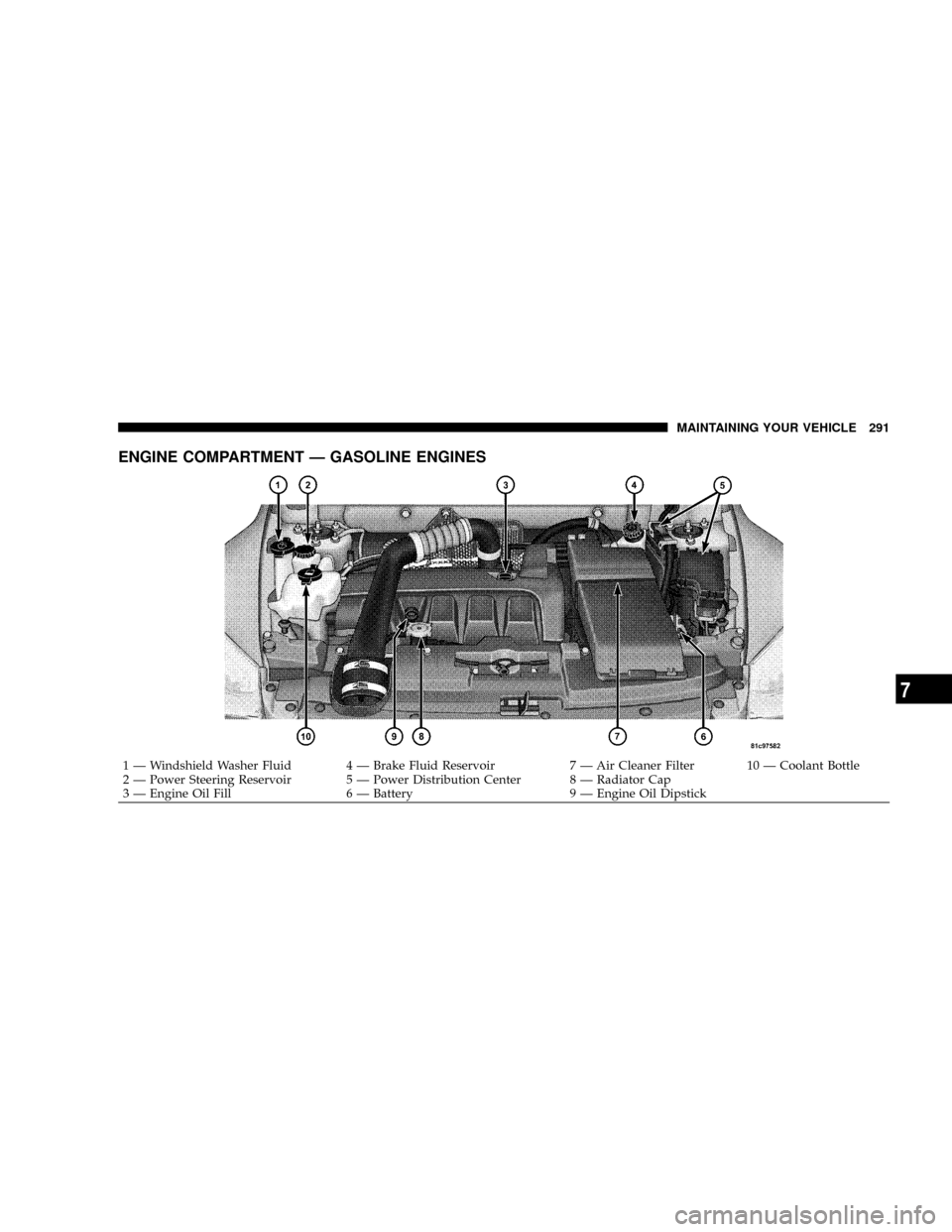
ENGINE COMPARTMENT Ð GASOLINE ENGINES
1 Ð Windshield Washer Fluid 4 Ð Brake Fluid Reservoir 7 Ð Air Cleaner Filter 10 Ð Coolant Bottle
2 Ð Power Steering Reservoir 5 Ð Power Distribution Center 8 Ð Radiator Cap
3 Ð Engine Oil Fill 6 Ð Battery 9 Ð Engine Oil DipstickMAINTAINING YOUR VEHICLE 291
7
Page 306 of 373
WARNING!
²Use only refrigerants and compressor lubricants
approved by the manufacturer for your air condi-
tioning system. Some unapproved refrigerants are
flammable and can explode, injuring you. Other
unapproved refrigerants or lubricants can cause
the system to fail, requiring costly repairs. Refer to
Section 3 of the Warranty Information book for
further warranty information.
²The air conditioning system contains refrigerant
under high pressure. To avoid risk of personal
injury or damage to the system, adding refrigerant
or any repair requiring lines to be disconnected
should be done by an experienced repairman.
Refrigerant Recovery and Recycling
R-134a Air Conditioning Refrigerant is a hydrofluorocar-
bon (HFC) that is endorsed by the Environmental Pro-
tection Agency and is an ozone-saving product. How-
ever, the manufacturer recommends that air conditioning
service be performed by dealers or other service facilities
using recovery and recycling equipment.
NOTE:Use only manufacturer approved A/C System
Sealers, Stop Leak Products, Seal Conditioners, Compres-
sor Oil, or Refrigerants.
Power Steering Ð Fluid Check
Checking the power steering fluid level at a defined
service interval is not required. The fluid should only be
checked if a leak is suspected, abnormal noises are
apparent, and/or the system is not functioning as antici-
pated. Coordinate inspection efforts through a certified
DaimlerChrysler Dealership.
MAINTAINING YOUR VEHICLE 305
7
Page 307 of 373
WARNING!
Fluid level should be checked on a level surface and
with the engine off to prevent injury from moving
parts and to insure accurate fluid level reading. Do
not overfill. Use only manufacturers recommended
power steering fluid.
If necessary, add fluid to restore to the proper indicated
level. With a clean cloth, wipe any spilled fluid from all
surfaces. Refer to ªFluids, Lubricants, and Genuine
Partsº for correct fluid types.
Front Suspension Ball Joints
There are two front suspension lower ball joints that are
permanently lubricated. Inspect these ball joints when-
ever under vehicle service is done. Damaged seals and
their corresponding potentially damaged ball joints must
be replaced.
Body Lubrication
Locks and all body pivot points, including such items as
seat tracks, doors, liftgate and hood hinges, should be
lubricated periodically to assure quiet, easy operation
and to protect against rust and wear. Prior to the appli-
cation of any lubricant, the parts concerned should be
wiped clean to remove dust and grit; after lubricating
excess oil and grease should be removed. Particular
attention should also be given to hood latching compo-
nents to insure proper function. When performing other
underhood services, the hood latch, release mechanism
and safety catch should be cleaned and lubricated.
The external lock cylinders should be lubricated twice a
year, preferably in the fall and spring. Apply a small
amount of a high quality lubricant such as MopartLock
Cylinder Lubricant directly into the lock cylinder.
306 MAINTAINING YOUR VEHICLE
Page 316 of 373
Brake System
In order to assure brake system performance, all brake
system components should be inspected periodically.
Suggested service intervals can be found in the Mainte-
nance Section.
WARNING!
Riding the brakes can lead to brake failure and
possibly an accident. Driving with your foot resting
or riding on the brake pedal can result in abnormally
high brake temperatures, excessive lining wear, and
possible brake damage. You wouldn't have your full
braking capacity in an emergency.
Brake And Power Steering System Hoses
When servicing the vehicle for scheduled maintenance,
inspect the surface of the hoses and nylon tubing for
evidence of heat and mechanical damage. Hard andbrittle rubber, cracking, tears, cuts, abrasions, and exces-
sive swelling suggest deterioration of the rubber. Particu-
lar attention should be made to examining those hose
surfaces nearest to high heat sources, such as the exhaust
manifold.
Inspect all hose clamps and couplings to make sure they
are secure and no leaks are present.
Insure nylon tubing in these areas has not melted or
collapsed.
NOTE:Often, fluids such as oil, power steering fluid,
and brake fluid are used during assembly plant opera-
tions to ease the assembly of hoses to couplings. There-
fore, oil wetness at the hose-coupling area is not neces-
sarily an indication of leakage. Actual dripping of hot
fluid when systems are under pressure (during vehicle
operation) should be noted before a hose is replaced
based on leakage.
MAINTAINING YOUR VEHICLE 315
7
Page 325 of 373
Cavity Cartridge
FuseMini
FuseDescription
6 10 Amp
RedIOD Sw / Pwr Mir /
Ocm Steering Cntrl
Sdar / Hands Free
Phone
7 30 Amp
GreenIOD Sense1
8 30 Amp
GreenIOD Sense2
9 40 Amp
GreenPower Seats
10 20 Amp
YellowCCN Power Locks
11 15 Amp
Lt BluePower Outlet
12 20 Amp
YellowIgn Run / Acc In-
verterCavity Cartridge
FuseMini
FuseDescription
13 20 Amp
YellowPwr run / Acc Outlet
RR
14 10 Amp
RedIOD CCN / Interior
Lighting
15 40 Amp
GreenRAD Fan Relay Bat-
tery Feed
16 15 Amp
Lt. BlueIGN Run / Acc Cigar
Ltr / Sunroof
17 10 Amp
RedIOD Feed Mod-Wcm
18 40 Amp
GreenASD Relay Contact
PWR Feed
19 20 Amp
YellowPWR Amp 1 & Amp
2 Feed
20 15 Amp
Lt. BlueIOD Feed Radio
324 MAINTAINING YOUR VEHICLE