ECU DODGE CALIBER SRT 2009 1.G Owner's Manual
[x] Cancel search | Manufacturer: DODGE, Model Year: 2009, Model line: CALIBER SRT, Model: DODGE CALIBER SRT 2009 1.GPages: 411, PDF Size: 6.36 MB
Page 143 of 411
WARNING!
•Never leave children in a vehicle, with the key in
the ignition switch. Occupants, particularly unat-
tended children, can become entrapped by the
power sunroof while operating the power sunroof
switch. Such entrapment may result in serious
injury or death.
•In an accident, there is a greater risk of being
thrown from a vehicle with an open sunroof. You
could also be seriously injured or killed. Always
fasten your seat belt properly and make sure all
passengers are properly secured too.
•Do not allow small children to operate the sun-
roof. Never allow fingers or other body parts, or
any object to project through the sunroof opening.
Injury may result.
Opening the Sunroof
Manual Mode
To open the sunroof, press and hold the switch rearward
to full open. Any release of the switch will stop the
movement and the sunroof will remain in a partial open
condition until the switch is pushed and held rearward
again.
Express Mode
Press the switch rearward and release, and the sunroof
will open automatically from any position. The sunroof
will open fully, and stop automatically, this is called
“express open”. During express open operation any
movement of the sunroof switch will stop the sunroof.
UNDERSTANDING THE FEATURES OF YOUR VEHICLE 141
3
Page 148 of 411
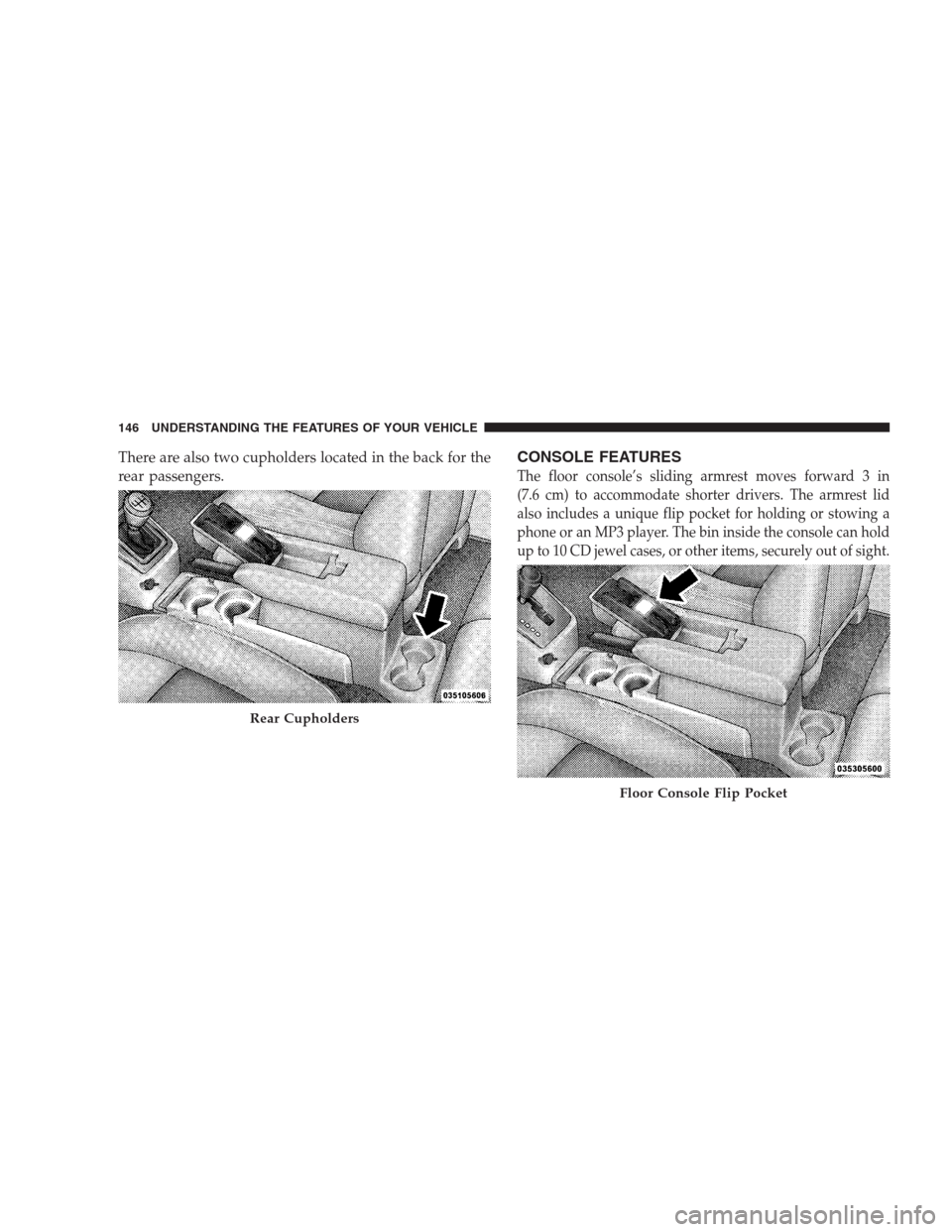
There are also two cupholders located in the back for the
rear passengers.CONSOLE FEATURES
The floor console’s sliding armrest moves forward 3 in
(7.6 cm) to accommodate shorter drivers. The armrest lid
also includes a unique flip pocket for holding or stowing a
phone or an MP3 player. The bin inside the console can hold
up to 10 CD jewel cases, or other items, securely out of sight.
Rear Cupholders
Floor Console Flip Pocket
146 UNDERSTANDING THE FEATURES OF YOUR VEHICLE
Page 152 of 411
Cargo Tie-Down Loops
There are two D-rings installed on the D-pillars for
securing a net across the liftgate opening.
WARNING!
•Cargo tie-down loops are not safe anchors for a
child seat tether strap. In a sudden stop or collision
a loop could pull loose and allow the child seat to
come loose. A child could be badly injured. Use
only the anchors provided for child seat tethers.
•The weight and position of cargo and passengers
can change the vehicle center of gravity and ve-
hicle handling. To avoid loss of control resulting
in personal injury, follow these guidelines for
loading your vehicle:
(Continued)
WARNING! (Continued)
•Always place cargo evenly on the cargo floor. Put
heavier objects as low and as far forward as
possible.
•Place as much cargo as possible in front of the rear
axle. Too much weight or improperly placed
weight over or behind the rear axle can cause the
rear of the vehicle to sway.
•Do not pile luggage or cargo higher than the top of
the seatback. This could impair visibility or be-
come a dangerous projectile in a sudden stop or
collision.
•To help protect against personal injury, passengers
should not be seated in the rear cargo area. The
rear cargo space is intended for load carrying
purposes only, not for passengers, who should sit
in seats and use seat belts.
150 UNDERSTANDING THE FEATURES OF YOUR VEHICLE
Page 167 of 411
4. Tachometer
The white area of the scale shows the permissible engine
revolutions-per-minute (RPM x 1000) for each gear range.
Before reaching the red area, ease up on the accelerator to
prevent engine damage.
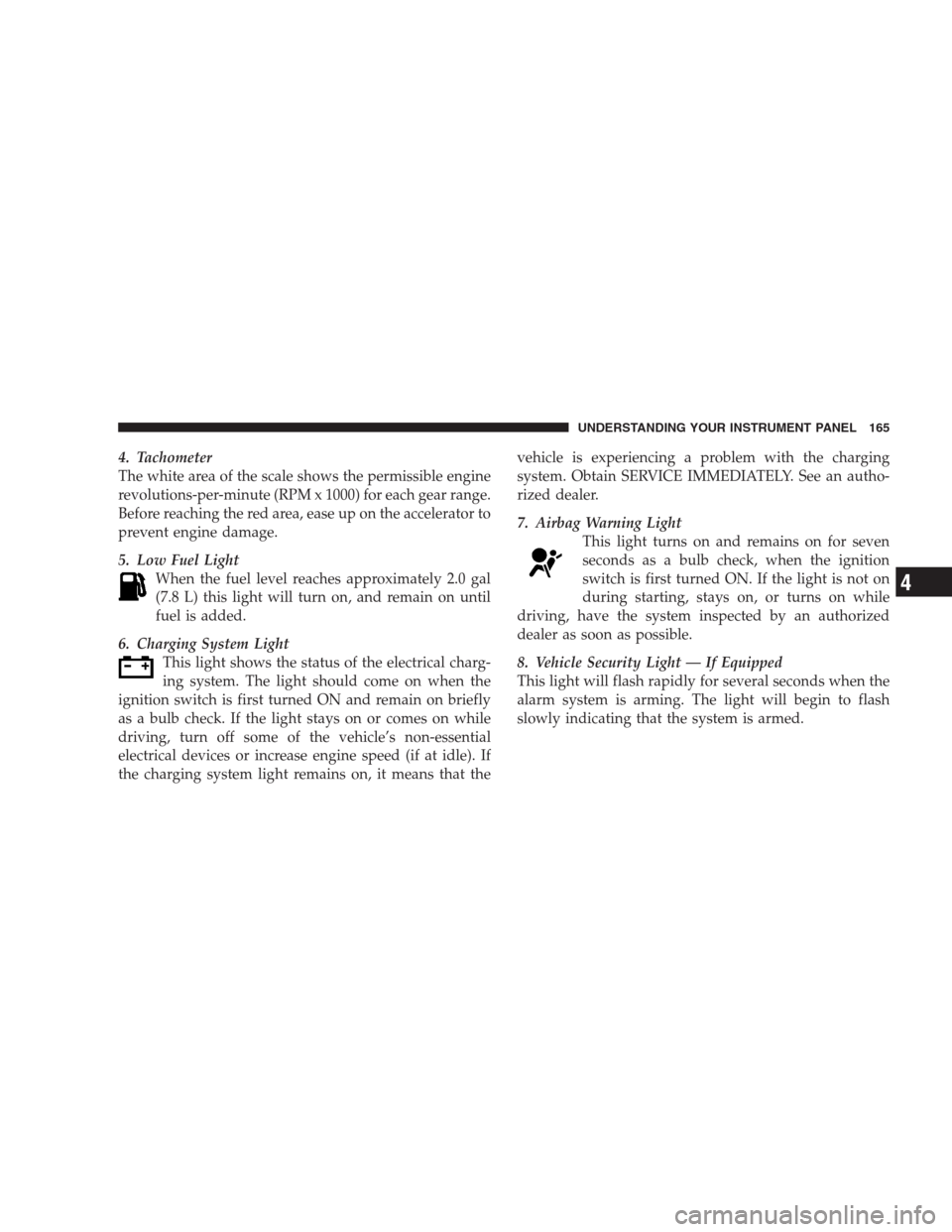
5. Low Fuel Light
When the fuel level reaches approximately 2.0 gal
(7.8 L) this light will turn on, and remain on until
fuel is added.
6. Charging System Light
This light shows the status of the electrical charg-
ing system. The light should come on when the
ignition switch is first turned ON and remain on briefly
as a bulb check. If the light stays on or comes on while
driving, turn off some of the vehicle’s non-essential
electrical devices or increase engine speed (if at idle). If
the charging system light remains on, it means that thevehicle is experiencing a problem with the charging
system. Obtain SERVICE IMMEDIATELY. See an autho-
rized dealer.
7. Airbag Warning Light
This light turns on and remains on for seven
seconds as a bulb check, when the ignition
switch is first turned ON. If the light is not on
during starting, stays on, or turns on while
driving, have the system inspected by an authorized
dealer as soon as possible.
8. Vehicle Security Light — If Equipped
This light will flash rapidly for several seconds when the
alarm system is arming. The light will begin to flash
slowly indicating that the system is armed.
UNDERSTANDING YOUR INSTRUMENT PANEL 165
4
Page 237 of 411
4. Fold the right rear passenger seat rearward into the
upright position. The rear tether anchors should engage
the hooks located on the back or the subwoofer.
5. Check the subwoofer for being securely fastened to the
seatback.
WARNING!
Always remove the subwoofer from the vehicle
whenever the tether anchors behind the subwoofer
are required for proper installation of a child re-
straining device. In the event of an accident, or under
severe vehicle maneuvers, leaving the subwoofer
unsecured in the vehicle could result in serious or
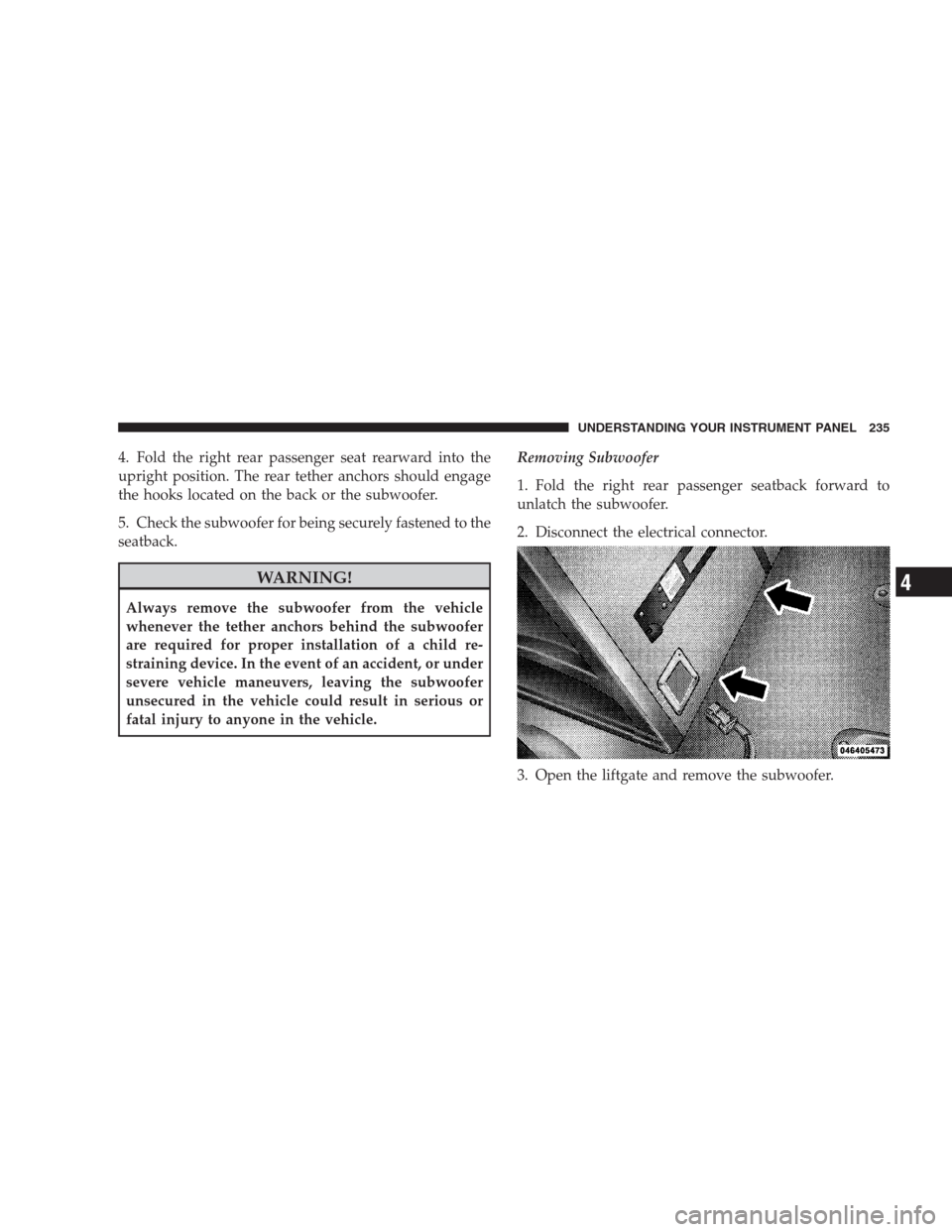
fatal injury to anyone in the vehicle.Removing Subwoofer
1. Fold the right rear passenger seatback forward to
unlatch the subwoofer.
2. Disconnect the electrical connector.
3. Open the liftgate and remove the subwoofer.
UNDERSTANDING YOUR INSTRUMENT PANEL 235
4
Page 245 of 411
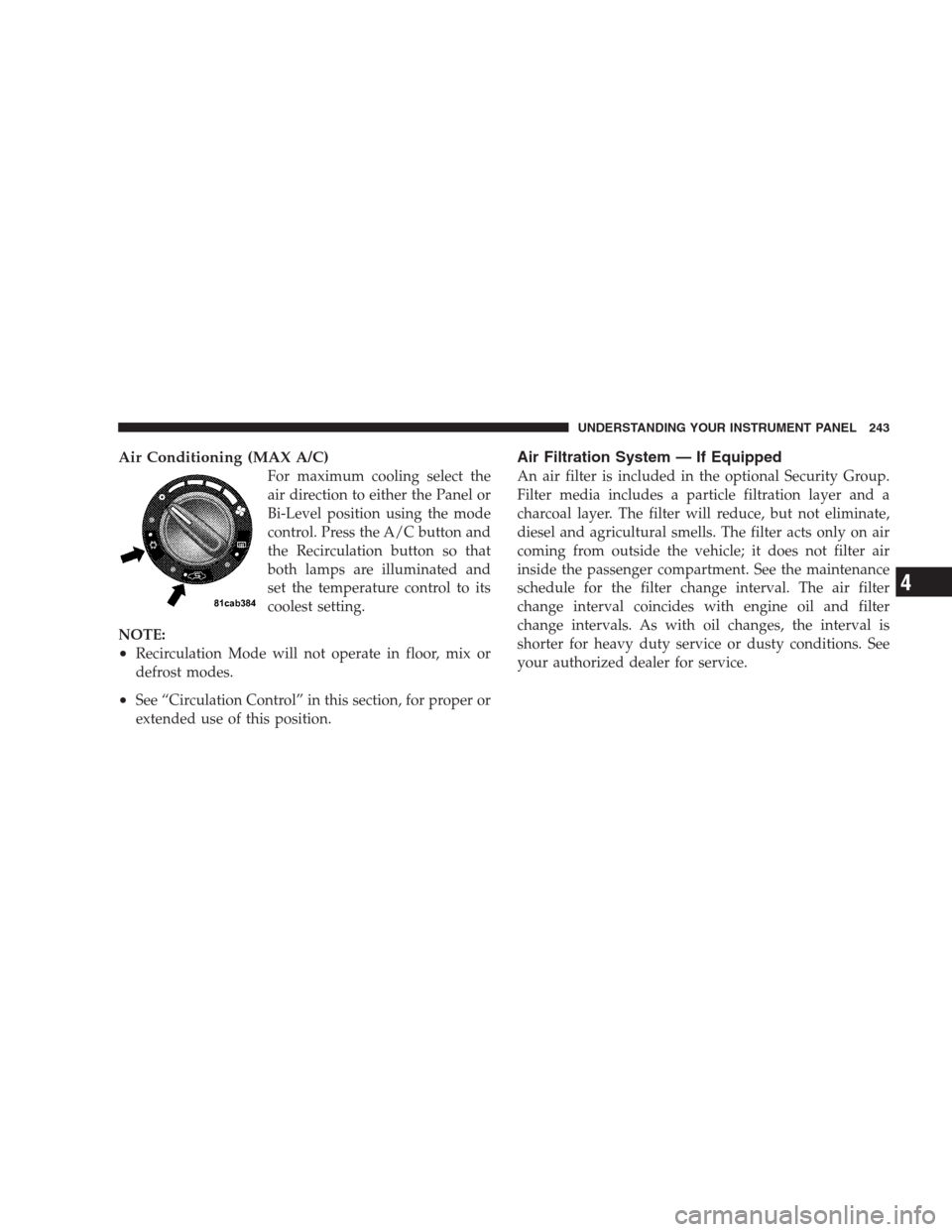
Air Conditioning (MAX A/C)
For maximum cooling select the
air direction to either the Panel or
Bi-Level position using the mode
control. Press the A/C button and
the Recirculation button so that
both lamps are illuminated and
set the temperature control to its
coolest setting.
NOTE:
•Recirculation Mode will not operate in floor, mix or
defrost modes.
•See “Circulation Control” in this section, for proper or
extended use of this position.
Air Filtration System — If Equipped
An air filter is included in the optional Security Group.
Filter media includes a particle filtration layer and a
charcoal layer. The filter will reduce, but not eliminate,
diesel and agricultural smells. The filter acts only on air
coming from outside the vehicle; it does not filter air
inside the passenger compartment. See the maintenance
schedule for the filter change interval. The air filter
change interval coincides with engine oil and filter
change intervals. As with oil changes, the interval is
shorter for heavy duty service or dusty conditions. See
your authorized dealer for service.
UNDERSTANDING YOUR INSTRUMENT PANEL 243
4
Page 316 of 411
(D) After Injecting TIREFIT Sealant:
1. Allow the air pump to inflate the tire to the pressure
indicated on the tire pressure label on the driver-side
latch pillar. Check the pressure in the tire by looking at
the Pressure Gauge (2).
•If the tire inflates to at least 26 psi (1.8 bar) within
15 minutes, proceed to Step 2 of this procedure.
•If tire fails to inflate to 26 psi (1.8 bar) within
15 minutes, perform the procedure steps described
under “(G) Distributing TIREFIT Sealant to Better
Enable Tire Inflation.”
2. Press the Air Pump Power Button (3) to
turn OFF the TIREFIT kit.3. Remove the Speed Limit sticker from the top of the
Sealant Bottle (1) and place the sticker on the steering
wheel.
4. Disconnect the Clear Sealant Hose (7) from the valve
stem, reinstall the Yellow Cap on the fitting at the end of
the hose, and place the TIREFIT kit in the vehicle.
CAUTION!
Failure to reinstall the Yellow Cap on the fitting at
the end of the Clear Sealant Hose (7) can result in
sealant contacting your skin, clothing, and the vehi-
cle’s interior. It can also result in sealant contacting
internal TIREFIT kit components causing permanent
damage to the kit.
(E) Securing TIREFIT Sealant in the Tire
Drive the vehicle for approximately 5 miles (8 km) to
ensure distribution of the TIREFIT Sealant within the tire.
314 WHAT TO DO IN EMERGENCIES
Page 317 of 411
WARNING!
TIREFIT is not a permanent flat tire repair. Have the
tire inspected and repaired or replaced after using
TIREFIT. Do not exceed 55 mph (90 km/h) until
having the tire repaired or replaced. Failure to follow
this warning can result in injuries that are serious or
fatal to you, your passengers, and others around you.
(F) After Securing TIREFIT Sealant in the Tire:
1. Turn the Mode Select knob (4) to the Air
Mode position.
2. Uncoil the Black Air Pump Hose (6) and connect it to
the valve stem.
3. Check the pressure in the tire by reading the Pressure
Gauge (2).
•If the pressure is less than 19 psi (1.3 bar), the tire is
too badly damaged. Do not attempt to drive the
vehicle further. Call for assistance.
•If the pressure is equal to or greater than 19 psi
(1.3 bar), but less than the level indicated on the tire
pressure label, proceed to Step 4 of this procedure.
•If the pressure is at the level indicated on the tire
pressure label on the driver-side latch pillar, proceed
to Step 5 of this procedure.
4. Inflate the tire to the pressure indicated on the tire
pressure label on the driver-side latch pillar.
5. Disconnect the TIREFIT kit from the valve stem and
then reinstall the cap on the valve stem.
6. Place the TIREFIT kit in its proper storage area in the
vehicle.
WHAT TO DO IN EMERGENCIES 315
6
Page 323 of 411
CAUTION!
DO NOT flat tow any vehicle equipped with an
automatic transmission. Damage to the drivetrain
will result.
Manual Transaxle
•
Front Wheel Drive (FWD) or All Wheel Drive (AWD)
vehicles can be flat towed (all four wheels on the
ground) with the transmission in NEUTRAL.
•FWD vehicles can be towed with the front or rear
wheels elevated.
•FWD or AWD vehicles can be towed on a flatbed truck
(all wheels off the ground).
All Transaxles
If it is necessary to use the accessories while being towed
(wipers, defrosters, etc.), the key must be in the ON
position, not the ACC position. Make certain the trans-
mission remains in NEUTRAL.
CAUTION!
•If the vehicle being towed requires steering, the
ignition switch must be in the ACC position, not
in the LOCK position.
•Do not attempt to use sling type equipment when
towing. When securing the vehicle to a flat bed
truck, do not attach to front or rear suspension
components. Damage to your vehicle may result
from improper towing.
WHAT TO DO IN EMERGENCIES 321
6
Page 354 of 411
Replace the seat belts if they appear frayed or worn or if
the buckles do not work properly.
Dry with a soft cloth.
FUSES
Integrated Power Module
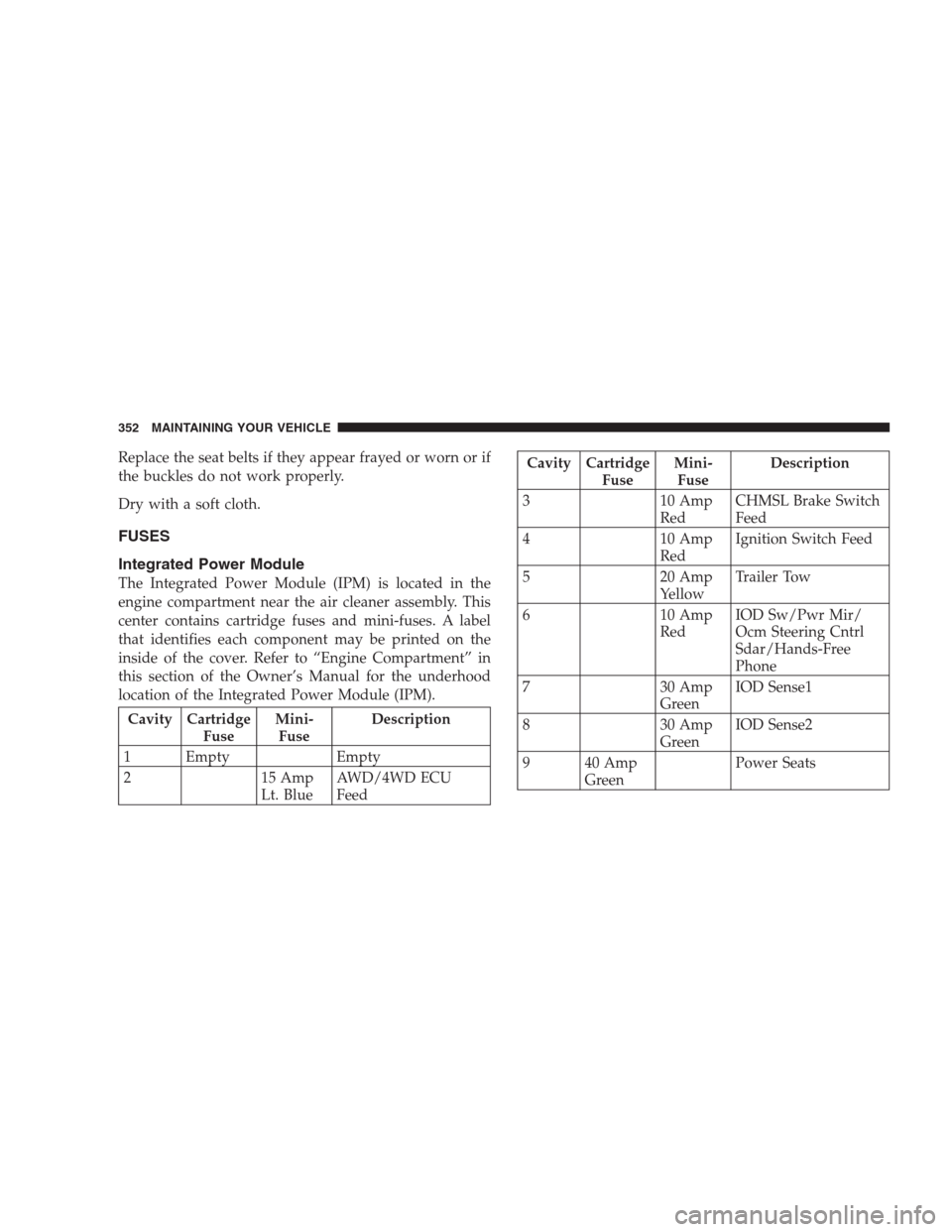
The Integrated Power Module (IPM) is located in the
engine compartment near the air cleaner assembly. This
center contains cartridge fuses and mini-fuses. A label
that identifies each component may be printed on the
inside of the cover. Refer to “Engine Compartment” in
this section of the Owner’s Manual for the underhood
location of the Integrated Power Module (IPM).
Cavity Cartridge
FuseMini-
FuseDescription
1 Empty Empty
2 15 Amp
Lt. BlueAWD/4WD ECU
Feed
Cavity Cartridge
FuseMini-
FuseDescription
3 10 Amp
RedCHMSL Brake Switch
Feed
4 10 Amp
RedIgnition Switch Feed
5 20 Amp
YellowTrailer Tow
6 10 Amp
RedIOD Sw/Pwr Mir/
Ocm Steering Cntrl
Sdar/Hands-Free
Phone
7 30 Amp
GreenIOD Sense1
8 30 Amp
GreenIOD Sense2
9 40 Amp
GreenPower Seats
352 MAINTAINING YOUR VEHICLE