child restraint DODGE CARAVAN 2004 4.G User Guide
[x] Cancel search | Manufacturer: DODGE, Model Year: 2004, Model line: CARAVAN, Model: DODGE CARAVAN 2004 4.GPages: 397, PDF Size: 6.83 MB
Page 65 of 397
In general, you will first loosen the adjusters on the lower
straps and tether straps so that you can more easily attach
the hook or connector to the lower anchorages and tether
anchorages. Then tighten all three straps as you push the
child restraint rearward and downward into the seat.
Not all child restraint systems will be installed as we
have described here. Again, carefully follow the instruc-
tions that come with the child restraint system.
WARNING!
Improper installation of a child restraint to the
LATCH anchorages can lead to failure of an infant or
child restraint. The child could be badly injured or
killed. Follow the manufacturer's directions exactly
when installing an infant or child restraint.
Children Too Large For Booster Seats
Children who are large enough to wear the shoulder belt
comfortably, and whose legs are long enough to bend
over the front of the seat when their back is against the
seatback, should use the lap/shoulder belt in a rear seat.
²Make sure that the child is upright in the seat.
²The lap portion should be low on the hips and as snug
as possible.
²Check belt fit periodically. A child's squirming or
slouching can move the belt out of position.
²If the shoulder belt contacts the face or neck, move the
child closer to the center of the vehicle. If this doesn't
help, move the child to the center rear seating position
and use the lap belt. Never allow a child to put the
shoulder belt under an arm or behind their back.
THINGS TO KNOW BEFORE STARTING YOUR VEHICLE 65
2
Page 66 of 397
Transporting Pets
Airbags deploying in the front seat could harm your pet.
An unrestrained pet could be thrown about and possibly
injured, or injure a passenger during panic braking or in
a collision.
Pets should be restrained in the rear seat in pet harnesses
or pet carriers that are secured by seat belts.
REAR SEAT DELETE FEATURE (COMMERCIAL
VEHICLES ONLY) Ð IF EQUIPPED
Commercial cargo vehicles are not designed for use as a
family vehicle and are not intended for carrying children
in the front passenger seat. However, if you must carry a
child in a vehicle without a rear seat, the passenger seat
should be moved to the full rearward position and the
child must be in a proper restraint system based on it's
age, size and weight. NEVER carry a child in a rear facinginfant carrier in a vehicle without rear seats. In an
accident, serious injury or death may occur from the
deploying passenger air bag.
This vehicle is equipped with a child restraint tether
anchor located on the floor, behind the front passenger
seat.Use this tether anchor to secure only forward
facing child restraints equipped with an upper tether
strap.WARNING!
Rear Facing Infant restraints must never be secured
in the passenger seat of a vehicle with a passenger
airbag. In an accident a passenger airbag may deploy
causing severe injury or death to infants riding in
rear facing infant restraints.
66 THINGS TO KNOW BEFORE STARTING YOUR VEHICLE
Page 67 of 397

Restraining Infants and Small Children with Seat
Delete Feature (Commercial Vehicles Only)
There are different sizes and types of restraints for
children from newborn size to the child almost large
enough for an adult safety belt. Use the restraint that is
correct for your child:
²The rearward-facing infant carrier is for babies weigh-
ing up to about 20 lbs (9 kg), and less than one year
old. THIS TYPE OF SEAT CANNOT BE USED IN A
VEHICLE EQUIPPED WITH THE REAR SEAT DE-
LETE FEATURE (Commercial Vehicles Only).
²The forward-facing child seat is for children from
about 20 to 40 lbs (9 to 18 kg), and more than one year
old.
²A ªconvertibleº child seat, one that is designed to be
used for children who are too heavy for a rear facing
infant seat, may be used IN THE FORWARD FACING
POSITION ONLY, IT MUST NEVER BE INSTALLEDFACING TO THE REAR IN A VEHICLE EQUIPPED
WITH THE REAR SEAT DELETE FEATURE (Com-
mercial Vehicles Only). When a convertible seat is
properly installed forward facing, the vehicle seat
should be adjusted to therear most position.
²Children more than 40 lbs (18 kg) should be secured in
the passenger seat in a child restraint or belt-
positioning booster seat with the seat adjusted to the
rear most position. Older children who do not use
child restraints or belt-positioning booster seats
should ride properly buckled in the passenger seat
with the seat adjusted to the rear most position. Never
allow children to slide the shoulder belt behind them
or under their arm.
Tether Installation For Commercial Vehicles With
Rear Seat Delete
To secure the child restraint upper tether strap to the
vehicle, follow the instructions shown:
THINGS TO KNOW BEFORE STARTING YOUR VEHICLE 67
2
Page 68 of 397

1. Locate the child restraint tether anchor on the floor
just behind the front passenger seat.
2. Extend the child restraint tether anchor forward to-
wards the front passenger seat.3. Follow the child restraint manufacturer's directions
for proper use of connecting the child restraint to the
extended tether strap.
4. If necessary, raise the passenger seat head restraint to
allow the tether strap to be routed under the head
restraint.
68 THINGS TO KNOW BEFORE STARTING YOUR VEHICLE
Page 69 of 397

5. Route the tether strap beneath the head restraint
between the two head restraint posts. Ensure that the
child restraint tether strap is centered between the two
head restraint posts.
6. Using the hook attached to the child restraint tether
strap, attach the child restraint tether strap to the metal
ring on the vehicle tether anchor.7. Following the child seat manufacturer's instructions,
tighten the child restraint tether strap.
8. If necessary, reposition the seat head restraint.
9. Inspect the tether anchor strap for nicks, abrasions,
discoloration, and loose threads. If these, or any other
condition that might effect the performance of the strap is
observed, DO NOT USE. Contact your local
DaimlerChrysler dealership for a replacement part.
NOTE:Stow the child restraint tether strap in its
original position when not in use.
THINGS TO KNOW BEFORE STARTING YOUR VEHICLE 69
2
Page 70 of 397
WARNING!
The vehicle tether anchor is designed to be used
with a child restraint only. It should not be used for
any other purpose. Before use inspect the tether
anchor strap for nicks, abrasions, discoloration, and
loose threads. If these or any other condition that
might effect the performance of the strap is ob-
served, DO NOT USE, personal injury may result.
Contact your local DaimlerChrysler dealership for a
replacement part.
ENGINE BREAK-IN RECOMMENDATIONS
A long break-in period is not required for the engine in
your new vehicle.
Drive moderately during the first 300 miles (500 km).
After the initial 60 miles (100 km), speeds up to 50 or 55
mph (80 or 90 km/h) are desirable.While cruising, brief full-throttle acceleration, within the
limits of local traffic laws, contributes to a good break-in.
Wide open throttle acceleration in low gear can be
detrimental and should be avoided.
The engine oil installed in the engine at the factory is a
high quality energy conserving type lubricant. Oil
changes should be consistent with anticipated climate
conditions under which vehicle operations will occur.
The recommended viscosity and quality grades are
shown in Section 7 of this manual. NON-DETERGENT
OR STRAIGHT MINERAL OILS MUST NEVER BE
USED.
A new engine may consume some oil during its first few
thousand miles (kilometers) of operation. This should be
considered as a normal part of the break-in and not
interpreted as an indication of difficulty.
70 THINGS TO KNOW BEFORE STARTING YOUR VEHICLE
Page 96 of 397
WARNING!
²Not all head restraints in this vehicle are the same.
Head restraints from one seating position should
not be removed and installed in any other seating
position. In a collision, serious injury or death may
result if the proper head restraint is not installed on
each seat.
²The cargo area in the rear of the vehicle should not
be used as a play area by children. They could be
seriously injured in a collision. Children should be
seated and using the proper restraint system.
²It is extremely dangerous to ride in a cargo area,
inside or outside of a vehicle. In a collision, people
riding in these areas are more likely to be seriously
injured or killed.
²Do not allow people to ride in any area of your
vehicle that is not equipped with seats and seat belts.
²Be sure everyone in your vehicle is in a seat and
using a seat belt properly.
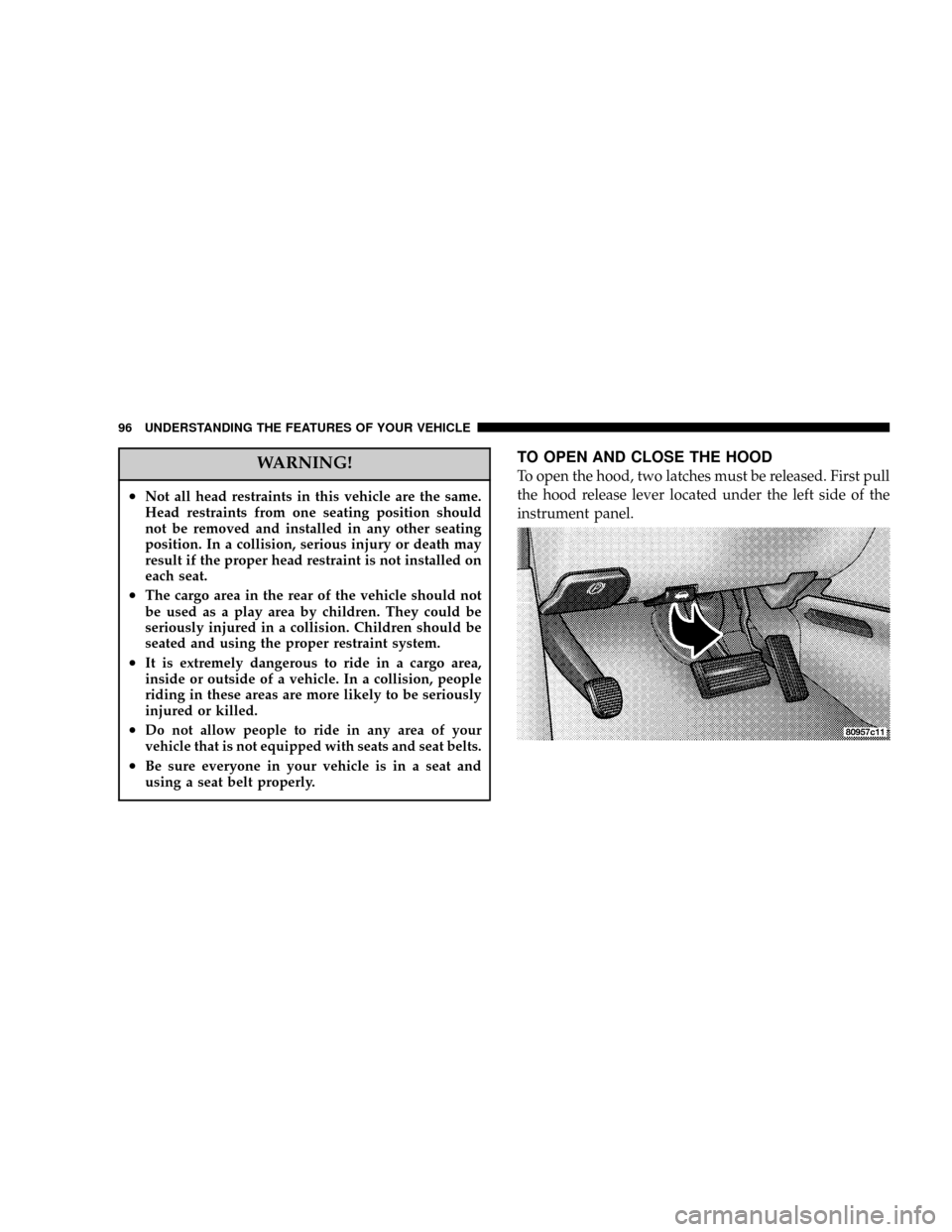
TO OPEN AND CLOSE THE HOOD
To open the hood, two latches must be released. First pull
the hood release lever located under the left side of the
instrument panel.
96 UNDERSTANDING THE FEATURES OF YOUR VEHICLE
Page 384 of 397

Cargo Compartment
Luggage Carrier....................... 139
Cassette Tape and Player Maintenance......... 197
Cassette Tape Player..................... 161
Catalytic Converter...................... 309
CD Changer......................170,182,187
CD Player...............167,171,174,178,180,187
Center High Mounted Stop Light............ 343
Center Lap Belts......................... 47
Chains, Tire............................ 263
Changing A Flat Tire..................... 282
Child Restraint.......................... 58
Child Restraint Tether Anchors............... 62
Child Safety Locks........................ 32
Child Seat............................58,64
Clean Air Gasoline....................... 266
Climate Control......................... 199
Clock................................ 159
Compact Disc Maintenance................. 198Compact Disc Player..................161,167
Compact Spare Tire...................... 255
Compass.............................. 111
Compass Calibration..................... 112
Compass Variance....................... 112
Computer, Trip/Travel.................... 114
Console, Overhead....................... 110
Console, Removable...................... 132
Contract, Service........................ 374
Coolant Pressure Cap..................... 320
Cooling System......................... 318
Adding Coolant (Antifreeze).............. 320
Coolant Capacity...................... 343
Coolant Level......................... 321
Disposal of Used Coolant................ 321
Drain, Flush, and Refill.................. 319
Inspection........................... 318
Points to Remember.................... 321
Pressure Cap......................... 320
384 INDEX
Page 388 of 397

High Beam/Low Beam Select Switch........ 103
Lights On Reminder.................... 101
Replacing............................ 339
Time Delay.......................... 101
Heated Seats............................ 82
Heater............................... 199
Heater, Engine Block..................... 230
Homelink Transmitter..................... 119
Hood Release........................... 96
Hoses.............................322,326
Ignition
Key ................................. 12
Illuminated Entry........................ 16
Immobilizer............................ 13
Indicator, Traction Control................. 156
Infant Restraint.......................... 59
Information Center.................... 115,159
Information Center, Vehicle.............. 115,159Inside Rearview Mirror.................... 77
Instrument Cluster.................149,150,151
Instrument Panel and Controls.............. 148
Instrument Panel Lens Cleaning............. 334
Integrated Child Seat...................... 58
Integrated Power Module.................. 336
Interior Appearance Care.................. 333
Interior Fuses.......................... 336
Interior Lights.........................98,99
Intermittent Wipers.................104,219,220
Introduction............................. 4
Jack Location........................... 283
Jack Operation.......................282,285
Jump Starting.......................... 288
Key, Programming........................ 15
Key, Replacement........................ 15
Key, Sentry............................. 13
388 INDEX
Page 393 of 397

Rear Window Features.................... 219
Rear Wiper/Washer................219,220,221
Rearview Mirrors........................ 77
Reclining Front Seats...................... 83
Recommended Fluids, Lubricants and Genuine
Parts............................... 344
Remote Keyless Entry..................... 20
Remote Sound System Controls.............. 195
Removable Floor Console.................. 132
Replacement Tires....................257,259
Reporting Safety Defects................... 376
Restraint, Head.......................... 82
Restraints, Child.......................58,64
Restraints, Infant......................... 59
Rocking Vehicle When Stuck................ 291
Roof Rack............................. 139
Rotation, Tires.......................... 265
Safety Checks Inside Vehicle................. 71Safety Checks Outside Vehicle............... 72
Safety, Exhaust Gas....................... 36
Safety Information, Tire................... 242
Safety Tips............................. 71
Schedule, Maintenance.................... 348
Seat Belt Maintenance.................... 334
Seat Belts.............................. 38
Adjustable Shoulder Belt.................. 44
Adjustable Upper Shoulder Anchorage........ 44
And Pregnant Women................... 48
Center Lap Belt........................ 47
Child Restraint......................... 58
Extender............................. 48
Front Seat............................ 39
Pretensioners.......................... 47
Rear Seat............................. 39
Untwisting Procedure.................... 45
Seats................................. 80
Adjustment........................... 80
INDEX 393
10