coolant DODGE CARAVAN 2008 5.G User Guide
[x] Cancel search | Manufacturer: DODGE, Model Year: 2008, Model line: CARAVAN, Model: DODGE CARAVAN 2008 5.GPages: 531, PDF Size: 7.72 MB
Page 460 of 531
Adding Coolant
Your vehicle has been built with an improved engine
coolant that allows extended maintenance intervals. This
coolant can be used up to five years or 102,000 mi (170
000 km) before replacement. To prevent reducing this
extended maintenance period, it is important that you
use the same coolant throughout the life of your vehicle.
Please review these recommendations for using Hybrid
Organic Additive Technology (HOAT) coolant.
When adding coolant, a minimum solution of 50% rec-
ommended MopartAntifreeze/ Coolant Five Year/
100,000 mi (160 934 km) Formula HOAT (Hybrid Organic
Additive Technology), or equivalent, in water should be
used. Use higher concentrations (not to exceed 70%) if
temperatures below234ÉF (237ÉC ) are anticipated.
Use only high purity water such as distilled or deionized
water when mixing the water/engine coolant solution.The use of lower quality water will reduce the amount of
corrosion protection in the engine cooling system.
Please note that it is the owner's responsibility to main-
tain the proper level of protection against freezing ac-
cording to the temperatures occurring in the area where
the vehicle is operated.
NOTE:Mixing coolant types will decrease the life of the
engine coolant and will require more frequent coolant
changes.
Cooling System Pressure Cap
The cap must be fully tightened to prevent loss of
coolant, and to ensure that coolant will return to the
radiator from the coolant recovery bottle.
The cap should be inspected and cleaned if there is any
accumulation of foreign material on the sealing surfaces.
458 MAINTAINING YOUR VEHICLE
Page 461 of 531
WARNING!
²The warning words ªDO NOT OPEN HOTº on
the cooling system pressure cap are a safety pre-
caution. Never add coolant when the engine is
overheated. Do not loosen or remove the cap to
cool an overheated engine. Heat causes pressure to
build up in the cooling system. To prevent scald-
ing or injury, do not remove the pressure cap while
the system is hot or under pressure.
²Do not use a pressure cap other than the one
specified for your vehicle. Personal injury or en-
gine damage may result.
Disposal of Used Coolant
Used ethylene glycol-based engine coolant is a regulated
substance requiring proper disposal. Check with your
local authorities to determine the disposal rules for yourcommunity. To prevent ingestion by animals or children
do not store ethylene glycol-based engine coolant in open
containers or allow it to remain in puddles on the
ground. If ingested by a child, contact a physician
immediately. Clean up any ground spills immediately.
Coolant Level
The coolant bottle provides a quick visual method for
determining that the coolant level is adequate. With the
engine cold, the level of the coolant in the coolant
recovery bottle should be between the ranges indicated
on the bottle.
The radiator normally remains completely full, so there is
no need to remove the radiator cap unless checking for
coolant freeze point or replacing coolant. Advise your
service attendant of this. As long as the engine operating
temperature is satisfactory, the coolant bottle need only
be checked once a month.
MAINTAINING YOUR VEHICLE 459
7
Page 462 of 531
When additional coolant is needed to maintain the
proper level, it should be added to the coolant bottle. Do
not overfill.
Points To Remember
NOTE:When the vehicle is stopped after a few miles (a
few kilometers) of operation, you may observe vapor
coming from the front of the engine compartment. This is
normally a result of moisture from rain, snow, or high
humidity accumulating on the radiator and being vapor-
ized when the thermostat opens, allowing hot coolant to
enter the radiator.
If an examination of your engine compartment shows no
evidence of radiator or hose leaks, the vehicle may be
safely driven. The vapor will soon dissipate.
²Do not overfill the coolant recovery bottle.
²Check coolant freeze point in the radiator and in the
coolant recovery bottle. If antifreeze needs to be
added, contents of coolant recovery bottle must also be
protected against freezing.
²If frequent coolant additions are required, or if the
level in the coolant recovery bottle does not drop when
the engine cools, the cooling system should be pres-
sure tested for leaks.
²Maintain coolant concentration at 50% HOAT engine
coolant (minimum) and distilled water for proper
corrosion protection of your engine which contains
aluminum components.
²Make sure that the radiator and coolant recovery
bottle overflow hoses are not kinked or obstructed.
²Keep the front of the radiator clean. If your vehicle is
equipped with air conditioning, keep the front of the
condenser clean, also.
460 MAINTAINING YOUR VEHICLE
Page 463 of 531
²Do not change the thermostat for summer or winter
operation. If replacement is ever necessary, install
ONLY the correct type thermostat. Other designs may
result in unsatisfactory coolant performance, poor gas
mileage, and increased emissions.
HOSES AND VACUUM/VAPOR HARNESSES
Inspect surfaces of hoses and nylon tubing for evidence
of heat and mechanical damage. Hard or soft spots,
brittle rubber, cracking, tears, cuts, abrasions, and exces-
sive swelling indicate deterioration of the rubber.
Pay particular attention to those hoses nearest to high
heat sources such as the exhaust manifold. Inspect hose
routing to be sure hoses do not come in contact with any
heat source or moving component which may cause heat
damage or mechanical wear.
Ensure nylon tubing in these areas has not melted or
collapsed.Inspect all hose connections such as clamps and cou-
plings to make sure they are secure and no leaks are
present.
Components should be replaced immediately if there is
any evidence of wear or damage that could cause failure.FUEL SYSTEM CONNECTIONS
The Electronic Fuel Injection high-pressure fuel system's
hoses and quick connect fittings have unique material
characteristics that provide adequate sealing and resist
attack by deteriorated gasoline.
You are urged to use only the manufacture specified
hoses with quick connect fittings, or their equivalent in
material and specification, in any fuel system servicing. It
is mandatory to replace any damaged hoses or quick
connect fittings that have been removed during service.
Care should be taken in installing quick connect fittings
to ensure they are properly installed and fully connected.
See your authorized dealer for service.
MAINTAINING YOUR VEHICLE 461
7
Page 488 of 531
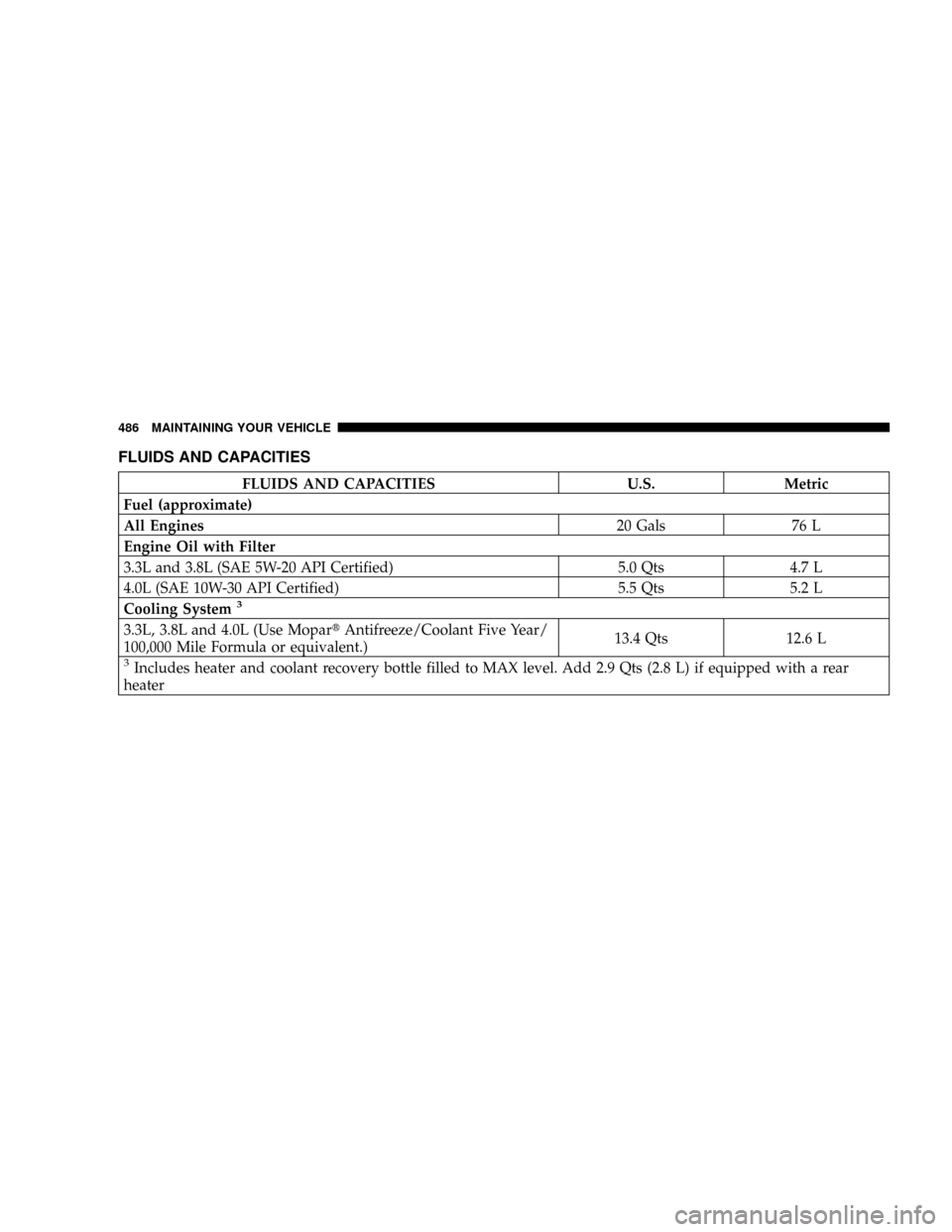
FLUIDS AND CAPACITIES
FLUIDS AND CAPACITIES U.S. Metric
Fuel (approximate)
All Engines20 Gals 76 L
Engine Oil with Filter
3.3L and 3.8L (SAE 5W-20 API Certified) 5.0 Qts 4.7 L
4.0L (SAE 10W-30 API Certified) 5.5 Qts 5.2 L
Cooling System
3
3.3L, 3.8L and 4.0L (Use MopartAntifreeze/Coolant Five Year/
100,000 Mile Formula or equivalent.)13.4 Qts 12.6 L
3Includes heater and coolant recovery bottle filled to MAX level. Add 2.9 Qts (2.8 L) if equipped with a rear
heater
486 MAINTAINING YOUR VEHICLE
Page 489 of 531
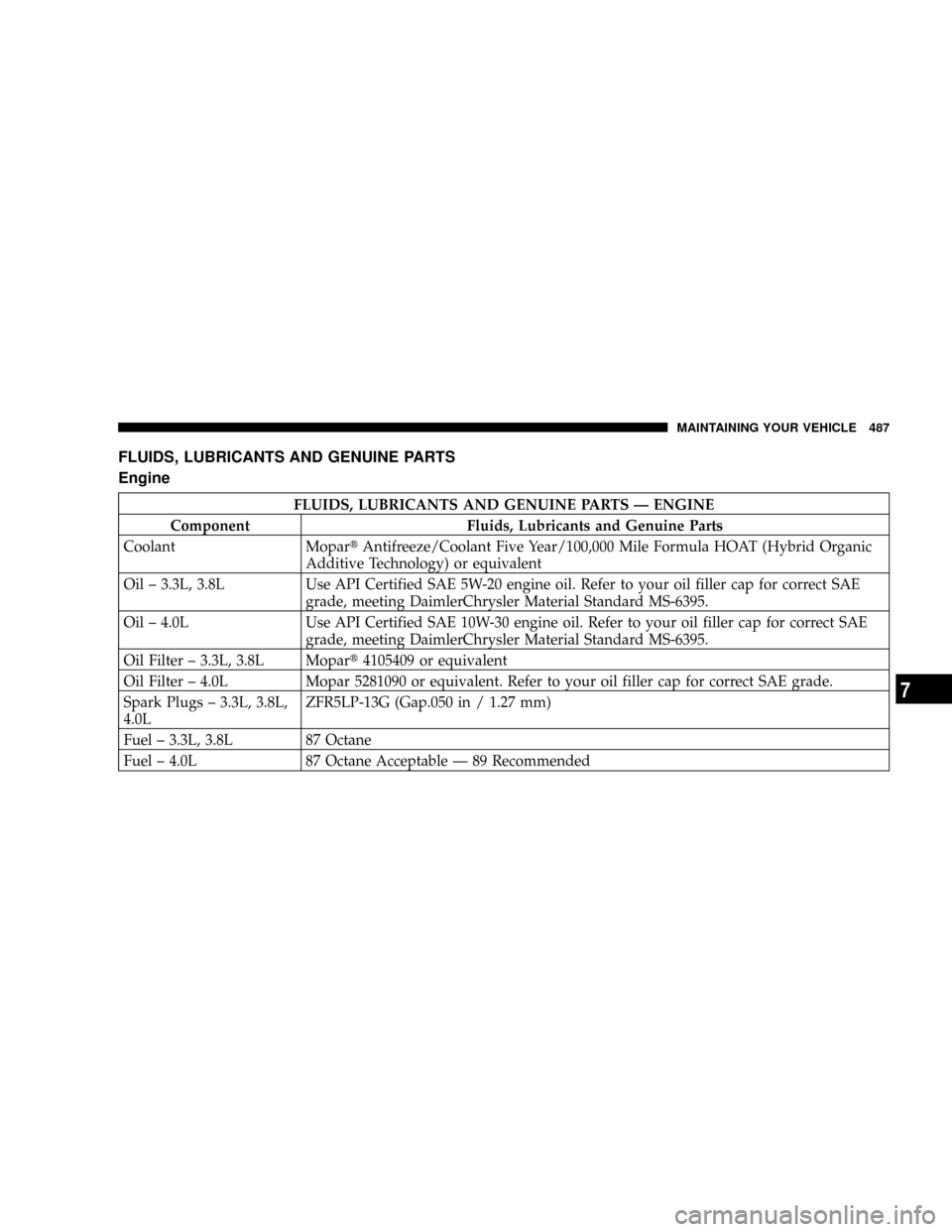
FLUIDS, LUBRICANTS AND GENUINE PARTS
Engine
FLUIDS, LUBRICANTS AND GENUINE PARTS Ð ENGINE
Component Fluids, Lubricants and Genuine Parts
Coolant MopartAntifreeze/Coolant Five Year/100,000 Mile Formula HOAT (Hybrid Organic
Additive Technology) or equivalent
Oil ± 3.3L, 3.8L Use API Certified SAE 5W-20 engine oil. Refer to your oil filler cap for correct SAE
grade, meeting DaimlerChrysler Material Standard MS-6395.
Oil ± 4.0L Use API Certified SAE 10W-30 engine oil. Refer to your oil filler cap for correct SAE
grade, meeting DaimlerChrysler Material Standard MS-6395.
Oil Filter ± 3.3L, 3.8L Mopart4105409 or equivalent
Oil Filter ± 4.0L Mopar 5281090 or equivalent. Refer to your oil filler cap for correct SAE grade.
Spark Plugs ± 3.3L, 3.8L,
4.0LZFR5LP-13G (Gap.050 in / 1.27 mm)
Fuel ± 3.3L, 3.8L 87 Octane
Fuel ± 4.0L 87 Octane Acceptable Ð 89 Recommended
MAINTAINING YOUR VEHICLE 487
7
Page 494 of 531
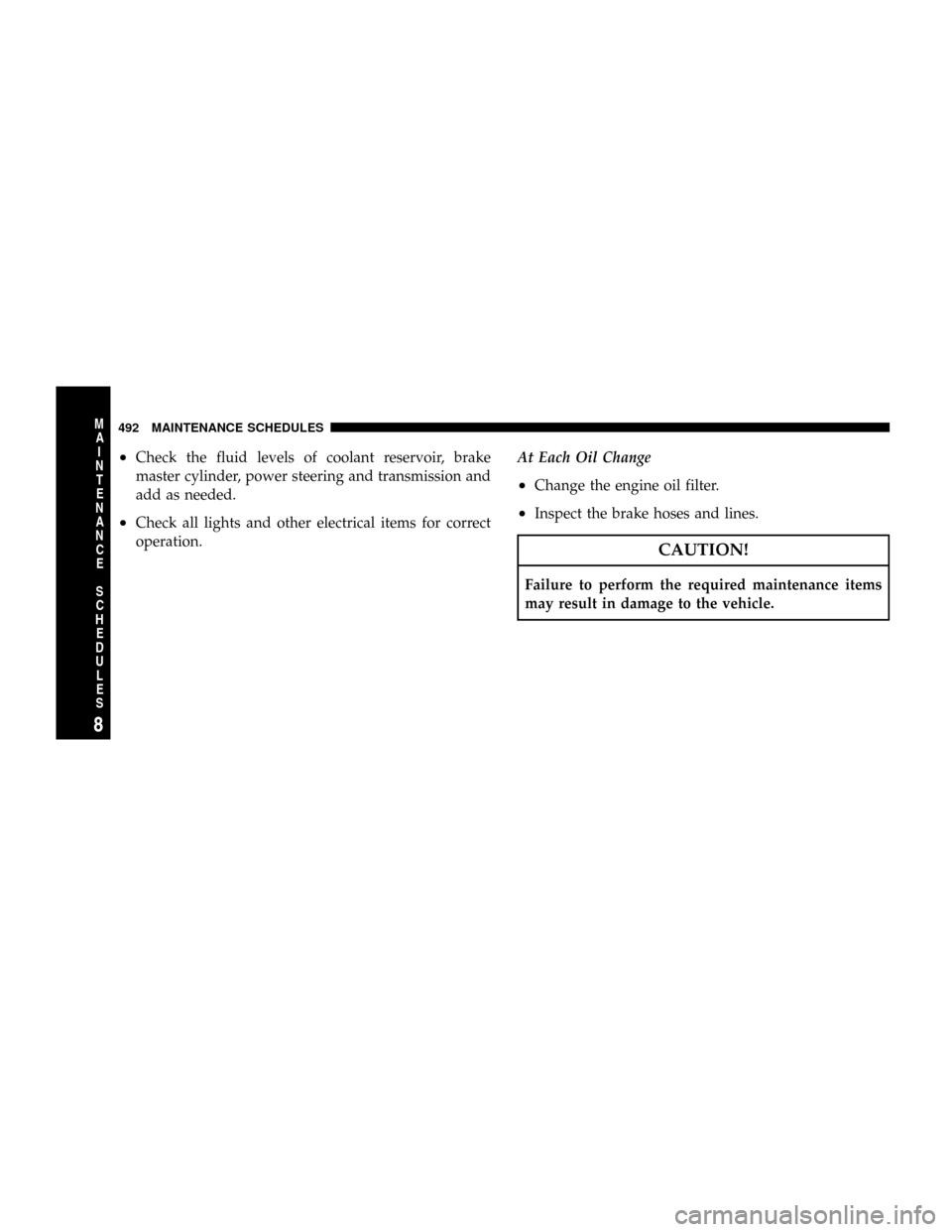
²Check the fluid levels of coolant reservoir, brake
master cylinder, power steering and transmission and
add as needed.
²Check all lights and other electrical items for correct
operation.At Each Oil Change
²Change the engine oil filter.
²Inspect the brake hoses and lines.
CAUTION!
Failure to perform the required maintenance items
may result in damage to the vehicle.
492 MAINTENANCE SCHEDULES
8
M
A
I
N
T
E
N
A
N
C
E
S
C
H
E
D
U
L
E
S
Page 496 of 531
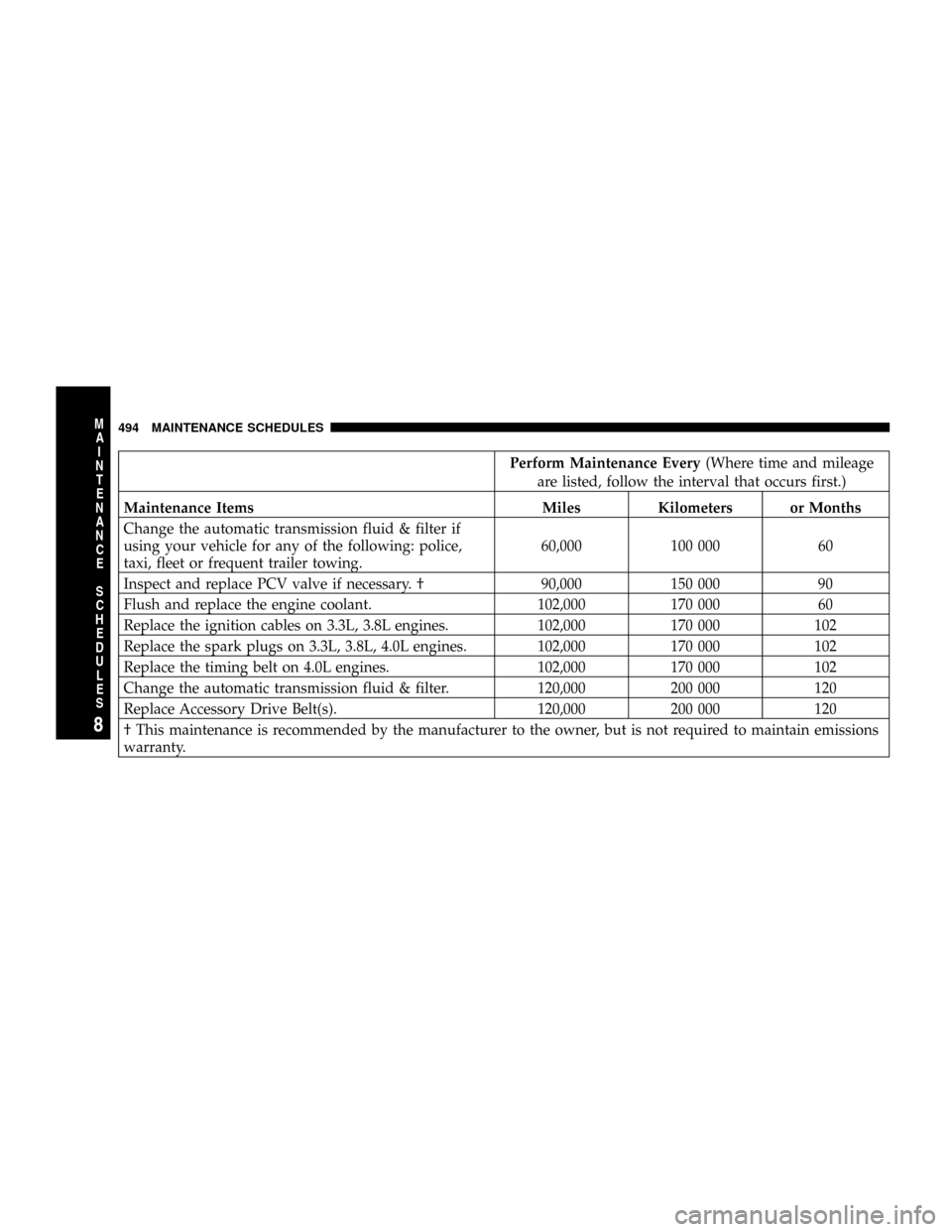
Perform Maintenance Every(Where time and mileage
are listed, follow the interval that occurs first.)
Maintenance Items Miles Kilometers or Months
Change the automatic transmission fluid & filter if
using your vehicle for any of the following: police,
taxi, fleet or frequent trailer towing.60,000 100 000 60
Inspect and replace PCV valve if necessary. ² 90,000 150 000 90
Flush and replace the engine coolant. 102,000 170 000 60
Replace the ignition cables on 3.3L, 3.8L engines. 102,000 170 000 102
Replace the spark plugs on 3.3L, 3.8L, 4.0L engines. 102,000 170 000 102
Replace the timing belt on 4.0L engines. 102,000 170 000 102
Change the automatic transmission fluid & filter. 120,000 200 000 120
Replace Accessory Drive Belt(s). 120,000 200 000 120
² This maintenance is recommended by the manufacturer to the owner, but is not required to maintain emissions
warranty.
494 MAINTENANCE SCHEDULES
8
M
A
I
N
T
E
N
A
N
C
E
S
C
H
E
D
U
L
E
S
Page 510 of 531
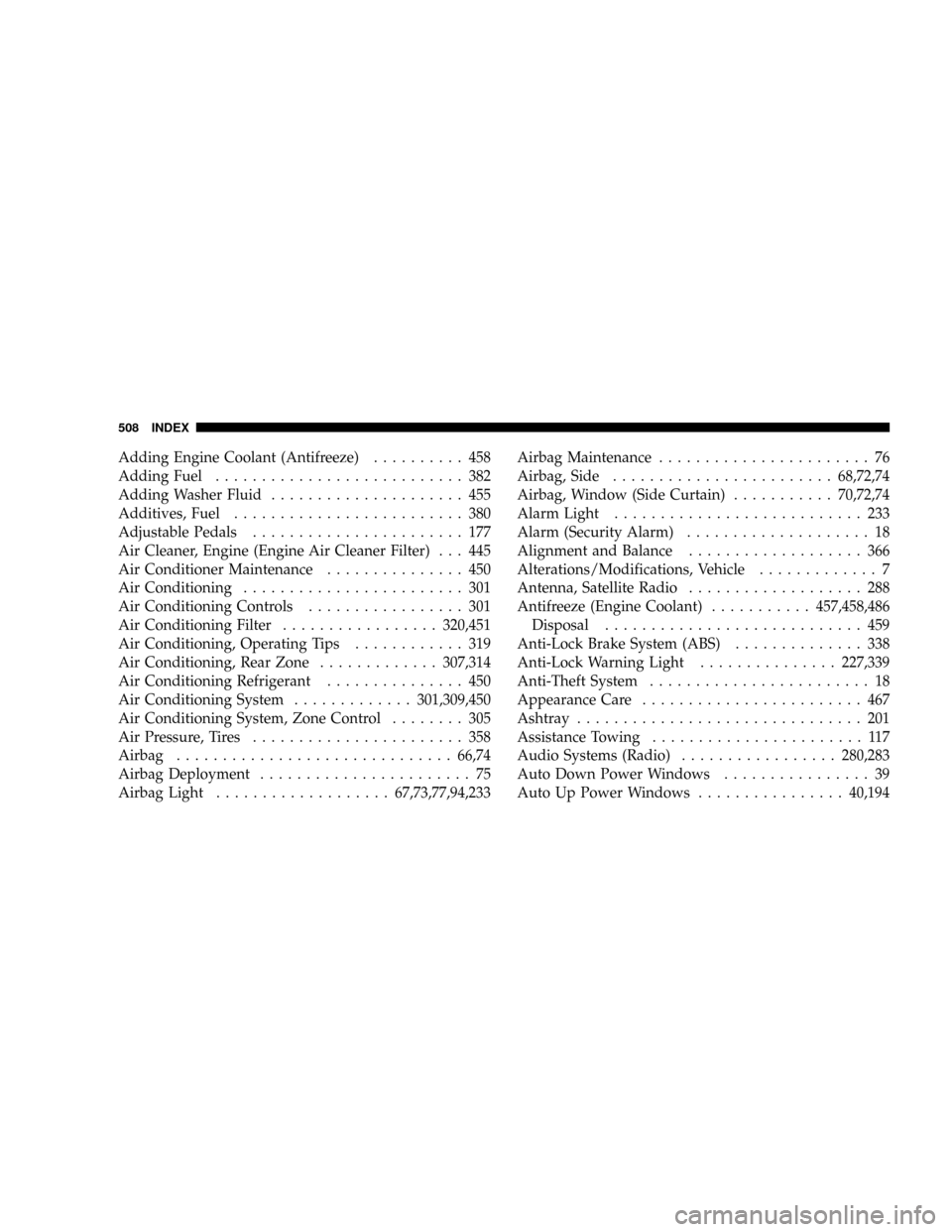
Adding Engine Coolant (Antifreeze).......... 458
Adding Fuel........................... 382
Adding Washer Fluid..................... 455
Additives, Fuel......................... 380
Adjustable Pedals....................... 177
Air Cleaner, Engine (Engine Air Cleaner Filter) . . . 445
Air Conditioner Maintenance............... 450
Air Conditioning........................ 301
Air Conditioning Controls................. 301
Air Conditioning Filter.................320,451
Air Conditioning, Operating Tips............ 319
Air Conditioning, Rear Zone.............307,314
Air Conditioning Refrigerant............... 450
Air Conditioning System.............301,309,450
Air Conditioning System, Zone Control........ 305
Air Pressure, Tires....................... 358
Airbag..............................66,74
Airbag Deployment....................... 75
Airbag Light...................67,73,77,94,233Airbag Maintenance....................... 76
Airbag, Side........................68,72,74
Airbag, Window (Side Curtain)...........70,72,74
Alarm Light........................... 233
Alarm (Security Alarm).................... 18
Alignment and Balance................... 366
Alterations/Modifications, Vehicle............. 7
Antenna, Satellite Radio................... 288
Antifreeze (Engine Coolant)...........457,458,486
Disposal............................ 459
Anti-Lock Brake System (ABS).............. 338
Anti-Lock Warning Light...............227,339
Anti-Theft System........................ 18
Appearance Care........................ 467
Ashtray............................... 201
Assistance Towing....................... 117
Audio Systems (Radio).................280,283
Auto Down Power Windows................ 39
Auto Up Power Windows................40,194
508 INDEX
Page 512 of 531
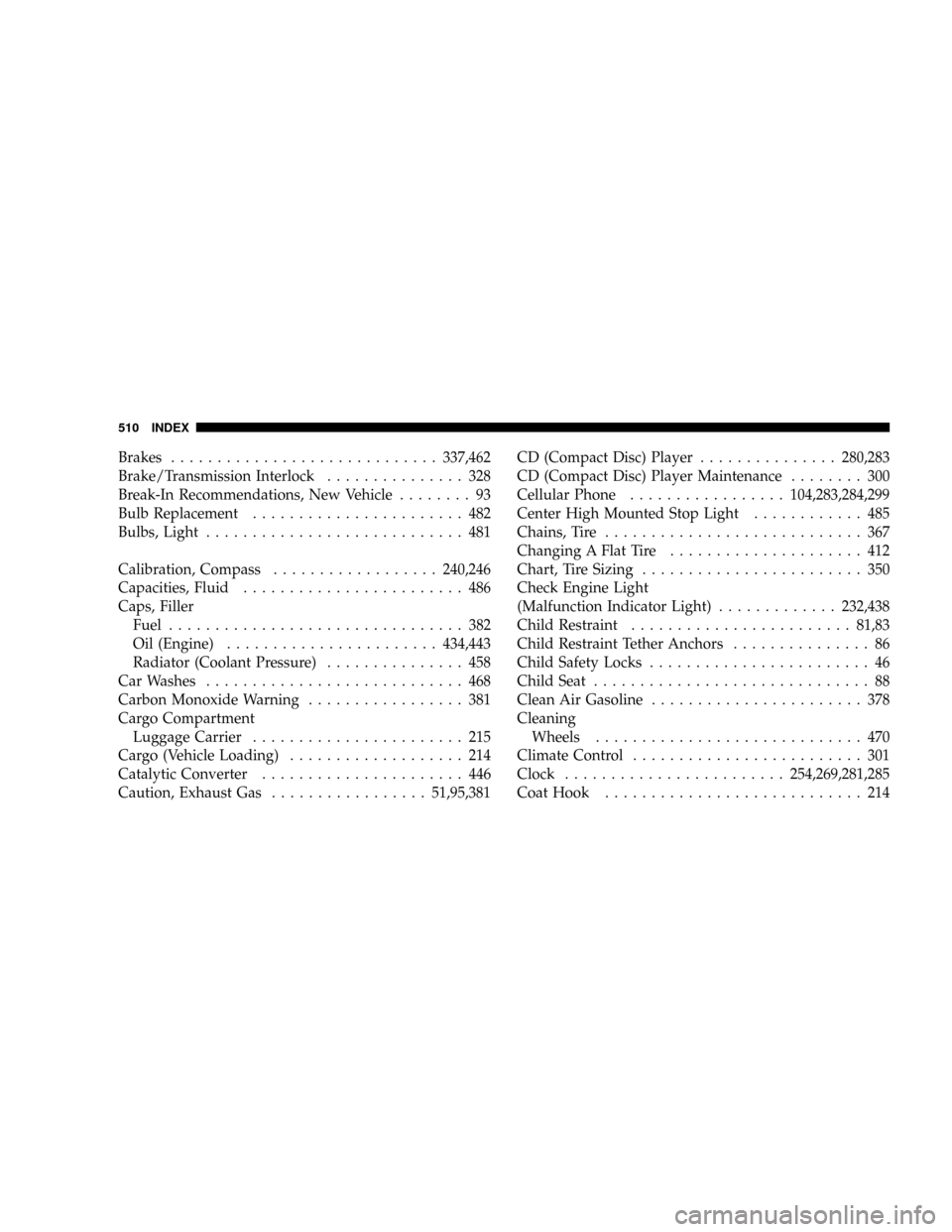
Brakes.............................337,462
Brake/Transmission Interlock............... 328
Break-In Recommendations, New Vehicle........ 93
Bulb Replacement....................... 482
Bulbs, Light............................ 481
Calibration, Compass..................240,246
Capacities, Fluid........................ 486
Caps, Filler
Fuel................................ 382
Oil (Engine).......................434,443
Radiator (Coolant Pressure)............... 458
Car Washes............................ 468
Carbon Monoxide Warning................. 381
Cargo Compartment
Luggage Carrier....................... 215
Cargo (Vehicle Loading)................... 214
Catalytic Converter...................... 446
Caution, Exhaust Gas.................51,95,381CD (Compact Disc) Player...............280,283
CD (Compact Disc) Player Maintenance........ 300
Cellular Phone.................104,283,284,299
Center High Mounted Stop Light............ 485
Chains, Tire............................ 367
Changing A Flat Tire..................... 412
Chart, Tire Sizing........................ 350
Check Engine Light
(Malfunction Indicator Light).............232,438
Child Restraint........................81,83
Child Restraint Tether Anchors............... 86
Child Safety Locks........................ 46
Child Seat.............................. 88
Clean Air Gasoline....................... 378
Cleaning
Wheels............................. 470
Climate Control......................... 301
Clock........................254,269,281,285
Coat Hook............................ 214
510 INDEX