fuel DODGE CARAVAN 2008 5.G Owner's Manual
[x] Cancel search | Manufacturer: DODGE, Model Year: 2008, Model line: CARAVAN, Model: DODGE CARAVAN 2008 5.GPages: 531, PDF Size: 7.72 MB
Page 373 of 531
CAUTION!
After inspecting or adjusting the tire pressure always
reinstall the valve stem cap. This will prevent mois-
ture and dirt from entering the valve stem, which
could damage the TPMS SENSOR.
NOTE:
²The TPMS is not intended to replace normal tire care
and maintenance, or to provide warning of a tire
failure or condition.
²The TPMS should not be used as a tire pressure gauge
while adjusting your tire pressure.
²Driving on a significantly under-inflated tire causes
the tire to overheat and can lead to tire failure.
Under-inflation also reduces fuel efficiency and tire
tread life, and may affect the vehicle's handling and
stopping ability.
²The TPMS is not a substitute for proper tire mainte-
nance, and it is the driver's responsibility to maintain
correct tire pressure, using an accurate tire pressure
gage, even if under-inflation has not reached the level
to trigger illumination of the TPMS Warning Lamp.
NOTE:Seasonal temperature changes will affect tire
pressure, and the TPMS will monitor the actual tire
pressure in the tire.
BASIC TPMS WITHOUT EVIC Ð IF EQUIPPED
The TPMS uses wireless technology with wheel rim
mounted electronic sensors to monitor tire pressure lev-
els. Sensors, mounted to each wheel as part of the valve
stem, transmit tire pressure readings to the Receiver
Module.
NOTE:It is particularly important, for you to check the
tire pressure in all of your tires regularly and to maintain
the proper pressure.
STARTING AND OPERATING 371
5
Page 379 of 531
5. Once you repair or replace the original road tire, and
reinstall it on the vehicle in place of the compact spare,
the TPMS will update automatically. In addition, the
TPMS Telltale Warning Light will turn off and the
graphic in the EVIC will display a new pressure value
instead of dashes (- -), as long no tire pressure is below
the low pressure warning limit in any of the four active
road tires.
NOTE:The vehicle may need to be driven for up to 10
minutes above 15 mph (25 km/h) in order for the TPMS
to receive this information.
General Information
This device complies with Part 15 of the FCC rules and
RSS 210 of Industry Canada. Operation is subject to the
following conditions:
²This device may not cause harmful interference.
²This device must accept any interference received,
including interference that may cause undesired op-
eration.
The tire pressure sensors are regulated under one of the
following licenses:
United States.....................KR5S120123
Canada........................2671-S120123
FUEL REQUIREMENTS
3.3L & 3.8L Gasoline Engine
All engines are designed to meet all emis-
sions regulations and provide excellent
fuel economy and performance when us-
ing high-quality unleaded ªregularº gaso-
line having an octane rating of 87. The use
of premium gasoline is not recommended.
Under normal conditions, the use of premium gasoline
will not provide a benefit over high-quality regular
STARTING AND OPERATING 377
5
Page 380 of 531
gasolines, and in some circumstances may result in
poorer performance.
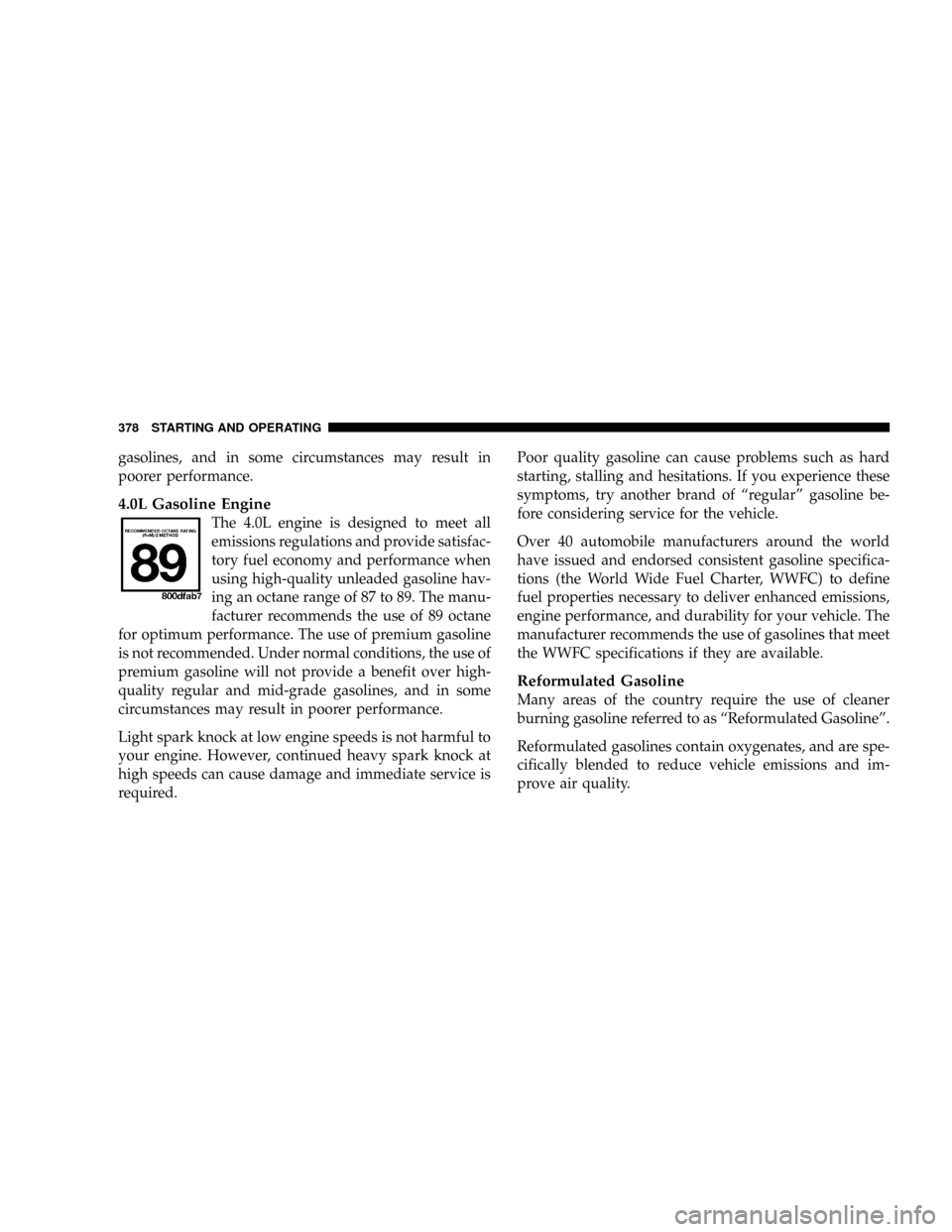
4.0L Gasoline Engine
The 4.0L engine is designed to meet all
emissions regulations and provide satisfac-
tory fuel economy and performance when
using high-quality unleaded gasoline hav-
ing an octane range of 87 to 89. The manu-
facturer recommends the use of 89 octane
for optimum performance. The use of premium gasoline
is not recommended. Under normal conditions, the use of
premium gasoline will not provide a benefit over high-
quality regular and mid-grade gasolines, and in some
circumstances may result in poorer performance.
Light spark knock at low engine speeds is not harmful to
your engine. However, continued heavy spark knock at
high speeds can cause damage and immediate service is
required.Poor quality gasoline can cause problems such as hard
starting, stalling and hesitations. If you experience these
symptoms, try another brand of ªregularº gasoline be-
fore considering service for the vehicle.
Over 40 automobile manufacturers around the world
have issued and endorsed consistent gasoline specifica-
tions (the World Wide Fuel Charter, WWFC) to define
fuel properties necessary to deliver enhanced emissions,
engine performance, and durability for your vehicle. The
manufacturer recommends the use of gasolines that meet
the WWFC specifications if they are available.
Reformulated Gasoline
Many areas of the country require the use of cleaner
burning gasoline referred to as ªReformulated Gasolineº.
Reformulated gasolines contain oxygenates, and are spe-
cifically blended to reduce vehicle emissions and im-
prove air quality.
378 STARTING AND OPERATING
Page 381 of 531
The manufacturer supports the use of reformulated gaso-
lines. Properly blended reformulated gasolines will pro-
vide excellent performance and durability of engine and
fuel system components.
Gasoline/Oxygenate Blends
Some fuel suppliers blend unleaded gasoline with oxy-
genates such as 10% ethanol, MTBE, and ETBE. Oxygen-
ates are required in some areas of the country during the
winter months to reduce carbon monoxide emissions.
Fuels blended with these oxygenates may be used in
your vehicle.
CAUTION!
DO NOT use gasolines containing Methanol or E85
Ethanol. Use of these blends may result in starting
and driveability problems and may damage critical
fuel system components.Problems that result from using methanol/gasoline or
E85 Ethanol blends are not the responsibility of the
manufacturer. While MTBE is an oxygenate made from
Methanol, it does not have the negative effects of Metha-
nol.
MMT In Gasoline
MMT is a manganese containing metallic additive that is
blended into some gasoline to increase octane. Gasoline
blended with MMT provides no performance advantage
beyond gasoline of the same octane number without
MMT. Gasoline blended with MMT reduces spark plug
life and reduces emission system performance in some
vehicles. The manufacturer recommends that gasoline
without MMT be used in your vehicle. The MMT content
of gasoline may not be indicated on the gasoline pump,
therefore, you should ask your gasoline retailer whether
the gasoline contains MMT.
STARTING AND OPERATING 379
5
Page 382 of 531
It is even more important to look for gasolines without
MMT in Canada, because MMT can be used at levels
higher than those allowed in the United States.
MMT is prohibited in Federal and California reformu-
lated gasolines.
Materials Added to Fuel
All gasoline sold in the United States is required to
contain effective detergent additives. Use of additional
detergents or other additives are not needed under
normal conditions and would result in additional cost.
Therefore you should not have to add anything to the
fuel.
Fuel System Cautions
CAUTION!
Follow these guidelines to maintain your vehicle's
performance:
²The use of leaded gas is prohibited by Federal law.
Using leaded gasoline can impair engine performance
and damage the emission control system.
²An out-of-tune engine, or certain fuel or ignition
malfunctions, can cause the catalytic converter to
overheat. If you notice a pungent burning odor or
some light smoke, your engine may be out of tune or
malfunctioning and may require immediate service.
Contact your authorized dealer for service assistance.
380 STARTING AND OPERATING
Page 383 of 531
²The use of fuel additives which are now being sold as
octane enhancers is not recommended. Most of these
products contain high concentrations of methanol.
Fuel system damage or vehicle performance problems
resulting from the use of such fuels or additives is not
the responsibility of the manufacturer.
NOTE:Intentional tampering with emissions control
systems can result in civil penalties being assessed
against you.Carbon Monoxide Warnings
WARNING!
Carbon monoxide (CO) in exhaust gases is deadly.
²To prevent carbon monoxide poisoning DO NOT
inhale exhaust gases. They contain carbon monox-
ide, a colorless and odorless gas which can kill.
²NEVER run the engine in a closed area, such as a
garage, and NEVER sit in a parked vehicle with
the engine running for an extended period. If the
vehicle is stopped in an open area with the engine
running for more than a short period, adjust the
ventilation system to force fresh, outside air into
the vehicle.
STARTING AND OPERATING 381
5
Page 384 of 531
WARNING!
Carbon monoxide (CO) in exhaust gases is deadly.
Follow the precautions below to prevent carbon
monoxide poisoning:
²Guard against carbon monoxide with proper
maintenance. Have the exhaust system inspected
every time the vehicle is raised. Have any abnor-
mal conditions repaired promptly. Until repaired,
drive with all side windows fully open.
²Keep the liftgate closed when driving your vehicle
to prevent carbon monoxide and other poisonous
exhaust gases from entering the vehicle.
ADDING FUEL
Fuel Filler Cap (Gas Cap)
As a reminder, a fuel icon with an arrow
indicating which side of the vehicle the fuel
filler door is located on, is located in the
instrument cluster, just below the Fuel Gage.
The gas cap is located behind the fuel filler door on the
left side of the vehicle. If the gas cap is lost or damaged,
be sure the replacement cap is for use with this vehicle.
NOTE:The driver's side sliding door cannot be opened
while the fuel door is open. This feature operates only
when the sliding door is fully closed prior to opening the
fuel door.
382 STARTING AND OPERATING
Page 385 of 531
CAUTION!
Damage to the fuel system or emission control sys-
tem could result from using an improper fuel tank
filler tube cap (gas cap). A poorly fitting cap could let
impurities into the fuel system and may cause the
Malfunction Indicator Light (MIL) to turn on due to
fuel vapors escaping from the system.
CAUTION!
To avoid fuel spillage and overfilling, do not ªtop
offº the fuel tank after filling.
NOTE:When the fuel nozzle ªclicksº or shuts off, the
fuel tank is full.
WARNING!
²Never have any smoking materials lit in or near
the vehicle when the gas cap is removed or the
tank filled.
²Never add fuel when the engine is running. This is
in violation of most state and federal fire regula-
tions and will cause the malfunction indicator
light to turn on.
NOTE:
²Tighten the fuel filler cap until you hear a ªclickingº
sound. This is an indication that the fuel filler cap is
properly tightened.
²If the gas cap is not tightened properly, the Malfunc-
tion Indicator Light may come on. Be sure the gas cap
is tightened every time the vehicle is refueled.
STARTING AND OPERATING 383
5
Page 386 of 531
WARNING!
A fire may result if gasoline is pumped into a
portable container that is inside of a vehicle. You
could be burned. Always place gas containers on the
ground while filling.
Loose Fuel Filler Cap Message
²
If thegASCAPmessage is displayed in the instrument
cluster, this signifies a leak or change in the evapora-
tive system is detected. Sometimes this is the result of
a loosely fitting (or possibly damaged) filler cap.
Tighten the fuel filler cap properly and press the
odometer reset button to turn thegASCAPmessage
off.
²Make sure that the fuel filler cap is tightened each time
the vehicle is refueled.
²If the problem continues, the message will appear the
next time the vehicle is started. See your authorized
dealer service center as soon as possible. See Section 7
of this manual for more information.
FLEXIBLE FUEL Ð 3.3L ENGINES ONLY
E-85 General Information
The information in this section is for Flexible Fuel Ve-
hicles (FFV) only. These vehicles can be identified by the
unique fuel filler door label that states:Ethanol (E-85) or
Unleaded Gasoline Only.This section only covers those
subjects that are unique to these vehicles. Please refer to
the other sections of this manual for information on
features that are common between Flexible Fuel and
gasoline only powered vehicles.
384 STARTING AND OPERATING
Page 387 of 531
CAUTION!
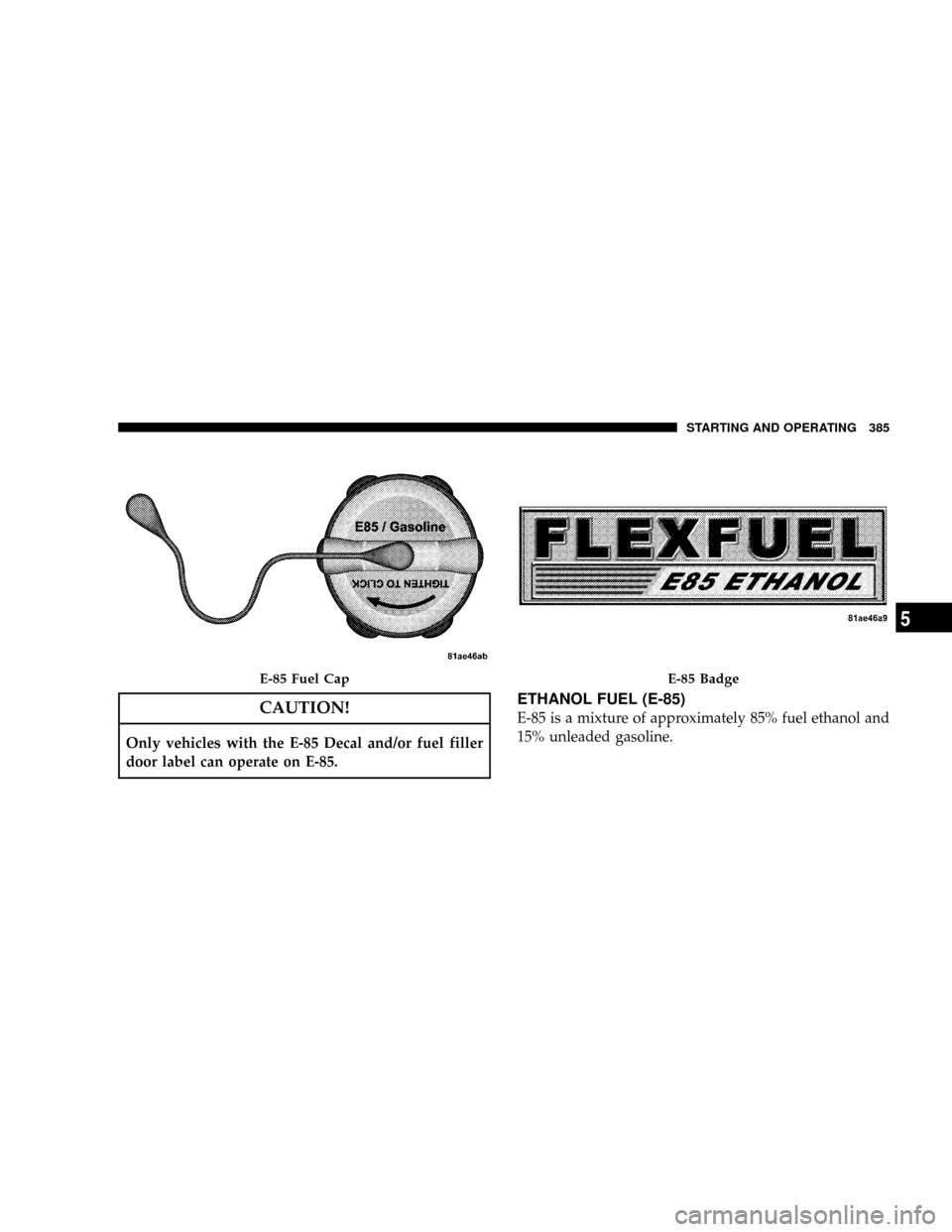
Only vehicles with the E-85 Decal and/or fuel filler
door label can operate on E-85.
ETHANOL FUEL (E-85)
E-85 is a mixture of approximately 85% fuel ethanol and
15% unleaded gasoline.
E-85 Fuel CapE-85 Badge
STARTING AND OPERATING 385
5