transmission DODGE CARAVAN 2008 5.G Owner's Manual
[x] Cancel search | Manufacturer: DODGE, Model Year: 2008, Model line: CARAVAN, Model: DODGE CARAVAN 2008 5.GPages: 531, PDF Size: 7.72 MB
Page 332 of 531
the instrument cluster will display transmission gear
selection as 6, 5, 4, 3, 2, 1 for six-speed and 4, 3, 2, 1 for
four-speed transmissions.
Gear Ranges
DO NOT race the engine when shifting the gear selector
lever from PARK or NEUTRAL positions into another
gear range.
PARK
Shifting the gear selector lever in PARK supplements the
parking brake by locking the transmission. The engine
can be started in this gear. Never attempt to use PARK
while vehicle is in motion. Apply the parking brake when
leaving the vehicle in this gear.
When parking on a flat surface, place the shift lever in the
PARK position first, and then apply the parking brake.When parking on a hill, it is important to set the parking
brake before placing the shift lever in PARK, otherwise
the load on the transmission locking mechanism may
make it difficult to move the shift lever out of PARK. As
an added precaution, turn the front wheels toward the
curb on a downhill grade and away from the curb on an
uphill grade.
WARNING!
Never use PARK position on an automatic transmis-
sion as a substitute for the parking brake. Always
apply parking brake fully when parked to guard
against vehicle movement and possible injury or
damage.
330 STARTING AND OPERATING
Page 333 of 531
WARNING!
Unintended movement of a vehicle could injure
those in and near the vehicle. As with all vehicles,
you should never exit a vehicle while the engine is
running. Before exiting a vehicle, you should always
shift the gear selector lever into PARK, remove the
key from the ignition, and apply the parking brake.
Once the key is removed from the ignition, the
transmission gear selector lever is locked in the
PARK position, securing the vehicle against un-
wanted movement. Furthermore, you should never
leave unattended children or pets inside a vehicle.
The following indicators should be used to ensure that
you have engaged the transmission gear selector lever
into the PARK position:
²When shifting the gear selector lever into PARK,
depress the button on the gear selector lever and
firmly move the lever all the way forward until it
stops.
²Look at the shift indicator window on the console to
ensure gear selector lever is in the PARK position.
²When engaged in PARK, you will not be able to move
the gear selector lever rearward without depressing
the gear selector lever button.
CAUTION!
Before moving the gear selector lever out of PARK,
you must turn the ignition from LOCK/OFF to ON so
the steering wheel and gear selector lever are re-
leased. Otherwise, damage to the steering column or
gear selector lever could result.
STARTING AND OPERATING 331
5
Page 334 of 531
REVERSE
Use REVERSE for moving the vehicle rearward. Shift into
REVERSE only after the vehicle has come to a complete
stop.
NEUTRAL
Shift the gear selector lever into this gear only after the
vehicle has come to a complete stop. The engine may be
started in this range.
WARNING!
Do not coast in NEUTRAL and never turn off the
ignition to coast down a hill. These are unsafe
practices that limit your response to changing traffic
or road conditions. You might lose control of the
vehicle and have an accident.
DRIVE Ð Six-Speed Transmission
This range should be used for most city and highway
driving. It provides the smoothest upshifts, downshifts,
and best fuel economy. However, use the Electronic
Range Select (ERS) mode by moving the leverÐ/+and
select the ª5º range when frequent transmission shifting
occurs while using the DRIVE range, such as when
operating the vehicle under heavy loading conditions,
(i.e., in hilly terrain, traveling into strong head winds or
while towing heavy trailers). Under these conditions,
using the ª5º range will improve performance and
extend transmission life by reducing excessive shifting
and heat build-up.
DRIVE Ð Four-Speed Transmission
This range should be used for most city and highway
driving. It provides the smoothest upshifts, downshifts,
and best fuel economy. However, select the ª3º range
when frequent transmission shifting occurs while using
the DRIVE range, such as when operating the vehicle
332 STARTING AND OPERATING
Page 335 of 531
under heavy loading conditions, (i.e., in hilly terrain,
traveling into strong head winds or while towing heavy
trailers). Under these conditions, using the ª3º range will
improve performance and extend transmission life by
reducing excessive shifting and heat build-up.
CAUTION!
If the transmission operating temperature exceeds
acceptable limits, the vehicle computer will override
DRIVE and select ª5º range (on six-speed transmis-
sions) or ª3º range (on four-speed transmissions) by
changing shift points. This is done to prevent trans-
mission damage due to overheating.
Electronic Range Select (ERS) Operation
The Electronic Range Select (ERS) shift control allows
you to move the gear selector lever to the left (-) or right
(+) when the gear selector lever is in the D (Drive)position, this allows the selection of the desired top gear.
For example, if the driver shifts the transmission into 3rd
gear, the transmission will never shift above 3rd gear, but
can shift down to 2nd or 1st gear automatically, when
needed.
Switching from ERS to D-Mode (Drive) can be done at any
vehicle speed. To shift from ªDriveº mode to ªERSº mode,
move gear selector lever to the left (-) once. The current gear
will be maintained as the top gear. To disable ERS, simply
press and hold the gear selector lever to the right (+) until
ªDº is displayed in the instrument cluster odometer.
WARNING!
Do not downshift for additional engine braking on a
slippery surface. The drive wheels could lose their
grip and the vehicle could skid causing an accident or
personal injury.
STARTING AND OPERATING 333
5
Page 336 of 531
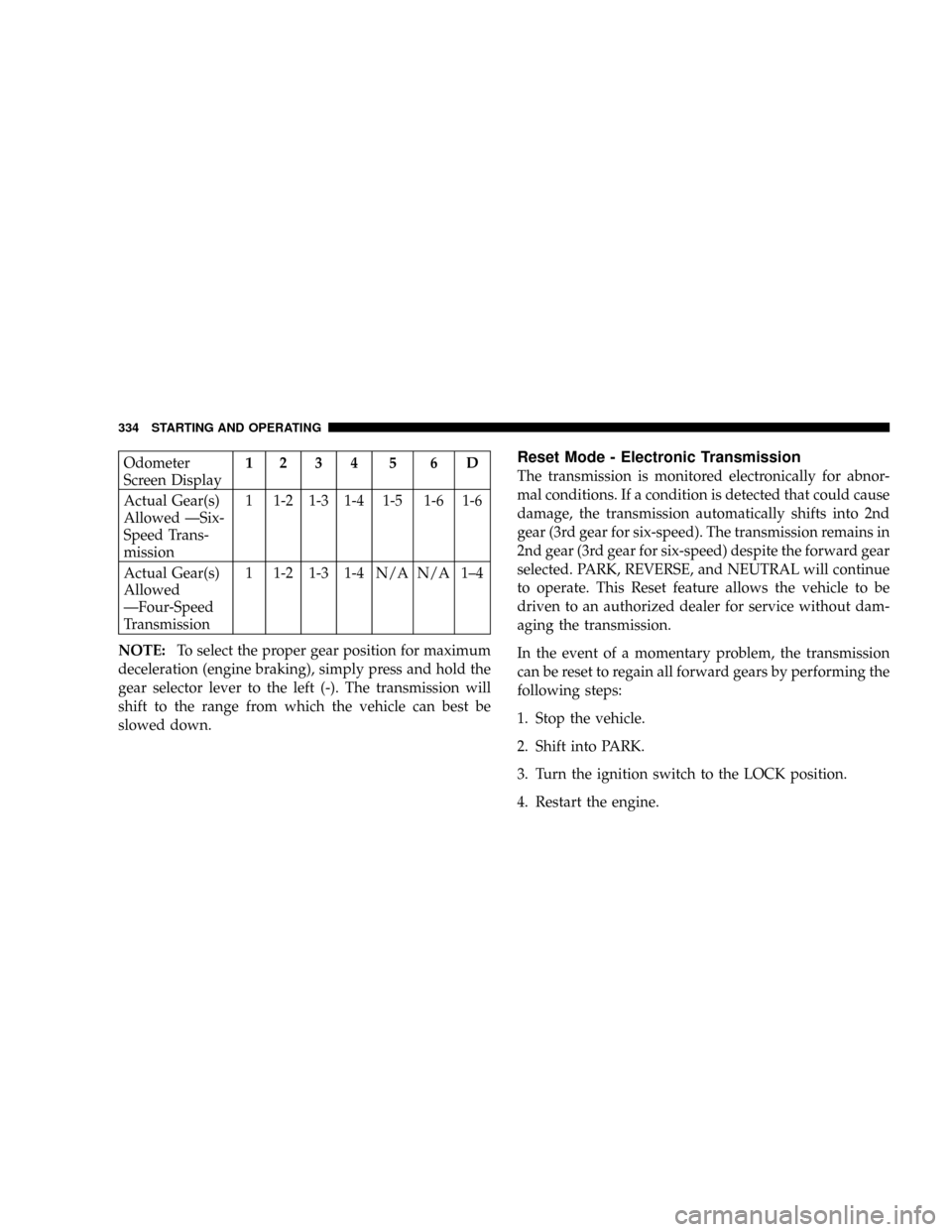
Odometer
Screen Display1234 5 6D
Actual Gear(s)
Allowed ÐSix-
Speed Trans-
mission1 1-2 1-3 1-4 1-5 1-6 1-6
Actual Gear(s)
Allowed
ÐFour-Speed
Transmission1 1-2 1-3 1-4 N/A N/A 1±4
NOTE:To select the proper gear position for maximum
deceleration (engine braking), simply press and hold the
gear selector lever to the left (-). The transmission will
shift to the range from which the vehicle can best be
slowed down.Reset Mode - Electronic Transmission
The transmission is monitored electronically for abnor-
mal conditions. If a condition is detected that could cause
damage, the transmission automatically shifts into 2nd
gear (3rd gear for six-speed). The transmission remains in
2nd gear (3rd gear for six-speed) despite the forward gear
selected. PARK, REVERSE, and NEUTRAL will continue
to operate. This Reset feature allows the vehicle to be
driven to an authorized dealer for service without dam-
aging the transmission.
In the event of a momentary problem, the transmission
can be reset to regain all forward gears by performing the
following steps:
1. Stop the vehicle.
2. Shift into PARK.
3. Turn the ignition switch to the LOCK position.
4. Restart the engine.
334 STARTING AND OPERATING
Page 337 of 531
5. Shift into the desired gear range and resume driving.
NOTE:Even if the transmission can be reset, it is
recommended that you visit an authorized dealer at your
earliest possible convenience. Your authorized dealer has
diagnostic equipment to determine if the problem could
recur.
If the transmission cannot be reset, authorized dealer
service is required.
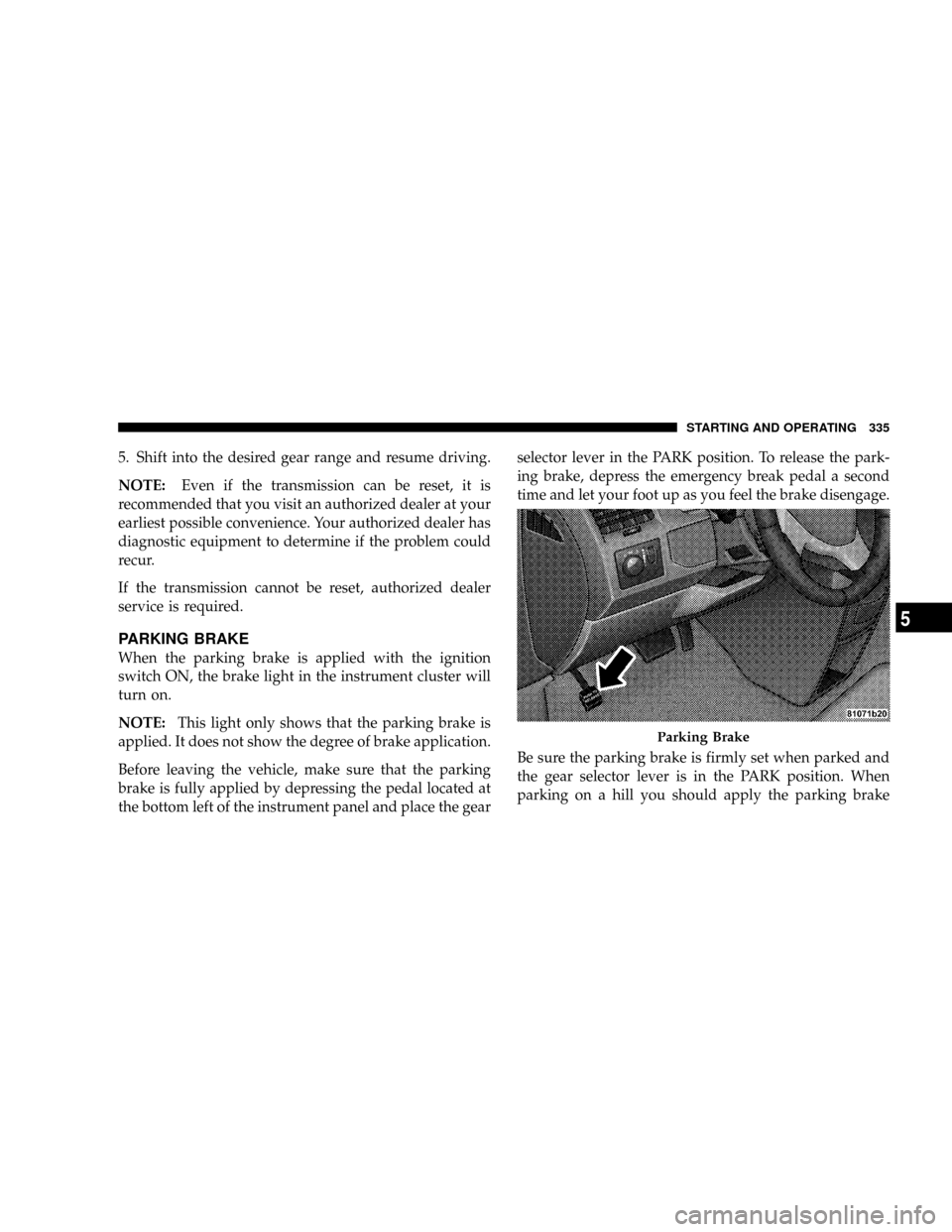
PARKING BRAKE
When the parking brake is applied with the ignition
switch ON, the brake light in the instrument cluster will
turn on.
NOTE:This light only shows that the parking brake is
applied. It does not show the degree of brake application.
Before leaving the vehicle, make sure that the parking
brake is fully applied by depressing the pedal located at
the bottom left of the instrument panel and place the gearselector lever in the PARK position. To release the park-
ing brake, depress the emergency break pedal a second
time and let your foot up as you feel the brake disengage.
Be sure the parking brake is firmly set when parked and
the gear selector lever is in the PARK position. When
parking on a hill you should apply the parking brake
Parking Brake
STARTING AND OPERATING 335
5
Page 338 of 531
before placing the gear selector lever in PARK, otherwise
the load on the transmission locking mechanism may
make it difficult to move the gear selector lever out of
PARK.
WARNING!
²Always fully apply the parking brake when leav-
ing your vehicle, or it may roll and cause damage
or injury. Also be certain to leave an automatic
transmission in PARK, a manual transmission in
REVERSE or first gear. Failure to do so may allow
the vehicle to roll and cause damage or injury.
²Be sure the parking brake is fully disengaged
before driving, failure to do so can lead to brake
problems due to excessive heating of the rear
brakes.
WARNING!
NEVER leave children alone in a vehicle. Leaving
unattended children in a vehicle is dangerous for a
number of reasons. A child or others could be seri-
ously or fatally injured. Don't leave the key in the
ignition. A child could operate power windows,
other controls, or move the vehicle
When parking on a hill, turn the front wheels toward the
curb on a downhill grade, and away from the curb on an
uphill grade.
The parking brake should always be applied whenever
the driver is not in the vehicle.
336 STARTING AND OPERATING
Page 349 of 531
Shallow Standing Water
Although your vehicle is capable of driving through
shallow standing water, consider the following Caution
and Warning before doing so.
CAUTION!
²Always check the depth of the standing water
before driving through it. Never drive through
standing water that is deeper than the bottom of
the tire rims mounted on the vehicle.
²Determine the condition of the road or the path
that is under water, and if there are any obstacles
in the way, before driving through the standing
water.
²Do not exceed 5 mph (8 km/h) when driving
through standing water. This will minimize wave
effects.
CAUTION!
²Driving through standing water may cause dam-
age to your vehicle's drivetrain components. Al-
ways inspect your vehicle's fluids (i.e., engine oil,
transmission, axle, etc.) for signs of contamination
(i.e., fluid that is milky or foamy in appearance)
after driving through standing water. Do not con-
tinue to operate the vehicle if any fluid appears
contaminated, as this may result in further dam-
age. Such damage is not covered by the New
Vehicle Limited Warranty.
²Getting water inside your vehicle's engine can
cause it to lock up and stall out, and cause serious
internal damage to the engine. Such damage is not
covered by the New Vehicle Limited Warranty.
STARTING AND OPERATING 347
5
Page 403 of 531
WARNING!
Improper towing can lead to an injury accident.
Follow these guidelines to make your trailer towing
as safe as possible:
Make certain that the load is secured in the trailer
and will not shift during travel. When trailering
cargo that is not fully secured, dynamic load shifts
can occur that may be difficult for the driver to
control. You could lose control of your vehicle and
have an accident.
²When hauling cargo or towing a trailer, do not over-
load your vehicle or trailer. Overloading can cause a
loss of control, poor performance or damage to brakes,
axle, engine, transmission, steering, suspension, chas-
sis structure or tires.
²Safety chains must always be used between your
vehicle and trailer. Always connect the chains to the
frame or hook retainers of the vehicle hitch. Cross the
chains under the trailer tongue and allow enough
slack for turning corners.
²Vehicles with trailers should not be parked on a grade.
When parking, apply the parking brake on the tow
vehicle. Put the tow vehicle automatic transmission in
PARK. Always, block or9chock9the trailer wheels.
²GCWR must not be exceeded.
²Total weight must be distributed between the tow
vehicle and the trailer such that the following four
ratings are not exceeded:
1. GVWR
2. GTW
3. GAWR
STARTING AND OPERATING 401
5
Page 407 of 531
Towing Tips
Before setting out on a trip, practice turning, stopping
and backing the trailer in an area away from heavy
traffic.
Towing Tips Ð Automatic Transmission
The DRIVE gear can be selected when towing. However,
if frequent shifting occurs while in DRIVE, move the gear
selector lever into third gear (with four-speed transmis-
sion) or fifth gear (with six-speed transmission).
NOTE:Moving the gear selector lever into third gear
(with four-speed transmission) or fifth gear (with six-
speed transmission) while operating the vehicle under
heavy operating conditions will improve performance
and extend transmission life by reducing excessive shift-
ing and heat build up. This action will also provide better
engine braking.
The automatic transmission fluid and filter should be
changed if you REGULARLY tow a trailer for more than
45 minutes of continuous operation. Refer to the ªMain-
tenance Scheduleº in Section 8 of this manual for trans-
mission fluid change intervals.
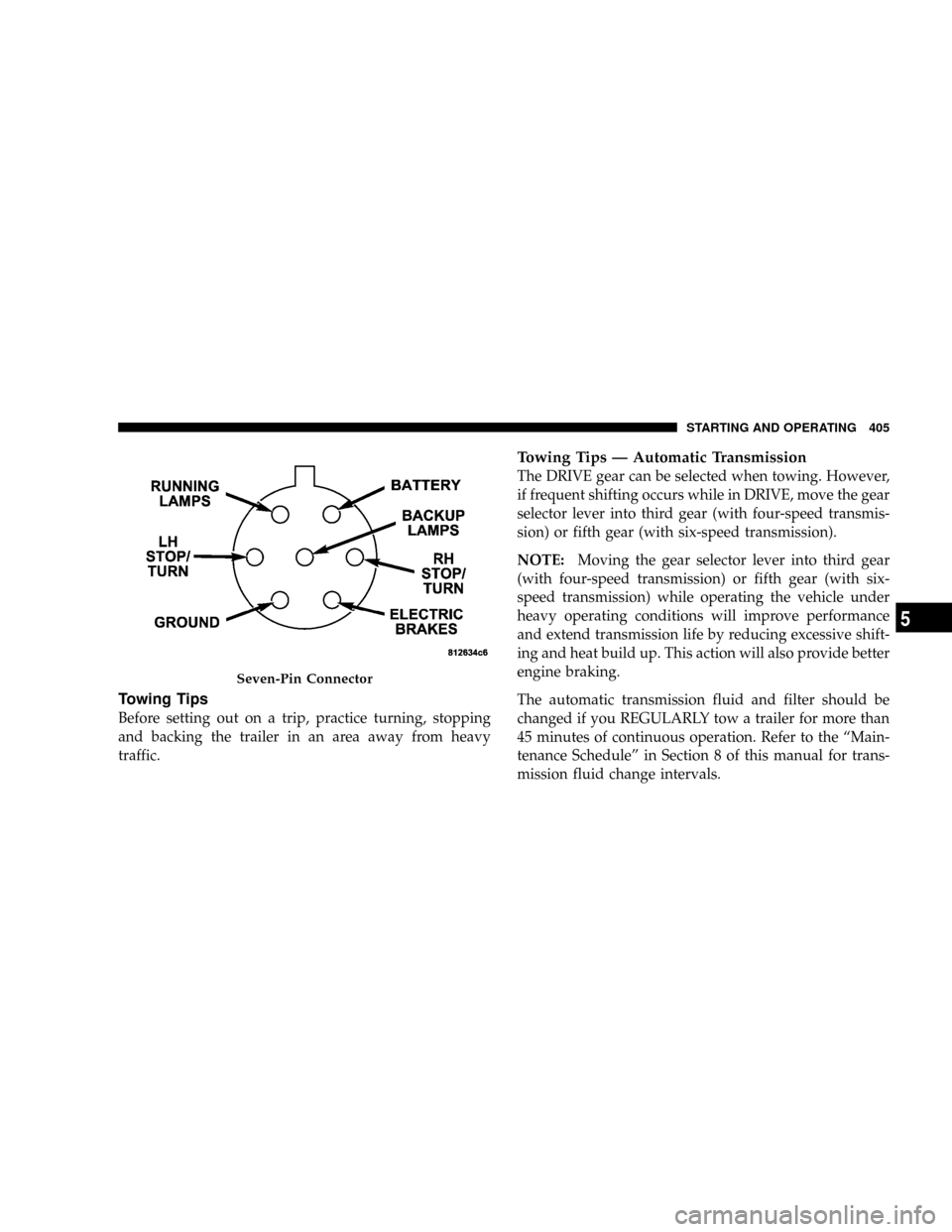
Seven-Pin Connector
STARTING AND OPERATING 405
5