wheel DODGE CARAVAN 2008 5.G Workshop Manual
[x] Cancel search | Manufacturer: DODGE, Model Year: 2008, Model line: CARAVAN, Model: DODGE CARAVAN 2008 5.GPages: 531, PDF Size: 7.72 MB
Page 420 of 531
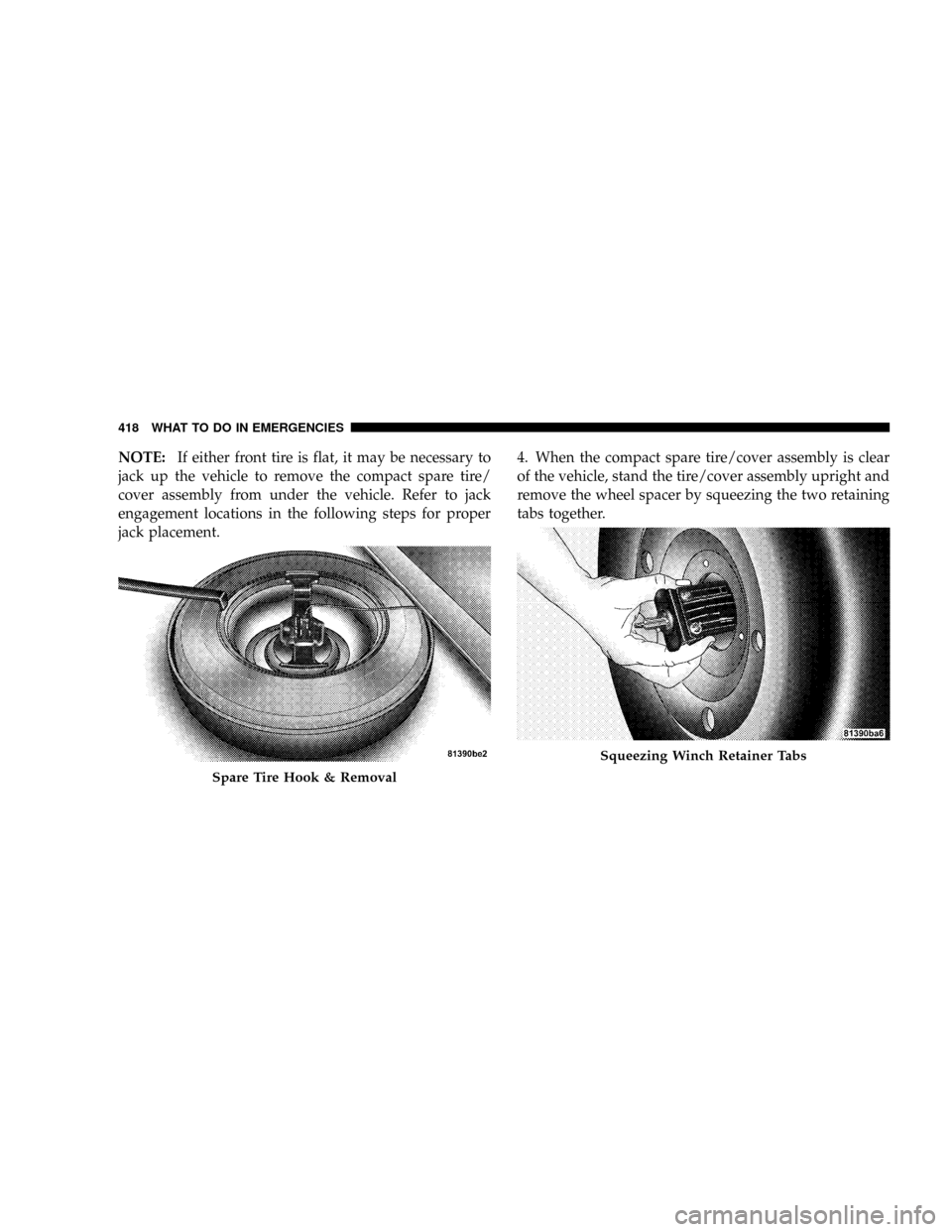
NOTE:If either front tire is flat, it may be necessary to
jack up the vehicle to remove the compact spare tire/
cover assembly from under the vehicle. Refer to jack
engagement locations in the following steps for proper
jack placement.4. When the compact spare tire/cover assembly is clear
of the vehicle, stand the tire/cover assembly upright and
remove the wheel spacer by squeezing the two retaining
tabs together.
Spare Tire Hook & Removal
Squeezing Winch Retainer Tabs
418 WHAT TO DO IN EMERGENCIES
Page 423 of 531
CAUTION!
Do not attempt to raise the vehicle by jacking on
locations other than those indicated in Step 5.
6. Place the wrench on the jack screw and turn to the
right until the jack head is properly engaged in the
described location.Do not raise the vehicle until you are
sure the jack is securely engaged.
7. Raise the vehicle by turning the jack screw to the right,
using the swivel wrench. Raise the vehicle only until the
tire just clears the surface and enough clearance is
obtained to install the spare tire. Minimum tire lift
provides maximum stability.
WARNING!
Raising the vehicle higher than necessary can make
the vehicle less stable. It could slip off the jack and
hurt someone near it. Raise the vehicle only enough
to remove the tire.
8. Remove the wheel lug nuts, for vehicles with wheel
covers, remove the cover from the wheel by hand. Do not
pry the wheel cover off. Then pull the wheel off the hub.
9. Install the compact spare tire. Lightly tighten the lug
nuts. To avoid the risk of forcing the vehicle off the jack,
do not tighten the lug nuts fully until the vehicle has been
lowered.
NOTE:Do not install the wheel cover on the compact
spare.
Do not use a hammer or force to install the wheel covers.
WHAT TO DO IN EMERGENCIES 421
6
Page 424 of 531
10. Lower the vehicle by turning the jack screw to the
left.
11. Finish tightening the lug nuts. Push down on the
wrench while tightening for increased leverage. Alternate
lug nuts until each nut has been tightened twice. Correct
wheel nut tightness is 95 ft lbs (130 N´m). If in doubt
about the correct tightness, have them checked with a
torque wrench by your authorized dealer or at a service
station.
12. Lower the jack to its fully-closed position.
WARNING!
A loose tire or jack thrown forward in a collision or
hard stop could endanger the occupants of the ve-
hicle. Always stow the jack parts and the spare tire in
the places provided. Have the deflated (flat) tire
repaired or replaced immediately.13. Place the deflated (flat) tire and compact spare tire
cover assembly in the rear cargo area.Do not stow the
deflated tire in the spare tire location.Have the full
sized tire repaired or replaced as soon as possible.
14. Stow the cable and wheel spacer before driving the
vehicle. Reassemble the winch handle extensions to form
a ªT' and fit the winch ªTº handle over the drive nut.
Rotate the nut to the right until the winch mechanism
clicks at least three times.
15. Stow the jack, jack handle and winch handle tools.
16. Check the compact spare tire pressure as soon as
possible. Correct pressure as required.Wheel Nuts
All wheel nuts should be tightened occasionally to elimi-
nate the possibility of wheel studs being sheared or the
bolt holes in the wheels becoming elongated. This is
especially important during the first few hundred miles
422 WHAT TO DO IN EMERGENCIES
Page 425 of 531
of operation, and after each time a tire is changed, to
allow the wheel nuts to become properly set. All nuts
should first be firmly seated against the wheel. The nuts
should then be tightened to recommended torque.
Tighten the nuts to final torque in increments. Progress
around the bolt circle, tightening the nut opposite to the
nut just previously tightened until final torque is
achieved. Recommended torque is 95 ft lbs (130 N´m).
Secure The Spare Tire As Follows:
1. To stow the compact spare tire/cover assembly on
vehicles equipped with Stow 'n Go seating, assemble the
winch handle extensions to form a ªT' and fit the winch
ªTº handle over the drive nut. Rotate the nut to the left
until the winch mechanism stops turning freely. This will
allow enough slack in the cable to allow you to pull the
wheel spacer out from under the vehicle.
WARNING!
A loose compact spare tire/cover assembly, thrown
forward in a collision or hard stop could endanger
the occupants of the vehicle. Always stow the com-
pact spare tire with the cover assembly in the place
provided.
CAUTION!
The winch mechanism is designed for use with the
winch ªTº handle only. Use of an air wrench or other
power tools is not recommended and can damage the
winch.
WHAT TO DO IN EMERGENCIES 423
6
Page 426 of 531
2. Assemble the winch handle extensions to form the
Spare Tire Hook and pull the wheel spacer from under
the vehicle.
3. Turn the compact spare tire so that the valve stem is
down and place the tire into the spare tire cover assem-
bly. Slide the wheel spacer through the center of the
wheel and spare tire cover assembly so that the two
retainer tabs snap out and engage the spare tire cover on
the opposite side.
CAUTION!
The compact spare tire cover assembly must be used
when the compact spare tire is stored. Failure to use
this cover could drastically reduce the life of the
compact spare tire.
WARNING!
Verify that 'both' retainer tabs of the wheel spacer
have been properly extended through the center of
the wheel and spare tire cover assembly. Failure to
properly engage both retainer tabs could result in
loss of the spare tire & cover assembly, which will
cause vehicle damage and may cause loss of control
of the vehicle.
4. Using the winch ªTº handle, rotate the drive nut to the
right until the compact spare tire/cover assembly is
drawn into place against the underside of the vehicle.
5. Continue to rotate the nut to the right until you hear
the winch mechanism click three times. It cannot be
overtightened. Check under the vehicle to ensure the
compact spare tire/cover assembly is positioned cor-
rectly against the underside of the vehicle.
424 WHAT TO DO IN EMERGENCIES
Page 429 of 531
6. Start the engine in the vehicle which has the booster
battery, let the engine idle a few minutes, then start the
engine in the vehicle with the discharged battery.
7. When removing the jumper cables, reverse the above
sequence exactly. Be careful of the moving belts and fan.
WARNING!
Any procedure other than the jump-starting process
listed could result in:
²Personal injury caused by electrolyte squirting out
the battery vent;
²Personal injury or property damage due to battery
explosion;
²Damage to charging system of booster vehicle or
of immobilized vehicle.
FREEING A STUCK VEHICLE
If your vehicle becomes stuck in mud, sand or snow, it
can often be moved by a rocking motion. Turn your
steering wheel right and left to clear the area around the
front wheels. Then shift the gear selector lever back and
forth between REVERSE and DRIVE. Usually the least
amount of accelerator pedal pressure to maintain the
rocking motion without spinning the wheels is most
effective.
WARNING!
Fast spinning tires can be dangerous. Forces gener-
ated by excessive wheel speeds may cause tire dam-
age or failure. A tire could explode and injure some-
one. Do not spin your vehicle's wheels faster than 35
mph (55 km/h) when you are stuck. And don't let
anyone near a spinning wheel, no matter what the
speed.
WHAT TO DO IN EMERGENCIES 427
6
Page 430 of 531
CAUTION!
Racing the engine or spinning the wheels too fast
may lead to transmission overheating and failure. It
can also damage the tires. Do not spin the wheels
above 35 mph (55 km/h).
TOWING A DISABLED VEHICLE
Towing With The Ignition Key
Your vehicle may be towed under the following condi-
tions: The gear selector lever must be in NEUTRAL, the
distance to be traveled must not exceed 100 mi (160 km),
and the towing speed must not exceed 44 mph (72
km/h). Exceeding these towing limits may cause a trans-
mission geartrain failure. If the transmission is not op-
erative, or if the vehicle is to be towed more than 100 mi
(160 km), the vehicle must be towed with the front
wheels off the ground.
CAUTION!
²Do not attempt to tow this vehicle from the front
with sling type towing equipment. Damage to the
front fascia will result.
²Always use wheel lift equipment when towing
from the front. The only other approved method of
towing is with a flat bed truck.
²Do not tow the vehicle from the rear. Damage to
the rear sheet metal, liftgate and fascia will occur.
428 WHAT TO DO IN EMERGENCIES
Page 431 of 531
CAUTION!
²Do not push or tow this vehicle with another
vehicle as damage to the bumper fascia and trans-
mission may result.
²If the vehicle being towed requires steering, the
ignition switch must be in the OFF position, not in
the LOCK or ACC positions.
If it is necessary to use the accessories while being towed
(wipers, defrosters, etc.), the key must be in the ON
position, not the ACC position. Make certain the trans-
mission remains in NEUTRAL.
Towing Without The Ignition Key
Special care must be taken when the vehicle is towed
with the ignition in the LOCK position. The only ap-
proved method of towing with out the ignition key is
with a flat bed truck. Proper towing equipment is neces-
sary to prevent damage to the vehicle.
Towing This Vehicle Behind Another Vehicle (Flat
towing with all four wheels on the ground)
Flat towing of vehicles equipped with an automatic
transmission, is only permitted within the limitations
described in this section.
Towing This Vehicle Behind Another Vehicle With
A Tow Dolly
The manufacturerdoes not recommendthat you tow a
front wheel drive vehicle on a tow dolly. Vehicle damage
may occur.
WHAT TO DO IN EMERGENCIES 429
6
Page 434 of 531
NPower Steering Ð Fluid Check............452
NFront Suspension Ð Ball Joints............453
NSteering Shaft Seal....................453
NDrive Shaft Universal Joints..............454
NBody Lubrication.....................454
NWindshield Wiper Blades................454
NCooling System.......................456
NHoses And Vacuum/Vapor Harnesses.......461
NFuel System Connections................461
NBrakes.............................462
NAutomatic Transaxle...................464
NFront And Rear Wheel Bearings...........467NAppearance Care And Protection From
Corrosion...........................467
NCleaning The Instrument Panel Cup Holders . . 473
mFuses/Totally Integrated Power Module
(TIPM)..............................474
mVehicle Storage........................481
mReplacement Light Bulbs.................481
mBulb Replacement......................482
NHeadlights..........................482
NFront Park/Turn Signal And Side Marker
Lights.............................483
NFog Lights..........................483
NRear Tail, Stop, Turn Signal, Side Marker And
Backup Lights........................484
432 MAINTAINING YOUR VEHICLE
Page 469 of 531
If the fluid level indicates low, add sufficient fluid to
bring to the proper level.
CAUTION!
Do not overfill. Dirt and water in the transaxle can
cause serious damage. To prevent dirt and water from
entering the transaxle after checking or replenishing
fluid, make certain that the dipstick cap is reseated
properly.
Fluid and Filter Changes
Refer to the ªMaintenance Scheduleº in Section 8 of this
manual for the recommended transaxle fluid and filter
change intervals.
If the transaxle is disassembled for any reason, the fluid
and filter should be changed.
Special Additives
Automatic Transmission Fluid (ATF) is an engineered
product and its performance may be impaired by supple-
mental additives. Therefore, do not add any fluid addi-
tives to the transaxle. The only exception to this policy is
the use of special dyes to aid in detecting fluid leaks. In
addition, avoid using transaxle sealers as they may
adversely affect seals.
FRONT AND REAR WHEEL BEARINGS
Front and rear wheel bearings are permanently sealed.
No regular maintenance is required for these compo-
nents.
APPEARANCE CARE AND PROTECTION FROM
CORROSION
Protection of Body and Paint from Corrosion
Vehicle body care requirements vary according to geo-
graphic locations and usage. Chemicals that make roads
passable in snow and ice, and those that are sprayed on
MAINTAINING YOUR VEHICLE 467
7