light DODGE CARAVAN 2009 Owners Manual
[x] Cancel search | Manufacturer: DODGE, Model Year: 2009, Model line: CARAVAN, Model: DODGE CARAVAN 2009Pages: 534, PDF Size: 9.93 MB
Page 375 of 534
The TPMS Telltale Warning Light will illumi-
nate in the instrument cluster, and an audible
chime will be activated when one or more of
the four active road tire pressures are low.
Should this occur, you should stop as soon as possible,
check the inflation pressure of each tire on your vehicle,
and inflate each tire to the vehicle’s recommended cold
tire pressure value (located on the placard on the
driver’s-side B-Pillar). The system will automatically
update and the TPMS Warning Lamp will extinguish
once the updated tire pressures have been received.
NOTE:The vehicle may need to be driven for up to
10 minutes above 15 mph (25 km/h) to receive this
information.
The TPMS Warning Lamp will flash on and off for
75 seconds, and remain on solid when a system fault is
detected. The system fault will also sound a chime. If theignition key is cycled, this sequence will repeat, provid-
ing the system fault still exists. The TPMS Warning Lamp
will turn off when the fault condition no longer exists. A
system fault can occur with any of the following sce-
narios:
1. Jamming due to electronic devices or driving next to
facilities emitting the same radio frequencies as the TPMS
sensors.
2. Installing some form of aftermarket window tinting
that affects radio wave signals.
3. Accumulation of excessive snow and/or ice around
the wheels or wheel housings.
4. Using tire chains on the vehicle.
5. Using wheels/tires not equipped with TPMS sensors.
STARTING AND OPERATING 373
5
ProCarManuals.com
Page 376 of 534
NOTE:
1. The compact spare tire (if equipped) does not have a
TPMS sensor. Therefore the TPMS will not monitor the
pressure in the compact spare tire.
2. If you install the compact spare tire in place of a road
tire that has a pressure below the low-pressure warning
limit, upon the next ignition key cycle, a chime will
sound and the TPMS Telltale Warning Light will turn on.
3. After driving for up to 10 minutes above 15 mph
(25 km/h), the TPMS Telltale Warning Light will flash on
and off for 75 seconds and then remain on solid.
4. For each subsequent ignition key cycle, a chime will
sound and the TPMS Telltale Warning Light will remain
on solid.
5. Once you repair or replace the original road tire and
reinstall it on the vehicle in place of the compact spare
tire, the TPMS will automatically update, and the TPMSTelltale Warning Light will turn off as long as no tire
pressure is below the low-pressure warning limit in any
of the four active road tires. The vehicle may need to be
driven for up to 10 minutes above 15 mph (25 km/h) for
the TPMS to receive this information.
PREMIUM TPMS WITH EVIC — IF EQUIPPED
The TPMS uses wireless technology with wheel rim-
mounted electronic sensors to monitor tire pressure lev-
els. Sensors mounted to each wheel as part of the valve
stem transmit tire pressure readings to the Receiver
Module.
NOTE:It is particularly important to regularly check
and maintain proper tire pressure in all the tires.
The Premium TPMS consists of the following compo-
nents:
•Receiver Module
•Four TPMS Sensors
374 STARTING AND OPERATING
ProCarManuals.com
Page 377 of 534
•Three Trigger Modules (mounted in three of the four
wheel wells)
•Various TPMS messages, which display in the Elec-
tronic Vehicle Information Center (EVIC), and graph-
ics displaying tire pressures
•Yellow TPMS Telltale Warning Light
TPMS Low Pressure Warnings
The TPMS Telltale Warning Light will illuminate in the
instrument cluster, and an audible chime will be acti-
vated when one or more of the four active road tire
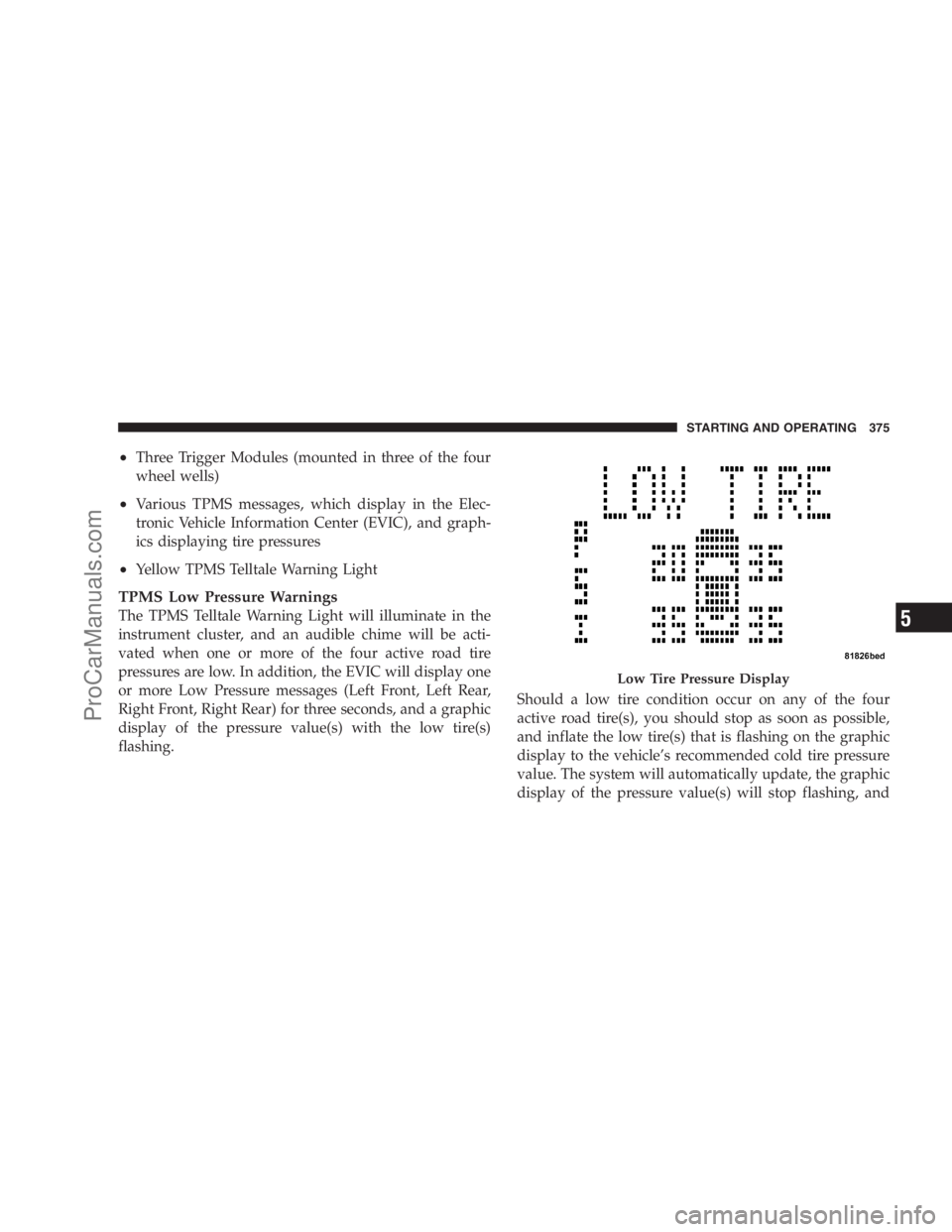
pressures are low. In addition, the EVIC will display one
or more Low Pressure messages (Left Front, Left Rear,
Right Front, Right Rear) for three seconds, and a graphic
display of the pressure value(s) with the low tire(s)
flashing.Should a low tire condition occur on any of the four
active road tire(s), you should stop as soon as possible,
and inflate the low tire(s) that is flashing on the graphic
display to the vehicle’s recommended cold tire pressure
value. The system will automatically update, the graphic
display of the pressure value(s) will stop flashing, and
Low Tire Pressure Display
STARTING AND OPERATING 375
5
ProCarManuals.com
Page 378 of 534
the TPMS Telltale Warning Light will extinguish once the
updated tire pressure(s) have been received. The vehicle
may need to be driven for up to 10 minutes above 15 mph
(25 km/h) to receive this information.
Check TPMS Message
The TPMS Telltale Warning Light will flash on and off for
75 seconds, and remain on solid when a system fault is
detected. The system fault will also sound a chime. The
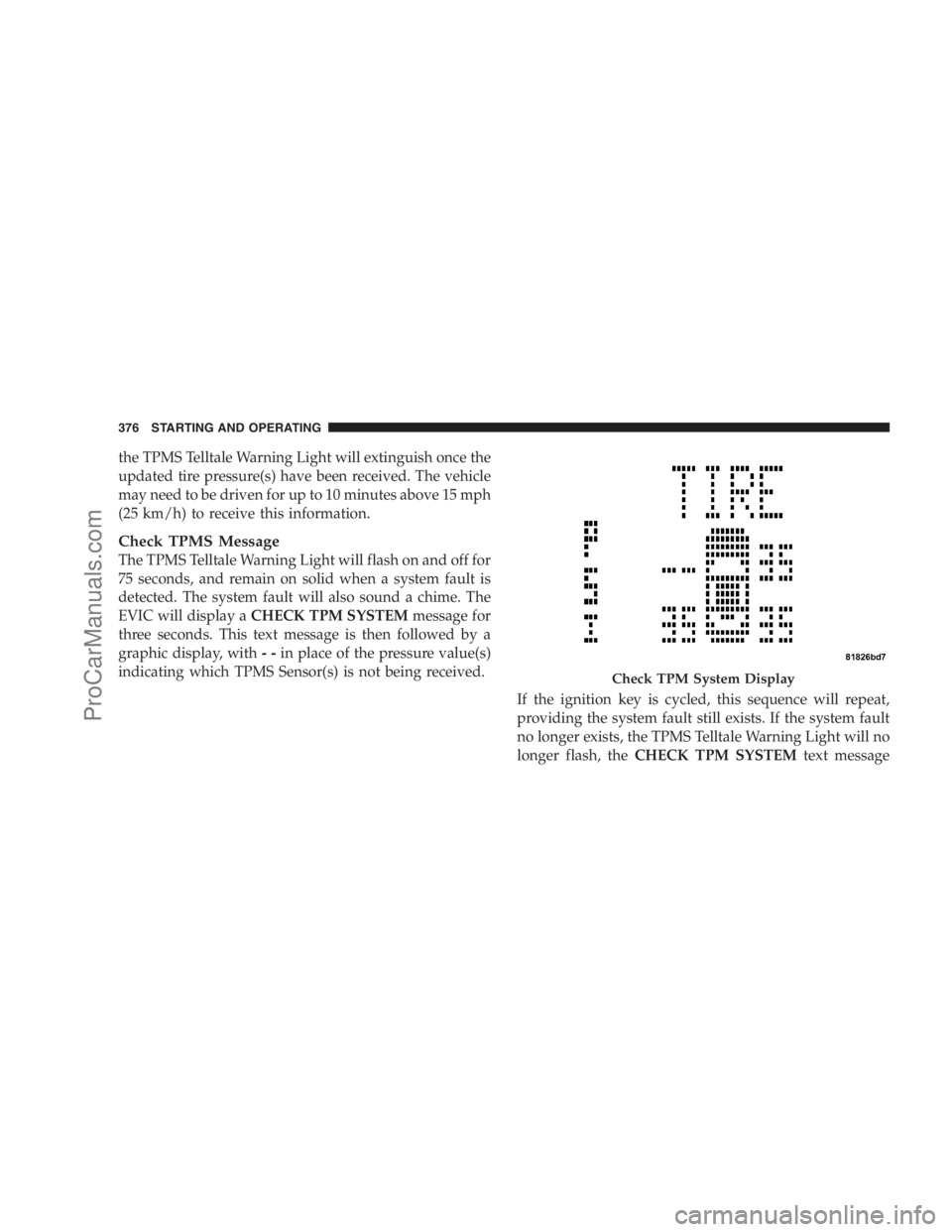
EVIC will display aCHECK TPM SYSTEMmessage for
three seconds. This text message is then followed by a
graphic display, with--in place of the pressure value(s)
indicating which TPMS Sensor(s) is not being received.
If the ignition key is cycled, this sequence will repeat,
providing the system fault still exists. If the system fault
no longer exists, the TPMS Telltale Warning Light will no
longer flash, theCHECK TPM SYSTEMtext message
Check TPM System Display
376 STARTING AND OPERATING
ProCarManuals.com
Page 379 of 534
will not be present, and a pressure value will be dis-
played instead of dashes. A system fault can occur by any
of the following scenarios:
1. Jamming due to electronic devices or driving next to
facilities emitting the same radio frequencies as the TPMS
sensors.
2. Installing some form of aftermarket window tinting
that affects radio wave signals.
3. Accumulation of excessive snow and/or ice around
the wheels or wheel housings.
4. Using tire chains on the vehicle.
5. Using wheels/tires not equipped with TPMS sensors.
NOTE:
1. The compact spare tire (if equipped) does not have a
TPMS. Therefore, the TPMS will not monitor the pressure
in the compact spare tire.2. If you install the compact spare tire in place of a road
tire that has a pressure below the low-pressure warning
limit, upon the next ignition key cycle, the TPMS Telltale
Warning Light will remain on, a chime will sound, and
the EVIC will still display a flashing pressure value in the
graphic display.
3. After driving the vehicle for up to 10 minutes above
15 mph (25 km/h), the TPMS Telltale Warning Light will
flash on and off for 75 seconds and then remain on solid.
In addition, the EVIC will display a CHECK TPM SYS-
TEM message for three seconds and then display dashes
(- -) in place of the pressure value.
4. For each subsequent ignition key cycle, a chime will
sound, the TPMS Telltale Warning Light will flash on and
off for 75 seconds and then remain on solid, and the EVIC
will display a CHECK TPM SYSTEM message for three
seconds and then display dashes (- -) in place of the
pressure value.
STARTING AND OPERATING 377
5
ProCarManuals.com
Page 380 of 534
5.Once you repair or replace the original road tire, and
reinstall it on the vehicle in place of the compact spare, the
TPMS will update automatically. In addition, the TPMS
Telltale Warning Light will turn off and the graphic in the
EVIC will display a new pressure value instead of dashes
(- -), as long no tire pressure is below the low pressure
warning limit in any of the four active road tires.
NOTE:The vehicle may need to be driven for up to
10 minutes above 15 mph (25 km/h) in order for the
TPMS to receive this information.
General Information
This device complies with Part 15 of the FCC rules and
RSS 210 of Industry Canada. Operation is subject to the
following conditions:
•This device may not cause harmful interference.
•This device must accept any interference received, includ-
ing interference that may cause undesired operation.
The tire pressure sensors are regulated under one of the
following licenses:
United States.....................KR5S120123
Canada........................2671-S120123
FUEL REQUIREMENTS
3.3L/3.8L Gasoline Engine
These engines are designed to meet all
emissions regulations and provide excel-
lent fuel economy and performance when
using high-quality unleaded “regular”
gasoline having an octane rating of 87. The
use of premium gasoline is not recom-
mended. Under normal conditions, the use of premium
gasoline will not provide a benefit over high-quality
regular gasolines, and in some circumstances may result
in poorer performance.
378 STARTING AND OPERATING
ProCarManuals.com
Page 381 of 534
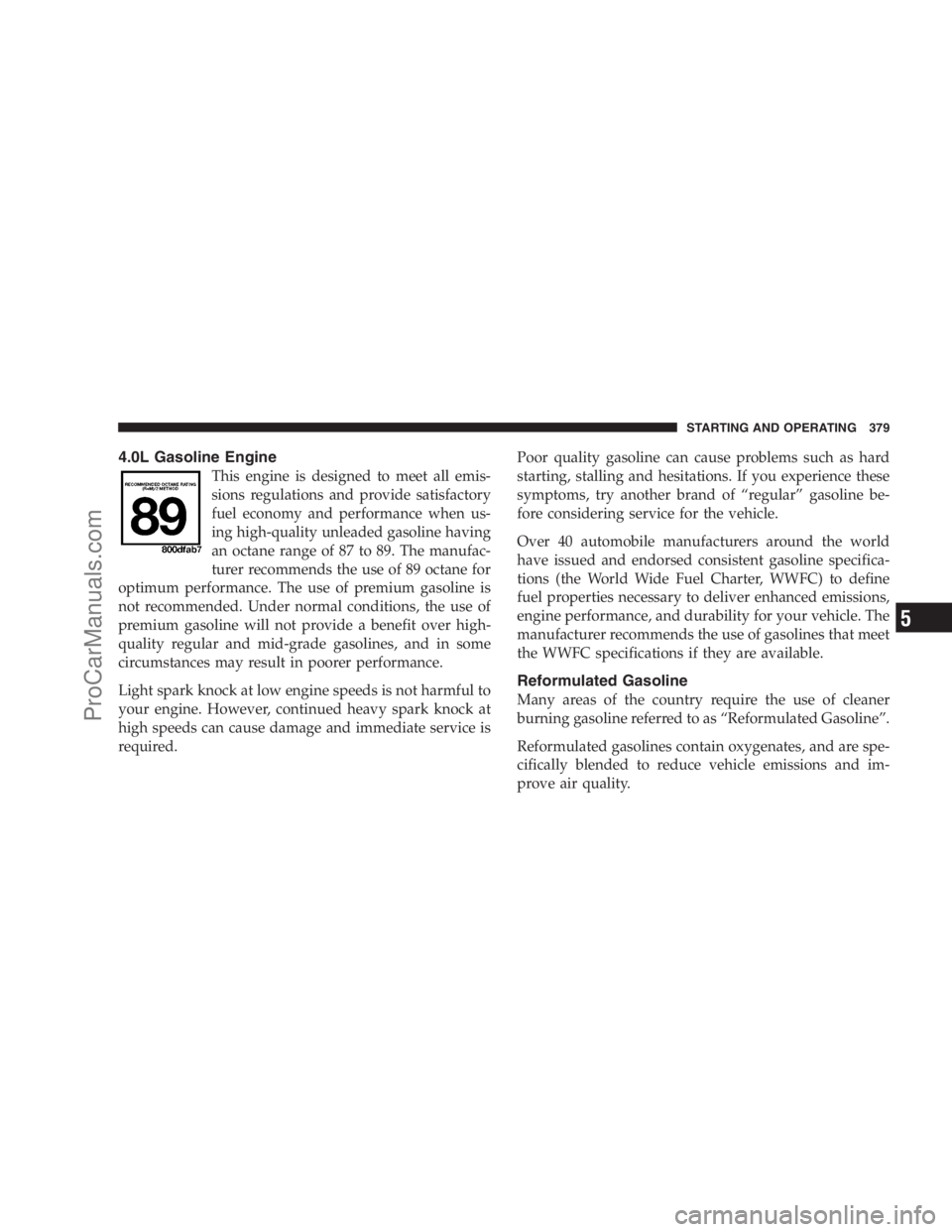
4.0L Gasoline Engine
This engine is designed to meet all emis-
sions regulations and provide satisfactory
fuel economy and performance when us-
ing high-quality unleaded gasoline having
an octane range of 87 to 89. The manufac-
turer recommends the use of 89 octane for
optimum performance. The use of premium gasoline is
not recommended. Under normal conditions, the use of
premium gasoline will not provide a benefit over high-
quality regular and mid-grade gasolines, and in some
circumstances may result in poorer performance.
Light spark knock at low engine speeds is not harmful to
your engine. However, continued heavy spark knock at
high speeds can cause damage and immediate service is
required.Poor quality gasoline can cause problems such as hard
starting, stalling and hesitations. If you experience these
symptoms, try another brand of “regular” gasoline be-
fore considering service for the vehicle.
Over 40 automobile manufacturers around the world
have issued and endorsed consistent gasoline specifica-
tions (the World Wide Fuel Charter, WWFC) to define
fuel properties necessary to deliver enhanced emissions,
engine performance, and durability for your vehicle. The
manufacturer recommends the use of gasolines that meet
the WWFC specifications if they are available.
Reformulated Gasoline
Many areas of the country require the use of cleaner
burning gasoline referred to as “Reformulated Gasoline”.
Reformulated gasolines contain oxygenates, and are spe-
cifically blended to reduce vehicle emissions and im-
prove air quality.
STARTING AND OPERATING 379
5
ProCarManuals.com
Page 382 of 534
The manufacturer supports the use of reformulated gaso-
lines. Properly blended reformulated gasolines will pro-
vide excellent performance and durability of engine and
fuel system components.
Gasoline/Oxygenate Blends
Some fuel suppliers blend unleaded gasoline with oxy-
genates such as 10% ethanol, MTBE, and ETBE. Oxygen-
ates are required in some areas of the country during the
winter months to reduce carbon monoxide emissions.
Fuels blended with these oxygenates may be used in
your vehicle.
CAUTION!
DO NOT use gasolines containing Methanol or E85
Ethanol. Use of these blends may result in starting
and driveability problems and may damage critical
fuel system components.Problems that result from using methanol/gasoline or
E85 Ethanol blends are not the responsibility of the
manufacturer. While MTBE is an oxygenate made from
Methanol, it does not have the negative effects of
Methanol.
E-85 Usage In Non-Flex Fuel Vehicles
Non-FFV vehicles are compatible with gasoline contain-
ing 10% ethanol (E10). Gasoline with higher ethanol
content may void the vehicle’s warranty.
If a Non-FFV vehicle is inadvertently fueled with E-85
fuel, the engine will have some or all of these symptoms:
•operate in a lean mode
•OBD II “Malfunction Indicator Light” on
•poor engine performance
•poor cold start and cold drivability
•increased risk for fuel system component corrosion
380 STARTING AND OPERATING
ProCarManuals.com
Page 384 of 534
Fuel System Cautions
CAUTION!
Follow these guidelines to maintain your vehicle’s
performance:
•The use of leaded gas is prohibited by Federal law.
Using leaded gasoline can impair engine performance
and damage the emission control system.
•An out-of-tune engine, or certain fuel or ignition
malfunctions, can cause the catalytic converter to
overheat. If you notice a pungent burning odor or
some light smoke, your engine may be out of tune or
malfunctioning and may require immediate service.
Contact your authorized dealer for service assistance.
•The use of fuel additives which are now being sold as
octane enhancers is not recommended. Most of these
products contain high concentrations of methanol.Fuel system damage or vehicle performance problems
resulting from the use of such fuels or additives is not
the responsibility of the manufacturer.
NOTE:Intentional tampering with emissions control
systems can result in civil penalties being assessed
against you.
Carbon Monoxide Warnings
WARNING!
Carbon monoxide (CO) in exhaust gases is deadly.
•To prevent carbon monoxide poisoning DO NOT
inhale exhaust gases. They contain carbon monox-
ide, a colorless and odorless gas which can kill.
(Continued)
382 STARTING AND OPERATING
ProCarManuals.com
Page 389 of 534
Maintenance
If you operate the vehicle using E-85 fuel, follow the
maintenance schedule section of this manual.
CAUTION!
Do not use ethanol mixture greater than 85% in your
vehicle. It will cause difficulty in cold starting and
may affect driveability.
ADDING FUEL
Fuel Filler Cap (Gas Cap)
As a reminder, a fuel icon with an arrow
indicating which side of the vehicle the fuel
filler door is located on, is located in the
instrument cluster, just below the Fuel Gauge.
The gas cap is located behind the fuel filler door on the
left side of the vehicle. If the gas cap is lost or damaged,
be sure the replacement cap is for use with this vehicle.NOTE:The driver’s side sliding door cannot be opened
while the fuel door is open. This feature operates only
when the sliding door is fully closed prior to opening the
fuel door.
CAUTION!
•Damage to the fuel system or emissions control
system could result from using an improper fuel
tank filler tube cap (gas cap). A poorly fitting cap
could let impurities into the fuel system and may
cause the Malfunction Indicator Light (MIL) to
turn on, due to fuel vapors escaping from the
system.
•To avoid fuel spillage and overfilling, do not “top
off” the fuel tank after filling.
NOTE:When the fuel nozzle “clicks” or shuts off, the
fuel tank is full.
STARTING AND OPERATING 387
5
ProCarManuals.com