spare tire DODGE CARAVAN 2009 User Guide
[x] Cancel search | Manufacturer: DODGE, Model Year: 2009, Model line: CARAVAN, Model: DODGE CARAVAN 2009Pages: 534, PDF Size: 9.93 MB
Page 376 of 534
NOTE:
1. The compact spare tire (if equipped) does not have a
TPMS sensor. Therefore the TPMS will not monitor the
pressure in the compact spare tire.
2. If you install the compact spare tire in place of a road
tire that has a pressure below the low-pressure warning
limit, upon the next ignition key cycle, a chime will
sound and the TPMS Telltale Warning Light will turn on.
3. After driving for up to 10 minutes above 15 mph
(25 km/h), the TPMS Telltale Warning Light will flash on
and off for 75 seconds and then remain on solid.
4. For each subsequent ignition key cycle, a chime will
sound and the TPMS Telltale Warning Light will remain
on solid.
5. Once you repair or replace the original road tire and
reinstall it on the vehicle in place of the compact spare
tire, the TPMS will automatically update, and the TPMSTelltale Warning Light will turn off as long as no tire
pressure is below the low-pressure warning limit in any
of the four active road tires. The vehicle may need to be
driven for up to 10 minutes above 15 mph (25 km/h) for
the TPMS to receive this information.
PREMIUM TPMS WITH EVIC — IF EQUIPPED
The TPMS uses wireless technology with wheel rim-
mounted electronic sensors to monitor tire pressure lev-
els. Sensors mounted to each wheel as part of the valve
stem transmit tire pressure readings to the Receiver
Module.
NOTE:It is particularly important to regularly check
and maintain proper tire pressure in all the tires.
The Premium TPMS consists of the following compo-
nents:
•Receiver Module
•Four TPMS Sensors
374 STARTING AND OPERATING
ProCarManuals.com
Page 379 of 534
will not be present, and a pressure value will be dis-
played instead of dashes. A system fault can occur by any
of the following scenarios:
1. Jamming due to electronic devices or driving next to
facilities emitting the same radio frequencies as the TPMS
sensors.
2. Installing some form of aftermarket window tinting
that affects radio wave signals.
3. Accumulation of excessive snow and/or ice around
the wheels or wheel housings.
4. Using tire chains on the vehicle.
5. Using wheels/tires not equipped with TPMS sensors.
NOTE:
1. The compact spare tire (if equipped) does not have a
TPMS. Therefore, the TPMS will not monitor the pressure
in the compact spare tire.2. If you install the compact spare tire in place of a road
tire that has a pressure below the low-pressure warning
limit, upon the next ignition key cycle, the TPMS Telltale
Warning Light will remain on, a chime will sound, and
the EVIC will still display a flashing pressure value in the
graphic display.
3. After driving the vehicle for up to 10 minutes above
15 mph (25 km/h), the TPMS Telltale Warning Light will
flash on and off for 75 seconds and then remain on solid.
In addition, the EVIC will display a CHECK TPM SYS-
TEM message for three seconds and then display dashes
(- -) in place of the pressure value.
4. For each subsequent ignition key cycle, a chime will
sound, the TPMS Telltale Warning Light will flash on and
off for 75 seconds and then remain on solid, and the EVIC
will display a CHECK TPM SYSTEM message for three
seconds and then display dashes (- -) in place of the
pressure value.
STARTING AND OPERATING 377
5
ProCarManuals.com
Page 380 of 534
5.Once you repair or replace the original road tire, and
reinstall it on the vehicle in place of the compact spare, the
TPMS will update automatically. In addition, the TPMS
Telltale Warning Light will turn off and the graphic in the
EVIC will display a new pressure value instead of dashes
(- -), as long no tire pressure is below the low pressure
warning limit in any of the four active road tires.
NOTE:The vehicle may need to be driven for up to
10 minutes above 15 mph (25 km/h) in order for the
TPMS to receive this information.
General Information
This device complies with Part 15 of the FCC rules and
RSS 210 of Industry Canada. Operation is subject to the
following conditions:
•This device may not cause harmful interference.
•This device must accept any interference received, includ-
ing interference that may cause undesired operation.
The tire pressure sensors are regulated under one of the
following licenses:
United States.....................KR5S120123
Canada........................2671-S120123
FUEL REQUIREMENTS
3.3L/3.8L Gasoline Engine
These engines are designed to meet all
emissions regulations and provide excel-
lent fuel economy and performance when
using high-quality unleaded “regular”
gasoline having an octane rating of 87. The
use of premium gasoline is not recom-
mended. Under normal conditions, the use of premium
gasoline will not provide a benefit over high-quality
regular gasolines, and in some circumstances may result
in poorer performance.
378 STARTING AND OPERATING
ProCarManuals.com
Page 404 of 534
Towing Requirements — Tires
•
Do not attempt to tow a trailer while using a compact
spare tire.
•Proper tire inflation pressures are essential to the safe
and satisfactory operation of your vehicle. Refer to the
“Tires–General Information” section for proper tire
inflation procedures.
•Also, check the trailer tires for proper tire inflation
pressures before trailer usage.
•Check for signs of tire wear or visible tire damage
before towing a trailer. Refer to the “Tires–General
Information” section of this manual for the proper
inspection procedure.
•When replacing tires, refer to the “Tires–General Infor-
mation” section of this manual for proper tire replace-
ment procedures. Replacing tires with a higher load
carrying capacity will not increase the vehicle’s GVWR
and GAWR limits.
Towing Requirements — Trailer Brakes
•
Donotinterconnect the hydraulic brake system or
vacuum system of your vehicle with that of the trailer.
This could cause inadequate braking and possible
personal injury.
•An electronically actuated trailer brake controller is
required when towing a trailer with electronically
actuated brakes. When towing a trailer equipped with
a hydraulic surge actuated brake system, an electronic
brake controller is not required.
402 STARTING AND OPERATING
ProCarManuals.com
Page 414 of 534
JACKING AND TIRE CHANGING
WARNING!
•Getting under a jacked-up vehicle is dangerous.
The vehicle could slip off the jack and fall on you.
You could be crushed. Never get any part of your
body under a vehicle that is on a jack. If you need
to get under a raised vehicle, take it to a service
center where it can be raised on a lift.
•The jack is designed to use as a tool for changing
tires only. The jack should not be used to lift the
vehicle for service purposes. The vehicle should
be jacked on a firm level surface only. Avoid ice or
slippery areas.
(Continued)
WARNING! (Continued)
•For vehicles equipped with Stow ’n Go seating, if
it is necessary to retrieve the spare tire from under
the vehicle on the side of the vehicle close to
moving traffic. Pull far enough off the road to
avoid the danger of being hit.
Jack Location
The jack, jack handle and winch handle tools are stowed
behind the rear left side trim panel in the rear cargo area.
Turn the two cover latches to release the cover.
412 WHAT TO DO IN EMERGENCIES
ProCarManuals.com
Page 415 of 534
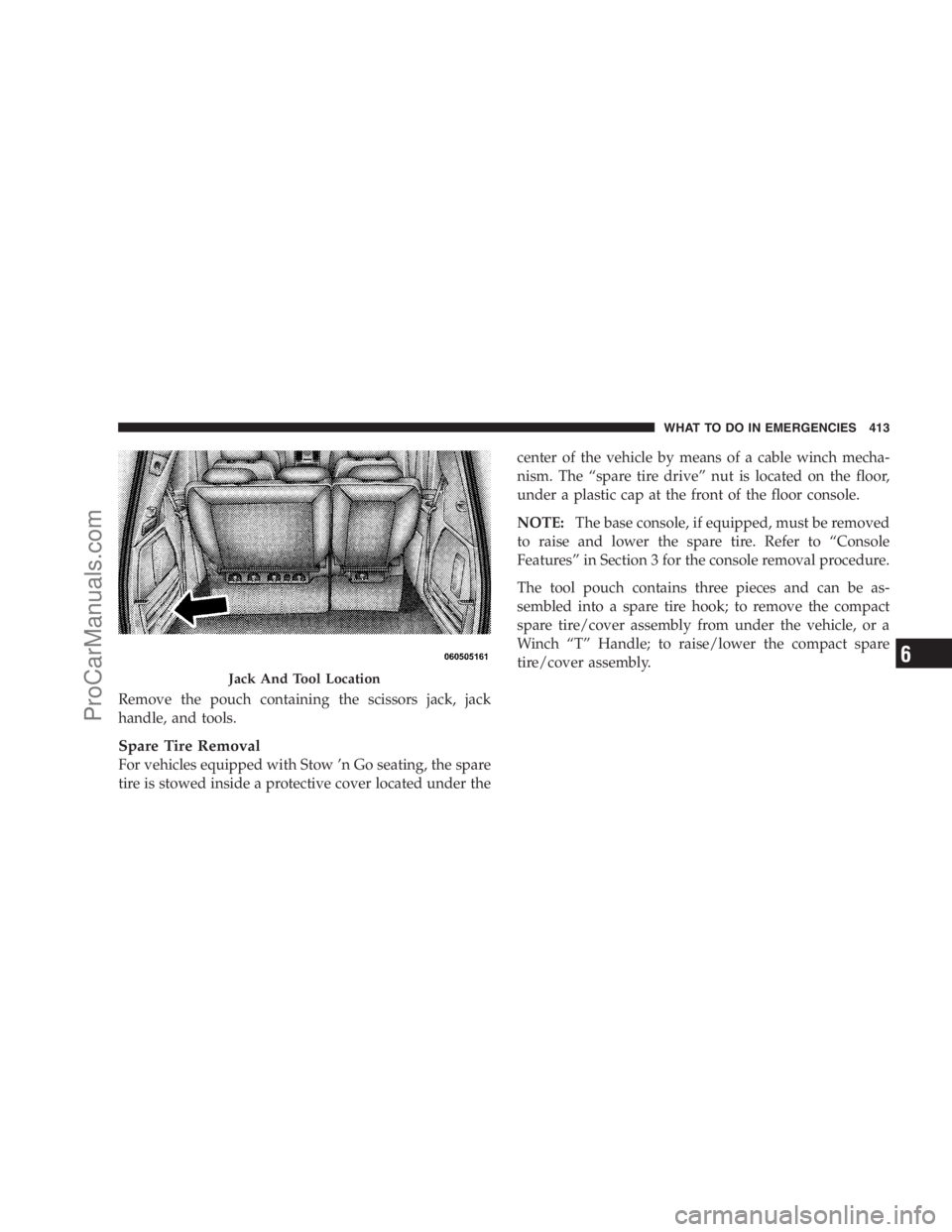
Remove the pouch containing the scissors jack, jack
handle, and tools.
Spare Tire Removal
For vehicles equipped with Stow ’n Go seating, the spare
tire is stowed inside a protective cover located under thecenter of the vehicle by means of a cable winch mecha-
nism. The “spare tire drive” nut is located on the floor,
under a plastic cap at the front of the floor console.
NOTE:The base console, if equipped, must be removed
to raise and lower the spare tire. Refer to “Console
Features” in Section 3 for the console removal procedure.
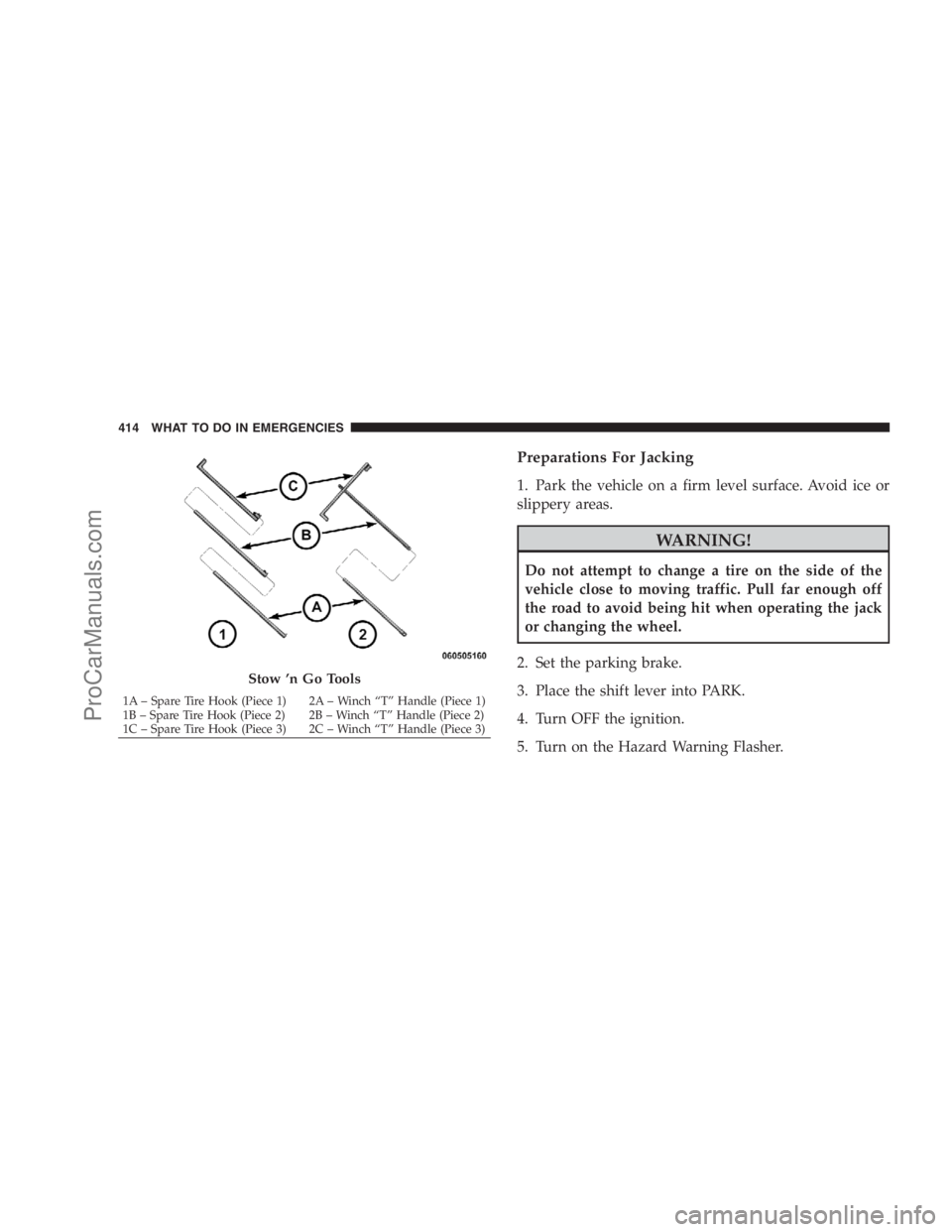
The tool pouch contains three pieces and can be as-
sembled into a spare tire hook; to remove the compact
spare tire/cover assembly from under the vehicle, or a
Winch “T” Handle; to raise/lower the compact spare
tire/cover assembly.
Jack And Tool Location
WHAT TO DO IN EMERGENCIES 413
6
ProCarManuals.com
Page 416 of 534
Preparations For Jacking
1. Park the vehicle on a firm level surface. Avoid ice or
slippery areas.
WARNING!
Do not attempt to change a tire on the side of the
vehicle close to moving traffic. Pull far enough off
the road to avoid being hit when operating the jack
or changing the wheel.
2. Set the parking brake.
3. Place the shift lever into PARK.
4. Turn OFF the ignition.
5. Turn on the Hazard Warning Flasher.
Stow ’n Go Tools
1A – Spare Tire Hook (Piece 1) 2A – Winch “T” Handle (Piece 1)
1B – Spare Tire Hook (Piece 2) 2B – Winch “T” Handle (Piece 2)
1C – Spare Tire Hook (Piece 3) 2C – Winch “T” Handle (Piece 3)
414 WHAT TO DO IN EMERGENCIES
ProCarManuals.com
Page 418 of 534
WARNING! (Continued)
•If working on or near a roadway, be extremely
careful of motor traffic.
•To assure that spare tires, flat or inflated are
securely stowed, spares must be stowed with the
valve stem facing the ground.
•Turn on the Hazard Warning Flasher.
1. Loosen (but do not remove) the wheel lug nuts by
turning them to the left one turn while the wheel is still
on the ground.2. To remove the compact spare tire/cover assembly,
assemble the winch handle extensions to form a “T’ and
fit the winch “T” handle over the drive nut. Rotate the
nut to the left until the winch mechanism stops turning
freely. This will allow enough slack in the cable to allow
you to pull the spare tire out from under the vehicle.CAUTION!
The winch mechanism is designed for use with the
winch “T” handle only. Use of an air wrench or other
power tools is not recommended and can damage the
winch.
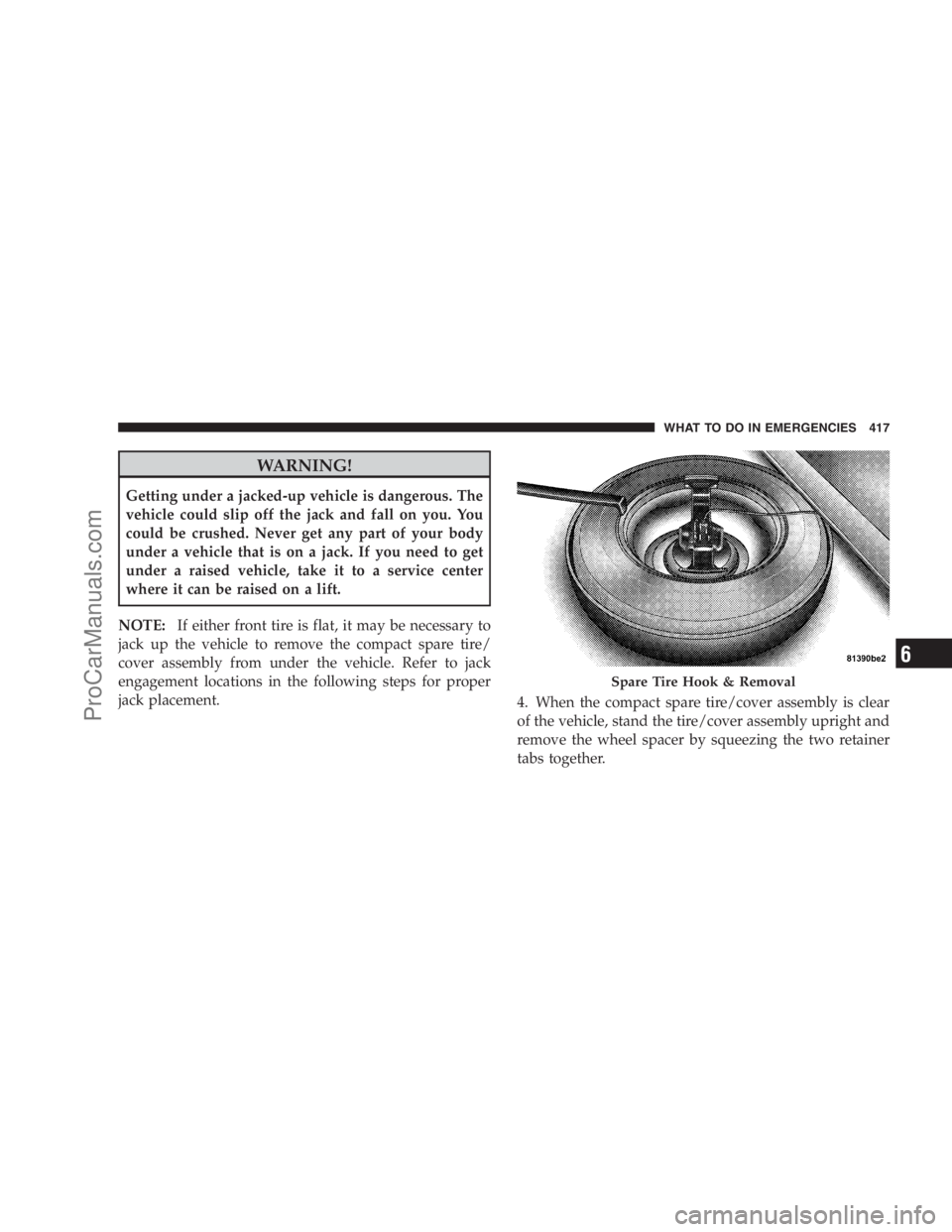
3. Assemble the winch handle extensions to form the
Spare Tire Hook and pull the compact spare tire/cover
assembly from under the vehicle.
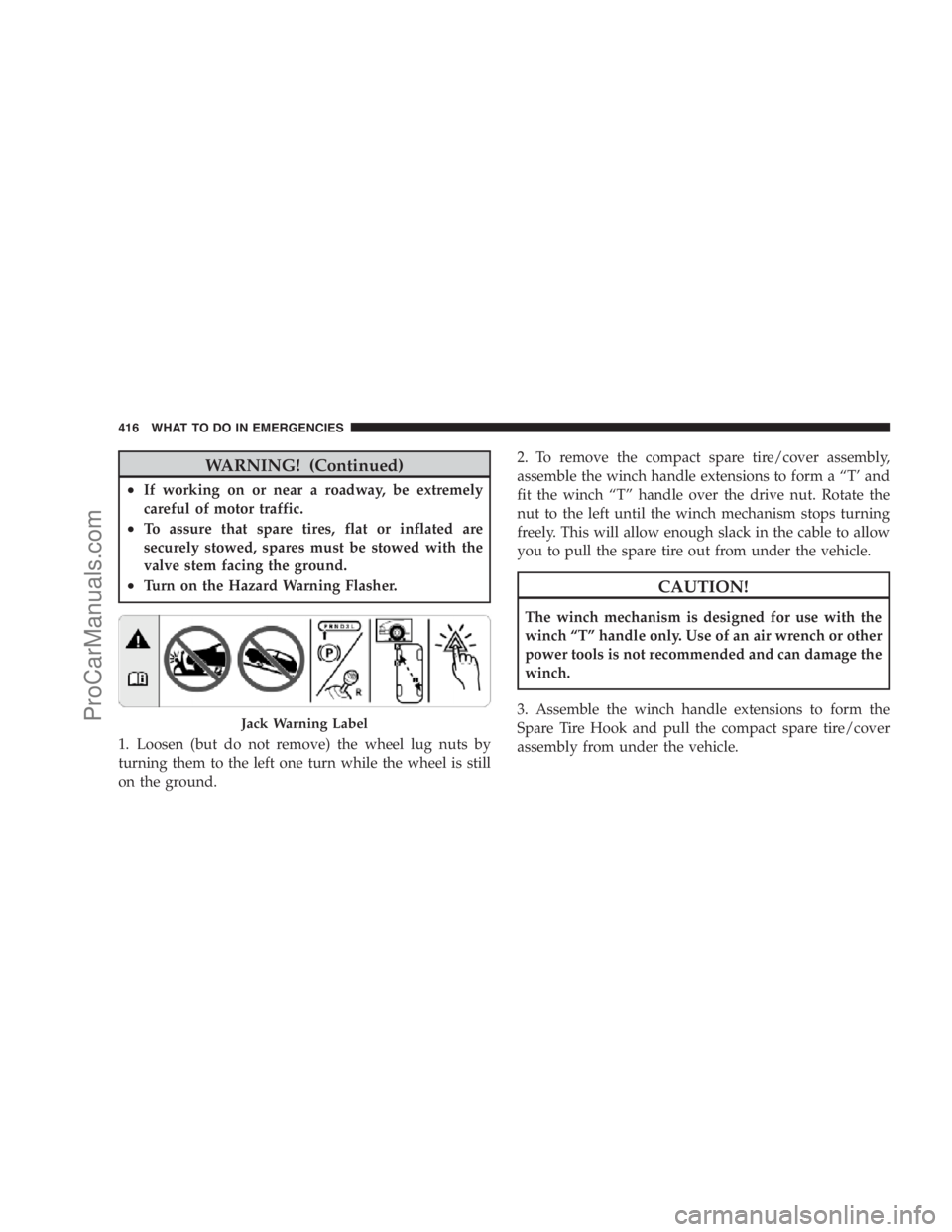
Jack Warning Label
416 WHAT TO DO IN EMERGENCIES
ProCarManuals.com
Page 419 of 534
WARNING!
Getting under a jacked-up vehicle is dangerous. The
vehicle could slip off the jack and fall on you. You
could be crushed. Never get any part of your body
under a vehicle that is on a jack. If you need to get
under a raised vehicle, take it to a service center
where it can be raised on a lift.
NOTE:If either front tire is flat, it may be necessary to
jack up the vehicle to remove the compact spare tire/
cover assembly from under the vehicle. Refer to jack
engagement locations in the following steps for proper
jack placement.
4. When the compact spare tire/cover assembly is clear
of the vehicle, stand the tire/cover assembly upright and
remove the wheel spacer by squeezing the two retainer
tabs together.
Spare Tire Hook & Removal
WHAT TO DO IN EMERGENCIES 417
6
ProCarManuals.com
Page 422 of 534
CAUTION!
Do not attempt to raise the vehicle by jacking on
locations other than those indicated in Step 5.
6. Place the wrench on the jack screw and turn to the
right until the jack head is properly engaged in the
described location.Do not raise the vehicle until you are
sure the jack is securely engaged.
7. Raise the vehicle by turning the jack screw to the right,
using the swivel wrench. Raise the vehicle only until the
tire just clears the surface and enough clearance is
obtained to install the spare tire. Minimum tire lift
provides maximum stability.
WARNING!
Raising the vehicle higher than necessary can make
the vehicle less stable. It could slip off the jack and
hurt someone near it. Raise the vehicle only enough
to remove the tire.
8. Remove the wheel lug nuts, for vehicles with wheel
covers, remove the cover from the wheel by hand. Do not
pry the wheel cover off. Then pull the wheel off the hub.
9. Install the compact spare tire. Lightly tighten the lug
nuts. To avoid the risk of forcing the vehicle off the jack,
do not tighten the lug nuts fully until the vehicle has been
lowered.
NOTE:
•Do not install the wheel cover on the compact spare.
•Do not use a hammer or force to install the wheel
covers.
420 WHAT TO DO IN EMERGENCIES
ProCarManuals.com