child seat DODGE CARAVAN 2009 Owner's Manual
[x] Cancel search | Manufacturer: DODGE, Model Year: 2009, Model line: CARAVAN, Model: DODGE CARAVAN 2009Pages: 534, PDF Size: 9.93 MB
Page 90 of 534
NOTE:
•When using the LATCH attaching system to install a
child restraint, please ensure that all seat belts not
being used for occupant restraints are stowed and out
of reach of children. It is recommended that before
installing the child restraint, buckle the seat belt so the
seat belt is tucked behind the child restraint and out of
reach. If the buckled seat belt interferes with the child
restraint installation, instead of tucking the seat belt
behind the child restraint, route the seat belt through
the child restraint belt path and then buckle it. This
should stow the seat belt out of the reach of an
inquisitive child. Remind all children in the vehicle
that the seat belts are not toys and should not be
played with, and never leave your child unattended in
the vehicle.
•If your child restraint seat is not LATCH compatible,
install the restraint using the vehicle seat belts.
Installing the Child Restraint Using the Vehicle
Seat Belts
Because the lower anchorages are to be introduced to
passenger carrying vehicles over a period of years, child
restraint systems having attachments for those anchor-
ages will continue to have features for installation in
vehicles using the lap or lap/shoulder belt. They will also
have tether straps, and you are urged to take advantage
of all of the available attachments provided with your
child restraint in any vehicle.Seat belts, except for the
driver’s seat belt, are equipped with an Automatic Lock-
ing Retractor (ALR) and/or a cinching latch plate. Both
types of seat belts are designed to keep the lap portion
tight around the child restraint so that it is not necessary
to use a locking clip. In seating positions that are
equipped with an ALR retractor, it will make a ratcheting
noise after all the webbing is extracted and allowed to
return back. For additional information, refer to “Auto-
matic Locking Mode” earlier in the section.
88 THINGS TO KNOW BEFORE STARTING YOUR VEHICLE
ProCarManuals.com
Page 91 of 534
To install a child restraint, pull enough of the seat belt
webbing from the retractor to route it through the belt
path of the child restraint and slide the latch plate into the
buckle. Next, pull all the seat belt webbing, until it is fully
extracted, from the retractor. Allow the belt to return to
the retractor, pulling on the excess webbing to tighten the
lap portion about the child restraint. (Any seat belt
system will loosen with time, so check the belt occasion-
ally and pull it tight if necessary).
Installing the Child Restraint System
We urge that you carefully follow the directions of the
manufacturer when installing your child restraint. Many,
but not all restraint systems will be equipped with
separate straps on each side, with each having a hook or
connector and a means for adjusting the tension in the
strap. Forward-facing toddler restraints and some
rearward-facing infant restraints will also be equipped
with a tether strap, a hook and means for adjusting the
tension in the strap.In general, you will first loosen the adjusters on the lower
straps and tether straps so that you can more easily attach
the hook or connector to the lower anchorages and tether
anchorages. Then tighten all three straps as you push the
child restraint rearward and downward into the seat.
Not all child restraint systems will be installed as we
have described here. Again, carefully follow the instruc-
tions that come with the child restraint system.
WARNING!
Improper installation of a child restraint to the
LATCH anchorages can lead to failure of an infant or
child restraint. The child could be badly injured or
killed. Follow the manufacturer’s directions exactly
when installing an infant or child restraint.
THINGS TO KNOW BEFORE STARTING YOUR VEHICLE 89
2
ProCarManuals.com
Page 92 of 534
Transporting Pets
Airbags deploying in the front seat could harm your pet.
An unrestrained pet could be thrown about and possibly
injured, or injure a passenger during panic braking or in
a collision.
Pets should be restrained in the rear seat in pet harnesses
or pet carriers that are secured by seat belts.
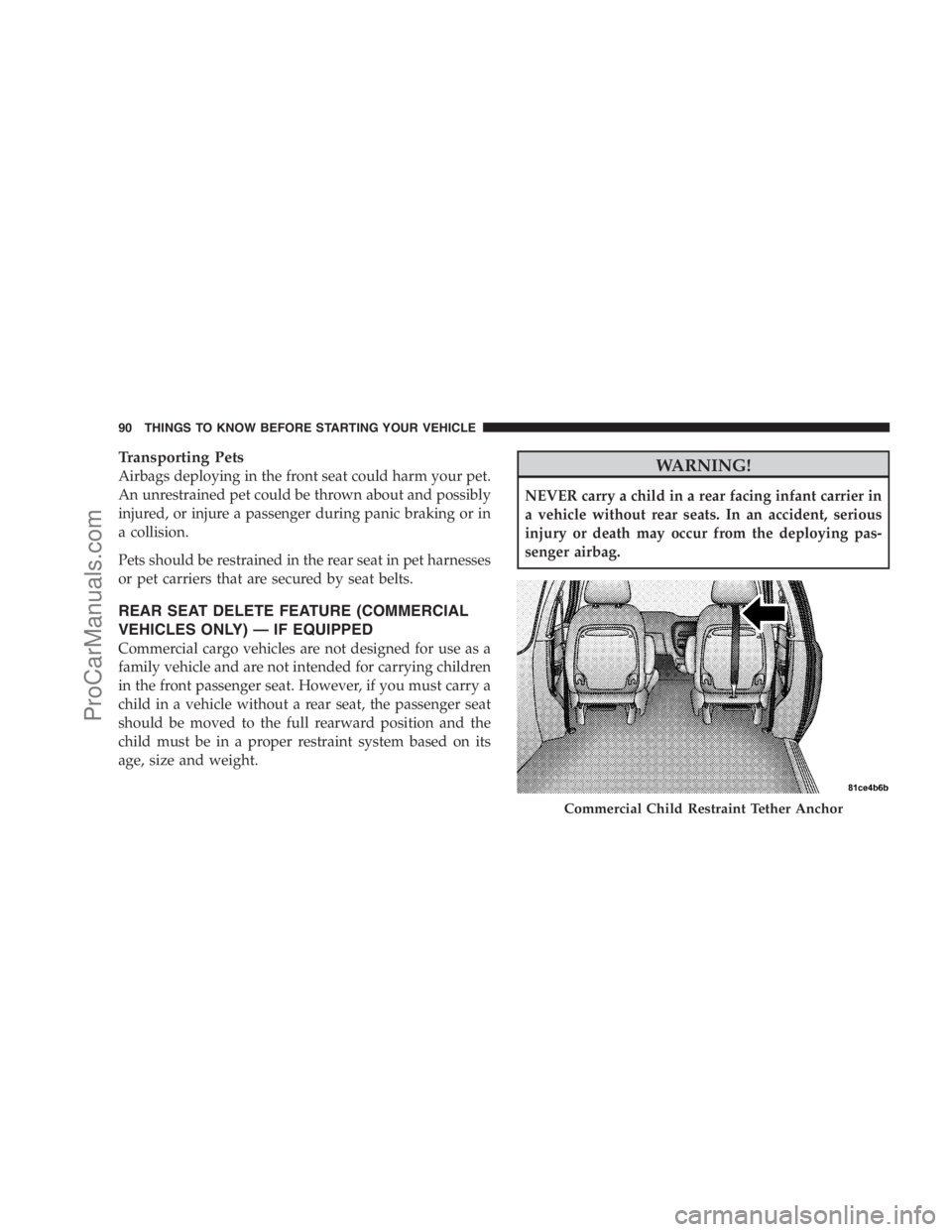
REAR SEAT DELETE FEATURE (COMMERCIAL
VEHICLES ONLY) — IF EQUIPPED
Commercial cargo vehicles are not designed for use as a
family vehicle and are not intended for carrying children
in the front passenger seat. However, if you must carry a
child in a vehicle without a rear seat, the passenger seat
should be moved to the full rearward position and the
child must be in a proper restraint system based on its
age, size and weight.
WARNING!
NEVER carry a child in a rear facing infant carrier in
a vehicle without rear seats. In an accident, serious
injury or death may occur from the deploying pas-
senger airbag.
Commercial Child Restraint Tether Anchor
90 THINGS TO KNOW BEFORE STARTING YOUR VEHICLE
ProCarManuals.com
Page 93 of 534
This vehicle is equipped with a child restraint tether
anchor located on the lower rear of the front passenger
seat.Use this tether anchor to secure only forward-
facing child restraints equipped with an upper tether
strap.
WARNING!
Rearward-facing infant restraints must never be se-
cured in the passenger seat of a vehicle with a
passenger airbag. In an accident, a passenger airbag
may deploy causing severe injury or death to infants
riding in rearward-facing infant restraints.
Restraining Infants and Small Children with Seat
Delete Feature (Commercial Vehicles Only)
There are different sizes and types of restraints for
children from newborn size to the child almost large
enough for an adult safety belt. Use the restraint that is
correct for your child:
•The rearward-facing infant carrier is for babies weigh-
ing up to about 20 lbs (9 kg), and less than one year
old. THIS TYPE OF SEAT CANNOT BE USED IN A
VEHICLE EQUIPPED WITH THE REAR SEAT DE-
LETE FEATURE (Commercial Vehicles Only).
•The forward-facing child seat is for children from
about 20 to 40 lbs (9 to 18 kg), and more than one year
old.
•A convertible child seat, one that is designed to be
used for children who are too heavy for a rearward-
facing infant seat, may be used IN THE FORWARD
FACING POSITION ONLY, IT MUST NEVER BE
INSTALLED FACING TO THE REAR IN A VEHICLE
EQUIPPED WITH THE REAR SEAT DELETE FEA-
TURE (Commercial Vehicles Only). When a convert-
ible seat is properly installed facing forward, the
vehicle seat should be adjusted to therear most
position.
THINGS TO KNOW BEFORE STARTING YOUR VEHICLE 91
2
ProCarManuals.com
Page 94 of 534
•Children more than 40 lbs (18 kg) should be secured in
the passenger seat in a child restraint or belt-
positioning booster seat with the seat adjusted to the
rear most position. Older children who do not use
child restraints or belt-positioning booster seats
should ride properly buckled in the passenger seat
with the seat adjusted to the rearmost position. Never
allow children to slide the shoulder belt behind them
or under their arm.
Tether Installation for Commercial Vehicles with
Rear Seat Delete
To secure the child restraint upper tether strap to the
vehicle, follow the instructions shown:
1. Locate the child restraint tether anchor on the lower
rear of the front passenger seat.
2. Follow the child restraint manufacturer’s directions
for proper use of connecting the child restraint to the
extended tether strap.3. Route the tether strap under the head rest.
NOTE:Ensure that the child restraint tether strap is
centered between the headrest supports underneath the
head rest.
4. Using the hook attached to the child restraint tether
strap, attach the child restraint tether strap to the metal
anchor on the lower rear of the front passenger seat.
5. Following the child seat manufacturer’s instructions,
tighten the child restraint tether strap.
6. Inspect the tether anchor strap for nicks, abrasions,
discoloration, and loose threads. If these, or any other
condition that might affect the performance of the strap is
observed, DO NOT USE. Contact your authorized deal-
ership for a replacement part.
92 THINGS TO KNOW BEFORE STARTING YOUR VEHICLE
ProCarManuals.com
Page 157 of 534
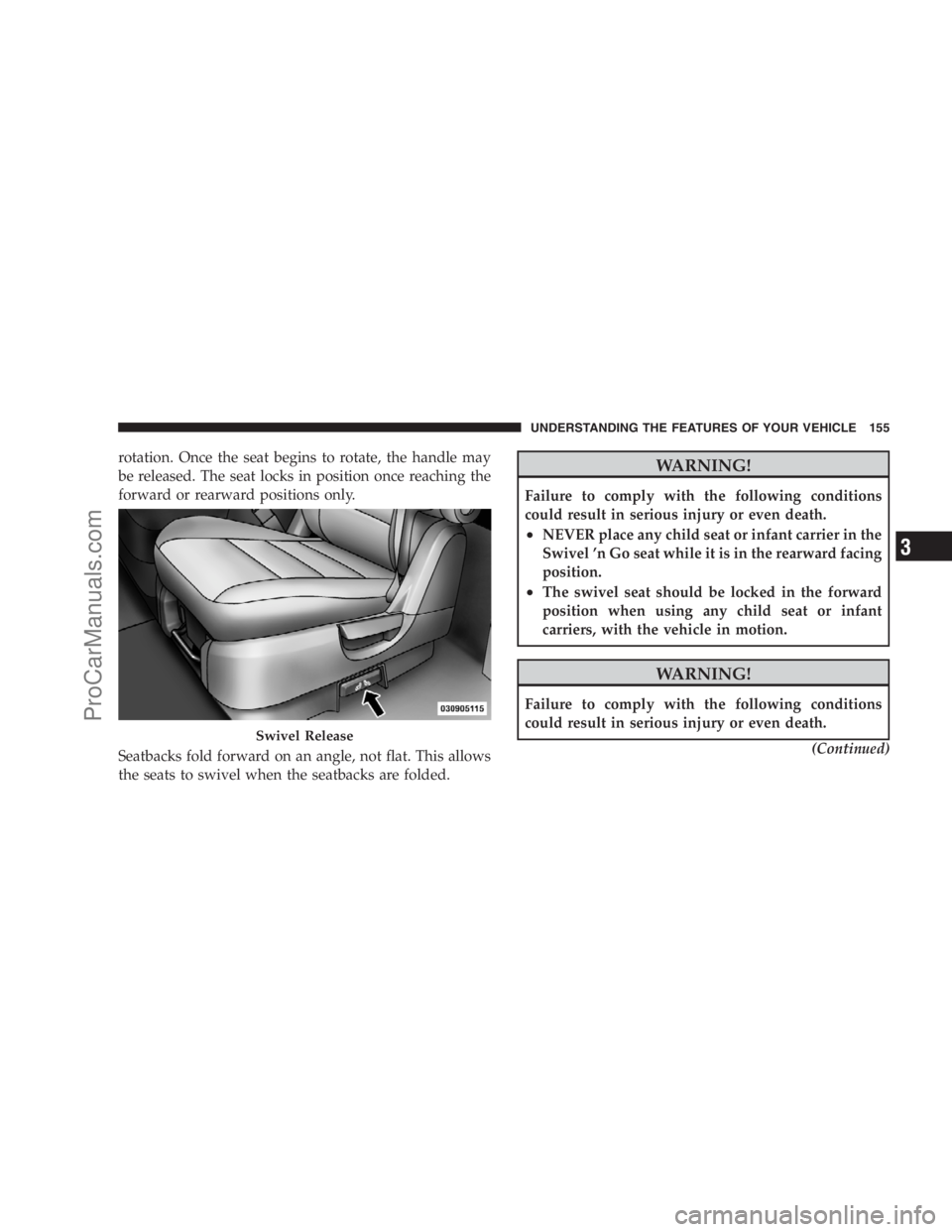
rotation. Once the seat begins to rotate, the handle may
be released. The seat locks in position once reaching the
forward or rearward positions only.
Seatbacks fold forward on an angle, not flat. This allows
the seats to swivel when the seatbacks are folded.WARNING!
Failure to comply with the following conditions
could result in serious injury or even death.
•NEVER place any child seat or infant carrier in the
Swivel ’n Go seat while it is in the rearward facing
position.
•The swivel seat should be locked in the forward
position when using any child seat or infant
carriers, with the vehicle in motion.
WARNING!
Failure to comply with the following conditions
could result in serious injury or even death.
(Continued)
Swivel Release
UNDERSTANDING THE FEATURES OF YOUR VEHICLE 155
3
ProCarManuals.com
Page 217 of 534
WARNING!
In an accident, serious injury could result if the seat
storage bin covers are not properly latched.
•DO NOT drive the vehicle with the storage bin
covers open.
•Keep the storage bin covers closed and latched
while the vehicle is in motion.
•DO NOT use a storage bin latch as a tie down.
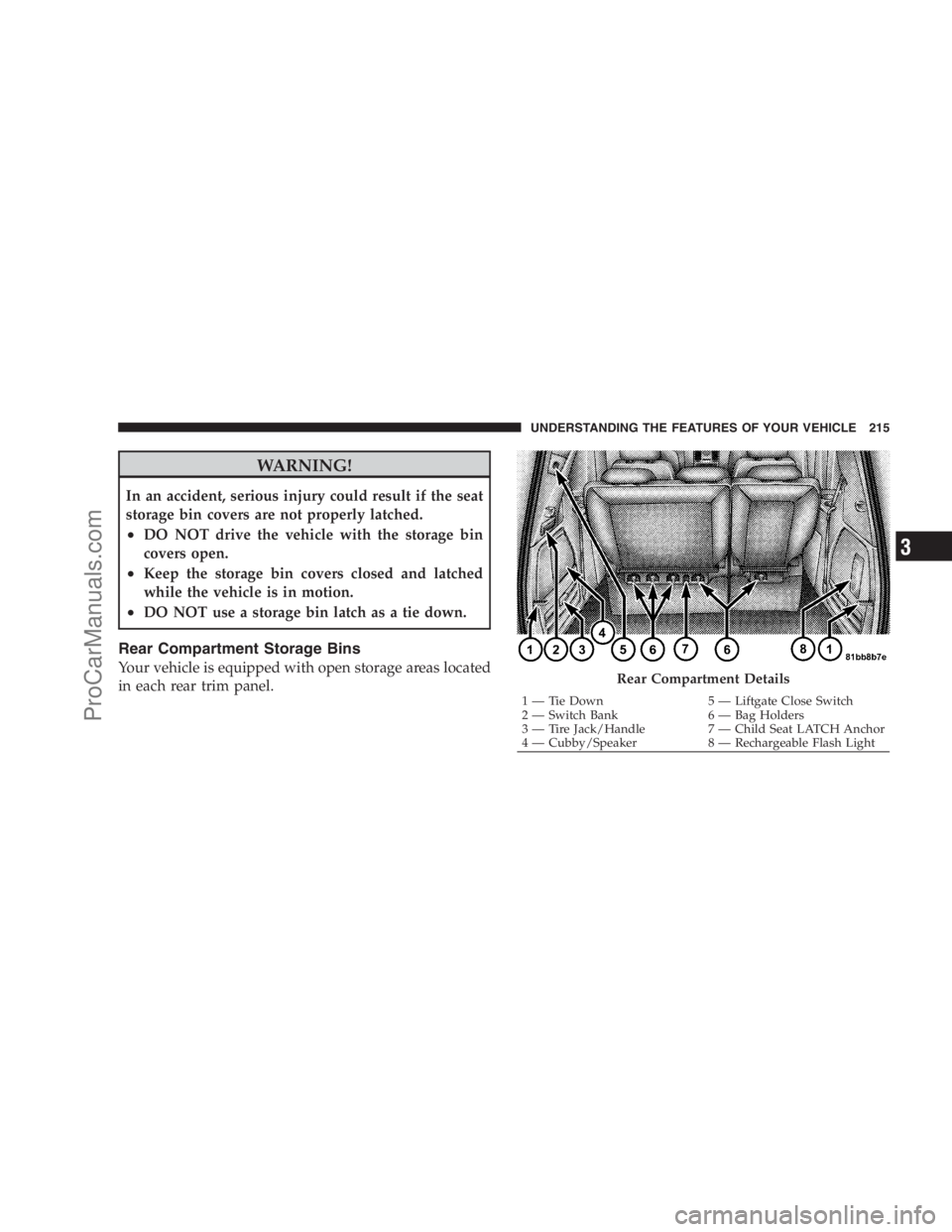
Rear Compartment Storage Bins
Your vehicle is equipped with open storage areas located
in each rear trim panel.Rear Compartment Details
1 — Tie Down 5 — Liftgate Close Switch
2 — Switch Bank 6 — Bag Holders
3 — Tire Jack/Handle 7 — Child Seat LATCH Anchor
4 — Cubby/Speaker 8 — Rechargeable Flash LightUNDERSTANDING THE FEATURES OF YOUR VEHICLE 215
3
ProCarManuals.com
Page 326 of 534
STARTING PROCEDURES
Before starting your vehicle, adjust your seat, adjust the
inside and outside mirrors, fasten your seat belt, and if
present, instruct all other occupants to buckle their seat
belts.
WARNING!
•Never leave unattended children alone in a ve-
hicle. Leaving children in a vehicle is dangerous
for a number of reasons. A child or others could be
seriously or fatally injured. Do not leave the key in
the ignition. A child could operate power win-
dows, other controls, or move the vehicle.
•Do not leave animals or children inside parked
vehicles in hot weather. Interior heat build-up may
cause serious injury or death.
(Continued)
WARNING! (Continued)
•Be sure to turn off the engine and remove the key
from the ignition switch if you want to rest or
sleep in your car. Accidents can be caused by
inadvertently moving the shift lever. Accidents
can also be caused by pressing the accelerator
pedal. This may cause excessive heat in the ex-
haust system, resulting in overheating and vehicle
fire, which may cause serious or fatal injuries.
Automatic Transaxle
The shift lever must be in the NEUTRAL or PARK
position before you can start the engine. Depress the
brake pedal before shifting into any driving gear.
Normal Starting (Above 32°F/0°C)
1. Do not depress the accelerator.
324 STARTING AND OPERATING
ProCarManuals.com
Page 516 of 534
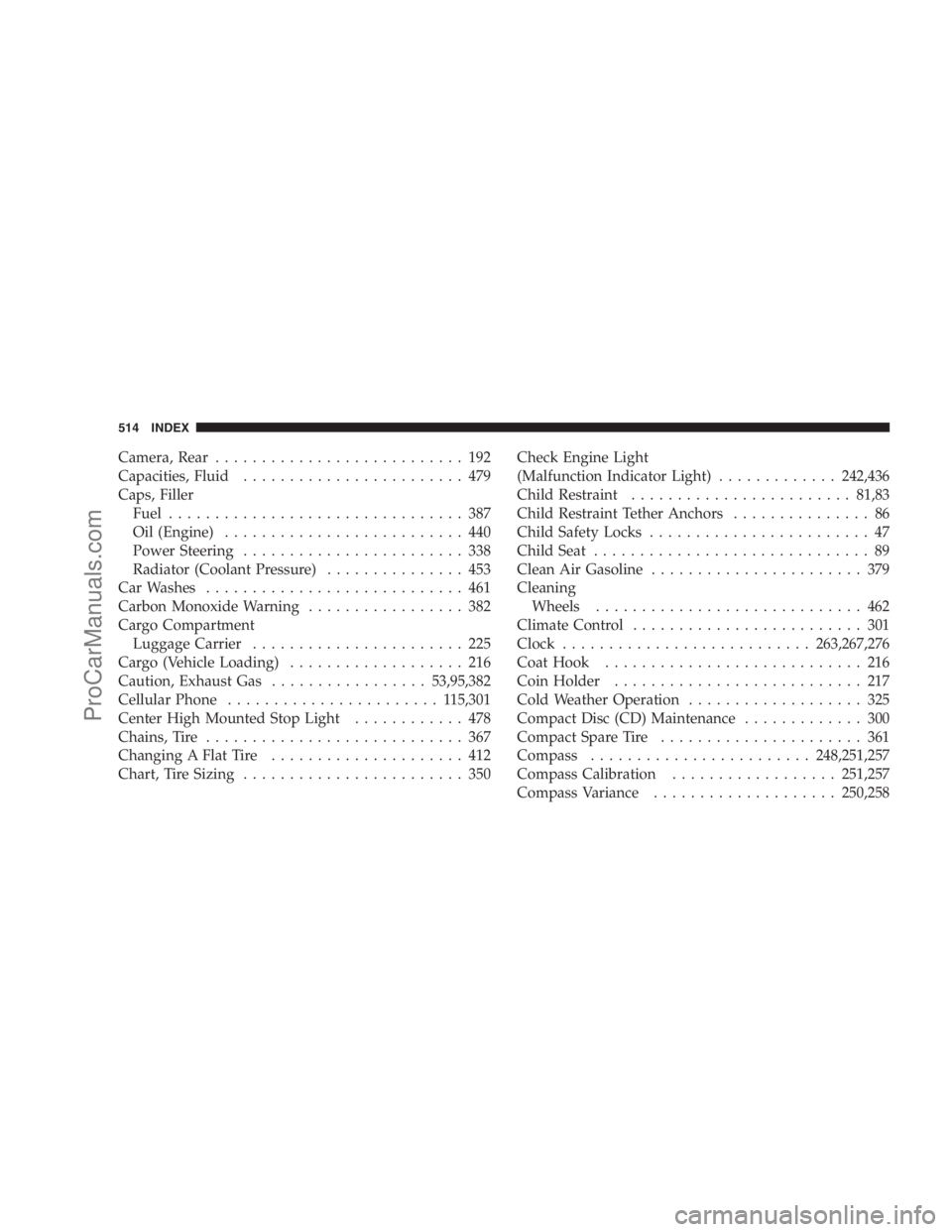
Camera, Rear........................... 192
Capacities, Fluid........................ 479
Caps, Filler
Fuel................................ 387
Oil (Engine).......................... 440
Power Steering........................ 338
Radiator (Coolant Pressure)............... 453
Car Washes............................ 461
Carbon Monoxide Warning................. 382
Cargo Compartment
Luggage Carrier....................... 225
Cargo (Vehicle Loading)................... 216
Caution, Exhaust Gas.................53,95,382
Cellular Phone....................... 115,301
Center High Mounted Stop Light............ 478
Chains, Tire............................ 367
Changing A Flat Tire..................... 412
Chart, Tire Sizing........................ 350Check Engine Light
(Malfunction Indicator Light).............242,436
Child Restraint........................81,83
Child Restraint Tether Anchors............... 86
Child Safety Locks........................ 47
Child Seat.............................. 89
Clean Air Gasoline....................... 379
Cleaning
Wheels............................. 462
Climate Control......................... 301
Clock...........................263,267,276
Coat Hook............................ 216
Coin Holder........................... 217
Cold Weather Operation................... 325
Compact Disc (CD) Maintenance............. 300
Compact Spare Tire...................... 361
Compass........................248,251,257
Compass Calibration..................251,257
Compass Variance....................250,258
514 INDEX
ProCarManuals.com
Page 524 of 534
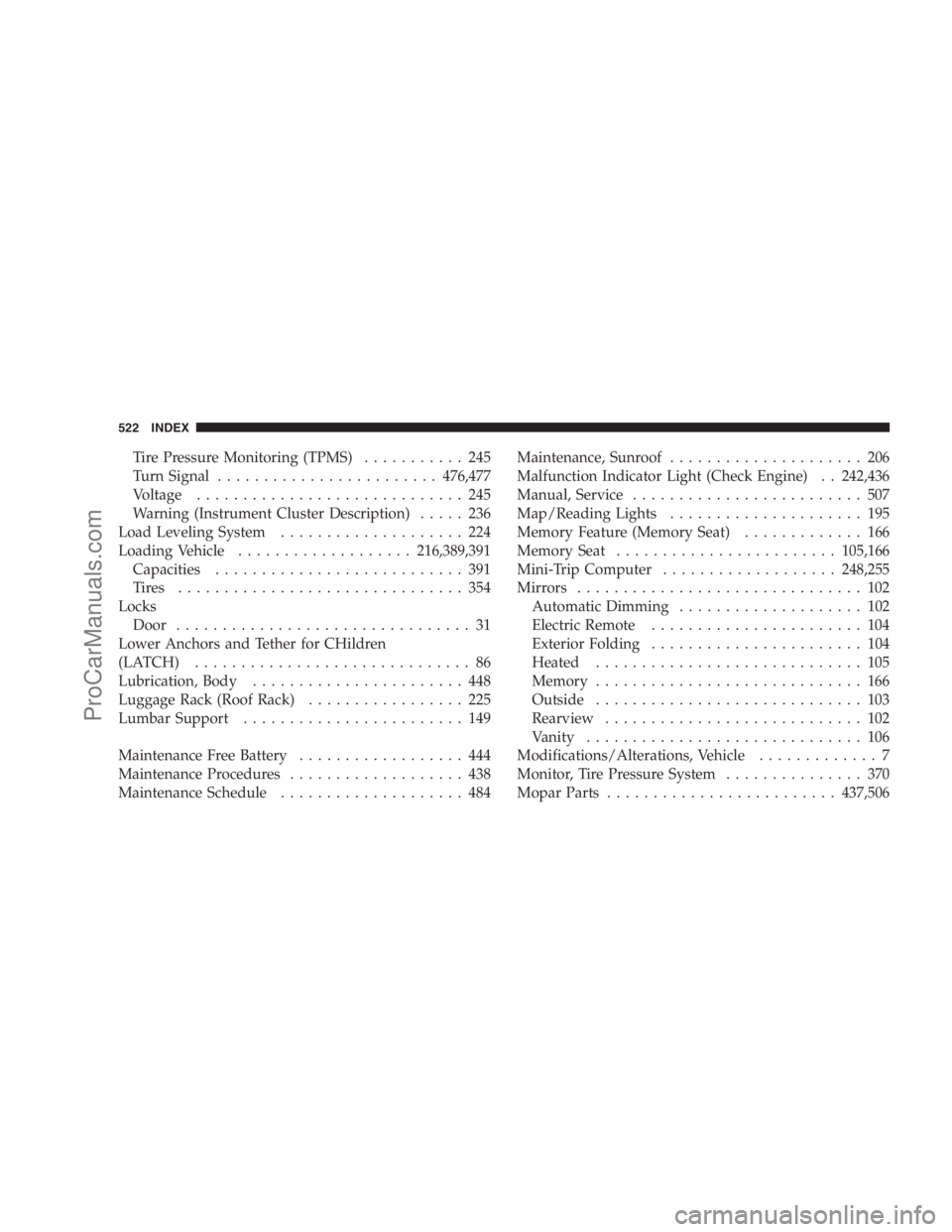
Tire Pressure Monitoring (TPMS)........... 245
Turn Signal........................476,477
Voltage............................. 245
Warning (Instrument Cluster Description)..... 236
Load Leveling System.................... 224
Loading Vehicle...................216,389,391
Capacities........................... 391
Tires ............................... 354
Locks
Door................................ 31
Lower Anchors and Tether for CHildren
(LATCH).............................. 86
Lubrication, Body....................... 448
Luggage Rack (Roof Rack)................. 225
Lumbar Support........................ 149
Maintenance Free Battery.................. 444
Maintenance Procedures................... 438
Maintenance Schedule.................... 484Maintenance, Sunroof..................... 206
Malfunction Indicator Light (Check Engine) . . 242,436
Manual, Service......................... 507
Map/Reading Lights..................... 195
Memory Feature (Memory Seat)............. 166
Memory Seat........................105,166
Mini-Trip Computer...................248,255
Mirrors............................... 102
Automatic Dimming.................... 102
Electric Remote....................... 104
Exterior Folding....................... 104
Heated............................. 105
Memory............................. 166
Outside............................. 103
Rearview............................ 102
Vanity.............................. 106
Modifications/Alterations, Vehicle............. 7
Monitor, Tire Pressure System............... 370
Mopar Parts.........................437,506
522 INDEX
ProCarManuals.com