flat tire DODGE CARAVAN 2009 Owner's Manual
[x] Cancel search | Manufacturer: DODGE, Model Year: 2009, Model line: CARAVAN, Model: DODGE CARAVAN 2009Pages: 534, PDF Size: 9.93 MB
Page 419 of 534
WARNING!
Getting under a jacked-up vehicle is dangerous. The
vehicle could slip off the jack and fall on you. You
could be crushed. Never get any part of your body
under a vehicle that is on a jack. If you need to get
under a raised vehicle, take it to a service center
where it can be raised on a lift.
NOTE:If either front tire is flat, it may be necessary to
jack up the vehicle to remove the compact spare tire/
cover assembly from under the vehicle. Refer to jack
engagement locations in the following steps for proper
jack placement.
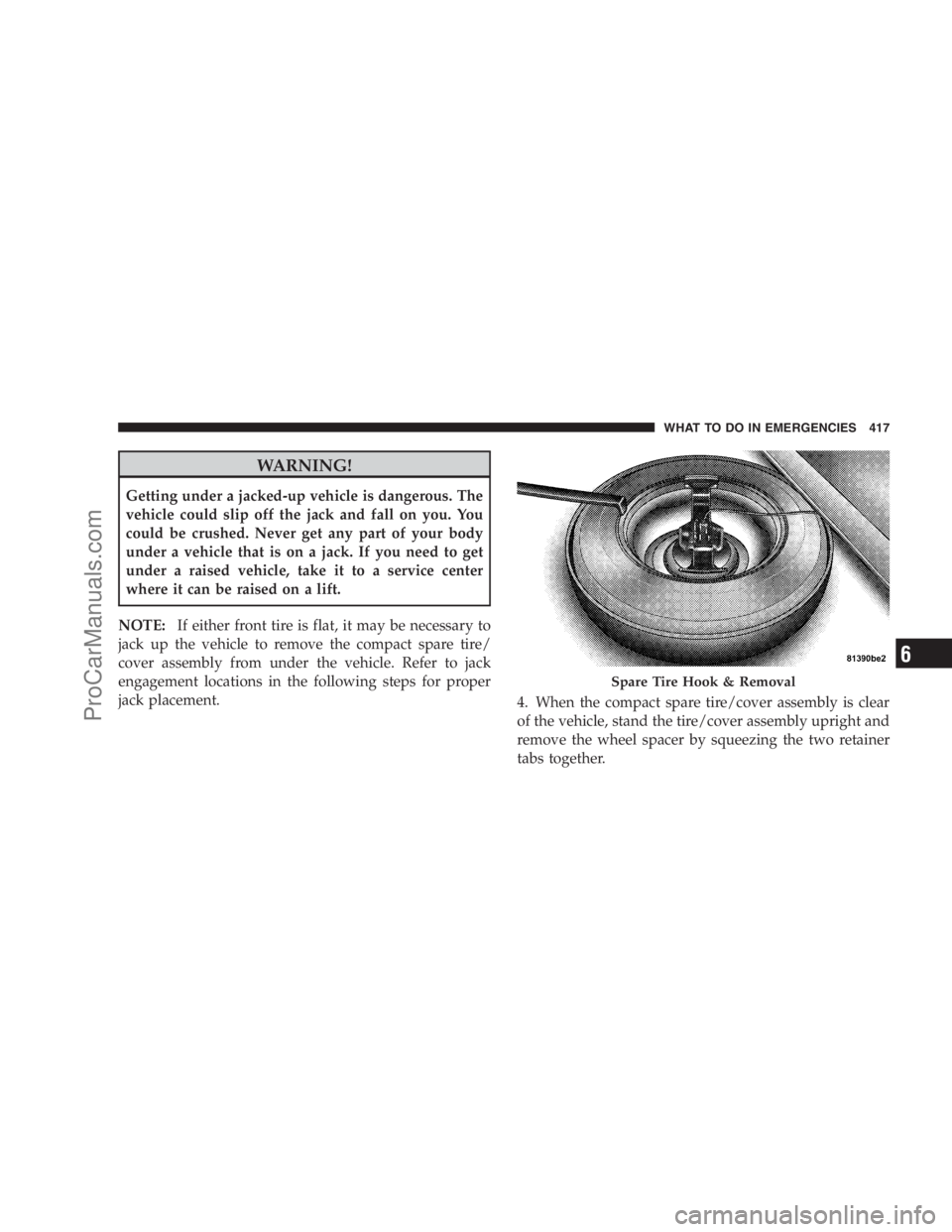
4. When the compact spare tire/cover assembly is clear
of the vehicle, stand the tire/cover assembly upright and
remove the wheel spacer by squeezing the two retainer
tabs together.
Spare Tire Hook & Removal
WHAT TO DO IN EMERGENCIES 417
6
ProCarManuals.com
Page 423 of 534
10. Lower the vehicle by turning the jack screw to the
left.
11. Finish tightening the lug nuts. Push down on the
wrench while tightening for increased leverage. Alternate
lug nuts until each nut has been tightened twice. Correct
wheel nut tightness is 95 ft lbs (130 N·m). If in doubt
about the correct tightness, have them checked with a
torque wrench by your authorized dealer or at a service
station.
12. Lower the jack to its fully-closed position.
WARNING!
A loose tire or jack thrown forward in a collision or
hard stop could endanger the occupants of the ve-
hicle. Always stow the jack parts and the spare tire in
the places provided. Have the deflated (flat) tire
repaired or replaced immediately.13. Place the deflated (flat) tire and compact spare tire
cover assembly. in the rear cargo area.Do not stow the
deflated tire in the spare tire location.Have the full-
sized tire repaired or replaced, as soon as possible.
14. Stow the cable and wheel spacer before driving the
vehicle. Reassemble the winch handle extensions to form
a “T” and fit the winch “T” handle over the drive nut.
Rotate the nut to the right until the winch mechanism
clicks at least three times.
15. Stow the jack, jack handle and winch handle tools.
16. Check the compact spare tire pressure as soon as
possible. Correct the pressure, as required.Wheel Nuts
All wheel nuts should be tightened occasionally, to
eliminate the possibility of wheel studs being sheared or
the bolt holes in the wheels becoming elongated. This is
especially important during the first few hundred miles
WHAT TO DO IN EMERGENCIES 421
6
ProCarManuals.com
Page 426 of 534
CAUTION!
For vehicles equipped with Stow ’n Go seating, the
winch mechanism is designed specifically to stow a
compact spare tire only. Do not attempt to use the
winch to stow the full size flat tire, or any other
full-size tire. Vehicle damage may result.
JUMP-STARTING PROCEDURE
WARNING!
•Do not attempt to push or tow the vehicle to get it
started. Vehicles equipped with an automatic
transmission cannot be started this way. Unburned
fuel could enter the catalytic converter and once
the engine has started, ignite and damage the
converter and vehicle.
(Continued)
WARNING! (Continued)
•If the vehicle has a discharged battery, booster
cables may be used to obtain a start from another
vehicle. This type of start can be dangerous if done
improperly, so follow this procedure carefully.
•Battery fluid is a corrosive acid solution; do not
allow battery fluid to contact eyes, skin or cloth-
ing. Do not lean over a battery when attaching
clamps, or allow the clamps to touch each other. If
acid splashes in eyes or on skin, flush the contami-
nated area immediately with large quantities of
water.
•A battery generates hydrogen gas, which is flam-
mable and explosive. Keep all flames and sparks
away from the vent holes. Do not use a booster
battery or any other booster source with an output
that exceeds 12-Volts.
(Continued)
424 WHAT TO DO IN EMERGENCIES
ProCarManuals.com
Page 512 of 534
Temperature Grades
The temperature grades are A (the highest), B, and C,
representing the tire’s resistance to the generation of heat
and its ability to dissipate heat, when tested under
controlled conditions on a specified indoor laboratory
test wheel. Sustained high temperature can cause the
material of the tire to degenerate and reduce tire life, and
excessive temperature can lead to sudden tire failure. The
grade C corresponds to a level of performance, which all
passenger car tires must meet under the Federal Motor
Vehicle Safety Standard No. 109. Grades B and A repre-
sent higher levels of performance on the laboratory test
wheel, than the minimum required by law.WARNING!
The temperature grade for this tire is established for
a tire that is properly inflated and not overloaded.
Excessive speed, under-inflation, or excessive load-
ing, either separately or in combination, can cause
heat buildup and possible tire failure.
510 IF YOU NEED CONSUMER ASSISTANCE
ProCarManuals.com
Page 516 of 534
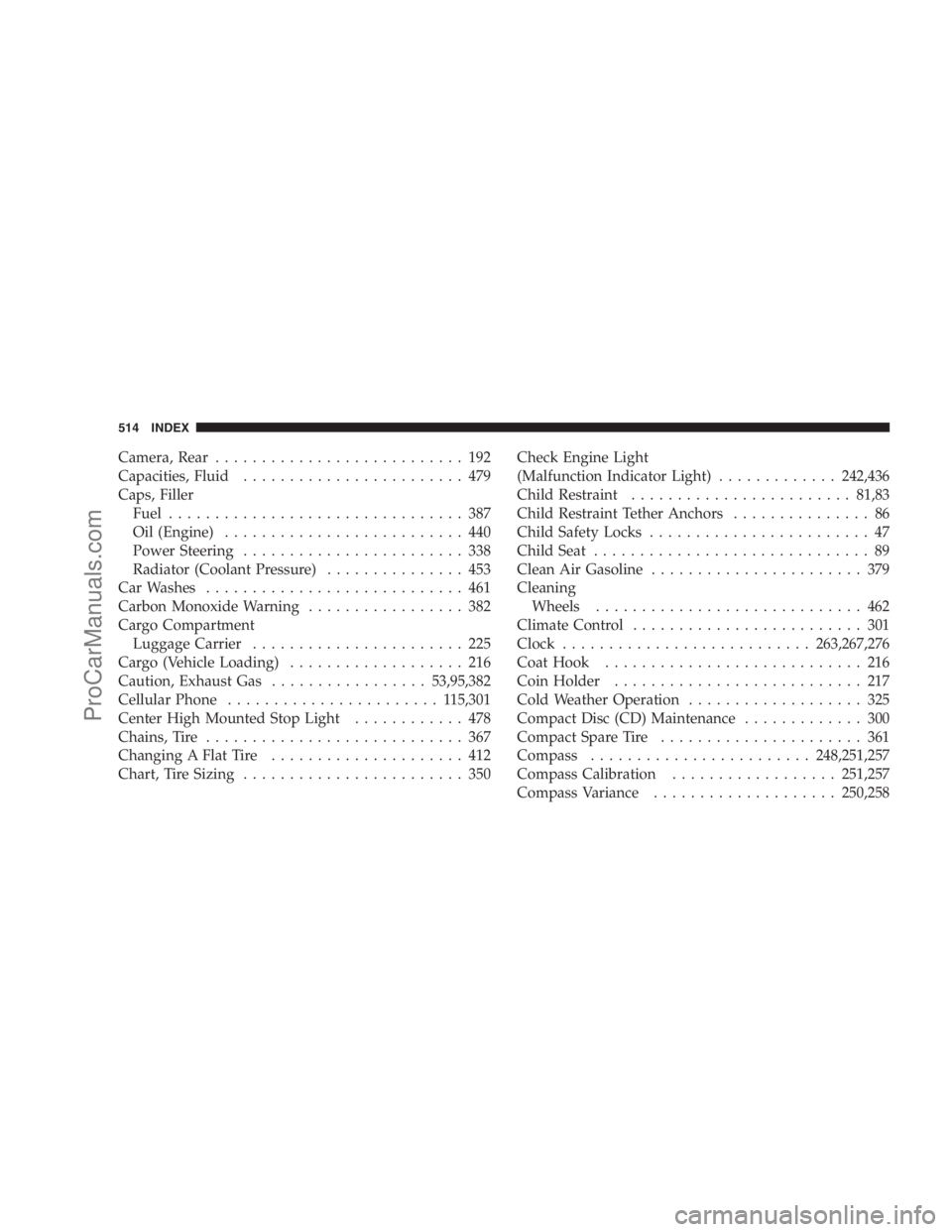
Camera, Rear........................... 192
Capacities, Fluid........................ 479
Caps, Filler
Fuel................................ 387
Oil (Engine).......................... 440
Power Steering........................ 338
Radiator (Coolant Pressure)............... 453
Car Washes............................ 461
Carbon Monoxide Warning................. 382
Cargo Compartment
Luggage Carrier....................... 225
Cargo (Vehicle Loading)................... 216
Caution, Exhaust Gas.................53,95,382
Cellular Phone....................... 115,301
Center High Mounted Stop Light............ 478
Chains, Tire............................ 367
Changing A Flat Tire..................... 412
Chart, Tire Sizing........................ 350Check Engine Light
(Malfunction Indicator Light).............242,436
Child Restraint........................81,83
Child Restraint Tether Anchors............... 86
Child Safety Locks........................ 47
Child Seat.............................. 89
Clean Air Gasoline....................... 379
Cleaning
Wheels............................. 462
Climate Control......................... 301
Clock...........................263,267,276
Coat Hook............................ 216
Coin Holder........................... 217
Cold Weather Operation................... 325
Compact Disc (CD) Maintenance............. 300
Compact Spare Tire...................... 361
Compass........................248,251,257
Compass Calibration..................251,257
Compass Variance....................250,258
514 INDEX
ProCarManuals.com
Page 519 of 534
Exhaust Gas Caution..................53,382
Flooded, Starting...................... 325
Fuel Requirements..................378,479
Oil ...........................438,479,480
Oil Change Interval.................... 439
Oil Disposal.......................... 441
Oil Filler Cap......................... 440
Oil Filter Disposal...................... 441
Oil Selection.......................439,479
Oil Synthetic......................... 441
Overheating.......................... 410
Starting............................. 324
Temperature Gauge..................... 236
Enhanced Accident Response Feature.......... 72
Event Data Recorder...................... 76
Exhaust Gas Caution..............53,95,382,443
Exhaust System......................... 442
Express Down Windows................... 23
Extender, Seat Belt........................ 64Exterior Folding Mirrors................... 104
Fabric Care.........................463,464
Filler Location Fuel...................... 236
Filters
Air Cleaner.......................... 441
Air Conditioning....................320,447
Engine Oil........................441,480
Engine Oil Disposal.................... 441
Flashers
Hazard Warning....................... 410
Turn Signal.....................237,476,477
Flash-To-Pass........................... 179
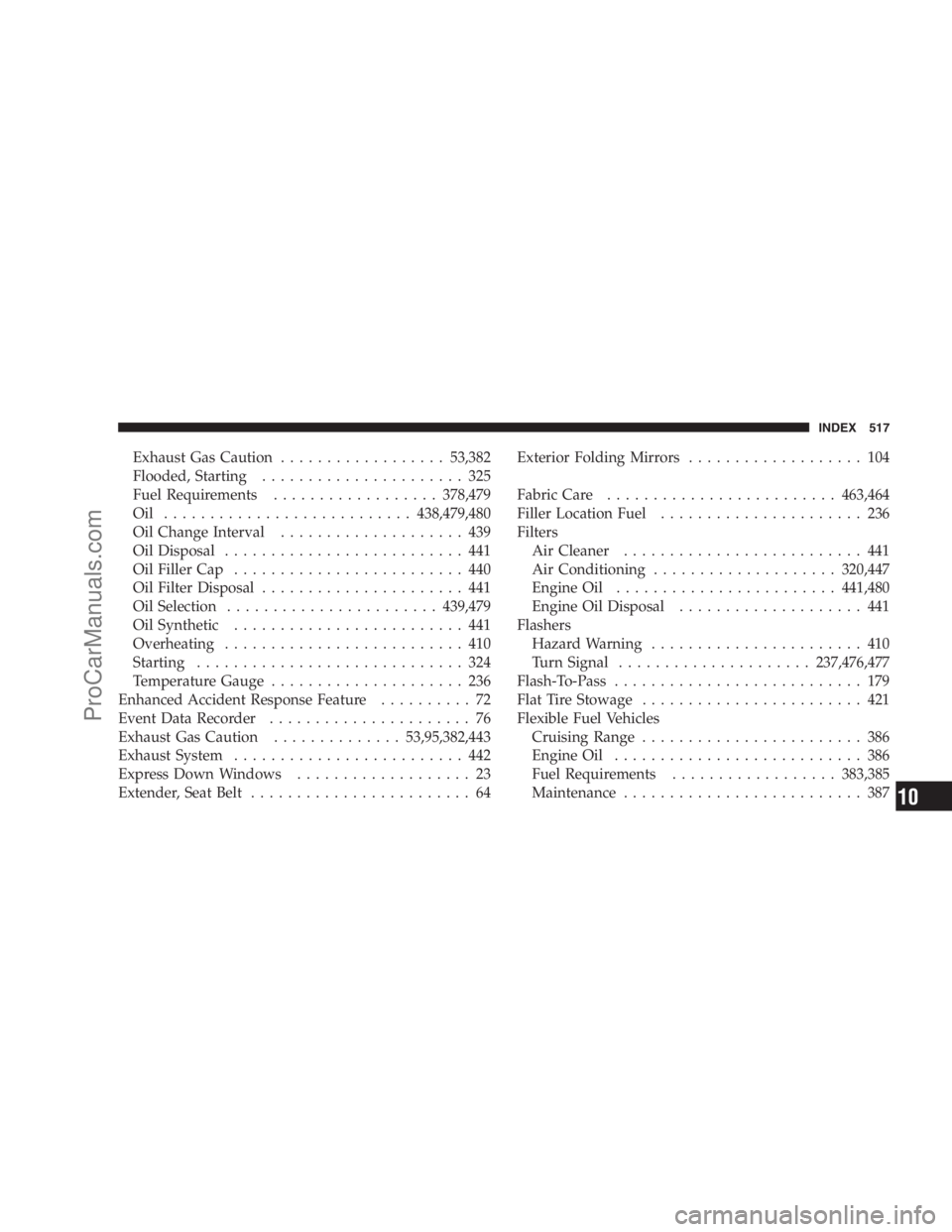
Flat Tire Stowage........................ 421
Flexible Fuel Vehicles
Cruising Range........................ 386
Engine Oil........................... 386
Fuel Requirements..................383,385
Maintenance.......................... 387
INDEX 517
10
ProCarManuals.com
Page 530 of 534
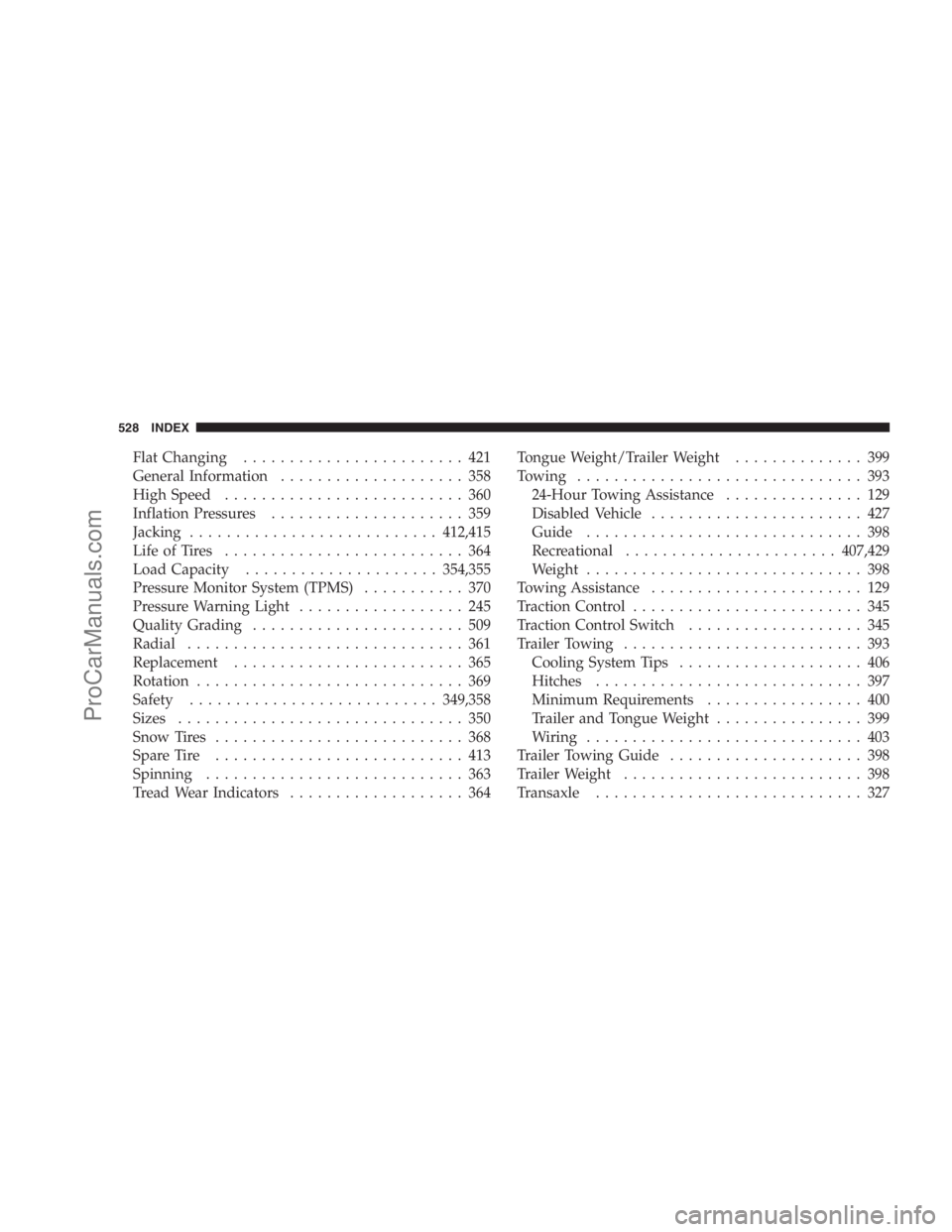
Flat Changing........................ 421
General Information.................... 358
High Speed.......................... 360
Inflation Pressures..................... 359
Jacking...........................412,415
Life of Tires.......................... 364
Load Capacity.....................354,355
Pressure Monitor System (TPMS)........... 370
Pressure Warning Light.................. 245
Quality Grading....................... 509
Radial.............................. 361
Replacement......................... 365
Rotation............................. 369
Safety...........................349,358
Sizes............................... 350
Snow Tires........................... 368
Spare Tire........................... 413
Spinning............................ 363
Tread Wear Indicators................... 364Tongue Weight/Trailer Weight.............. 399
Towing............................... 393
24-Hour Towing Assistance............... 129
Disabled Vehicle....................... 427
Guide.............................. 398
Recreational.......................407,429
Weight.............................. 398
Towing Assistance....................... 129
Traction Control......................... 345
Traction Control Switch................... 345
Trailer Towing.......................... 393
Cooling System Tips.................... 406
Hitches............................. 397
Minimum Requirements................. 400
Trailer and Tongue Weight................ 399
Wiring.............................. 403
Trailer Towing Guide..................... 398
Trailer Weight.......................... 398
Transaxle............................. 327
528 INDEX
ProCarManuals.com