lock DODGE CARAVAN 2009 Owner's Guide
[x] Cancel search | Manufacturer: DODGE, Model Year: 2009, Model line: CARAVAN, Model: DODGE CARAVAN 2009Pages: 534, PDF Size: 9.93 MB
Page 51 of 534
NOTE:
•After setting the Child Protection Door Lock system,
always test the door from the inside to make certain it
is in the desired position.
•The power sliding side door switches will not operate
if the vehicle is in gear or the vehicle speed is above
0 mph (0 km/h).
•The power sliding door will operate from the outside
door handle, the RKE transmitter, the switches on the
overhead console, or the switches located on the trim
panel just in front of the power sliding door when the
shift lever is in PARK, regardless of the child lock lever
position.
LIFTGATE
On vehicles equipped with power locks, the liftgate can
be unlocked using the Remote Keyless Entry (RKE)
transmitter button, or by activating the power door lock
switches located on the front doors.
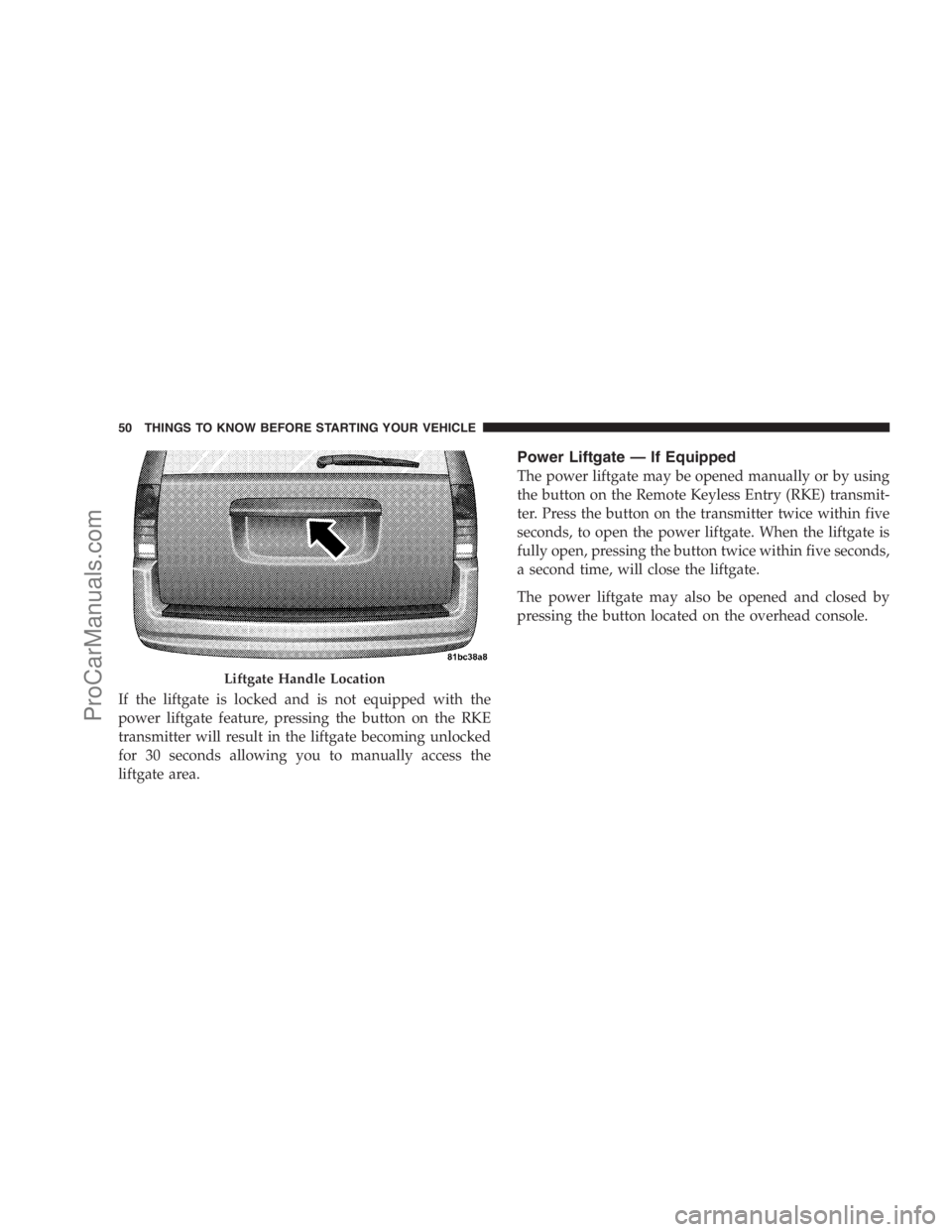
To open the liftgate, depress the liftgate release handle
located on the underside of the license plate bar and pull
the liftgate open with one fluid motion.
THINGS TO KNOW BEFORE STARTING YOUR VEHICLE 49
2
ProCarManuals.com
Page 52 of 534
If the liftgate is locked and is not equipped with the
power liftgate feature, pressing the button on the RKE
transmitter will result in the liftgate becoming unlocked
for 30 seconds allowing you to manually access the
liftgate area.
Power Liftgate — If Equipped
The power liftgate may be opened manually or by using
the button on the Remote Keyless Entry (RKE) transmit-
ter. Press the button on the transmitter twice within five
seconds, to open the power liftgate. When the liftgate is
fully open, pressing the button twice within five seconds,
a second time, will close the liftgate.
The power liftgate may also be opened and closed by
pressing the button located on the overhead console.
Liftgate Handle Location
50 THINGS TO KNOW BEFORE STARTING YOUR VEHICLE
ProCarManuals.com
Page 53 of 534
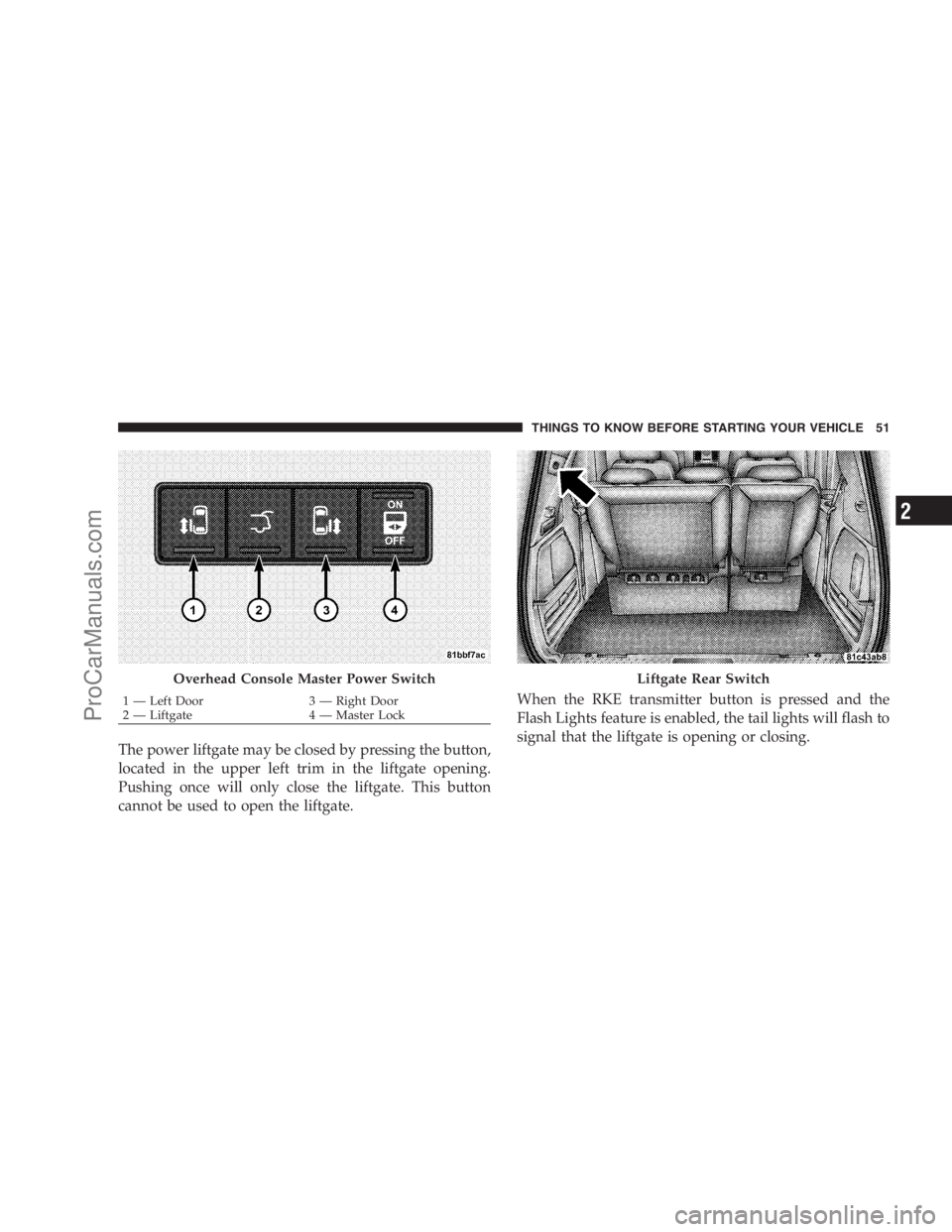
The power liftgate may be closed by pressing the button,
located in the upper left trim in the liftgate opening.
Pushing once will only close the liftgate. This button
cannot be used to open the liftgate.When the RKE transmitter button is pressed and the
Flash Lights feature is enabled, the tail lights will flash to
signal that the liftgate is opening or closing.
Overhead Console Master Power Switch
1 — Left Door 3 — Right Door
2 — Liftgate 4 — Master Lock
Liftgate Rear Switch
THINGS TO KNOW BEFORE STARTING YOUR VEHICLE 51
2
ProCarManuals.com
Page 56 of 534
WARNING! (Continued)
•Do not operate the storage bin covers while the
vehicle is in motion.
•Do not use a storage bin latch as a tie down.
CAUTION!
The storage bin cover must be flat and locked to
avoid damage from contact with the front seat tracks,
which have minimal clearance to the cover.
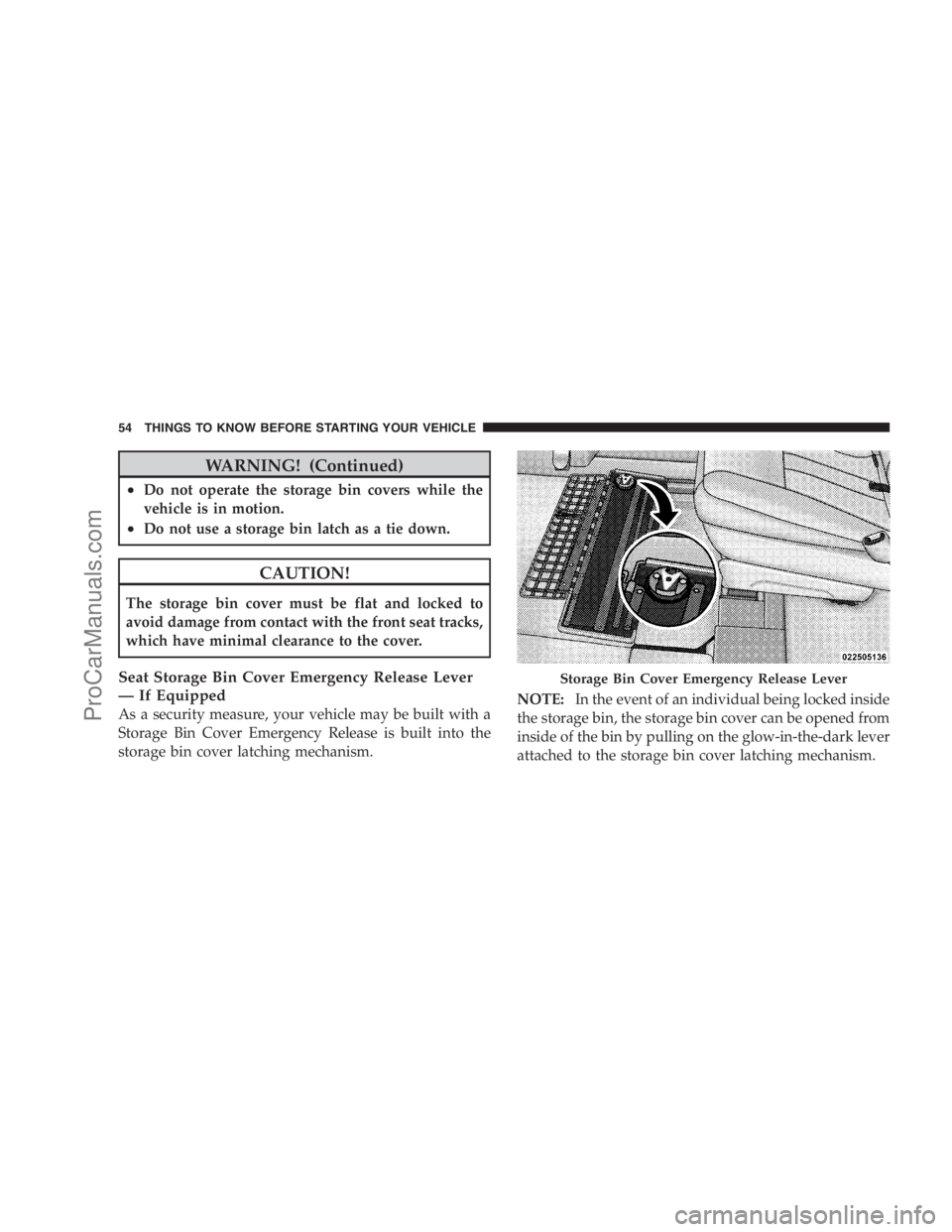
Seat Storage Bin Cover Emergency Release Lever
— If Equipped
As a security measure, your vehicle may be built with a
Storage Bin Cover Emergency Release is built into the
storage bin cover latching mechanism.NOTE:In the event of an individual being locked inside
the storage bin, the storage bin cover can be opened from
inside of the bin by pulling on the glow-in-the-dark lever
attached to the storage bin cover latching mechanism.
Storage Bin Cover Emergency Release Lever
54 THINGS TO KNOW BEFORE STARTING YOUR VEHICLE
ProCarManuals.com
Page 57 of 534
OCCUPANT RESTRAINTS
Some of the most important safety features in your
vehicle are the restraint systems:
•Three-point lap and shoulder belts for all seating
positions
•Pretensioning and load-limiting retractors for the front
seat belts
•Advanced multistage driver and new active-vent front
passenger airbags
•Supplemental side airbags that span the front, second,
and third row seating for the driver and passengers
seated next to a window.
•An energy-absorbing steering column and steering
wheel
•Knee bolsters/blockers for front seat occupants
•Front seat belt retractors incorporate pretensioners to
enhance occupant protection by managing occupant
energy during an impact event.
•All seat belt systems (except the driver’s, Swivel n’ Go,
and third row center position) include Automatic
Locking Retractors (ALRs), which lock the seat belt
webbing into position by extending the belt all the
way out and then adjusting the belt to the desired
length to restrain a child seat or secure a large item in
a seat.
If you will be carrying children too small for adult-size
seat belts, your seat belts or the Lower Anchors and
Tether for CHildren (LATCH) feature also can be used to
hold infant and child restraint systems.
NOTE:The front airbags have a multistage inflator
design. This allows the airbag to have different rates of
inflation that are based on collision severity.
THINGS TO KNOW BEFORE STARTING YOUR VEHICLE 55
2
ProCarManuals.com
Page 58 of 534
Please pay close attention to the information in this
section. It tells you how to use your restraint system
properly to keep you and your passengers as safe as
possible.
WARNING!
In a collision, you and your passengers can suffer
much greater injuries if you are not properly buckled
up. You can strike the interior of your vehicle or other
passengers, or you can be thrown out of the vehicle.
Always be sure you and others in your vehicle are
buckled up properly.
Buckle up even though you are an excellent driver, even
on short trips. Someone on the road may be a poor driver
and cause a collision that includes you. This can happen
far away from home or on your own street.Research has shown that seat belts save lives, and they
can reduce the seriousness of injuries in a collision. Some
of the worst injuries happen when people are thrown
from the vehicle. Seat belts reduce the possibility of
ejection and the risk of injury caused by striking the
inside of the vehicle.Everyone in a motor vehicle should
be belted at all times.
Lap/Shoulder Belts
All seats in your vehicle are equipped with lap/shoulder
belts.
The belt webbing in the retractor is designed to lock
during very sudden stops or collisions. This feature
allows the shoulder part of the belt to move freely with
you under normal conditions. But in a collision, the belt
will lock and reduce the risk of your striking the inside of
the vehicle or being thrown out.
56 THINGS TO KNOW BEFORE STARTING YOUR VEHICLE
ProCarManuals.com
Page 64 of 534
As a guide, if you are shorter than average you will
prefer a lower position, and if you are taller than average
you will prefer a higher position. When you release the
anchorage, try to move it up or down to make sure that
it is locked in position.
Automatic Locking Retractors (ALR) Mode — If
Equipped
In this mode, the shoulder belt is automatically pre-
locked. The belt will still retract to remove any slack in
the shoulder belt. The Automatic Locking mode is avail-
able on all passenger-seating positions with a combina-
tion lap/shoulder belt.
When to Use the Automatic Locking Mode
Use The Automatic Locking mode anytime a child safety
seat is installed in a passenger seating position. Children
12 years old and younger should be properly restrained
in the rear seat whenever possible.
How to Use the Automatic Locking Mode
1. Buckle the combination lap/shoulder belt.
2. Grasp the shoulder portion and pull downward until
the entire belt is extracted.
3. Allow the belt to retract. As the belt retracts, you will
hear a clicking sound. This indicates the safety belt is
now in the Automatic Locking mode.
How to Disengage the Automatic Locking Mode
Disconnect the combination lap/shoulder belt and allow
it to retract completely to disengage the Automatic
Locking mode and activate the Vehicle Sensitive (Emer-
gency) Locking mode.
Seat Belt Pretensioners
The seat belts for both front seating positions are
equipped with pretensioning devices that are designed to
remove slack from the seat belt in the event of a collision.
These devices improve the performance of the seat belt
62 THINGS TO KNOW BEFORE STARTING YOUR VEHICLE
ProCarManuals.com
Page 70 of 534
Supplemental Side Airbag Inflatable Curtain
(SABIC) — If Equipped
SABIC Airbags offer side-impact and vehicle rollover
protection to front and rear seat outboard occupants in
addition to that provided by the body structure. Each
airbag features inflated chambers placed adjacent to the
head of each outboard occupant that reduce the potential
for side-impact head injuries. The curtains deploy down-
ward, covering both windows on the impact side.
NOTE:
•Should a vehicle rollover occur, the SABIC curtains on
both sides of the vehicle are deployed.
•Airbag covers may not be obvious in the interior trim;
but they will open to allow airbag deployment.
The system includes sensors adjacent to both front and
rear seat occupants that are calibrated to deploy during
an impact severe enough to require airbag occupant
protection.
WARNING!
If your vehicle is equipped with left and right Side
Airbag Inflatable Curtain (SABIC), do not stack
luggage or other cargo up high enough to block the
location of the SABIC. The area where the side
curtain airbag is located should remain free from any
obstructions.
Airbags inflate in moderate to high speed impacts. Along
with seat belts and pretensioners, front airbags work with
the knee bolsters to provide improved protection for the
driver and front passenger. Side airbags also work with
seat belts to improve occupant protection.
The seat belts are designed to protect you in many types
of collisions. The front airbags deploy in moderate to
severe frontal collisions. If your vehicle is equipped, the
side airbag on the crash side of the vehicle is triggered in
moderate to severe side collisions. In certain types of
68 THINGS TO KNOW BEFORE STARTING YOUR VEHICLE
ProCarManuals.com
Page 74 of 534
Acceleration Sensors
Acceleration Sensors trigger airbag deployment based on
dramatic acceleration change of the vehicle.
Pressure Sensors
Pressure Sensors trigger airbag deployment based on
door cavity pressure changes.
Rollover Sensors
Rollover Sensors trigger airbag deployment in the event
of vehicle rollover and aid the ORC in deploying Side
Airbag Inflatable Curtains (SABIC) for rollover events.
Supplemental Side Airbag Inflatable Curtain
(SABIC) — If Equipped
The ORC deploys the SABIC during a collision with
other vehicles and during collisions where the impact is
confined to a particular area of the vehicle, such as,
collisions with poles, trees or similar objects. In these
events, the ORC will deploy the SABIC only on the
impact side of the vehicle.NOTE:The ORC will also detect and protect for rollover
when equipped with SABIC airbags. In a rollover the
SABIC airbags will deploy on both sides of the vehicle.
Enhanced Accident Response System
In the event of an impact causing airbag deployment, and
the vehicle communication network intact, and the
power intact, the Enhanced Accident Response System
performs the following functions:
•Cuts off fuel to the engine.
•Flashes hazard lights.
•Turns on the interior lights, which remain on as long as
the battery has power or until the ignition key is
removed.
•Unlocks the doors automatically.
72 THINGS TO KNOW BEFORE STARTING YOUR VEHICLE
ProCarManuals.com
Page 77 of 534
WARNING! (Continued)
•Do not attempt to modify any part of your ad-
vanced airbag system. The airbag may inflate
accidentally or may not function properly if modi-
fications are made. Take your vehicle to an autho-
rized dealer for any advanced airbag system ser-
vice. If your seat, including your trim cover and
cushion, needs to be serviced in any way (includ-
ing removal or loosening/tightening of seat attach-
ment bolts), take the vehicle to your authorized
dealer. Only manufacturer approved seat accesso-
ries may be used. If it is necessary to modify an
advanced airbag system for persons with disabili-
ties, contact your authorized dealer.
NOTE:
Perchlorate Material — special handling may ap-
ply. See: www.dtsc.ca.gov/hazardouswaste/perchlorate.
Airbag Warning Light
You will want to have the airbags ready to
inflate for your protection in a collision. While
the airbag system is designed to be mainte-
nance free, if any of the following occurs, have
an authorized dealer service the system immediately.
•The Airbag Warning Light does not come on for
approximately four to six seconds when the ignition
switch is first turned ON.
•The light remains on after the approximate four to
six-second interval.
•The light comes on and remains on while driving.
NOTE:If the speedometer, tachometer, or any engine
related gauges are not working, the Occupant Restraint
Controller (ORC) may also be disabled. The airbags may
not be ready to inflate for your protection. Promptly
check the fuse block for blown fuses. Refer to the label
THINGS TO KNOW BEFORE STARTING YOUR VEHICLE 75
2
ProCarManuals.com