brake light DODGE CARAVAN 2010 User Guide
[x] Cancel search | Manufacturer: DODGE, Model Year: 2010, Model line: CARAVAN, Model: DODGE CARAVAN 2010Pages: 530, PDF Size: 9.59 MB
Page 335 of 530
CAUTION! (Continued)
•Driving through standing water may cause dam-
age to your vehicle’s drivetrain components. Al-
ways inspect your vehicle’s fluids (i.e., engine oil,
transmission, axle, etc.) for signs of contamination
(i.e., fluid that is milky or foamy in appearance)
after driving through standing water. Do not con-
tinue to operate the vehicle if any fluid appears
contaminated, as this may result in further dam-
age. Such damage is not covered by the New
Vehicle Limited Warranty.
•Getting water inside your vehicle’s engine can
cause it to lock up and stall out, and cause serious
internal damage to the engine. Such damage is not
covered by the New Vehicle Limited Warranty.
WARNING!
•Driving through standing water limits your vehi-
cle’s traction capabilities. Do not exceed 5 mph
(8 km/h) when driving through standing water.
•Driving through standing water limits your vehi-
cle’s braking capabilities, which increases stop-
ping distances. Therefore, after driving through
standing water, drive slowly and lightly press on
the brake pedal several times to dry the brakes.
•Getting water inside your vehicle’s engine can
cause it to lock up and stall out, and leave you
stranded.
•Failure to follow these warnings may result in
injuries that are serious or fatal to you, your
passengers, and others around you.
334 STARTING AND OPERATING
ProCarManuals.com
Page 338 of 530
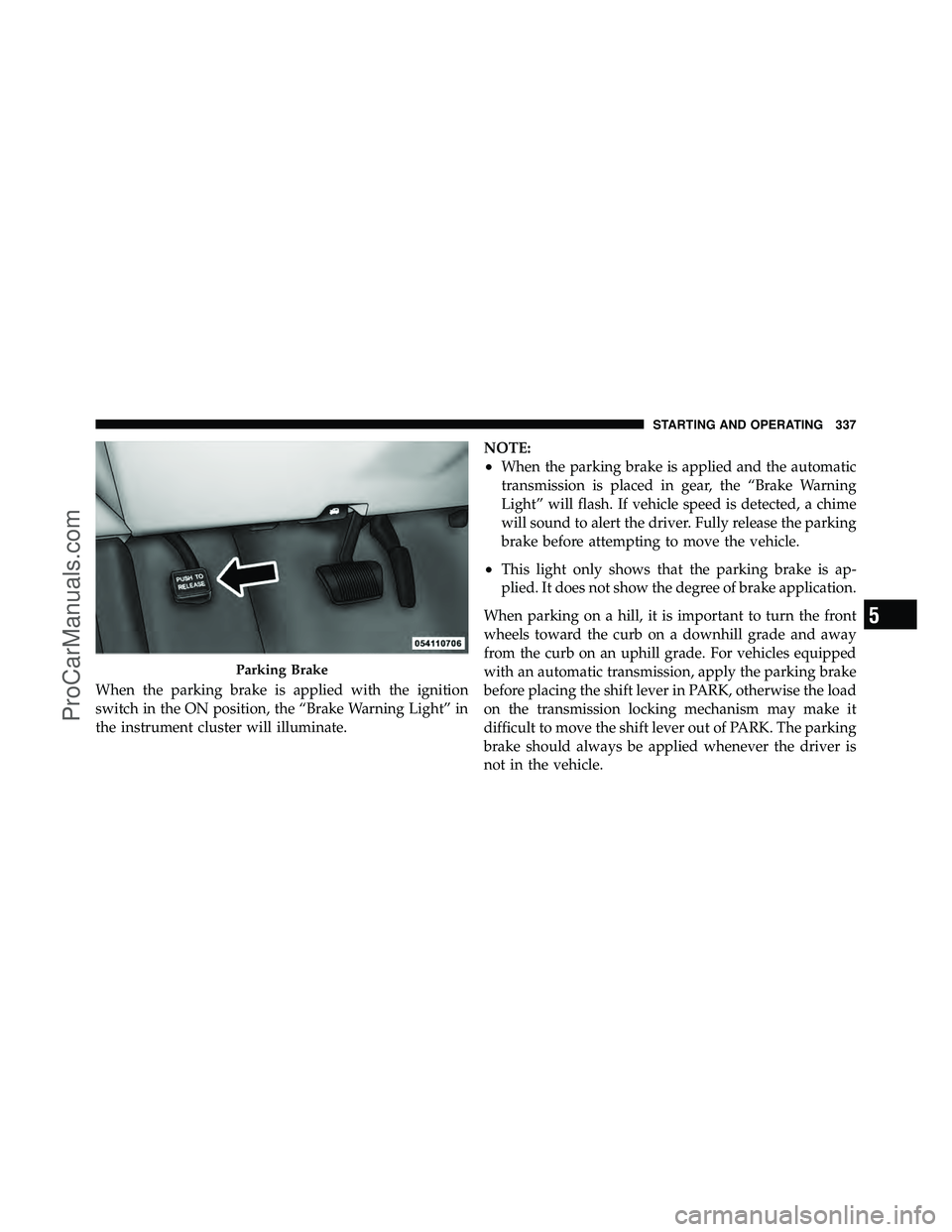
When the parking brake is applied with the ignition
switch in the ON position, the “Brake Warning Light” in
the instrument cluster will illuminate.NOTE:
•When the parking brake is applied and the automatic
transmission is placed in gear, the “Brake Warning
Light” will flash. If vehicle speed is detected, a chime
will sound to alert the driver. Fully release the parking
brake before attempting to move the vehicle.
•This light only shows that the parking brake is ap-
plied. It does not show the degree of brake application.
When parking on a hill, it is important to turn the front
wheels toward the curb on a downhill grade and away
from the curb on an uphill grade. For vehicles equipped
with an automatic transmission, apply the parking brake
before placing the shift lever in PARK, otherwise the load
on the transmission locking mechanism may make it
difficult to move the shift lever out of PARK. The parking
brake should always be applied whenever the driver is
not in the vehicle.
Parking Brake
5
STARTING AND OPERATING 337
ProCarManuals.com
Page 339 of 530
WARNING!
•Never leave children alone in a vehicle. Leaving
unattended children in a vehicle is dangerous for a
number of reasons. A child or others could be
seriously or fatally injured.
•Do not leave the key fob in the ignition switch. A
child could operate power windows, other con-
trols, or move the vehicle.
•Be sure the parking brake is fully disengaged
before driving; failure to do so can lead to brake
failure and an accident.
•Always fully apply the parking brake when leav-
ing your vehicle, or it may roll and cause damage
or injury. Also be certain to leave the transmission
in PARK. Failure to do so may allow the vehicle to
roll and cause damage or injury.
CAUTION!
If the Brake System Warning Light remains on with
the parking brake released, a brake system malfunc-
tion is indicated. Have the brake system serviced by
an authorized dealer immediately.
ANTI-LOCK BRAKE SYSTEM (ABS)
The Anti-Lock Brake System (ABS) provides increased
vehicle stability and brake performance under most
braking conditions. The system operates with a separate
computer to modulate hydraulic pressure to prevent
wheel lock-up and help avoid skidding on slippery
surfaces.
ABS is activated during braking under certain road or
stopping conditions. ABS-inducing conditions can in-
clude ice, snow, gravel, bumps, railroad tracks, loose
debris, or panic stops.
338 STARTING AND OPERATING
ProCarManuals.com
Page 340 of 530
You may experience the following when the brake system
goes into anti-lock:
•The ABS motor running (it may continue to run for a
short time after the stop)
•A clicking sound of solenoid valves
•Brake pedal pulsations
•A slight drop or fall away of the brake pedal at the end
of the stop
WARNING!
•The Anti-Lock Brake System contains sophisti-
cated electronic equipment that may be suscep-
tible to interference caused by improperly in-
stalled, or high output radio transmitting
equipment. This interference can cause possible
loss of anti-lock braking capability. Installation of
such equipment should be performed by qualified
professionals.
•Pumping of the Anti-Lock Brakes will diminish
their effectiveness and may lead to an accident.
Pumping makes the stopping distance longer. Just
press firmly on your brake pedal when you need
to slow down or stop.(Continued)
5
STARTING AND OPERATING 339
ProCarManuals.com
Page 341 of 530
WARNING! (Continued)
•The Anti-Lock Brake System cannot prevent acci-
dents, including those resulting from excessive
speed in turns, following another vehicle too
closely, or hydroplaning. Only a safe, attentive,
and skillful driver can prevent accidents.
•The capabilities of an ABS-equipped vehicle must
never be exploited in a reckless or dangerous
manner, which could jeopardize the user ’s safety
or the safety of others.
All vehicle wheels and tires must be the same size and
type, and tires must be properly inflated to produce
accurate signals for the computer.
Anti-Lock Brake Warning Light
The “Anti-Lock Brake Warning Light” moni-
tors the anti-lock brake system. The light will
come on when the ignition switch is turned to
the ON position and may stay on for as long as
four seconds.
If the “Anti-Lock Brake Warning Light” remains on or
comes on while driving, it indicates that the anti-lock
portion of the brake system is not functioning and that
service is required. However, the conventional brake
system will continue to operate normally if the “Brake
Warning Light” is not on.
If the “Anti-Lock Brake Warning Light” is on, the brake
system should be serviced as soon as possible to restore
the benefits of anti-lock brakes. If the “Anti-Lock Brake
Warning Light” does not come on when the ignition
switch is turned to the ON position, have the bulb
repaired as soon as possible.
340 STARTING AND OPERATING
ProCarManuals.com
Page 342 of 530
If both the “Brake Warning Light” and the “Anti-Lock
Brake Warning Light” remain on, the ABS and Electronic
Brake Force Distribution (EBD) systems are not function-
ing. Immediate repair to the ABS system is required.
Consult with your authorized dealer service center as
soon as possible.
ELECTRONIC BRAKE CONTROL SYSTEM
Your vehicle is equipped with an advanced electronic
brake control system that includes the Traction Control
System (TCS), Brake Assist System (BAS) and Electronic
Stability Program (ESP). These systems complement the
Anti-Lock Brake System (ABS) by optimizing the vehicle
braking capability during emergency braking maneu-
vers.
Traction Control System (TCS)
The Traction Control System (TCS) monitors the amount
of wheel spin of each of the driven wheels. If wheel spin
is detected, brake pressure is applied to the slippingwheel(s) and engine power is reduced, to provide en-
hanced acceleration and stability. A feature of the TCS
functions similarly to a limited-slip differential, and
controls the wheel spin across a driven axle. If one wheel
on a driven axle is spinning faster than the other, the
system will apply the brake of the spinning wheel. This
will allow more engine torque to be applied to the wheel
that is not spinning. This feature remains active even if
the ESP is in the “Partial Off” mode.
The “ESP/TCS Indicator Light” (in the instru-
ment cluster) will start to flash as soon as the
tires lose traction and the wheels begin to spin.
This indicates that the TCS is active. If the
indicator light flashes during acceleration, ease up on the
accelerator and apply as little throttle as possible. Be sure
to adapt your speed and driving to the prevailing road
conditions, and do not switch off the ESP or TCS.
5
STARTING AND OPERATING 341
ProCarManuals.com
Page 455 of 530
•Make sure that the radiator and coolant recovery
bottle overflow hoses are not kinked or obstructed.
•Keep the front of the radiator clean. If your vehicle is
equipped with air conditioning, also keep the front of
the condenser clean.
•Do not change the thermostat for Summer or Winter
operation. If replacement is ever necessary, install
ONLY the correct type thermostat. Other designs may
result in unsatisfactory coolant performance, poor gas
mileage, and increased emissions.
Brakes
In order to assure brake system performance, all brake
system components should be inspected periodically.
Refer to “Maintenance Schedule” for the proper mainte-
nance intervals.
WARNING!
Riding the brakes can lead to brake failure and
possibly an accident. Driving with your foot resting
or riding on the brake pedal can result in abnormally
high brake temperatures, excessive lining wear, and
possible brake damage. You would not have your full
braking capacity in an emergency.
Master Cylinder – Brake Fluid Level Check
The fluid level in the master cylinder should be checked
when performing underhood services, or immediately if
the “Brake System Warning Light” indicates system
failure.
Clean the top of the master cylinder area before removing
the cap. Add fluid to bring the level up to the top of the
“FULL” mark on the side of the master cylinder reservoir.
Overfilling of fluid is not recommended because it may
cause leaking in the system.
454 MAINTAINING YOUR VEHICLE
ProCarManuals.com
Page 485 of 530
Once A Month
•Check tire pressure and look for unusual wear or
damage.
•Inspect the battery and clean and tighten the terminals
as required.
•Check the fluid levels of the coolant reservoir, the
brake master cylinder, the power steering and the
transmission and add as needed.
•Check all lights and other electrical items for correct
operation.At Each Oil Change
•Change the engine oil filter.
•Inspect the brake hoses and lines.
CAUTION!
Failure to perform the required maintenance items
may result in damage to the vehicle.
Required Maintenance Intervals
Refer to the Maintenance Schedules on the following
pages for the required maintenance intervals.
8
M
A I
N T
E
N A
N CE
S
C
H E
D
U L
E
S484 MAINTENANCE SCHEDULES
ProCarManuals.com
Page 512 of 530
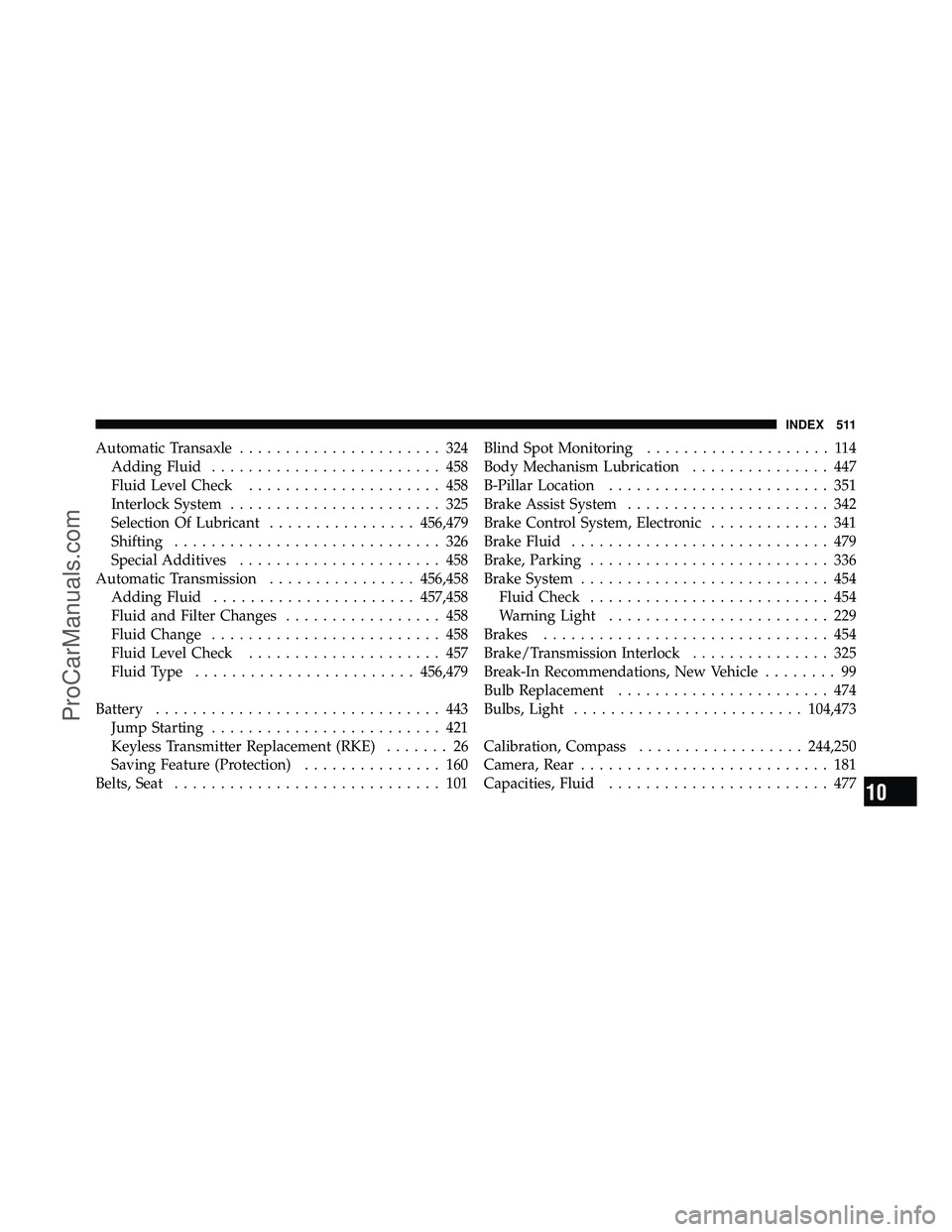
Automatic Transaxle...................... 324
Adding Fluid ......................... 458
Fluid Level Check ..................... 458
Interlock System ....................... 325
Selection Of Lubricant ................456,479
Shifting ............................. 326
Special Additives ...................... 458
Automatic Transmission ................456,458
Adding Fluid ...................... 457,458
Fluid and Filter Changes ................. 458
Fluid Change ......................... 458
Fluid Level Check ..................... 457
Fluid Type ........................ 456,479
Battery ............................... 443
Jump Starting ......................... 421
Keyless Transmitter Replacement (RKE) ....... 26
Saving Feature (Protection) ............... 160
Belts, Seat ............................. 101 Blind Spot Monitoring
.................... 114
Body Mechanism Lubrication ............... 447
B-Pillar Location ........................ 351
Brake Assist System ...................... 342
Brake Control System, Electronic ............. 341
Brake Fluid ............................ 479
Brake, Parking .......................... 336
Brake System ........................... 454
Fluid Check .......................... 454
Warning Light ........................ 229
Brakes ............................... 454
Brake/Transmission Interlock ............... 325
Break-In Recommendations, New Vehicle ........ 99
Bulb Replacement ....................... 474
Bulbs, Light ......................... 104,473
Calibration, Compass .................. 244,250
Camera, Rear ........................... 181
Capacities, Fluid ........................ 477
10
INDEX 511
ProCarManuals.com
Page 515 of 530
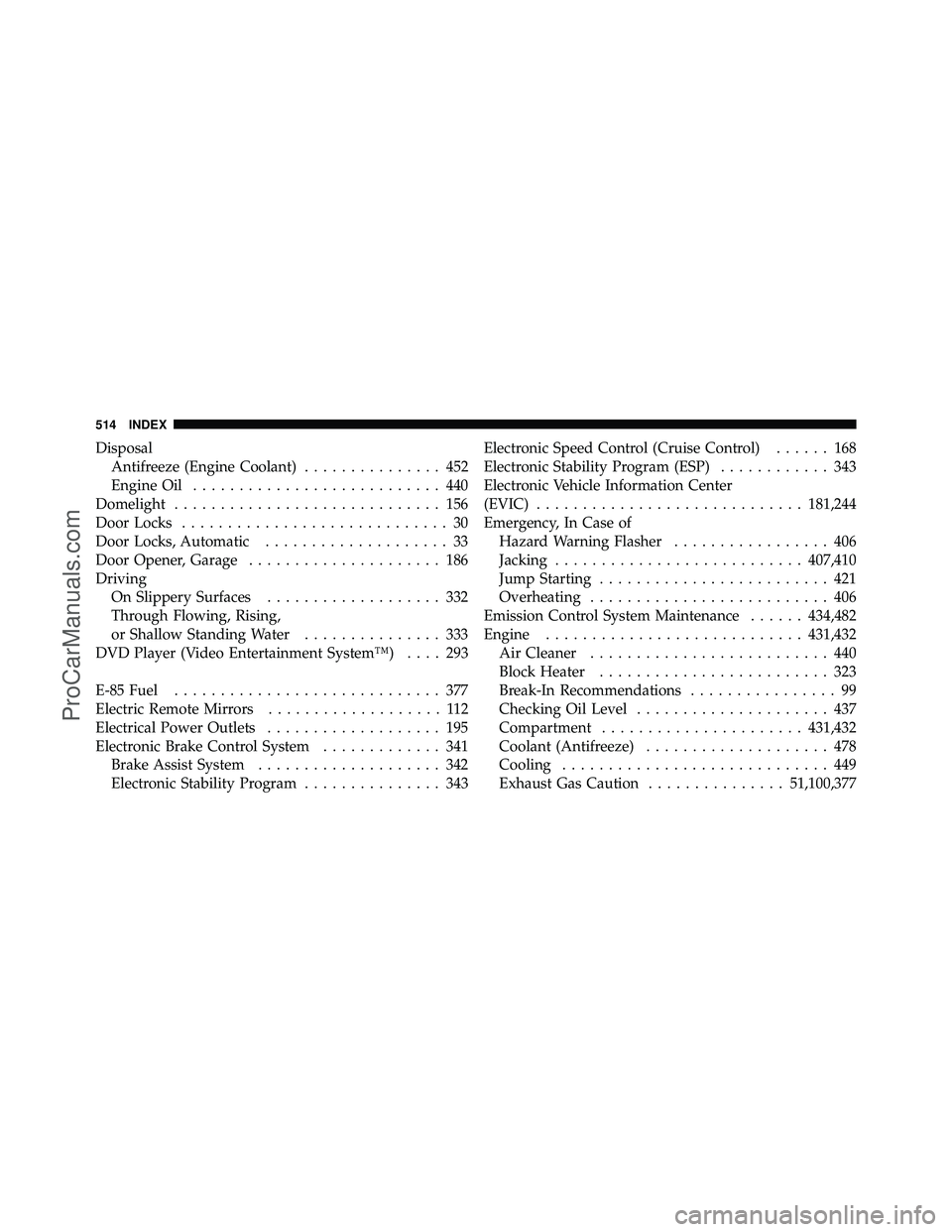
DisposalAntifreeze (Engine Coolant) ............... 452
Engine Oil ........................... 440
Domelight ............................. 156
Door Locks ............................. 30
Door Locks, Automatic .................... 33
Door Opener, Garage ..................... 186
Driving On Slippery Surfaces ................... 332
Through Flowing, Rising,
or Shallow Standing Water ............... 333
DVD Player (Video Entertainment System™) .... 293
E-85 Fuel ............................. 377
Electric Remote Mirrors ................... 112
Electrical Power Outlets ................... 195
Electronic Brake Control System ............. 341
Brake Assist System .................... 342
Electronic Stability Program ............... 343Electronic Speed Control (Cruise Control)
...... 168
Electronic Stability Program (ESP) ............ 343
Electronic Vehicle Information Center
(EVIC) ............................. 181,244
Emergency, In Case of Hazard Warning Flasher ................. 406
Jacking ........................... 407,410
Jump Starting ......................... 421
Overheating .......................... 406
Emission Control System Maintenance ......434,482
Engine ............................ 431,432
Air Cleaner .......................... 440
Block Heater ......................... 323
Break-In Recommendations ................ 99
Checking Oil Level ..................... 437
Compartment ...................... 431,432
Coolant (Antifreeze) .................... 478
Cooling ............................. 449
Exhaust Gas Caution ...............51,100,377
514 INDEX
ProCarManuals.com