brake light DODGE CARAVAN 2011 User Guide
[x] Cancel search | Manufacturer: DODGE, Model Year: 2011, Model line: CARAVAN, Model: DODGE CARAVAN 2011Pages: 562, PDF Size: 7.79 MB
Page 370 of 562
NOTE:
•When the parking brake is applied and the automatic
transmission is placed in gear, the “Brake Warning
Light” will flash. If vehicle speed is detected, a chime
will sound to alert the driver. Fully release the parking
brake before attempting to move the vehicle.
•This light only shows that the parking brake is ap-
plied. It does not show the degree of brake application.
When parking on a hill, it is important to turn the front
wheels toward the curb on a downhill grade and away
from the curb on an uphill grade. For vehicles equipped
with an automatic transmission, apply the parking brake
before placing the shift lever in PARK, otherwise the load
on the transmission locking mechanism may make it
difficult to move the shift lever out of PARK. The parking
brake should always be applied whenever the driver is
not in the vehicle.
WARNING!
•Never leave children alone in a vehicle. Leaving
unattended children in a vehicle is dangerous for a
number of reasons. A child or others could be
seriously or fatally injured.
•Do not leave the key fob in the ignition switch. A
child could operate power windows, other con-
trols, or move the vehicle.
•Be sure the parking brake is fully disengaged
before driving; failure to do so can lead to brake
failure and a collision.
•Always fully apply the parking brake when leav-
ing your vehicle, or it may roll and cause damage
or injury. Also be certain to leave the transmission
in PARK. Failure to do so may allow the vehicle to
roll and cause damage or injury.
368 STARTING AND OPERATING
ProCarManuals.com
Page 371 of 562
CAUTION!
If the Brake System Warning Light remains on with
the parking brake released, a brake system malfunc-
tion is indicated. Have the brake system serviced by
an authorized dealer immediately.
ANTI-LOCK BRAKE SYSTEM (ABS)
The Anti-Lock Brake System (ABS) provides increased
vehicle stability and brake performance under most
braking conditions. The system operates with a separate
computer to modulate hydraulic pressure to prevent
wheel lock-up and help avoid skidding on slippery
surfaces.
ABS is activated during braking under certain road or
stopping conditions. ABS-inducing conditions can in-
clude ice, snow, gravel, bumps, railroad tracks, loose
debris, or panic stops.You may experience the following when the brake system
goes into anti-lock:
•The ABS motor running (it may continue to run for a
short time after the stop)
•A clicking sound of solenoid valves
•Brake pedal pulsations
•A slight drop or fall away of the brake pedal at the end
of the stop
5
STARTING AND OPERATING 369
ProCarManuals.com
Page 373 of 562
Anti-Lock Brake Warning Light
The “Anti-Lock Brake Warning Light” moni-
tors the anti-lock brake system. The light will
come on when the ignition switch is turned to
the ON position and may stay on for as long as
four seconds.
If the “Anti-Lock Brake Warning Light” remains on or
comes on while driving, it indicates that the anti-lock
portion of the brake system is not functioning and that
service is required. However, the conventional brake
system will continue to operate normally if the “Brake
Warning Light” is not on.
If the “Anti-Lock Brake Warning Light” is on, the brake
system should be serviced as soon as possible to restore
the benefits of anti-lock brakes. If the “Anti-Lock Brake
Warning Light” does not come on when the ignition
switch is turned to the ON position, have the bulb
repaired as soon as possible. If both the “Brake Warning Light” and the “Anti-Lock
Brake Warning Light” remain on, the ABS and Electronic
Brake Force Distribution (EBD) systems are not function-
ing. Immediate repair to the ABS system is required.
Consult with your authorized dealer service center as
soon as possible.
ELECTRONIC BRAKE CONTROL SYSTEM
Your vehicle is equipped with an advanced electronic
brake control system that includes the Traction Control
System (TCS), Brake Assist System (BAS) and Electronic
Stability Control (ESC). These systems complement the
Anti-Lock Brake System (ABS) by optimizing the vehicle
braking capability during emergency braking maneu-
vers.
Traction Control System (TCS)
The Traction Control System (TCS) monitors the amount
of wheel spin of each of the driven wheels. If wheel spin
is detected, brake pressure is applied to the slipping
5
STARTING AND OPERATING 371
ProCarManuals.com
Page 374 of 562
wheel(s) and engine power is reduced, to provide en-
hanced acceleration and stability. A feature of the TCS
functions similarly to a limited-slip differential, and
controls the wheel spin across a driven axle. If one wheel
on a driven axle is spinning faster than the other, the
system will apply the brake of the spinning wheel. This
will allow more engine torque to be applied to the wheel
that is not spinning. This feature remains active even if
the ESC is in the “Partial Off” mode.
The “ESC Activation/Malfunction Indicator Light” (in
the instrument cluster) will start to flash as soon as the
tires lose traction and the wheels begin to spin. This
indicates that the TCS is active. If the indicator light
flashes during acceleration, ease up on the accelerator
and apply as little throttle as possible. Be sure to adapt
your speed and driving to the prevailing road conditions,
and do not switch off the ESC or TCS.WARNING!
•The TCS cannot prevent the natural laws of phys-
ics from acting on the vehicle, nor can it increase
the traction afforded.
•The TCS cannot prevent collisions, including
those resulting from excessive speed in turns, or
hydroplaning.
•The capabilities of a TCS-equipped vehicle must
never be exploited in a reckless or dangerous
manner, which could jeopardize the user’s safety
or the safety of others.
Brake Assist System (BAS)
The Brake Assist System (BAS) is designed to optimize
the vehicle’s braking capability during emergency brak-
ing maneuvers. The system detects an emergency brak-
ing situation by sensing the rate and amount of brake
application, and then applies optimum pressure to the
372 STARTING AND OPERATING
ProCarManuals.com
Page 434 of 562
•An electronically actuated trailer brake controller is
required when towing a trailer with electronically
actuated brakes. When towing a trailer equipped with
a hydraulic surge actuated brake system, an electronic
brake controller is not required.
•Trailer brakes are recommended for trailers over
1,000 lbs (454 kg) and required for trailers in excess of
2,000 lbs (907 kg).
CAUTION!
If the trailer weighs more than 1,000 lbs (454 kg)
loaded, it should have its own brakes and they
should be of adequate capacity. Failure to do this
could lead to accelerated brake lining wear, higher
brake pedal effort, and longer stopping distances.
WARNING!
•Do not connect trailer brakes to your vehicle’s
hydraulic brake lines. It can overload your brake
system and cause it to fail. You might not have
brakes when you need them and could have a
collision.
•Towing any trailer will increase your stopping
distance. When towing you should allow for addi-
tional space between your vehicle and the vehicle
in front of you. Failure to do so could result in an
collision.
Towing Requirements – Trailer Lights And Wiring
Whenever you pull a trailer, regardless of the trailer size,
stop lights and turn signals on the trailer are required for
motoring safety.
432 STARTING AND OPERATING
ProCarManuals.com
Page 492 of 562
WARNING!
Riding the brakes can lead to brake failure and
possibly a collision. Driving with your foot resting or
riding on the brake pedal can result in abnormally
high brake temperatures, excessive lining wear, and
possible brake damage. You would not have your full
braking capacity in an emergency.
Master Cylinder – Brake Fluid Level Check
The fluid level in the master cylinder should be checked
when performing underhood services, or immediately if
the “Brake System Warning Light” indicates system
failure.
Clean the top of the master cylinder area before removing
the cap. Add fluid to bring the level up to the top of the
“FULL” mark on the side of the master cylinder reservoir.Overfilling of fluid is not recommended because it may
cause leaking in the system.
Add enough fluid to bring the level up to the require-
ments described on the brake fluid reservoir. With disc
brakes, fluid level can be expected to fall as the brake
pads wear. However, low fluid level may be caused by a
leak and a checkup may be needed.
Use only manufacturer’s recommended brake fluid. Re-
fer to “Fluids, Lubricants, and Genuine Parts” in “Main-
taining Your Vehicle” for further information.
490 MAINTAINING YOUR VEHICLE
ProCarManuals.com
Page 519 of 562
•Under no circumstances should oil change intervals
exceed 8,000 miles (13 000 km) or six months, which-
ever comes first.
Your authorized dealer will reset the oil change indicator
message after completing the scheduled oil change. If a
scheduled oil change is performed by someone other
than your authorized dealer, the message can be reset by
referring to the steps described under “Electronic Vehicle
Information Center (EVIC)/Oil Change Required” in
“Understanding Your Instrument Panel” or under “In-
strument Cluster Description/Odometer/Trip Odom-
eter” in “Understanding Your Instrument Panel” for
further information.
At Each Stop For Fuel
•Check the engine oil level about five minutes after a
fully warmed engine is shut OFF. Checking the oil
level while the vehicle is on level ground will improve the accuracy of the oil level reading. Add oil only
when the level is at or below the ADD, SAFE or MIN
mark.
•Check the windshield washer solvent and add if
required.
Once A Month
•Check tire pressure and look for unusual wear or
damage.
•Inspect the battery and clean and tighten the terminals
as required.
•Check the fluid levels of the coolant reservoir, the
brake master cylinder, the power steering and the
transmission and add as needed.
•Check all lights and other electrical items for correct
operation.
8
M A I
N T
E
N A
N CE
S
C
H E
D
U L
E
SMAINTENANCE SCHEDULES 517
ProCarManuals.com
Page 543 of 562
Automatic TransaxleAdding Fluid ....................... 493
Fluid Level Check .................... 493
Selection Of Lubricant ..............492,513
Shifting ........................... 358
Special Additives ..................... 493
Automatic Transmission .............354,492,493
Adding Fluid ....................... 493
Fluid and Filter Changes ............... 493
Fluid Change ....................... 493
Fluid Type ...................... 492,513
B-Pillar Location ........................ 382
Battery ............................... 478
Jump Starting ....................... 456
Keyless Transmitter Replacement (RKE) ..... 26
Saving Feature (Protection) .............. 171
Belts, Seat ............................. 102
Blind Spot Monitoring .................... 118 Body Mechanism Lubrication
............... 482
Brake Assist System ...................... 372
Brake Control System, Electronic ............. 371
Brake Fluid ............................ 513
Brake System ........................... 489
Fluid Check ........................ 490
Parking ........................... 367
Warning Light ....................... 257
Brake/Transmission Interlock ............... 355
Brakes ............................... 489
Break-In Recommendations, New Vehicle ....... 100
Bulb Replacement ....................... 507
Bulbs, Light ......................... 104,507
Calibration, Compass .................. 265,278
Camera, Rear ........................... 191
Capacities, Fluid ........................ 511
Caps, Filler Fuel .............................. 416
10
INDEX 541
ProCarManuals.com
Page 548 of 562
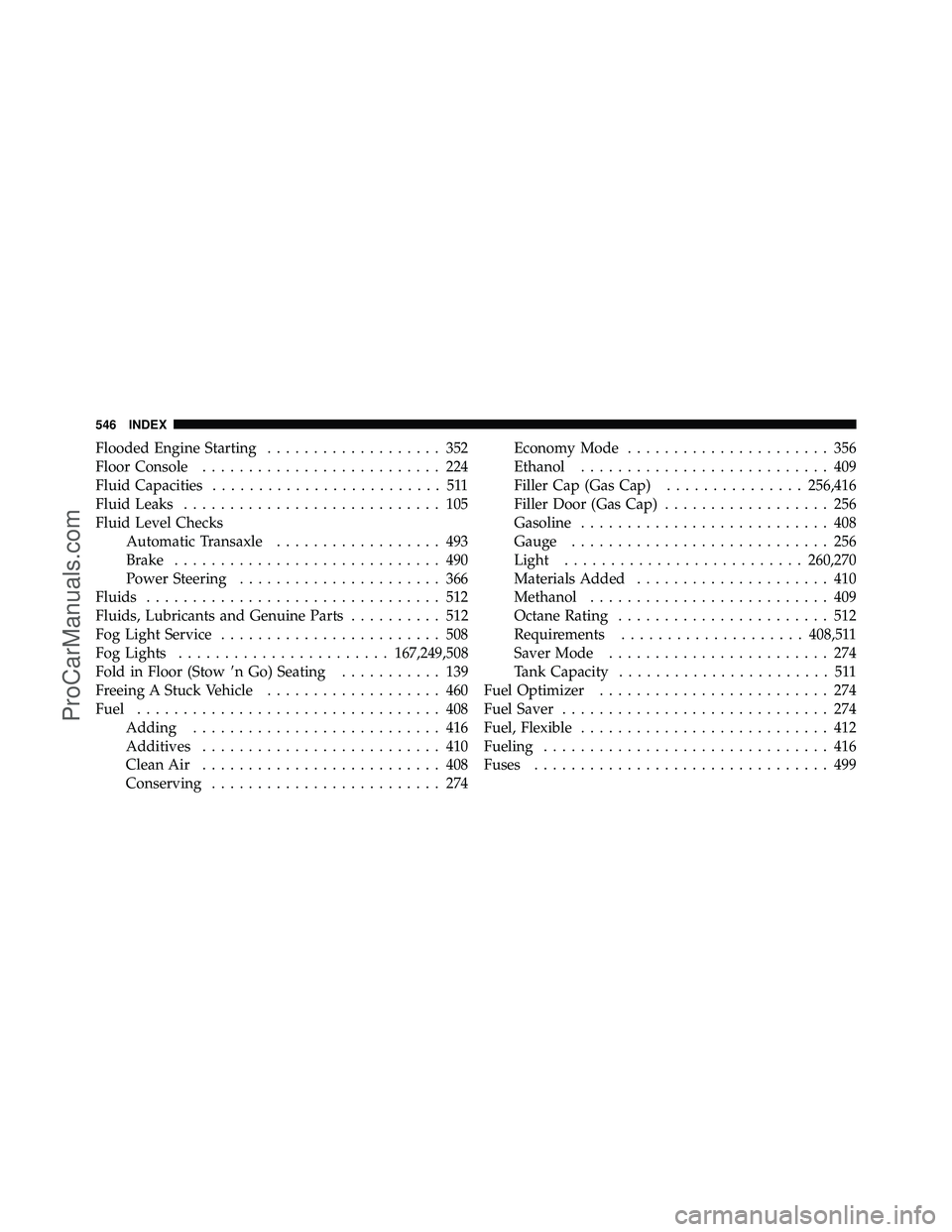
Flooded Engine Starting................... 352
Floor Console .......................... 224
Fluid Capacities ......................... 511
Fluid Leaks ............................ 105
Fluid Level Checks Automatic Transaxle .................. 493
Brake ............................. 490
Power Steering ...................... 366
Fluids ................................ 512
Fluids, Lubricants and Genuine Parts .......... 512
Fog Light Service ........................ 508
Fog Lights ....................... 167,249,508
Fold in Floor (Stow \bn Go) Seating........... 139
Freeing A Stuck Vehicle ................... 460
Fuel ................................. 408
Adding ........................... 416
Additives .......................... 410
Clean Air .......................... 408
Conserving ......................... 274 Economy Mode
...................... 356
Ethanol ........................... 409
Filler Cap (Gas Cap) ...............256,416
Filler Door (Gas Cap) .................. 256
Gasoline ........................... 408
Gauge ............................ 256
Light .......................... 260,270
Materials Added ..................... 410
Methanol .......................... 409
Octane Rating ....................... 512
Requirements .................... 408,511
Saver Mode ........................ 274
Tank Capacity ....................... 511
Fuel Optimizer ......................... 274
Fuel Saver ............................. 274
Fuel, Flexible ........................... 412
Fueling ............................... 416
Fuses ................................ 499
546 INDEX
ProCarManuals.com
Page 551 of 562
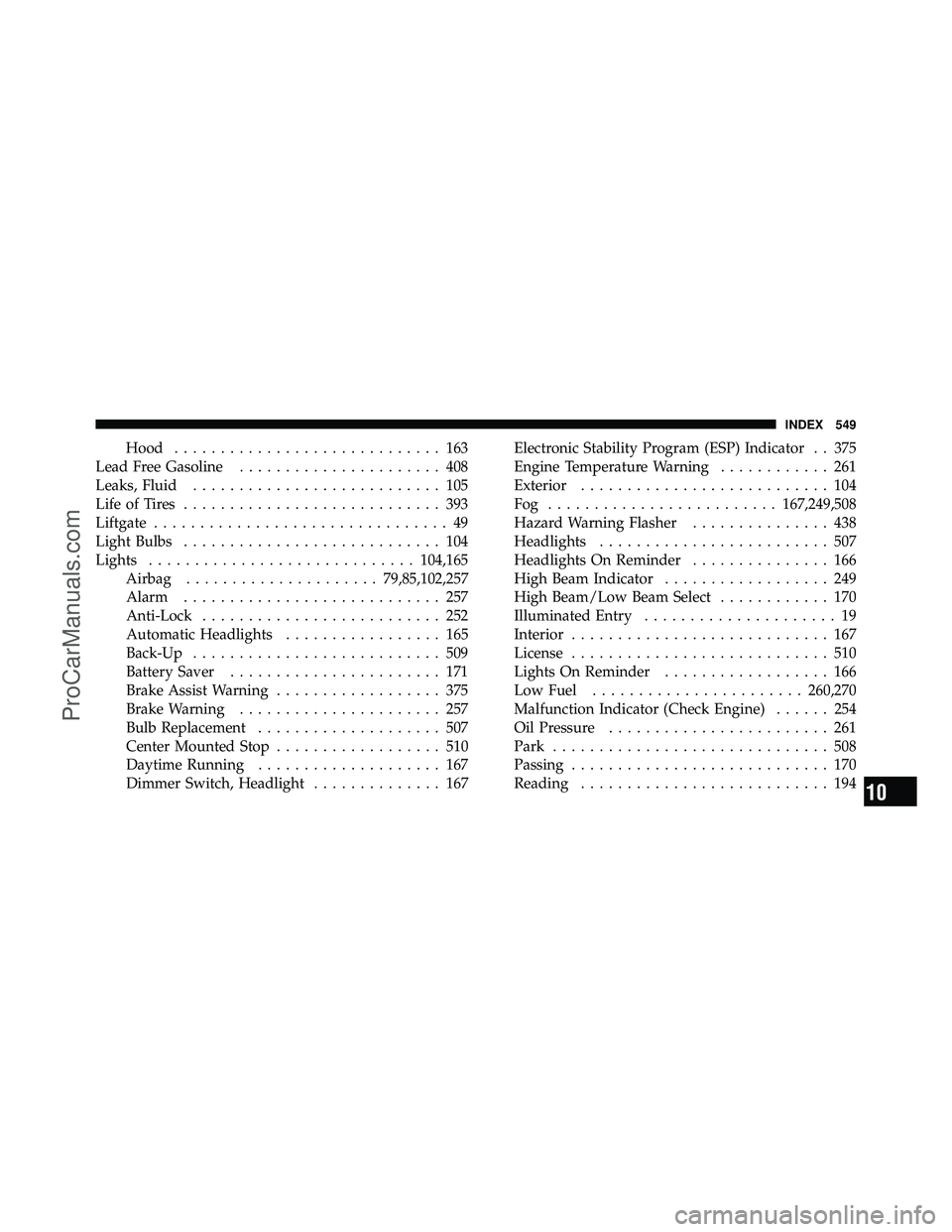
Hood............................. 163
Lead Free Gasoline ...................... 408
Leaks, Fluid ........................... 105
Life of Tires ............................ 393
Liftgate ................................ 49
Light Bulbs ............................ 104
Lights ............................. 104,165
Airbag ..................... 79,85,102,257
Alarm ............................ 257
Anti-Lock .......................... 252
Automatic Headlights ................. 165
Back-Up ........................... 509
Battery Saver ....................... 171
Brake Assist Warning .................. 375
Brake Warning ...................... 257
Bulb Replacement .................... 507
Center Mounted Stop .................. 510
Daytime Running .................... 167
Dimmer Switch, Headlight .............. 167 Electronic Stability Program (ESP) Indicator . . 375
Engine Temperature Warning
............ 261
Exterior ........................... 104
Fog ......................... 167,249,508
Hazard Warning Flasher ............... 438
Headlights ......................... 507
Headlights On Reminder ............... 166
High Beam Indicator .................. 249
High Beam/Low Beam Select ............ 170
Illuminated Entry ..................... 19
Interior ............................ 167
License ............................ 510
Lights On Reminder .................. 166
Low Fuel ....................... 260,270
Malfunction Indicator (Check Engine) ...... 254
Oil Pressure ........................ 261
Park .............................. 508
Passing ............................ 170
Reading ........................... 194
10
INDEX 549
ProCarManuals.com