child restraint DODGE CARAVAN 2011 User Guide
[x] Cancel search | Manufacturer: DODGE, Model Year: 2011, Model line: CARAVAN, Model: DODGE CARAVAN 2011Pages: 562, PDF Size: 7.79 MB
Page 95 of 562
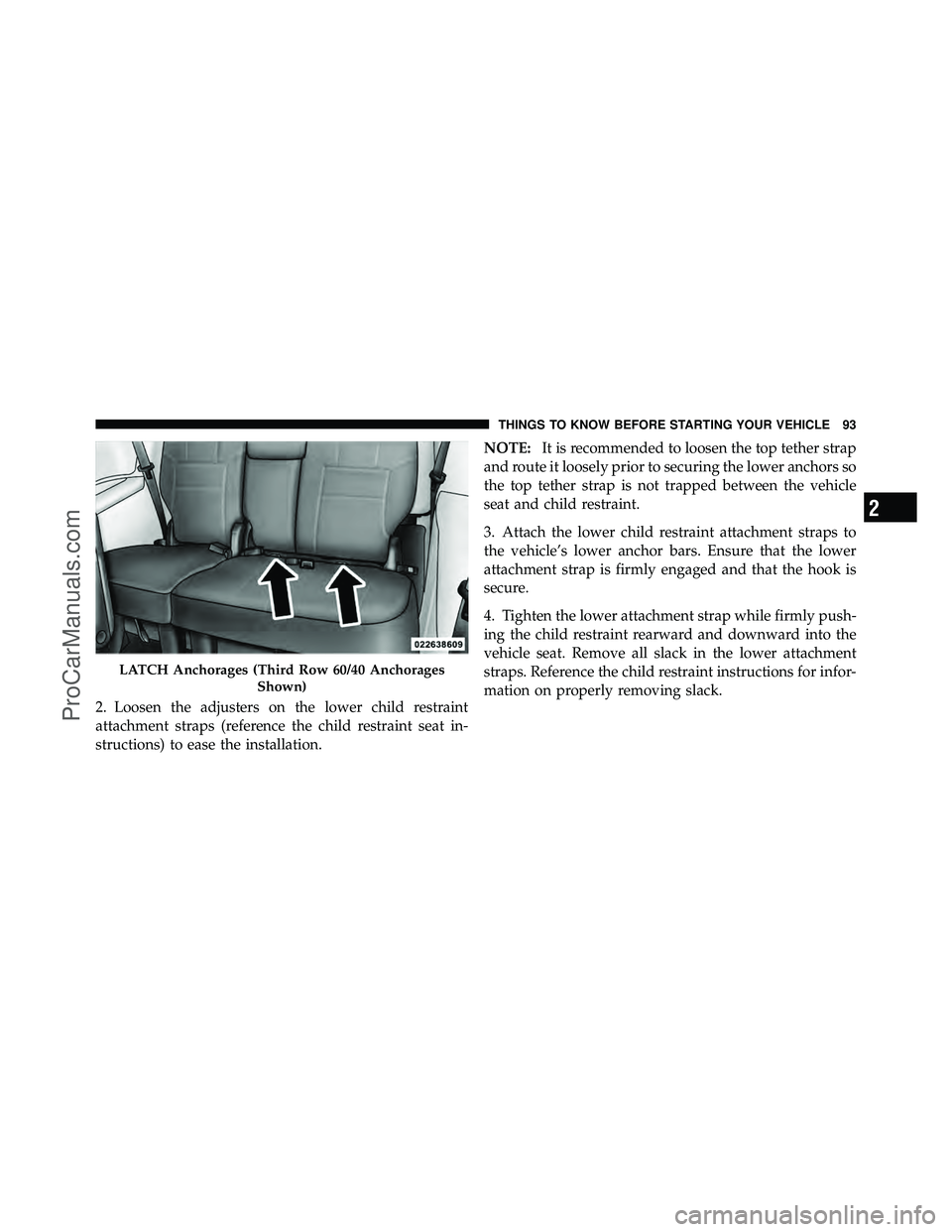
2. Loosen the adjusters on the lower child restraint
attachment straps (reference the child restraint seat in-
structions) to ease the installation.NOTE:
It is recommended to loosen the top tether strap
and route it loosely prior to securing the lower anchors so
the top tether strap is not trapped between the vehicle
seat and child restraint.
3. Attach the lower child restraint attachment straps to
the vehicle’s lower anchor bars. Ensure that the lower
attachment strap is firmly engaged and that the hook is
secure.
4. Tighten the lower attachment strap while firmly push-
ing the child restraint rearward and downward into the
vehicle seat. Remove all slack in the lower attachment
straps. Reference the child restraint instructions for infor-
mation on properly removing slack.
LATCH Anchorages (Third Row 60/40 Anchorages
Shown)
2
THINGS TO KNOW BEFORE STARTING YOUR VEHICLE 93
ProCarManuals.com
Page 96 of 562
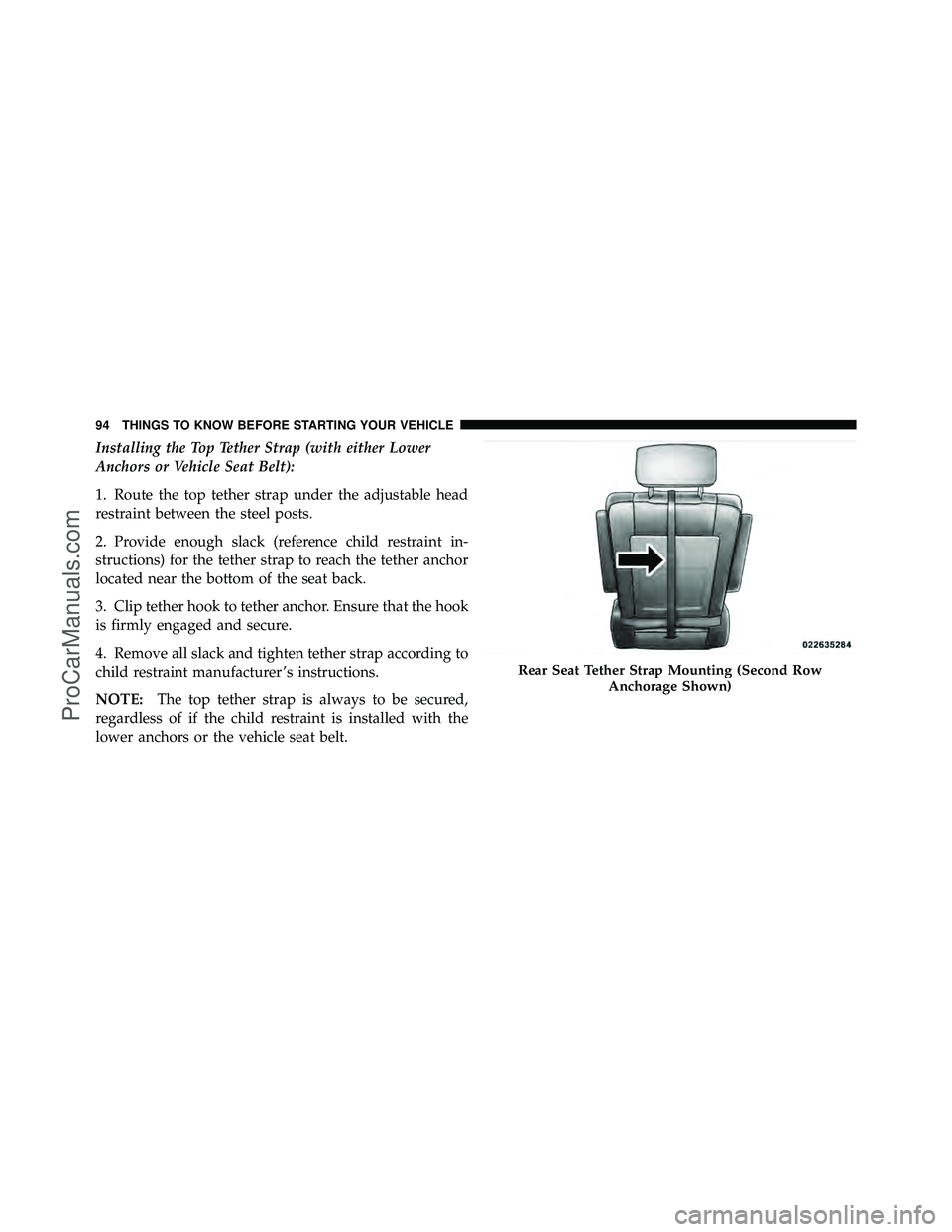
Installing the Top Tether Strap (with either Lower
Anchors or Vehicle Seat Belt):
1. Route the top tether strap under the adjustable head
restraint between the steel posts.
2. Provide enough slack (reference child restraint in-
structions) for the tether strap to reach the tether anchor
located near the bottom of the seat back.
3. Clip tether hook to tether anchor. Ensure that the hook
is firmly engaged and secure.
4. Remove all slack and tighten tether strap according to
child restraint manufacturer ’s instructions.
NOTE:The top tether strap is always to be secured,
regardless of if the child restraint is installed with the
lower anchors or the vehicle seat belt.
Rear Seat Tether Strap Mounting (Second Row
Anchorage Shown)
94 THINGS TO KNOW BEFORE STARTING YOUR VEHICLE
ProCarManuals.com
Page 97 of 562
WARNING!
An incorrectly anchored tether strap could lead to
increased head motion and possible injury to the
child. Use only the anchor positions directly behind
the child seat to secure a child restraint top tether
strap.
Installing The Child Restraint Using The Vehicle
Seat Belts
The seat belts in the passenger seating positions are
equipped with an Automatic Locking Retractor to secure
a Child Restraint System (CRS). These types of seat belts
are designed to keep the lap portion of the seat belt tight
around the child restraint so that it is not necessary to use
a locking clip. The ALR will make a ratcheting noise if
you extract the entire belt from the retractor and then
allow the belt to retract into the retractor. For additional
information on ALR, refer to “Automatic Locking Mode”
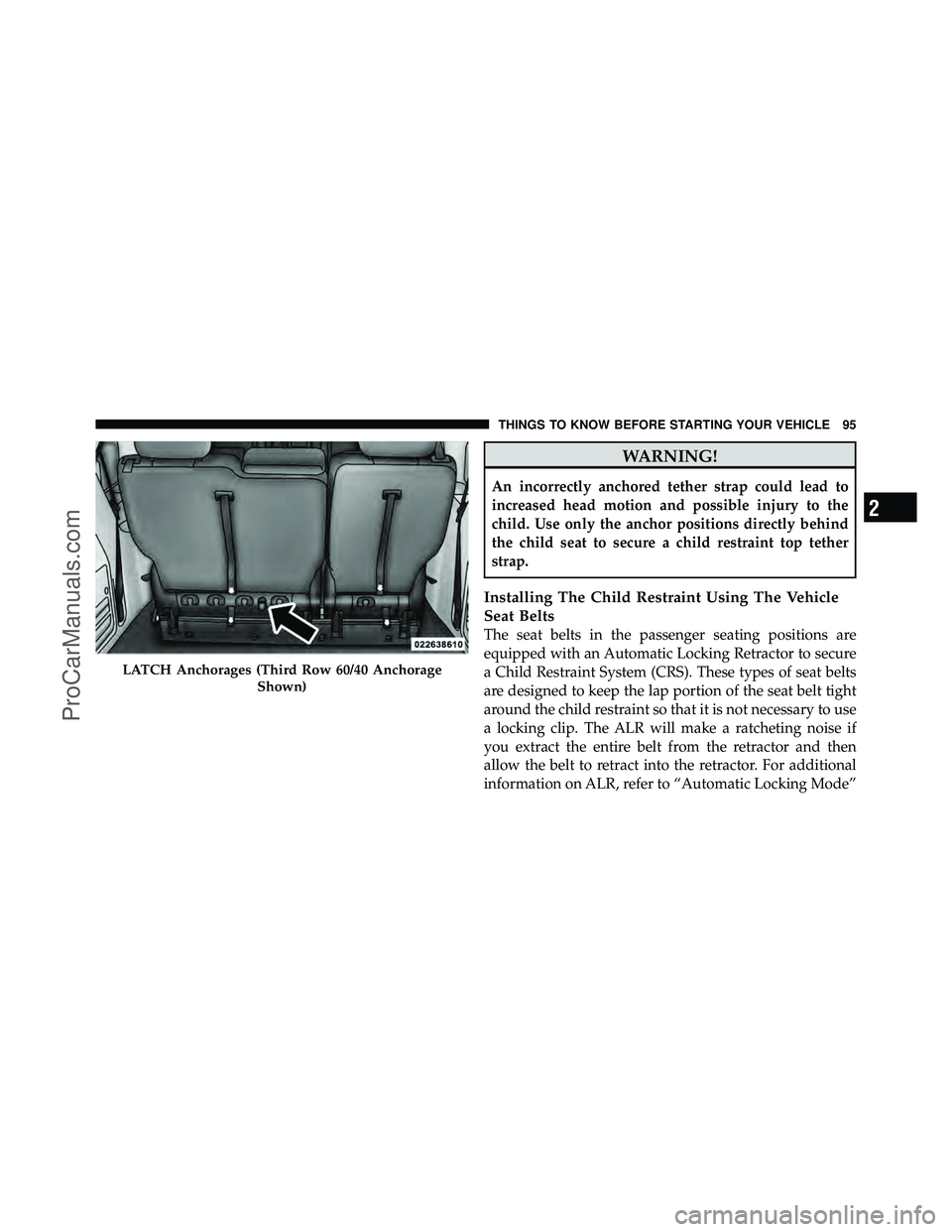
LATCH Anchorages (Third Row 60/40 AnchorageShown)
2
THINGS TO KNOW BEFORE STARTING YOUR VEHICLE 95
ProCarManuals.com
Page 98 of 562
description under “Seat Belts In Passenger Seating Posi-
tions” section. The chart below defines the seating posi-
tions with an Automatic Locking Retractor (ALR) or a
cinching latch plate.
Driver Center Passenger
CRS Lock CRS Lock CRS Lock
First Row N/A N/A ALR
Second Row ALR N/A ALR Third Row ALR Cinch ALR
•N/A — Not Applicable
•ALR — Automatic Locking Retractor
Installing a Child Restraint with an ALR:
1. To install a child restraint with ALR, first, pull enough
of the seat belt webbing from the retractor to route it
through the belt path of the child restraint. Slide the latch
plate into the buckle until you hear a “click.” Next,
extract all the seat belt webbing out of the retractor and then allow the belt to retract into the retractor. As the belt
retracts, you will hear a ratcheting sound. This indicates
the safety belt is now in the Automatic Locking mode.
2. Finally, pull on any excess webbing to tighten the lap
portion around the child restraint. Any seat belt system
will loosen with time, so check the belt occasionally, and
pull it tight if necessary.
Installing a Child Restraint with a Cinching Latch Plate:
1. To install a child restraint with a cinching latch plate,
first, pull enough of the seat belt webbing from the
retractor to route it through the belt path of the child
restraint. Slide the latch plate into the buckle until you
hear a “click.”
2. Finally, pull on any excess webbing to tighten the lap
portion around the child restraint. Any seat belt system
will loosen with time, so check the belt occasionally, and
pull it tight if necessary.
96 THINGS TO KNOW BEFORE STARTING YOUR VEHICLE
ProCarManuals.com
Page 99 of 562
Transporting Pets
Air Bags deploying in the front seat could harm your pet.
An unrestrained pet could be thrown about and possibly
injured, or injure a passenger during panic braking or in
an accident.
Pets should be restrained in the rear seat in pet harnesses
or pet carriers that are secured by seat belts.
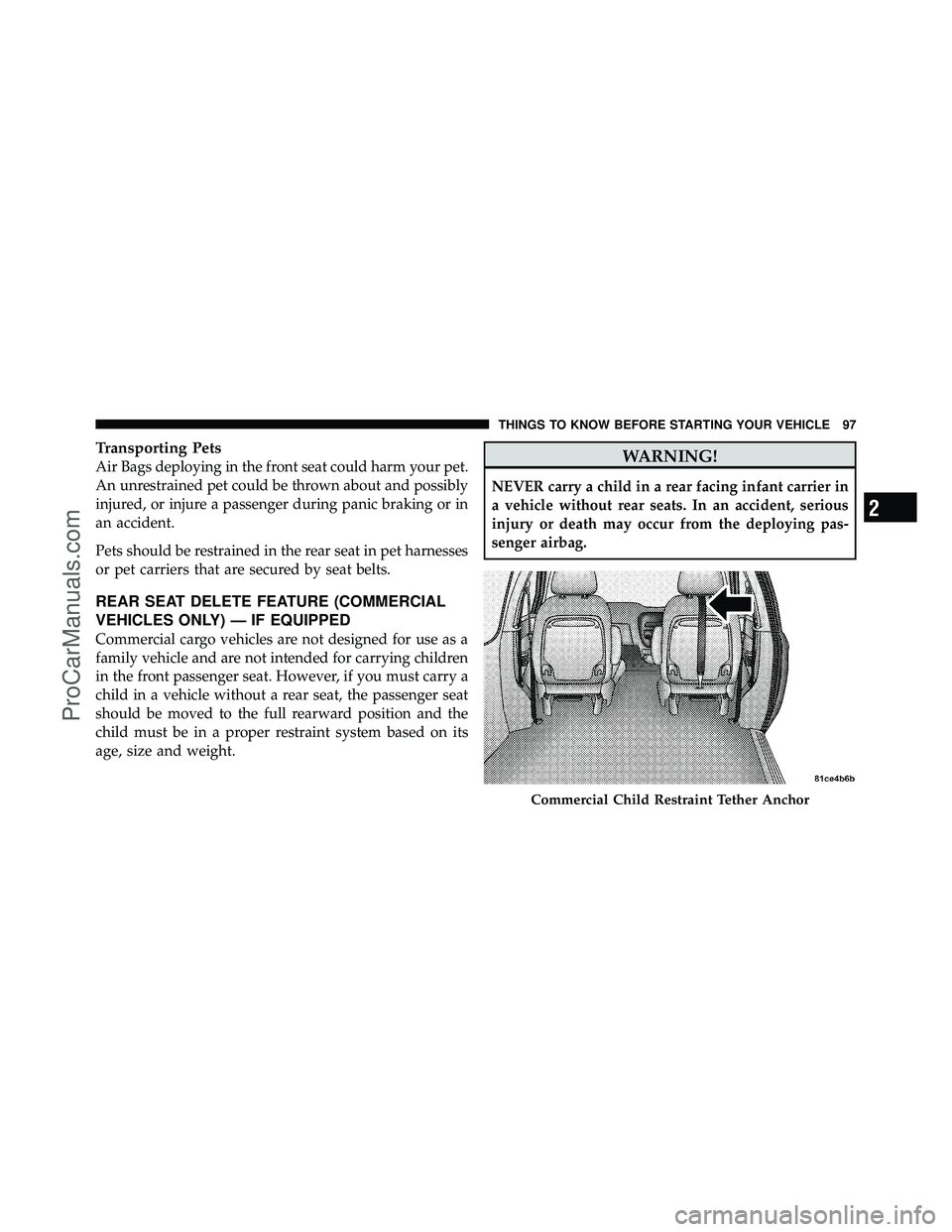
REAR SEAT DELETE FEATURE (COMMERCIAL
VEHICLES ONLY) — IF EQUIPPED
Commercial cargo vehicles are not designed for use as a
family vehicle and are not intended for carrying children
in the front passenger seat. However, if you must carry a
child in a vehicle without a rear seat, the passenger seat
should be moved to the full rearward position and the
child must be in a proper restraint system based on its
age, size and weight.
WARNING!
NEVER carry a child in a rear facing infant carrier in
a vehicle without rear seats. In an accident, serious
injury or death may occur from the deploying pas-
senger airbag.
Commercial Child Restraint Tether Anchor
2
THINGS TO KNOW BEFORE STARTING YOUR VEHICLE 97
ProCarManuals.com
Page 100 of 562
This vehicle is equipped with a child restraint tether
anchor located on the lower rear of the front passenger
seat.Use this tether anchor to secure only forward-
facing child restraints equipped with an upper tether
strap.
WARNING!
Rearward-facing infant restraints must never be se-
cured in the passenger seat of a vehicle with a
passenger airbag. In an accident, a passenger airbag
may deploy causing severe injury or death to infants
riding in rearward-facing infant restraints.
Restraining Infants and Small Children with Seat
Delete Feature (Commercial Vehicles Only)
There are different sizes and types of restraints for
children from newborn size to the child almost large
enough for an adult safety belt. Use the restraint that is
correct for your child:
•The rearward-facing infant carrier is for babies weigh-
ing up to about 20 lbs (9 kg), and less than one year
old. THIS TYPE OF SEAT CANNOT BE USED IN A
VEHICLE EQUIPPED WITH THE REAR SEAT DE-
LETE FEATURE (Commercial Vehicles Only).
•The forward-facing child seat is for children from
about 20 to 40 lbs (9 to 18 kg), and more than one year
old.
•A convertible child seat, one that is designed to be
used for children who are too heavy for a rearward-
facing infant seat, may be used IN THE FORWARD
FACING POSITION ONLY, IT MUST NEVER BE
INSTALLED FACING TO THE REAR IN A VEHICLE
EQUIPPED WITH THE REAR SEAT DELETE FEA-
TURE (Commercial Vehicles Only). When a convert-
ible seat is properly installed facing forward, the
vehicle seat should be adjusted to the rear most
position.
98 THINGS TO KNOW BEFORE STARTING YOUR VEHICLE
ProCarManuals.com
Page 101 of 562
•Children more than 40 lbs (18 kg) should be secured in
the passenger seat in a child restraint or belt-
positioning booster seat with the seat adjusted to the
rear most position. Older children who do not use
child restraints or belt-positioning booster seats
should ride properly buckled in the passenger seat
with the seat adjusted to the rearmost position. Never
allow children to slide the shoulder belt behind them
or under their arm.
Tether Installation for Commercial Vehicles with
Rear Seat Delete
To secure the child restraint upper tether strap to the
vehicle, follow the instructions shown:
1. Locate the child restraint tether anchor on the lower
rear of the front passenger seat.
2. Follow the child restraint manufacturer’s directions
for proper use of connecting the child restraint to the
extended tether strap.3. Route the tether strap under the head rest.
NOTE:
Ensure that the child restraint tether strap is
centered between the headrest supports underneath the
head rest.
4. Using the hook attached to the child restraint tether
strap, attach the child restraint tether strap to the metal
anchor on the lower rear of the front passenger seat.
5. Following the child seat manufacturer’s instructions,
tighten the child restraint tether strap.
6. Inspect the tether anchor strap for nicks, abrasions,
discoloration, and loose threads. If these, or any other
condition that might affect the performance of the strap is
observed, DO NOT USE. Contact your authorized deal-
ership for a replacement part.
2
THINGS TO KNOW BEFORE STARTING YOUR VEHICLE 99
ProCarManuals.com
Page 102 of 562
WARNING!
The vehicle tether anchor is designed to be used with
a child restraint only. It should not be used for any
other purpose. Before use, inspect the tether anchor
strap for nicks, abrasions, discoloration, and loose
threads. If these or any other condition that might
affect the performance of the strap is observed, DO
NOT USE that strap. Personal injury may result.
Contact your authorized dealership for a replacement
part.
ENGINE BREAK-IN RECOMMENDATIONS
A long break-in period is not required for the engine and
drivetrain (transmission and axle) in your vehicle.
Drive moderately during the first 300 miles (500 km).
After the initial 60 miles (100 km), speeds up to 50 or
55 mph (80 or 90 km/h) are desirable.While cruising, brief full-throttle acceleration within the
limits of local traffic laws contributes to a good break-in.
Wide-open throttle acceleration in low gear can be detri-
mental and should be avoided.
The engine oil installed in the engine at the factory is a
high-quality energy conserving type lubricant. Oil
changes should be consistent with anticipated climate
conditions under which vehicle operations will occur. For
the recommended viscosity and quality grades, refer to
“Maintenance Procedures” in “Maintaining Your Ve-
hicle”. NON-DETERGENT OR STRAIGHT MINERAL
OILS MUST NEVER BE USED.
A new engine may consume some oil during its first few
thousand miles (kilometers) of operation. This should be
considered a normal part of the break-in and not inter-
preted as an indication of difficulty.
100 THINGS TO KNOW BEFORE STARTING YOUR VEHICLE
ProCarManuals.com
Page 544 of 562
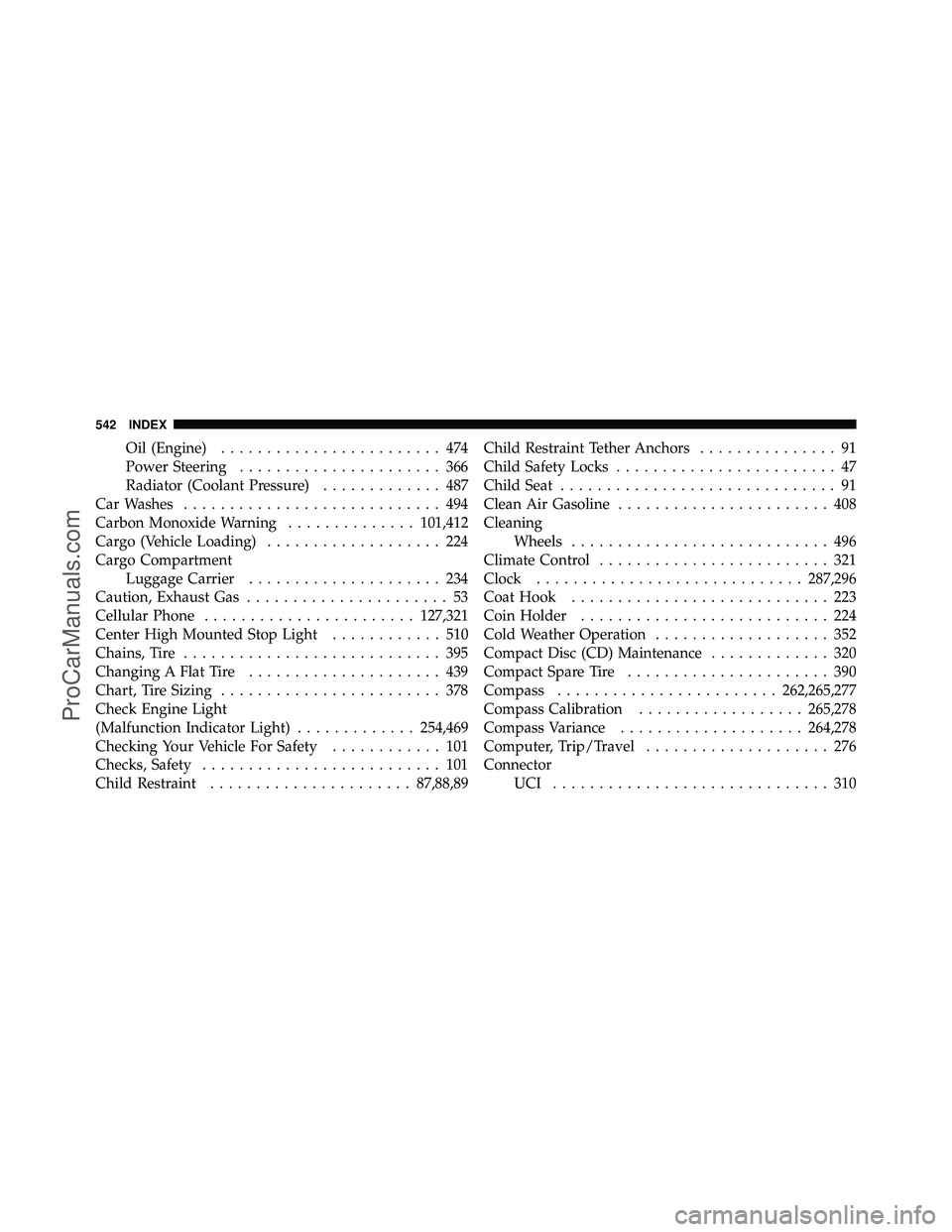
Oil (Engine)........................ 474
Power Steering ...................... 366
Radiator (Coolant Pressure) ............. 487
Car Washes ............................ 494
Carbon Monoxide Warning ..............101,412
Cargo (Vehicle Loading) ................... 224
Cargo Compartment Luggage Carrier ..................... 234
Caution, Exhaust Gas ...................... 53
Cellular Phone ....................... 127,321
Center High Mounted Stop Light ............ 510
Chains, Tire ............................ 395
Changing A Flat Tire ..................... 439
Chart, Tire Sizing ........................ 378
Check Engine Light
(Malfunction Indicator Light) .............254,469
Checking Your Vehicle For Safety ............ 101
Checks, Safety .......................... 101
Child Restraint ...................... 87,88,89Child Restraint Tether Anchors
............... 91
Child Safety Locks ........................ 47
Child Seat .............................. 91
Clean Air Gasoline ....................... 408
Cleaning Wheels ............................ 496
Climate Control ......................... 321
Clock ............................. 287,296
Coat Hook ............................ 223
Coin Holder ........................... 224
Cold Weather Operation ................... 352
Compact Disc (CD) Maintenance ............. 320
Compact Spare Tire ...................... 390
Compass ........................ 262,265,277
Compass Calibration .................. 265,278
Compass Variance .................... 264,278
Computer, Trip/Travel .................... 276
Connector UCI .............................. 310
542 INDEX
ProCarManuals.com
Page 550 of 562
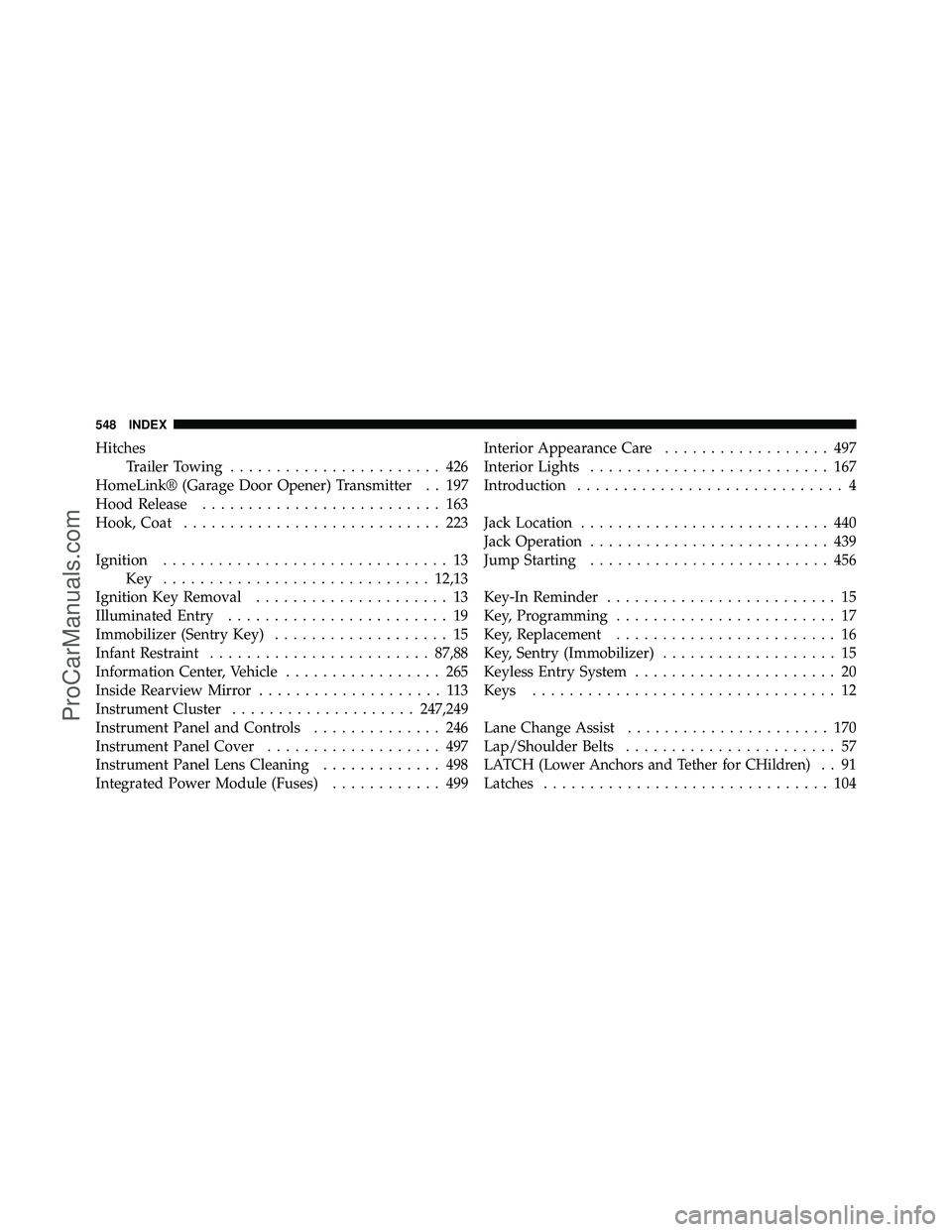
HitchesTrailer Towing ....................... 426
HomeLink® (Garage Door Opener) Transmitter . . 197
Hood Release .......................... 163
Hook, Coat ............................ 223
Ignition ............................... 13
Key ............................. 12,13
Ignition Key Removal ..................... 13
Illuminated Entry ........................ 19
Immobilizer (Sentry Key) ................... 15
Infant Restraint ........................ 87,88
Information Center, Vehicle ................. 265
Inside Rearview Mirror .................... 113
Instrument Cluster .................... 247,249
Instrument Panel and Controls .............. 246
Instrument Panel Cover ................... 497
Instrument Panel Lens Cleaning ............. 498
Integrated Power Module (Fuses) ............ 499Interior Appearance Care
.................. 497
Interior Lights .......................... 167
Introduction ............................. 4
Jack Location ........................... 440
Jack Operation .......................... 439
Jump Starting .......................... 456
Key-In Reminder ......................... 15
Key, Programming ........................ 17
Key, Replacement ........................ 16
Key, Sentry (Immobilizer) ................... 15
Keyless Entry System ...................... 20
Keys ................................. 12
Lane Change Assist ...................... 170
Lap/Shoulder Belts ....................... 57
LATCH (Lower Anchors and Tether for CHildren).. 91
Latches ............................... 104
548 INDEX
ProCarManuals.com