ECO mode DODGE CHALLENGER 2010 3.G Workshop Manual
[x] Cancel search | Manufacturer: DODGE, Model Year: 2010, Model line: CHALLENGER, Model: DODGE CHALLENGER 2010 3.GPages: 477, PDF Size: 4.79 MB
Page 318 of 477
CAUTION!
Do not use gasolines containing Methanol or E85
Ethanol. Use of these blends may result in starting
and driveability problems and may damage critical
fuel system components.
Problems that result from using methanol/gasoline or
E85 ethanol blends are not the responsibility of the
manufacturer. While MTBE is an oxygenate made from
methanol, it does not have the negative effects of
methanol.
E-85 Usage In Non-Flex Fuel Vehicles
Non-FFV vehicles are compatible with gasoline contain-
ing 10% ethanol (E10). Gasoline with higher ethanol
content may void the vehicle’s warranty.
If a Non-FFV vehicle is inadvertently fueled with E-85
fuel, the engine will have some or all of these symptoms:
•operate in a lean mode
•OBD II “Malfunction Indicator Light” on
•poor engine performance
•poor cold start and cold drivability
•increased risk for fuel system component corrosion
To fix a Non-FFV vehicle inadvertently fueled once with
E-85 perform the following:
•drain the fuel tank (see your authorized dealer)
•change the engine oil and oil filter
•disconnect and reconnect the battery to reset the
engine controller memory
More extensive repairs will be required for prolonged
exposure to E-85 fuel.
316 STARTING AND OPERATING
Page 344 of 477
5. Mode Select Knob
6. Sealant Hose (Clear with Yellow Cap)
7. Air Pump Hose (Black)
8. Power Plug
Using the Mode Select Knob and Hoses
Your TIREFIT kit may be equipped with either of the
following symbols to indicate the air or sealant mode.
Selecting Air ModeTurn the Mode Select Knob (5) to this
position for air pump operation only.
Use the Black Air Pump Hose (7)
when selecting this mode. Selecting Sealant Mode
Turn the Mode Select Knob (5) to this
position to inject the TIREFIT Sealant
and to inflate the tire. Use the Sealant
Hose (clear hose with the yellow cap)
(6) when selecting this mode.
Using the Power Button Push and release the Power Button (4) once to
turn ON the TIREFIT kit. Push and release the
Power Button (4) again to turn OFF the TIRE-
FIT kit.
Using the Deflation Button — If Equipped Press the Deflation Button (2) to reduce the air
pressure in the tire if it becomes over-inflated.
342 WHAT TO DO IN EMERGENCIES
Page 348 of 477
3. Uncoil the Sealant Hose (6) and then remove the
yellow cap from the fitting at the end of the hose.
4. Place the TIREFIT kit flat on the ground next to the
deflated tire.
5. Remove the cap from the valve stem and then screw
the fitting at the end of the Sealant Hose (6) onto the
valve stem.
6. Uncoil the Power Plug (8) and then insert the plug into
the vehicle’s 12 Volt power outlet.
NOTE:Do not remove foreign objects (e.g., screws or
nails) from the tire.
(C) Injecting TIREFIT Sealant into the deflated
tire:
•
Always start the engine before turning ON the TIRE-
FIT kit. NOTE:
Manual transmission vehicles must have the
parking brake engaged and the shifter in NEUTRAL.
•After pressing the Power Button (4), the sealant (white
fluid) will flow from the Sealant Bottle (1) through the
Sealant Hose (6) and into the tire.
NOTE: Sealant may leak out through the puncture in
the tire.
If the sealant (white fluid) does not flow within 0 –
10 seconds through the Sealant Hose (6):
1. Press the Power Button (4) to turn OFF the TIREFIT
kit. Disconnect the Sealant Hose (6) from the valve stem.
Make sure the valve stem is free of debris. Reconnect the
Sealant Hose (6) to the valve stem. Check that the Mode
Select Knob (5) is in the sealant mode position and not air
mode. Press the Power Button (4) to turn ON the TIREFIT
kit.
346 WHAT TO DO IN EMERGENCIES
Page 349 of 477
2. Connect the Power Plug (8) to a different 12 Volt
power outlet in your vehicle or another vehicle, if avail-
able. Make sure the engine is running before turning ON
the TIREFIT kit.
3. The Sealant Bottle (1) may be empty due to previous
use. Call for assistance.
NOTE:If the Mode Select Knob (5) is on air mode and
pump is operating, air will dispense from the Air Pump
Hose (7) only, not the Sealant Hose (6).
If the sealant (white fluid) does flow through the
Sealant Hose (6):
1. Continue to operate pump until sealant is no longer
flowing through hose (typically takes 30 - 70 seconds). As
the sealant flows through the Sealant Hose (6), the
Pressure Gauge (3) can read as high as 70 psi (5 Bar). The Pressure Gauge (3) will decrease quickly from approxi-
mately 70 psi (5 Bar) to the actual tire pressure when the
Sealant Bottle (1) is empty.
2. The pump will start to inject air into the tire immedi-
ately after the Sealant Bottle (1) is empty. Continue to
operate pump and inflate the tire to the pressure indi-
cated on the tire pressure label on the driver-side latch
pillar (recommended pressure). Check the tire pressure
by looking at the Pressure Gauge (3).
If the tire does not inflate to at least 26 psi (1.8 Bar)
pressure within 15 minutes:
•The tire is too badly damaged. Do not attempt to drive
the vehicle further. Call for assistance.
NOTE: If the air pump is equipped with a Deflation
Button and the tire becomes over-inflated, press the
Deflation Button to reduce the tire pressure to the
recommended inflation pressure before continuing.
6
WHAT TO DO IN EMERGENCIES 347
Page 351 of 477
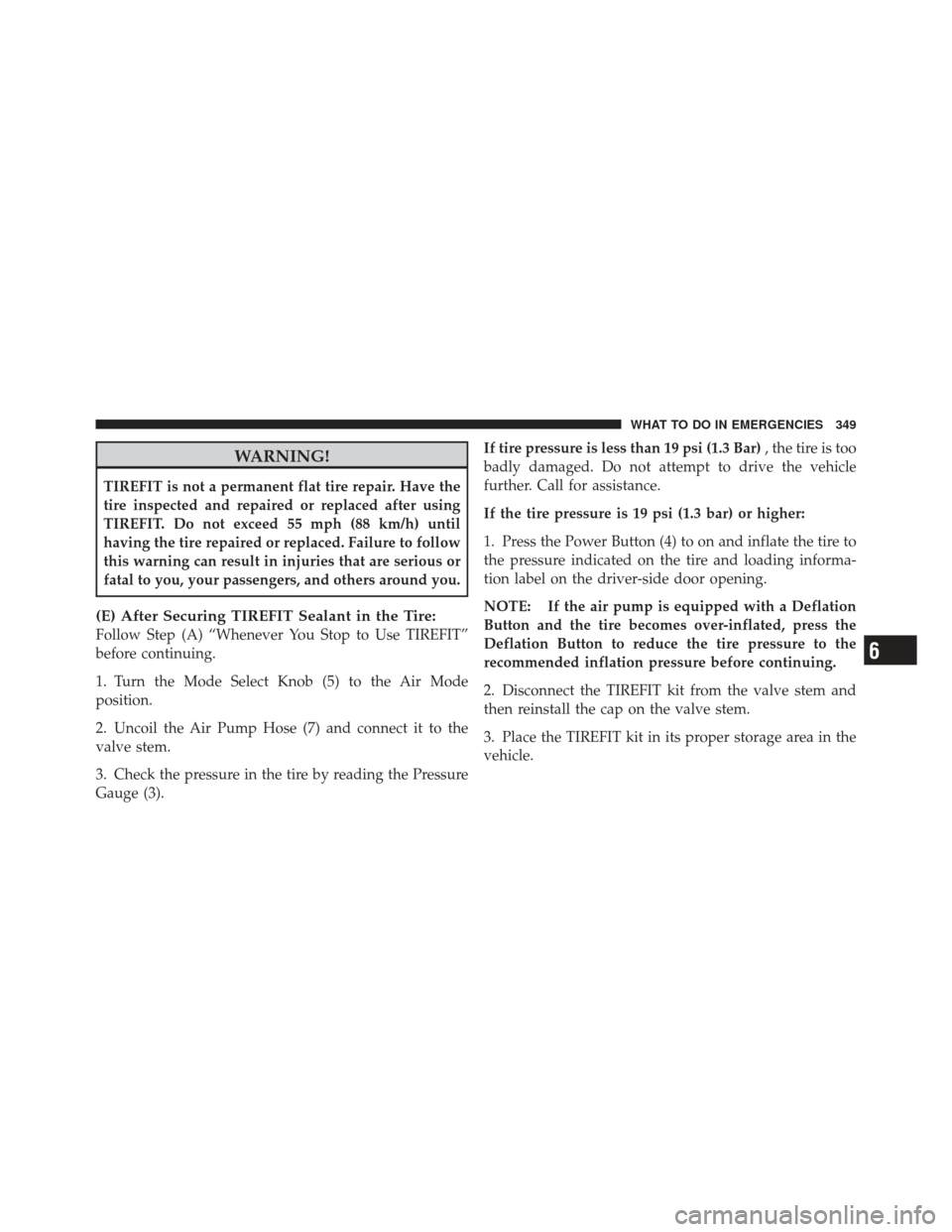
WARNING!
TIREFIT is not a permanent flat tire repair. Have the
tire inspected and repaired or replaced after using
TIREFIT. Do not exceed 55 mph (88 km/h) until
having the tire repaired or replaced. Failure to follow
this warning can result in injuries that are serious or
fatal to you, your passengers, and others around you.
(E) After Securing TIREFIT Sealant in the Tire:
Follow Step (A) “Whenever You Stop to Use TIREFIT”
before continuing.
1. Turn the Mode Select Knob (5) to the Air Mode
position.
2. Uncoil the Air Pump Hose (7) and connect it to the
valve stem.
3. Check the pressure in the tire by reading the Pressure
Gauge (3).If tire pressure is less than 19 psi (1.3 Bar)
, the tire is too
badly damaged. Do not attempt to drive the vehicle
further. Call for assistance.
If the tire pressure is 19 psi (1.3 bar) or higher:
1. Press the Power Button (4) to on and inflate the tire to
the pressure indicated on the tire and loading informa-
tion label on the driver-side door opening.
NOTE: If the air pump is equipped with a Deflation
Button and the tire becomes over-inflated, press the
Deflation Button to reduce the tire pressure to the
recommended inflation pressure before continuing.
2. Disconnect the TIREFIT kit from the valve stem and
then reinstall the cap on the valve stem.
3. Place the TIREFIT kit in its proper storage area in the
vehicle.
6
WHAT TO DO IN EMERGENCIES 349
Page 457 of 477
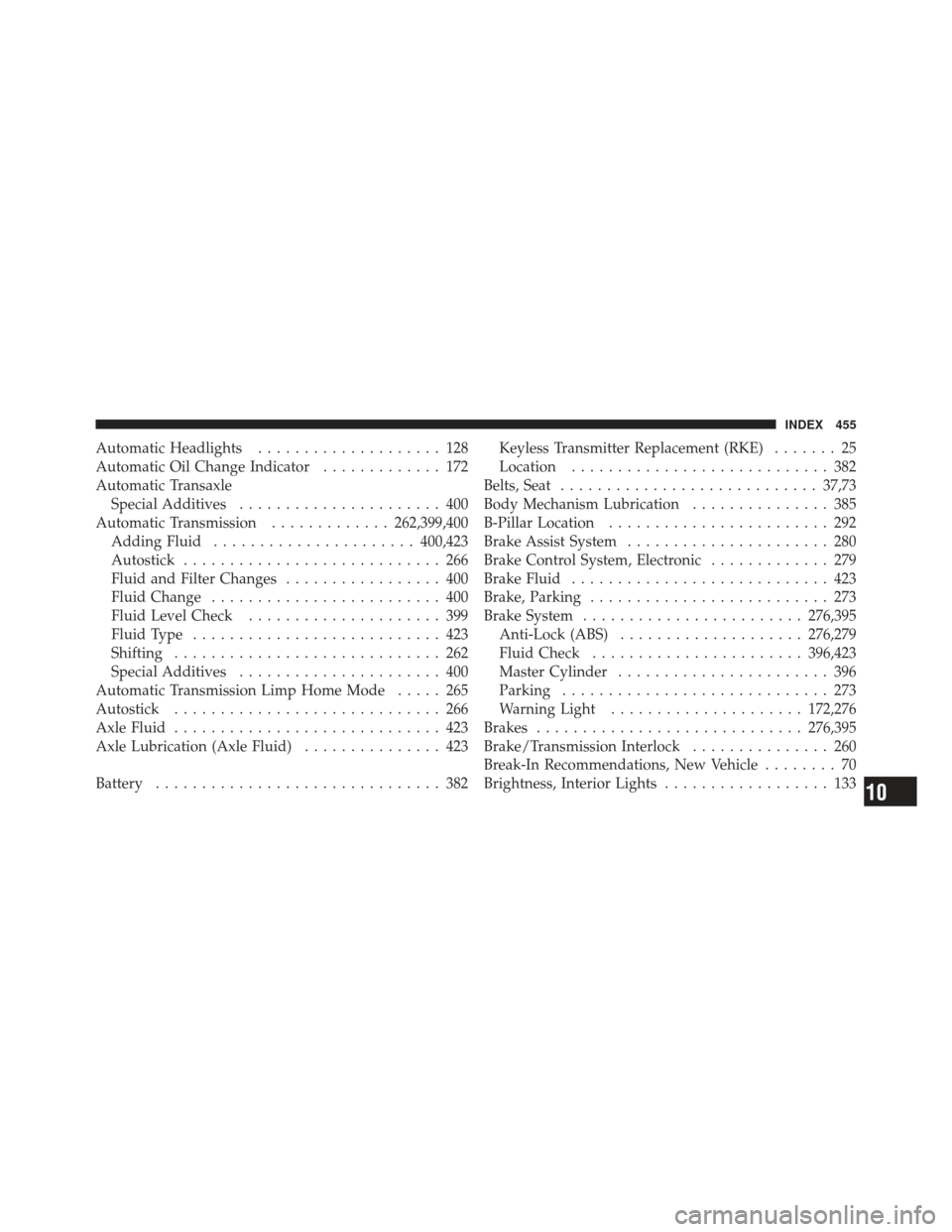
Automatic Headlights.................... 128
Automatic Oil Change Indicator ............. 172
Automatic Transaxle Special Additives ...................... 400
Automatic Transmission .............262,399,400
Adding Fluid ...................... 400,423
Autostick ............................ 266
Fluid and Filter Changes ................. 400
Fluid Change ......................... 400
Fluid Level Check ..................... 399
Fluid Type ........................... 423
Shifting ............................. 262
Special Additives ...................... 400
Automatic Transmission Limp Home Mode ..... 265
Autostick ............................. 266
Axle Fluid ............................. 423
Axle Lubrication (Axle Fluid) ............... 423
Battery ............................... 382 Keyless Transmitter Replacement (RKE)
....... 25
Location ............................ 382
Belts, Seat ............................ 37,73
Body Mechanism Lubrication ............... 385
B-Pillar Location ........................ 292
Brake Assist System ...................... 280
Brake Control System, Electronic ............. 279
Brake Fluid ............................ 423
Brake, Parking .......................... 273
Brake System ........................ 276,395
Anti-Lock (ABS) .................... 276,279
Fluid Check ....................... 396,423
Master Cylinder ....................... 396
Parking ............................. 273
Warning Light ..................... 172,276
Brakes ............................. 276,395
Brake/Transmission Interlock ............... 260
Break-In Recommendations, New Vehicle ........ 70
Brightness, Interior Lights .................. 133
10
INDEX 455