tire pressure DODGE CHALLENGER 2012 3.G Owner's Manual
[x] Cancel search | Manufacturer: DODGE, Model Year: 2012, Model line: CHALLENGER, Model: DODGE CHALLENGER 2012 3.GPages: 124, PDF Size: 4.99 MB
Page 95 of 124
FREEING A STUCK VEHICLE
• If your vehicle becomes stuck in mud, sand or snow, it can often be moved by arocking motion. Turn your steering wheel right and left to clear the area around the
front wheels. Then, move the shift lever back and forth between REVERSE and
DRIVE. Using minimal accelerator pedal pressure to maintain the rocking motion,
without spinning the wheels, is most effective.
NOTE: If your vehicle is equipped with Electronic Stability Control (ESC) or Traction
Control
, turn the system off before attempting to “rock” the vehicle.
CAUTION!
• When “rocking” a stuck vehicle by moving between REVERSE and DRIVE, do not spin the wheels faster than 15 mph (24 km/h), or drivetrain damage may
result.
• Revving the engine or spinning the wheels too fast may lead to transmission overheating and failure. It can also damage the tires. Do not spin the wheels
above 30 mph (48 km/h) while in gear (no transmission shifting occurring).
WARNING!
Fast spinning tires can be dangerous. Forces generated by excessive wheel
speeds may cause tire damage or failure. A tire could explode and injure
someone. Do not spin your vehicle's wheels faster than 30 mph (48 km/h) when
you are stuck. Do not let anyone near a spinning wheel, no matter what the
speed.
WHAT TO DO IN EMERGENCIES
93
Page 113 of 124
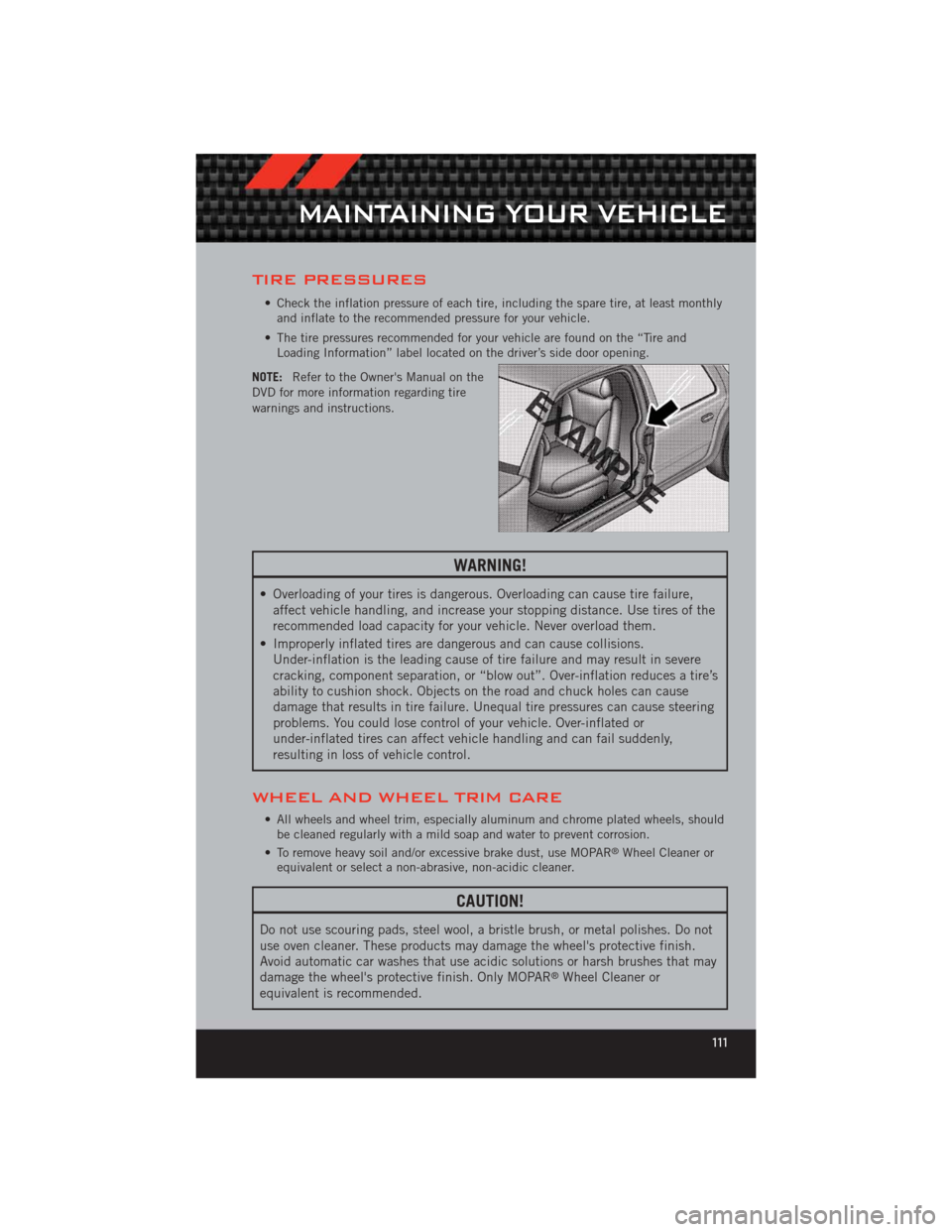
TIRE PRESSURES
• Check the inflation pressure of each tire, including the spare tire, at least monthlyand inflate to the recommended pressure for your vehicle.
• The tire pressures recommended for your vehicle are found on the “Tire and Loading Information” label located on the driver’s side door opening.
NOTE: Refer to the Owner's Manual on the
DVD for more information regarding tire
warnings and instructions.
WARNING!
• Overloading of your tires is dangerous. Overloading can cause tire failure, affect vehicle handling, and increase your stopping distance. Use tires of the
recommended load capacity for your vehicle. Never overload them.
• Improperly inflated tires are dangerous and can cause collisions. Under-inflation is the leading cause of tire failure and may result in severe
cracking, component separation, or “blow out”. Over-inflation reduces a tire’s
ability to cushion shock. Objects on the road and chuck holes can cause
damage that results in tire failure. Unequal tire pressures can cause steering
problems. You could lose control of your vehicle. Over-inflated or
under-inflated tires can affect vehicle handling and can fail suddenly,
resulting in loss of vehicle control.
WHEEL AND WHEEL TRIM CARE
• All wheels and wheel trim, especially aluminum and chrome plated wheels, shouldbe cleaned regularly with a mild soap and water to prevent corrosion.
• To remove heavy soil and/or excessive brake dust, use MOPAR
®Wheel Cleaner or
equivalent or select a non-abrasive, non-acidic cleaner.
CAUTION!
Do not use scouring pads, steel wool, a bristle brush, or metal polishes. Do not
use oven cleaner. These products may damage the wheel's protective finish.
Avoid automatic car washes that use acidic solutions or harsh brushes that may
damage the wheel's protective finish. Only MOPAR
®Wheel Cleaner or
equivalent is recommended.
MAINTAINING YOUR VEHICLE
111
Page 120 of 124
SteeringTiltColumn .............. 21
Steering Wheel Audio Controls .... 56
Store Radio Presets ........ 31,33
Stuck, Freeing ............. 93
SunRoof ................ 26
Supplemental Restraint
System - Airbag ............. 14
Temperature Control,
Automatic (ATC) ............ 26
Temperature Gauge, Engine
Coolant ................. 78
Text Messaging ............. 60
Theft Alarm (Security Alarm) ..... 13
Theft System Arming ......... 13
Theft System Disarming ........ 13
Tilt Steering Column .......... 21
TIREFIT ................. 84
Tires Air Pressure ............. 111
Changing ............. 79,81
FlatChanging ............ 79
Jacking .............. 80,81 Pressure Warning Light
....... 74
SpareTire ............... 79
Towing .................. 68 24-Hour Towing Assistance ..... 74
Disabled Vehicle ........... 92
Recreational ............. 69
Trailer Towing Trailer and Tongue Weight ..... 68
Trailer Weight .............. 68
Transmission Fluid ................. 99
TurnSignals ............... 22
Uconnect™Phone ........... 56
Uconnect™ Voice Command ..... 59
Voice Commands ............ 59
Washers, Windshield .......... 23
Wheel and Wheel Trim Care ..... 111
Wind Buffeting ............. 27
Windshield Washers .......... 23
Windshield Wipers ........... 23
INDEX
118
Page 121 of 124
FREQUENTLY ASKED QUESTIONS
GETTING STARTED
• How do I install my LATCH Equipped Child Seat? pg. 15
ELECTRONICS
• Which radio is in my vehicle? pg. 30, 32, 34, 43
• How do I activate the Audio Jack? pg. 31, 34, 37, 46
• How do I set the clock on my radio? pg. 30, 32, 35, 43
• How do I use the Navigation feature? pg. 40, 49
• How do I pair my cell phone via Bluetooth
®with the UConnect™ Hands-Free Voice
Activation System? pg. 56
• How do I use my iPod
®?pg.61
• How do I use my USB port to listen to audio through my touch-screen radio? pg. 61
• What does the ECO message mean on the EVIC display? pg. 63
• How do I configure my Universal Garage Door Opener (HomeLink)? pg. 64
UTILITY
• How do I know how much I can tow with my Dodge Challenger? pg. 68
WHAT TO DO IN EMERGENCIES
• What do I do if my TPMS warning light is blinking? pg. 74
• How do I change a flat tire? pg. 79
• How do I use my Tirefit kit? pg. 84
• How do I Jump-Start my vehicle? pg. 89
MAINTAINING YOUR VEHICLE
• Where is my Fuse Block located? pg. 108
• What type of oil do I use? pg. 99
• How often should I change my engine’s oil? pg. 102
• What should my tire pressure be set at? pg. 111
FAQ (How To?)
119