brakes DODGE CHALLENGER 2013 3.G User Guide
[x] Cancel search | Manufacturer: DODGE, Model Year: 2013, Model line: CHALLENGER, Model: DODGE CHALLENGER 2013 3.GPages: 543, PDF Size: 3.04 MB
Page 397 of 543
Towing Requirements
To promote proper break-in of your new vehicle drive-
train components the following guidelines are recom-
mended:
CAUTION!
•Do not tow a trailer at all during the first 500 miles
(805 km) the new vehicle is driven. The engine, axle
or other parts could be damaged.
• Then, during the first 500 miles (805 km) that a
trailer is towed, do not drive over 50 mph (80 km/h)
and do not make starts at full throttle. This helps
the engine and other parts of the vehicle wear in at
the heavier loads.
WARNING!
Improper towing can lead to a collision. Follow these
guidelines to make your trailer towing as safe as
possible:
• Make certain that the load is secured in the trailer
and it will not shift during travel. When trailering
cargo that is not fully secured, dynamic load shifts
can occur that may be difficult for the driver to
control. You could lose control of your vehicle and
have a collision.
• When hauling cargo or towing a trailer, do not
overload your vehicle or trailer. Overloading can
cause a loss of control, poor performance, or dam-
age to brakes, axle, engine, transmission, steering,
suspension, chassis structure, or tires.
(Continued)
5
STARTING AND OPERATING 395
Page 399 of 543
Towing Requirements – Tires
•Do not attempt to tow a trailer while using a compact
spare tire.
• Proper tire inflation pressures are essential to the safe
and satisfactory operation of your vehicle. Refer to
“Tires – General Information” in “Starting and Oper-
ating” for proper tire inflation procedures.
• Check the trailer tires for proper tire inflation pres-
sures before trailer usage.
• Check for signs of tire wear or visible tire damage
before towing a trailer. Refer to “Tires – General
Information” in “Starting and Operating” for the
proper inspection procedure. •
When replacing tires, refer to “Tires – General Infor-
mation” in “Starting and Operating” for the proper tire
replacement procedures. Replacing tires with a higher
load carrying capacity will not increase the vehicle’s
GVWR and GAWR limits.
Towing Requirements – Trailer Brakes
• Do not interconnect the hydraulic brake system or
vacuum system of your vehicle with that of the trailer.
This could cause inadequate braking and possible
personal injury.
• An electronically actuated trailer brake controller is
required when towing a trailer with electronically
actuated brakes. When towing a trailer equipped with
a hydraulic surge actuated brake system, an electronic
brake controller is not required.
5
STARTING AND OPERATING 397
Page 400 of 543
•Trailer brakes are recommended for trailers over
1,000 lbs (454 kg) and required for trailers in excess of
2,000 lbs (907 kg).
CAUTION!
If the trailer weighs more than 1,000 lbs (454 kg)
loaded, it should have its own brakes and they
should be of adequate capacity. Failure to do this
could lead to accelerated brake lining wear, higher
brake pedal effort, and longer stopping distances.
WARNING!
• Do not connect trailer brakes to your vehicle’s
hydraulic brake lines. It can overload your brake
system and cause it to fail. You might not have
brakes when you need them and could have a
collision.
• Towing any trailer will increase your stopping
distance. When towing you should allow for addi-
tional space between your vehicle and the vehicle
in front of you. Failure to do so could result in a
collision.
398 STARTING AND OPERATING
Page 402 of 543
Towing Tips
Before setting out on a trip, practice turning, stopping,
and backing up the trailer in an area located away from
heavy traffic.
Automatic Transmission
The DRIVErange can be selected when towing. The
transmission controls include a adaptive drive strategy to
avoid frequent shifting when towing. However, if frequent
shifting does occur while in DRIVE, you can use the
AutoStick® shift control to manually select a lower gear.
NOTE: Using a lower gear while operating the vehicle
under heavy loading conditions will improve perfor-
mance and extend transmission life by reducing exces-
sive shifting and heat build up. This action will also
provide better engine braking.
If you
REGULARLY tow a trailer for more than 45 minutes
of continuous operation, then change the transmission
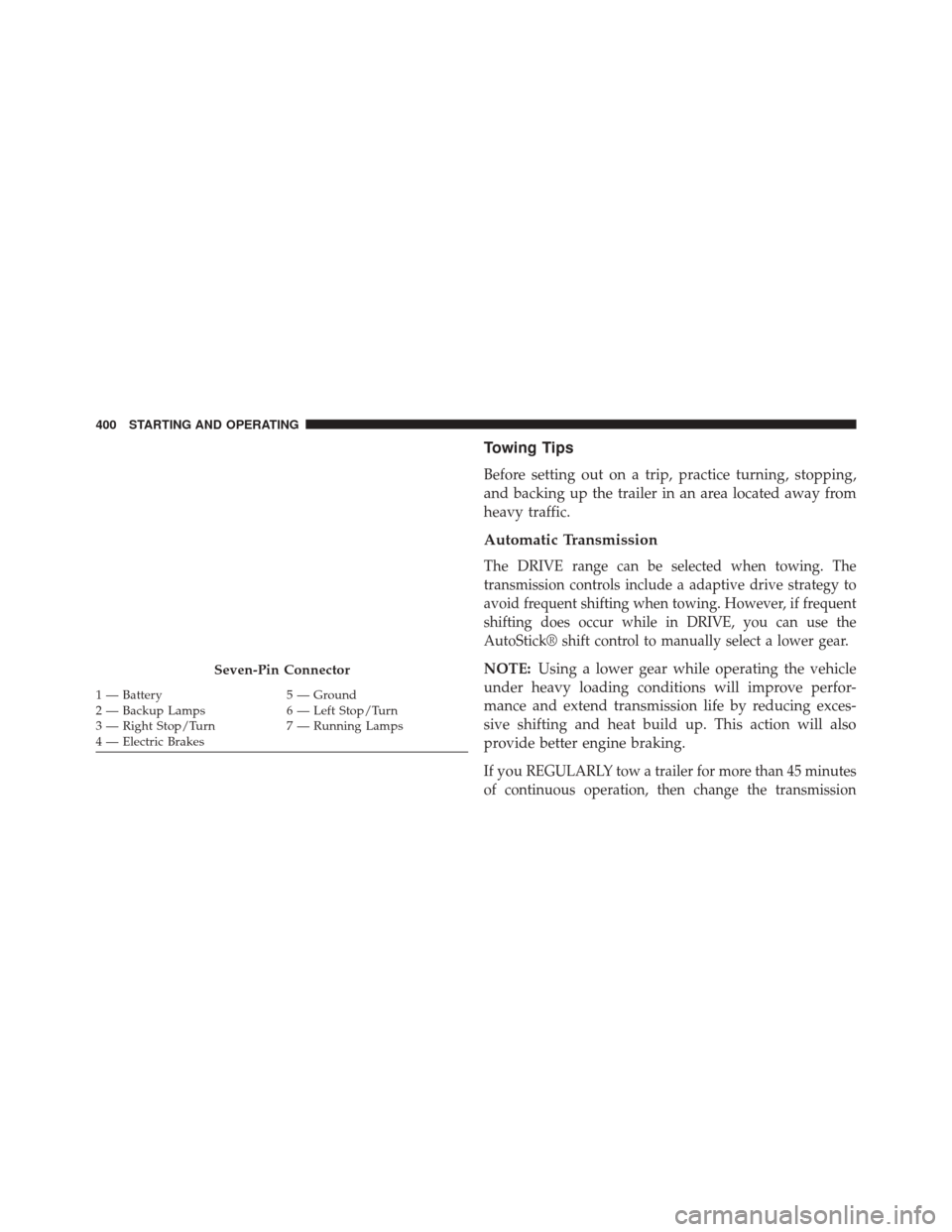
Seven-Pin Connector
1 — Battery 5 — Ground
2 — Backup Lamps 6 — Left Stop/Turn
3 — Right Stop/Turn 7 — Running Lamps
4 — Electric Brakes 400 STARTING AND OPERATING
Page 471 of 543
•Make sure that the coolant expansion bottle overflow
hoses are not kinked or obstructed.
• Keep the front of the radiator clean. If your vehicle is
equipped with air conditioning, keep the front of the
condenser clean.
• Do not change the thermostat for Summer or Winter
operation. If replacement is ever necessary, install
ONLY the correct type thermostat. Other designs may
result in unsatisfactory engine coolant (antifreeze)
performance, poor gas mileage, and increased emis-
sions.
Brake System
In order to assure brake system performance, all brake
system components should be inspected periodically.
Refer to the “Maintenance Schedule” for the proper
maintenance intervals.
WARNING!
Riding the brakes can lead to brake failure and
possibly a collision. Driving with your foot resting or
riding on the brake pedal can result in abnormally
high brake temperatures, excessive lining wear, and
possible brake damage. You would not have your full
braking capacity in an emergency.
Master Cylinder – Brake Fluid Level Check
Check the fluid level in the master cylinder immediately
if the brake system warning light indicates system fail-
ure.
Check the fluid level in the master cylinder when per-
forming underhood services.
Clean the top of the master cylinder area before removing
the cap. Add fluid to bring the level up to the “MAX”
mark on the side of the master cylinder reservoir.
7
MAINTAINING YOUR VEHICLE 469
Page 472 of 543
Overfilling of fluid is not recommended because it may
cause leaking in the system.
Add enough fluid to bring the level up to the require-
ments described on the brake fluid reservoir. With disc
brakes, fluid level can be expected to fall as the brake
pads wear. However, low fluid level may be caused by a
leak and a checkup may be needed.
Use only manufacturer’s recommended brake fluid. Re-
fer to “Fluids, Lubricants, and Genuine Parts” in “Main-
taining Your Vehicle” for further information.WARNING!
•Use only manufacturer’s recommended brake
fluid. Refer to “Fluids, Lubricants, and Genuine
Parts” in “Maintaining Your Vehicle” for further
information. Using the wrong type of brake fluid
can severely damage your brake system and/or
impair its performance. The proper type of brake
fluid for your vehicle is also identified on the
original factory installed hydraulic master cylinder
reservoir.
(Continued)
470 MAINTAINING YOUR VEHICLE
Page 522 of 543
About Your Brakes....................... .326
ABS (Anti-Lock Brake System) ................330
Adding Engine Coolant (Antifreeze) ............465
Adding Fuel ............................ .383
Adding Washer Fluid ..................... .459
Additives, Fuel .......................... .382
Airbag ..................................59
Airbag Deployment ........................69
Airbag Light .............................66
Airbag Maintenance ........................71
Airbag, Side ..............................62
Airbag, Window (Side Curtain) ................63
Air Cleaner, Engine (Engine Air Cleaner Filter) . . . .453
Air Conditioner Maintenance .................455
Air Conditioning Filter .....................287
Air Conditioning, Operating Tips ..............288
Air Conditioning Refrigerant .................455
Air Conditioning System ....................280
Air Pressure, Tires ........................ .356Alarm Light
............................ .220
Alarm, Panic .............................27
Alarm (Security Alarm) ......................19
Alarm System (Security Alarm) ................19
Alterations/Modifications, Vehicle ...............7
Antenna, Satellite Radio .....................265
Antifreeze (Engine Coolant) ..................464
Disposal ............................. .467
Anti-Lock Brake System (ABS) ................330
Anti-Lock Warning Light ....................222
Anti-Theft Security Alarm (Theft Alarm) ..........19
Appearance Care ........................ .475
Arming Theft System (Security Alarm) ...........19
Assistance Towing ........................ .127
Auto Down Power Windows ..................42
Automatic Dimming Mirror ..................108
Automatic Door Locks ......................35
Automatic Headlights ..................... .163
Automatic Temperature Control (ATC) ..........280
520 INDEX
Page 523 of 543
Automatic Transmission....................310
Adding Fluid ......................... .474
Autostick ............................ .318
Fluid and Filter Changes ..................474
Fluid Change ......................... .474
Fluid Level Check ...................... .473
Fluid Type ........................... .472
Special Additives ...................... .473
Autostick .............................. .318
Auto Unlock, Doors ........................35
Axle Fluid ............................. .498
Axle Lubrication (Axle Fluid) .................498
Battery ................................ .453
Keyless Transmitter Replacement (RKE) ........28
Location ............................. .453
Belts, Seat ...............................49
Body Mechanism Lubrication .................458
B-Pillar Location ......................... .349Brake Assist System
...................... .334
Brake Control System, Electronic ..............332
Brake Fluid ............................ .498
Brake, Parking .......................... .326
Brakes ................................ .329
Brake System ........................... .329
Anti-Lock (ABS) ....................... .330
Fluid Check .......................... .469
Master Cylinder ....................... .469
Parking ............................. .326
Warning Light ........................ .219
Brake/Transmission Interlock .................310
Break-In Recommendations, New Vehicle .........96
Brightness, Interior Lights ...................168
Bulb Replacement ........................ .489
Bulbs, Light ............................ .101
Calibration, Compass ..................... .234
Capacities, Fluid ......................... .495
10
INDEX 521
Page 532 of 543
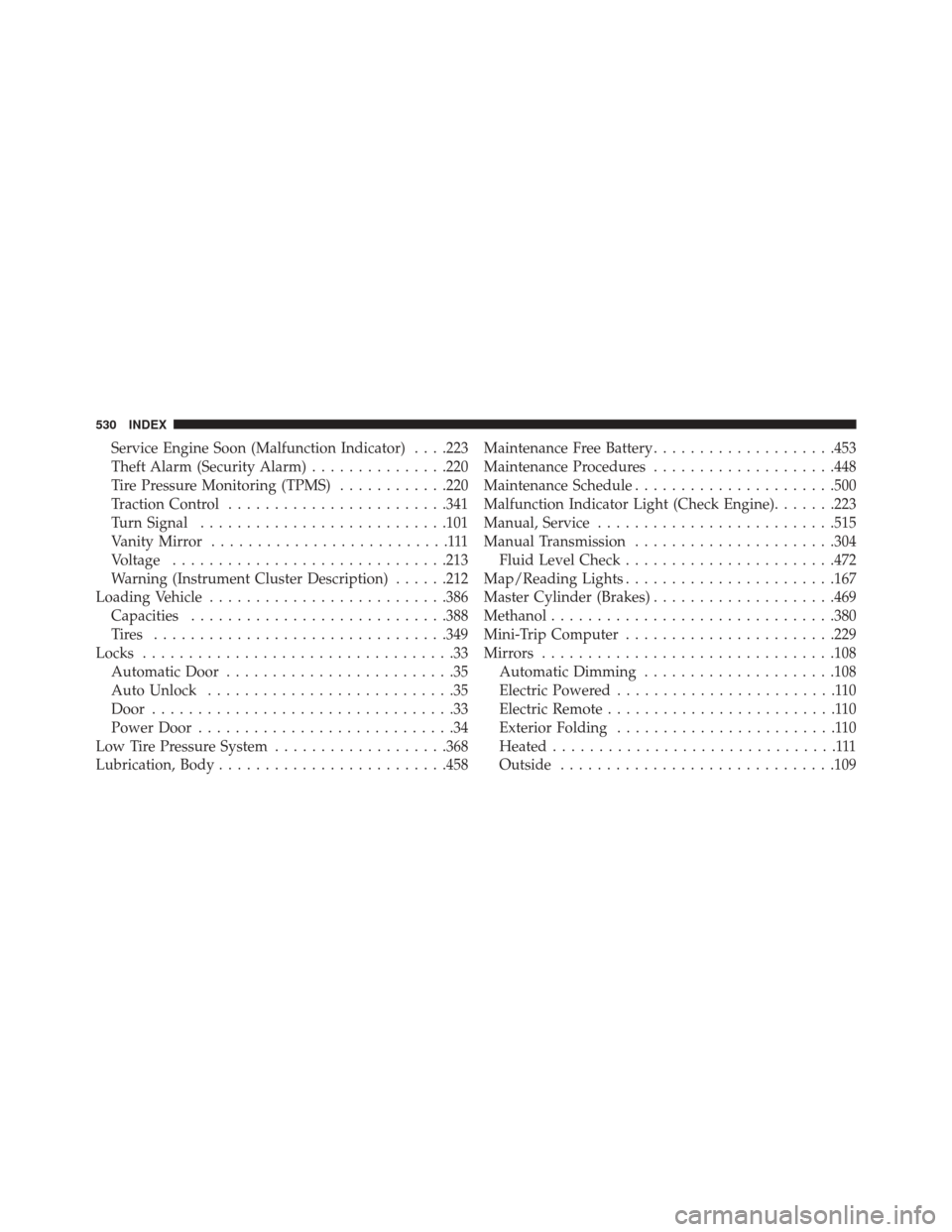
Service Engine Soon (Malfunction Indicator) . . . .223
Theft Alarm (Security Alarm)...............220
Tire Pressure Monitoring (TPMS) ............220
Traction Control ....................... .341
Turn Signal .......................... .101
Vanity Mirror ..........................111
Voltage ............................. .213
Warning (Instrument Cluster Description) ......212
Loading Vehicle ......................... .386
Capacities ........................... .388
Tires ............................... .349
Locks ..................................33
Automatic Door .........................35
Auto Unlock ...........................35
Door .................................33
Power Door ............................34
Low Tire Pressure System ...................368
Lubrication, Body ........................ .458Maintenance Free Battery
....................453
Maintenance Procedures ....................448
Maintenance Schedule ..................... .500
Malfunction Indicator Light (Check Engine) .......223
Manual, Service ......................... .515
Manual Transmission ..................... .304
Fluid Level Check ...................... .472
Map/Reading Lights ...................... .167
Master Cylinder (Brakes) ....................469
Methanol .............................. .380
Mini-Trip Computer ...................... .229
Mirrors ............................... .108
Automatic Dimming .....................108
Electric Powered ........................110
Electric Remote .........................110
Exterior Folding ........................110
Heated ...............................111
Outside ............................. .109
530 INDEX
Page 534 of 543
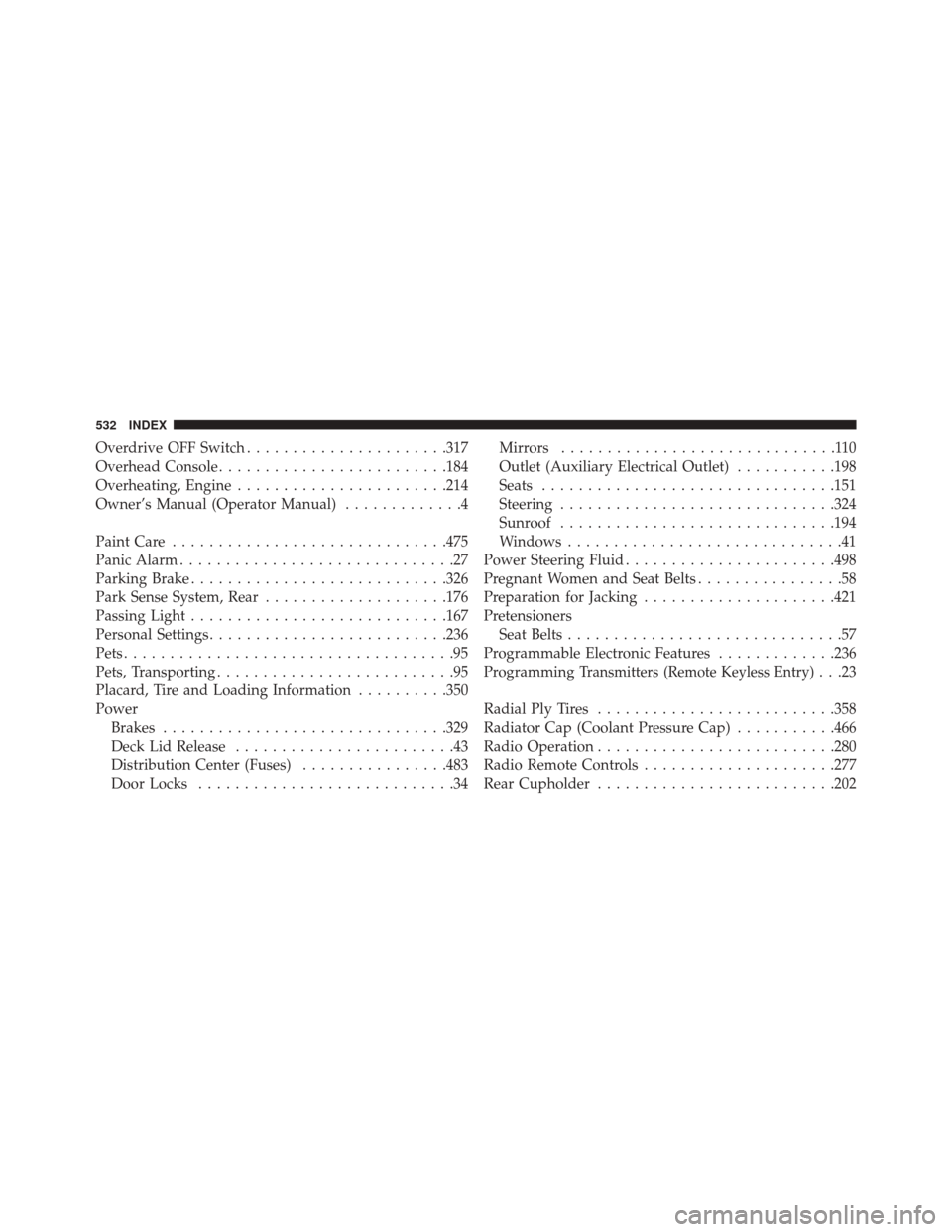
Overdrive OFF Switch..................... .317
Overhead Console ........................ .184
Overheating, Engine ...................... .214
Owner’s Manual (Operator Manual) .............4
Paint Care ............................. .475
Panic Alarm ..............................27
Parking Brake ........................... .326
Park Sense System, Rear ....................176
Passing Light ........................... .167
Personal Settings ......................... .236
Pets ....................................95
Pets, Transporting ..........................95
Placard, Tire and Loading Information ..........350
Power Brakes .............................. .329
Deck Lid Release ........................43
Distribution Center (Fuses) ................483
Door Locks ............................34 Mirrors
..............................110
Outlet (Auxiliary Electrical Outlet) ...........198
Seats ............................... .151
Steering ............................. .324
Sunroof ............................. .194
Windows ..............................41
Power Steering Fluid ...................... .498
Pregnant Women and Seat Belts ................58
Preparation for Jacking .....................421
Pretensioners Seat Belts ..............................57
Programmable Electronic Features .............236
Programming
Transmitters (Remote Keyless Entry). . .23
Radial Ply Tires ......................... .358
Radiator Cap (Coolant Pressure Cap) ...........466
Radio Operation ......................... .280
Radio Remote Controls .....................277
Rear Cupholder ......................... .202
532 INDEX