engine oil DODGE CHALLENGER 2013 3.G Owner's Manual
[x] Cancel search | Manufacturer: DODGE, Model Year: 2013, Model line: CHALLENGER, Model: DODGE CHALLENGER 2013 3.GPages: 543, PDF Size: 3.04 MB
Page 462 of 543
WARNING!
Commercially available windshield washer solvents
are flammable. They could ignite and burn you. Care
must be exercised when filling or working around
the washer solution.
Exhaust System
The best protection against carbon monoxide entry into
the vehicle body is a properly maintained engine exhaust
system.
If you notice a change in the sound of the exhaust system;
or if the exhaust fumes can be detected inside the vehicle;
or when the underside or rear of the vehicle is damaged;have an authorized technician inspect the complete ex-
haust system and adjacent body areas for broken, dam-
aged, deteriorated, or mispositioned parts. Open seams
or loose connections could permit exhaust fumes to seep
into the passenger compartment. In addition, have the
exhaust system inspected each time the vehicle is raised
for lubrication or oil change. Replace as required.WARNING!
•
Exhaust gases can injure or kill. They contain
carbon monoxide (CO), which is colorless and
odorless. Breathing it can make you unconscious
and can eventually poison you. To avoid breathing
CO, refer to “Safety Tips/Exhaust Gas” in “Things
To Know Before Starting Your Vehicle” for further
information.
(Continued)
460 MAINTAINING YOUR VEHICLE
Page 473 of 543
WARNING!(Continued)
•To avoid contamination from foreign matter or
moisture, use only new brake fluid or fluid that has
been in a tightly closed container. Keep the master
cylinder reservoir cap secured at all times. Brake
fluid in a open container absorbs moisture from the
air resulting in a lower boiling point. This may
cause it to boil unexpectedly during hard or pro-
longed braking, resulting in sudden brake failure.
This could result in a collision.
• Overfilling the brake fluid reservoir can result in
spilling brake fluid on hot engine parts, causing
the brake fluid to catch fire. Brake fluid can also
damage painted and vinyl surfaces, care should be
taken to avoid its contact with these surfaces.
(Continued)
WARNING! (Continued)
•Do not allow petroleum based fluid to contaminate
the brake fluid. Brake seal components could be
damaged, causing partial or complete brake failure.
This could result in a collision.
Clutch Hydraulic System – Manual Transmission
(If Equipped)
The clutch hydraulic system is fed by a segregated
volume of fluid within the brake system master cylinder
reservoir. In the event of leakage or wear, use only the
manufacturer’s recommended brake fluid. Refer to “Flu-
ids, Lubricants, and Genuine Parts” in “Maintaining Your
Vehicle” for further information.
7
MAINTAINING YOUR VEHICLE 471
Page 497 of 543
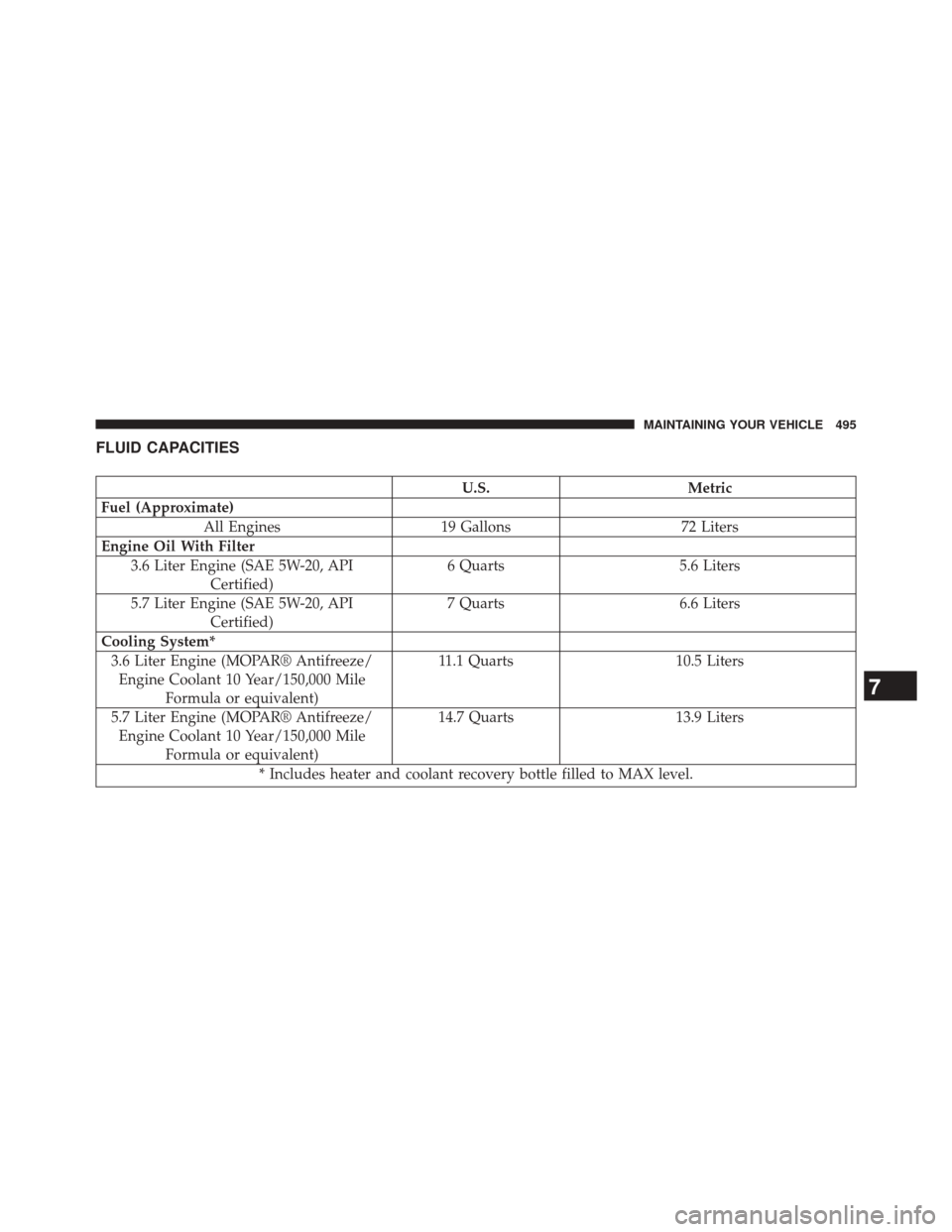
FLUID CAPACITIES
U.S.Metric
Fuel (Approximate) All Engines 19 Gallons 72 Liters
Engine Oil With Filter 3.6 Liter Engine (SAE 5W-20, API Certified) 6 Quarts
5.6 Liters
5.7 Liter Engine (SAE 5W-20, API Certified) 7 Quarts
6.6 Liters
Cooling System* 3.6 Liter Engine (MOPAR® Antifreeze/Engine Coolant 10 Year/150,000 Mile Formula or equivalent) 11.1 Quarts
10.5 Liters
5.7 Liter Engine (MOPAR® Antifreeze/ Engine Coolant 10 Year/150,000 Mile Formula or equivalent) 14.7 Quarts
13.9 Liters
* Includes heater and coolant recovery bottle filled to MAX level.
7
MAINTAINING YOUR VEHICLE 495
Page 498 of 543
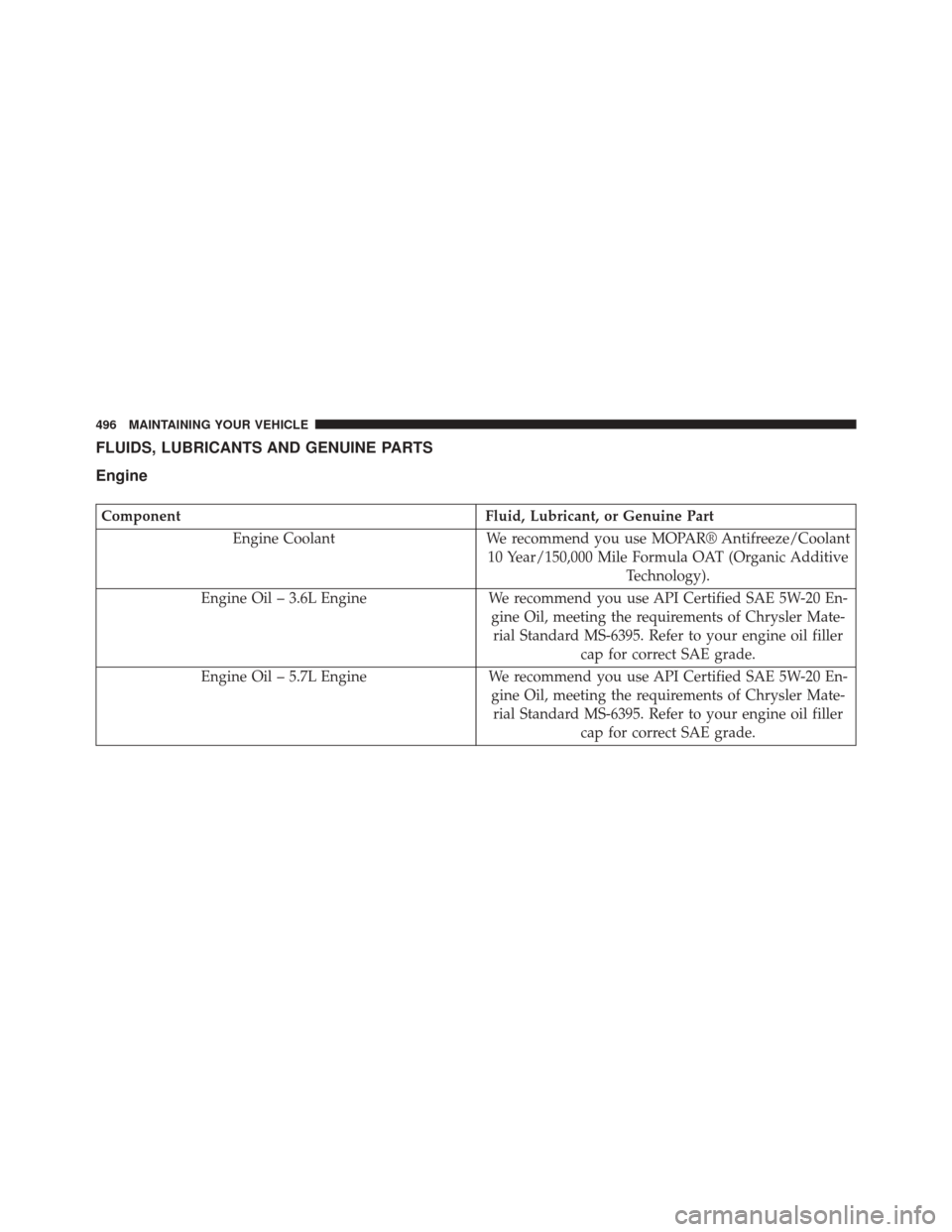
FLUIDS, LUBRICANTS AND GENUINE PARTS
Engine
ComponentFluid, Lubricant, or Genuine Part
Engine Coolant We recommend you use MOPAR® Antifreeze/Coolant
10 Year/150,000 Mile Formula OAT (Organic Additive Technology).
Engine Oil – 3.6L Engine We recommend you use API Certified SAE 5W-20 En-
gine Oil, meeting the requirements of Chrysler Mate-rial Standard MS-6395. Refer to your engine oil filler cap for correct SAE grade.
Engine Oil – 5.7L Engine We recommend you use API Certified SAE 5W-20 En-
gine Oil, meeting the requirements of Chrysler Mate-rial Standard MS-6395. Refer to your engine oil filler cap for correct SAE grade.
496 MAINTAINING YOUR VEHICLE
Page 499 of 543
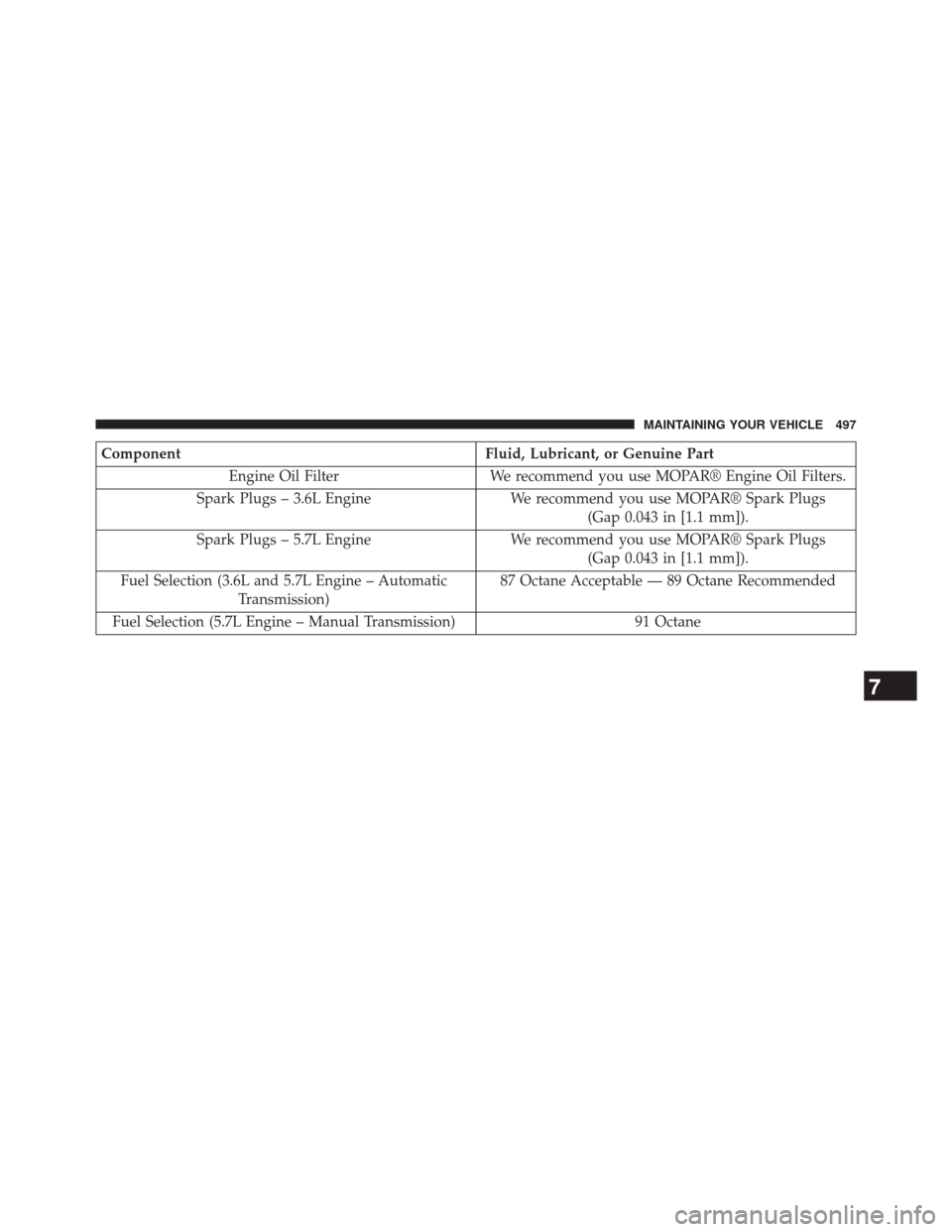
ComponentFluid, Lubricant, or Genuine Part
Engine Oil Filter We recommend you use MOPAR® Engine Oil Filters.
Spark Plugs – 3.6L Engine We recommend you use MOPAR® Spark Plugs
(Gap 0.043 in [1.1 mm]).
Spark Plugs – 5.7L Engine We recommend you use MOPAR® Spark Plugs
(Gap 0.043 in [1.1 mm]).
Fuel Selection (3.6L and 5.7L Engine – Automatic Transmission) 87 Octane Acceptable — 89 Octane Recommended
Fuel Selection (5.7L Engine – Manual Transmission) 91 Octane
7
MAINTAINING YOUR VEHICLE 497
Page 502 of 543
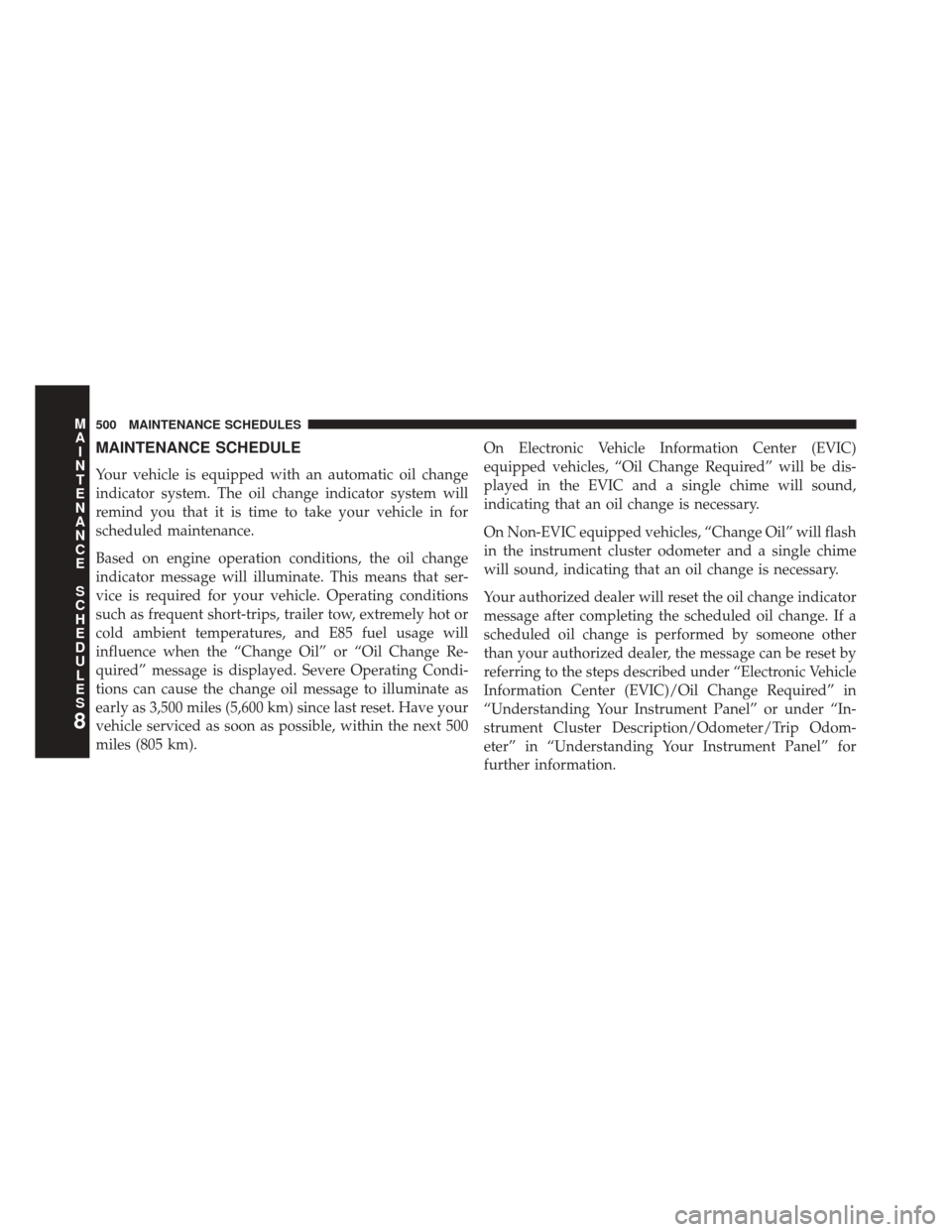
MAINTENANCE SCHEDULE
Your vehicle is equipped with an automatic oil change
indicator system. The oil change indicator system will
remind you that it is time to take your vehicle in for
scheduled maintenance.
Based on engine operation conditions, the oil change
indicator message will illuminate. This means that ser-
vice is required for your vehicle. Operating conditions
such as frequent short-trips, trailer tow, extremely hot or
cold ambient temperatures, and E85 fuel usage will
influence when the “Change Oil” or “Oil Change Re-
quired” message is displayed. Severe Operating Condi-
tions can cause the change oil message to illuminate as
early as 3,500 miles (5,600 km) since last reset. Have your
vehicle serviced as soon as possible, within the next 500
miles (805 km).On Electronic Vehicle Information Center (EVIC)
equipped vehicles, “Oil Change Required” will be dis-
played in the EVIC and a single chime will sound,
indicating that an oil change is necessary.
On Non-EVIC equipped vehicles, “Change Oil” will flash
in the instrument cluster odometer and a single chime
will sound, indicating that an oil change is necessary.
Your authorized dealer will reset the oil change indicator
message after completing the scheduled oil change. If a
scheduled oil change is performed by someone other
than your authorized dealer, the message can be reset by
referring to the steps described under “Electronic Vehicle
Information Center (EVIC)/Oil Change Required” in
“Understanding Your Instrument Panel” or under “In-
strument Cluster Description/Odometer/Trip Odom-
eter” in “Understanding Your Instrument Panel” for
further information.
8
M
A I
N T
E
N
A
N
C E
S
C
H E
D
U L
E
S500 MAINTENANCE SCHEDULES
Page 503 of 543
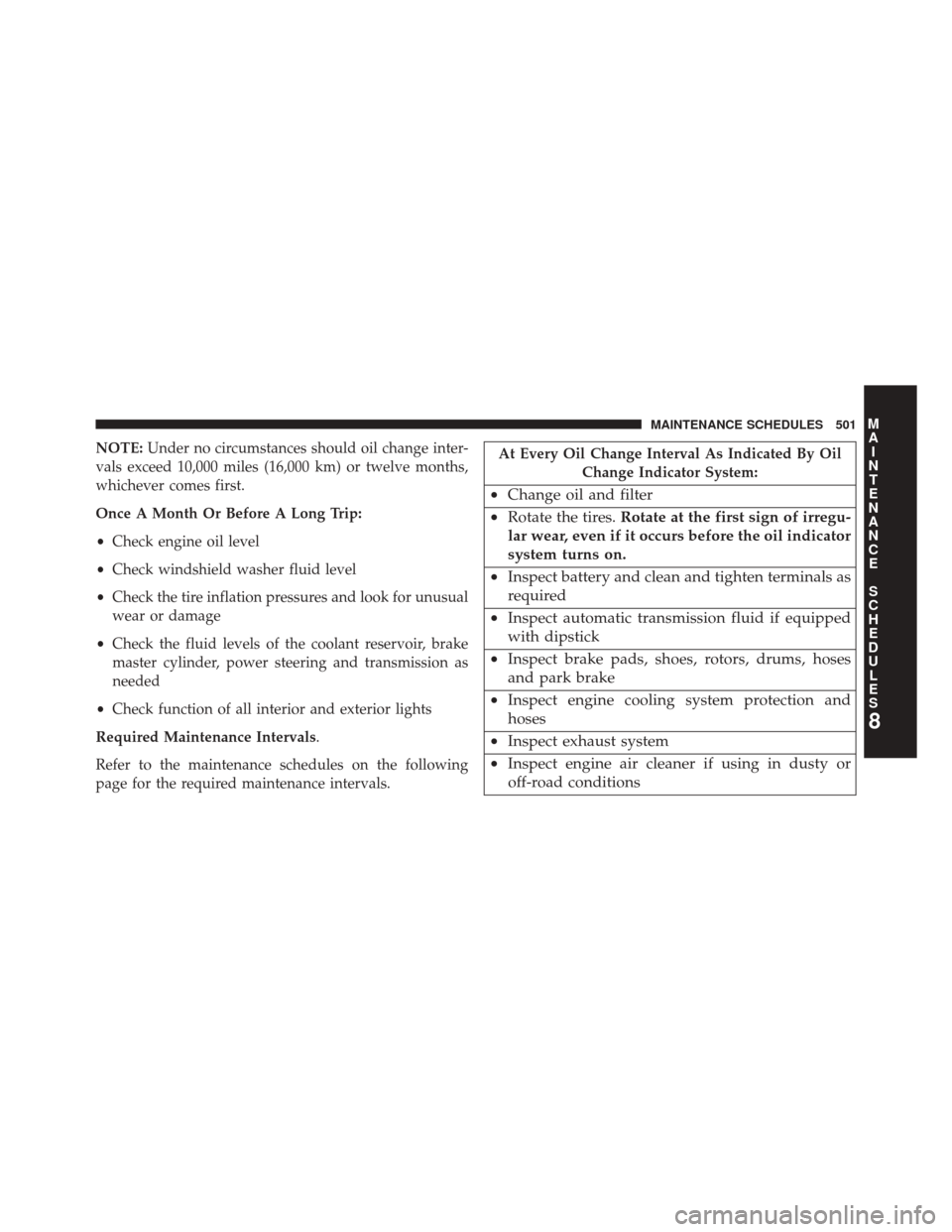
NOTE:Under no circumstances should oil change inter-
vals exceed 10,000 miles (16,000 km) or twelve months,
whichever comes first.
Once A Month Or Before A Long Trip:
• Check engine oil level
• Check windshield washer fluid level
• Check the tire inflation pressures and look for unusual
wear or damage
• Check the fluid levels of the coolant reservoir, brake
master cylinder, power steering and transmission as
needed
• Check function of all interior and exterior lights
Required Maintenance Intervals.
Refer to the maintenance schedules on the following
page for the required maintenance intervals.At Every Oil Change Interval As Indicated By Oil Change Indicator System:
•Change oil and filter
• Rotate the tires. Rotate at the first sign of irregu-
lar wear, even if it occurs before the oil indicator
system turns on.
• Inspect battery and clean and tighten terminals as
required
• Inspect automatic transmission fluid if equipped
with dipstick
• Inspect brake pads, shoes, rotors, drums, hoses
and park brake
• Inspect engine cooling system protection and
hoses
• Inspect exhaust system
• Inspect engine air cleaner if using in dusty or
off-road conditions
8
M
A I
N T
E
N
A
N
C E
S
C
H E
D
U L
E
SMAINTENANCE SCHEDULES 501
Page 524 of 543
Caps, FillerFuel ................................ .383
Oil (Engine) .......................... .451
Radiator (Coolant Pressure) ................466
Carbon Monoxide Warning ...................97
Cargo (Vehicle Loading) ....................386
Car Washes ............................ .476
Cellular Phone .......................... .280
Center High Mounted Stop Light ..............494
Certification Label ........................ .386
Chains, Tire ............................ .366
Changing A Flat Tire ...................... .418
Chart, Tire Sizing ........................ .344
Check
Engine Light (Malfunction Indicator Light). . .445
Checking Your Vehicle For Safety ...............97
Checks, Safety ............................97
Child Restraint ............................74
Clean Air Gasoline ....................... .380Cleaning
Wheels .............................. .477
Climate Control ......................... .280
Clock ................................. .243
Cold Weather Operation ....................300
Compact Disc (CD) Maintenance ..............279
Compact Spare Tire ....................... .361
Compass .............................. .233
Compass Calibration ...................... .234
Compass Variance ........................ .234
Computer, Trip/Travel ..................... .229
Connector UCI................................ .268
Universal Consumer Interface (UCI) ..........268
Conserving Fuel ......................... .229
Console ............................... .203
Console, Floor .......................... .203
Console, Overhead ....................... .184
Contract, Service ......................... .512
522 INDEX
Page 525 of 543
Coolant Pressure Cap (Radiator Cap)...........466
Cooling System .......................... .463
Adding Coolant (Antifreeze) ...............465
Coolant Capacity ...................... .495
Coolant Level ......................... .463
Disposal of Used Coolant .................467
Drain, Flush, and Refill ...................464
Inspection ........................... .467
Points to Remember .....................468
Pressure Cap ......................... .466
Radiator Cap ......................... .466
Selection of Coolant (Antifreeze) .............464
Corrosion Protection ...................... .475
Cruise Light ............................ .212
Cupholders ............................ .201
Customer Assistance ...................... .509
Data Recorder, Event .......................72
Daytime Brightness, Interior Lights .............169Daytime Running Lights
....................164
Dealer Service ........................... .447
Deck Lid, Emergency Release .................45
Deck Lid, Power Release .....................43
Defroster, Rear Window .....................205
Defroster, Windshield .......................99
Delay (Intermittent) Wipers ..................170
Diagnostic System, Onboard .................444
Dimmer Switch, Headlight ...................167
Dipsticks Oil (Engine) .......................... .448
Disabled Vehicle Towing ....................435
Disposal Antifreeze (Engine Coolant) ................467
Door Locks ..............................33
Door Locks, Automatic ......................35
Driving Through Flowing, Rising, or Shallow Standing
Water ............................... .322
10
INDEX 523
Page 526 of 543
Driving to Achieve Maximum Fuel Economy......229
Electrical Power Outlets .....................198
Electric Remote Mirrors .....................110
Electronic Brake Control System ...............332
Electronic Power Distribution Center (Fuses) ......483
Electronic Speed Control (Cruise Control) ........173
Electronic Stability Control (ESC) ..............337
Electronic Throttle Control Warning Light ........213
Electronic Vehicle Information Center (EVIC) ......224
Emergency Deck Lid Release ..................45
Emergency, In Case of Freeing Vehicle When Stuck ................432
Hazard Warning Flasher ..................406
Jacking .............................. .418
Jump Starting ......................... .427
Overheating .......................... .406
Towing ............................. .435
Emergency Trunk Release ....................45 Emission Control System Maintenance
..........445
Engine ................................ .443
Air Cleaner .......................... .453
Block Heater ......................... .303
Break-In Recommendations .................96
Checking Oil Level ..................... .448
Compartment ......................... .442
Compartment Identification ................442
Coolant (Antifreeze) .....................463
Cooling ............................. .463
Exhaust Gas Caution .....................97
Fails to Start .......................... .301
Flooded, Starting ...................... .301
Fuel Requirements ..................... .378
Jump Starting ......................... .427
Oil................................. .448
Oil Filler Cap ......................... .451
Oil Selection .......................... .450
Oil Synthetic ......................... .452
524 INDEX