cooling DODGE CHALLENGER 2014 3.G User Guide
[x] Cancel search | Manufacturer: DODGE, Model Year: 2014, Model line: CHALLENGER, Model: DODGE CHALLENGER 2014 3.GPages: 539, PDF Size: 3.49 MB
Page 459 of 539
Check the coolant recovery bottle tubing for brittle rub-
ber, cracking, tears, cuts, and tightness of the connection
at the bottle and radiator. Inspect the entire system for
leaks.
With the engine at normal operating temperature (but
not running), check the cooling system pressure cap for
proper vacuum sealing by draining a small amount of
coolant from the radiator drain cock. If the cap is sealing
properly, the engine coolant (antifreeze) will begin to
drain from the coolant recovery bottle. DO NOT RE-
MOVE THE COOLANT PRESSURE CAP WHEN THE
COOLING SYSTEM IS HOT.Cooling System — Drain Flush And Refill
If the engine coolant (antifreeze) is dirty or contains a
considerable amount of sediment, clean and flush with a
reliable cooling system cleaner. Follow with a thorough
rinsing to remove all deposits and chemicals. Properly
dispose of old engine coolant (antifreeze).
Refer to the “Maintenance Schedule” for the proper
maintenance intervals.
Selection Of Coolant
Refer to “Fluids, Lubricants, and Genuine Parts” in
“Maintaining Your Vehicle” for further information.
7
MAINTAINING YOUR VEHICLE 457
Page 460 of 539
CAUTION!
•Mixing of engine coolant (antifreeze) other than
specified Organic Additive Technology (OAT) en-
gine coolant (antifreeze), may result in engine
damage and may decrease corrosion protection.
Organic Additive Technology (OAT) engine cool-
ant is different and should not be mixed with
Hybrid Organic Additive Technology (HOAT) en-
gine coolant (antifreeze) or any “globally compat-
ible” coolant (antifreeze). If a non-OAT engine
coolant (antifreeze) is introduced into the cooling
system in an emergency, the cooling system will
need to be drained, flushed, and refilled with fresh
OAT coolant (conforming to MS-12106), by an
authorized dealer as soon as possible.
(Continued)
CAUTION! (Continued)
•Do not use water alone or alcohol-based engine
coolant (antifreeze) products. Do not use additional
rust inhibitors or antirust products, as they may not
be compatible with the radiator engine coolant and
may plug the radiator.
• This vehicle has not been designed for use with
propylene glycol-based engine coolant (antifreeze).
Use of propylene glycol-based engine coolant (an-
tifreeze) is not recommended.
Adding Coolant
Your vehicle has been built with an improved engine
coolant (OAT coolant conforming to MS-12106) that
allows extended maintenance intervals. This engine cool-
ant (antifreeze) can be used up to ten years or 150,000
miles (240,000 km) before replacement. To prevent reduc-
ing this extended maintenance period, it is important that
458 MAINTAINING YOUR VEHICLE
Page 461 of 539
you use the same engine coolant (OAT coolant conform-
ing to MS-12106) throughout the life of your vehicle.
Please review these recommendations for using Organic
Additive Technology (OAT) engine coolant (antifreeze)
that meets the requirements of Chrysler Material Stan-
dard MS-12106. When adding engine coolant (antifreeze):
•We recommend using MOPAR® Antifreeze/Coolant
10 Year/150,000 Mile Formula OAT (Organic Additive
Technology) that meets the requirements of Chrysler
Material Standard MS-12106.
• Mix a minimum solution of 50% OAT engine coolant
that meets the requirements of Chrysler Material Stan-
dard MS-12106 and distilled water. Use higher concen-
trations (not to exceed 70%) if temperatures below
34° F (37° C) are anticipated.
• Use only high purity water such as distilled or deion-
ized water when mixing the water/engine coolant (antifreeze) solution. The use of lower quality water
will reduce the amount of corrosion protection in the
engine cooling system.
Please note that it is the owner’s responsibility to main-
tain the proper level of protection against freezing ac-
cording to the temperatures occurring in the area where
the vehicle is operated.
NOTE:
• Some vehicles require special tools to add coolant
properly. Failure to fill these systems properly could
lead to severe internal engine damage. If any coolant is
needed to be added to the system please contact your
local authorized dealer.
• Mixing engine coolant (antifreeze) types is not recom-
mended and can result in cooling system damage. If
HOAT and OAT coolant are mixed in an emergency,
7
MAINTAINING YOUR VEHICLE 459
Page 462 of 539
have a authorized dealer drain, flush, and refill with
OAT coolant (conforming to MS-12106) as soon as
possible.
Cooling System Pressure Cap
The cap must be fully tightened to prevent loss of engine
coolant (antifreeze), and to ensure that engine coolant
(antifreeze) will return to the radiator from the coolant
recovery bottle.
The cap should be inspected and cleaned if there is any
accumulation of foreign material on the sealing surfaces.
WARNING!
•The warning words “DO NOT OPEN HOT” on the
cooling system pressure cap are a safety precaution.
Never add engine coolant (antifreeze) when the
engine is overheated. Do not loosen or remove the
cap to cool an overheated engine. Heat causes
pressure to build up in the cooling system. To
prevent scalding or injury, do not remove the
pressure cap while the system is hot or under
pressure.
• Do not use a pressure cap other than the one
specified for your vehicle. Personal injury or en-
gine damage may result.
Disposal Of Used Engine Coolant
Used ethylene glycol-based engine coolant (antifreeze) is
a regulated substance requiring proper disposal. Check
with your local authorities to determine the disposal
460 MAINTAINING YOUR VEHICLE
Page 464 of 539
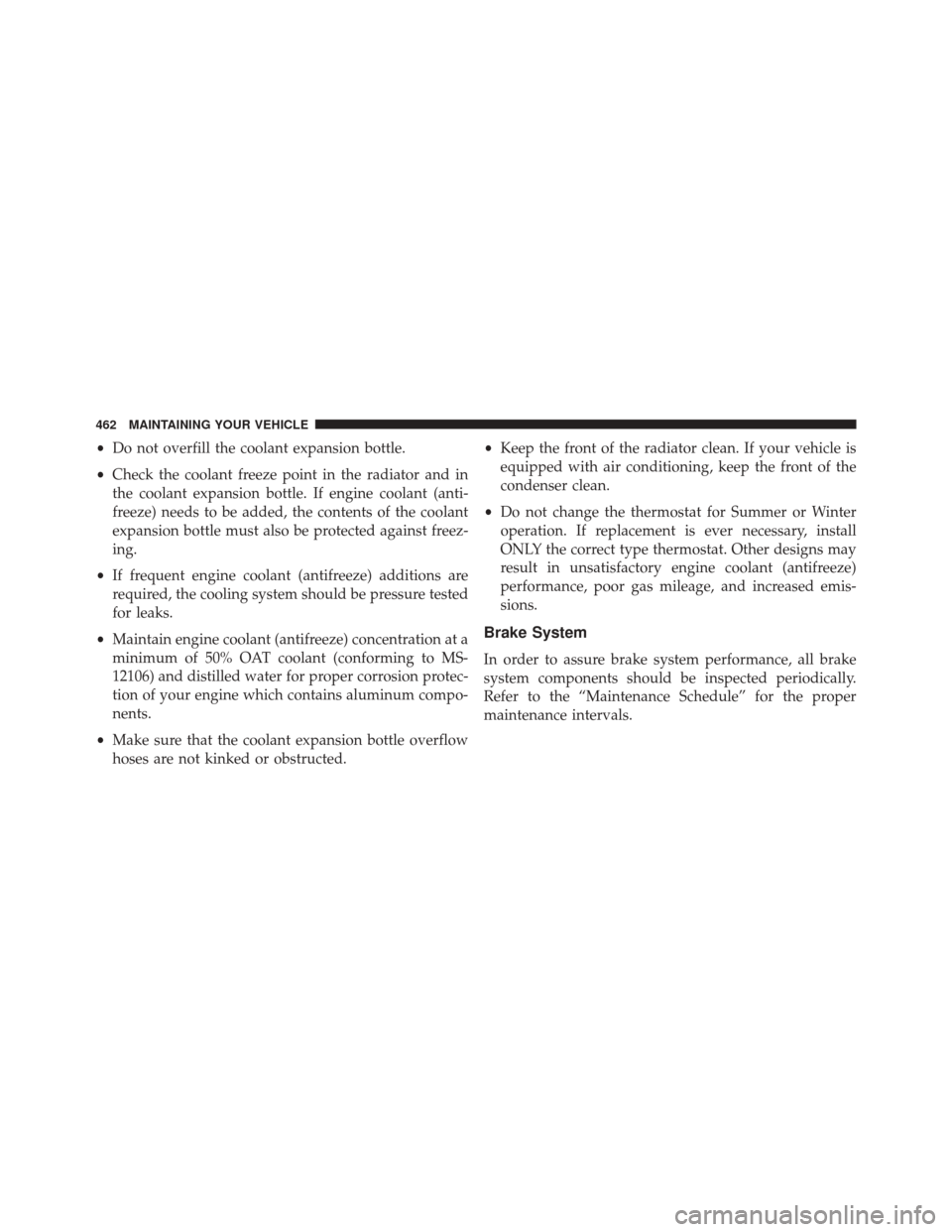
•Do not overfill the coolant expansion bottle.
• Check the coolant freeze point in the radiator and in
the coolant expansion bottle. If engine coolant (anti-
freeze) needs to be added, the contents of the coolant
expansion bottle must also be protected against freez-
ing.
• If frequent engine coolant (antifreeze) additions are
required, the cooling system should be pressure tested
for leaks.
• Maintain engine coolant (antifreeze) concentration at a
minimum of 50% OAT coolant (conforming to MS-
12106) and distilled water for proper corrosion protec-
tion of your engine which contains aluminum compo-
nents.
• Make sure that the coolant expansion bottle overflow
hoses are not kinked or obstructed. •
Keep the front of the radiator clean. If your vehicle is
equipped with air conditioning, keep the front of the
condenser clean.
• Do not change the thermostat for Summer or Winter
operation. If replacement is ever necessary, install
ONLY the correct type thermostat. Other designs may
result in unsatisfactory engine coolant (antifreeze)
performance, poor gas mileage, and increased emis-
sions.
Brake System
In order to assure brake system performance, all brake
system components should be inspected periodically.
Refer to the “Maintenance Schedule” for the proper
maintenance intervals.
462 MAINTAINING YOUR VEHICLE
Page 493 of 539
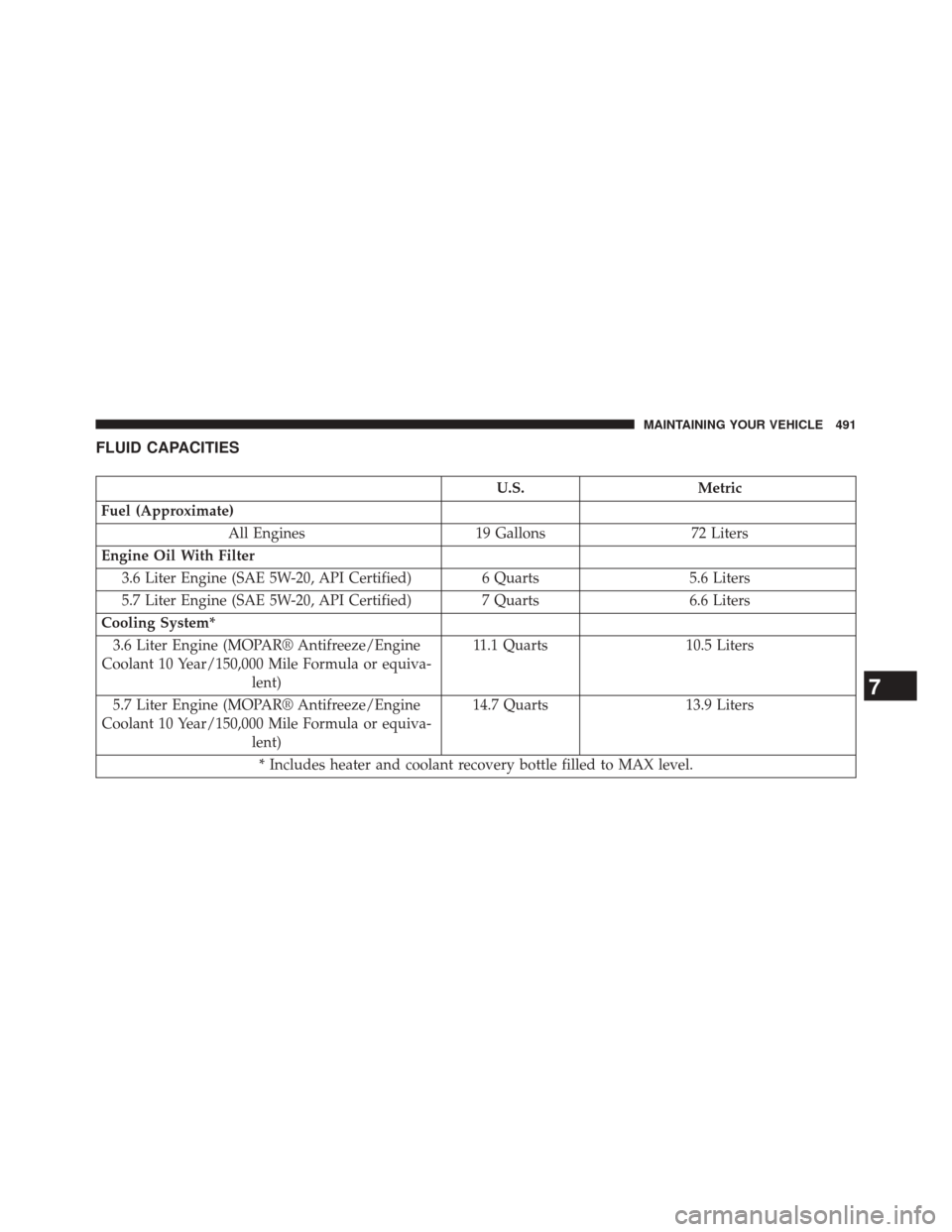
FLUID CAPACITIES
U.S.Metric
Fuel (Approximate) All Engines 19 Gallons72 Liters
Engine Oil With Filter 3.6 Liter Engine (SAE 5W-20, API Certified) 6 Quarts 5.6 Liters
5.7 Liter Engine (SAE 5W-20, API Certified) 7 Quarts 6.6 Liters
Cooling System* 3.6 Liter Engine (MOPAR® Antifreeze/Engine
Coolant 10 Year/150,000 Mile Formula or equiva- lent) 11.1 Quarts
10.5 Liters
5.7 Liter Engine (MOPAR® Antifreeze/Engine
Coolant 10 Year/150,000 Mile Formula or equiva- lent) 14.7 Quarts
13.9 Liters
* Includes heater and coolant recovery bottle filled to MAX level.
7
MAINTAINING YOUR VEHICLE 491
Page 499 of 539
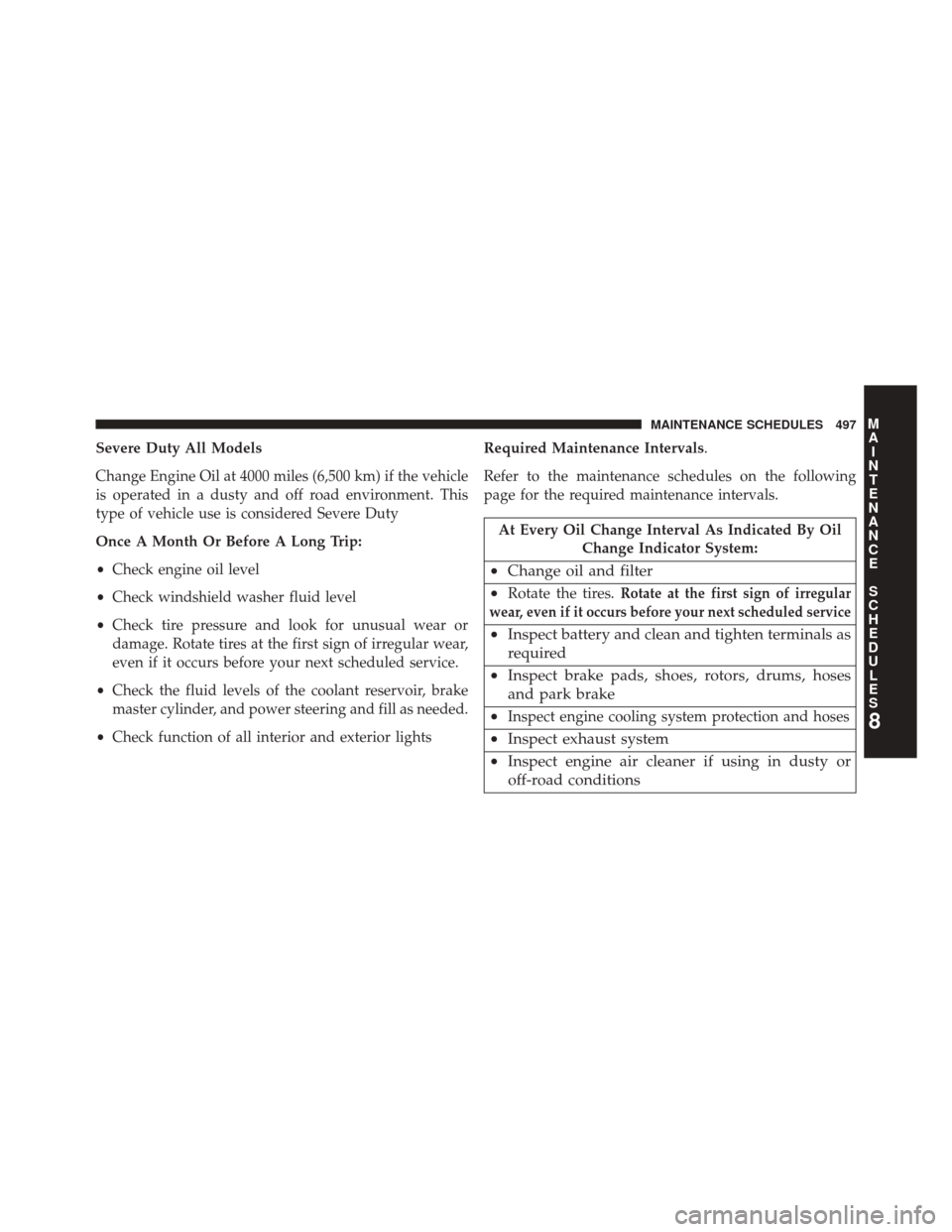
Severe Duty All Models
Change Engine Oil at 4000 miles (6,500 km) if the vehicle
is operated in a dusty and off road environment. This
type of vehicle use is considered Severe Duty
Once A Month Or Before A Long Trip:
•Check engine oil level
• Check windshield washer fluid level
• Check tire pressure and look for unusual wear or
damage. Rotate tires at the first sign of irregular wear,
even if it occurs before your next scheduled service.
• Check the fluid levels of the coolant reservoir, brake
master cylinder, and power steering and fill as needed.
• Check function of all interior and exterior lights Required Maintenance Intervals.
Refer to the maintenance schedules on the following
page for the required maintenance intervals.
At Every Oil Change Interval As Indicated By Oil
Change Indicator System:
•Change oil and filter
•
Rotate the tires.Rotate at the first sign of irregular
wear, even if it occurs before your next scheduled service
• Inspect battery and clean and tighten terminals as
required
• Inspect brake pads, shoes, rotors, drums, hoses
and park brake
•
Inspect engine cooling system protection and hoses
• Inspect exhaust system
• Inspect engine air cleaner if using in dusty or
off-road conditions8
M
A I
N T
E
N
A
N
C E
S
C
H E
D
U L
E
SMAINTENANCE SCHEDULES 497
Page 521 of 539
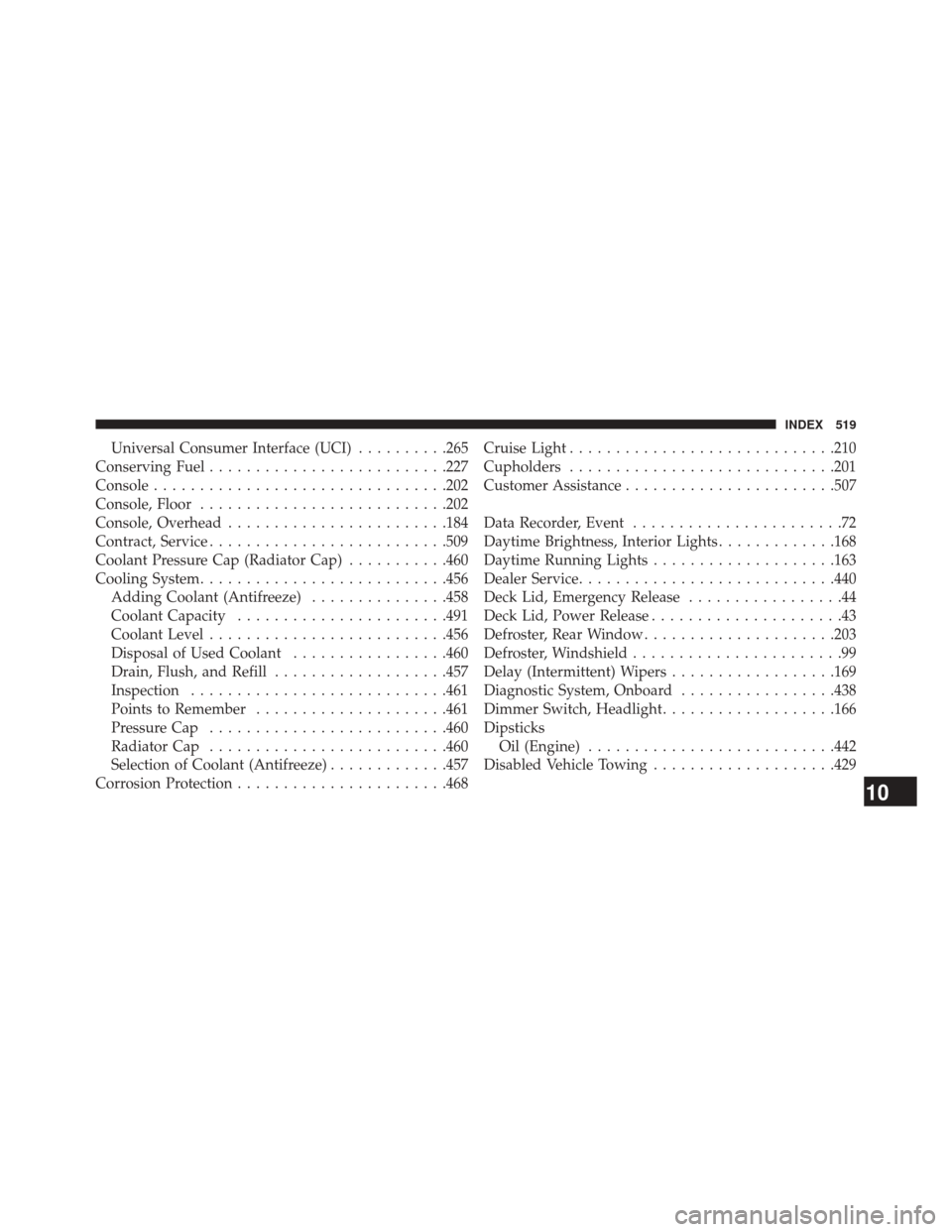
Universal Consumer Interface (UCI)..........265
Conserving Fuel ......................... .227
Console ............................... .202
Console, Floor .......................... .202
Console, Overhead ....................... .184
Contract, Service ......................... .509
Coolant Pressure Cap (Radiator Cap) ...........460
Cooling System .......................... .456
Adding Coolant (Antifreeze) ...............458
Coolant Capacity ...................... .491
Coolant Level ......................... .456
Disposal of Used Coolant .................460
Drain, Flush, and Refill ...................457
Inspection ........................... .461
Points to Remember .....................461
Pressure Cap ......................... .460
Radiator Cap ......................... .460
Selection of Coolant (Antifreeze) .............457
Corrosion Protection ...................... .468Cruise Light
............................ .210
Cupholders ............................ .201
Customer Assistance ...................... .507
Data Recorder, Event .......................72
Daytime Brightness, Interior Lights .............168
Daytime Running Lights ....................163
Dealer Service ........................... .440
Deck Lid, Emergency Release .................44
Deck Lid, Power Release .....................43
Defroster, Rear Window .....................203
Defroster, Windshield .......................99
Delay (Intermittent) Wipers ..................169
Diagnostic System, Onboard .................438
Dimmer Switch, Headlight ...................166
Dipsticks Oil (Engine) .......................... .442
Disabled Vehicle Towing ................... .429
10
INDEX 519
Page 523 of 539
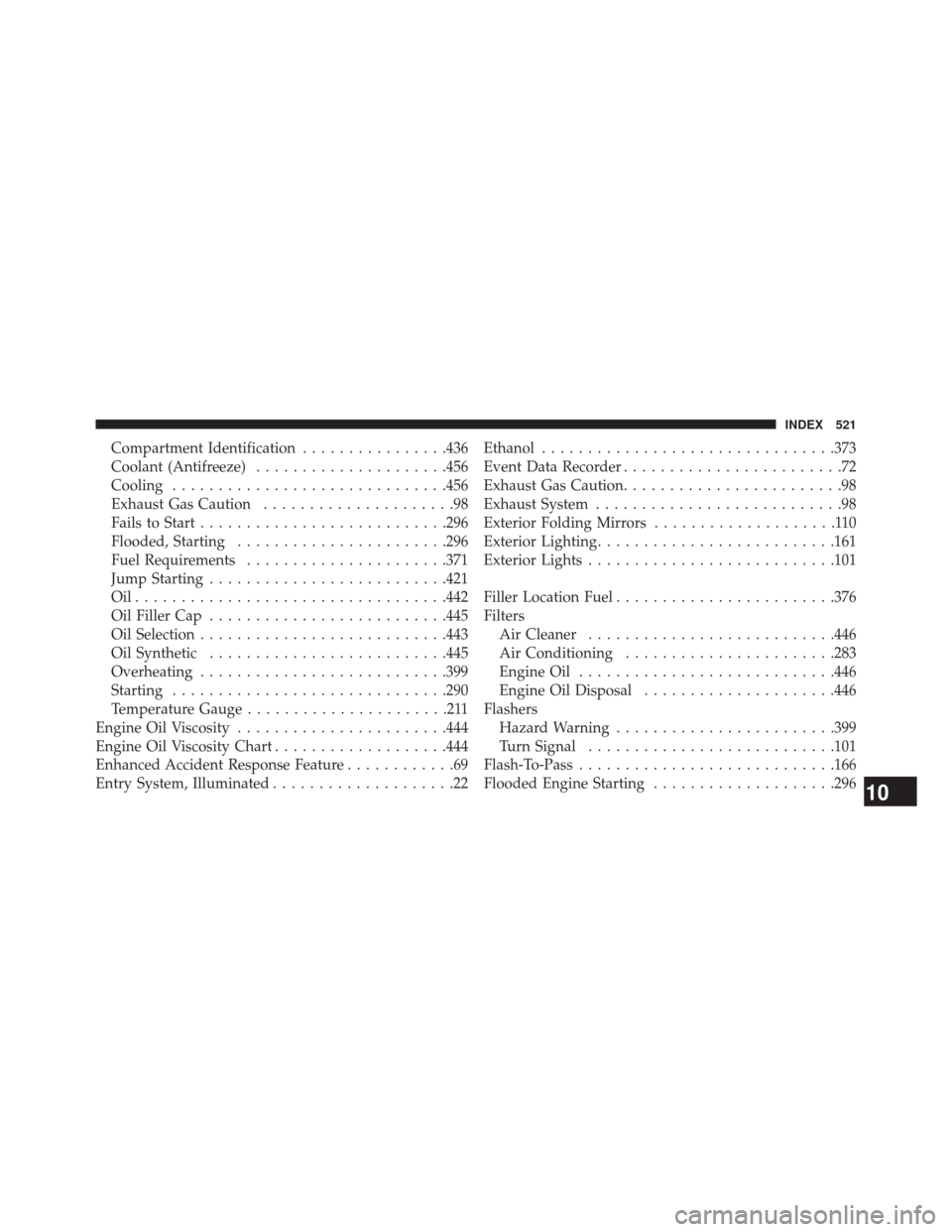
Compartment Identification................436
Coolant (Antifreeze) .....................456
Cooling ............................. .456
Exhaust Gas Caution .....................98
Fails to Start .......................... .296
Flooded, Starting ...................... .296
Fuel Requirements ..................... .371
Jump Starting ......................... .421
Oil................................. .442
Oil Filler Cap ......................... .445
Oil Selection .......................... .443
Oil Synthetic ......................... .445
Overheating .......................... .399
Starting ............................. .290
Temperature Gauge ......................211
Engine Oil Viscosity ...................... .444
Engine Oil Viscosity Chart ...................444
Enhanced Accident Response Feature ............69
Entry System, Illuminated ....................22 Ethanol
............................... .373
Event Data Recorder ........................72
Exhaust Gas Caution ........................98
Exhaust System ...........................98
Exterior Folding Mirrors ....................110
Exterior Lighting ......................... .161
Exterior Lights .......................... .101
Filler Location Fuel ....................... .376
Filters Air Cleaner .......................... .446
Air Conditioning ...................... .283
Engine Oil ........................... .446
Engine Oil Disposal .....................446
Flashers Hazard Warning ....................... .399
Turn Signal .......................... .101
Flash-To-Pass ........................... .166
Flooded Engine Starting ....................296
10
INDEX 521
Page 524 of 539
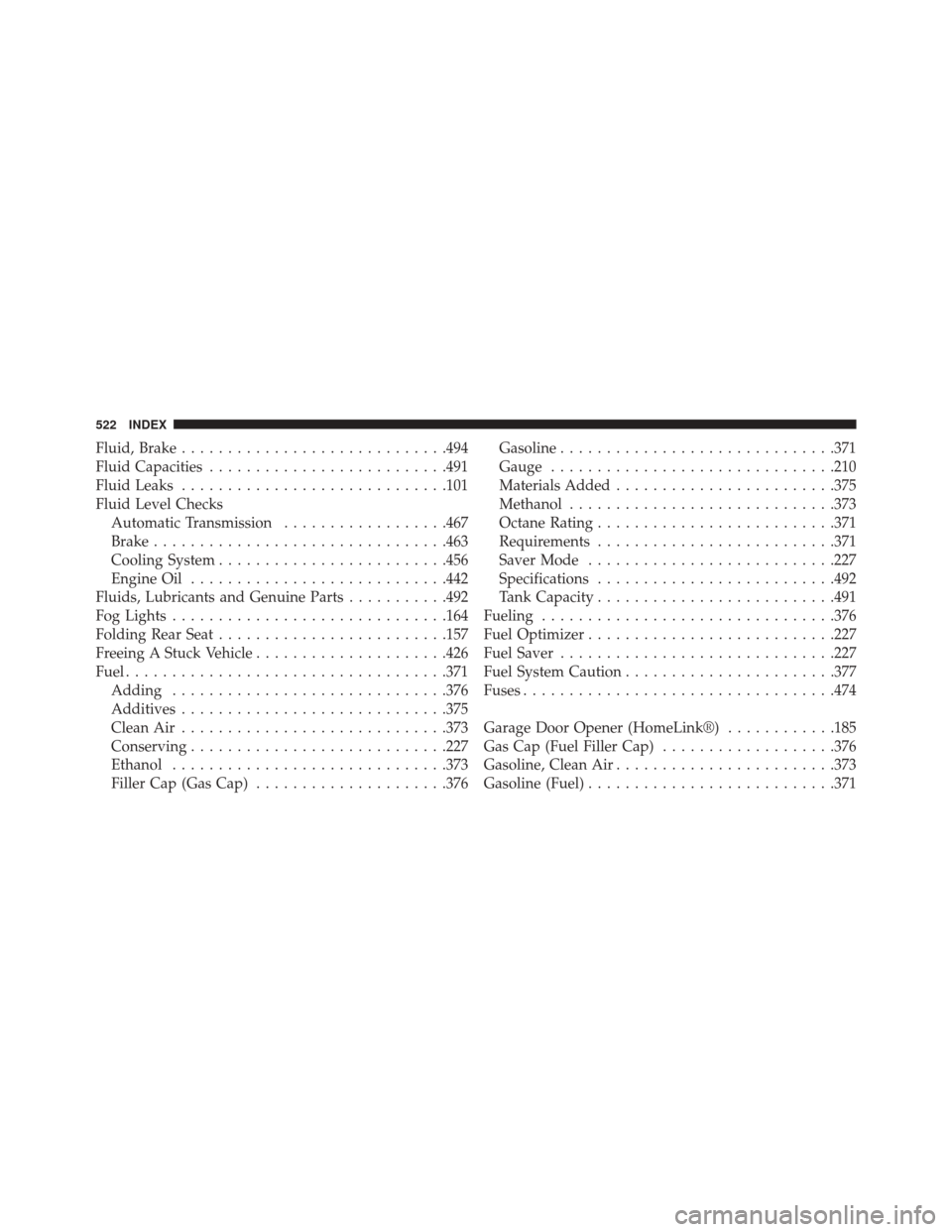
Fluid, Brake............................ .494
Fluid Capacities ......................... .491
Fluid Leaks ............................ .101
Fluid Level Checks Automatic Transmission ..................467
Brake ............................... .463
Cooling System ........................ .456
Engine Oil ........................... .442
Fluids, Lubricants and Genuine Parts ...........492
Fog Lights ............................. .164
Folding Rear Seat ........................ .157
Freeing A Stuck Vehicle .....................426
Fuel .................................. .371
Adding ............................. .376
Additives ............................ .375
Clean Air ............................ .373
Conserving ........................... .227
Ethanol ............................. .373
Filler Cap (Gas Cap) .....................376 Gasoline
............................. .371
Gauge .............................. .210
Materials Added ....................... .375
Methanol ............................ .373
Octane Rating ......................... .371
Requirements ......................... .371
Saver Mode .......................... .227
Specifications ......................... .492
Tank Capacity ......................... .491
Fueling ............................... .376
Fuel Optimizer .......................... .227
Fuel Saver ............................. .227
Fuel System Caution ...................... .377
Fuses ................................. .474
Garage Door Opener (HomeLink®) ............185
Gas Cap (Fuel Filler Cap) ...................376
Gasoline,
Clean Air ....................... .373
Gasoline (Fuel) .......................... .371
522 INDEX