battery DODGE CHALLENGER 2016 3.G Workshop Manual
[x] Cancel search | Manufacturer: DODGE, Model Year: 2016, Model line: CHALLENGER, Model: DODGE CHALLENGER 2016 3.GPages: 651, PDF Size: 4.47 MB
Page 605 of 651
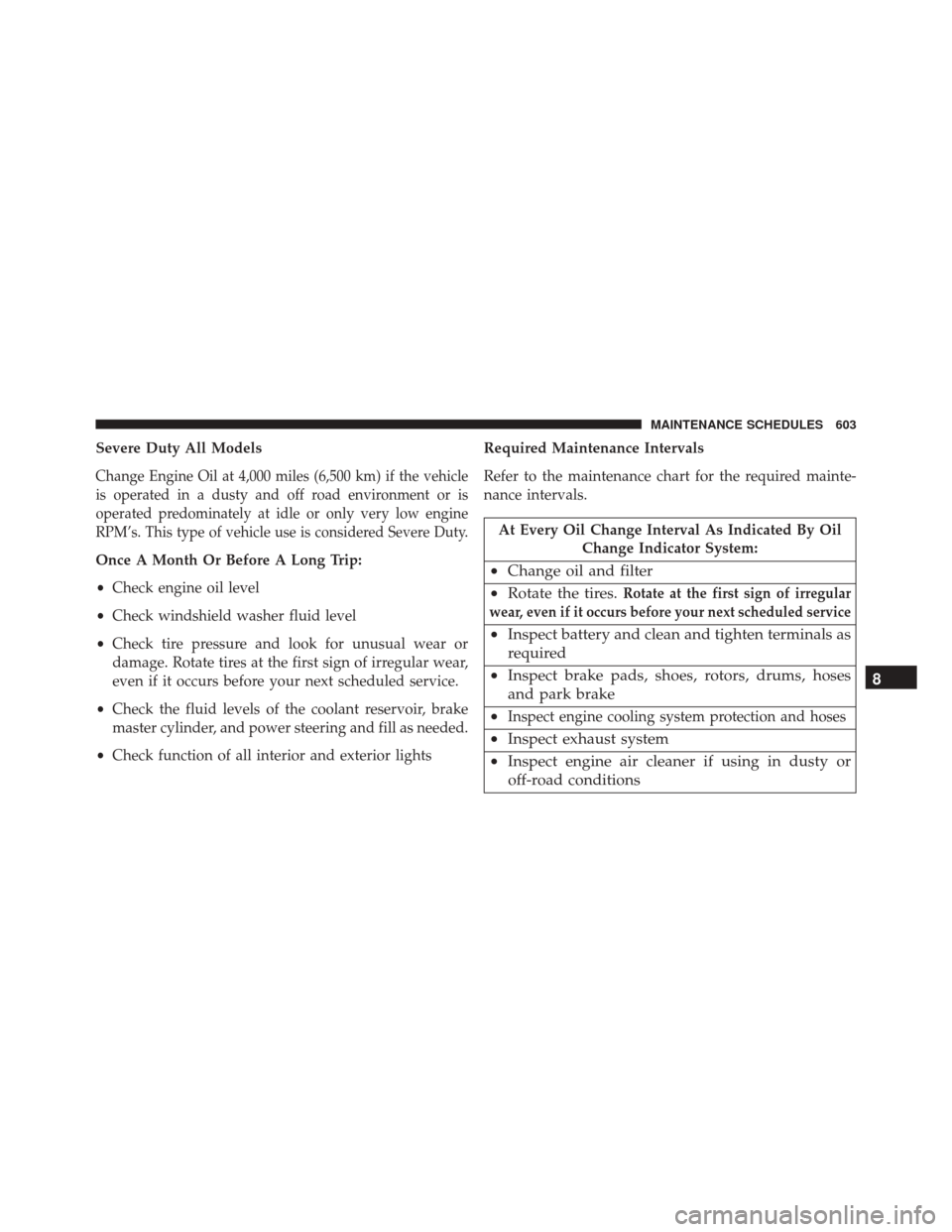
Severe Duty All Models
Change Engine Oil at 4,000 miles (6,500 km) if the vehicle
is operated in a dusty and off road environment or is
operated predominately at idle or only very low engine
RPM’s. This type of vehicle use is considered Severe Duty.
Once A Month Or Before A Long Trip:
•Check engine oil level
• Check windshield washer fluid level
• Check tire pressure and look for unusual wear or
damage. Rotate tires at the first sign of irregular wear,
even if it occurs before your next scheduled service.
• Check the fluid levels of the coolant reservoir, brake
master cylinder, and power steering and fill as needed.
• Check function of all interior and exterior lights Required Maintenance Intervals
Refer to the maintenance chart for the required mainte-
nance intervals.
At Every Oil Change Interval As Indicated By Oil
Change Indicator System:
•Change oil and filter
• Rotate the tires.
Rotate at the first sign of irregular
wear, even if it occurs before your next scheduled service
• Inspect battery and clean and tighten terminals as
required
• Inspect brake pads, shoes, rotors, drums, hoses
and park brake
•
Inspect engine cooling system protection and hoses
• Inspect exhaust system
• Inspect engine air cleaner if using in dusty or
off-road conditions 8
MAINTENANCE SCHEDULES 603
Page 611 of 651
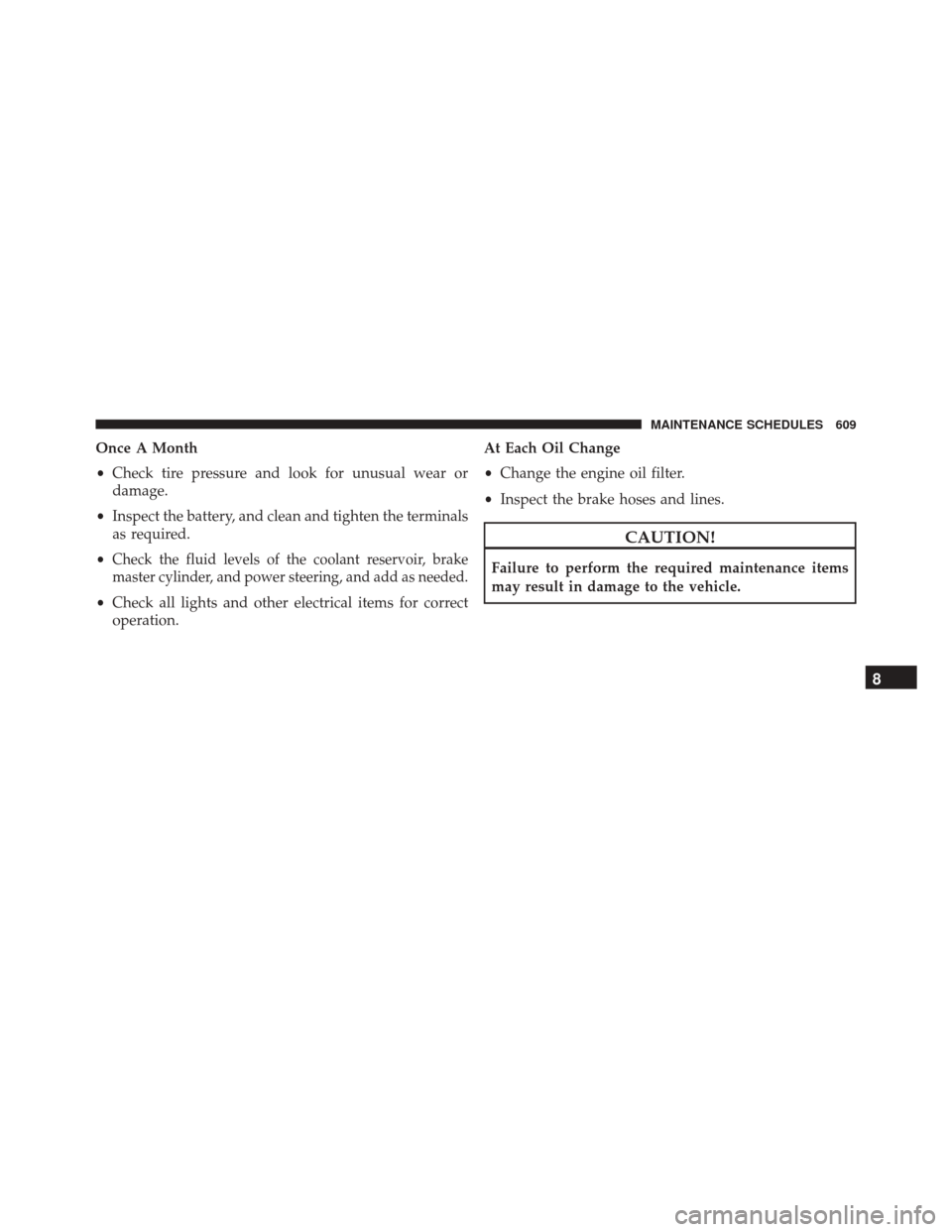
Once A Month
•Check tire pressure and look for unusual wear or
damage.
• Inspect the battery, and clean and tighten the terminals
as required.
•
Check the fluid levels of the coolant reservoir, brake
master cylinder, and power steering, and add as needed.
• Check all lights and other electrical items for correct
operation. At Each Oil Change
•
Change the engine oil filter.
• Inspect the brake hoses and lines.
CAUTION!
Failure to perform the required maintenance items
may result in damage to the vehicle.
8
MAINTENANCE SCHEDULES 609
Page 629 of 651
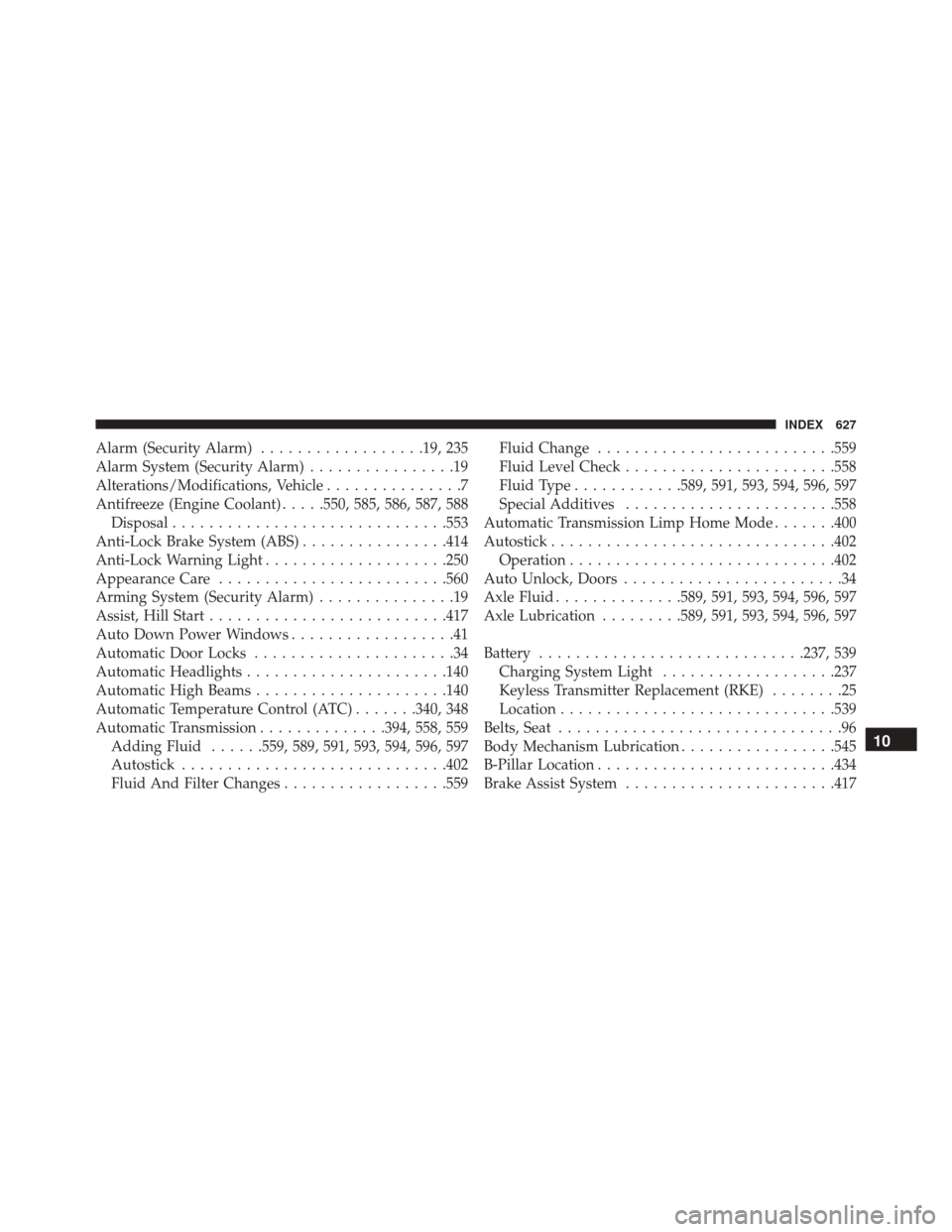
Alarm (Security Alarm)..................19, 235
Alarm System (Security Alarm) ................19
Alterations/Modifications, Vehicle ...............7
Antifreeze (Engine Coolant) .....550, 585, 586, 587, 588
Disposal ............................. .553
Anti-Lock Brake System (ABS) ................414
Anti-Lock Warning Light ....................250
Appearance Care ........................ .560
Arming System (Security Alarm) ...............19
Assist, Hill Start ......................... .417
Auto Down Power Windows ..................41
Automatic Door Locks ......................34
Automatic Headlights ..................... .140
Automatic High Beams .....................140
Automatic Temperature Control (ATC) .......340, 348
Automatic Transmission ..............394, 558, 559
Adding Fluid ......559, 589, 591, 593, 594, 596, 597
Autostick ............................ .402
Fluid And Filter Changes ..................559 Fluid Change
......................... .559
Fluid Level Check ...................... .558
Fluid Type ............589, 591, 593, 594, 596, 597
Special Additives ...................... .558
Automatic Transmission Limp Home Mode .......400
Autostick .............................. .402
Operation ............................ .402
Auto Unlock, Doors ........................34
Axle Fluid ..............589, 591, 593, 594, 596, 597
Axle Lubrication .........589, 591, 593, 594, 596, 597
Battery ............................ .237, 539
Charging System Light ...................237
Keyless Transmitter Replacement (RKE) ........25
Location ............................. .539
Belts, Seat ...............................96
Body Mechanism Lubrication .................545
B-Pillar Location ......................... .434
Brake Assist System ...................... .417
10
INDEX 627
Page 639 of 651
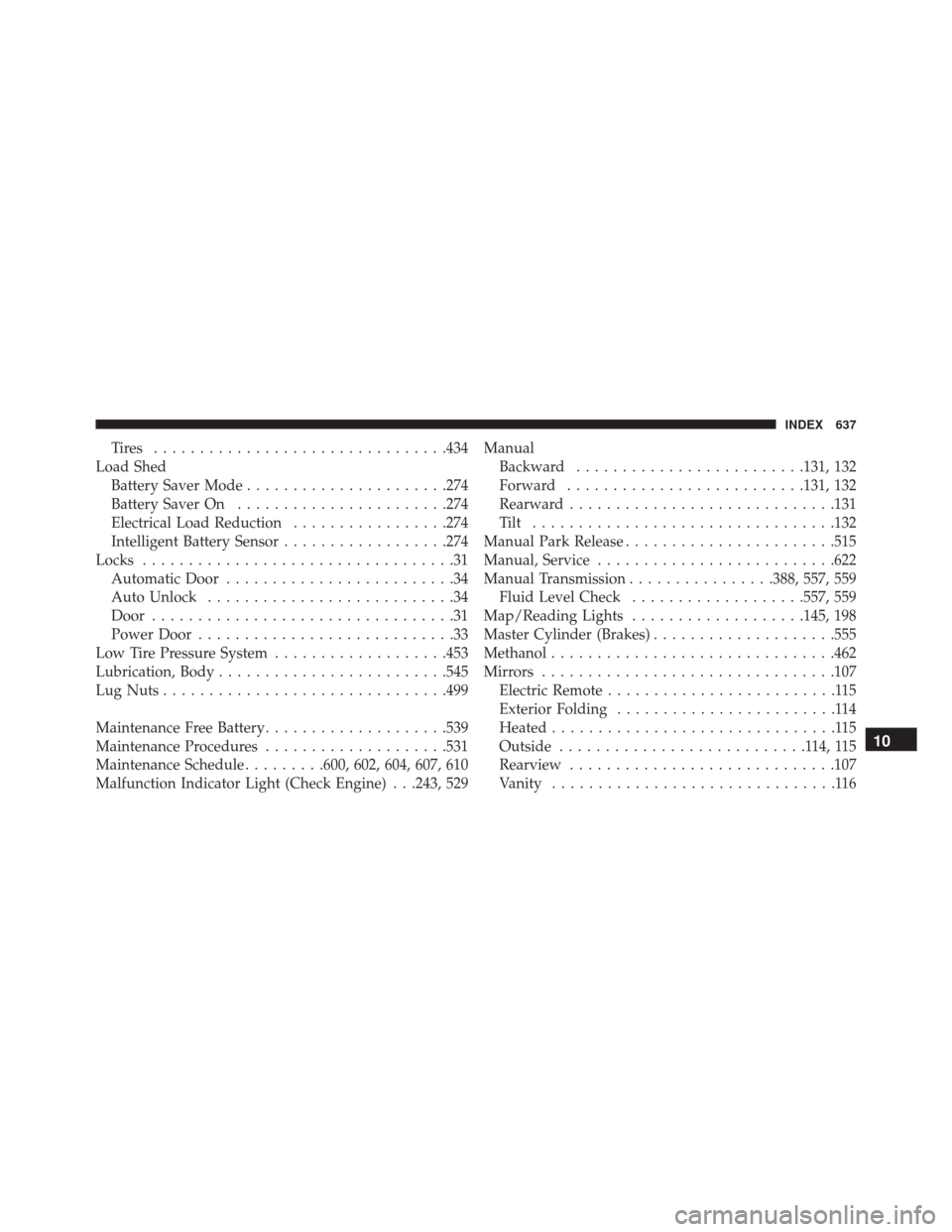
Tires ................................434
Load Shed Battery Saver Mode ..................... .274
Battery Saver On ...................... .274
Electrical Load Reduction .................274
Intelligent Battery Sensor ..................274
Locks ..................................31
Automatic Door .........................34
Auto Unlock ...........................34
Door .................................31
Power Door ............................33
Low Tire Pressure System ...................453
Lubrication, Body ........................ .545
Lug Nuts .............................. .499
Maintenance Free Battery ....................539
Maintenance Procedures ....................531
Maintenance Schedule .........600, 602, 604, 607, 610
Malfunction Indicator Light (Check Engine) . . .243, 529 Manual
Backward ........................ .131, 132
Forward ......................... .131, 132
Rearward ............................ .131
Tilt ................................ .132
Manual Park Release ...................... .515
Manual, Service ......................... .622
Manual Transmission ................388, 557, 559
Fluid Level Check ...................557, 559
Map/Reading Lights ...................145, 198
Master Cylinder (Brakes) ....................555
Methanol .............................. .462
Mirrors ............................... .107
Electric Remote .........................115
Exterior Folding ........................114
Heated ...............................115
Outside ...........................114,115
Rearview ............................ .107
Vanity ...............................116
10
INDEX 637
Page 647 of 651
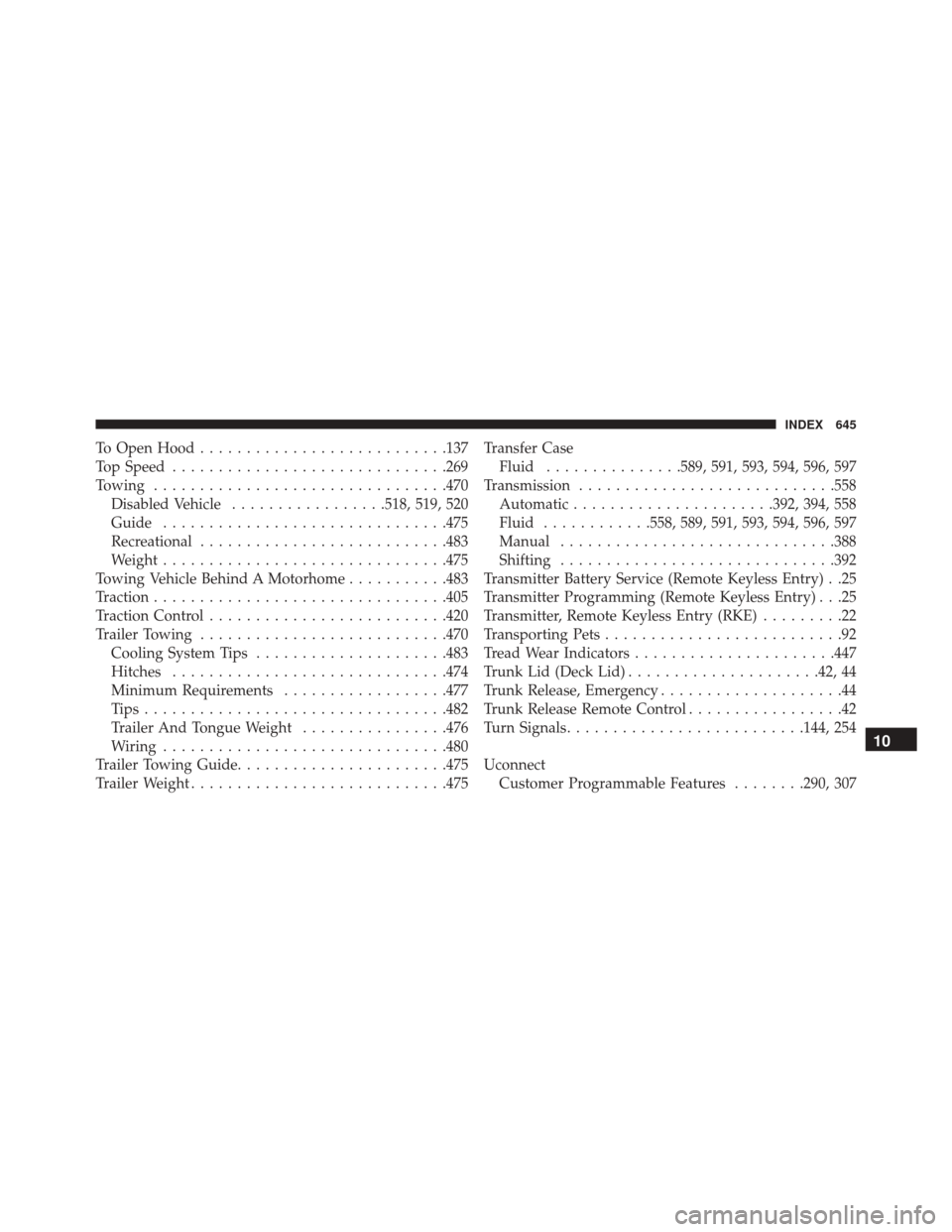
To Open Hood.......................... .137
Top Speed ............................. .269
Towing ............................... .470
Disabled Vehicle .................518, 519, 520
Guide .............................. .475
Recreational .......................... .483
Weight .............................. .475
Towing Vehicle Behind A Motorhome ...........483
Traction ............................... .405
Traction Control ......................... .420
Trailer Towing .......................... .470
Cooling System Tips .....................483
Hitches ............................. .474
Minimum Requirements ..................477
Tips................................ .482
Trailer And Tongue Weight ................476
Wiring .............................. .480
Trailer Towing Guide ...................... .475
Trailer Weight ........................... .475Transfer Case
Fluid ...............589, 591, 593, 594, 596, 597
Transmission ........................... .558
Automatic ..................... .392, 394, 558
Fluid ............558, 589, 591, 593, 594, 596, 597
Manual ............................. .388
Shifting ............................. .392
Transmitter Battery Service (Remote Keyless Entry) . .25
Transmitter Programming (Remote Keyless Entry) . . .25
Transmitter, Remote Keyless Entry (RKE) .........22
Transporting Pets ..........................92
Tread Wear Indicators ..................... .447
Trunk Lid (Deck Lid) .....................42, 44
Trunk Release, Emergency ....................44
Trunk Release Remote Control .................42
Turn Signals ......................... .144, 254
Uconnect Customer Programmable Features ........290, 307
10
INDEX 645
Page 650 of 651

INSTALLATION OF RADIO TRANSMITTING
EQUIPMENT
Special design considerations are incorporated into this
vehicle’s electronic system to provide immunity to radio
frequency signals. Mobile two-way radios and telephone
equipment must be installed properly by trained person-
nel. The following must be observed during installation.
The positive power connection should be made directly
to the battery and fused as close to the battery as possible.
The negative power connection should be made to body
sheet metal adjacent to the negative battery connection.
This connection should not be fused.
Antennas for two-way radios should be mounted on the
roof or the rear area of the vehicle. Care should be used
in mounting antennas with magnet bases. Magnets may
affect the accuracy or operation of the compass on
vehicles so equipped.The antenna cable should be as short as practical and
routed away from the vehicle wiring when possible. Use
only fully shielded coaxial cable.
Carefully match the antenna and cable to the radio to
ensure a low Standing Wave Ratio (SWR).
Mobile radio equipment with output power greater than
normal may require special precautions.
All installations should be checked for possible interfer-
ence between the communications equipment and the
vehicle’s electronic systems.