child restraint DODGE CHALLENGER 2018 Owner's Manual
[x] Cancel search | Manufacturer: DODGE, Model Year: 2018, Model line: CHALLENGER, Model: DODGE CHALLENGER 2018Pages: 516, PDF Size: 5.17 MB
Page 183 of 516
following the instructions below. See the section “Installing
Child Restraints Using the Vehicle Seat Belt” to check what
type of seat belt each seating position has.
1. Loosen the adjusters on the lower straps and on thetether strap of the child seat so that you can more easily
attach the hooks or connectors to the vehicle anchor-
ages.
2. Place the child seat between the lower anchorages for that seating position. For some second row seats, you
may need to recline the seat and / or raise the head
restraint to get a better fit. If the rear seat can be moved
forward and rearward in the vehicle, you may wish to
move it to its rear-most position to make room for the
child seat. You may also move the front seat forward to
allow more room for the child seat.
3. Attach the lower hooks or connectors of the child restraint to the lower anchorages in the selected seating
position.
4. If the child restraint has a tether strap, connect it to the top tether anchorage. See the section “Installing Child
Restraints Using the Top Tether Anchorage” for direc-
tions to attach a tether anchor. 5. Tighten all of the straps as you push the child restraint
rearward and downward into the seat. Remove slack in
the straps according to the child restraint manufactur-
er ’s instructions.
6. Test that the child restraint is installed tightly by pulling back and forth on the child seat at the belt path. It
should not move more than 1 inch (25.4 mm) in any
direction.
How To Stow An Unused Switchable-ALR (ALR)
Seat Belt:
When using the LATCH attaching system to install a child
restraint, stow all ALR seat belts that are not being used by
other occupants or being used to secure child restraints. An
unused belt could injure a child if they play with it and
accidentally lock the seat belt retractor. Before installing a
child restraint using the LATCH system, buckle the seat
belt behind the child restraint and out of the child’s reach.
If the buckled seat belt interferes with the child restraint
installation, instead of buckling it behind the child re-
straint, route the seat belt through the child restraint belt
path and then buckle it. Do not lock the seat belt. Remind
all children in the vehicle that the seat belts are not toys and
that they should not play with them.
5
SAFETY 181
Page 184 of 516
WARNING!
•Improper installation of a child restraint to the
LATCH anchorages can lead to failure of the re-
straint. The child could be badly injured or killed.
Follow the child restraint manufacturer ’s directions
exactly when installing an infant or child restraint.
• Child restraint anchorages are designed to withstand
only those loads imposed by correctly-fitted child
restraints. Under no circumstances are they to be
used for adult seat belts, harnesses, or for attaching
other items or equipment to the vehicle.
Installing Child Restraints Using The Vehicle Seat
Belt
Child restraint systems are designed to be secured in
vehicle seats by lap belts or the lap belt portion of a
lap/shoulder belt.
WARNING!
• Improper installation or failure to properly secure a
child restraint can lead to failure of the restraint. The
child could be badly injured or killed.
(Continued)
WARNING! (Continued)
•Follow the child restraint manufacturer ’s directions
exactly when installing an infant or child restraint.
The seat belts in the passenger seating positions are
equipped with a Switchable Automatic Locking Retractor
(ALR) that is designed to keep the lap portion of the seat
belt tight around the child restraint so that it is not
necessary to use a locking clip. The ALR retractor can be
“switched” into a locked mode by pulling all of the
webbing out of the retractor and then letting the webbing
retract back into the retractor. If it is locked, the ALR will
make a clicking noise while the webbing is pulled back into
the retractor. Refer to the “Automatic Locking Mode”
description in “Switchable Automatic Locking Retractors
(ALR)” under “Occupant Restraint Systems” for additional
information on ALR.
Please see the table below and the following sections for
more information.
182 SAFETY
Page 185 of 516
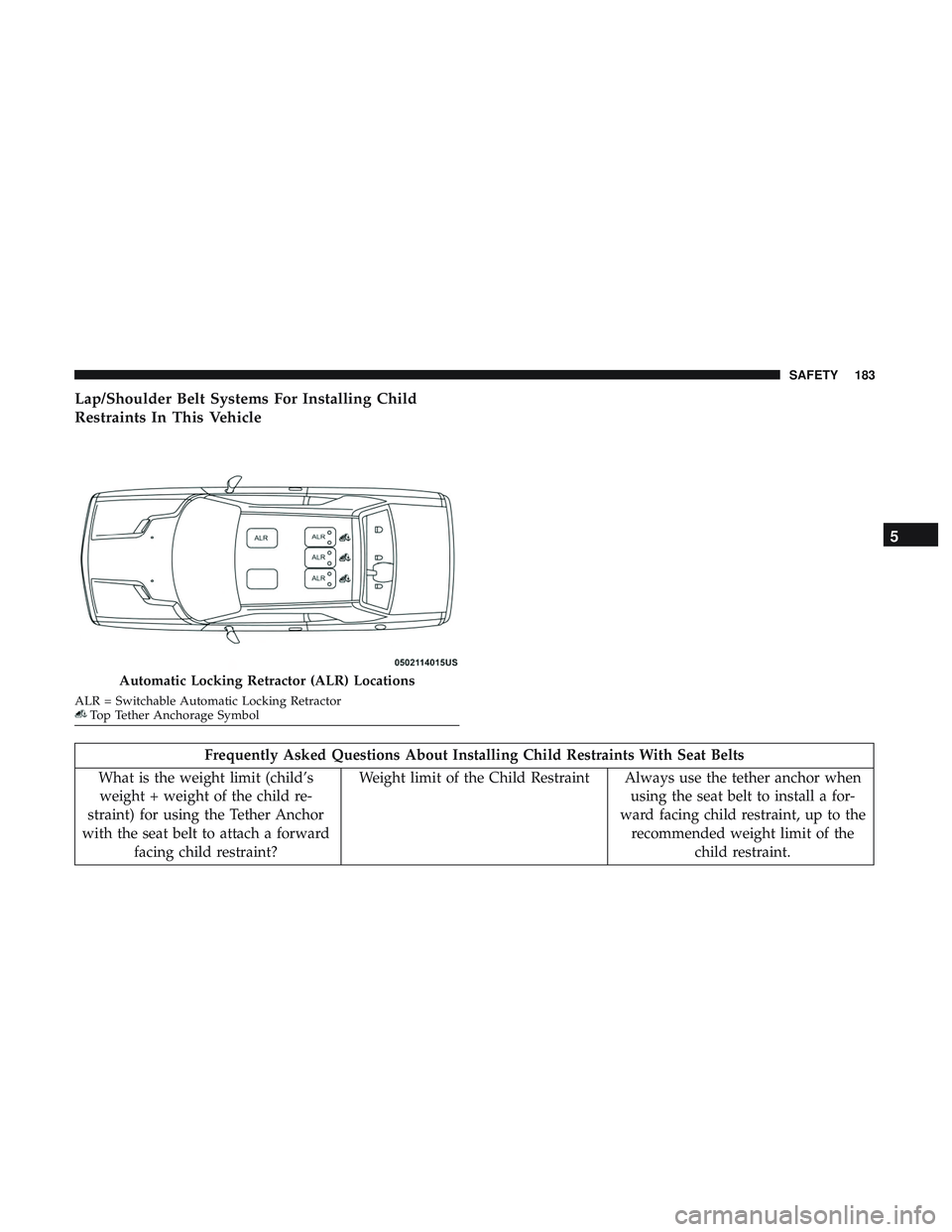
Lap/Shoulder Belt Systems For Installing Child
Restraints In This Vehicle
Frequently Asked Questions About Installing Child Restraints With Seat Belts
What is the weight limit (child’s weight + weight of the child re-
straint) for using the Tether Anchor
with the seat belt to attach a forward facing child restraint? Weight limit of the Child Restraint Always use the tether anchor when
using the seat belt to install a for-
ward facing child restraint, up to the recommended weight limit of the child restraint.
Automatic Locking Retractor (ALR) Locations
ALR = Switchable Automatic Locking RetractorTop Tether Anchorage Symbol
5
SAFETY 183
Page 186 of 516
Frequently Asked Questions About Installing Child Restraints With Seat Belts
Can the rear-facing child restraint
touch the back of the front passenger seat? Yes Contact between the front passenger
seat and the child restraint is al-
lowed, if the child restraint manufac- turer also allows contact.
Can the head restraints be removed? No
Can the buckle stalk be twisted to
tighten the seat belt against the belt path of the child restraint? No
Do not twist the buckle stalk in a
seating position with an ALR retractor.
Installing A Child Restraint With A Switchable
Automatic Locking Retractor (ALR):
Child restraint systems are designed to be secured in
vehicle seats by lap belts or the lap belt portion of a
lap/shoulder belt.
WARNING!
•Improper installation or failure to properly secure a
child restraint can lead to failure of the restraint. The
child could be badly injured or killed.
• Follow the child restraint manufacturer ’s directions
exactly when installing an infant or child restraint. 1. Place the child seat in the center of the seating position.
For some second row seats, you may need to recline the
seat and/or raise the head restraint to get a better fit. If
the rear seat can be moved forward and rearward in the
vehicle, you may wish to move it to its rear-most
position to make room for the child seat. You may also
move the front seat forward to allow more room for the
child seat.
2. Pull enough of the seat belt webbing from the retractor to pass it through the belt path of the child restraint. Do
not twist the belt webbing in the belt path.
3. Slide the latch plate into the buckle until you hear a “click.”
184 SAFETY
Page 187 of 516
4. Pull on the webbing to make the lap portion tightagainst the child seat.
5. To lock the seat belt, pull down on the shoulder part of the belt until you have pulled all the seat belt webbing
out of the retractor. Then, allow the webbing to retract
back into the retractor. As the webbing retracts, you will
hear a clicking sound. This means the seat belt is now in
the Automatic Locking mode.
6. Try to pull the webbing out of the retractor. If it is locked, you should not be able to pull out any webbing.
If the retractor is not locked, repeat step 5.
7. Finally, pull up on any excess webbing to tighten the lap portion around the child restraint while you push the
child restraint rearward and downward into the vehicle
seat.
8. If the child restraint has a top tether strap and the seating position has a top tether anchorage, connect the
tether strap to the anchorage and tighten the tether
strap. See the section “Installing Child Restraints Using
the Top Tether Anchorage” for directions to attach a
tether anchor. 9. Test that the child restraint is installed tightly by pulling
back and forth on the child seat at the belt path. It
should not move more than 1 inch (25.4 mm) in any
direction.
Any seat belt system will loosen with time, so check the
belt occasionally, and pull it tight if necessary.
Installing Child Restraints Using The Top Tether
Anchorage:
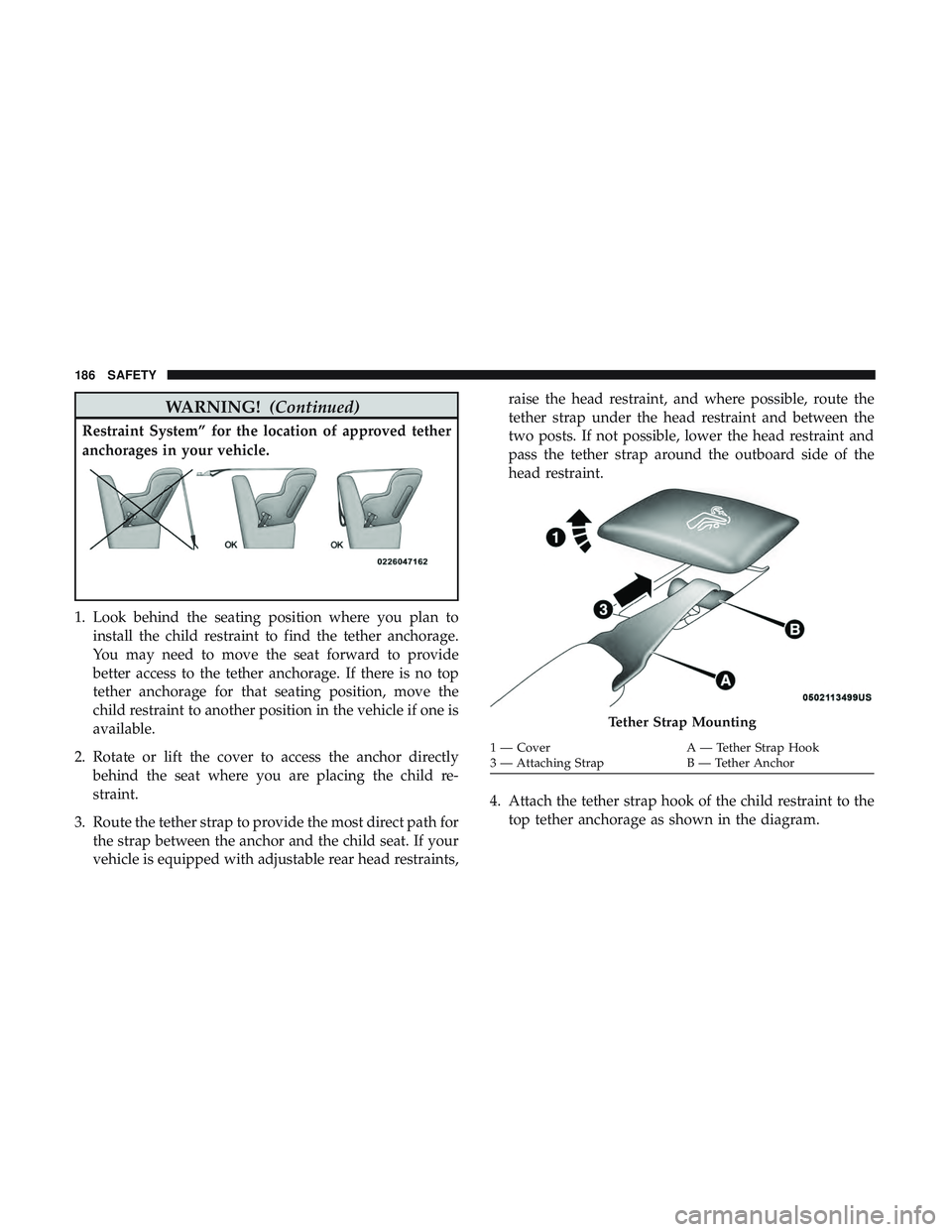
WARNING!
Do not attach a tether strap for a rear-facing car seat to
any location in front of the car seat, including the seat
frame or a tether anchorage. Only attach the tether
strap of a rear-facing car seat to the tether anchorage
that is approved for that seating position, located
behind the top of the vehicle seat. See the section
“Lower Anchors and Tethers for CHildren (LATCH)
(Continued)
5
SAFETY 185
Page 188 of 516
WARNING!(Continued)
Restraint System” for the location of approved tether
anchorages in your vehicle.
1. Look behind the seating position where you plan to
install the child restraint to find the tether anchorage.
You may need to move the seat forward to provide
better access to the tether anchorage. If there is no top
tether anchorage for that seating position, move the
child restraint to another position in the vehicle if one is
available.
2. Rotate or lift the cover to access the anchor directly behind the seat where you are placing the child re-
straint.
3. Route the tether strap to provide the most direct path for the strap between the anchor and the child seat. If your
vehicle is equipped with adjustable rear head restraints, raise the head restraint, and where possible, route the
tether strap under the head restraint and between the
two posts. If not possible, lower the head restraint and
pass the tether strap around the outboard side of the
head restraint.
4. Attach the tether strap hook of the child restraint to the top tether anchorage as shown in the diagram.
Tether Strap Mounting
1 — Cover A — Tether Strap Hook
3 — Attaching Strap B — Tether Anchor
186 SAFETY
Page 189 of 516
5. Remove slack in the tether strap according to the childrestraint manufacturer ’s instructions.
WARNING!
•An incorrectly anchored tether strap could lead to
increased head motion and possible injury to the
child. Use only the anchorage position directly be-
hind the child seat to secure a child restraint top
tether strap.
• If your vehicle is equipped with a split rear seat,
make sure the tether strap does not slip into the
opening between the seatbacks as you remove slack
in the strap.
Transporting Pets
Air Bags deploying in the front seat could harm your pet.
An unrestrained pet will be thrown about and possibly
injured, or injure a passenger during panic braking or in a
collision.
Pets should be restrained in the rear seat in pet harnesses or
pet carriers that are secured by seat belts.
SAFETY TIPS
Transporting Passengers
NEVER TRANSPORT PASSENGERS IN THE CARGO
AREA.
WARNING!
• Do not leave children or animals inside parked
vehicles in hot weather. Interior heat build-up may
cause serious injury or death.
• It is extremely dangerous to ride in a cargo area,
inside or outside of a vehicle. In a collision, people
riding in these areas are more likely to be seriously
injured or killed.
• Do not allow people to ride in any area of your
vehicle that is not equipped with seats and seat belts.
• Be sure everyone in your vehicle is in a seat and
using a seat belt properly.5
SAFETY 187
Page 502 of 516
Caps, FillerFuel ................................. .250
Oil (Engine) ........................ .329, 337
Radiator (Coolant Pressure) .................351
Carbon Monoxide Warning ................188, 396
Cargo Vehicle Loading ......................... .251
Car Washes .............................. .383
Cellular Phone ........................... .469
Certification Label ......................... .251
Chains, Tire ............................. .379
Changing A Flat Tire ....................... .358
Chart, Tire Sizing .......................... .360
Check Engine Light (Malfunction Indicator Light) ....119
Checking Your Vehicle For Safety ...............187
Checks, Safety ............................ .187
Child Restraint ........................... .171
Child Restraints Booster Seats ........................... .175
Child Seat Installation .....................184
How To Stow An unused ALR Seat Belt ........181
Infant And Child Restraints .................173
Lower Anchors And Tethers For Children .......177
Older Children And Child Restraints ...........174
Seating Positions ........................ .176Clean Air Gasoline
........................ .393
Cleaning Wheels ............................... .378
Climate Control ............................64
Cold Weather Operation ..................... .199
Compact Disc (CD) Maintenance ................489
Compact Spare Tire ........................ .376
Contract, Service .......................... .494
Cooling Pressure Cap (Radiator Cap) ............351
Cooling System ........................... .349
Adding Coolant (Antifreeze) .................350
Coolant Level ....................... .349, 352
Cooling Capacity ........................ .396
Disposal
Of Used Coolant ..................352
Drain, Flush, And Refill ....................349
Inspection ............................. .352
Points To Remember ..................... .352
Pressure Cap ........................... .351
Radiator Cap .......................... .351
Selection Of Coolant (Antifreeze) .......350, 396, 398
Corrosion Protection ....................... .382
Cruise Control (Speed Control) ..............219, 222
Cruise Light ..............................117
Customer Assistance ....................... .492
Customer Programmable Features ...............405
500 INDEX
Page 510 of 516
Refrigerant........................... .340, 341
Release, Hood ..............................78
Reminder, Lights On .........................57
Reminder, Seat Belt ........................ .149
Remote Keyless Entry Arm The Alarm ..........................31
Panic Alarm .............................19
Programming Additional Key Fobs ..........22, 30
Unlatch The Trunk ........................19
Remote Starting Exit Remote Start Mode .....................28
Uconnect Customer Programmable Features . . .29, 418
Uconnect Settings ..................... .29, 418
Remote Trunk Release ........................79
Replacement Bulbs ........................ .275
Replacement Keys ....................... .22, 30
Replacement Tires ......................... .373
Reporting Safety Defects .....................495
Restraints, Child .......................... .171
Restraints, Head ......................... .46, 47
Rocking Vehicle When Stuck ...................311
Rotation, Tires ............................ .380
Safety Checks Inside Vehicle ...................188
Safety Checks Outside Vehicle .................190Safety Defects, Reporting
.....................495
Safety, Exhaust Gas ........................ .188
Safety Information, Tire ..................... .358
Safety Tips .............................. .187
Schedule, Maintenance ................319, 320, 324
Seat Belt Reminder ........................ .108
Seat Belts ............................ .149, 188
Automatic Locking Retractor (ALR) ...........156
Child Restraints ........................ .171
Energy Management Feature ................156
Extender .............................. .155
Front Seat ...................... .149, 150, 152
Inspection ............................. .188
Lap/Shoulder Belt Operation ................152
Lap/Shoulder Belts ...................... .150
Lap/Shoulder
Belt Untwisting ...............154
Operating Instructions .....................152
Pregnant Women ........................ .155
Pretensioners .......................... .156
Rear Seat ............................. .150
Reminder ............................. .149
Seat Belt Extender ....................... .155
Seat Belt Pretensioner .....................156
Untwisting Procedure .....................154
Seat Belts Maintenance ...................... .385
508 INDEX