clutch DODGE CHALLENGER 2020 User Guide
[x] Cancel search | Manufacturer: DODGE, Model Year: 2020, Model line: CHALLENGER, Model: DODGE CHALLENGER 2020Pages: 396, PDF Size: 16.64 MB
Page 160 of 396
158STARTING AND OPERATING
(Continued)
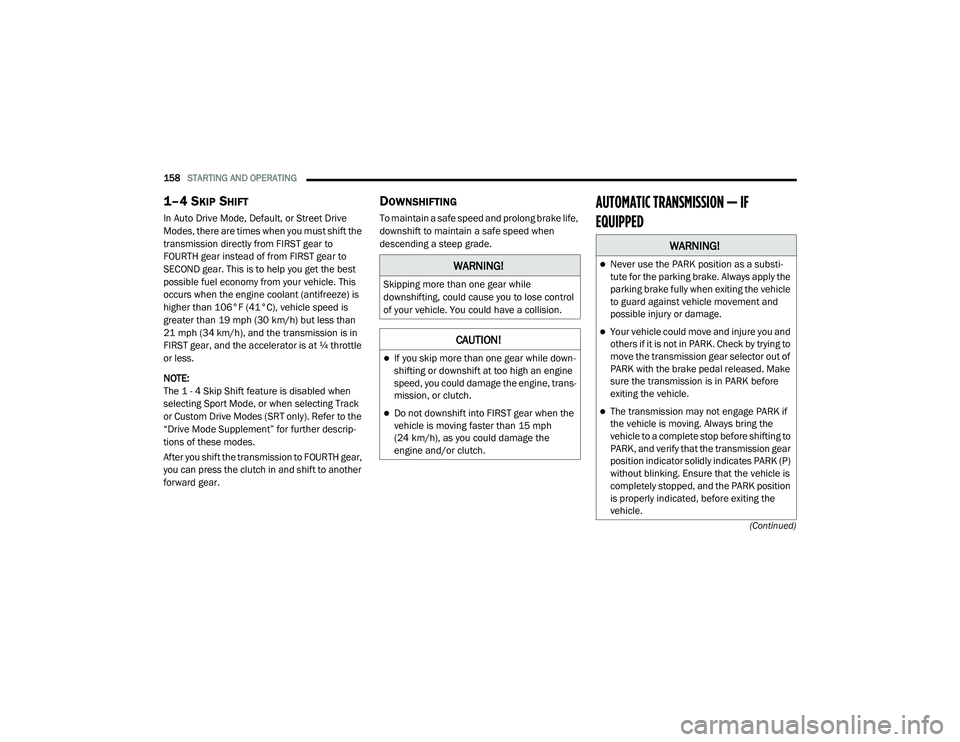
1–4 SKIP SHIFT
In Auto Drive Mode, Default, or Street Drive
Modes, there are times when you must shift the
transmission directly from FIRST gear to
FOURTH gear instead of from FIRST gear to
SECOND gear. This is to help you get the best
possible fuel economy from your vehicle. This
occurs when the engine coolant (antifreeze) is
higher than 106°F (41°C), vehicle speed is
greater than 19 mph (30 km/h) but less than
21 mph (34 km/h), and the transmission is in
FIRST gear, and the accelerator is at ¼ throttle
or less.
NOTE:
The 1 - 4 Skip Shift feature is disabled when
selecting Sport Mode, or when selecting Track
or Custom Drive Modes (SRT only). Refer to the
“Drive Mode Supplement” for further descrip-
tions of these modes.
After you shift the transmission to FOURTH gear,
you can press the clutch in and shift to another
forward gear.
DOWNSHIFTING
To maintain a safe speed and prolong brake life,
downshift to maintain a safe speed when
descending a steep grade.
AUTOMATIC TRANSMISSION — IF
EQUIPPED
WARNING!
Skipping more than one gear while
downshifting, could cause you to lose control
of your vehicle. You could have a collision.
CAUTION!
If you skip more than one gear while down -
shifting or downshift at too high an engine
speed, you could damage the engine, trans -
mission, or clutch.
Do not downshift into FIRST gear when the
vehicle is moving faster than 15 mph
(24 km/h), as you could damage the
engine and/or clutch.
WARNING!
Never use the PARK position as a substi -
tute for the parking brake. Always apply the
parking brake fully when exiting the vehicle
to guard against vehicle movement and
possible injury or damage.
Your vehicle could move and injure you and
others if it is not in PARK. Check by trying to
move the transmission gear selector out of
PARK with the brake pedal released. Make
sure the transmission is in PARK before
exiting the vehicle.
The transmission may not engage PARK if
the vehicle is moving. Always bring the
vehicle to a complete stop before shifting to
PARK, and verify that the transmission gear
position indicator solidly indicates PARK (P)
without blinking. Ensure that the vehicle is
completely stopped, and the PARK position
is properly indicated, before exiting the
vehicle.
20_LA_OM_EN_USC_t.book Page 158
Page 171 of 396
STARTING AND OPERATING169
(Continued)
The following conditions will also deactivate the
speed control without erasing the set speed
from memory:
Vehicle parking brake is applied
Stability event occurs
Gear selector is moved out of DRIVE
Engine overspeed occurs
Clutch pedal is pressed (manual transmis -
sion only)
Pushing the on/off button or placing the ignition
in the OFF position erases the set speed from
memory.
ADAPTIVE CRUISE CONTROL (ACC) — IF
EQUIPPED
Adaptive Cruise Control (ACC) increases the
driving convenience provided by cruise control
while traveling on highways and major
roadways. However, it is not a safety system
and not designed to prevent collisions. Speed
Control function performs differently. Please
refer to the proper section within this chapter.
ACC will allow you to keep cruise control
engaged in light to moderate traffic conditions
without the constant need to reset your cruise
control. ACC utilizes a radar sensor and a forward facing
camera designed to detect a vehicle directly
ahead of you.
NOTE:
If the sensor does not detect a vehicle ahead
of you, ACC will maintain a fixed set speed.
If the ACC sensor detects a vehicle ahead,
ACC will apply limited braking or accelerate
(not to exceed the original set speed) auto
-
matically to maintain a preset following
distance, while matching the speed of the
vehicle ahead.
The Cruise Control system has two control
modes:
Adaptive Cruise Control mode for main -
taining an appropriate distance between
vehicles.
Normal (Fixed Speed) Cruise Control mode
for cruising at a constant preset speed. For
additional information, refer to “Normal
(Fixed Speed) Cruise Control Mode” in this
section. NOTE:
Normal (Fixed Speed) Cruise Control will not
react to preceding vehicles. Always be aware of
the mode selected.
You can change the mode by using the Cruise
Control buttons. The two control modes
function differently. Always confirm which mode
is selected.
WARNING!
Adaptive Cruise Control (ACC) is a conve
-
nience system. It is not a substitute for
active driver involvement. It is always the
driver’s responsibility to be attentive of
road, traffic, and weather conditions,
vehicle speed, distance to the vehicle
ahead; and, most importantly, brake opera -
tion to ensure safe operation of the vehicle
under all road conditions. Your complete
attention is always required while driving to
maintain safe control of your vehicle.
Failure to follow these warnings can result
in a collision and death or serious personal
injury.
5
20_LA_OM_EN_USC_t.book Page 169
Page 211 of 396
IN CASE OF EMERGENCY209
CavityCartridge Fuse Mini-Fuse Description
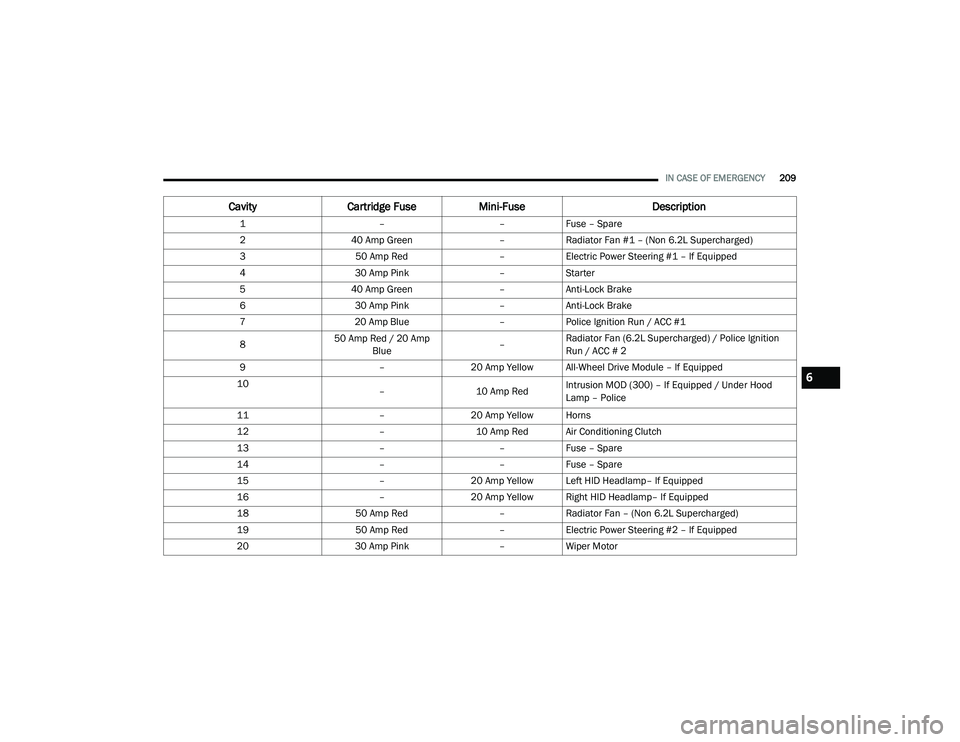
1––Fuse – Spare
2 40 Amp Green –Radiator Fan #1 – (Non 6.2L Supercharged)
3 50 Amp Red –Electric Power Steering #1 – If Equipped
4 30 Amp Pink –Starter
5 40 Amp Green –Anti-Lock Brake
6 30 Amp Pink –Anti-Lock Brake
7 20 Amp Blue –Police Ignition Run / ACC #1
8 50 Amp Red / 20 Amp
Blue –Radiator Fan (6.2L Supercharged) / Police Ignition
Run / ACC # 2
9 –20 Amp Yellow All-Wheel Drive Module – If Equipped
10 –
10 Amp RedIntrusion MOD (300) – If Equipped / Under Hood
Lamp – Police
11 –20 Amp Yellow Horns
12 –10 Amp Red Air Conditioning Clutch
13 ––Fuse – Spare
14 ––Fuse – Spare
15 –20 Amp Yellow Left HID Headlamp– If Equipped
16 –20 Amp Yellow Right HID Headlamp– If Equipped
18 50 Amp Red –Radiator Fan – (Non 6.2L Supercharged)
19 50 Amp Red –Electric Power Steering #2 – If Equipped
20 30 Amp Pink –Wiper Motor
6
20_LA_OM_EN_USC_t.book Page 209
Page 212 of 396
210IN CASE OF EMERGENCY
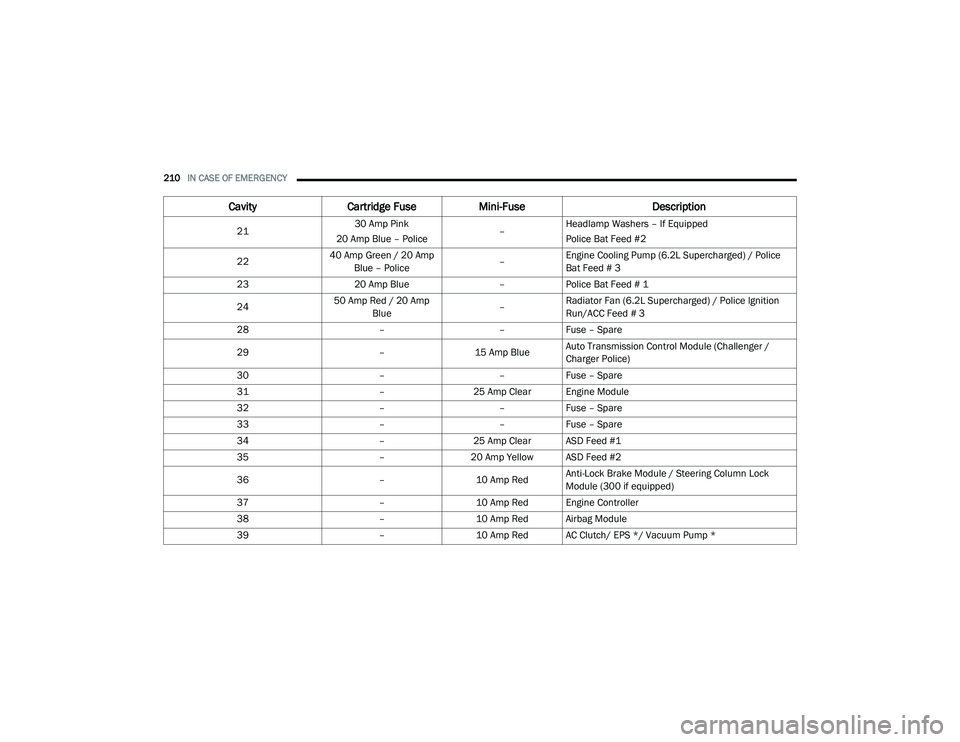
21 30 Amp Pink
20 Amp Blue – Police –Headlamp Washers – If Equipped
Police Bat Feed #2
22 40 Amp Green / 20 Amp
Blue – Police –Engine Cooling Pump (6.2L Supercharged) / Police
Bat Feed # 3
23 20 Amp Blue –Police Bat Feed # 1
24 50 Amp Red / 20 Amp
Blue –Radiator Fan (6.2L Supercharged) / Police Ignition
Run/ACC Feed # 3
28 ––Fuse – Spare
29 –15 Amp BlueAuto Transmission Control Module (Challenger /
Charger Police)
30 ––Fuse – Spare
31 –25 Amp Clear Engine Module
32 ––Fuse – Spare
33 ––Fuse – Spare
34 –25 Amp Clear ASD Feed #1
35 –20 Amp Yellow ASD Feed #2
36 –10 Amp RedAnti-Lock Brake Module / Steering Column Lock
Module (300 if equipped)
37 –10 Amp Red Engine Controller
38 –10 Amp Red Airbag Module
39 –10 Amp Red AC Clutch/ EPS */ Vacuum Pump *
Cavity Cartridge Fuse Mini-Fuse Description
20_LA_OM_EN_USC_t.book Page 210
Page 233 of 396
IN CASE OF EMERGENCY231
FREEING A STUCK VEHICLE
If your vehicle becomes stuck in mud, sand, or
snow, it can often be moved using a rocking
motion. Turn the steering wheel right and left to
clear the area around the front wheels. For
vehicles with automatic transmission, push and
hold the lock button on the gear selector. Then
shift back and forth between DRIVE and
REVERSE (with automatic transmission) or
FIRST gear and REVERSE (with manual
transmission), while gently pressing the
accelerator. Use the least amount of
accelerator pedal pressure that will maintain
the rocking motion, without spinning the wheels
or racing the engine.
NOTE:
For vehicles with automatic transmission: Shifts
between DRIVE and REVERSE can only be
achieved at wheel speeds of 5 mph (8 km/h) or
less. Whenever the transmission remains in
NEUTRAL for more than two seconds, you must
press the brake pedal to engage DRIVE or
REVERSE. NOTE:
Push the ESC OFF switch (if necessary), to place
the Electronic Stability Control (ESC) system in
“Partial Off” mode, before rocking the vehicle.
Refer to “Electronic Brake Control System” in
“Safety” for further information. Once the
vehicle has been freed, push the ESC OFF
switch again to restore “ESC On” mode.
CAUTION!
Racing the engine or spinning the wheels may
lead to transmission overheating and failure.
Allow the engine to idle with the transmission
in NEUTRAL for at least one minute after
every five rocking-motion cycles. This will
minimize overheating and reduce the risk of
clutch or transmission failure during
prolonged efforts to free a stuck vehicle.
WARNING!
Fast spinning tires can be dangerous. Forces
generated by excessive wheel speeds may
cause damage, or even failure, of the axle
and tires. A tire could explode and injure
someone. Do not spin your vehicle's wheels
faster than 30 mph (48 km/h) or for longer
than 30 seconds continuously without
stopping when you are stuck and do not let
anyone near a spinning wheel, no matter
what the speed.
CAUTION!
When “rocking” a stuck vehicle by shifting
between DRIVE / FIRST gear and REVERSE,
do not spin the wheels faster than 15 mph
(24 km/h), or drivetrain damage may
result.
Revving the engine or spinning the wheels
too fast may lead to transmission over -
heating and failure. It can also damage the
tires. Do not spin the wheels above 30 mph
(48 km/h) while in gear (no transmission
shifting occurring).
6
20_LA_OM_EN_USC_t.book Page 231
Page 269 of 396
SERVICING AND MAINTENANCE267
CLUTCH HYDRAULIC SYSTEM — MANUAL
T
RANSMISSION (IF EQUIPPED)
The clutch hydraulic system is fed by a
segregated volume of fluid within the brake
system master cylinder reservoir. In the event of
leakage or wear, use only the manufacturer's
recommended brake fluid. Refer to “Fluids And
Lubricants” in “Technical Specifications” for
further information.
MANUAL TRANSMISSION — IF EQUIPPED
Fluid Level Check
Check the fluid level by removing the fill plug on
the left side of the transmission. The fluid level
should be 1/4 inch (6.4mm) below the bottom
of the fill hole. Add fluid, if necessary, to
maintain the proper level. Refer to “Fluids And
Lubricants” in “Technical Specifications” for
further information.
Change Transmission Fluid
If contaminated with water, change the fluid
immediately. See an authorized dealer for
service.
Refer to the “Maintenance Plan” in this section
for the proper maintenance intervals.
AUTOMATIC TRANSMISSION — IF
E
QUIPPED
Selection Of Lubricant
It is important to use the proper transmission
fluid to ensure optimum transmission
performance and life. Use only the
manufacturer's specified transmission fluid.
Refer to “Fluids And Lubricants” in “Technical
Specifications” for fluid specifications. It is
important to maintain the transmission fluid at
the correct level using the recommended fluid.
NOTE:
No chemical flushes should be used in any
transmission; only the approved lubricant
should be used.
Special Additives
The manufacturer strongly recommends
against using any special additives in the
transmission. Automatic Transmission Fluid
(ATF) is an engineered product and its
performance may be impaired by supplemental
additives. Therefore, do not add any fluid
additives to the transmission. Avoid using
transmission sealers as they may adversely
affect seals.
CAUTION!
Using a transmission fluid other than the
manufacturer's recommended fluid may
cause deterioration in transmission shift
quality and/or damage to the transmission.
Refer to “Fluids And Lubricants” in “Technical
Specifications” for fluid specifications.
CAUTION!
Using a transmission fluid other than the
manufacturer’s recommended fluid may
cause deterioration in transmission shift
quality and/or torque converter shudder.
Refer to “Fluids And Lubricants” in “Technical
Specifications” for fluid specifications.
CAUTION!
Do not use chemical flushes in your
transmission as the chemicals can damage
your transmission components. Such damage
is not covered by the New Vehicle Limited
Warranty.
7
20_LA_OM_EN_USC_t.book Page 267