trailer DODGE CHALLENGER 2020 Owner's Manual
[x] Cancel search | Manufacturer: DODGE, Model Year: 2020, Model line: CHALLENGER, Model: DODGE CHALLENGER 2020Pages: 396, PDF Size: 16.64 MB
Page 236 of 396
234
SERVICING AND MAINTENANCE
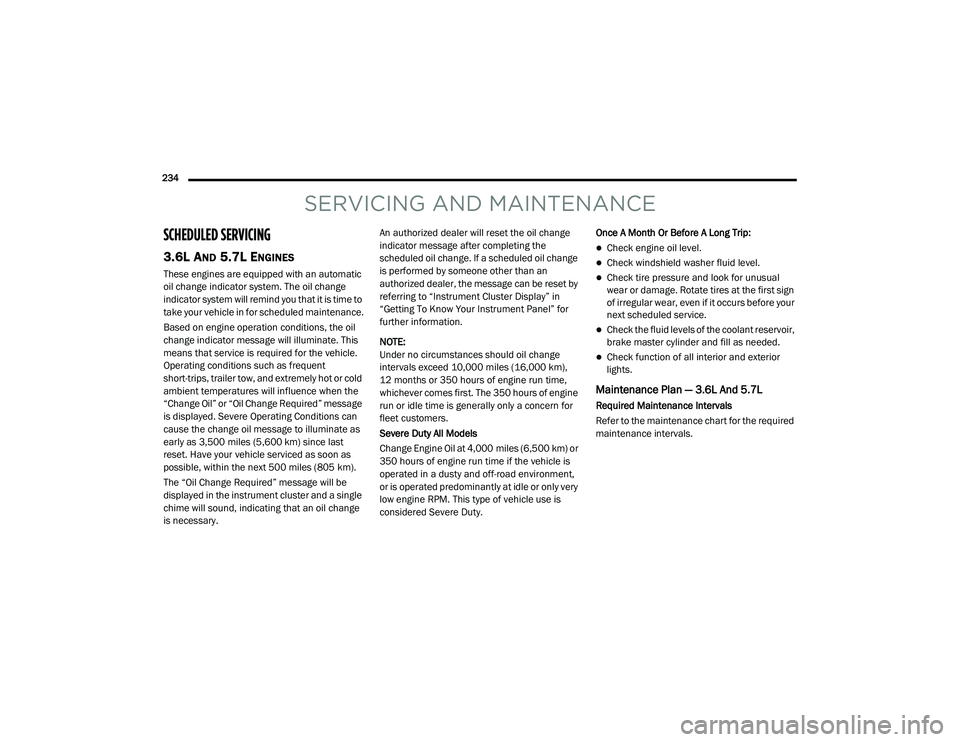
SCHEDULED SERVICING
3.6L AND 5.7L ENGINES
These engines are equipped with an automatic
oil change indicator system. The oil change
indicator system will remind you that it is time to
take your vehicle in for scheduled maintenance.
Based on engine operation conditions, the oil
change indicator message will illuminate. This
means that service is required for the vehicle.
Operating conditions such as frequent
short-trips, trailer tow, and extremely hot or cold
ambient temperatures will influence when the
“Change Oil” or “Oil Change Required” message
is displayed. Severe Operating Conditions can
cause the change oil message to illuminate as
early as 3,500 miles (5,600 km) since last
reset. Have your vehicle serviced as soon as
possible, within the next 500 miles (805 km).
The “Oil Change Required” message will be
displayed in the instrument cluster and a single
chime will sound, indicating that an oil change
is necessary.An authorized dealer will reset the oil change
indicator message after completing the
scheduled oil change. If a scheduled oil change
is performed by someone other than an
authorized dealer, the message can be reset by
referring to “Instrument Cluster Display” in
“Getting To Know Your Instrument Panel” for
further information.
NOTE:
Under no circumstances should oil change
intervals exceed 10,000 miles (16,000 km),
12 months or 350 hours of engine run time,
whichever comes first. The 350 hours of engine
run or idle time is generally only a concern for
fleet customers.
Severe Duty All Models
Change Engine Oil at 4,000 miles (6,500 km) or
350 hours of engine run time if the vehicle is
operated in a dusty and off-road environment,
or is operated predominantly at idle or only very
low engine RPM. This type of vehicle use is
considered Severe Duty.
Once A Month Or Before A Long Trip:
Check engine oil level.
Check windshield washer fluid level.
Check tire pressure and look for unusual
wear or damage. Rotate tires at the first sign
of irregular wear, even if it occurs before your
next scheduled service.
Check the fluid levels of the coolant reservoir,
brake master cylinder and fill as needed.
Check function of all interior and exterior
lights.
Maintenance Plan — 3.6L And 5.7L
Required Maintenance Intervals
Refer to the maintenance chart for the required
maintenance intervals.
20_LA_OM_EN_USC_t.book Page 234
Page 239 of 396
SERVICING AND MAINTENANCE237
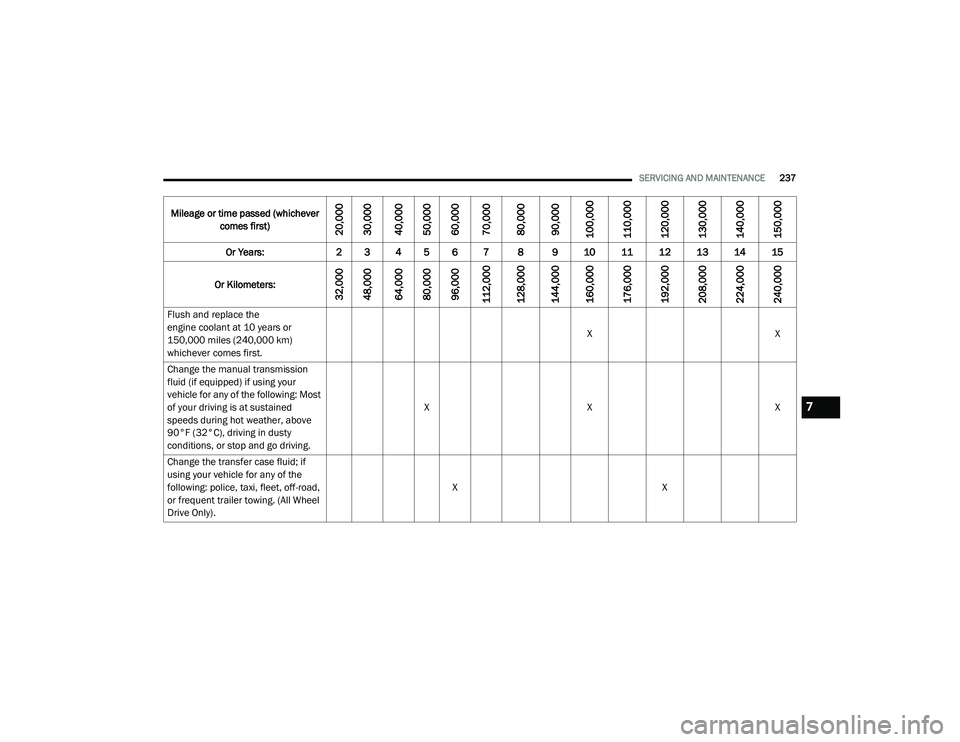
Flush and replace the
engine coolant at 10 years or
150,000 miles (240,000 km)
whichever comes first. X
X
Change the manual transmission
fluid (if equipped) if using your
vehicle for any of the following: Most
of your driving is at sustained
speeds during hot weather, above
90°F (32°C), driving in dusty
conditions, or stop and go driving. X
X X
Change the transfer case fluid; if
using your vehicle for any of the
following: police, taxi, fleet, off-road,
or frequent trailer towing. (All Wheel
Drive Only). X
X
Mileage or time passed (whichever
comes first)
20,000
30,000
40,000
50,000
60,000
70,000
80,000
90,000
100,000
110,000
120,000
130,000
140,000
150,000
Or Years: 2 3 4 5 6 7 8 9 10 11 12 13 14 15
Or Kilometers:
32,000
48,000
64,000
80,000
96,000
112,000
128,000
144,000
160,000
176,000
192,000
208,000
224,000
240,000
7
20_LA_OM_EN_USC_t.book Page 237
Page 240 of 396
238SERVICING AND MAINTENANCE
(Continued)
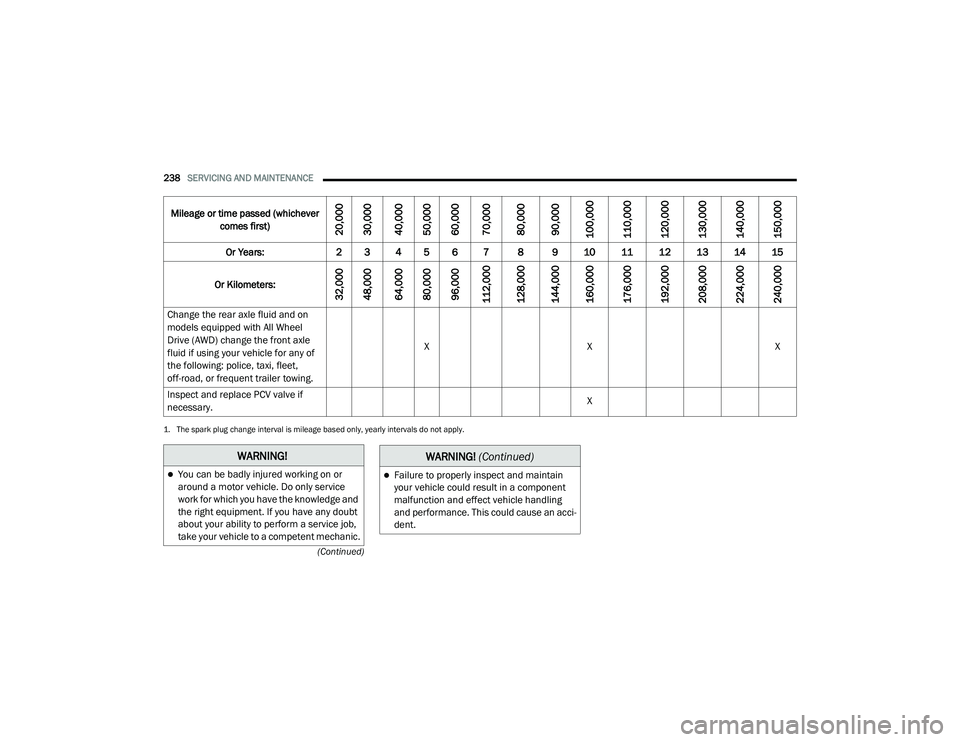
Change the rear axle fluid and on
models equipped with All Wheel
Drive (AWD) change the front axle
fluid if using your vehicle for any of
the following: police, taxi, fleet,
off-road, or frequent trailer towing. X
X X
Inspect and replace PCV valve if
necessary. X
1. The spark plug change interval is mileage based only, yearly intervals do not apply.
Mileage or time passed (whichever
comes first)
20,000
30,000
40,000
50,000
60,000
70,000
80,000
90,000
100,000
110,000
120,000
130,000
140,000
150,000
Or Years: 2 3 4 5 6 7 8 9 10 11 12 13 14 15
Or Kilometers:
32,000
48,000
64,000
80,000
96,000
112,000
128,000
144,000
160,000
176,000
192,000
208,000
224,000
240,000
WARNING!
You can be badly injured working on or
around a motor vehicle. Do only service
work for which you have the knowledge and
the right equipment. If you have any doubt
about your ability to perform a service job,
take your vehicle to a competent mechanic.Failure to properly inspect and maintain
your vehicle could result in a component
malfunction and effect vehicle handling
and performance. This could cause an acci -
dent.
WARNING! (Continued)
20_LA_OM_EN_USC_t.book Page 238
Page 245 of 396
SERVICING AND MAINTENANCE243
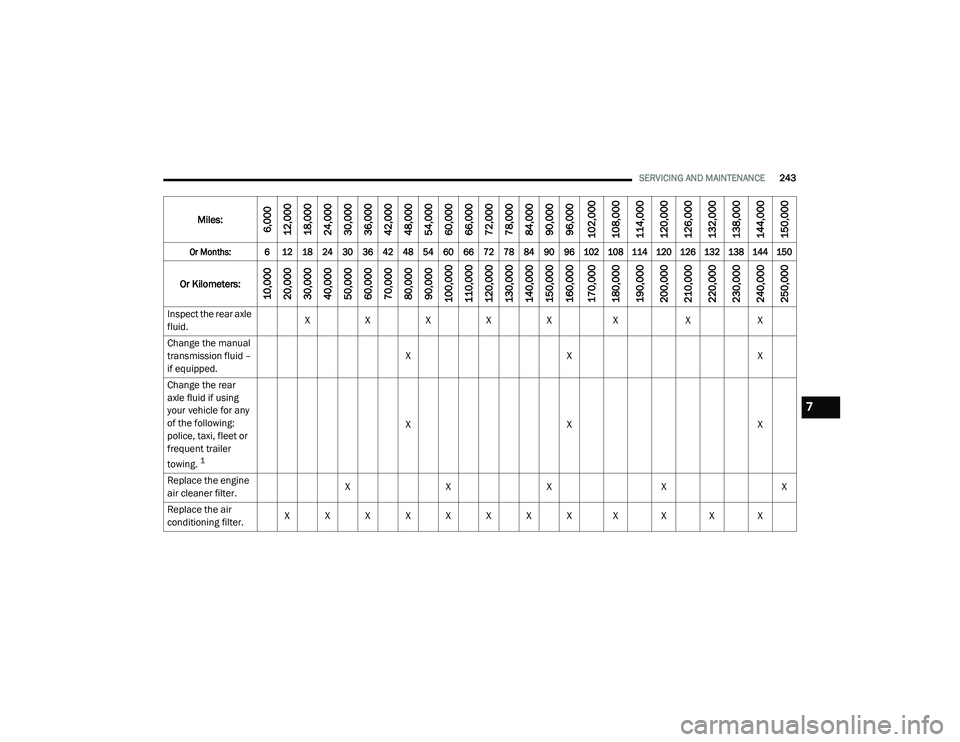
Inspect the rear axle
fluid.X
XXXX X XX
Change the manual
transmission fluid –
if equipped. X
X X
Change the rear
axle fluid if using
your vehicle for any
of the following:
police, taxi, fleet or
frequent trailer
towing.
1
X X X
Replace the engine
air cleaner filter. X
XX X X
Replace the air
conditioning filter. X X X X X X X X X X X X
Miles:
6,000
12,000
18,000
24,000
30,000
36,000
42,000
48,000
54,000
60,000
66,000
72,000
78,000
84,000
90,000
96,000
102,000
108,000
114,000
120,000
126,000
132,000
138,000
144,000
150,000
Or Months: 6 12 18 24 30 36 42 48 54 60 66 72 78 84 90 96 102 108 114 120 126 132 138 144 150
Or Kilometers:
10,000
20,000
30,000
40,000
50,000
60,000
70,000
80,000
90,000
100,000
110,000
120,000
130,000
140,000
150,000
160,000
170,000
180,000
190,000
200,000
210,000
220,000
230,000
240,000
250,0 00
7
20_LA_OM_EN_USC_t.book Page 243
Page 276 of 396
274SERVICING AND MAINTENANCE
For further information on GAWRs, vehicle
loading, and trailer towing, refer to “Vehicle
Loading” in the “Starting And Operating”
section of this manual.
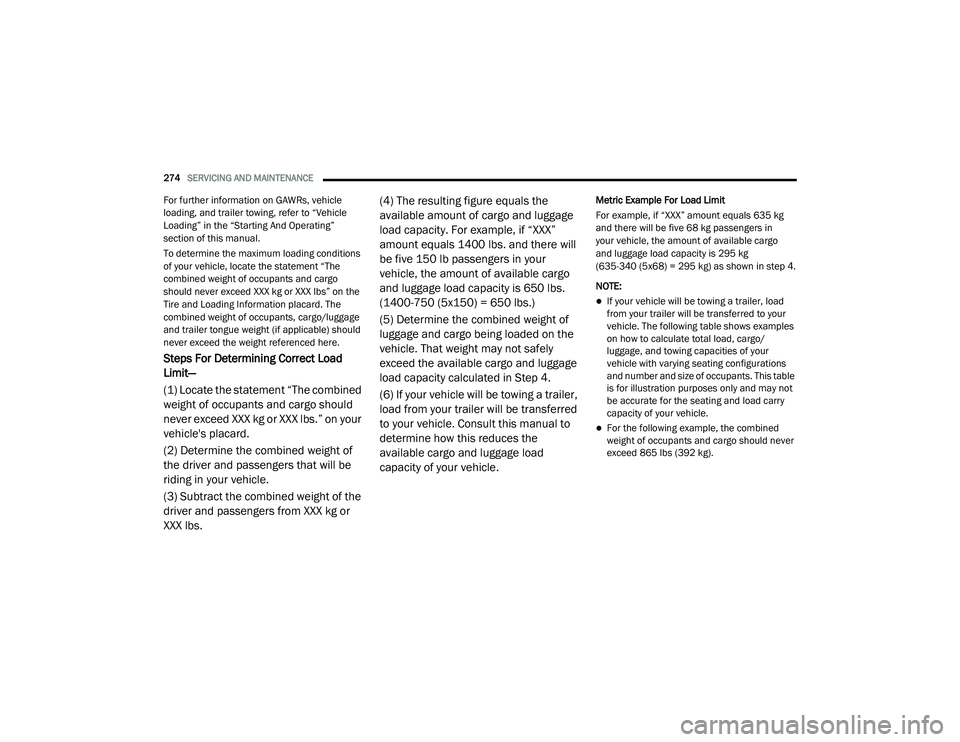
To determine the maximum loading conditions
of your vehicle, locate the statement “The
combined weight of occupants and cargo
should never exceed XXX kg or XXX lbs” on the
Tire and Loading Information placard. The
combined weight of occupants, cargo/luggage
and trailer tongue weight (if applicable) should
never exceed the weight referenced here.
Steps For Determining Correct Load
Limit—
(1) Locate the statement “The combined
weight of occupants and cargo should
never exceed XXX kg or XXX lbs.” on your
vehicle's placard.
(2) Determine the combined weight of
the driver and passengers that will be
riding in your vehicle.
(3) Subtract the combined weight of the
driver and passengers from XXX kg or
XXX lbs. (4) The resulting figure equals the
available amount of cargo and luggage
load capacity. For example, if “XXX”
amount equals 1400 lbs. and there will
be five 150 lb passengers in your
vehicle, the amount of available cargo
and luggage load capacity is 650 lbs.
(1400-750 (5x150) = 650 lbs.)
(5) Determine the combined weight of
luggage and cargo being loaded on the
vehicle. That weight may not safely
exceed the available cargo and luggage
load capacity calculated in Step 4.
(6) If your vehicle will be towing a trailer,
load from your trailer will be transferred
to your vehicle. Consult this manual to
determine how this reduces the
available cargo and luggage load
capacity of your vehicle.
Metric Example For Load Limit
For example, if “XXX” amount equals 635 kg
and there will be five 68 kg passengers in
your vehicle, the amount of available cargo
and luggage load capacity is 295 kg
(635-340 (5x68) = 295 kg) as shown in step 4.
NOTE:
If your vehicle will be towing a trailer, load
from your trailer will be transferred to your
vehicle. The following table shows examples
on how to calculate total load, cargo/
luggage, and towing capacities of your
vehicle with varying seating configurations
and number and size of occupants. This table
is for illustration purposes only and may not
be accurate for the seating and load carry
capacity of your vehicle.
For the following example, the combined
weight of occupants and cargo should never
exceed 865 lbs (392 kg).
20_LA_OM_EN_USC_t.book Page 274
Page 280 of 396
278SERVICING AND MAINTENANCE
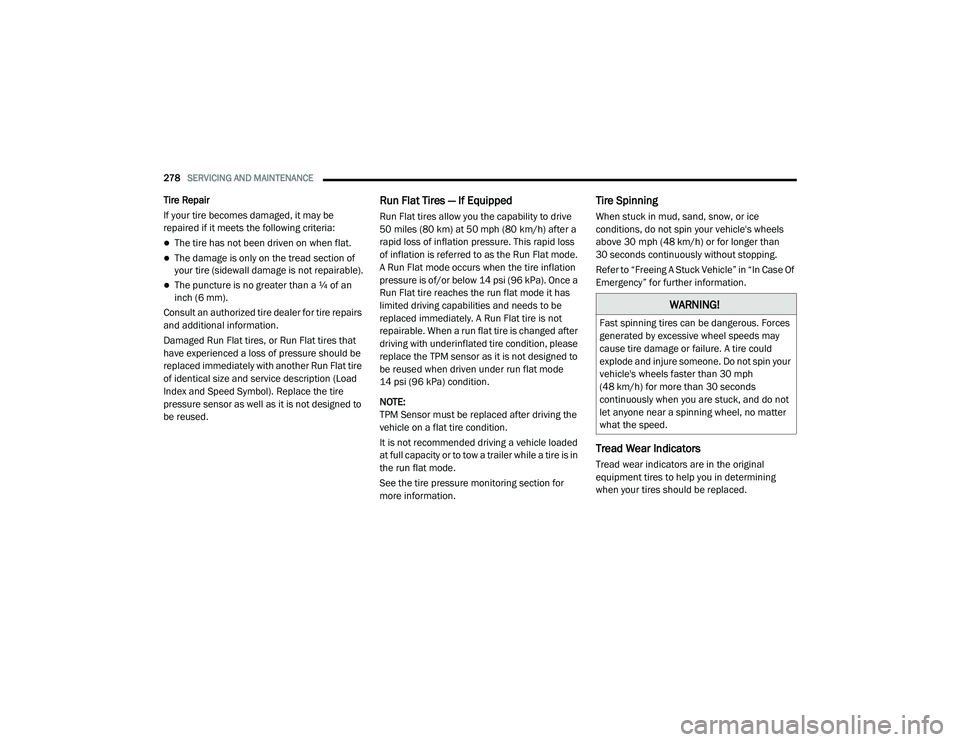
Tire Repair
If your tire becomes damaged, it may be
repaired if it meets the following criteria:
The tire has not been driven on when flat.
The damage is only on the tread section of
your tire (sidewall damage is not repairable).
The puncture is no greater than a ¼ of an
inch (6 mm).
Consult an authorized tire dealer for tire repairs
and additional information.
Damaged Run Flat tires, or Run Flat tires that
have experienced a loss of pressure should be
replaced immediately with another Run Flat tire
of identical size and service description (Load
Index and Speed Symbol). Replace the tire
pressure sensor as well as it is not designed to
be reused.
Run Flat Tires — If Equipped
Run Flat tires allow you the capability to drive
50 miles (80 km) at 50 mph (80 km/h) after a
rapid loss of inflation pressure. This rapid loss
of inflation is referred to as the Run Flat mode.
A Run Flat mode occurs when the tire inflation
pressure is of/or below 14 psi (96 kPa). Once a
Run Flat tire reaches the run flat mode it has
limited driving capabilities and needs to be
replaced immediately. A Run Flat tire is not
repairable. When a run flat tire is changed after
driving with underinflated tire condition, please
replace the TPM sensor as it is not designed to
be reused when driven under run flat mode
14 psi (96 kPa) condition.
NOTE:
TPM Sensor must be replaced after driving the
vehicle on a flat tire condition.
It is not recommended driving a vehicle loaded
at full capacity or to tow a trailer while a tire is in
the run flat mode.
See the tire pressure monitoring section for
more information.
Tire Spinning
When stuck in mud, sand, snow, or ice
conditions, do not spin your vehicle's wheels
above 30 mph (48 km/h) or for longer than
30 seconds continuously without stopping.
Refer to “Freeing A Stuck Vehicle” in “In Case Of
Emergency” for further information.
Tread Wear Indicators
Tread wear indicators are in the original
equipment tires to help you in determining
when your tires should be replaced.
WARNING!
Fast spinning tires can be dangerous. Forces
generated by excessive wheel speeds may
cause tire damage or failure. A tire could
explode and injure someone. Do not spin your
vehicle's wheels faster than 30 mph
(48 km/h) for more than 30 seconds
continuously when you are stuck, and do not
let anyone near a spinning wheel, no matter
what the speed.
20_LA_OM_EN_USC_t.book Page 278
Page 385 of 396
383
Engine Oil Viscosity
.............................. 253, 254Engine Oil Viscosity Chart.............................. 253Enhanced Accident Response
Feature................................................ 128, 233Ethanol.......................................................... 295Exhaust Gas Cautions.......................... 145, 296Exhaust System................................... 145, 261Exterior Lighting............................................... 40Exterior Lights......................................... 40, 147
F
Filler Location Fuel........................................ 188Filters Air Cleaner................................................. 255Air Conditioning.................................. 54, 258Engine Oil............................... 255, 299, 302Engine Oil Disposal................................... 255Flashers......................................................... 199Hazard Warning......................................... 199Turn Signals................................ 43, 89, 147Flash-To-Pass.................................................. 42Flooded Engine Starting................................ 152Fluid Capacities................................... 297, 298Fluid Leaks.................................................... 147Fluid Level ChecksBrake........................................................ 266Cooling System.......................................... 262Engine Oil.................................................. 250Transfer Case............................................ 268Fluid, Brake....................... 299, 301, 302, 304
Fluids And Lubricants.......................... 299, 302Fog Lights........................................................ 43Fold-Flat Seats.......................................... 29, 30Forward Collision Warning............................ 105Freeing A Stuck Vehicle................................ 231Fuel............................................................... 293Additives................................................... 295Clean Air................................................... 294Ethanol..................................................... 295Filler Cap (Gas Cap).................................. 188Gasoline................................................... 293Materials Added....................................... 295Methanol.................................................. 295Octane Rating......................... 293, 299, 302Requirements........................................... 293Specifications.................................. 299, 302Tank Capacity.................................. 297, 298Fueling.......................................................... 188Fuses............................................................ 207
G
Garage Door Opener (HomeLink)..................... 59Gas Cap (Fuel Filler Cap).............................. 188Gasoline, Clean Air........................................ 294Gasoline, Reformulated................................ 294Gear Ranges................................................. 161Glass Cleaning.............................................. 290Gross Axle Weight Rating..................... 189, 190Gross Vehicle Weight Rating................ 189, 190GVWR............................................................ 189
H
HazardDriving Through Flowing, Rising, Or Shallow Standing Water
....................... 197Hazard Warning Flashers.............................. 199Head Restraints........................................34, 35Head Rests............................................... 34, 35HeadlightsAutomatic....................................................42Cleaning.................................................... 288High Beam/Low Beam Select Switch..........41Lights On Reminder.....................................42On With Wipers............................................42Passing........................................................42Switch..........................................................40Time Delay...................................................42Washers.................................................... 250Heated Mirrors.................................................39Heater..............................................................47Heater, Engine Block..................................... 152High Beam/Low Beam Select (Dimmer)
Switch..............................................................41Hill Start Assist.................................................98HitchesTrailer Towing........................................... 191HomeLink (Garage Door Opener).....................59Hood Prop........................................................57Hood Release...................................................5711
20_LA_OM_EN_USC_t.book Page 383
Page 390 of 396
388 Changing
................................ 216, 217, 269Compact Spare......................................... 281General Information........................ 276, 281High Speed................................................ 277Inflation Pressure...................................... 277Jacking............................................ 217, 269Life Of Tires............................................... 279Load Capacity............................................ 273Pressure Monitoring System(TPMS)........................................... 87, 107Quality Grading.......................................... 286Radial........................................................ 277Replacement............................................. 279Rotation.................................................... 285Safety.............................................. 269, 276Sizes.......................................................... 270Snow Tires................................................. 281Spare Tires............................. 216, 281, 282Spinning.................................................... 278Trailer Towing............................................ 194Tread Wear Indicators............................... 278Wheel Nut Torque..................................... 291To Open Hood.................................................. 57Tongue Weight/Trailer Weight....................... 193Towing........................................................... 190Disabled Vehicle........................................ 232Guide......................................................... 192Recreational.............................................. 197Weight....................................................... 192
Towing Behind A Motorhome........................ 197Traction......................................................... 197Traction Control............................................ 100Trailer Towing............................................... 190Cooling System Tips................................. 196Hitches..................................................... 191Minimum Requirements........................... 193Tips........................................................... 196Trailer And Tongue Weight........................ 193Wiring....................................................... 195Trailer Towing Guide..................................... 192Trailer Weight................................................ 192Transfer CaseFluid.............................. 268, 299, 301, 302Maintenance............................................ 268Transmission................................................ 160Automatic............................... 158, 160, 267Fluid.............................. 299, 301, 302, 304Maintenance............................................ 267Manual..................................................... 155Shifting..................................................... 158Transporting Pets.......................................... 145Tread Wear Indicators.................................. 278Trunk Lid (Deck Lid)......................................... 58Trunk Release Remote Control........................ 58Turn Signals.............................................. 43, 89
U
UconnectAdvanced Phone Connectivity
................... 366Phone Call Features................................. 363Things You Should Know About YourUconnect Phone................................... 366Uconnect Settings............... 13, 14, 21, 317Uconnect 4 With 7-Inch Display.................... 307Uconnect 4C/4C Nav With 8.4-Inch
Display.......................................................... 323Uconnect Phone................ 359, 360, 361, 362Answer Or Ignore An Incoming Call — Call Currently In Progress..................... 364Answer Or Ignore An Incoming Call — No Call Currently In Progress................ 364Bluetooth Communication Link................ 367Call By Saying A Phonebook Name........... 363Call Continuation...................................... 366Call Controls............................................. 364Call Termination....................................... 365Cancel Command..................................... 359Connect Or Disconnect Link Between The Uconnect Phone And Mobile
Phone
................................................... 366Connecting To A Particular Mobile Phone Or Audio Device After Pairing..... 361Deleting A Phone Or Audio Device............ 362Dial By Saying A Number.......................... 363
20_LA_OM_EN_USC_t.book Page 388