transmission DODGE CHALLENGER 2020 Repair Manual
[x] Cancel search | Manufacturer: DODGE, Model Year: 2020, Model line: CHALLENGER, Model: DODGE CHALLENGER 2020Pages: 396, PDF Size: 16.64 MB
Page 244 of 396

242SERVICING AND MAINTENANCE
Inspect the brake
linings; replace if
necessary.X X X X X X X X X X X X
Inspect the
CV/Universal joints. X X X X X X X X X X X X X X X X X X X X X X X X X
Inspect the exhaust
system. X X X X X X X X
X X X
Adjust the parking
brake on vehicles
equipped with four
wheel disc brakes. X
XX X X
Inspect the manual
transmission fluid –
if equipped. X
XXXX X XX
Miles:
6,000
12,000
18,000
24,000
30,000
36,000
42,000
48,000
54,000
60,000
66,000
72,000
78,000
84,000
90,000
96,000
102,000
108,000
114,000
120,000
126,000
132,000
138,000
144,000
150,000
Or Months: 6 12 18 24 30 36 42 48 54 60 66 72 78 84 90 96 102 108 114 120 126 132 138 144 150
Or Kilometers:
10,000
20,000
30,000
40,000
50,000
60,000
70,000
80,000
90,000
100,000
110,000
120,000
130,000
140,000
150,000
160,000
170,000
180,000
190,000
200,000
210,0 00
220,000
230,000
240,000
250,000
20_LA_OM_EN_USC_t.book Page 242
Page 245 of 396
SERVICING AND MAINTENANCE243
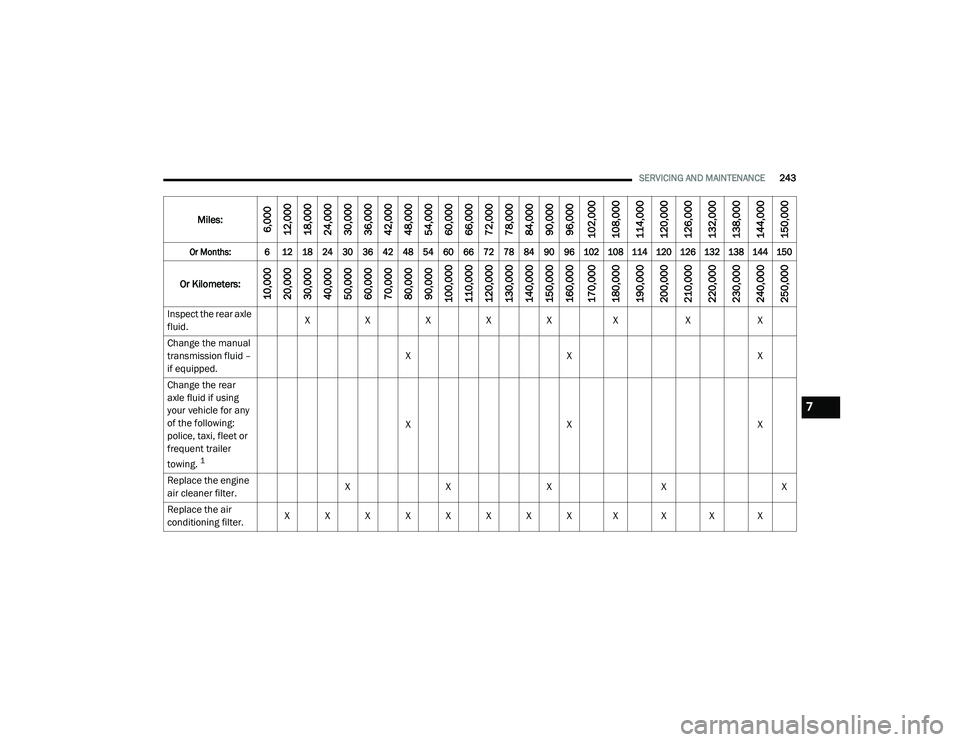
Inspect the rear axle
fluid.X
XXXX X XX
Change the manual
transmission fluid –
if equipped. X
X X
Change the rear
axle fluid if using
your vehicle for any
of the following:
police, taxi, fleet or
frequent trailer
towing.
1
X X X
Replace the engine
air cleaner filter. X
XX X X
Replace the air
conditioning filter. X X X X X X X X X X X X
Miles:
6,000
12,000
18,000
24,000
30,000
36,000
42,000
48,000
54,000
60,000
66,000
72,000
78,000
84,000
90,000
96,000
102,000
108,000
114,000
120,000
126,000
132,000
138,000
144,000
150,000
Or Months: 6 12 18 24 30 36 42 48 54 60 66 72 78 84 90 96 102 108 114 120 126 132 138 144 150
Or Kilometers:
10,000
20,000
30,000
40,000
50,000
60,000
70,000
80,000
90,000
100,000
110,000
120,000
130,000
140,000
150,000
160,000
170,000
180,000
190,000
200,000
210,000
220,000
230,000
240,000
250,0 00
7
20_LA_OM_EN_USC_t.book Page 243
Page 264 of 396
262SERVICING AND MAINTENANCE
(Continued)
Under normal operating conditions, the
catalytic converter will not require
maintenance. However, it is important to keep
the engine properly tuned to ensure proper
catalyst operation and prevent possible catalyst
damage.
NOTE:
Intentional tampering with emissions control
systems can result in civil penalties being
assessed against you.
In unusual situations involving grossly
malfunctioning engine operation, a scorching
odor may suggest severe and abnormal catalyst
overheating. If this occurs, stop the vehicle, turn
off the engine and allow it to cool. Service,
including a tune-up to manufacturer's
specifications, should be obtained immediately.
To minimize the possibility of catalytic converter
damage:
Do not shut off the engine or interrupt the
ignition when the transmission is in gear and
the vehicle is in motion.
Do not try to start the engine by pushing or
towing the vehicle.
Do not idle the engine with any spark plug
wires disconnected or removed, such as
when diagnostic testing, or for prolonged
periods during very rough idle or malfunc-
tioning operating conditions.
NOTE:
The vehicle exhaust system may be equipped
with an Electronic Exhaust Valve (EEV) system,
if the exhaust system is replaced with after -
market products a Malfunction Indicator Lamp
(MIL) will illuminate.
COOLING SYSTEM
Coolant Checks
Check engine coolant (antifreeze) protection
every 12 months (before the onset of freezing
weather, where applicable). If coolant is dirty or
rusty in appearance, the system should be
drained, flushed, and refilled with fresh coolant.
Check the front of the radiator for any
accumulation of bugs, leaves, etc. If dirty, clean
by gently spraying water from a garden hose
vertically down the face of the condenser.
Check the coolant recovery bottle tubing for
brittle rubber, cracking, tears, cuts, and
tightness of the connection at the bottle and
radiator. Inspect the entire system for leaks. DO
NOT REMOVE THE COOLANT PRESSURE CAP
WHEN THE COOLING SYSTEM IS HOT.
WARNING!
You or others can be badly burned by hot
engine coolant (antifreeze) or steam from
your radiator. If you see or hear steam
coming from under the hood, do not open
the hood until the radiator has had time to
cool. Never open a cooling system pressure
cap when the radiator or coolant bottle is
hot.
Keep hands, tools, clothing, and jewelry
away from the radiator cooling fan when
the hood is raised. The fan starts automati -
cally and may start at any time, whether the
engine is running or not.
When working near the radiator cooling fan,
disconnect the fan motor lead or turn the
ignition to the OFF mode. The fan is
temperature controlled and can start at any
time the ignition is in the ON mode.
WARNING! (Continued)
20_LA_OM_EN_USC_t.book Page 262
Page 269 of 396
SERVICING AND MAINTENANCE267
CLUTCH HYDRAULIC SYSTEM — MANUAL
T
RANSMISSION (IF EQUIPPED)
The clutch hydraulic system is fed by a
segregated volume of fluid within the brake
system master cylinder reservoir. In the event of
leakage or wear, use only the manufacturer's
recommended brake fluid. Refer to “Fluids And
Lubricants” in “Technical Specifications” for
further information.
MANUAL TRANSMISSION — IF EQUIPPED
Fluid Level Check
Check the fluid level by removing the fill plug on
the left side of the transmission. The fluid level
should be 1/4 inch (6.4mm) below the bottom
of the fill hole. Add fluid, if necessary, to
maintain the proper level. Refer to “Fluids And
Lubricants” in “Technical Specifications” for
further information.
Change Transmission Fluid
If contaminated with water, change the fluid
immediately. See an authorized dealer for
service.
Refer to the “Maintenance Plan” in this section
for the proper maintenance intervals.
AUTOMATIC TRANSMISSION — IF
E
QUIPPED
Selection Of Lubricant
It is important to use the proper transmission
fluid to ensure optimum transmission
performance and life. Use only the
manufacturer's specified transmission fluid.
Refer to “Fluids And Lubricants” in “Technical
Specifications” for fluid specifications. It is
important to maintain the transmission fluid at
the correct level using the recommended fluid.
NOTE:
No chemical flushes should be used in any
transmission; only the approved lubricant
should be used.
Special Additives
The manufacturer strongly recommends
against using any special additives in the
transmission. Automatic Transmission Fluid
(ATF) is an engineered product and its
performance may be impaired by supplemental
additives. Therefore, do not add any fluid
additives to the transmission. Avoid using
transmission sealers as they may adversely
affect seals.
CAUTION!
Using a transmission fluid other than the
manufacturer's recommended fluid may
cause deterioration in transmission shift
quality and/or damage to the transmission.
Refer to “Fluids And Lubricants” in “Technical
Specifications” for fluid specifications.
CAUTION!
Using a transmission fluid other than the
manufacturer’s recommended fluid may
cause deterioration in transmission shift
quality and/or torque converter shudder.
Refer to “Fluids And Lubricants” in “Technical
Specifications” for fluid specifications.
CAUTION!
Do not use chemical flushes in your
transmission as the chemicals can damage
your transmission components. Such damage
is not covered by the New Vehicle Limited
Warranty.
7
20_LA_OM_EN_USC_t.book Page 267
Page 270 of 396
268SERVICING AND MAINTENANCE
Fluid Level Check
The fluid level is preset at the factory and does
not require adjustment under normal operating
conditions. Routine fluid level checks are not
required; therefore the transmission has no
dipstick. An authorized dealer can check your
transmission fluid level using special service
tools. If you notice fluid leakage or transmission
malfunction, visit an authorized dealer
immediately to have the transmission fluid level
checked. Operating the vehicle with an
improper fluid level can cause severe
transmission damage.
Fluid And Filter Changes
Under normal operating conditions, the fluid
installed at the factory will provide satisfactory
lubrication for the life of the vehicle.
Routine fluid and filter changes are not
required. However, change the fluid and filter if
the fluid becomes contaminated (with water,
etc.), or if the transmission is disassembled for
any reason.
ALL WHEEL DRIVE (AWD) — IF
E
QUIPPED
The All Wheel Drive system consists of a
transfer case and front differential. The exterior
surface of these components should be
inspected for evidence of fluid leaks. Confirmed
leaks should be repaired as soon as possible.
The transfer case fluid fill/inspection plug is
located in the middle of the rear housing. To
inspect the transfer case fluid level, remove the
fill/inspection plug. The fluid level should be
even with the bottom of the hole. Use this plug
to add fluid as required. The front differential fill plug is located on the
outer cover near the halfshaft attachment. To
inspect the differential fluid level, remove the fill
plug. The fluid level should be even with or
slightly below the bottom of the hole.
Fluid Changes
Refer to “Scheduled Servicing” in “Servicing
And Maintenance” for the proper maintenance
intervals.
REAR AXLE
Fluid Level Check
Checking the fluid level while the vehicle is on
level ground and has been stationary for
15 minutes will improve the accuracy of the
fluid level reading.
Check the fluid level by removing the fill plug on
the axle. The fluid level should be 1-2.5 mm
below the fill plug. Add fluid, if necessary, to
maintain the proper level. Refer to “Fluids And
Lubricants” in "Servicing And Maintenance” for
further information.CAUTION!
If a transmission fluid leak occurs, visit an
authorized dealer immediately. Severe
transmission damage may occur. An
authorized dealer has the proper tools to
adjust the fluid level accurately.
20_LA_OM_EN_USC_t.book Page 268
Page 299 of 396
TECHNICAL SPECIFICATIONS297
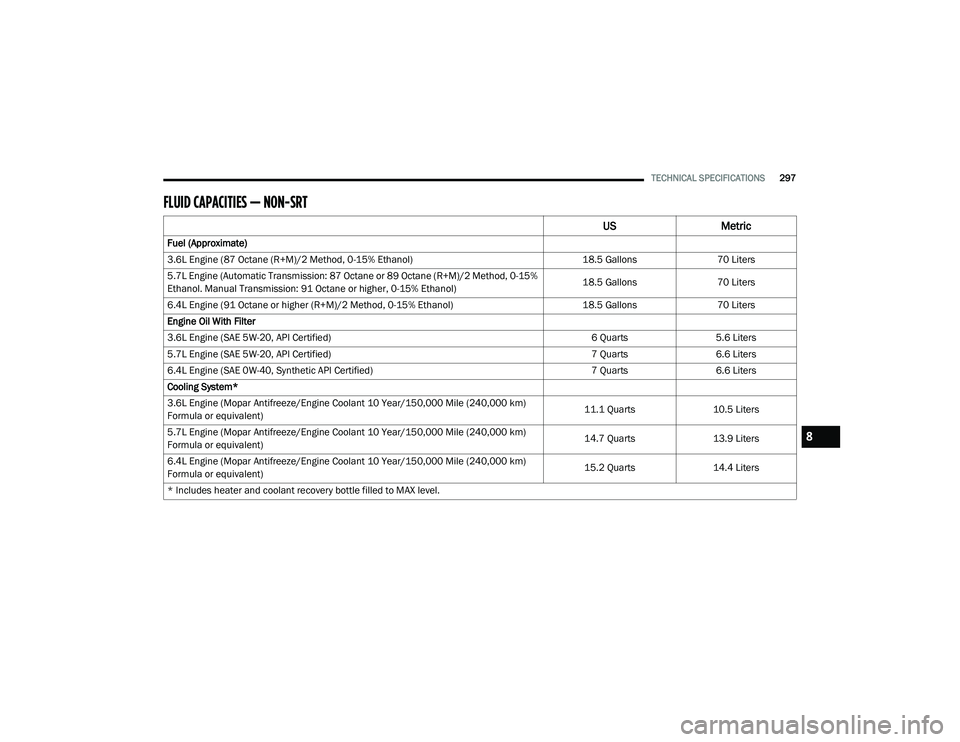
FLUID CAPACITIES — NON-SRT
USMetric
Fuel (Approximate)
3.6L Engine (87 Octane (R+M)/2 Method, 0-15% Ethanol) 18.5 Gallons70 Liters
5.7L Engine (Automatic Transmission: 87 Octane or 89 Octane (R+M)/2 Method, 0-15%
Ethanol. Manual Transmission: 91 Octane or higher, 0-15% Ethanol) 18.5 Gallons
70 Liters
6.4L Engine (91 Octane or higher (R+M)/2 Method, 0-15% Ethanol) 18.5 Gallons70 Liters
Engine Oil With Filter
3.6L Engine (SAE 5W-20, API Certified) 6 Quarts5.6 Liters
5.7L Engine (SAE 5W-20, API Certified) 7 Quarts6.6 Liters
6.4L Engine (SAE 0W-40, Synthetic API Certified) 7 Quarts6.6 Liters
Cooling System*
3.6L Engine (Mopar Antifreeze/Engine Coolant 10 Year/150,000 Mile (240,000 km)
Formula or equivalent) 11.1 Quarts
10.5 Liters
5.7L Engine (Mopar Antifreeze/Engine Coolant 10 Year/150,000 Mile (240,000 km)
Formula or equivalent) 14.7 Quarts
13.9 Liters
6.4L Engine (Mopar Antifreeze/Engine Coolant 10 Year/150,000 Mile (240,000 km)
Formula or equivalent) 15.2 Quarts
14.4 Liters
* Includes heater and coolant recovery bottle filled to MAX level.
8
20_LA_OM_EN_USC_t.book Page 297
Page 301 of 396

TECHNICAL SPECIFICATIONS299
FLUIDS AND LUBRICANTS — NON-SRT
ENGINE
Component Fluid, Lubricant, or Genuine Part
Engine Coolant We recommend you use Mopar Antifreeze/Coolant 10 Year/150,000
Mile (240,000 km) Formula OAT (Organic Additive Technology).
Engine Oil – 3.6L & 5.7L Engine We recommend you use API Certified SAE 5W-20 Engine Oil, meeting the
requirements of FCA Material Standard MS-6395 such as Mopar SAE
5W-20, Pennzoil SAE 5W-20, and Pennzoil gold 5W-20 semi-synthetic oil.
Refer to your engine oil filler cap for correct SAE grade.
Engine Oil – 6.4L Engine For best performance and maximum protection under all types of
operating conditions, the manufacturer only recommends full synthetic
engine oils.
The manufacturer recommends the use of Pennzoil Ultra Platinum
0W-40 or equivalent Mopar engine oil meeting the requirements of
FCA Material Standard MS-12633 for use in all operating temperatures.
Engine Oil Filter We recommend you use Mopar Engine Oil Filters.
Spark Plugs We recommend you use Mopar Spark Plugs.
Fuel Selection – 3.6 Engine 87 Octane (R+M)/2 Method, 0-15% Ethanol.
Fuel Selection – 5.7 Engine With Automatic Transmission 89 Octane recommended – 87 Octane acceptable (R+M)/2 Method,
0-15% Ethanol.
Fuel Selection – 6.4L Engine & 5.7 Engine With Manual Transmission 91 Octane or higher (R+M)/2 Method, 0-15% Ethanol.
8
20_LA_OM_EN_USC_t.book Page 299
Page 303 of 396

TECHNICAL SPECIFICATIONS301
CHASSIS
Component Fluid, Lubricant, or Genuine Part
8-Speed Automatic TransmissionUse only Mopar ZF 8&9 Speed ATF Automatic Transmission Fluid, or equivalent. Failure to use the
correct fluid may affect the function or performance of your transmission.
Manual Transmission – If Equipped We recommend you use Mopar ATF+4 Automatic Transmission Fluid.
Brake Master Cylinder We recommend you use Mopar DOT 3, SAE J1703.
Front Axle We recommend you use Mopar Synthetic Gear Lubricant SAE 75W90 (API GL-5).
Rear Axle – 3.6L/5.7L Engine With Automatic
Transmission We recommend you use Mopar OD Synthetic Gear Lubricant SAE 75W85 (API GL-5).
Rear Axle – 5.7L/6.4LEngine With Manual
Transmission We recommend you use Mopar LSD Synthetic Gear Lubricant SAE 75W85 (API GL-5).
Transfer Case – AWD (If Equipped) We recommend you use Mopar Transfer Case Lubricant for BorgWarner 44–40.
8
20_LA_OM_EN_USC_t.book Page 301
Page 306 of 396

304TECHNICAL SPECIFICATIONS
CHASSIS
Component Fluid, Lubricant, or Genuine Part
Manual Transmission – If EquippedWe recommend you use Mopar ATF+4 Automatic Transmission Fluid.
Automatic Transmission – If Equipped Use only Mopar ZF 8&9 Speed ATF Automatic Transmission Fluid, or equivalent. Failure to use the
correct fluid may affect the function or performance of your transmission.
Brake Master Cylinder We recommend you use Mopar DOT 3, SAE J1703 should be used. If DOT 3, SAE J1703 brake fluid
is not available, then DOT 4 is acceptable.
DOT 4 brake fluid must be changed every 24 months. This interval is time based only, mileage
intervals do not apply.
Rear Axle We recommend you use Mopar LSD Synthetic Gear Lubricant SAE 75W85 (API GL-5).
20_LA_OM_EN_USC_t.book Page 304
Page 313 of 396
MULTIMEDIA311
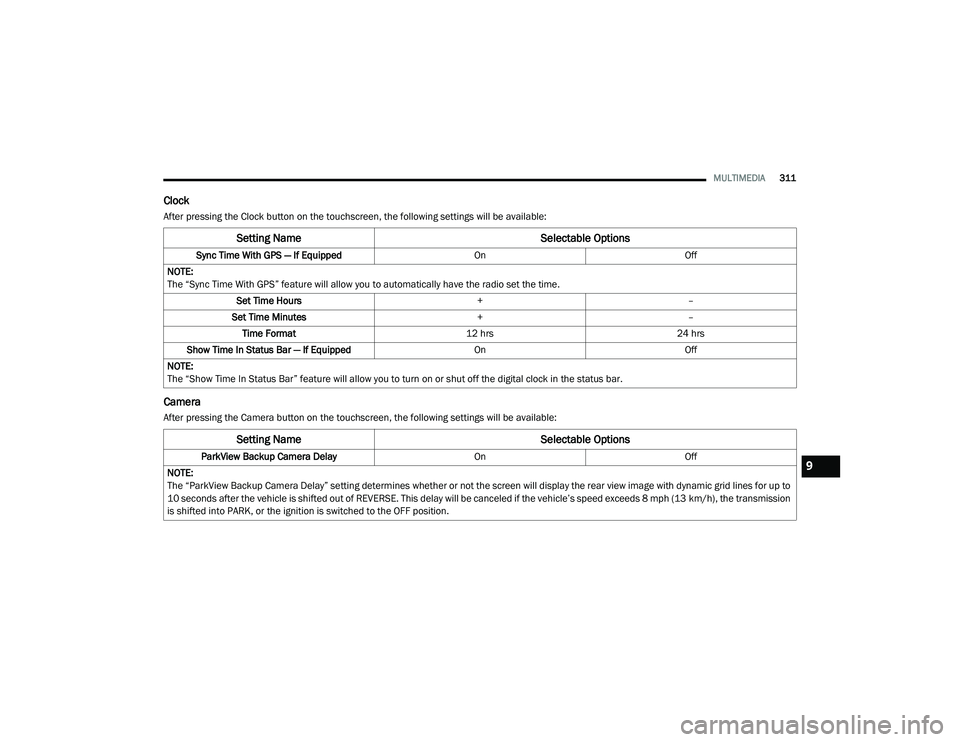
Clock
After pressing the Clock button on the touchscreen, the following settings will be available:
Camera
After pressing the Camera button on the touchscreen, the following settings will be available:
Setting Name Selectable Options
Sync Time With GPS — If Equipped OnOff
NOTE:
The “Sync Time With GPS” feature will allow you to automatically have the radio set the time. Set Time Hours +–
Set Time Minutes +–
Time Format 12 hrs24 hrs
Show Time In Status Bar — If Equipped OnOff
NOTE:
The “Show Time In Status Bar” feature will allow you to turn on or shut off the digital clock in the status bar.
Setting Name Selectable Options
ParkView Backup Camera Delay OnOff
NOTE:
The “ParkView Backup Camera Delay” setting determines whether or not the screen will display the rear view image with dynamic grid lines for up to
10 seconds after the vehicle is shifted out of REVERSE. This delay will be canceled if the vehicle’s speed exceeds 8 mph (13 km/h), the transmission
is shifted into PARK, or the ignition is switched to the OFF position.9
20_LA_OM_EN_USC_t.book Page 311