storage DODGE CHALLENGER 2022 User Guide
[x] Cancel search | Manufacturer: DODGE, Model Year: 2022, Model line: CHALLENGER, Model: DODGE CHALLENGER 2022Pages: 336, PDF Size: 16.47 MB
Page 247 of 336
IN CASE OF EMERGENCY245
If the sealant (white fluid) does flow through the
Sealant Hose :
1. Continue to operate the pump until sealant is no longer flowing through the hose (typically
takes 30 - 70 seconds). As the sealant flows
through the Sealant Hose (4), the Pressure
Gauge (5) can read as high as 70 psi
(4.8 Bar). The Pressure Gauge (5) will
decrease quickly from approximately 70 psi
(4.8 Bar) to the actual tire pressure when the
Sealant Bottle (1) is empty.
2. The pump will start to inject air into the tire immediately after the Sealant Bottle (1) is
empty. Continue to operate the pump and
inflate the tire to the pressure indicated on the
tire pressure label on the driver-side latch
pillar (recommended pressure). Check the tire
pressure by looking at the Pressure Gauge (5).
If the tire does not inflate to at least 26 psi (1.8
Bar) pressure within 15 minutes:
The tire is too badly damaged. Do not attempt to
drive the vehicle further. Call for assistance.
NOTE:If the tire becomes overinflated, push the Deflation
Button (2) to reduce the tire pressure to the recom -
mended inflation pressure before continuing. If the tire inflates to the recommended pressure or
is at least 26 psi (1.8 Bar) pressure within
15 minutes:
1. Push the Power Button (3) to turn off the Tire
Service Kit.
2. Remove the Speed Limit sticker from the top of the Sealant Bottle (1) and place the sticker on
the instrument panel.
3. Immediately disconnect the Sealant Hose (4) from the valve stem, reinstall the cap on the
fitting at the end of the hose, and place the Tire
Service Kit in the vehicle storage location.
(D) Drive Vehicle:
Immediately after injecting sealant and inflating the
tire, drive the vehicle 5 miles (8 km) or 10 minutes to ensure distribution of the Tire Service Kit Sealant
within the tire. Do not exceed 50 mph (80 km/h).
(E) After Driving:
Pull over to a safe location before continuing
Ú
page 244.
1. Push in the Mode Select Knob (6) and turn to the Air Mode position.
2. Uncoil the power plug and insert the plug into the vehicle's 12 Volt power outlet.
3. Uncoil the Air Pump Hose (8) (black in color) and screw the fitting at the end of hose on to the valve
stem.
4. Check the pressure in the tire by reading the Pressure Gauge (5).
CAUTION!
The metal end fitting from Power Plug (7) may
get hot after use, so it should be handled care -
fully.
Failure to reinstall the cap on the fitting at the
end of the Sealant Hose (4) can result in
sealant contacting your skin, clothing, and the
vehicle’s interior. It can also result in sealant
contacting internal Tire Service Kit compo -
nents which may cause permanent damage to
the kit.
WARNING!
Tire Service Kit is not a permanent flat tire
repair. Have the tire inspected and repaired or
replaced after using Tire Service Kit. Do not
exceed 50 mph (80 km/h) until the tire is
repaired or replaced. Failure to follow this
warning can result in injuries that are serious or
fatal to you, your passengers, and others around
you.
7
22_LA_OM_EN_USC_t.book Page 245
Page 248 of 336
246IN CASE OF EMERGENCY
If tire pressure is less than 19 psi (1.3 Bar):
The tire is too badly damaged. Do not attempt to drive
the vehicle further. Call for assistance.
If the tire pressure is 19 psi (1.3 Bar) or higher:
1. Push the Power Button (3) to turn on Tire Service Kit and inflate the tire to the pressure indicated
on the tire and loading information label on the
driver-side door opening.
NOTE:
If the tire becomes overinflated, push the Deflation
Button (2) to reduce the tire pressure to the recom -
mended inflation pressure before continuing.
2. Disconnect the Tire Service Kit from the valve stem, reinstall the cap on the valve stem and
unplug from 12 Volt outlet.
3. Place the Tire Service Kit in its proper storage area in the vehicle.
4. Have the tire inspected and repaired or replaced at the earliest opportunity at an authorized
dealer or tire service center.
5. Remove the Speed Limit sticker from the instrument panel after the tire has been
repaired.
6. Replace the Sealant Bottle (1) and Sealant Hose (4) assembly at an authorized dealer as soon as
possible.
NOTE:
When having the tire serviced, advise the authorized
dealer or service center that the tire has been sealed
using the Tire Service Kit.
(F) Sealant Bottle And Hose Replacement:
1. Uncoil the Sealant Hose (4) (clear in color).
2. Locate the round Sealant Bottle release button in the recessed area under the sealant bottle.
3. Push the Sealant Bottle release button. The Sealant Bottle (1) will pop up. Remove the
bottle and dispose of it accordingly.
4. Clean any remaining sealant from the Tire Service Kit housing.
5. Position the new Sealant Bottle (1) in the housing so that the Sealant Hose (4) aligns
with the hose slot in the front of the housing.
Push the bottle into the housing. An audible
click will be heard indicating the bottle is
locked into place.
6. Verify that the cap is installed on the fitting at the end of the Sealant Hose (4) and return the
hose to its storage area (located on the bottom
of the air pump).
7. Return the Tire Service Kit to its storage location in the vehicle.
JUMP STARTING
If your vehicle has a discharged battery, it can be
jump started using a set of jumper cables and a
battery in another vehicle, or by using a portable
battery booster pack. Jump starting can be
dangerous if done improperly, so please follow the
procedures in this section carefully.
NOTE:When using a portable battery booster pack, follow
the manufacturer's operating instructions and
precautions.
WARNING!
Do not attempt jump starting if the battery is
frozen. It could rupture or explode and cause
personal injury.
CAUTION!
Do not use a portable battery booster pack or
any other booster source with a system voltage
greater than 12 Volts or damage to the battery,
starter motor, alternator or electrical system may
occur.
22_LA_OM_EN_USC_t.book Page 246
Page 251 of 336
IN CASE OF EMERGENCY249
NOTE:There are steps that you can take to slow down an
impending overheat condition:
If your Air Conditioner (A/C) is on, turn it off. The
A/C system adds heat to the engine cooling
system and turning the A/C off can help remove
this heat.
You can also turn the temperature control to
maximum heat, the mode control to floor and
the blower control to high. This allows the heater
core to act as a supplement to the radiator and
aids in removing heat from the engine cooling
system.
MANUAL PARK RELEASE — 8–SPEED
TRANSMISSION
In order to move the vehicle in cases where the
transmission will not shift out of PARK (P) (such as
a depleted battery), a Manual Park Release is
available.
Follow these steps to use the Manual Park
Release:
1. Firmly apply the parking brake.
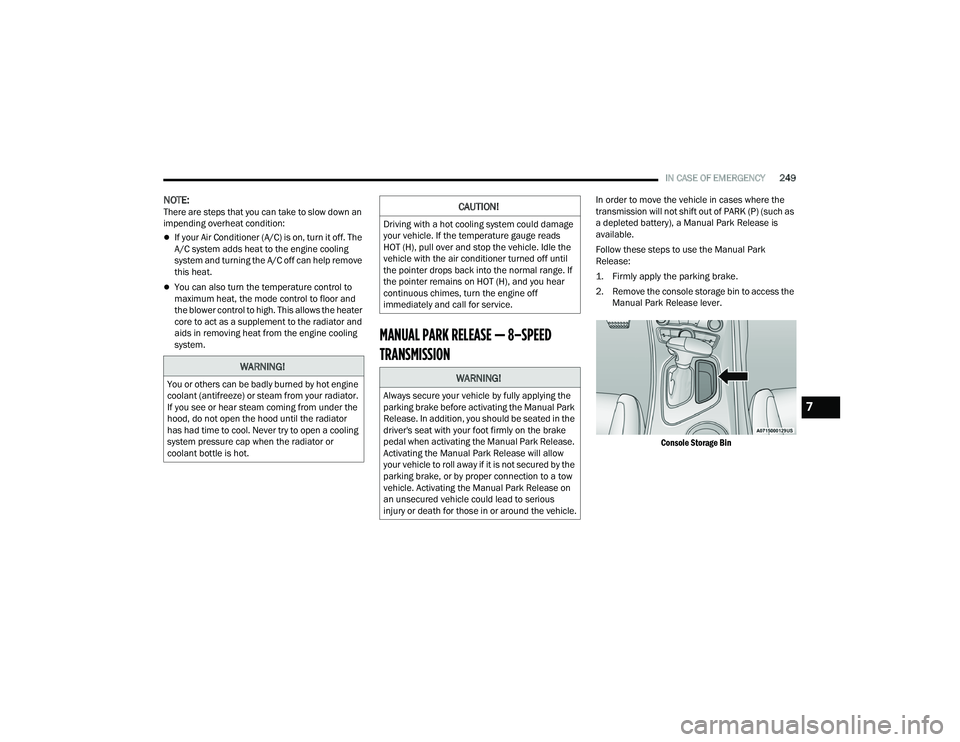
2. Remove the console storage bin to access the
Manual Park Release lever.
Console Storage Bin
WARNING!
You or others can be badly burned by hot engine
coolant (antifreeze) or steam from your radiator.
If you see or hear steam coming from under the
hood, do not open the hood until the radiator
has had time to cool. Never try to open a cooling
system pressure cap when the radiator or
coolant bottle is hot.
CAUTION!
Driving with a hot cooling system could damage
your vehicle. If the temperature gauge reads
HOT (H), pull over and stop the vehicle. Idle the
vehicle with the air conditioner turned off until
the pointer drops back into the normal range. If
the pointer remains on HOT (H), and you hear
continuous chimes, turn the engine off
immediately and call for service.
WARNING!
Always secure your vehicle by fully applying the
parking brake before activating the Manual Park
Release. In addition, you should be seated in the
driver's seat with your foot firmly on the brake
pedal when activating the Manual Park Release.
Activating the Manual Park Release will allow
your vehicle to roll away if it is not secured by the
parking brake, or by proper connection to a tow
vehicle. Activating the Manual Park Release on
an unsecured vehicle could lead to serious
injury or death for those in or around the vehicle.
7
22_LA_OM_EN_USC_t.book Page 249
Page 252 of 336
250IN CASE OF EMERGENCY
3. Using a small screwdriver or similar tool, fish the tether strap up through the opening in the
console base.
4. Press and maintain firm pressure on the brake pedal.
5. Insert the screwdriver into the slot in the center of the lever, and disengage the lever
locking tab by pushing it to the right.
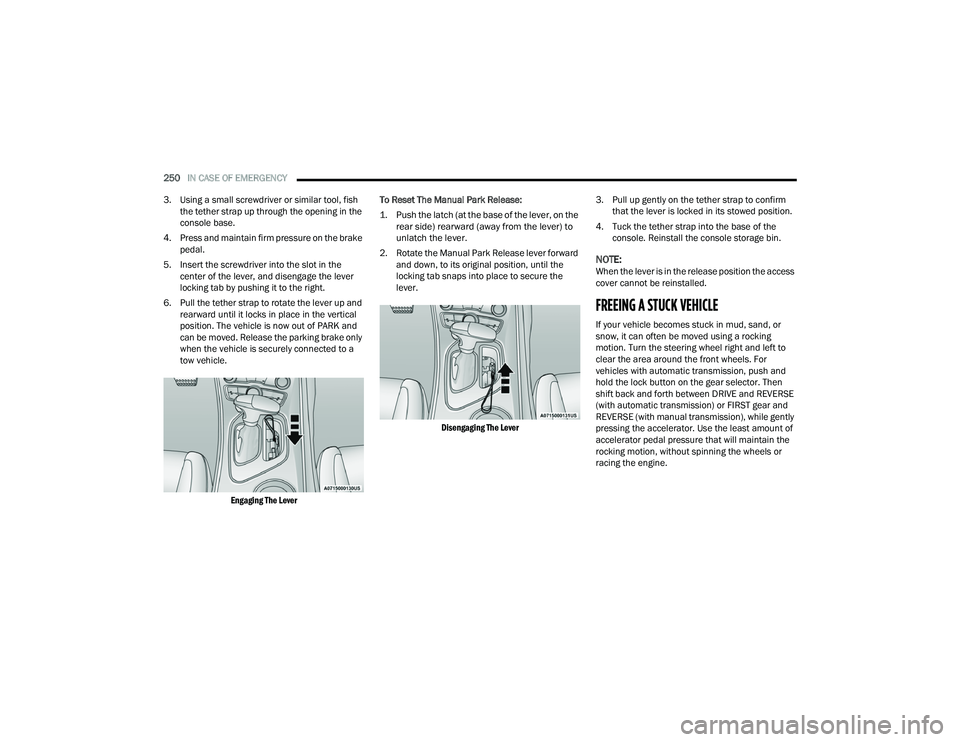
6. Pull the tether strap to rotate the lever up and rearward until it locks in place in the vertical
position. The vehicle is now out of PARK and
can be moved. Release the parking brake only
when the vehicle is securely connected to a
tow vehicle.
Engaging The Lever
To Reset The Manual Park Release:
1. Push the latch (at the base of the lever, on the
rear side) rearward (away from the lever) to
unlatch the lever.
2. Rotate the Manual Park Release lever forward and down, to its original position, until the
locking tab snaps into place to secure the
lever.
Disengaging The Lever
3. Pull up gently on the tether strap to confirm
that the lever is locked in its stowed position.
4. Tuck the tether strap into the base of the console. Reinstall the console storage bin.
NOTE:When the lever is in the release position the access
cover cannot be reinstalled.
FREEING A STUCK VEHICLE
If your vehicle becomes stuck in mud, sand, or
snow, it can often be moved using a rocking
motion. Turn the steering wheel right and left to
clear the area around the front wheels. For
vehicles with automatic transmission, push and
hold the lock button on the gear selector. Then
shift back and forth between DRIVE and REVERSE
(with automatic transmission) or FIRST gear and
REVERSE (with manual transmission), while gently
pressing the accelerator. Use the least amount of
accelerator pedal pressure that will maintain the
rocking motion, without spinning the wheels or
racing the engine.
22_LA_OM_EN_USC_t.book Page 250
Page 309 of 336
SERVICING AND MAINTENANCE307
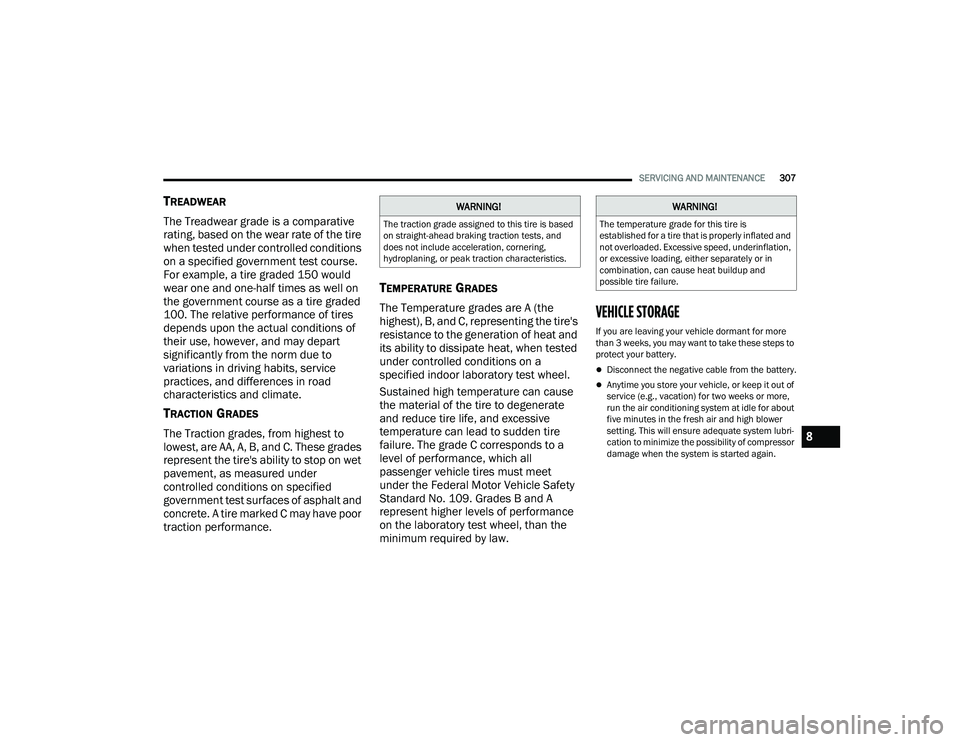
TREADWEAR
The Treadwear grade is a comparative
rating, based on the wear rate of the tire
when tested under controlled conditions
on a specified government test course.
For example, a tire graded 150 would
wear one and one-half times as well on
the government course as a tire graded
100. The relative performance of tires
depends upon the actual conditions of
their use, however, and may depart
significantly from the norm due to
variations in driving habits, service
practices, and differences in road
characteristics and climate.
TRACTION GRADES
The Traction grades, from highest to
lowest, are AA, A, B, and C. These grades
represent the tire's ability to stop on wet
pavement, as measured under
controlled conditions on specified
government test surfaces of asphalt and
concrete. A tire marked C may have poor
traction performance.
TEMPERATURE GRADES
The Temperature grades are A (the
highest), B, and C, representing the tire's
resistance to the generation of heat and
its ability to dissipate heat, when tested
under controlled conditions on a
specified indoor laboratory test wheel.
Sustained high temperature can cause
the material of the tire to degenerate
and reduce tire life, and excessive
temperature can lead to sudden tire
failure. The grade C corresponds to a
level of performance, which all
passenger vehicle tires must meet
under the Federal Motor Vehicle Safety
Standard No. 109. Grades B and A
represent higher levels of performance
on the laboratory test wheel, than the
minimum required by law.VEHICLE STORAGE
If you are leaving your vehicle dormant for more
than 3 weeks, you may want to take these steps to
protect your battery.
Disconnect the negative cable from the battery.
Anytime you store your vehicle, or keep it out of
service (e.g., vacation) for two weeks or more,
run the air conditioning system at idle for about
five minutes in the fresh air and high blower
setting. This will ensure adequate system lubri-
cation to minimize the possibility of compressor
damage when the system is started again.
WARNING!
The traction grade assigned to this tire is based
on straight-ahead braking traction tests, and
does not include acceleration, cornering,
hydroplaning, or peak traction characteristics.
WARNING!
The temperature grade for this tire is
established for a tire that is properly inflated and
not overloaded. Excessive speed, underinflation,
or excessive loading, either separately or in
combination, can cause heat buildup and
possible tire failure.
8
22_LA_OM_EN_USC_t.book Page 307
Page 332 of 336
330 Pregnant Women
...................................... 205Pretensioners............................................ 205Rear Seat.................................................. 202Reminder.................................................. 201Seat Belt Extender.................................... 205Seat Belt Pretensioner.............................. 205Untwisting Procedure................................ 204Seat Belts Maintenance................................ 309Seats.......................................... 32, 34, 35, 37Adjustment........................................... 32, 34Easy Entry................................................... 34Head Restraints................................... 37, 38Heated........................................................ 35Height Adjustment....................................... 34Power.......................................................... 34Rear Folding......................................... 32, 33Seatback Release................................ 32, 33Tilting............................................ 32, 34, 37Vented......................................................... 36Ventilated.................................................... 36Security Alarm................................... 21, 22, 76Arm The System.......................................... 21Sentry Key (Immobilizer).................................. 16Sentry Key Replacement................................. 16Service Assistance......................................... 319Service Contract............................................ 320Service Manuals............................................ 322Settings, Audio.............................................. 152Shift Indicator Light......................................... 89
Shifting............................................................ 90Automatic Transmission....................... 90, 91Shoulder Belts.............................................. 202Side View Mirror Adjustment............................ 40Signals, Turn....................................47, 79, 232Sirius Satellite Radio..................................... 147Favorites................................................... 150Replay...................................................... 148SiriusXM Satellite RadioBrowse in SXM......................................... 150Favorites................................................... 150Replay...................................................... 148Snow Chains (Tire Chains)............................ 304Snow Tires.................................................... 301Spare Tires........................ 237, 301, 302, 303SpecificationsFuel (Gasoline)......................................... 316Oil............................................................. 316Speed ControlAccel/Decel.......................................... 98, 99Cancel......................................................... 99Resume....................................................... 99Set............................................................... 98Speed Control (Cruise Control)................. 97, 98Sport Mode...................................................... 96Starting..................................................... 82, 83Automatic Transmission.............................. 82Button......................................................... 17Cold Weather............................................... 86
Engine Fails To Start....................................85Remote........................................................18Starting And Operating..............................82, 83Starting Procedures..................................82, 83Steering...........................................................27Column Lock................................................27Power...........................................................97Tilt Column............................................ 27, 28Wheel, Heated.............................................28Wheel, Tilt.............................................27, 28Steering Wheel Audio Controls...................... 144Steering Wheel Mounted Sound System....... 144Storage.................................................. 56, 307Storage, Vehicle..................................... 55, 307Store Radio Presets...................................... 151Storing Your Vehicle...................................... 307Stuck, Freeing............................................... 250Sun Roof...................................................60, 61Supplemental Restraint System –
Air Bag.......................................................... 208Symbol Glossary...............................................10Synthetic Engine Oil...................................... 263System, Remote Starting.................................18
T
Telescoping Steering Column.................... 27, 28Temperature Control, Automatic (ATC).............54Tilt Steering Column..................................27, 28Time DelayHeadlight.....................................................47
22_LA_OM_EN_USC_t.book Page 330
Page 334 of 336
332 Overview
.................................................... 156Pair (Link) Uconnect Phone To AMobile Phone........................................ 158Pair A Bluetooth Streaming Audio Device......................................... 160Phonebook Download............................... 161Place/Retrieve A Call From Hold............... 164Power-Up................................................... 167Recent Calls.............................................. 163Redial........................................................ 164To Remove A Favorite............................... 162Toggling Between Calls............................. 164Touch-Tone Number Entry......................... 163Transfer Call To And FromMobile Phone........................................ 165Voice Command........................................ 165Uconnect SettingsCustomer Programmable Features............. 20Uconnect System........................................... 141Uconnect Voice Command.............................. 29Uniform Tire Quality Grades........................... 306Universal Garage Door Opener
(Homelink®)
b
............................................. 40Unleaded Gasoline........................................ 312Untwisting Procedure, Seat Belt.................... 204
V
Vanity Mirrors.................................................. 39Vehicle Certification Label............................ 113Vehicle Identification Number (VIN).............. 311Vehicle Loading.......................... 113, 114, 294Vehicle Modifications/Alterations...................... 9Vehicle Security Alarm..................................... 21Vehicle Storage.......................................55, 307Voice Command................................... 168, 170Voice Recognition System (VR)........................ 29
W
Warning LightsBlue
............................................................. 80Green.......................................................... 79Red.............................................................. 73White........................................................... 80Yellow.......................................................... 76Warning Lights (Instrument
Cluster Descriptions)....................................... 77Warning Lights And Messages......................... 73Warranty Information.................................... 321
WasherAdding Fluid.............................................. 261Washers, Windshield............................. 50, 261Washing Vehicle............................................ 308WaterDriving Through........................................ 121Wheel And Wheel Tire Care........................... 303Wheel And Wheel Tire Trim........................... 303Wind Buffeting.................................................60Window Fogging...............................................55Windows..........................................................59Power...........................................................59Windshield Defroster.................................... 230Windshield Washers........................................50Fluid.......................................................... 261Windshield Wiper Blades.............................. 268Windshield Wipers...........................................50Wipers Blade Replacement........................... 268Wipers, Intermittent.........................................50Wipers, Rain Sensitive.....................................51
22_LA_OM_EN_USC_t.book Page 332