Back DODGE CHALLENGER 2022 Repair Manual
[x] Cancel search | Manufacturer: DODGE, Model Year: 2022, Model line: CHALLENGER, Model: DODGE CHALLENGER 2022Pages: 336, PDF Size: 16.47 MB
Page 251 of 336
IN CASE OF EMERGENCY249
NOTE:There are steps that you can take to slow down an
impending overheat condition:
If your Air Conditioner (A/C) is on, turn it off. The
A/C system adds heat to the engine cooling
system and turning the A/C off can help remove
this heat.
You can also turn the temperature control to
maximum heat, the mode control to floor and
the blower control to high. This allows the heater
core to act as a supplement to the radiator and
aids in removing heat from the engine cooling
system.
MANUAL PARK RELEASE — 8–SPEED
TRANSMISSION
In order to move the vehicle in cases where the
transmission will not shift out of PARK (P) (such as
a depleted battery), a Manual Park Release is
available.
Follow these steps to use the Manual Park
Release:
1. Firmly apply the parking brake.
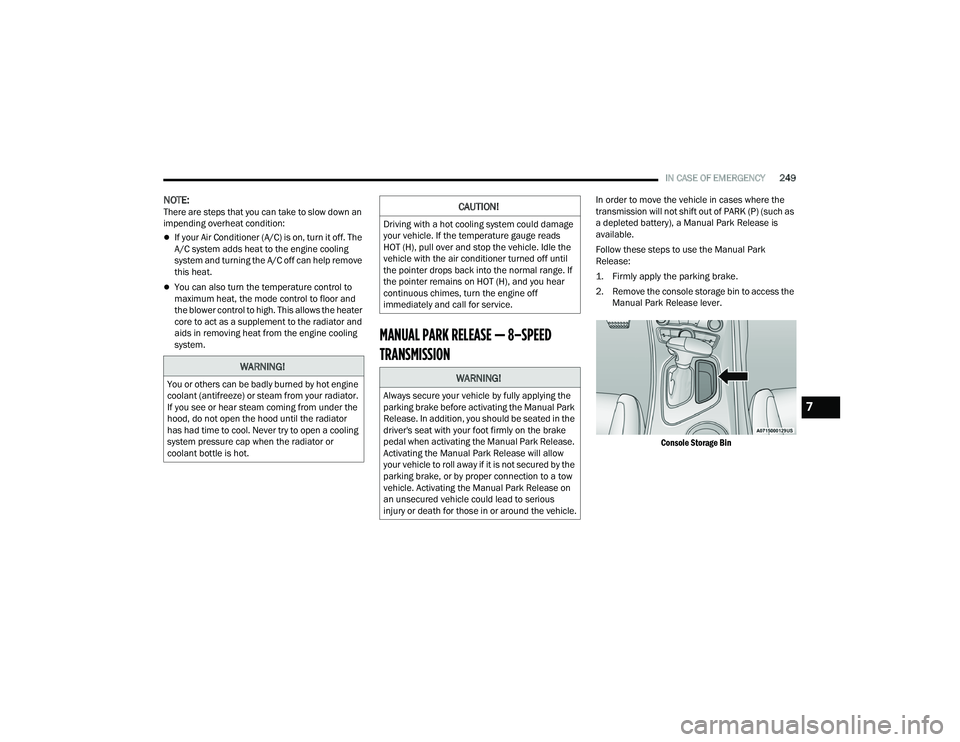
2. Remove the console storage bin to access the
Manual Park Release lever.
Console Storage Bin
WARNING!
You or others can be badly burned by hot engine
coolant (antifreeze) or steam from your radiator.
If you see or hear steam coming from under the
hood, do not open the hood until the radiator
has had time to cool. Never try to open a cooling
system pressure cap when the radiator or
coolant bottle is hot.
CAUTION!
Driving with a hot cooling system could damage
your vehicle. If the temperature gauge reads
HOT (H), pull over and stop the vehicle. Idle the
vehicle with the air conditioner turned off until
the pointer drops back into the normal range. If
the pointer remains on HOT (H), and you hear
continuous chimes, turn the engine off
immediately and call for service.
WARNING!
Always secure your vehicle by fully applying the
parking brake before activating the Manual Park
Release. In addition, you should be seated in the
driver's seat with your foot firmly on the brake
pedal when activating the Manual Park Release.
Activating the Manual Park Release will allow
your vehicle to roll away if it is not secured by the
parking brake, or by proper connection to a tow
vehicle. Activating the Manual Park Release on
an unsecured vehicle could lead to serious
injury or death for those in or around the vehicle.
7
22_LA_OM_EN_USC_t.book Page 249
Page 252 of 336
250IN CASE OF EMERGENCY
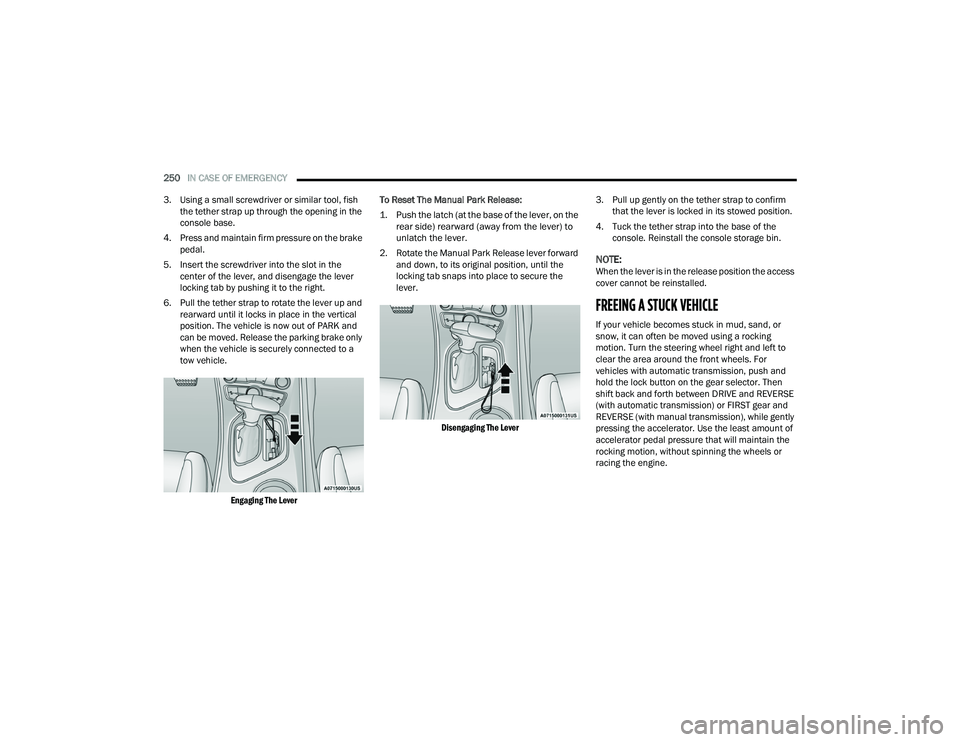
3. Using a small screwdriver or similar tool, fish the tether strap up through the opening in the
console base.
4. Press and maintain firm pressure on the brake pedal.
5. Insert the screwdriver into the slot in the center of the lever, and disengage the lever
locking tab by pushing it to the right.
6. Pull the tether strap to rotate the lever up and rearward until it locks in place in the vertical
position. The vehicle is now out of PARK and
can be moved. Release the parking brake only
when the vehicle is securely connected to a
tow vehicle.
Engaging The Lever
To Reset The Manual Park Release:
1. Push the latch (at the base of the lever, on the
rear side) rearward (away from the lever) to
unlatch the lever.
2. Rotate the Manual Park Release lever forward and down, to its original position, until the
locking tab snaps into place to secure the
lever.
Disengaging The Lever
3. Pull up gently on the tether strap to confirm
that the lever is locked in its stowed position.
4. Tuck the tether strap into the base of the console. Reinstall the console storage bin.
NOTE:When the lever is in the release position the access
cover cannot be reinstalled.
FREEING A STUCK VEHICLE
If your vehicle becomes stuck in mud, sand, or
snow, it can often be moved using a rocking
motion. Turn the steering wheel right and left to
clear the area around the front wheels. For
vehicles with automatic transmission, push and
hold the lock button on the gear selector. Then
shift back and forth between DRIVE and REVERSE
(with automatic transmission) or FIRST gear and
REVERSE (with manual transmission), while gently
pressing the accelerator. Use the least amount of
accelerator pedal pressure that will maintain the
rocking motion, without spinning the wheels or
racing the engine.
22_LA_OM_EN_USC_t.book Page 250
Page 266 of 336
264SERVICING AND MAINTENANCE
Shaker Hood — If Equipped
Shaker Hood Oil Filler
For vehicles equipped with a “Shaker Hood”, the
upper scoop will need to be removed so that oil can
be properly added to the engine.
To do this, you will need follow the procedure
below:
1. Remove the four nuts with the Shaker tool
located in glove compartment.
2. Lift off the upper scoop.
NOTE:Be sure to clean off all debris around or inside for
the Shaker assembly.
3. Locate the oil fill cover in base assembly to expose the oil fill cap.
4. Remove oil fill cap to add oil.
5. Re-install Shaker assembly.
Shaker Hood Air Filter Cleaning
Shaker air filters are made of a unique, washable
synthetic material. Base program air filters with
paper media cannot be washed. All filters follow
the same service interval, though Shaker systems
substitute a cleaning while paper air filter
elements are to be replaced.
1. Remove the air filter from the intake and set
the filter clamp aside.
2. Measure the length of the filter media.
3. Fill a bucket with warm clean water to the depth matching the filter media measurement
and add a mild household detergent or air
filter cleaning solution.
NOTE:Never use strong detergents, high pressure, or
gasoline on air filters.
4. Without allowing the solution to flow back into the inside of the air filter, submerge the filter
media into the water and let it soak for ten
minutes.
5. Empty the bucket filled with dirty water and repeat steps 3 and 4.
6. Refill the bucket with clean warm water and rinse the filter by rotating the filter.
NOTE:The water should be clean with no signs of dirt in
the bucket.
7. Allow the filter to air dry. Reinstall the filter on the intake system once it is dry.
NOTE:Do not use forced air pressure to dry the air filter
as damage may occur and void the warranty. Shaker Hood Removal And Cleaning
1. Remove the four nuts with the Shaker tool
located in the glove compartment.
2. Lift off the upper scoop.
NOTE:Be sure to clean off all debris around or inside of
the Shaker assembly.
3. Using a water and mild detergent clean the following locations:
The water drain slot located at the front
forward edge of the Shaker assembly.
The seals attached to the scoop and air box.
Lower water drains located in the lower
Shaker assembly and air box as well as the
hood interface areas for the seals. Apply
Mopar® Leather, Rubber & Vinyl Protectant
after cleaning to seals.
4. Reinstall Shaker assembly.
Materials Added To Engine Oil
The manufacturer strongly recommends against
the addition of any additives (other than leak
detection dyes) to the engine oil. Engine oil is an
engineered product and its performance may be
impaired by supplemental additives.
22_LA_OM_EN_USC_t.book Page 264
Page 267 of 336
SERVICING AND MAINTENANCE265
Disposing Of Used Engine Oil And Oil
Filters
Care should be taken in disposing of used engine
oil and oil filters from your vehicle. Used oil and oil
filters, indiscriminately discarded, can present a
problem to the environment. Contact an
authorized dealer, service station or governmental
agency for advice on how and where used oil and
oil filters can be safely discarded in your area.
ENGINE OIL FILTER
The engine oil filter should be replaced with a new
filter at every engine oil change.
Engine Oil Filter Selection
A full-flow type disposable oil filter should be used
for replacement. The quality of replacement filters
varies considerably. Only high quality Mopar®
certified filters should be used.
ENGINE AIR CLEANER FILTER
For the proper maintenance intervals Úpage 255.
NOTE:Be sure to follow the “Severe Duty Conditions”
maintenance interval if applicable. Engine Air Cleaner Filter Selection
The quality of replacement filters varies
considerably. Only high quality Mopar® certified
filters should be used.
T/A Air Filter Maintenance — If Equipped
Clean Engine Air Filter
T/A air filters are made of a unique, washable
material. Follow the recommended service interval
as for non-T/A air filters, substituting a cleaning for
replacement.Cleaning your engine air filter with the
recommended Mopar® Performance Air Filter
Service Kit is not required if you can still see any
part of the wire screen on the entire air filter
regardless of how dirty it may appear. When any
part of the wire screen is no longer visible on the air
filter, that is an indication it is time to clean the air
filter.
For cleaning instructions see steps 1-7 from the
Shaker Hood Air Filter Cleaning section
Ú
page 264.
8. Unique for T/A, using the Mopar® Performance
Air Filter Service Kit, spray oil evenly along the
crown of each filter pleat holding the nozzle about
3 inches (76 mm) away from the air filter. One
spray per 2 square inches (1,290 square mm) of
air filter. With one complete coat of oil, let it wick
(saturate) for about 20 minutes, and if required
touch up any light areas on either side of the filter.
WARNING!
The air induction system (air cleaner, hoses,
etc.) can provide a measure of protection in the
case of engine backfire. Do not remove the air
induction system (air cleaner, hoses, etc.) unless
such removal is necessary for repair or
maintenance. Make sure that no one is near the
engine compartment before starting the vehicle
with the air induction system (air cleaner, hoses,
etc.) removed. Failure to do so can result in
serious personal injury.
8
22_LA_OM_EN_USC_t.book Page 265
Page 271 of 336
SERVICING AND MAINTENANCE269
NOTE:Life expectancy of wiper blades varies depending
on geographical area and frequency of use. Poor
performance of blades may be present with chat -
tering, marks, water lines or wet spots. If any of
these conditions are present, clean the wiper
blades or replace as necessary.
Wiper Blade Removal/Installation
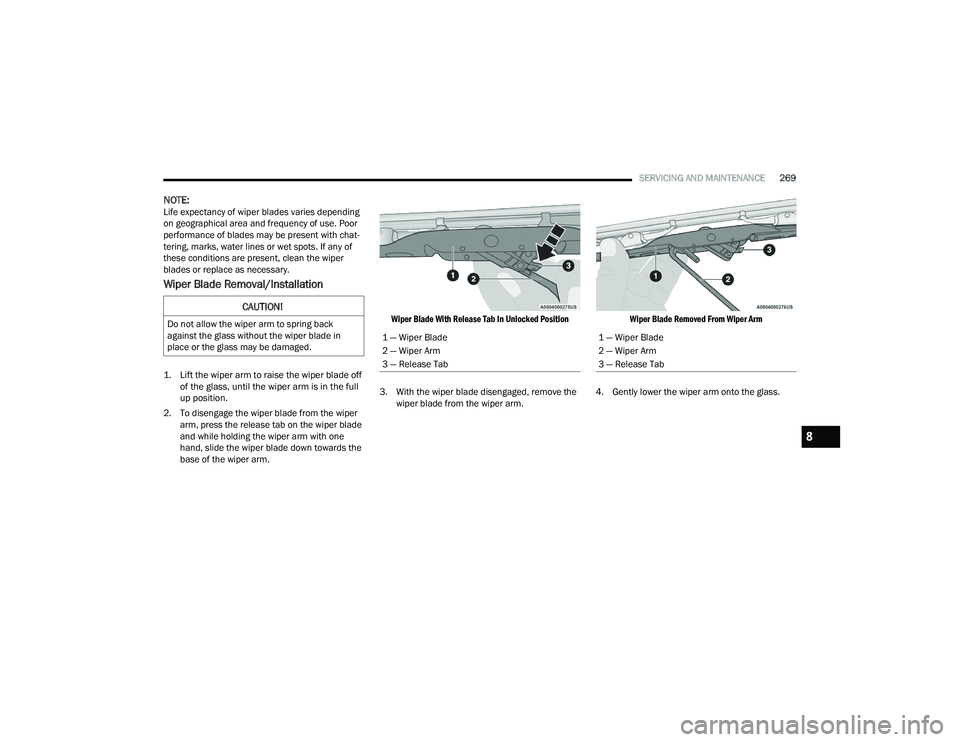
1. Lift the wiper arm to raise the wiper blade off of the glass, until the wiper arm is in the full
up position.
2. To disengage the wiper blade from the wiper arm, press the release tab on the wiper blade
and while holding the wiper arm with one
hand, slide the wiper blade down towards the
base of the wiper arm.
Wiper Blade With Release Tab In Unlocked Position
3. With the wiper blade disengaged, remove the wiper blade from the wiper arm.
Wiper Blade Removed From Wiper Arm
4. Gently lower the wiper arm onto the glass.
CAUTION!
Do not allow the wiper arm to spring back
against the glass without the wiper blade in
place or the glass may be damaged.
1 — Wiper Blade
2 — Wiper Arm
3 — Release Tab1 — Wiper Blade
2 — Wiper Arm
3 — Release Tab
8
22_LA_OM_EN_USC_t.book Page 269
Page 289 of 336
SERVICING AND MAINTENANCE287
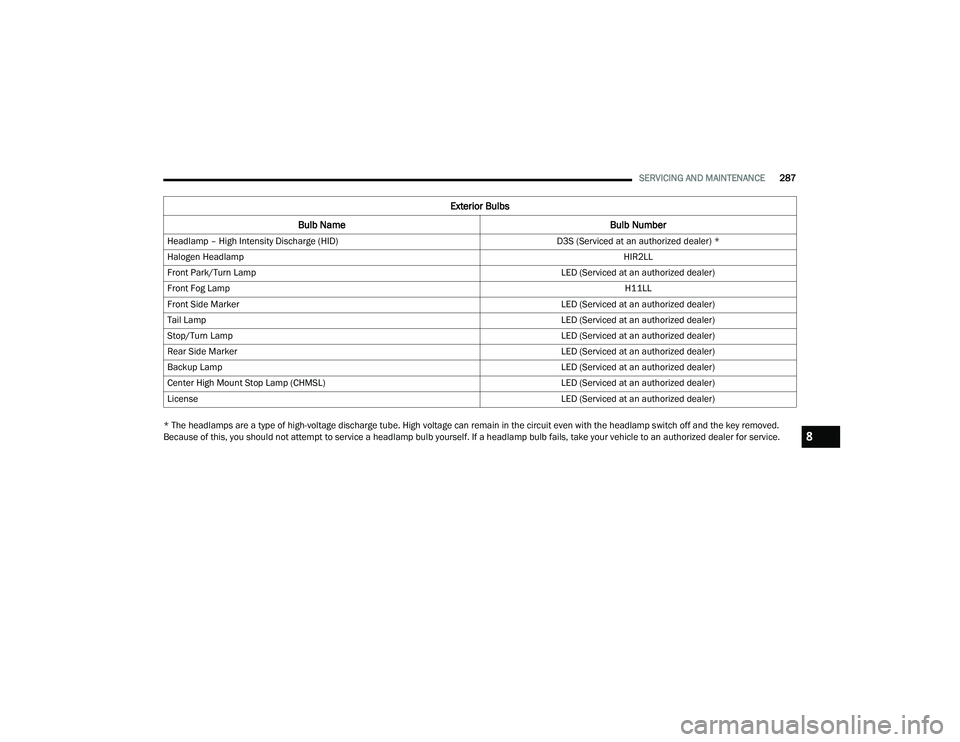
* The headlamps are a type of high-voltage discharge tube. High voltage can remain in the circuit even with the headlamp switch off and the key removed.
Because of this, you should not attempt to service a headlamp bulb yourself. If a headlamp bulb fails, take your vehicle to an authorized dealer for service.
Exterior Bulbs
Bulb Name Bulb Number
Headlamp – High Intensity Discharge (HID) D3S (Serviced at an authorized dealer) *
Halogen Headlamp HIR2LL
Front Park/Turn Lamp LED (Serviced at an authorized dealer)
Front Fog Lamp H11LL
Front Side Marker LED (Serviced at an authorized dealer)
Tail Lamp LED (Serviced at an authorized dealer)
Stop/Turn Lamp LED (Serviced at an authorized dealer)
Rear Side Marker LED (Serviced at an authorized dealer)
Backup Lamp LED (Serviced at an authorized dealer)
Center High Mount Stop Lamp (CHMSL) LED (Serviced at an authorized dealer)
License LED (Serviced at an authorized dealer)
8
22_LA_OM_EN_USC_t.book Page 287
Page 291 of 336
SERVICING AND MAINTENANCE289
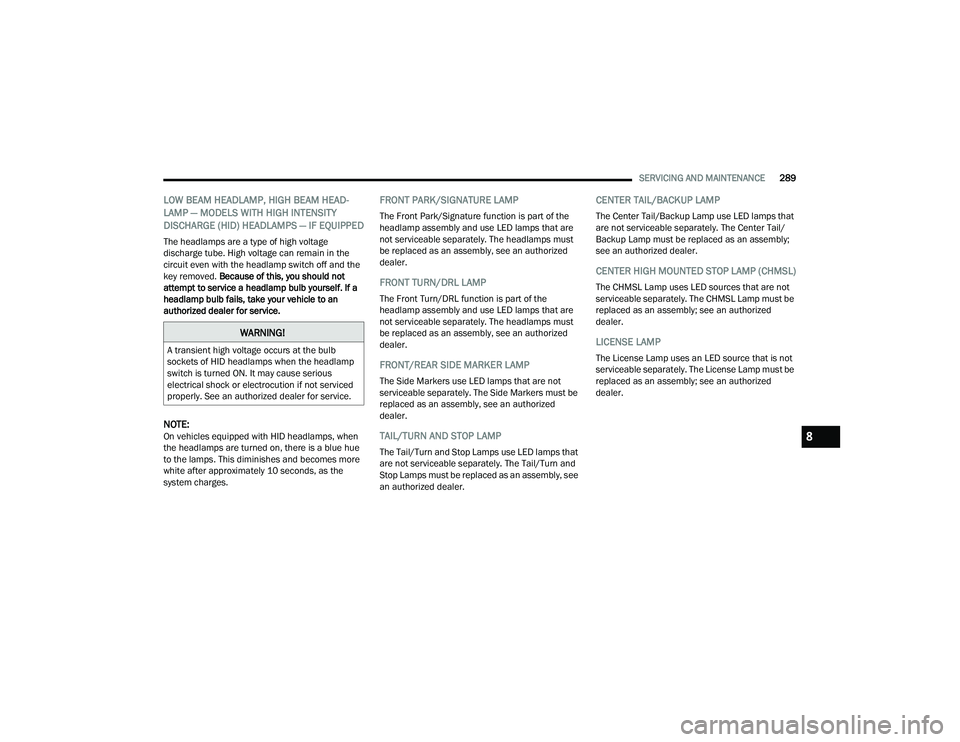
LOW BEAM HEADLAMP, HIGH BEAM HEAD -
LAMP — MODELS WITH HIGH INTENSITY
DISCHARGE (HID) HEADLAMPS — IF EQUIPPED
The headlamps are a type of high voltage
discharge tube. High voltage can remain in the
circuit even with the headlamp switch off and the
key removed. Because of this, you should not
attempt to service a headlamp bulb yourself. If a
headlamp bulb fails, take your vehicle to an
authorized dealer for service.
NOTE:On vehicles equipped with HID headlamps, when
the headlamps are turned on, there is a blue hue
to the lamps. This diminishes and becomes more
white after approximately 10 seconds, as the
system charges.
FRONT PARK/SIGNATURE LAMP
The Front Park/Signature function is part of the
headlamp assembly and use LED lamps that are
not serviceable separately. The headlamps must
be replaced as an assembly, see an authorized
dealer.
FRONT TURN/DRL LAMP
The Front Turn/DRL function is part of the
headlamp assembly and use LED lamps that are
not serviceable separately. The headlamps must
be replaced as an assembly, see an authorized
dealer.
FRONT/REAR SIDE MARKER LAMP
The Side Markers use LED lamps that are not
serviceable separately. The Side Markers must be
replaced as an assembly, see an authorized
dealer.
TAIL/TURN AND STOP LAMP
The Tail/Turn and Stop Lamps use LED lamps that
are not serviceable separately. The Tail/Turn and
Stop Lamps must be replaced as an assembly, see
an authorized dealer.
CENTER TAIL/BACKUP LAMP
The Center Tail/Backup Lamp use LED lamps that
are not serviceable separately. The Center Tail/
Backup Lamp must be replaced as an assembly;
see an authorized dealer.
CENTER HIGH MOUNTED STOP LAMP (CHMSL)
The CHMSL Lamp uses LED sources that are not
serviceable separately. The CHMSL Lamp must be
replaced as an assembly; see an authorized
dealer.
LICENSE LAMP
The License Lamp uses an LED source that is not
serviceable separately. The License Lamp must be
replaced as an assembly; see an authorized
dealer.
WARNING!
A transient high voltage occurs at the bulb
sockets of HID headlamps when the headlamp
switch is turned ON. It may cause serious
electrical shock or electrocution if not serviced
properly. See an authorized dealer for service.
8
22_LA_OM_EN_USC_t.book Page 289
Page 322 of 336
320CUSTOMER ASSISTANCE
MEXICO
Av. Prolongacion Paseo de la Reforma, 1240
Sante Fe C.P. 05109
Mexico, D. F.
In Mexico City: (800) 505-1300
Outside Mexico City: +(52) 55 50817568
PUERTO RICO AND US VIRGIN ISLANDS
FCA Caribbean LLC
P.O. Box 191857
San Juan 00919-1857
Phone: (800) 423-6343
Fax: (787) 782-3345
CUSTOMER ASSISTANCE FOR THE
H
EARING OR SPEECH IMPAIRED
(TDD/TTY)
To assist customers who have hearing difficulties,
FCA US LLC has installed special TDD (Telecommu -
nication Devices for the Deaf) equipment at its
customer center. Any hearing or speech impaired
customer, who has access to a TDD or a
conventional teletypewriter (TTY) in the United
States, can communicate with FCA US LLC by
dialing 1-800-380-2479. Canadian residents with hearing difficulties that
require assistance can use the special needs relay
service offered by Bell Canada. For TTY
teletypewriter users, dial 711 and for Voice callers,
dial 1-800-855-0511 to connect with a Bell Relay
Service operator.
SERVICE CONTRACT
You may have purchased a service contract for a
vehicle to help protect you from the high cost of
unexpected repairs after FCA US LLC's New Vehicle
Limited Warranty expires. The Mopar® Vehicle
Protection plans are the ONLY vehicle extended
protection plans authorized, endorsed and backed
by FCA US LLC to provide additional protection
beyond your vehicle’s warranty. If you purchased a
Mopar® Vehicle Protection Plan, you will receive
Plan Provisions and an Owner Identification Card in
the mail within three weeks of the vehicle delivery
date. If you have any questions about the service
contract, call the FCA US LLC’s Service Contract
National Customer Hotline at 1-800-521-9922
(Canadian residents, call (800) 465-2001
English / (800) 387-9983 French).
FCA US LLC is not responsible for any service
contract you may have purchased from another
manufacturer. If you require service after the
FCA US LLC New Vehicle Limited Warranty expires,
please refer to the contract documents, and
contact the person listed in those documents.
We appreciate that you have made a major
investment when you purchased the vehicle. An
authorized dealer has also made a major
investment in facilities, tools, and training to
ensure that you are absolutely delighted with the
ownership experience.
WARNING!
Engine exhaust (internal combustion engines
only), some of its constituents, and certain
vehicle components contain, or emit, chemicals
known to the State of California to cause cancer
and birth defects, or other reproductive harm. In
addition, certain fluids contained in vehicles and
certain products of component wear contain, or
emit, chemicals known to the State of California
to cause cancer and birth defects, or other
reproductive harm.
22_LA_OM_EN_USC_t.book Page 320
Page 326 of 336
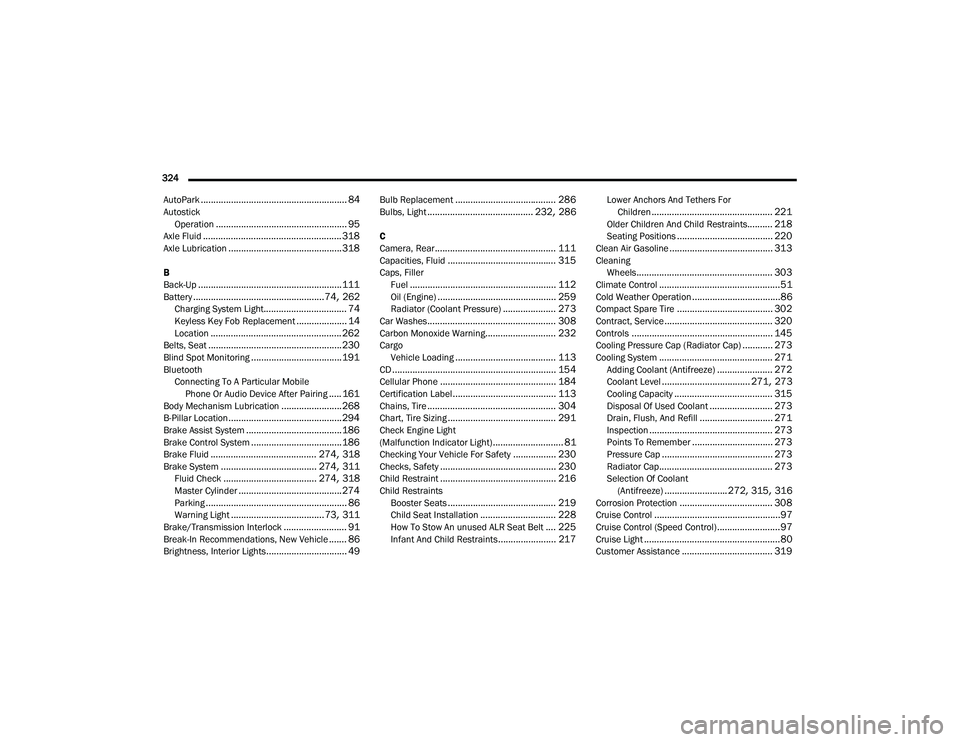
324 AutoPark
.......................................................... 84Autostick Operation.................................................... 95Axle Fluid....................................................... 318Axle Lubrication............................................. 318
B
Back-Up......................................................... 111Battery.................................................... 74, 262Charging System Light................................. 74Keyless Key Fob Replacement.................... 14Location.................................................... 262Belts, Seat..................................................... 230Blind Spot Monitoring.................................... 191BluetoothConnecting To A Particular MobilePhone Or Audio Device After Pairing
..... 161Body Mechanism Lubrication........................ 268B-Pillar Location............................................. 294Brake Assist System...................................... 186Brake Control System.................................... 186Brake Fluid.......................................... 274, 318Brake System...................................... 274, 311Fluid Check..................................... 274, 318Master Cylinder......................................... 274Parking........................................................ 86Warning Light..................................... 73, 311Brake/Transmission Interlock......................... 91Break-In Recommendations, New Vehicle....... 86Brightness, Interior Lights................................ 49
Bulb Replacement........................................ 286Bulbs, Light.......................................... 232, 286
C
Camera, Rear................................................ 111Capacities, Fluid........................................... 315Caps, FillerFuel.......................................................... 112Oil (Engine)............................................... 259Radiator (Coolant Pressure)..................... 273Car Washes................................................... 308Carbon Monoxide Warning............................ 232CargoVehicle Loading........................................ 113CD................................................................. 154Cellular Phone.............................................. 184Certification Label......................................... 113Chains, Tire................................................... 304Chart, Tire Sizing........................................... 291Check Engine Light
(Malfunction Indicator Light)............................ 81Checking Your Vehicle For Safety................. 230Checks, Safety.............................................. 230Child Restraint.............................................. 216Child RestraintsBooster Seats........................................... 219Child Seat Installation.............................. 228How To Stow An unused ALR Seat Belt.... 225Infant And Child Restraints....................... 217
Lower Anchors And Tethers ForChildren................................................ 221Older Children And Child Restraints.......... 218Seating Positions...................................... 220Clean Air Gasoline......................................... 313CleaningWheels...................................................... 303Climate Control................................................51Cold Weather Operation...................................86Compact Spare Tire...................................... 302Contract, Service........................................... 320Controls........................................................ 145Cooling Pressure Cap (Radiator Cap)............ 273Cooling System............................................. 271Adding Coolant (Antifreeze)...................... 272Coolant Level................................... 271, 273Cooling Capacity....................................... 315Disposal Of Used Coolant......................... 273Drain, Flush, And Refill............................. 271Inspection................................................. 273Points To Remember................................ 273Pressure Cap............................................ 273Radiator Cap............................................. 273Selection Of Coolant(Antifreeze)......................... 272, 315, 316Corrosion Protection..................................... 308Cruise Control..................................................97Cruise Control (Speed Control).........................97Cruise Light......................................................80Customer Assistance.................................... 319
22_LA_OM_EN_USC_t.book Page 324
Page 327 of 336
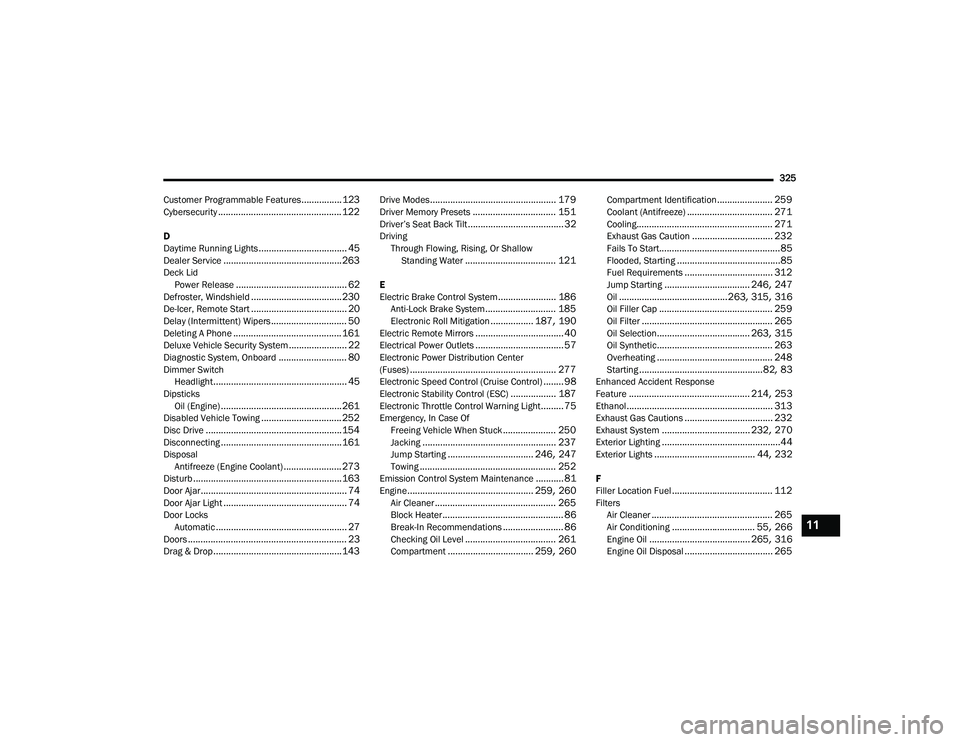
325
Customer Programmable Features
................123Cybersecurity................................................. 122
D
Daytime Running Lights................................... 45Dealer Service............................................... 263Deck Lid Power Release............................................ 62Defroster, Windshield.................................... 230De-Icer, Remote Start...................................... 20Delay (Intermittent) Wipers.............................. 50Deleting A Phone........................................... 161Deluxe Vehicle Security System....................... 22Diagnostic System, Onboard........................... 80Dimmer SwitchHeadlight..................................................... 45DipsticksOil (Engine)................................................ 261Disabled Vehicle Towing................................ 252Disc Drive...................................................... 154Disconnecting................................................ 161DisposalAntifreeze (Engine Coolant)....................... 273Disturb........................................................... 163Door Ajar.......................................................... 74Door Ajar Light................................................. 74Door LocksAutomatic.................................................... 27Doors............................................................... 23Drag & Drop................................................... 143
Drive Modes.................................................. 179Driver Memory Presets................................. 151Driver’s Seat Back Tilt...................................... 32DrivingThrough Flowing, Rising, Or ShallowStanding Water
.................................... 121
E
Electric Brake Control System....................... 186Anti-Lock Brake System............................ 185Electronic Roll Mitigation................. 187, 190Electric Remote Mirrors................................... 40Electrical Power Outlets................................... 57Electronic Power Distribution Center
(Fuses).......................................................... 277Electronic Speed Control (Cruise Control)........ 98Electronic Stability Control (ESC).................. 187Electronic Throttle Control Warning Light......... 75Emergency, In Case OfFreeing Vehicle When Stuck..................... 250Jacking..................................................... 237Jump Starting.................................. 246, 247Towing...................................................... 252Emission Control System Maintenance........... 81Engine.................................................. 259, 260Air Cleaner................................................ 265Block Heater................................................ 86Break-In Recommendations........................ 86Checking Oil Level.................................... 261Compartment.................................. 259, 260
Compartment Identification...................... 259Coolant (Antifreeze).................................. 271Cooling...................................................... 271Exhaust Gas Caution................................ 232Fails To Start................................................85Flooded, Starting.........................................85Fuel Requirements................................... 312Jump Starting.................................. 246, 247Oil...........................................263, 315, 316Oil Filler Cap............................................. 259Oil Filter.................................................... 265Oil Selection..................................... 263, 315Oil Synthetic.............................................. 263Overheating.............................................. 248Starting.................................................82, 83Enhanced Accident Response
Feature................................................ 214, 253Ethanol.......................................................... 313Exhaust Gas Cautions................................... 232Exhaust System................................... 232, 270Exterior Lighting...............................................44Exterior Lights........................................ 44, 232
F
Filler Location Fuel........................................ 112FiltersAir Cleaner................................................ 265Air Conditioning................................. 55, 266Engine Oil........................................ 265, 316Engine Oil Disposal................................... 265
11
22_LA_OM_EN_USC_t.book Page 325