Dealer mode DODGE CHALLENGER 2023 Owner's Manual
[x] Cancel search | Manufacturer: DODGE, Model Year: 2023, Model line: CHALLENGER, Model: DODGE CHALLENGER 2023Pages: 300, PDF Size: 12.82 MB
Page 220 of 300

218IN CASE OF EMERGENCY
If frequent jump starting is required to start your vehicle
you should have the battery and charging system
inspected at an authorized dealer.
IF YOUR ENGINE OVERHEATS
If the vehicle is overheating, it will need to be serviced by
an authorized dealer.
Potential signs of vehicle overheating can be:
Temperature gauge is at HOT (H)
Strong smell of coolant
White smoke coming from engine or exhaust
Coolant bottle coolant has bubbles present In the event it is observed that the temperature gauge is
moving towards or close to the HOT (H) position, you can
reduce the potential for overheating by taking the
appropriate action.
On the highways — slow down.
In city traffic — while stopped, place the transmission in
NEUTRAL (N), but do not increase the engine idle speed
while preventing vehicle motion with the brakes.
If your Air Conditioner (A/C) is on, turn it off. The A/C
system adds heat to the engine cooling system and
turning the A/C off can help remove this heat.
You can also turn the temperature control to maximum
heat, the mode control to floor and the blower control
to high. This allows the heater core to act as a supple -
ment to the radiator and aids in removing heat from the
engine cooling system.
MANUAL PARK RELEASE–8–SPEED
TRANSMISSION
CAUTION!
Accessories plugged into the vehicle power outlets draw
power from the vehicle’s battery, even when not in use
(i.e., cellular devices, etc.). Eventually, if plugged in long
enough without engine operation, the vehicle’s battery
will discharge sufficiently to degrade battery life and/or
prevent the engine from starting.
WARNING!
You or others can be badly burned by hot engine
coolant (antifreeze) or steam from your radiator. If you
see or hear steam coming from under the hood, do not
open the hood until the radiator has had time to cool.
Never try to open a cooling system pressure cap when
the radiator or coolant bottle is hot.
CAUTION!
Driving with a hot cooling system could damage your
vehicle. If the temperature gauge reads HOT (H), pull
over and stop the vehicle. Idle the vehicle with the air
conditioner turned off until the pointer drops back into
the normal range. If the pointer remains on HOT (H),
and you hear continuous chimes, turn the engine off
immediately and call for service.
WARNING!
Always secure your vehicle by fully applying the parking
brake before activating the Manual Park Release. In
addition, you should be seated in the driver's seat with
your foot firmly on the brake pedal when activating the
Manual Park Release. Activating the Manual Park
Release will allow your vehicle to roll away if it is not
secured by the parking brake, or by proper connection
to a tow vehicle. Activating the Manual Park Release on
an unsecured vehicle could lead to serious injury or
death for those in or around the vehicle.
23_LA_OM_EN_USC_t.book Page 218
Page 237 of 300
SERVICING AND MAINTENANCE235
(Continued)
3. Remove the used filter.
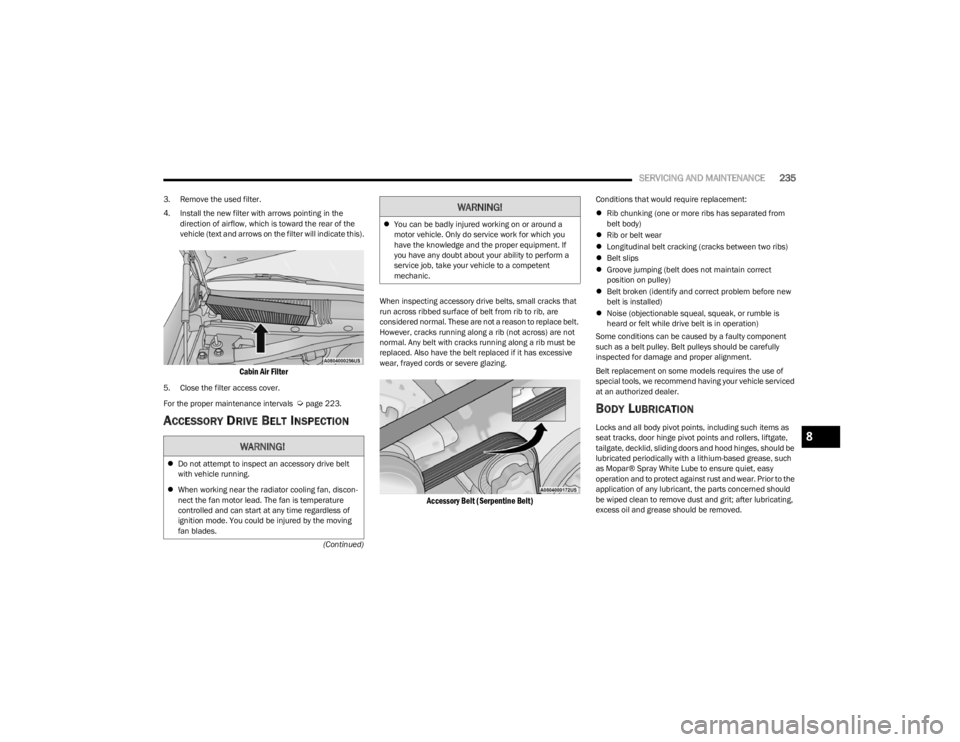
4. Install the new filter with arrows pointing in the
direction of airflow, which is toward the rear of the
vehicle (text and arrows on the filter will indicate this).
Cabin Air Filter
5. Close the filter access cover.
For the proper maintenance intervals
Úpage 223.
ACCESSORY DRIVE BELT INSPECTION
When inspecting accessory drive belts, small cracks that
run across ribbed surface of belt from rib to rib, are
considered normal. These are not a reason to replace belt.
However, cracks running along a rib (not across) are not
normal. Any belt with cracks running along a rib must be
replaced. Also have the belt replaced if it has excessive
wear, frayed cords or severe glazing.
Accessory Belt (Serpentine Belt)
Conditions that would require replacement:
Rib chunking (one or more ribs has separated from
belt body)
Rib or belt wear
Longitudinal belt cracking (cracks between two ribs)
Belt slips
Groove jumping (belt does not maintain correct
position on pulley)
Belt broken (identify and correct problem before new
belt is installed)
Noise (objectionable squeal, squeak, or rumble is
heard or felt while drive belt is in operation)
Some conditions can be caused by a faulty component
such as a belt pulley. Belt pulleys should be carefully
inspected for damage and proper alignment.
Belt replacement on some models requires the use of
special tools, we recommend having your vehicle serviced
at an authorized dealer.
BODY LUBRICATION
Locks and all body pivot points, including such items as
seat tracks, door hinge pivot points and rollers, liftgate,
tailgate, decklid, sliding doors and hood hinges, should be
lubricated periodically with a lithium-based grease, such
as Mopar® Spray White Lube to ensure quiet, easy
operation and to protect against rust and wear. Prior to the
application of any lubricant, the parts concerned should
be wiped clean to remove dust and grit; after lubricating,
excess oil and grease should be removed.
WARNING!
Do not attempt to inspect an accessory drive belt
with vehicle running.
When working near the radiator cooling fan, discon -
nect the fan motor lead. The fan is temperature
controlled and can start at any time regardless of
ignition mode. You could be injured by the moving
fan blades.
You can be badly injured working on or around a
motor vehicle. Only do service work for which you
have the knowledge and the proper equipment. If
you have any doubt about your ability to perform a
service job, take your vehicle to a competent
mechanic.
WARNING!
8
23_LA_OM_EN_USC_t.book Page 235
Page 254 of 300
252SERVICING AND MAINTENANCE
Replacing Exterior Bulbs
LOW BEAM HEADLAMP, HIGH BEAM
HEADLAMP — MODELS WITH HALOGEN
HEADLAMPS — IF EQUIPPED
See the following steps to replace:
1. Open the hood.
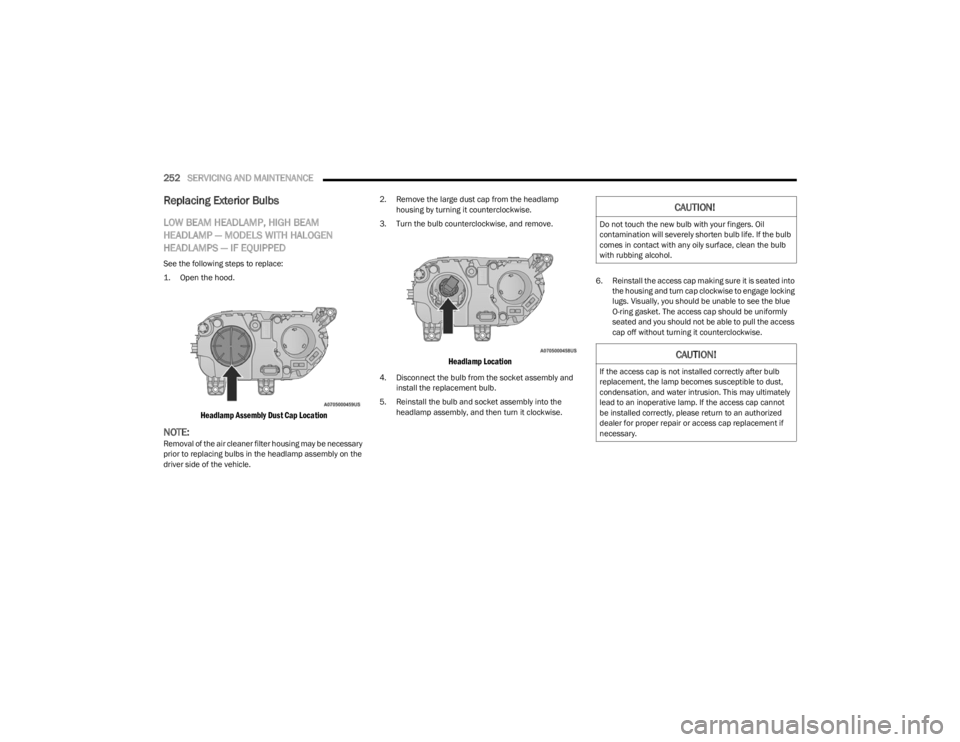
Headlamp Assembly Dust Cap Location
NOTE:Removal of the air cleaner filter housing may be necessary
prior to replacing bulbs in the headlamp assembly on the
driver side of the vehicle. 2. Remove the large dust cap from the headlamp
housing by turning it counterclockwise.
3. Turn the bulb counterclockwise, and remove.
Headlamp Location
4. Disconnect the bulb from the socket assembly and install the replacement bulb.
5. Reinstall the bulb and socket assembly into the headlamp assembly, and then turn it clockwise. 6. Reinstall the access cap making sure it is seated into
the housing and turn cap clockwise to engage locking
lugs. Visually, you should be unable to see the blue
O-ring gasket. The access cap should be uniformly
seated and you should not be able to pull the access
cap off without turning it counterclockwise.
CAUTION!
Do not touch the new bulb with your fingers. Oil
contamination will severely shorten bulb life. If the bulb
comes in contact with any oily surface, clean the bulb
with rubbing alcohol.
CAUTION!
If the access cap is not installed correctly after bulb
replacement, the lamp becomes susceptible to dust,
condensation, and water intrusion. This may ultimately
lead to an inoperative lamp. If the access cap cannot
be installed correctly, please return to an authorized
dealer for proper repair or access cap replacement if
necessary.
23_LA_OM_EN_USC_t.book Page 252
Page 255 of 300

SERVICING AND MAINTENANCE253
LOW BEAM HEADLAMP, HIGH BEAM HEAD -
LAMP — MODELS WITH HIGH INTENSITY
DISCHARGE (HID) HEADLAMPS — IF EQUIPPED
The headlamps are a type of high voltage discharge tube.
High voltage can remain in the circuit even with the
headlamp switch off and the key removed. Because of
this, you should not attempt to service a headlamp bulb
yourself. If a headlamp bulb fails, take your vehicle to an
authorized dealer for service.
NOTE:On vehicles equipped with HID headlamps, when the
headlamps are turned on, there is a blue hue to the lamps.
This diminishes and becomes more white after approxi -
mately 10 seconds, as the system charges.
FRONT PARK/SIGNATURE LAMP
The Front Park/Signature function is part of the headlamp
assembly and use LED lamps that are not serviceable
separately. The headlamps must be replaced as an
assembly, see an authorized dealer.
FRONT TURN/DRL LAMP
The Front Turn/DRL function is part of the headlamp
assembly and use LED lamps that are not serviceable
separately. The headlamps must be replaced as an
assembly, see an authorized dealer.
FRONT/REAR SIDE MARKER LAMP
The Side Markers use LED lamps that are not serviceable
separately. The Side Markers must be replaced as an
assembly, see an authorized dealer.
TAIL/TURN AND STOP LAMP
The Tail/Turn and Stop Lamps use LED lamps that are not
serviceable separately. The Tail/Turn and Stop Lamps
must be replaced as an assembly, see an authorized
dealer.
CENTER TAIL/BACKUP LAMP
The Center Tail/Backup Lamp use LED lamps that are not
serviceable separately. The Center Tail/Backup Lamp
must be replaced as an assembly; see an authorized
dealer.
CENTER HIGH MOUNTED STOP LAMP (CHMSL)
The CHMSL Lamp uses LED sources that are not
serviceable separately. The CHMSL Lamp must be
replaced as an assembly; see an authorized dealer.
LICENSE LAMP
The License Lamp uses an LED source that is not
serviceable separately. The License Lamp must be
replaced as an assembly; see an authorized dealer.
TIRES
TIRE SAFETY INFORMATION
Tire safety information will cover aspects of the following
information: Tire Markings, Tire Identification Numbers,
Tire Terminology and Definitions, Tire Pressures, and Tire
Loading.
WARNING!
A transient high voltage occurs at the bulb sockets of
HID headlamps when the headlamp switch is turned
ON. It may cause serious electrical shock or
electrocution if not serviced properly. See an authorized
dealer for service.
8
23_LA_OM_EN_USC_t.book Page 253
Page 264 of 300

262SERVICING AND MAINTENANCE
Check tire pressures more often if subject to a wide range
of outdoor temperatures, as tire pressures vary with
temperature changes.
Tire pressures change by approximately 1 psi (7 kPa) per
12°F (7°C) of air temperature change. Keep this in mind
when checking tire pressure inside a garage, especially in
the Winter.
Example: If garage temperature = 68°F (20°C) and the
outside temperature = 32°F (0°C) then the cold tire
inflation pressure should be increased by 3 psi (21 kPa),
which equals 1 psi (7 kPa) for every 12°F (7°C) for this
outside temperature condition.
Tire pressure may increase from 2 to 6 psi (13 to 40 kPa)
during operation. DO NOT reduce this normal pressure
build up or your tire pressure will be too low.
Tire Pressures For High Speed Operation
The manufacturer advocates driving at safe speeds and
within posted speed limits. Where speed limits or
conditions are such that the vehicle can be driven at high
speeds, maintaining correct tire inflation pressure is very
important. Increased tire pressure and reduced vehicle
loading may be required for high-speed vehicle operation.
Refer to an authorized tire dealer or original equipment
vehicle dealer for recommended safe operating speeds,
loading and cold tire inflation pressures.
Radial Ply Tires
Tire Repair
If your tire becomes damaged, it may be repaired if it
meets the following criteria:
The tire has not been driven on when flat.
The damage is only on the tread section of your tire
(sidewall damage is not repairable).
The puncture is no greater than ¼ of an inch (6 mm).
Consult an authorized tire dealer for tire repairs and
additional information.
Damaged Run Flat tires, or Run Flat tires that have
experienced a loss of pressure should be replaced
immediately with another Run Flat tire of identical size and
service description (Load Index and Speed Symbol). Replace the tire pressure sensor as well as it is not
designed to be reused.
Run Flat Tires — If Equipped
Run Flat tires allow you the capability to drive 50 miles
(80 km) at 50 mph (80 km/h) after a rapid loss of inflation
pressure. This rapid loss of inflation is referred to as the
Run Flat mode. A Run Flat mode occurs when the tire
inflation pressure is of/or below 14 psi (96 kPa).
Once a Run Flat tire reaches the Run Flat mode it has
limited driving capabilities and needs to be replaced
immediately. A Run Flat tire is not repairable. When a Run
Flat tire is changed after being driven under a Run Flat
mode 14 psi (96 kPa) condition, please replace the TPMS
sensor as it is not designed to be reused.
NOTE:TPMS sensor must be replaced after driving the vehicle on
a flat tire condition.
It is not recommended driving a vehicle loaded at full
capacity or to tow a trailer while a tire is in the Run Flat
mode.
See the Tire Pressure Monitoring System section for more
information.
Tire Spinning
When stuck in mud, sand, snow, or ice conditions, do not
spin your vehicle's wheels above 30 mph (48 km/h) or for
longer than 30 seconds continuously without stopping.
For further information
Úpage 220.
WARNING!
High speed driving with your vehicle under maximum
load is dangerous. The added strain on your tires could
cause them to fail. You could have a serious collision.
Do not drive a vehicle loaded to the maximum capacity
at continuous speeds above 75 mph (120 km/h).
WARNING!
Combining radial ply tires with other types of tires on
your vehicle will cause your vehicle to handle poorly.
The instability could cause a collision. Always use radial
ply tires in sets of four. Never combine them with other
types of tires.
23_LA_OM_EN_USC_t.book Page 262
Page 288 of 300

286
Brake Assist System .................................................... 160
Brake Control System .................................................. 160
Brake Fluid .......................................................... 240
, 279
Brake System ...................................................... 240, 273
Fluid Check..................................................... 240, 279
Master Cylinder ....................................................... 240
Parking ....................................................................... 74
Warning Light ................................................... 64
, 273
Brake/Transmission Interlock........................................79
Break-In Recommendations, New Vehicle .................... 74
Brightness, Interior Lights .............................................. 43
Bulb Replacement ....................................................... 250
Bulbs, Light.......................................................... 198
, 250
CCamera, Rear ..................................................................96
Capacities, Fluid ........................................................... 277
Caps, Filler Fuel .............................................................................96
Oil (Engine) .............................................................. 228
Radiator (Coolant Pressure)................................... 239
Car Washes .................................................................. 270
Carbon Monoxide Warning .......................................... 198
Cargo Vehicle Loading..........................................................97
Cargo Net .........................................................................55
CD.................................................................................. 133
Cellular Phone .............................................................. 158
Certification Label ...........................................................98
Chains, Tire................................................................... 267
Chart, Tire Sizing .......................................................... 255
Check Engine Light (Malfunction Indicator Light) .........70
Checking Your Vehicle For Safety ............................... 196
Checks, Safety.............................................................. 196 Child Restraint .............................................................. 185
Child Restraints
Booster Seats .......................................................... 187
Child Seat Installation ............................................. 194How To Stow An unused ALR Seat Belt .................192Infant And Child Restraints ..................................... 186
Lower Anchors And Tethers For Children............... 188
Older Children And Child Restraints....................... 187
Seating Positions ..................................................... 188
Clean Air Gasoline ........................................................ 275
Cleaning Wheels .....................................................................266
Climate Control ............................................................... 45
Cold Weather Operation ................................................. 74
Compact Spare Tire ...................................................... 265
Contract, Service .......................................................... 282
Controls ......................................................................... 125
Cooling Pressure Cap (Radiator Cap) ..........................239
Cooling System ............................................................. 237 Adding Coolant (Antifreeze) ....................................238
Coolant Level ................................................. 238
, 239
Cooling Capacity ...................................................... 277
Disposal Of Used Coolant ....................................... 239 Drain, Flush, And Refill............................................238
Inspection ................................................................ 239
Points To Remember............................................... 239
Pressure Cap ...........................................................239
Radiator Cap ............................................................239Selection Of Coolant (Antifreeze) ........ 238
, 277, 278
Corrosion Protection ..................................................... 270
Cruise Control ................................................................. 84
Cruise Control (Speed Control) ...................................... 84 Cruise Light ..................................................................... 69 Cupholders
Illuminated................................................................. 50
Customer Assistance ................................................... 280
Customer Programmable Features ............................. 107
Cybersecurity ................................................................ 106
DDaytime Running Lights ................................................. 40 Dealer Service .............................................................. 231
Defroster, Windshield .................................................. 197
De-Icer, Remote Start .................................................... 19
Delay (Intermittent) Wipers............................................ 44
Deleting A Phone .......................................................... 139
Deluxe Vehicle Security System .................................... 20
Diagnostic System, Onboard ......................................... 69Dimmer Control .............................................................. 43Dipsticks Oil (Engine) .............................................................. 230
Disabled Vehicle Towing .............................................. 221
Disc Drive ...................................................................... 133
Disconnecting ............................................................... 139
Disposal Antifreeze (Engine Coolant) .................................... 239
Disturb........................................................................... 141
Door Ajar ......................................................................... 64
Door Ajar Light ................................................................ 64
Door Locks Automatic .................................................................. 24
Remote Keyless Entry ............................................... 12
Doors ............................................................................... 21
Drag & Drop .................................................................. 123
Drive Modes.................................................................. 154
Driver Memory Presets ................................................ 131
Driver Memory Settings ................................................. 27
23_LA_OM_EN_USC_t.book Page 286