flat tire DODGE CHALLENGER SRT 2010 3.G Owner's Manual
[x] Cancel search | Manufacturer: DODGE, Model Year: 2010, Model line: CHALLENGER SRT, Model: DODGE CHALLENGER SRT 2010 3.GPages: 436, PDF Size: 8.59 MB
Page 321 of 436
the vehicle or tire and wheel components. Once the
sealant dries, it can easily be peeled off and properly
discarded.
•For optimum performance, make sure the valve stem
on the wheel is free of debris before connecting the
TIREFIT kit.
•You can use the TIREFIT air pump to inflate bicycle
tires. The kit also comes with two needles located in
the Accessory Storage Compartment (8) for inflating
sport balls, rafts, or like inflatable items. However, use
only the Black Air Pump Hose (6) and make sure the
Mode Select Knob (4) is in the Air Mode when
inflating such items to avoid injecting sealant into
them. The TIREFIT Sealant is only intended to seal
punctures less than
14” (6mm) diameter in the tread of
your vehicle.
•Do not lift or carry TIREFIT kit by hoses.
WARNING!
•Do not attempt to seal a tire on the side of the
vehicle close to traffic. Pull far enough off the road
to avoid the danger of being hit when using the
TIREFIT kit.
•Do not use TIREFIT or drive the vehicle under the
following circumstances:
If the cut or puncture in the tire tread is approxi-
mately 0.24 in. (6 mm) or larger.
If the tire has any sidewall damage.
If the tire has any damage from driving with
extremely low tire pressure.
If the tire has any damage from driving on a flat
tire.
If the wheel has any damage.
(Continued)
320 WHAT TO DO IN EMERGENCIES
Page 323 of 436
Sealing a Tire with TIREFIT
(A) Whenever You Stop to Use TIREFIT:
1. Pull over to a safe location and turn ON the vehicle’s
Hazard Warning flashers.
2. Verify that the valve stem (on the wheel with the
deflated tire) is in a position that is near to the ground.
This will allow the TIREFIT Hoses (6) and (7) to reach the
valve stem and keep the TIREFIT kit flat on the ground.
This will provide the best positioning of the kit when
injecting the sealant into the deflated tire and running the
air pump. Move the vehicle as necessary to place the
valve stem in this position before proceeding.
3. Place the transmission in PARK (auto transmission) or
in Gear (manual transmission) and turn OFF the ignition.
4. Set the parking brake.
(B) Setting Up to Use TIREFIT:
1. Remove the gloves from the Accessory Storage Com-
partment (8) and place them on your hands.
2. Turn the Mode Select knob (4) to the Sealant Mode
position.
3. Uncoil the Clear Sealant Hose (7) and then remove the
Yellow Cap from the fitting at the end of the hose.
4. Place the TIREFIT kit flat on the ground next to the
deflated tire.
5. Remove the cap from the valve stem and then screw
the fitting at the end of the Clear Sealant Hose (7) onto
the valve stem.
6. Uncoil the Power Plug and Cable (5) and then insert
the plug into the vehicle’s 12 Volt power outlet.
NOTE:Do not remove foreign objects (e.g., screws or
nails) from the tire.
322 WHAT TO DO IN EMERGENCIES
Page 324 of 436
(C) Injecting TIREFIT Sealant into the deflated
tire:
•
Always start the engine before turning ON the TIRE-
FIT kit.
NOTE: Manual transmission vehicles must have the
parking brake engaged and the shifter in NEUTRAL.
•After pressing the Power Button (3), the sealant (white
fluid) will flow from the Sealant Bottle (1) through the
Sealant Hose (7) and into the tire.
NOTE: Sealant may leak out through the puncture in
the tire.
If the sealant (white fluid) does not flow within 0 –
10 seconds through the clear Sealant Hose (7):
1. Press the Power Button (3) to turn OFF the TIREFIT
kit. Disconnect the Clear Sealant Hose (7) from the valve stem. Make sure the valve stem is free of debris. Recon-
nect the Clear Sealant Hose (7) to the valve stem. Check
that mode select knob (4) is on sealant mode position and
not air mode. Press the Power Button (3) to turn ON the
TIREFIT kit.
2. Connect the Power Plug (5) to a different 12 Volt
power outlet in your vehicle or another vehicle, if avail-
able. Make sure the engine is running before turning ON
the TIREFIT kit.
3. The Sealant Bottle (1) may be empty due to previous
use. Call for assistance.
NOTE:
If mode select knob (4) is on air mode and pump
is operating, air will dispense from black air pump hose
(6) only, not the clear sealant hose (7).
6
WHAT TO DO IN EMERGENCIES 323
Page 325 of 436
If the sealant (white fluid) does flowthrough the clear
Sealant Hose (7):
1. Continue to operate pump until sealant is no longer
flowing through hose (typically takes 30 - 70 seconds). As
the sealant flows through hose (7), the pressure gauge (2)
can read as high as 70 psi (5 Bar). The pressure gauge (2)
will decrease quickly from approximately 70 psi to the
actual tire pressure when the sealant bottle is empty.
2. The pump will start to inject air into the tire immedi-
ately after the sealant bottle is empty. Continue to operate
pump and inflate the tire to the pressure indicated on the
tire pressure label on the driver-side latch pillar (recom-
mended pressure). Check the tire pressure by looking at
the pressure gauge (2). If the tire does not inflate to at least 26 psi (1.8 Bar)
pressure within 15 minutes:
•The tire is too badly damaged. Do not attempt to drive
the vehicle further. Call for assistance.
If the tire inflates to the recommended pressure or is at
least 26 psi (1.8 Bar) pressure within 15 minutes:
1. Press the power button (3) to turn off the TIREFIT kit.
2. Remove the Speed Limit sticker from the top of the
Sealant Bottle (1) and place the sticker on the steering
wheel.
3. Immediately disconnect the Clear Sealant Hose (7)
from the valve stem, reinstall the Yellow Cap on the
fitting at the end of the hose, and place the TIREFIT kit in
the vehicle storage location. Quickly proceed to (D)
“Securing TIREFIT Sealant in the Tire”.
324 WHAT TO DO IN EMERGENCIES
Page 326 of 436
CAUTION!
•The metal end fitting from Power Plug and Cable
(5) may get hot after use, so should be handled
carefully.
•Failure to reinstall the Yellow Cap on the fitting at
the end of the Clear Sealant Hose (7) can result in
sealant contacting your skin, clothing, and the
vehicle’s interior. It can also result in sealant
contacting internal TIREFIT kit components
which may cause permanent damage to the kit.
(D) Securing TIREFIT Sealant in the Tire:
Immediately after injecting sealant, and inflating tire,
drive the vehicle 5 miles (8 km) or 10 minutes to ensure
distribution of the TIREFIT Sealant within the tire. Do not
exceed 55 mph (88 km/h).
WARNING!
TIREFIT is not a permanent flat tire repair. Have the
tire inspected and repaired or replaced after using
TIREFIT. Do not exceed 55 mph (88 km/h) until
having the tire repaired or replaced. Failure to follow
this warning can result in injuries that are serious or
fatal to you, your passengers, and others around you.
(E) After Securing TIREFIT Sealant in the Tire:
Follow Step (A) “Whenever You Stop to Use TIREFIT”
before continuing.
1. Turn the Mode Select knob (4) to the Air Mode
position.
2. Uncoil the Black Air Pump Hose (6) and connect it to
the valve stem.
3. Check the pressure in the tire by reading the Pressure
Gauge (2).
6
WHAT TO DO IN EMERGENCIES 325
Page 327 of 436
If tire pressure is less than 19 psi (1.3 Bar), the tire is too
badly damaged. Do not attempt to drive the vehicle
further. Call for assistance.
If the tire pressure is 19 psi (1.3 bar) or higher:
1. Press the power button (3) to on and inflate the tire to
the pressure indicated on the tire and loading informa-
tion label on the driver-side door opening.
2. Disconnect the TIREFIT kit from the valve stem and
then reinstall the cap on the valve stem.
3. Place the TIREFIT kit in its proper storage area in the
vehicle.
4. Have the tire inspected and repaired or replaced at the
earliest opportunity at an authorized dealer or tire ser-
vice center. 5. Replace the Sealant Bottle (1) and Sealant Hose (7)
assembly at your authorized dealer as soon as possible.
Refer to “(F) Sealant Bottle and Hose Replacement.”
NOTE:
When having the tire serviced advise the autho-
rized dealer or service center that the tire has been sealed
using the TIREFIT service kit.
(F) Sealant Bottle and Hose Replacement:
1. Uncoil the Clear Sealant Hose (7).
2. Locate the rectangular Sealant Bottle release button in
the recessed area where you place your fingers to unlatch
the hoses (6) (7) from their storage area.
3. Use the Yellow Cap on end of the Clear Sealant Hose
(7) to depress the Sealant Bottle release button. The
Sealant Bottle (1) will pop up. Remove the bottle and
dispose of it accordingly.
326 WHAT TO DO IN EMERGENCIES
Page 333 of 436
CAUTION!
•When “rocking” a stuck vehicle by moving be-
tween “1st” and REVERSE, do not spin the wheels
faster than 15 mph (24 km/h), or drivetrain damage
may result.
•Revving the engine or spinning the wheels too fast
may lead to transmission overheating and failure.
It can also damage the tires. Do not spin the
wheels above 30 mph (48 km/h) while in gear (no
transmission shifting occurring).
WARNING!
Fast spinning tires can be dangerous. Forces gener-
ated by excessive wheel speeds may cause damage, or
even failure, of the axle and tires. A tire could
explode and injure someone. Do not spin your vehi-
cle’s wheels faster than 30 mph (48 km/h) or for
longer than 30 seconds continuously without stop-
ping when you are stuck and do not let anyone near
a spinning wheel, no matter what the speed.
TOWING A DISABLED VEHICLE
Without The Key Fob
Special care must be taken when the vehicle is towed
with the ignition in the OFF position. The only approved
method of towing without the ignition key is with a
flatbed truck. Proper towing equipment is necessary to
prevent damage to the vehicle.
332 WHAT TO DO IN EMERGENCIES
Page 415 of 436
WARNING!
The traction grade assigned to this tire is based on
straight-ahead braking traction tests, and does not
include acceleration, cornering, hydroplaning, or
peak traction characteristics.
Temperature Grades
The temperature grades are A (the highest), B, and C,
representing the tire’s resistance to the generation of heat
and its ability to dissipate heat, when tested under
controlled conditions on a specified indoor laboratory
test wheel. Sustained high temperature can cause the
material of the tire to degenerate and reduce tire life, and
excessive temperature can lead to sudden tire failure. The
grade C corresponds to a level of performance, which all
passenger car tires must meet under the Federal MotorVehicle Safety Standard No. 109. Grades B and A repre-
sent higher levels of performance on the laboratory test
wheel, than the minimum required by law.
WARNING!
The temperature grade for this tire is established for
a tire that is properly inflated and not overloaded.
Excessive speed, under-inflation, or excessive load-
ing, either separately or in combination, can cause
heat buildup and possible tire failure.
414 IF YOU NEED CONSUMER ASSISTANCE
Page 433 of 436
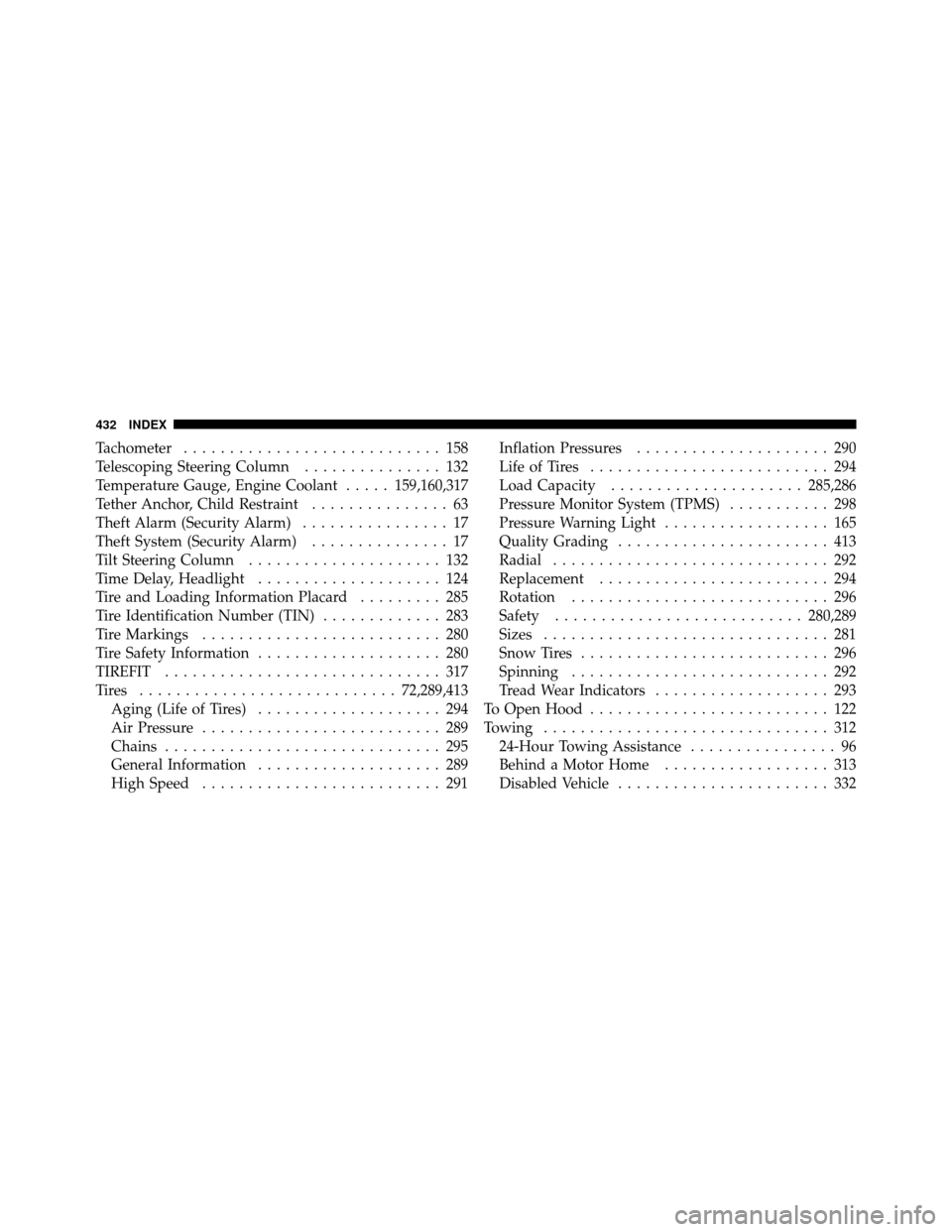
Tachometer............................ 158
Telescoping Steering Column ............... 132
Temperature Gauge, Engine Coolant .....159,160,317
Tether Anchor, Child Restraint ............... 63
Theft Alarm (Security Alarm) ................ 17
Theft System (Security Alarm) ............... 17
Tilt Steering Column ..................... 132
Time Delay, Headlight .................... 124
Tire and Loading Information Placard ......... 285
Tire Identification Number (TIN) ............. 283
Tire Markings .......................... 280
Tire Safety Information .................... 280
TIREFIT .............................. 317
Tires ............................ 72,289,413
Aging (Life of Tires) .................... 294
Air Pressure .......................... 289
Chains .............................. 295
General Information .................... 289
High Speed .......................... 291 Inflation Pressures
..................... 290
Life of Tires .......................... 294
Load Capacity ..................... 285,286
Pressure Monitor System (TPMS) ........... 298
Pressure Warning Light .................. 165
Quality Grading ....................... 413
Radial .............................. 292
Replacement ......................... 294
Rotation ............................ 296
Safety ........................... 280,289
Sizes ............................... 281
Snow Tires ........................... 296
Spinning ............................ 292
Tread Wear Indicators ................... 293
To Open Hood .......................... 122
Towing ............................... 312
24-Hour Towing Assistance ................ 96
Behind a Motor Home .................. 313
Disabled Vehicle ....................... 332
432 INDEX