tire size DODGE CHALLENGER SRT 2012 3.G User Guide
[x] Cancel search | Manufacturer: DODGE, Model Year: 2012, Model line: CHALLENGER SRT, Model: DODGE CHALLENGER SRT 2012 3.GPages: 471, PDF Size: 3.21 MB
Page 319 of 471
WARNING! (Continued)
•Never use a tire with a smaller load index or
capacity, other than what was originally equipped
on your vehicle. Using a tire with a smaller load
index could result in tire overloading and failure.
You could lose control and have a collision.
•Failure to equip your vehicle with tires having
adequate speed capability can result in sudden tire
failure and loss of vehicle control.
CAUTION!
Replacing original tires with tires of a different size may
result in false speedometer and odometer readings.
TIRE CHAINS
Use only compact chains or other traction aids that meet
SAE type “Class S” specifications. Chains must be the
proper size for the vehicle, as recommended by the chain
manufacturer. Only install tire chains on 245/45ZR20 size
tires.
NOTE:Do not use tire chains on a compact spare tire.
CAUTION!
To avoid damage to your vehicle or tires, observe the
following precautions:
•Because of restricted chain clearance between tires
and other suspension components, it is important
that only chains in good condition are used. Broken
chains can cause serious damage. Stop the vehicle
immediately if noise occurs that could indicate chain
breakage. Remove the damaged parts of the chain
before further use.
(Continued)
5
STARTING AND OPERATING 317
Page 321 of 471
SNOW TIRES
Some areas of the country require the use of snow tires
during the winter. All season tires can be identified by the
M+S designation on the tire sidewall.
If you need snow tires, select tires equivalent in size and
type to the original equipment tires. Use snow tires only
in sets of four; failure to do so may adversely affect the
safety and handling of your vehicle.
Snow tires generally have lower speed ratings than what
was originally equipped with your vehicle and should
not be operated at sustained speeds over 75 mph
(120 km/h). For speeds above 75 mph (120 km/h) refer to
original equipment or an authorized tire dealer for
recommended safe operating speeds, loading and cold
tire inflation pressures.While studded tires improve performance on ice, skid
and traction capability on wet or dry surfaces may be
poorer than that of non-studded tires. Some states pro-
hibit studded tires; therefore, local laws should be
checked before using these tire types.
TIRE ROTATION RECOMMENDATIONS
The tires on the front and rear of your vehicle operate at
different loads and perform different steering, driving,
and braking functions. For these reasons, they wear at
unequal rates.
These effects can be reduced by timely rotation of tires.
The benefits of rotation are especially worthwhile with
aggressive tread designs such as those on all season type
tires. Rotation will increase tread life, help to maintain
mud, snow, and wet traction levels, and contribute to a
smooth, quiet ride.
5
STARTING AND OPERATING 319
Page 323 of 471
Tire Rotation – F1 Three Season Tires
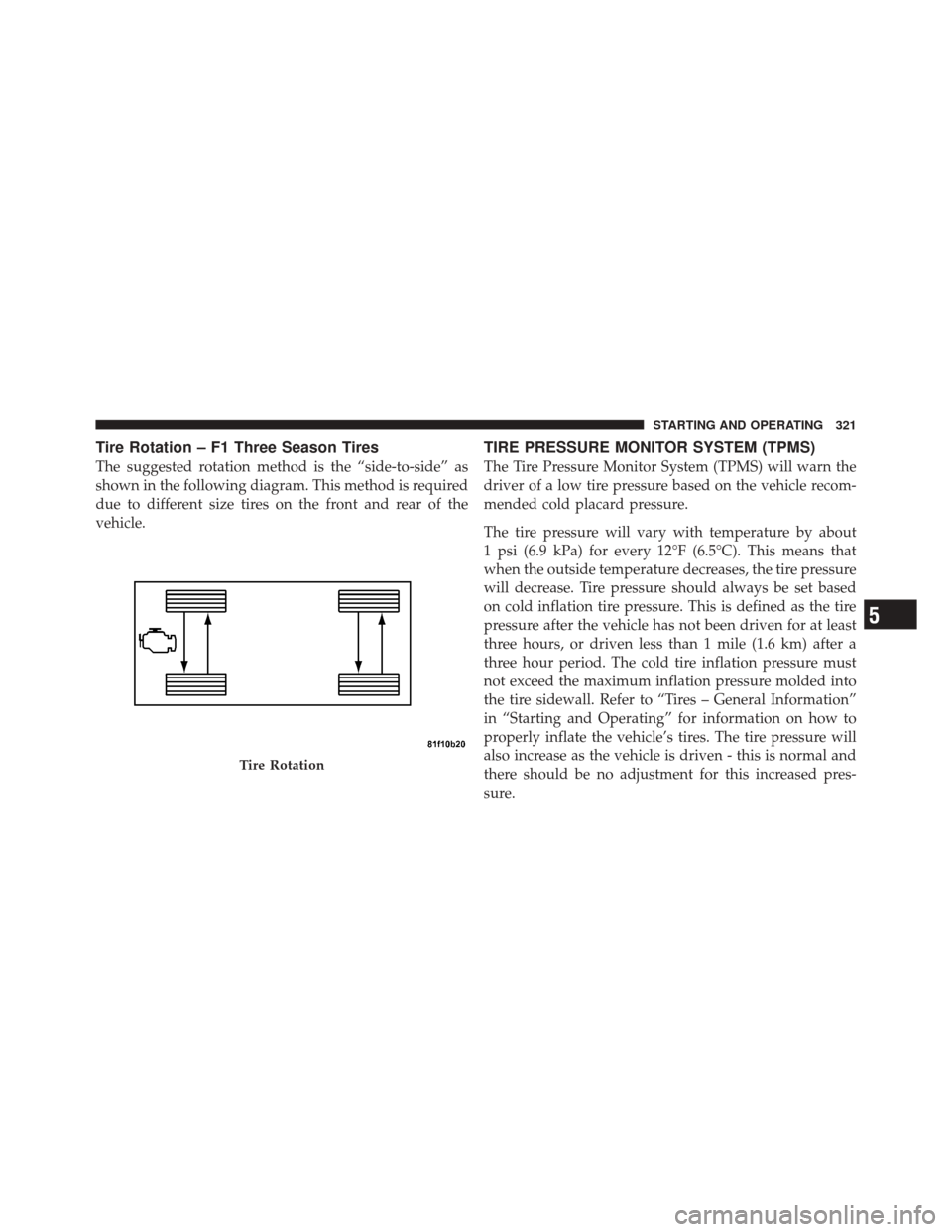
The suggested rotation method is the “side-to-side” as
shown in the following diagram. This method is required
due to different size tires on the front and rear of the
vehicle.
TIRE PRESSURE MONITOR SYSTEM (TPMS)
The Tire Pressure Monitor System (TPMS) will warn the
driver of a low tire pressure based on the vehicle recom-
mended cold placard pressure.
The tire pressure will vary with temperature by about
1 psi (6.9 kPa) for every 12°F (6.5°C). This means that
when the outside temperature decreases, the tire pressure
will decrease. Tire pressure should always be set based
on cold inflation tire pressure. This is defined as the tire
pressure after the vehicle has not been driven for at least
three hours, or driven less than 1 mile (1.6 km) after a
three hour period. The cold tire inflation pressure must
not exceed the maximum inflation pressure molded into
the tire sidewall. Refer to “Tires – General Information”
in “Starting and Operating” for information on how to
properly inflate the vehicle’s tires. The tire pressure will
also increase as the vehicle is driven - this is normal and
there should be no adjustment for this increased pres-
sure.
Tire Rotation
5
STARTING AND OPERATING 321
Page 325 of 471
CAUTION!
•The TPMS has been optimized for the original
equipment tires and wheels. TPMS pressures and
warning have been established for the tire size
equipped on your vehicle. Undesirable system
operation or sensor damage may result when us-
ing replacement equipment that is not of the same
size, type, and/or style. Aftermarket wheels can
cause sensor damage. Do not use aftermarket tire
sealants or balance beads if your vehicle is
equipped with a TPMS, as damage to the sensors
may result.
•After inspecting or adjusting the tire pressure,
always reinstall the valve stem cap. This will
prevent moisture and dirt from entering the valve
stem, which could damage the TPM sensor.NOTE:
•The TPMS is not intended to replace normal tire care
and maintenance or to provide warning of a tire failure
or condition.
•The TPMS should not be used as a tire pressure gauge
while adjusting your tire pressure.
•Driving on a significantly under-inflated tire causes
the tire to overheat and can lead to tire failure.
Under-inflation also reduces fuel efficiency and tire
tread life, and may affect the vehicle’s handling and
stopping ability.
•The TPMS is not a substitute for proper tire mainte-
nance, and it is the driver ’s responsibility to maintain
correct tire pressure using an accurate tire pressure
gauge, even if under-inflation has not reached the
level to trigger illumination of the “TPM Telltale
Light.”
5
STARTING AND OPERATING 323
Page 467 of 471
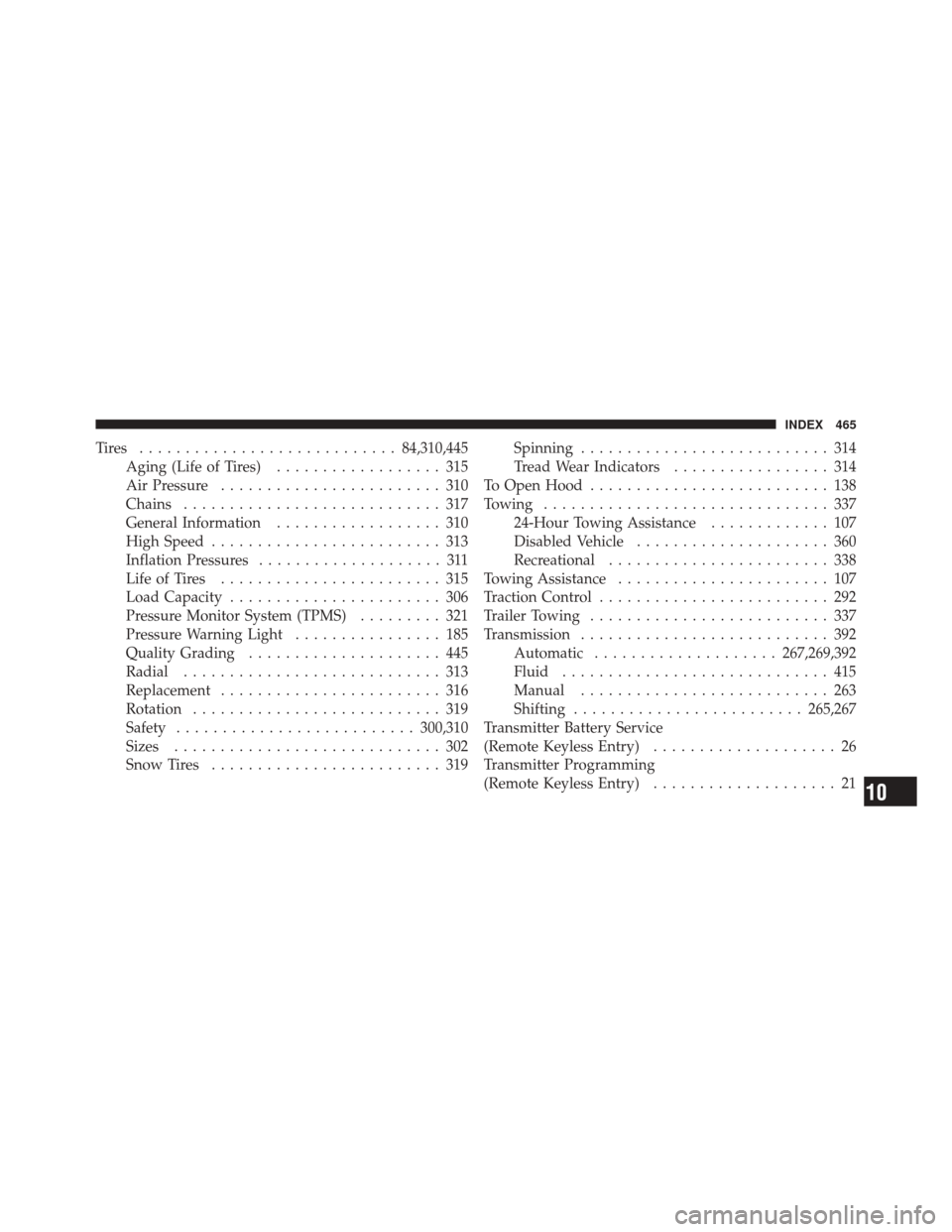
Tires ............................84,310,445
Aging (Life of Tires) .................. 315
Air Pressure ........................ 310
Chains ............................ 317
General Information .................. 310
High Speed ......................... 313
Inflation Pressures .................... 311
Life of Tires ........................ 315
Load Capacity ....................... 306
Pressure Monitor System (TPMS) ......... 321
Pressure Warning Light ................ 185
Quality Grading ..................... 445
Radial ............................ 313
Replacement ........................ 316
Rotation ........................... 319
Safety .......................... 300,310
Sizes ............................. 302
Snow Tires ......................... 319 Spinning
........................... 314
Tread Wear Indicators ................. 314
To Open Hood .......................... 138
Towing ............................... 337
24-Hour Towing Assistance ............. 107
Disabled Vehicle ..................... 360
Recreational ........................ 338
Towing Assistance ....................... 107
Traction Control ......................... 292
Trailer Towing .......................... 337
Transmission ........................... 392
Automatic .................... 267,269,392
Fluid ............................. 415
Manual ........................... 263
Shifting ......................... 265,267
Transmitter Battery Service
(Remote Keyless Entry) .................... 26
Transmitter Programming
(Remote Keyless Entry) .................... 21
10
INDEX 465