light DODGE CHALLENGER SRT 2016 3.G Manual Online
[x] Cancel search | Manufacturer: DODGE, Model Year: 2016, Model line: CHALLENGER SRT, Model: DODGE CHALLENGER SRT 2016 3.GPages: 616, PDF Size: 4.45 MB
Page 253 of 616
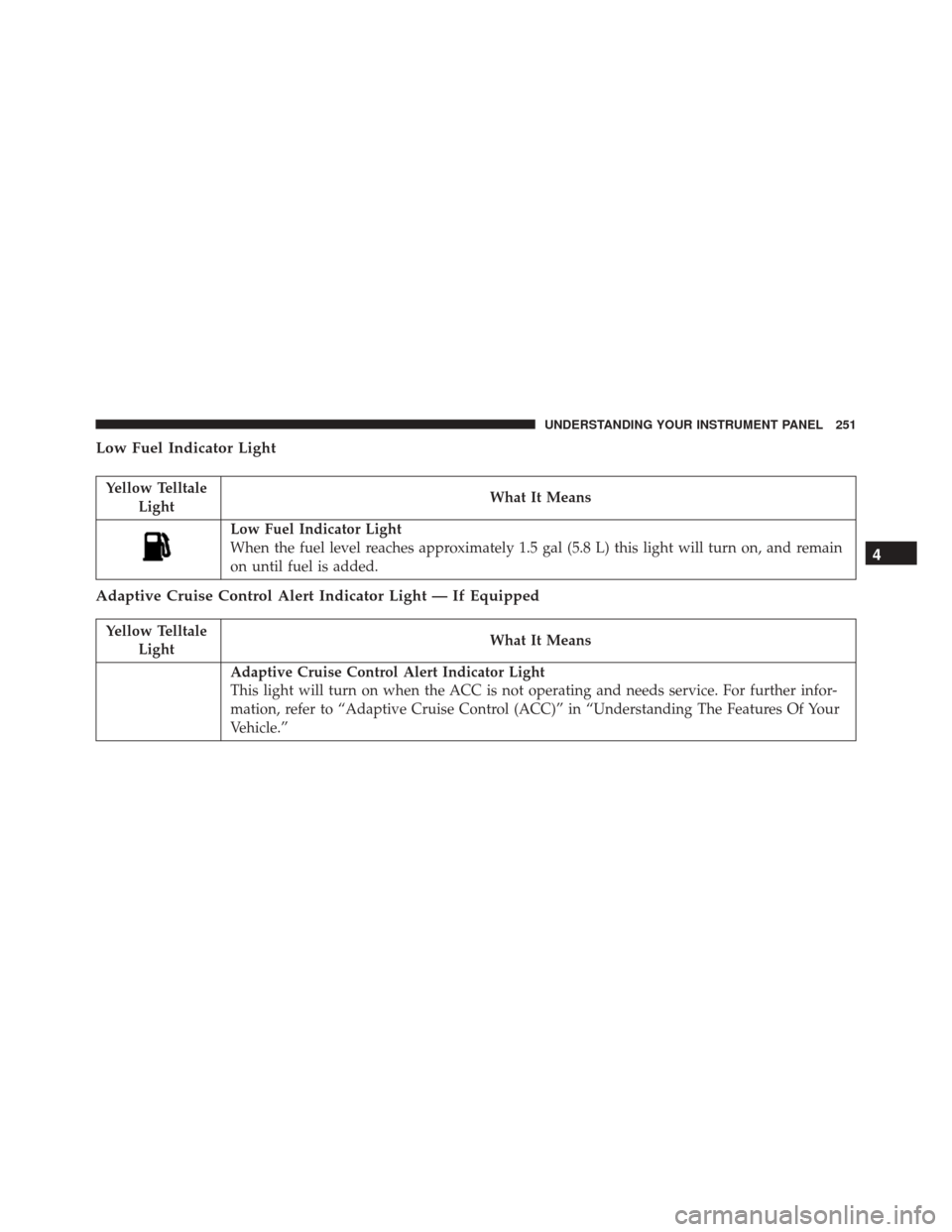
Low Fuel Indicator Light
Yellow TelltaleLight What It Means
Low Fuel Indicator Light
When the fuel level reaches approximately 1.5 gal (5.8 L) this light will turn on, and remain
on until fuel is added.
Adaptive Cruise Control Alert Indicator Light — If Equipped
Yellow Telltale
Light What It Means
Adaptive Cruise Control Alert Indicator Light
This light will turn on when the ACC is not operating and needs service. For further infor-
mation, refer to “Adaptive Cruise Control (ACC)” in “Understanding The Features Of Your
Vehicle.”
4
UNDERSTANDING YOUR INSTRUMENT PANEL 251
Page 254 of 616
Service Forward Collision Warning Indicator Light — If Equipped
Yellow TelltaleLight What It Means
Service Forward Collision Warning Indicator Light — If Equipped
This telltale will turn on when there is a fault in the Forward Collision Warning system.
Contact your authorized dealership.
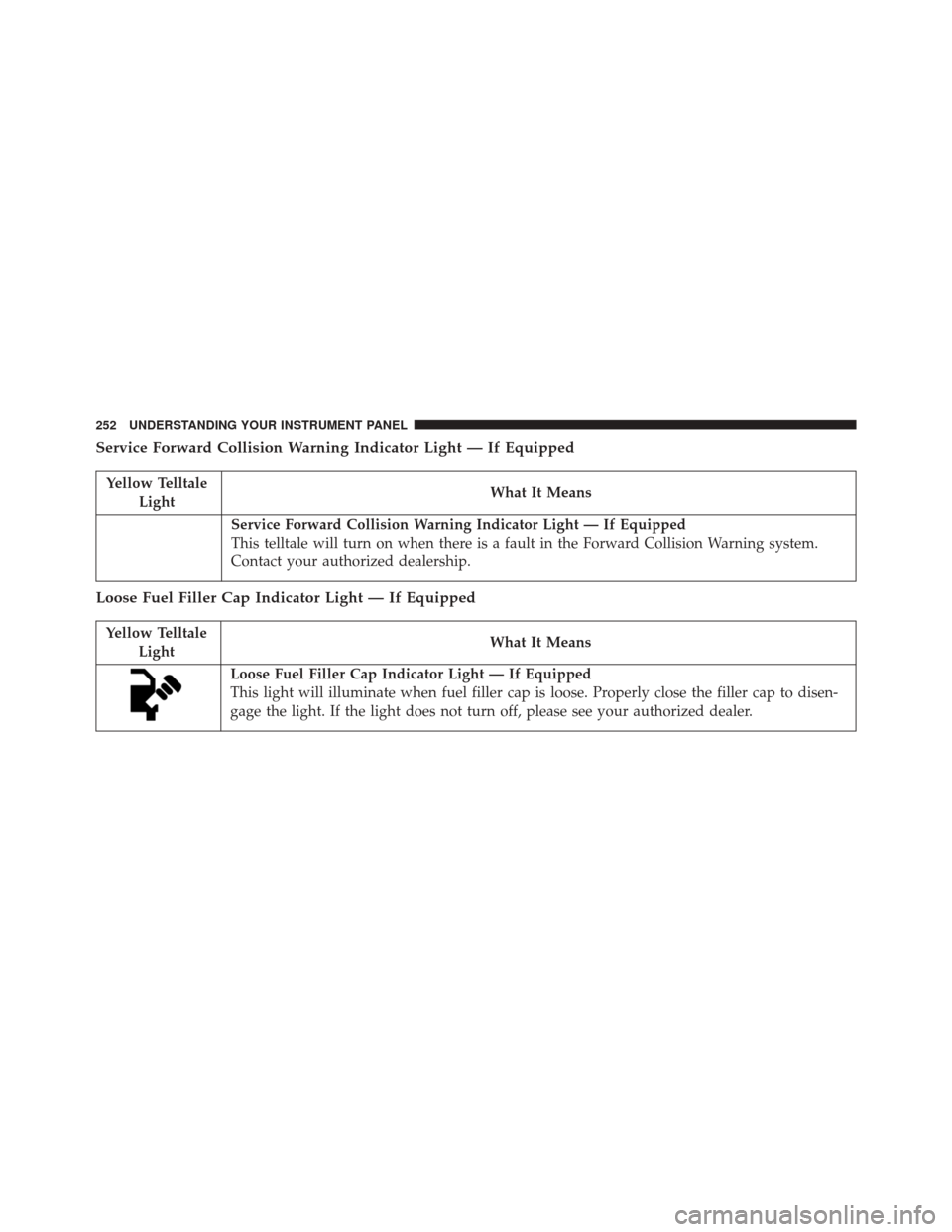
Loose Fuel Filler Cap Indicator Light — If Equipped
Yellow Telltale
Light What It Means
Loose Fuel Filler Cap Indicator Light — If Equipped
This light will illuminate when fuel filler cap is loose. Properly close the filler cap to disen-
gage the light. If the light does not turn off, please see your authorized dealer.
252 UNDERSTANDING YOUR INSTRUMENT PANEL
Page 255 of 616
Green Telltale Indicator Lights
Front Fog Indicator Light — If Equipped
Green TelltaleLight What It Means
Front Fog Indicator Light — If Equipped
This indicator will illuminate when the front fog lights are on.
Park/Headlight ON Indicator Light
Green Telltale
Light What It Means
Park/Headlight ON Indicator Light
This indicator will illuminate when the park lights or headlights are turned on.
4
UNDERSTANDING YOUR INSTRUMENT PANEL 253
Page 256 of 616
Turn Signal Indicator Lights
Green Tell-tale Light What It Means
Turn Signal Indicator Lights
The instrument cluster directional arrow will flash independently for the LEFT or RIGHT turn
signal as selected, as well as the exterior turn signal lamp(s) (front and rear) as selected when
the multifunction lever is moved down (LEFT) or up (RIGHT).
NOTE:
•A continuous chime will sound if the vehicle is driven more than 1 mile (1.6 km) with either
turn signal on.
•Check for an inoperative outside light bulb if either indicator flashes at a rapid rate.
254 UNDERSTANDING YOUR INSTRUMENT PANEL
Page 257 of 616
Cruise Control Engaged Indicator Light
Green TelltaleLight What It Means
Cruise Control Engaged Indicator Light
This light will turn on when the cruise control has been engaged.
Blue Telltale Indicator Lights
High Beam Indicator Light
Blue Telltale
Light What It Means
High Beam Indicator Light
This indicator shows that the high beam headlights are on. Push the multifunction control
lever away from you to switch the headlights to high beam. Pull the lever toward you to
switch the headlights back to low beam.
4
UNDERSTANDING YOUR INSTRUMENT PANEL 255
Page 258 of 616
White Telltale Indicator Lights
Electronic Speed Control ON Indicator Light
White TelltaleLight What It Means
Electronic Speed Control ON Indicator Light
This light will turn on when the electronic speed control is ON.
256 UNDERSTANDING YOUR INSTRUMENT PANEL
Page 267 of 616
– Will list the last 5 lap with the best lap highlightedin green.
• Top Speed
The following describes each feature and its operation:
0-60 MPH (0-100 km/h)
When selected, this screen displays the time it takes for
the vehicle to go from 0 to 60 MPH (0 to 100 km/h)
within 10 seconds.
• The feature will “ready” when the vehicle speed is at 0
MPH (0 km/h). The word “READY” will flash when
conditions are met for the event to begin.
• Dashes will display if the vehicle fails to reach 60 MPH
(100 km/h) in less then 10 seconds.
• To clear the vehicle’s best, last, and current 0-60 MPH
(0-100 km/h) time, push and hold the OKbutton for
two seconds. 0 to 100 MPH (0 to 161 km/h)
When selected, this screen displays the time it takes for
the vehicle to go from 0 to 100 MPH (0 to 161 km/h)
within 15 seconds.
•
The feature will “ready” when the vehicle speed is at 0
MPH (0 km/h). The word “READY” will flash when
conditions are met for the event to begin.
• Dashes will display if the vehicle fails to reach 0 to 100
MPH (0 to 161 km/h) in less then 15 seconds.
• To clear the vehicle’s best, last and current 0 to 100
MPH (0 to 161 km/h) time, push and hold the OK
button for two seconds.
Reaction Timer
Press OK to engage Countdown Timer. The time it takes
for wheel speed not equal to 0 MPH after the words ’GO’
4
UNDERSTANDING YOUR INSTRUMENT PANEL 265
Page 270 of 616
•As soon as the driver exits the Lap Timer pages, the
“current” timer will stop and the time will be reset to
0:00.00.
• If the driver stays on the Lap Timer pages, the “cur-
rent” timer will reset to 0:00.0 when ignition is placed
in the off position, or ignition placed in the ON
position (or will roll over at 59:59.99 if ever possible).
• Each time the driver pushes OKfor a Lap that current
time populates, the Last time and also populates the
1st (top) space on the Timer History page the current
time resets to 0:00.0 at every push of the OKbutton.
• The timer will stop when the driver navigates away
from this page.
Lap History
When selected, this screen displays the Lap History, and
will color highlight the time that is the best time from the
Timer Page. •
Each time the driver pushes the OKbutton (while on
the Lap Timer page) the current Lap Time populates
the 1st spot and the rest of the data shifts down.
• Color will indicate the time that is the best time from
the Timer Page.
• Holding the OKbutton only resets the page you are
on.
• Lap History page is a static display of lap times only.
Top Speed
When selected, this screen displays the Top Speed since
last reset:
• Populates a top speed from first drive cycle and every
time that speed is exceeded that number is stored here
unless/until the driver resets the screen.
• Latching over ignition cycles.
268 UNDERSTANDING YOUR INSTRUMENT PANEL
Page 276 of 616
driving time and distance of the vehicle. This is done by
reducing power to or turning off non-essential electrical
loads.
Load reduction is only active when the engine is running.
It will display a message if there is a risk of battery
depletion to the point where the vehicle may stall due to
lack of electrical supply, or will not restart after the
current drive cycle.
When load reduction is activated, the message “Battery
Saver On” or “Battery Saver Mode” will appear in the
Electronic Vehicle Information Center (EVIC) or Driver
Information Display (DID).
These messages indicate the vehicle battery has a low
state of charge and continues to lose electrical charge at a
rate that the charging system cannot sustain.NOTE:
•
The charging system is independent from load reduc-
tion. The charging system performs a diagnostic on the
charging system continuously.
• If the Charging System Light is on it may indicate a
problem with the charging system. Refer to “Charging
System Light” in “Understanding Your Instrument
Panel” for further information.
The electrical loads that may be switched off (if
equipped), and vehicle functions which can be effected
by load reduction:
• Heated Seat/Vented Seats/Heated Wheel
• Heated/Cooled Cup Holders
• Rear Defroster And Heated Mirrors
• HVAC System
274 UNDERSTANDING YOUR INSTRUMENT PANEL
Page 277 of 616
•115V AC Power Inverter System
• Audio and Telematics System
Loss of the battery charge may indicate one or more of
the following conditions:
• The charging system cannot deliver enough electrical
power to the vehicle system because the electrical
loads are larger than the capability of charging system.
The charging system is still functioning properly.
• Turning on all possible vehicle electrical loads (e.g.
HVAC to max settings, exterior and interior lights,
overloaded power outlets +12V, 115V AC, USB ports)
during certain driving conditions (city driving, tow-
ing, frequent stopping).
• Installing options like additional lights, upfitter elec-
trical accessories, audio systems, alarms and similar
devices. •
Unusual driving cycles (short trips separated by long
parking periods).
• The vehicle was parked for an extended period of time
(weeks, months).
• The battery was recently replaced and was not charged
completely.
• The battery was discharged by an electrical load left on
when the vehicle was parked.
• The battery was used for an extended period with the
engine not running to supply radio, lights, chargers,
+12V portable appliances like vacuum cleaner ’s, game
consoles and similar devices.
4
UNDERSTANDING YOUR INSTRUMENT PANEL 275