engine oil DODGE CHALLENGER SRT 2019 Owner's Manual
[x] Cancel search | Manufacturer: DODGE, Model Year: 2019, Model line: CHALLENGER SRT, Model: DODGE CHALLENGER SRT 2019Pages: 500, PDF Size: 4.73 MB
Page 344 of 500
NOTE:Do not overfill crankcase with engine oil, pressure
loss or oil foaming can result.
To access these oil drains, the vehicle needs to be safely
lifted and supported to remove the front underbody
shields (belly pan). Your service technician will refer to the
Service Manual for proper under body shield (belly pan)
removal and installation procedures.
An authorized dealer has the qualified service personnel,
special tools, and equipment to perform all service opera-
tions in an expert manner. Service Manuals are available
which include detailed service information for your ve-
hicle. Refer to these Service Manuals before attempting any
procedure yourself.
WARNING!
You can be badly injured working on or around a
motor vehicle. Do only that service work for which you
have the knowledge and the right equipment. If you
have any doubt about your ability to perform a service
job, take your vehicle to a competent mechanic.
Disposing Of Used Engine Oil And Oil Filters
Care should be taken in disposing of used engine oil and
oil filters from your vehicle. Used oil and oil filters,
indiscriminately discarded, can present a problem to the
environment. Contact an authorized dealer, service station
or governmental agency for advice on how and where used
oil and oil filters can be safely discarded in your area.
Engine Oil Filter
The engine oil filter should be replaced with a new filter at
every engine oil change.
Engine Oil Filter Selection
This manufacturer’s engines have a full-flow type dispos-
able oil filter. Use a filter of this type for replacement. The
quality of replacement filters varies considerably. Only
high quality filters should be used to assure most efficient
service. Mopar engine oil filters are high quality oil filters
and are recommended.
Engine Air Cleaner Filter
Refer to the “Maintenance Plan” in this section for the
proper maintenance intervals.
342 SERVICING AND MAINTENANCE
Page 349 of 500
•Noise (objectionable squeal, squeak, or rumble is heard
or felt while drive belt is in operation)
Some conditions can be caused by a faulty component such
as a belt pulley. Belt pulleys should be carefully inspected
for damage and proper alignment.
Belt replacement on some models requires the use of
special tools, we recommend having your vehicle serviced
at an authorized dealer.
Body Lubrication
Locks and all body pivot points, including such items as
seat tracks, door hinge pivot points and rollers, liftgate,
tailgate, decklid, sliding doors and hood hinges, should be
lubricated periodically with a lithium based grease, such as
Mopar Spray White Lube to assure quiet, easy operation
and to protect against rust and wear. Prior to the applica-
tion of any lubricant, the parts concerned should be wiped
clean to remove dust and grit; after lubricating excess oil
and grease should be removed. Particular attention should
also be given to hood latching components to ensure
proper function. When performing other underhood ser-
vices, the hood latch, release mechanism and safety catch
should be cleaned and lubricated. The external lock cylinders should be lubricated twice a
year, preferably in the Fall and Spring. Apply a small
amount of a high quality lubricant, such as Mopar Lock
Cylinder Lubricant directly into the lock cylinder.
Windshield Wiper Blades
Clean the rubber edges of the wiper blades and the
windshield periodically with a sponge or soft cloth and a
mild nonabrasive cleaner. This will remove accumulations
of salt or road film.
Operation of the wipers on dry glass for long periods may
cause deterioration of the wiper blades. Always use washer
fluid when using the wipers to remove salt or dirt from a
dry windshield.
Avoid using the wiper blades to remove frost or ice from
the windshield. Keep the blade rubber out of contact with
petroleum products such as engine oil, gasoline, etc.
NOTE:
Life expectancy of wiper blades varies depending
on geographical area and frequency of use. Poor perfor-
mance of blades may be present with chattering, marks,
water lines or wet spots. If any of these conditions are
present, clean the wiper blades or replace as necessary.
8
SERVICING AND MAINTENANCE 347
Page 351 of 500
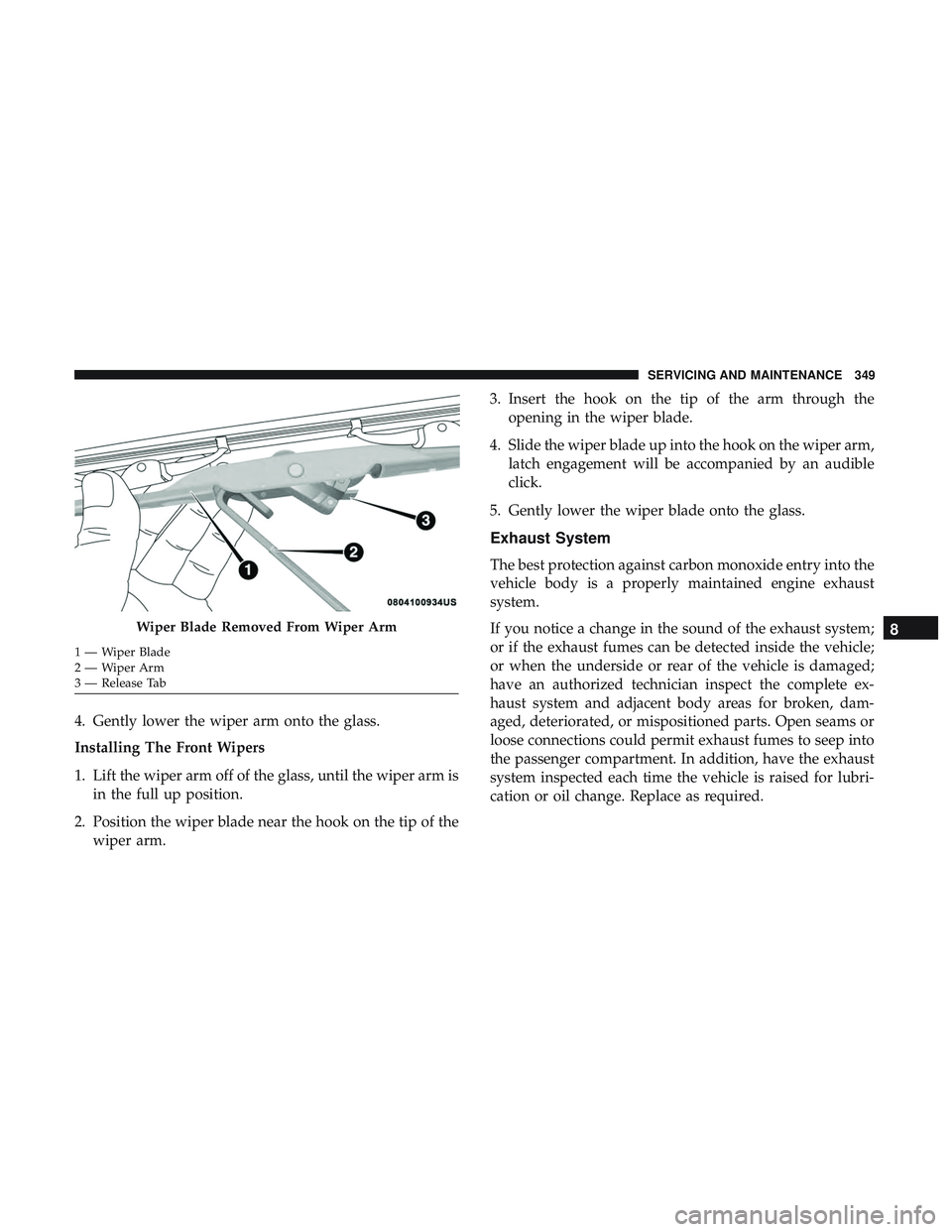
4. Gently lower the wiper arm onto the glass.
Installing The Front Wipers
1. Lift the wiper arm off of the glass, until the wiper arm isin the full up position.
2. Position the wiper blade near the hook on the tip of the wiper arm. 3. Insert the hook on the tip of the arm through the
opening in the wiper blade.
4. Slide the wiper blade up into the hook on the wiper arm, latch engagement will be accompanied by an audible
click.
5. Gently lower the wiper blade onto the glass.
Exhaust System
The best protection against carbon monoxide entry into the
vehicle body is a properly maintained engine exhaust
system.
If you notice a change in the sound of the exhaust system;
or if the exhaust fumes can be detected inside the vehicle;
or when the underside or rear of the vehicle is damaged;
have an authorized technician inspect the complete ex-
haust system and adjacent body areas for broken, dam-
aged, deteriorated, or mispositioned parts. Open seams or
loose connections could permit exhaust fumes to seep into
the passenger compartment. In addition, have the exhaust
system inspected each time the vehicle is raised for lubri-
cation or oil change. Replace as required.
Wiper Blade Removed From Wiper Arm
1—WiperBlade
2—WiperArm
3 — Release Tab
8
SERVICING AND MAINTENANCE 349
Page 359 of 500
WARNING!
•Use only manufacturer’s recommended brake fluid.
Refer to “Fluids And Lubricants” in “Technical
Specifications” for further information. Using the
wrong type of brake fluid can severely damage your
brake system and/or impair its performance. The
proper type of brake fluid for your vehicle is also
identified on the original factory installed hydraulic
master cylinder reservoir.
• To avoid contamination from foreign matter or mois-
ture, use only new brake fluid or fluid that has been
in a tightly closed container. Keep the master cylin-
der reservoir cap secured at all times. Brake fluid in
a open container absorbs moisture from the air
resulting in a lower boiling point. This may cause it
to boil unexpectedly during hard or prolonged brak-
ing, resulting in sudden brake failure. This could
result in a collision.
• Overfilling the brake fluid reservoir can result in
spilling brake fluid on hot engine parts, causing the
brake fluid to catch fire. Brake fluid can also damage
painted and vinyl surfaces, care should be taken to
avoid its contact with these surfaces.
(Continued)
WARNING! (Continued)
•Do not allow petroleum based fluid to contaminate
the brake fluid. Brake seal components could be
damaged, causing partial or complete brake failure.
This could result in a collision.
Clutch Hydraulic System — Manual Transmission
(If Equipped)
The clutch hydraulic system is fed by a segregated volume
of fluid within the brake system master cylinder reservoir.
In the event of leakage or wear, use only the manufactur-
er’s recommended brake fluid. Refer to “Fluids And Lu-
bricants” in “Technical Specifications” for further informa-
tion.
Manual Transmission — If Equipped
Fluid Level Check
Check the fluid level by removing the fill plug on the left
side of the transmission. The fluid level should be 1/4 inch
(6.4mm) below the bottom of the fill hole. Add fluid, if
necessary, to maintain the proper level. Refer to “Fluids
And Lubricants” in “Technical Specifications” for further
information.
8
SERVICING AND MAINTENANCE 357
Page 393 of 500
In the event power assist is lost for any reason (for
example, repeated brake applications with the engine
OFF), the brakes will still function. The effort required to
brake the vehicle will be much greater than that required
with the power system operating.
NOTE:Your vehicle is equipped with a high performance
braking system. The brake pads are a semi-metallic com-
pound, which offer superior fade resistance for consistent
operation. A compromise to using this type of brake pad is
that the brakes may produce more brake dust and may
squeal slightly under certain weather and operating con-
ditions (i.e., during light brake applications). These are
considered normal conditions.
WHEEL AND TIRE TORQUE SPECIFICATIONS
Proper lug nut/bolt torque is very important to ensure that
the wheel is properly mounted to the vehicle. Any time a
wheel has been removed and reinstalled on the vehicle, the
lug nuts/bolts should be torqued using a properly cali-
brated torque wrench using a high quality six sided (hex)
deep wall socket.
Torque Specifications
Lug Nut/Bolt Torque **Lug Nut/Bolt
Size Lug Nut/Bolt
Socket Size
111 Ft-Lbs (150 N·m) M14 x 1.50 22 mm
**Use only your authorized dealer recommended lug nuts/
bolts and clean or remove any dirt or oil before tightening.
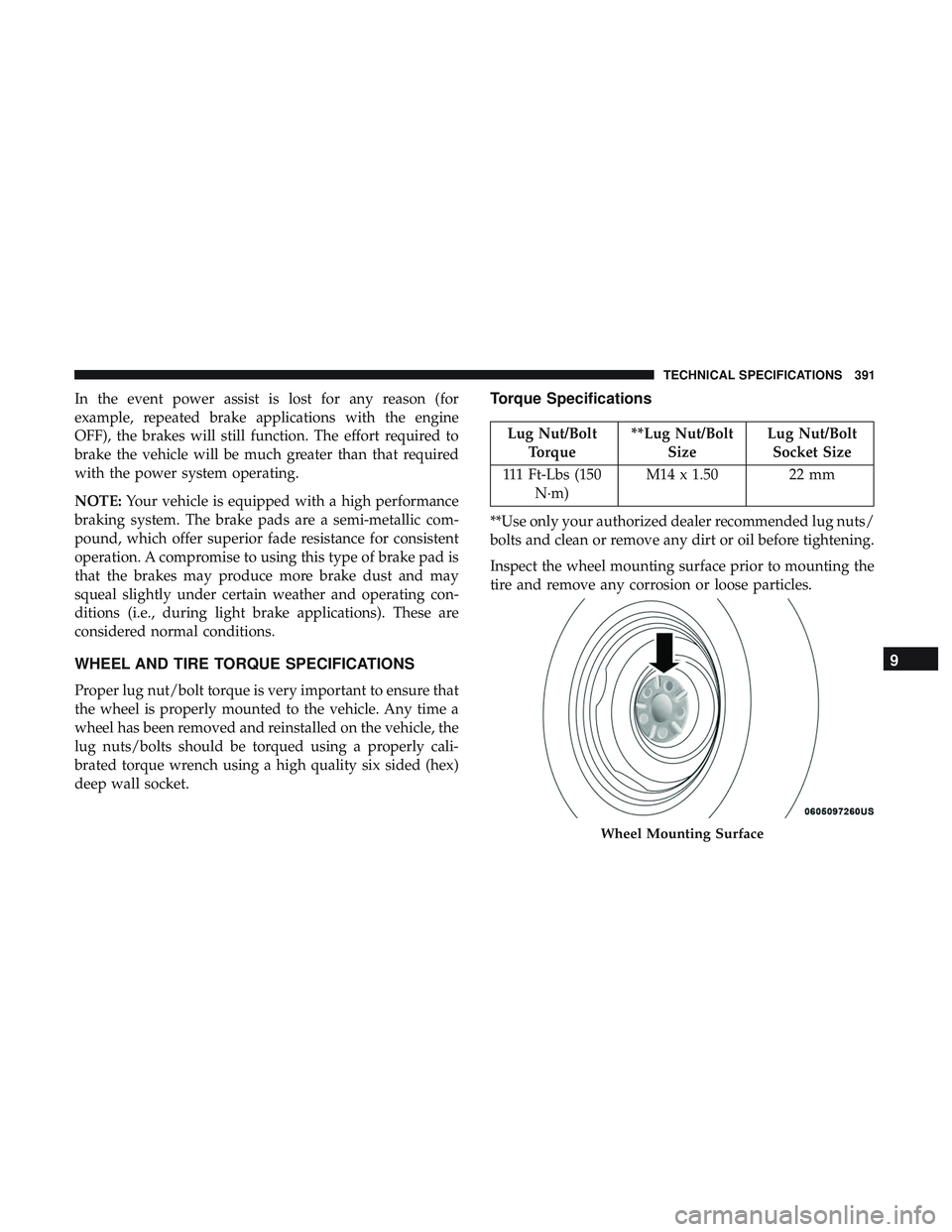
Inspect the wheel mounting surface prior to mounting the
tire and remove any corrosion or loose particles.
Wheel Mounting Surface
9
TECHNICAL SPECIFICATIONS 391
Page 399 of 500
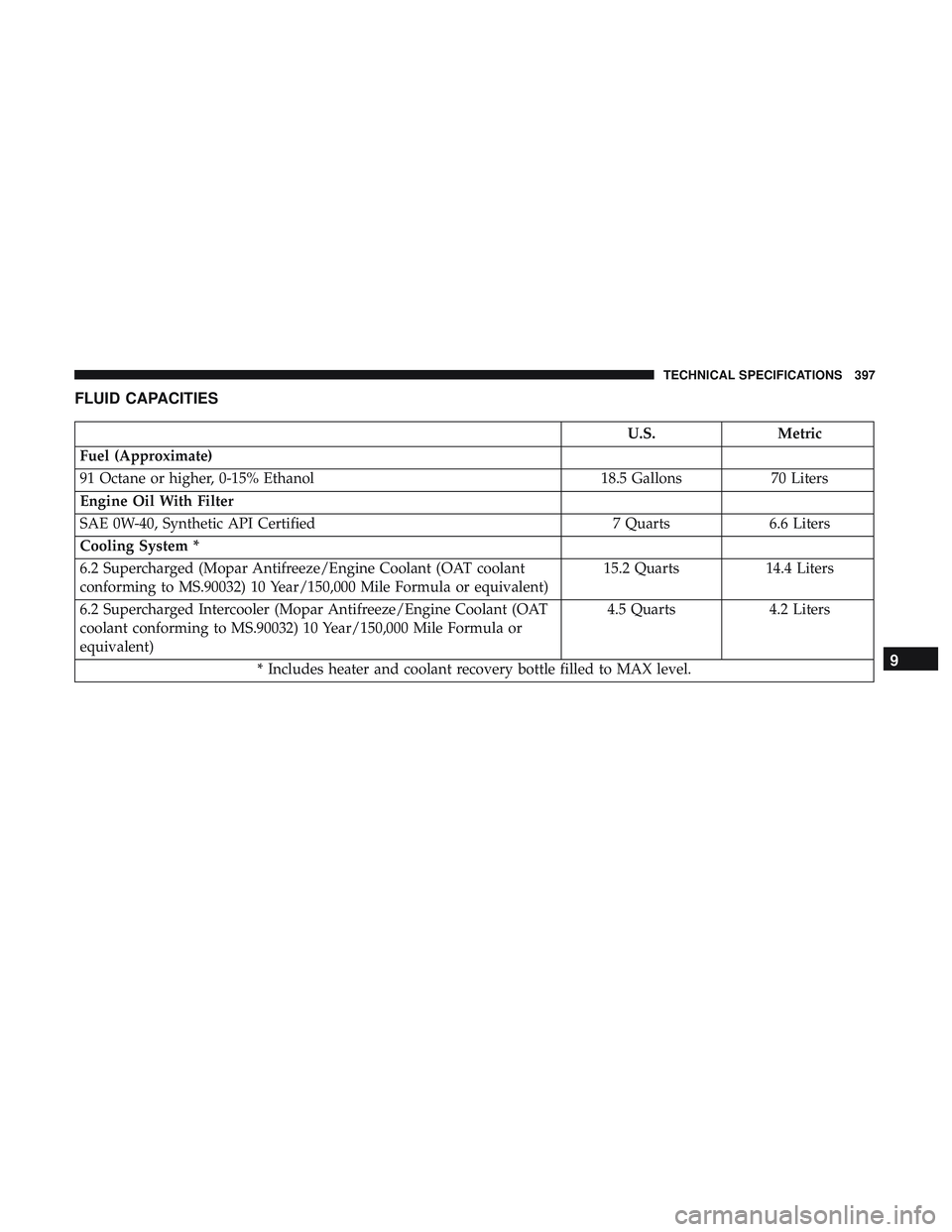
FLUID CAPACITIES
U.S.Metric
Fuel (Approximate)
91 Octane or higher, 0-15% Ethanol 18.5 Gallons70 Liters
Engine Oil With Filter
SAE 0W-40, Synthetic API Certified 7 Quarts6.6 Liters
Cooling System *
6.2 Supercharged (Mopar Antifreeze/Engine Coolant (OAT coolant
conforming to MS.90032) 10 Year/150,000 Mile Formula or equivalent) 15.2 Quarts
14.4 Liters
6.2 Supercharged Intercooler (Mopar Antifreeze/Engine Coolant (OAT
coolant conforming to MS.90032) 10 Year/150,000 Mile Formula or
equivalent) 4.5 Quarts
4.2 Liters
* Includes heater and coolant recovery bottle filled to MAX level.
9
TECHNICAL SPECIFICATIONS 397
Page 400 of 500
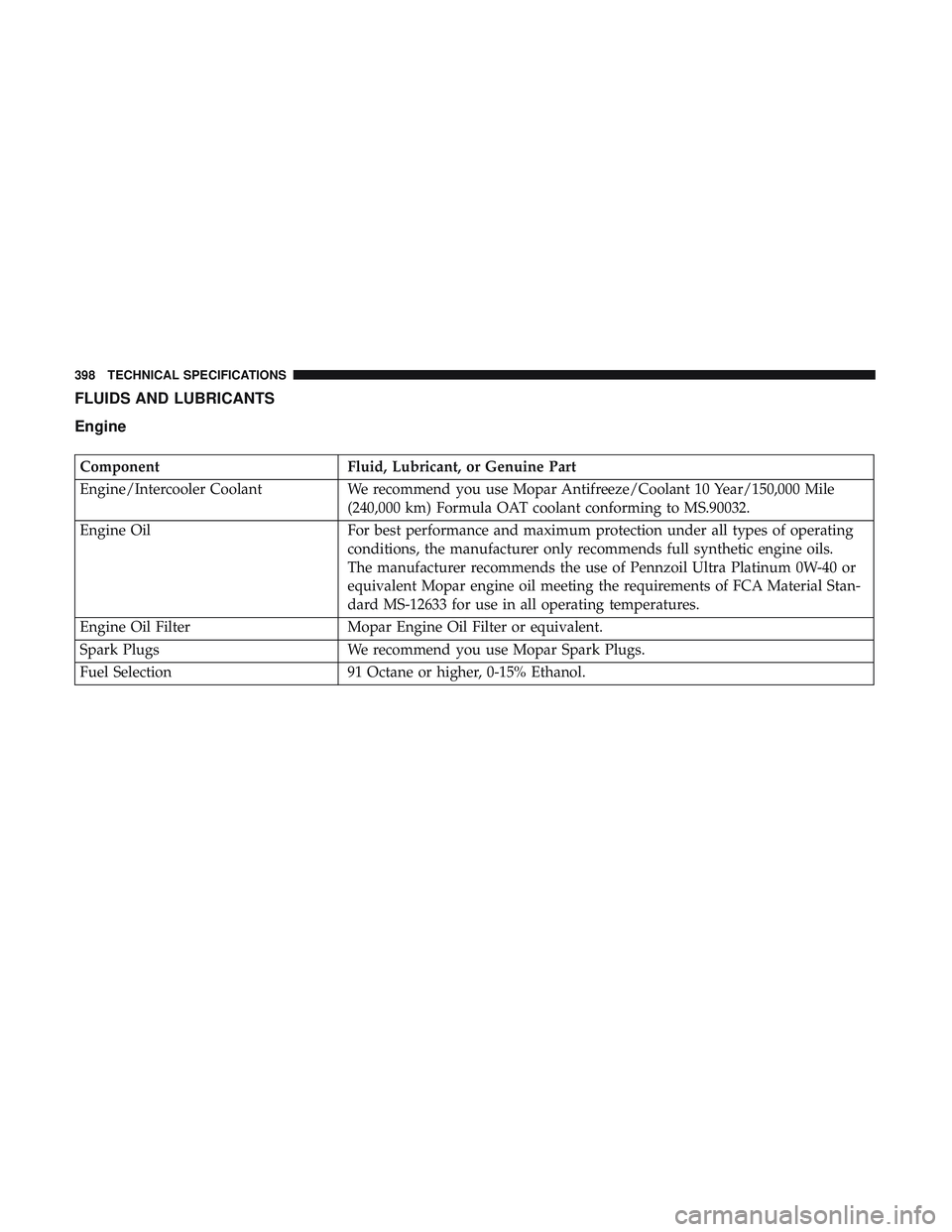
FLUIDS AND LUBRICANTS
Engine
ComponentFluid, Lubricant, or Genuine Part
Engine/Intercooler Coolant We recommend you use Mopar Antifreeze/Coolant 10 Year/150,000 Mile
(240,000 km) Formula OAT coolant conforming to MS.90032.
Engine Oil For best performance and maximum protection under all types of operating
conditions, the manufacturer only recommends full synthetic engine oils.
The manufacturer recommends the use of Pennzoil Ultra Platinum 0W-40 or
equivalent Mopar engine oil meeting the requirements of FCA Material Stan-
dard MS-12633 for use in all operating temperatures.
Engine Oil Filter Mopar Engine Oil Filter or equivalent.
Spark Plugs We recommend you use Mopar Spark Plugs.
Fuel Selection 91 Octane or higher, 0-15% Ethanol.
398 TECHNICAL SPECIFICATIONS
Page 429 of 500
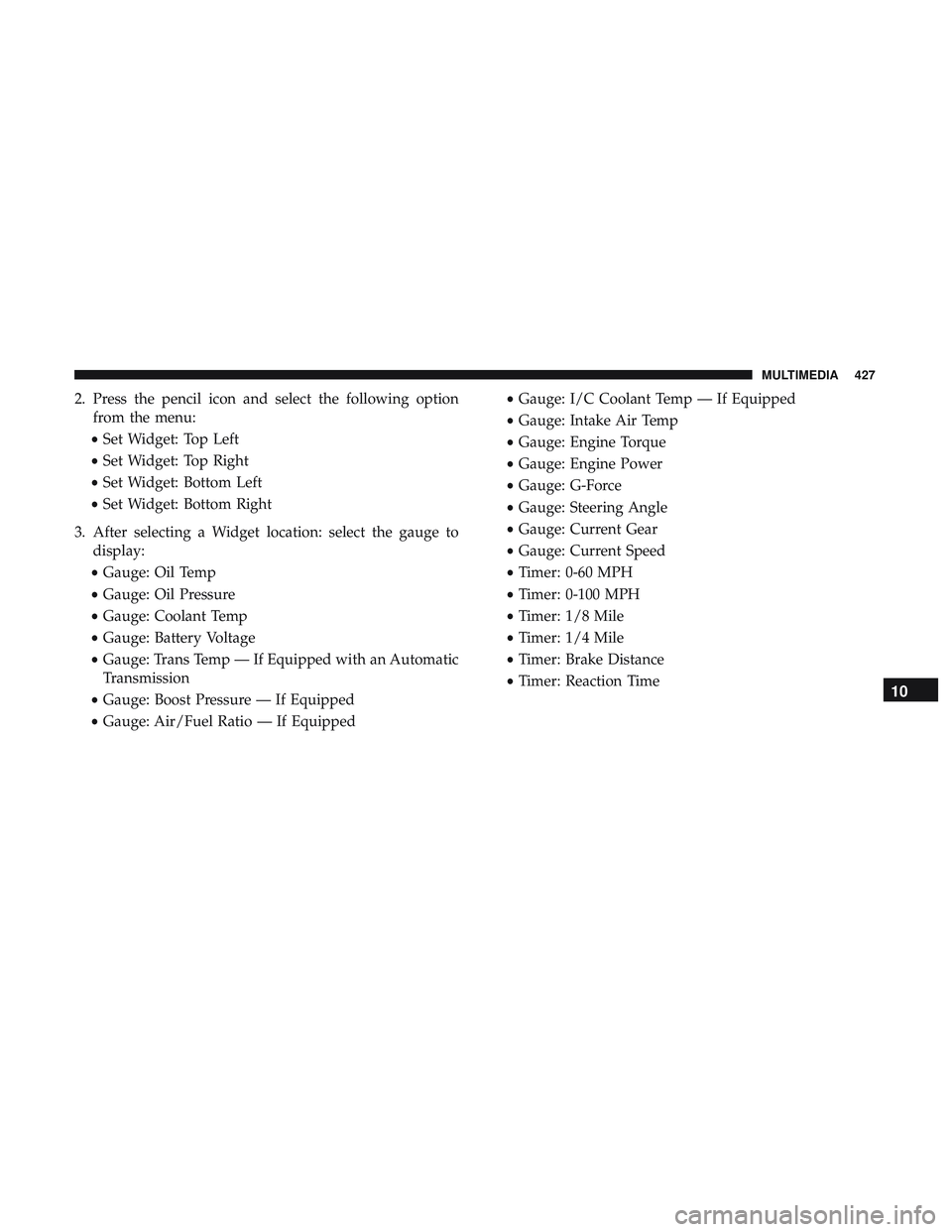
2. Press the pencil icon and select the following optionfrom the menu:
• Set Widget: Top Left
• Set Widget: Top Right
• Set Widget: Bottom Left
• Set Widget: Bottom Right
3. After selecting a Widget location: select the gauge to display:
• Gauge: Oil Temp
• Gauge: Oil Pressure
• Gauge: Coolant Temp
• Gauge: Battery Voltage
• Gauge: Trans Temp — If Equipped with an Automatic
Transmission
• Gauge: Boost Pressure — If Equipped
• Gauge: Air/Fuel Ratio — If Equipped •
Gauge: I/C Coolant Temp — If Equipped
• Gauge: Intake Air Temp
• Gauge: Engine Torque
• Gauge: Engine Power
• Gauge: G-Force
• Gauge: Steering Angle
• Gauge: Current Gear
• Gauge: Current Speed
• Timer: 0-60 MPH
• Timer: 0-100 MPH
• Timer: 1/8 Mile
• Timer: 1/4 Mile
• Timer: Brake Distance
• Timer: Reaction Time
10
MULTIMEDIA 427
Page 485 of 500
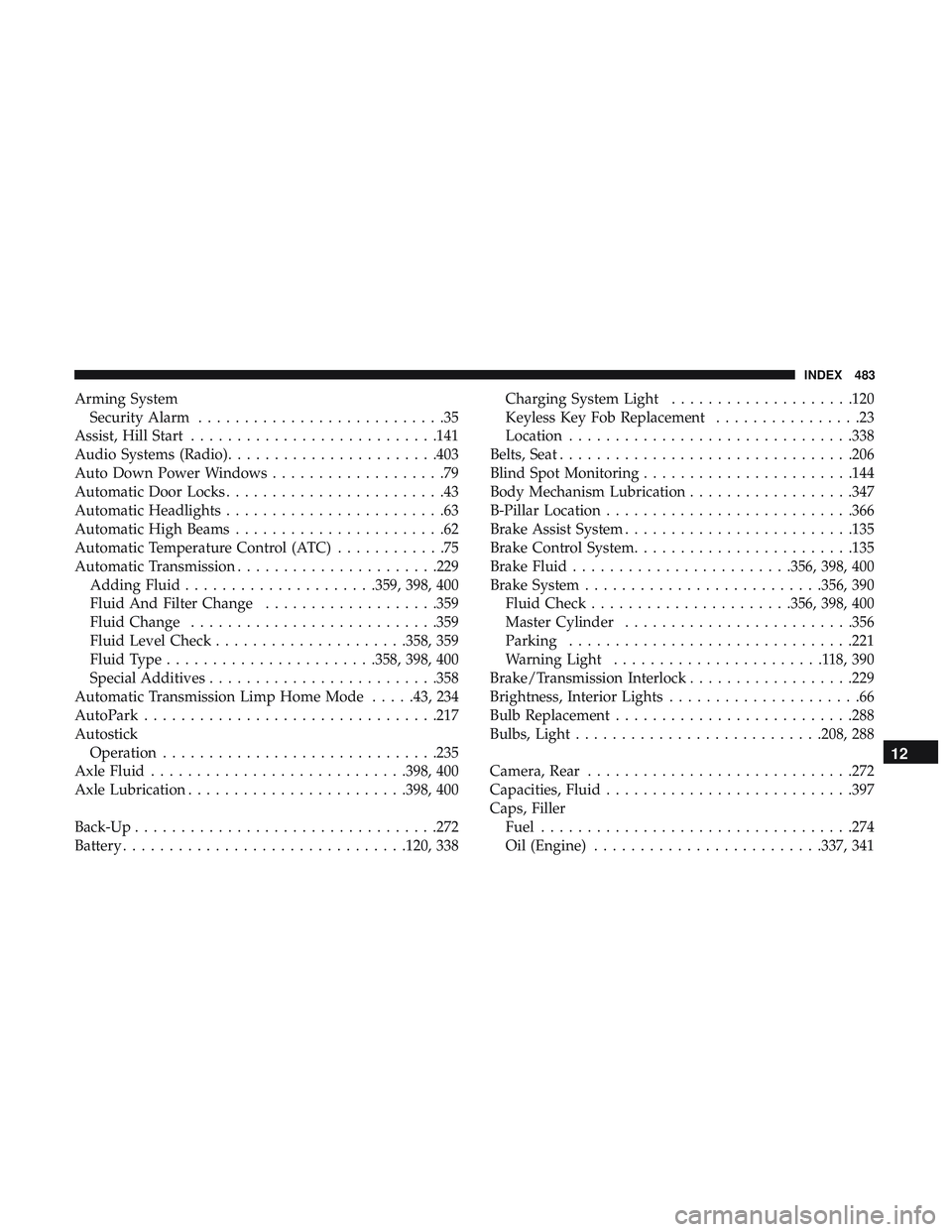
Arming SystemSecurity Alarm ...........................35
Assist, Hill Start .......................... .141
Audio Systems (Radio) .......................403
Auto Down Power Windows ...................79
Automatic Door Locks ........................43
Automatic Headlights ........................63
Automatic High Beams .......................62
Automatic Temperature Control (ATC) ............75
Automatic Transmission ..................... .229
Adding Fluid .....................359, 398, 400
Fluid And Filter Change ...................359
Fluid Change .......................... .359
Fluid Level Check .....................358, 359
Fluid Type .......................358, 398, 400
Special Additives ........................ .358
Automatic Transmission Limp Home Mode .....43, 234
AutoPark ............................... .217
Autostick Operation ............................. .235
Axle Fluid ............................398, 400
Axle Lubrication ........................398, 400
Back-Up .................................272
Battery ...............................120, 338 Charging System Light
....................120
Keyless Key Fob Replacement ................23
Location ...............................338
Belts, Seat ............................... .206
Blind Spot Monitoring .......................144
Body Mechanism Lubrication ..................347
B-Pillar Location .......................... .366
Brake Assist System ........................ .135
Brake Control System ........................135
Brake Fluid ........................356, 398, 400
Brake System ..........................356, 390
Fluid Check ..................... .356, 398, 400
Master Cylinder ........................ .356
Parking ...............................221
W arning
Light .......................118,390
Brake/Transmission Interlock ..................229
Brightness, Interior Lights .....................66
Bulb Replacement ..........................288
Bulbs, Light .......................... .208, 288
Camera, Rear ............................ .272
Capacities, Fluid .......................... .397
Caps, Filler Fuel ................................. .274
Oil (Engine) ........................ .337, 341
12
INDEX 483
Page 487 of 500
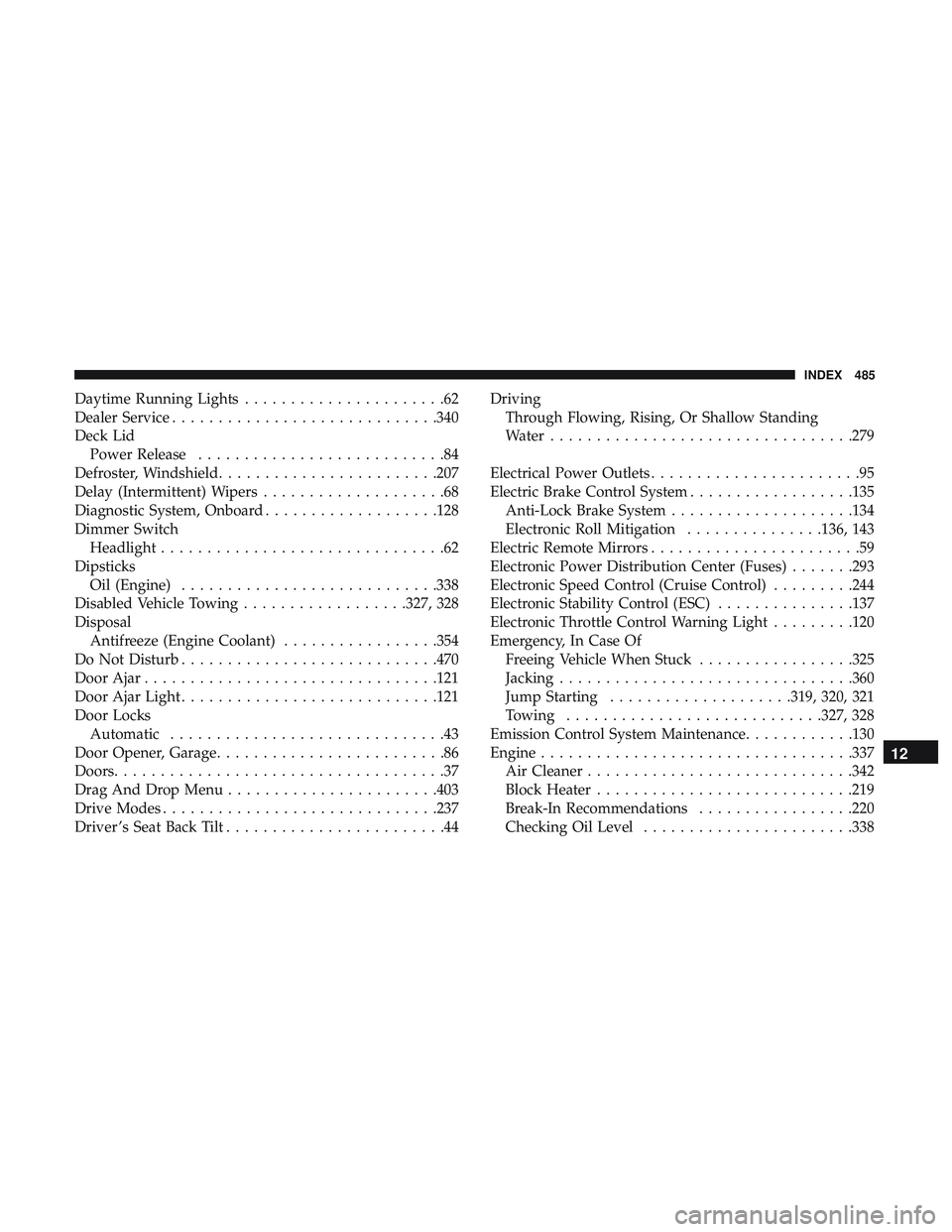
Daytime Running Lights......................62
Dealer Service ............................ .340
Deck Lid Power Release ...........................84
Defroster, Windshield ........................207
Delay (Intermittent) Wipers ....................68
Diagnostic System, Onboard ...................128
Dimmer Switch Headlight ...............................62
Dipsticks Oil (Engine) ............................338
Disabled Vehicle Towing ..................327, 328
Disposal Antifreeze (Engine Coolant) .................354
Do Not Disturb ............................470
Door Ajar ............................... .121
Door Ajar Light ............................121
Door Locks Automatic ..............................43
Door Opener, Garage .........................86
Doors ....................................37
Drag And Drop Menu .......................403
Drive Modes ............................. .237
Driver ’s Seat Back Tilt ........................44 Driving
Through Flowing, Rising, Or Shallow Standing
Water .................................279
Electrical Power Outlets .......................95
Electric Brake Control System ..................135
Anti-Lock Brake System ....................134
Electronic Roll Mitigation ...............136, 143
Electric Remote Mirrors .......................59
Electronic Power Distribution Center (Fuses) .......293
Electronic Speed Control (Cruise Control) .........244
Electronic Stability Control (ESC) ...............137
Electronic Throttle Control Warning Light .........120
Emergency, In Case Of Freeing Vehicle When Stuck .................325
Jacking ............................... .360
Jump Starting ....................319, 320, 321
Towing ............................327, 328
Emission Control System Maintenance ............130
Engine ................................. .337
Air Cleaner ............................ .342
Block
Heater ............................219
Break-In Recommendations .................220
Checking Oil Level .......................33812
INDEX 485