service DODGE CHARGER 2007 6.G Owner's Manual
[x] Cancel search | Manufacturer: DODGE, Model Year: 2007, Model line: CHARGER, Model: DODGE CHARGER 2007 6.GPages: 384, PDF Size: 6.4 MB
Page 208 of 384
NOTE:To avoid overrevving the engine when the
selector lever is moved in “D -” direction, the transmis-
sion will not shift to a lower gear if the engine’s revolu-
tions per minute (RPM) limit would be exceeded.
Briefly, press the selector lever in the “D +” direction and
the transmission will shift from the current gear to the
next higher gear.
Press and hold the selector lever in the “D +” direction
and the transmission will shift from the current gear
directly to gear “D.”
WARNING!
On slippery road surfaces, never downshift in order
to obtain braking action. This could result in drive
wheel slip and reduced vehicle control. Your vehi-
cle’s ABS will not prevent this type of loss of control.
You could lose control of your vehicle and have an
accident.
Delayed Shifts in Cold Temperatures
During cold temperature operation, you may notice
delayed upshifts depending on engine and transmission
temperature as well as vehicle speed. This feature im-
proves warm up time of the engine and transmission to
achieve maximum efficiency.
Temporary Transmission Limp Home Mode
The transmission is monitored for abnormal conditions.
If a condition is detected that could result in transmission
damage, the transmission will engage Limp Home Mode.
If vehicle acceleration worsens, or the transmission no
longer shifts, the transmission is most likely operating in
the Limp Home Mode. In this mode, the transmission
will remain in the current gear until the vehicle is
brought to a stop. After the vehicle has stopped, P (Park),
R (Reverse), and N (Neutral) will continue to operate.
Second gear will operate in the D (Drive) shifter position.
The Malfunction Indicator Light may be illuminated.
A reset feature is available to allow the vehicle to be
driven to a dealer for service. To reset the transmission,
use the following procedure:
1. Stop the vehicle.
208 STARTING AND OPERATING
Page 216 of 384
WARNING!
•The Anti-Lock Brake System contains sophisticated
electronic equipment that may be susceptible to
interference caused by improperly installed or high
output radio transmitting equipment. This interfer-
ence can cause possible loss of anti-lock braking
capability. Installation of such equipment should be
performed by qualified professionals.
•Pumping of the Anti-Lock Brakes will diminish their
effectiveness and may lead to an accident. Pumping
makes the stopping distance longer. Just press firmly
on your brake pedal when you need to slow down or
stop.
•Anti-lock system (ABS) cannot prevent the natural
laws of physics from acting on the vehicle, nor can it
increase braking or steering efficiency beyond that
afforded by the condition of the vehicle brakes and
tires or the traction afforded.
•The ABS cannot prevent accidents, including those
resulting from excessive speed in turns, following
another vehicle too closely, or hydroplaning. Only a
safe, attentive, and skillful driver can prevent acci-
dents.
•The capabilities of an ABS equipped vehicle must
never be exploited in a reckless or dangerous man-
ner, which could jeopardize the user’s safety or the
safety of others.
All vehicle wheels and tires must be the same size and
type and tires must be properly inflated to produce
accurate signals for the computer.
Anti-Lock Brake Light
The ABS light monitors the Anti-Lock Brake Sys-
tem. The light will come on when the ignition
switch is turned to the ON position and may stay on for
as long as four seconds.
If the ABS light remains on or comes on while driving, it
indicates that the Anti-Lock portion of the brake system
is not functioning and that service is required. However,
the conventional brake system will continue to operate
normally if the BRAKE warning light is not on.
If the ABS light is on, the brake system should be serviced
as soon as possible to restore the benefits of Anti-Lock
brakes. If the ABS light does not come on when the
Ignition switch is turned to the ON position, have the
bulb repaired as soon as possible.
If both the Brake Warning Light and the ABS Light
remain on, the Anti-Lock brakes (ABS) and Electronic
216 STARTING AND OPERATING
Page 217 of 384
Brake Force Distribution (EBD) systems are not function-
ing. Immediate repair to the ABS system is required.
POWER STEERING
The standard power steering system will give you good
vehicle response and increased ease of maneuverability
in tight spaces. The system will provide mechanical
steering capability if power assist is lost.
If for some reason the power assist is interrupted, it will
still be possible to steer your vehicle. Under these condi-
tions, you will observe a substantial increase in steering
effort, especially at very low vehicle speeds and during
parking maneuvers.
NOTE:Increased noise levels at the end of the steering
wheel travel are considered normal and do not indicate
that there is a problem with the power steering system.
Upon initial start-up in cold weather, the power
steering pump may make noise for a short amount of
time. This is due to the cold, thick fluid in the steering
system. This noise should be considered normal, and
does not in any way damage the steering system.
WARNING!
Continued operation with reduced power steering
assist could pose a safety risk to yourself and others.
Service should be obtained as soon as possible.
CAUTION!
Prolonged operation of the steering system at the
end of the steering wheel travel will increase the
steering fluid temperature and it should be avoided
when possible. Damage to the power steering pump
may occur.
STARTING AND OPERATING 217
5
Page 226 of 384
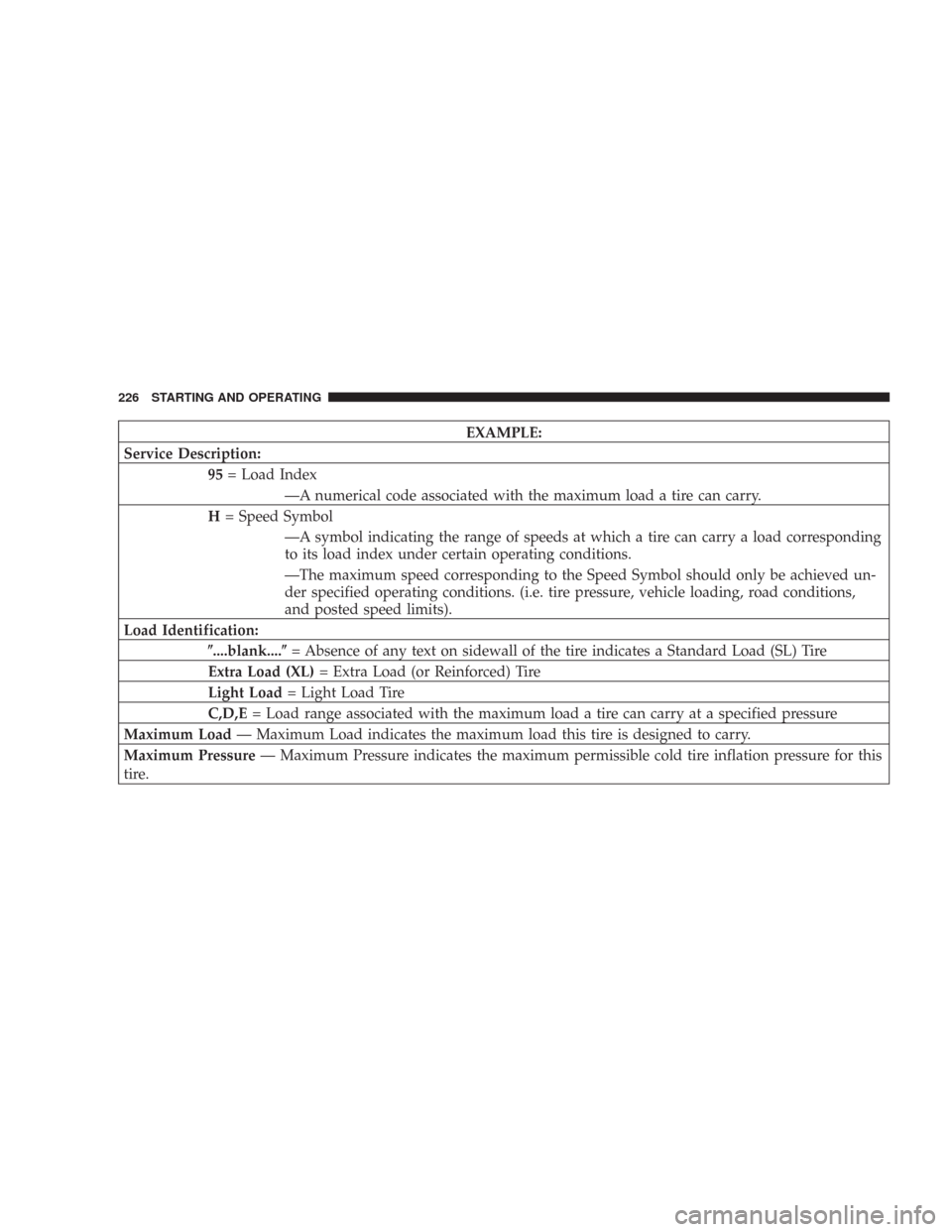
EXAMPLE:
Service Description:
95= Load Index
—A numerical code associated with the maximum load a tire can carry.
H= Speed Symbol
—A symbol indicating the range of speeds at which a tire can carry a load corresponding
to its load index under certain operating conditions.
—The maximum speed corresponding to the Speed Symbol should only be achieved un-
der specified operating conditions. (i.e. tire pressure, vehicle loading, road conditions,
and posted speed limits).
Load Identification:
....blank.... = Absence of any text on sidewall of the tire indicates a Standard Load (SL) Tire
Extra Load (XL)= Extra Load (or Reinforced) Tire
Light Load= Light Load Tire
C,D,E= Load range associated with the maximum load a tire can carry at a specified pressure
Maximum Load— Maximum Load indicates the maximum load this tire is designed to carry.
Maximum Pressure— Maximum Pressure indicates the maximum permissible cold tire inflation pressure for this
tire.
226 STARTING AND OPERATING
Page 238 of 384
Life of Tire
The service life of a tire is dependent upon varying
factors including but not limited to:
•Driving style
•Tire pressure
•Distance driven
WARNING!
Tires and spare tire should be replaced after six
years, regardless of the remaining tread. Failure to
follow this warning can result in sudden tire failure.
You could lose control and have an accident result-
ing in serious injury or death.
Keep dismounted tires in a cool, dry place with as little
exposure to light as possible. Protect tires from contact
with oil, grease, and gasoline.
Replacement Tires
The tires on your new vehicle provide a balance of many
characteristics. They should be inspected regularly for
wear and correct cold tire inflation pressure. The manu-
facturer strongly recommends that you use tires equiva-
lent to the originals in size, quality and performance
when replacement is needed (refer to the paragraph on
“Tread Wear Indicators”). Refer to the “Tire and Loading
Information” placard for the size designation of your tire.
The service description and load identification will be
found on the original equipment tire. Failure to use
equivalent replacement tires may adversely affect the
safety, handling, and ride of your vehicle. We recommend
that you contact your original equipment or an autho-
rized tire dealer with any questions you may have on tire
specifications or capability.
238 STARTING AND OPERATING
Page 250 of 384
FUEL REQUIREMENTS
2.7L Engine
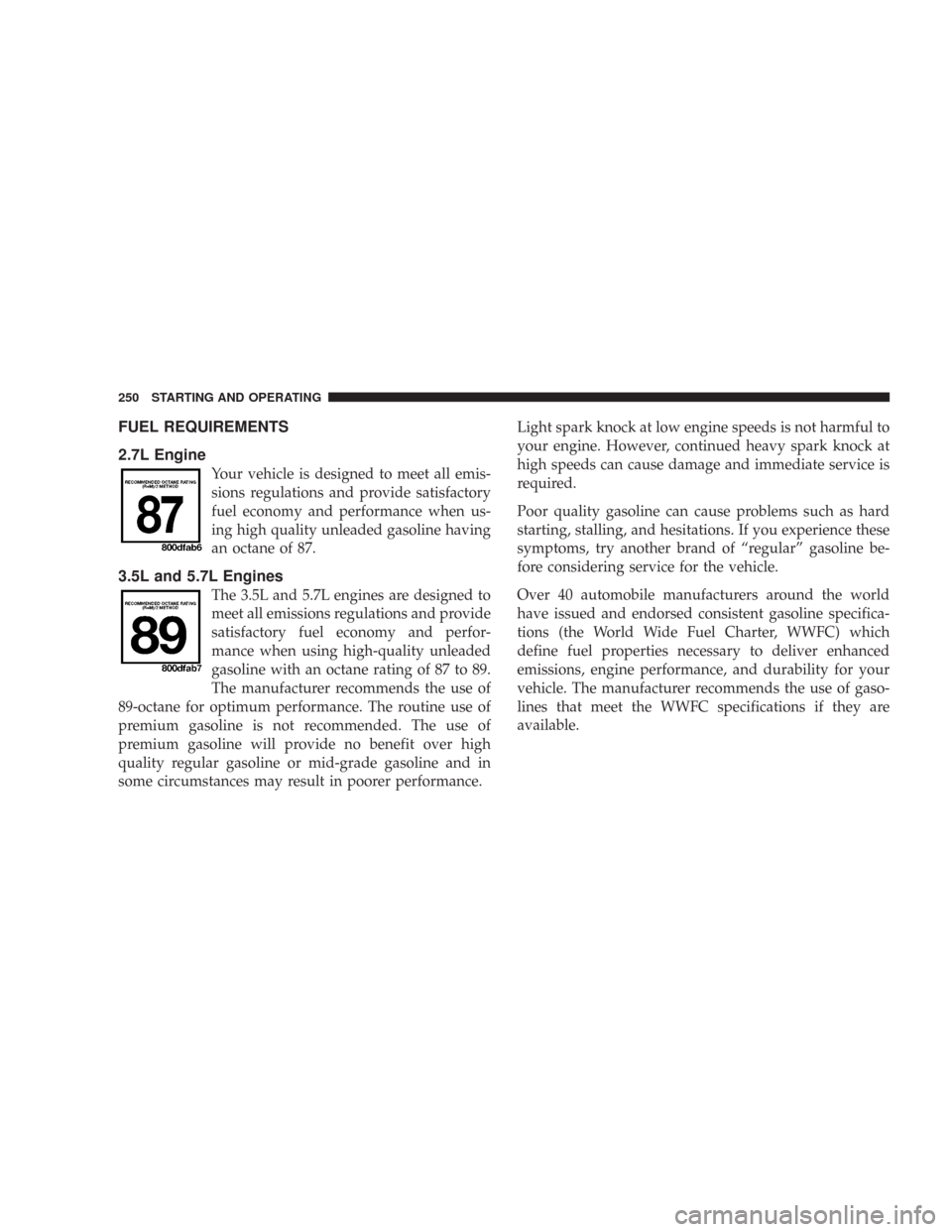
Your vehicle is designed to meet all emis-
sions regulations and provide satisfactory
fuel economy and performance when us-
ing high quality unleaded gasoline having
an octane of 87.
3.5L and 5.7L Engines
The 3.5L and 5.7L engines are designed to
meet all emissions regulations and provide
satisfactory fuel economy and perfor-
mance when using high-quality unleaded
gasoline with an octane rating of 87 to 89.
The manufacturer recommends the use of
89-octane for optimum performance. The routine use of
premium gasoline is not recommended. The use of
premium gasoline will provide no benefit over high
quality regular gasoline or mid-grade gasoline and in
some circumstances may result in poorer performance.Light spark knock at low engine speeds is not harmful to
your engine. However, continued heavy spark knock at
high speeds can cause damage and immediate service is
required.
Poor quality gasoline can cause problems such as hard
starting, stalling, and hesitations. If you experience these
symptoms, try another brand of “regular” gasoline be-
fore considering service for the vehicle.
Over 40 automobile manufacturers around the world
have issued and endorsed consistent gasoline specifica-
tions (the World Wide Fuel Charter, WWFC) which
define fuel properties necessary to deliver enhanced
emissions, engine performance, and durability for your
vehicle. The manufacturer recommends the use of gaso-
lines that meet the WWFC specifications if they are
available.
250 STARTING AND OPERATING
Page 252 of 384
MMT In Gasoline
MMT is a manganese containing metallic additive that is
blended into some gasoline to increase the octane num-
ber. Gasolines blended with MMT offer no performance
advantage beyond gasolines of the same octane number
without MMT. Gasolines blended with MMT have shown
to reduce spark plug life and reduce emission system
performance in some vehicles. The manufacturer recom-
mends using gasolines without MMT. Since the MMT
content of gasoline may not be indicated on the pump,
you should ask your gasoline retailer if his/her gasoline
contains MMT.
It is even more important to look for gasolines without
MMT in Canada, because MMT can be used at levels
higher than allowed in the United States. MMT is pro-
hibited in Federal and California reformulated gasolines.
Materials Added to Fuel
All gasoline sold in the United States is required to
contain effective detergent additives. Use of additional
detergents or other additives are not needed undernormal conditions and they would result in additional
cost. Therefore, you should not have to add anything to
the fuel.
Fuel System Cautions
CAUTION!
Follow these guidelines to maintain your vehicle’s
performance:
•The use of leaded gas is prohibited by Federal law.
Using leaded gasoline can impair engine performance,
or damage the emission control system.
•An out-of-tune engine, or certain fuel or ignition
malfunctions, can cause the catalytic converter to
overheat. If you notice a pungent burning odor or
some light smoke, your engine may be out-of-tune or
malfunctioning and may require immediate service.
Contact your dealer for service assistance.
252 STARTING AND OPERATING
Page 257 of 384
•Vehicle Identification Number (VIN)
•Type of Vehicle
•Month Day and Hour of Manufacture (MDH)
The bar code allows a computer scanner to read the
Vehicle Identification Number (VIN).
Gross Vehicle Weight Rating (GVWR)
The GVWR is the total allowable weight of your vehicle.
This includes driver, passengers, and cargo. The total
load must be limited so that you do not exceed the
GVWR.
Gross Axle Weight Rating (GAWR)
The GAWR is the maximum capacity of the front and rear
axles. Distribute the load over the front and rear axles
evenly. Make sure that you do not exceed either front or
rear GAWR.
WARNING!
Because the front wheels steer the vehicle, it is
important that you do not exceed the maximum front
or rear GAWR. A dangerous driving condition can
result if either rating is exceeded. You could lose
control of the vehicle and have an accident.
Overloading
The load carrying components (axle, springs, tires,
wheels, etc.) of your vehicle will provide satisfactory
service as long as you do not exceed the GVWR and front
and rear GAWR.
The best way to figure out the total weight of your
vehicle is to weigh it when it is fully loaded and ready for
operation. Weigh it on a commercial scale to insure that it
is not over the GVWR.
STARTING AND OPERATING 257
5
Page 258 of 384
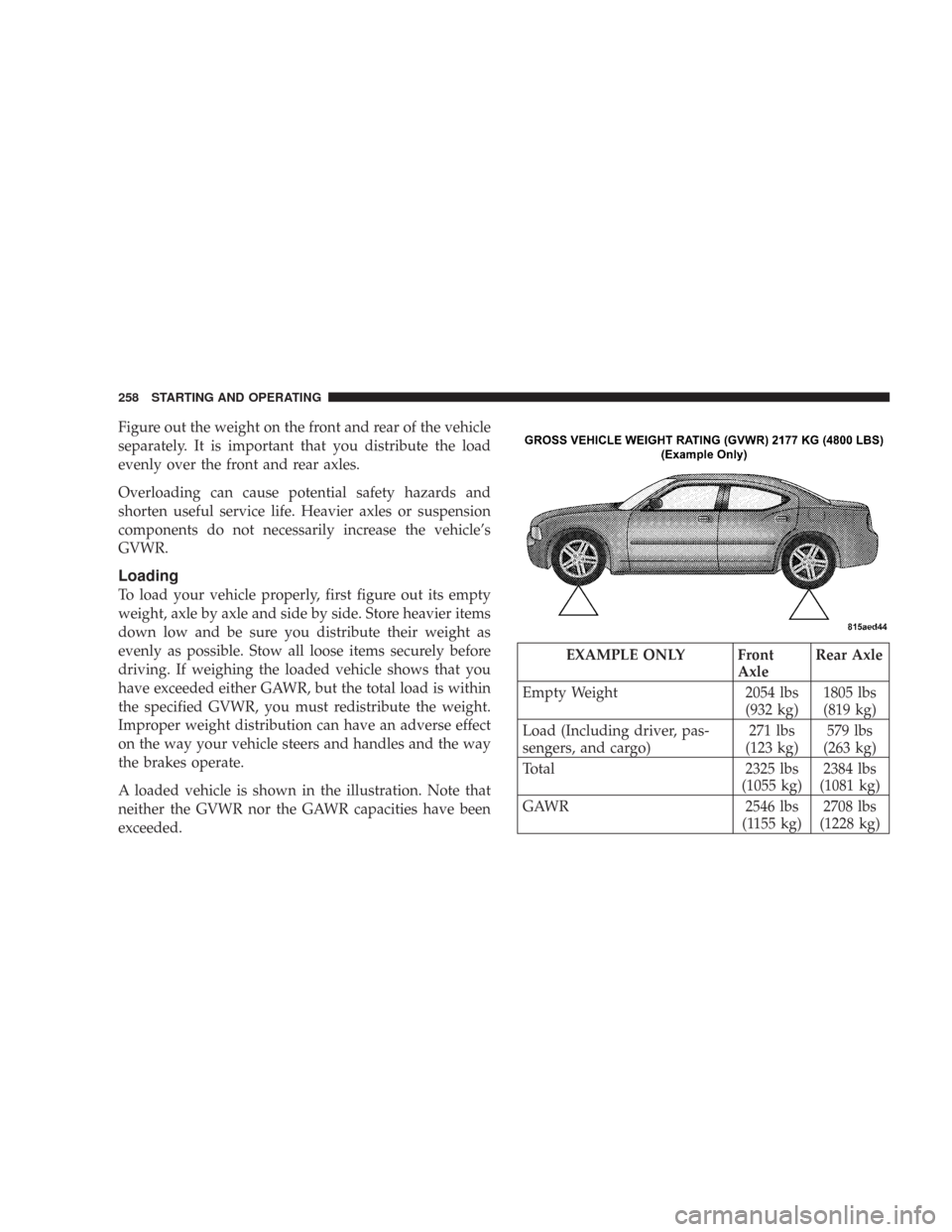
Figure out the weight on the front and rear of the vehicle
separately. It is important that you distribute the load
evenly over the front and rear axles.
Overloading can cause potential safety hazards and
shorten useful service life. Heavier axles or suspension
components do not necessarily increase the vehicle’s
GVWR.
Loading
To load your vehicle properly, first figure out its empty
weight, axle by axle and side by side. Store heavier items
down low and be sure you distribute their weight as
evenly as possible. Stow all loose items securely before
driving. If weighing the loaded vehicle shows that you
have exceeded either GAWR, but the total load is within
the specified GVWR, you must redistribute the weight.
Improper weight distribution can have an adverse effect
on the way your vehicle steers and handles and the way
the brakes operate.
A loaded vehicle is shown in the illustration. Note that
neither the GVWR nor the GAWR capacities have been
exceeded.
EXAMPLE ONLY Front
AxleRear Axle
Empty Weight 2054 lbs
(932 kg)1805 lbs
(819 kg)
Load (Including driver, pas-
sengers, and cargo)271 lbs
(123 kg)579 lbs
(263 kg)
Total 2325 lbs
(1055 kg)2384 lbs
(1081 kg)
GAWR 2546 lbs
(1155 kg)2708 lbs
(1228 kg)
258 STARTING AND OPERATING
Page 273 of 384
NOTE:There are steps that you can take to slow down
an impending overheat condition. If your air conditioner
is on, turn it off. The air conditioning system adds heat to
the engine cooling system and turning off the A/C
removes this heat. You can also turn the Temperature
control to maximum heat, the Mode control to floor, and
the fan control to HI. This allows the heater core to act as
a supplement to the radiator and aids in removing heat
from the engine cooling system.
CAUTION!
Driving with a hot cooling system could damage
your vehicle. If temperature gauge reads “H”, pull
over and stop the vehicle. Idle the vehicle with the
air conditioner turned off until the pointer drops
back into the normal range. If the pointer remains on
the “H”, turn the engine off immediately, and call for
service.
WARNING!
A hot engine cooling system is dangerous. You or
others could be badly burned by steam or boiling
coolant. You may want to call a service center if your
vehicle overheats. If you decide to look under the
hood yourself, see Section 7, Maintenance, of this
manual. Follow the warnings under the Cooling
System Pressure Cap paragraph.
WHAT TO DO IN EMERGENCIES 273
6